The Worst Filing System Known To Humans

-Punk (5) A Song of Ice and Fire (2) Affect (9) Alienating My Audience (31) Animation (28) Anime (19) Anonymous (3) Anything Salvaged (15) Art Crit (42) Avatar the Last Airbender (2) Black Lives Matter (1) Bonus Article (1) Children's Media (6) Close Reading (90) Collaboration (1) comics (30) Cyborg Feminism (3) Deconstruction (10) Devin Townsend (2) Discworld (1) Evo Psych (1) Fandom Failstates (7) Fanfiction (28) Feminism (24) Fiction Experiments (13) Food (1) Fragments (11) Games (29) Geek Culture (28) Gender Shit (2) Getting Kicked Off Of TV Tropes For This One (11) Gnostic (6) Guest Posts (5) Guest: Ian McDevitt (2) Guest: Jon Grasseschi (3) Guest: Leslie the Sleepless Film Producer (1) Guest: Sara the Hot Librarian (2) Guest: Timebaum (1) Harry Potter (8) Harry Potter and the Methods of Rationality (3) Has DC Done Something Stupid Today (5) Hauntology (6) Homestuck (18) How Very Queer (35) hyperallthethings (10) hyperanimation (1) Hypercomics (11) I Didn't Ask For Your Life Story Sheesh (24) Illustrated (37) In The Shadow Of No Towers (1) It Just Keeps Tumblring Down Tumblring Down Tumblring Down (9) It's D&D (2) Judeo-Christian (9) Lady Gaga (5) Let's Read Theory (3) Lit Crit (20) Living In The Future Problems (11) Lord of the Rings (4) Mad Max (1) Madoka Magica (1) Magic The Gathering (4) Manos (2) Marvel Cinematic Universe (17) Marx My Words (15) Medium Specificity (15) Meme Hell (1) Metal (2) Movies (33) Music (26) Music Videos (21) NFTs (10) Object Oriented Ontology (4) Occupy Wall Street (3) Pacific Rim (2) Paradise Lost (2) Parafiction (6) Patreon Announcements (15) Phenomenology (4) Poetry (6) Pokemon (3) Politics and Taxes and People Grinding Axes (13) PONIES (9) Pop Art (6) Raising My Pageranks Through Porn (4) Reload The Canons! (7) Remixes (8) Review Compilations (6) Room For You Inside (2) Science Fiction Double Feature (32) Self-Referential Bullshit (23) Semiotics (3) Sense8 (4) Sociology (12) Spooky Stuff (45) Sports (1) Star Wars (6) Steven Universe (3) Surrealism (11) The Net Is Vast (36) Time (1) To Make An Apple Pie (4) Transhumanism (9) Twilight (4) Using This Thing To Explain That Thing (120) Video Response (2) Watchmen (3) Webcomics (2) Who Killed The World? (9)

Reload the Canons!

This series of articles is an attempt to play through The Canon of videogames: your Metroids, your Marios, your Zeldas, your Pokemons, that kind of thing.

Except I'm not playing the original games. Instead, I'm playing only remakes, remixes, and weird fan projects. This is the canon of games as seen through the eyes of fans, and I'm going to treat fan games as what they are: legitimate works of art in their own right that deserve our analysis and respect.

Showing posts with label Surrealism. Show all posts

Tuesday, June 28, 2022

Autonomous Dreams: AI Art and AI Agency

Throw out the science fictions about intelligent robots. To understand AI art we don't need to get lost in press release fantasies, we need to understand the century-old art that paved the way for Dall-E.


Sunday, July 25, 2021

The NFT Rube Goldberg Machine, or, Why is NFT Art So Lazy?

Art and automation's merger long predates cryptoart's use of procedural generation.

You'll never hear NFT sellers talk seriously about that history, though, cause it reveals not just NFT art's contradictions, but also its cynical laziness. 


Thursday, August 27, 2020

Nasty, Brutish, and Short: The Promised Neverland and Human Nature

The nightmarish final boss of hit manga The Promised Neverland is... philosopher Thomas Hobbes??

Content warning for major late manga spoilers for The Promised Neverland, cannibalism, gore, monarchy, body horror.

Wednesday, August 19, 2020

Room For You Inside: Pink Floyd In Quarantine

You barricade yourself in your hotel room; it becomes a fascist rally. You write a concept album about your alienation; it becomes the Thatcherite Revolution. You live in modern luxury; it becomes a mad haunted house. This is a story about Pink Floyd's The Wall and the culmination of half a century of No Alternative.

Content warnings for discussion of quarantine, isolation, apartment horror, drug abuse, mental breakdowns, neoliberalism and its brother, fascism.

Tuesday, February 9, 2016

Stars Are Never Sleeping: David Bowie's Last Albums and Cosmic Horror


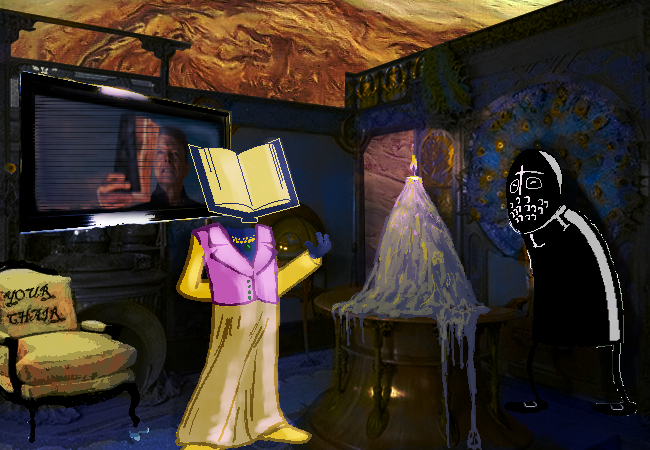
You arrive at the pub to find it strangely transformed. Not the gaping hole providing you with a view of the tempestuous heart of Jupiter's great red spot, no, that was already there. The dim lighting is new though, as is the giant, dripping candle standing on the table... and is that David Bowie on the screen over there? It is, it's a music video from that album he put out right before he died! Just what is going on here?

Sensing another dire misadventure, you begin to edge out the door. But Abraxas the Hideous Armchair Rat and Lord Humongous block your way! Curses.

Your captor looks up from your chair and claps their hands together happily. "Ah, you're here!" they say cheerfully. "Finally, the ritual can begin! But first, let's talk about David Bowie and the use of weird horror tropes in his albums. I think that will help to clarify what's going on here...

I had a dream the other night about David Bowie.

It wasn’t as exciting as it sounds. He was giving me an art critique. Not… not what I hoped from a David Bowie dream, frankly. Particularly since he didn’t like my painting very much.

But the thing was that within the dream I knew that David Bowie had died, but there he was, still telling me with sadness in his eyes that my paintings just weren’t very good. And my rationalization of this within the dream was that the reality of David Bowie’s death had yet to reach this part of the world, this backwater in which I live (Canada). The news of his death preceded the gravitational wave of its reality--news traveling faster than the sluggish transmutations of matter.


Tuesday, June 26, 2012

Come Into The Light: Getting Mindfucked by Surrealism

Chicken a la Croix, the dish we'll be making here on Surrealist Baking.
Surrealism is weird.

Wait, sorry, that's a totally banal way of starting a conversation. It's like saying discomfort is uncomfortable, or water is watery, or your chair is now my chair; it's basically inherent in the definition.

Or is it?

"Surreal"certainly tends to be used by folks nowadays as a simple synonym for "weird." I don't think anyone would balk at describing that image above as surreal--it's certainly a weird image, and that, in and of itself, seems to be enough to merit the use of the term "Surreal". I wouldn't balk at using the term here either, but not just because it's a strange image. No, I'm interested in using the term because it doesn't just fit the typical connotation of weird, it also fits the more specific artistic and literary definition. In fact, the video that the previous image is from, the Scissor Sisters' song "Invisible Light," is an absolute masterpiece of surrealism, a wonderful blend of early 20th century methods with 80s symbolism. 1880s, that is: see, the video is--

Well, hold on, I'm getting ahead of myself.

See, I can't start explaining how the video works until I talk a little bit about what makes Surrealism tick as a method of making art. Part of what makes Surrealism weird is that its resistant to normal forms of criticism. It's not the kind of thing where you can simply jump from symbol to symbol and directly read the secret message. In fact, you shouldn't do that ANYWAY, but it's something you have to be particularly careful of here, since it's so tempting. There's so many strange objects here! you might think. They have to stand for something. And if they don't, well, it's just a mindfuck, the author didn't give me anything to work with, and there's no point in exploring it further!

Surrealism is weird in two ways, then. First, it's weird because the images and juxtapositions are weird. Second, it's weird because if you try to untangle those images the way you might be used to, you'll get totally snarled up in the surrealist web. You've got to learn to navigate surrealism with something more than your intellect alone.

See, surrealism asserts that there are realms that can only be realized through techniques designed to make the unseen visible. You need a kind of amber spyglass or thermal goggles to see into this realm. What's more, this reality is more real than reality itself--a surreality--and it exists closer than you might expect.

It is the reality within the unconscious mind.

The surrealist project emerges from the idea that art can express what is locked away deep within the human unconscious. It comes, conceptually, from the birth of modern psychoanalysis in the late 19th century. The surrealists adored Freud, in particular, because they saw, in his analysis of dreams and his ideas of sexual and death drives, a mirror that they could hold up to the, if I may be so bold, totally fucked up mess that was Europe in the 20th Century.

Have you ever tried to navigate through the realm of dreams? Or, for that matter, have you read Alice in Wonderland or watched Jim Henson's The Labyrinth? These aren't strictly surreal works, I wouldn't say, but they should give you a sense of the underlying irrationality of this kind of art. You can't attack it the way you would other art, because it is resistant to conscious interpretation the same way dreams are resistant to normal world logic.

Want an example?

Think of Dali, one of the absolute masters of surrealism. He had all kind of clever symbolism in his work, all sorts of recurring signs for various ideas, and his work was all capable of being unlocked by studying it as a whole and reading his autobiography.

Except that his autobiography was all bullshit.

Dali lied through his teeth constantly.

And that makes perfect sense for surrealism! Because you're essentially trying to force the unconscious mind to the surface by confusing the crap out of the surface mind, through automatic associations outside of your control, through the emerging patterns in an inkblot test, the patterns created when you drizzle glue on paper, the Exquisite Corpse, and so on. And the more you can fuck with your audience, the closer to their own hidden thoughts and desires they get. Ever had a Freudian slip, where you try to say something banal and blurt out something dirty instead? Yeah, that's your Id--the deep animal desires--making itself known, and it's a proto-surrealist act.

In accident, in chaos, in confusion, in hallucination, in the juxtaposition of elements, in the twisting of reality, the warping of perspective, the blending of night and day... in all of this lies the Surreal.

So, how do we tackle the Surreal critically?

The same way you do Inception.

You've got to go deeper.


Before we begin, I should warn you that this video is:


So, what makes this video surreal?

Well, for one thing it's using a bunch of stuff straight from an older Surrealist film--Dali's An Andalusian Dog:


Now wasn't that just a thing?

But did you catch some of the similarities?

The image of the Stigmata in the hand, for example?

I actually made these wallpaper sized, in case you want a closeup of the ants going in and out of the dude's hand

Yeah, that's culled straight from An Andalusian Dog, and it's a good sign that the creators of this video were thinking of surrealism when they put it together. We can also note things like the fact that the female lead is undergoing hypnosis as a sign that the creators of this video may just possibly have had Freudian psychology on the brain. You know, maybe.

But there's a deeper similarity. Sure, they share the use of grotesque, bizarre, and at times impossible or fantastic images (like the crucified chicken thing at the beginning of this article, for example) but these images aren't presented just on their own. Rather, they're presented within a system of juxtapositions.

Remember the eye-slitting part?

Yeah, you'll remember that for a while, I suspect.

But there's something really interesting going on in that shot. It's not just a sequence of someone slitting an eye, it's a sequence of the eye slitting juxtaposed with a cloud traveling across a moon:

It's actually a cow's eye, but I bet you didn't realize that at first, did you? Hehehe.
What we've got there is a juxtaposition of different concepts, and it's up to the viewer to piece together what--if anything--that juxtaposition means. Now, personally, I'm at a bit of a loss here. I'm not exactly an expert in dream interpretation, and I suspect that without a dialogue with the artists here we wouldn't get far, anyway.

I do have a better idea of what to do with this juxtaposition, though:

And that's what the NSFW image was for, folks.
Ever heard someone talk about being made to feel like a piece of meat?

Ayup. This is about as literal as you can get--it's the transformation of a human into a sexual object--and here, literally, a piece of meat, very similar to the plucked and crucified bird in an earlier image (which itself calls to mind the woman chained to the wall, no?).

Except here there's a sense of the repressed sexuality coming not just from without but from within--it's the Id breaking through to the real world. What's more that chicken is constantly used to suggest--not to represent, exactly, but to bring to mind--a violent sexuality that is at once threatened by the wolf--or, perhaps, the powerful man--but also lusts after that wolf. It is the burning bed, the wild beast kept in a cage within the daughter's room, it is the screaming creature in the cage.

But there's another beast prowling around--a horse. Not just a horse but a stallion, a stud. As the female figure fears and lusts after the fierce masculinity of the wolf, she also seeks the free, forceful masculinity of that horse. But, not only does that horse carry connotations of the free spirit (and escape, perhaps, from the cage that is Civilization?), it also is an animal that can be trained... broken... and ridden.

There's other ways of fighting back against these urges, though. One of them is hinted at in the band's name: Scissor Sisters. It's a reference to the idea of Scissoring--a lesbian sex act--hence the band's logo of the woman's legs becoming sheers. And what weapon does the female character wield in an effort to protect herself from the violent masculine wolf's sexuality? That's right. Scissors.

Now, I just typed that out through free association. You'll note that I didn't say any of those images stood for the ideas I'm bringing up, I'm just wandering through my own associations and what I'm inclined to see in the piece. In a way, this is a deeply personal analysis, because I'm really exploring my own unconscious mind. And my mind is, apparently, Full Of Fuck. Isn't that an interestingly Freudian bit of slang in and of itself? It's very similar to how surreal pieces of art are often described as a Mindfuck--we're associating the confusion of the images with the confusion and chaos of sex. As the Ego and Superego lose their way, the Id asserts itself and our primal desires come out.

And that's really what a lot of surrealism ultimately is: you're "opening up your joy and letting the sailors climb the walls"--you're spilling the seed of your unconscious mind on the ground, as it were. Surrealism is ultimately the intrusion of that hidden space into our reality, and it's something that ultimately you have to personally experience. I suspect that the best way of going about a surrealist analysis would be to embrace Reader Response criticism and the idea of the Gestalt--you're muscling in and filling all the gaps (sorry, is this getting to be excessive?) with your own innermost drives.


Surrealism is, for that reason, far more than just weirdness. It's not something you can just immediately dismiss if it doesn't make sense. It may never make sense. It doesn't matter. What matters is that you're engaging in it, and through that engagement you engage with your own deeply cloistered mind.


Surrealism is a light that is invisible, intangible, but that leads you to an internal vision that your conscious mind could never condone or imagine.


Come into the light.


Into the light.


The Invisible Light.


There are SO MANY DOUBLE ENTENDRES in this article, and not all of them are deliberate! That's Freud, always sticking his... nose into other people's business! That dick. You can follow me on Google+ at gplus.to/SamKeeper or on Twitter @SamFateKeeper. As always, you can e-mail me at KeeperofManyNames@gmail.com. If you liked this piece please share it on Facebook, Google+, Twitter, Reddit, Equestria Daily, Xanga, MySpace, or whathaveyou, and leave some thoughts in the comments below.

Saturday, January 21, 2012

Gaga Intermission: Pop.Sci.Fi Part II

If you want to really understand music videos, sci fi pop videos are a great place to start. They already, after all, have an established genre they're working in that we can compare to other media. We understand science fiction tropes and we understand pop music tropes, so we can stat with a strong foundation and, from there, pick apart just why certain videos work.

And, occasionally, why certain videos stride into the territory of the staggeringly brilliant.

To pick apart some of this, I'm going to delve into what are probably two of the most interesting videos in this genre out right now, Nero's "Promises" and... alright, hold the laughter till the end, people, please... Katy Perry's "ET." Yes, ladies and gentlemen, it's time for me to aesthetically critique a Katy Perry video. [downs the entire wine glass] Let's get this show moving, shall we?


Check out this video by Nero. This video is doing a lot of what we saw in WoRG1: we've got the predominantly white surroundings, we've got a dystopia where technology is used to subjugate and cut people off from love, and we've got a female lead that rebels against the society. We can also see its relationship to some of the works in Tuesday's article, going all the way back to Orgy's "Stitches." It's a great aesthetic that here, as in those other videos, is used to wonderful stylistic effect. The overwhelming whiteness of the scenery perfectly reinforces the sterilized atmosphere and, unlike in "Bad Romance," this sterility is never disrupted. It's all black, white, and blue.

The band they're dancing to is Kraftwerk Orange.
What's interesting, actually, is how completely opposed the two visions in "Promises" and "Bad Romance" are. Gaga's is flashy. It ends with her torching the bed of her buyer with a flamethrower bra--the sterility is destroyed. The dancing is spasmodic and extremely overstated. The cuts between individual shots are extremely rapid and often jump back and forth in time and space. In Nero's video, on the other hand, everything is drawn back and extremely understated. But it is no less powerful and, in some ways, is even more emotionally gripping.

There's only three real movements here plus intro and conclusion--the introduction at the beginning, the first scene where we see the taking of the pills and the fact that the main character isn't taking her meds, the second scene where we see the dance, and the tragic, 1984 style finale, where the pathetically brief romance shatters and our rebel is made to understand that She Loves Big Brother. When you put the last audio clip, "It's so... beautiful", what you have is not just the perfect five part PSSA essay (shout out to my American standardized test bullshit hommies!) but also a very simple rising action, short climax, and even shorter denouement. This is a far cry from the jumbled stories of Bad Romance and Alejandro, and by limiting the structure of the story so much each element stands out crystal clear, not hidden under the jumble of interesting visuals that Gaga is so fond of. So, one thing that we can learn here is that music videos have incredible stylistic freedom, but that means that their creators have to use the style consciously to reinforce whatever the video is saying.

Then, of course, there's the incredible power that comes from the tension during the climax. Rewatch that scene where our rebel hero and her ten-minute boyfriend dance. It's so slow, and so controlled, and so undramatic compared to Gaga's dance style... but every single fucking nerve is on edge, you can see their bodies quivering, you can sense the tension in the air. It's incredibly sensual, incredibly sexy, and incredibly heartbreaking if you know what's coming. It's the perfect setup for the silent anguished cry that we see as the two are ripped apart.

The dancing in this sequence serves as a good example of the distillation of Gaga's (and, consequentially, Pop's) use of traditional music video qualities in order to set up a science fiction story. As my lovely girlfriend Sara pointed out to me, the style of the dancing is very strongly tied to the individual characters. As a dancer, she noticed that the figures in the background are using smooth, controlled motions at every point. Yeah, sure, great, who cares, right? That's obvious. Well, maybe not quite as obvious as you might think. Look at that little movement they do as they move their hands upward and then back down. It's a very smooth movement. Now, even though our main characters are dancing together in a similarly slow and smooth way--which, again, really adds to the tension of the moment--their movements are not uniformly smooth. There's a slight accent on that hand flip, and that's what tells us, consciously or not, that these two are different. It's incredible how subtly this works in our minds, but it's undeniable that they stand out from the other dancers, even though they aren't doing the crazy gyrations that the main character was doing a few moments before.

Walk Like An Egyptian?
Now, of course, music videos have always used dancing, and often used dancing for quite effective storytelling purposes. "Thriller" is probably the best example of this. But I think what sets this apart is the fact that the dancing is really quite subtle, understated, and ultimately there to serve a story purpose. The dancing makes sense from a narrative perspective while also serving as a perfect way of showing the sudden growth in emotion in the two characters, with their very human dancing style subtly played off of the very inhuman dancing of the other drugged dystopians.

It's a good example, therefore, of how important dance is to music videos, and also how powerful it can be when integrated into the narrative of the video. For a sillier example of this, check out LMFAO's "Party Rock Anthem," a great example of a video that explicitly plays with horror movie tropes. And, there's the chaotic dancing at the end of Katy Perry's "Firework" that expresses so effectively the vibrant message of the video as a whole. ... Alright, ladies and gentlemen, I said that last sentence with a straight face. Let's see how the rest of the article goes.


Since I've already tipped my hat here to the fact that this article is going to critically engage Katy Perry, an artist not known for the profundity of her work, let me just get my two great blasphemies out of the way right up front here.

I think ET is a stunning video and a stunning song.

I also think that Kanye West really bungles the whole thing up.

Now that you've presumably splattered your whiskey all over the monitor here, let me explain in a bit more detail.

Perry's piece sets itself up, in a way, for a harder struggle than Nero's piece. She's not putting together a narrative, really. It's much more of a tonal work that uses lots of different images to create a particular thematic response. To my mind, that's a bit harder, because it's very easy for that to come across as pretentious or a cop-out. But Perry largely succeeds for a few reasons.

Her images, for one thing, are interesting. They verge on the territory of the surreal, actually, in the traditional sense: they seem to come more from the unconscious mind than from any real desire to depict The World of Tomorrow. The recurring image of the deer getting eaten by a... cheetah, I think that is... certainly works in this way, especially since she ends up with deer legs at the end. This kind of thing doesn't really make sense literally, but she's building a system of symbols here, not a narrative.

Furthermore, she's similarly using style to reinforce her theme. If there's one overriding idea that the song and video center upon it is this idea of an attraction and obsession that moves beyond human terms into something truly fantastic. This is an interesting contrast to Nero's video, where the music was used to help explore a science fiction concept. Here, the science fiction and music are both used to explore a metaphor.

As a consequence, the style is much more lush and exaggerated than the toned down minimalism of Nero or Orgy. If we want to go back to our predecessors again (although, judging by the mediocre pageviews of my last article, no, "we" really don't even if "I" do) this video has a lot more in common with "Blue" and "Larger Than Life." Hell, it's theme even is similar to "Larger than Life," although it expresses that theme in a far, far more effective way than that video does. 1 The colors are vibrant, the movements fluid and full of strange shapeshifting, and the creators of the video have really gone out of their way to emphasize the strangeness of virtually everything that's happening.

"Lady Gaga? Never heard of her."
The video as a whole really expresses the kind of celestial, transhuman passion that Perry is trying to express.

Which is why Kanye is able to so fully fuck everything up.

Really, his sections are a disaster. Is the rap good? Oh, sure. Is the style good? Well, alright, I guess, although it's nowhere near as interesting as the other sections--one of its great flaws and possibly an indication that the director was just not that interested in jamming Kanye in. Is he flying around in Sputnik? Yes. Yes he is. And I've really got to hand it to whoever came up with that idea... that's just hilarious.

Sputnik.
But it does. not. fit. the theme.

Remember how I said earlier that this video sets itself up for a harder struggle because it relies so heavily upon symbolism and theme? Well, this is the problem with that manifested. Kanye's bits just stick out like a sore thumb because they really are all about the idea of Kanye fucking aliens, whereas the whole rest of the video is driving toward an idea of a sexual, sure, but also celestial encounter. Perry is off touching greatness, and Kanye is off touching... himself? Maybe. He certainly seems to spend every available moment stroking his ego, at the very least, in a way that totally intrudes upon the song and makes it all about him.

So, what can we learn from this? Well, what this tells us is that what makes sense as a musical choice (although I'm still not sold on the idea that this musical choice made sense to begin with) might not make sense in the context of the music video. The people who created this set out to portray a particular theme, and they really succeeded.

Kanye should have been jettisoned (Jetsoned?) in order to keep that theme intact.

Because, Kanye, I know you think you're super sexy, and I'mma let you finish, but...

[drool]

This is one of the sexiest guys of all time.

And he doesn't interrupt the theme to rap about it.

At any rate, what we have here is two very different but very effective ways of treating sci fi content in music videos. Both are indebted to their predecessors (it's pretty obvious that Perry is cribbing notes furiously from Lady Gaga--at least she's copying from the best, I suppose) and each expands on the tradition in quite different ways. There's a lot that one could work with here, between the use of style and setting, the use of dance, how the musical choices impact the video, and so on. There's probably much more than I can fully analyze here.

So, rather than gush on further about these videos, let me just leave you with this gem of a performance from will.i.am, which brings us full circle, back to where we began so many words and years ago, with those dancing robots in "Larger than Life":


Because beyond anything else, pop sci fi is about the movie and the music and how powerful and awesome the two are when used together.

Here, let's get some Reader Involvement. Your homework for this week is: find another science fiction music video, and post it in the comments section with your analysis. You've got the tools, let's see what you can do. I suspect that you, too, will find that will.i.am is a genius. Or something. As always, feel free to leave comments, complaints, or, best of all, your own interpretations, or e-mail me at keeperofmanynames@gmail.com . And, if you like what you've read here, share it on Facebook, Google+, Twitter, Reddit, Equestria Daily, Xanga, Netscape, or whatever else you crazy kids are using to surf the blogoblag these days.

1 It's worth remembering, though, what I said in the last article: The Backstreet Boys are more interested in coolness here than theme, so it's probably unfair to compare the two.

Tuesday, November 22, 2011

Send Me An Angel

When I was thirty years of age, I was living with the exiles on the Kebar River. On the fifth day of the fourth month, the sky opened up and I saw visions of God...
I'm home for Thanksgiving now, and absolutely on my last legs. It's been a hellish few days of tutoring and meetings and class and preparations for the break. I am, in short, exhausted. So, because I want to write about something fairly simple, and since I've had this topic requested, I'm going to devote tonight's article to Angels and what they are.

Turns out that they're cosmic eldrich horrors.

What, you were expecting beautiful men and women with long golden hair and big fluffy wings? Hah! Not in Old Testament God's Heaven! No, if you hadn't noticed, Old Testament God is less interested in making the world a pretty place and more interested in killing all the firstborn sons of Egypt, turning people into salt pillars, and dicking around with Job's life because of a sucker's bet with Satan. He's not a kindly, friendly, forgiving type of god, and his messengers reflect that. You can see it reflected in their billions of eyes.

But I'm getting ahead of myself.

Let's look at some of the angel species, shall we?

CHERUBIM

Cherubs! Aw, this is a nice start, right? Because Cherubim are just those cute babies with wings that fly around in Rococo paintings and--

WRONG

No, let me tell you about Cherubim. These are beings that have four heads--human, ox, lion, eagle--some variable number of wings (Ezekiel says four, but I've seen them described as having a range of numbers up to Far Too Many For Comfort), and billions and billions of eyes.

These are entities that have wings covered in eyes, and they are all watching you. Right. Now.

I'm actually kind of baffled as to how the term Cherub got attached to what are properly known as Putti--the little winged babies. Those things are actually a Roman import from when Christianity was becoming the hip new thing (I was a fan of Jesus before he got popular, &c.) in the decaying Roman Empire. See, the Romans liked this new Christianity thing but also dug their old artistic traditions, so you have these weird pieces of art cropping up where biblical characters show up next to Roman and Greek heroes. Remember how I talked last time about Typology? This is part of where that comes from--it's the reinterpretation and adoption of older heroes and images for the new Christian iconography.

Somewhere along the way the name Cherub got attached to those little naked cloudrats (seriously, look at baroque and rococo paintings--these things are an infestation) and since then people calling upon cherubs for angelic assistance have been getting all sorts of nasty, hilarious shocks.

According to some sources, Cherubim are among the highest ranking angels--typically the second ones down. The highest rankers are:

SERAPHIM

Seraphim are probably the most badass of all the angels, simply due to the composition of their bodies. See, Seraphim cover their bodies with their wings constantly (they've got six, so they certainly have a few to spare). And why, O student, do they cover their bodies in this way?

It turns out that they burn with a celestial radiance so pure that they cause mortals to basically explode. They're like great glowing basilisks on steroids that've been plugged into a nuclear power plant.

Or like this:

See, it turns out part of what makes Indiana Jones so awesome is that it accurately portrays the interaction between mortals and God--the mortals get their faces melted off.

THRONES

It's kind of scary that Thrones are both a step down in the Angelic Hierarchy from the others, and a step down in mindbending creepiness. Scary because Thrones are, themselves, deeply unnerving. This is another of those things where a number of accounts sort of have gotten merged together, I think, because I can't find them identified by this name in Ezekiel. Still, these angels show up in Ezekiel:

As I watched the four [cherubim], I saw something that looked like a wheel on the ground beside each of the four-faced creatures. This is what the wheels looked like: They were identical wheels, sparkling like diamonds in the sun. It looked like they were wheels within wheels, like a gyroscope.
Wheels within wheels. I've seen them described elsewhere as being covered in eyes and burning with fire. We're making progress here in that we can look at these guys without our brains exploding, but this is still some pretty freaky noneuclidean stuff. And these things are supposedly the throne and chariot of God. Yes, his throne is composed of living beings that are geometric shapes covered in eyes and fire. Old Testament God, remember?

OTHER ANGELS

A few other odd beings crop up. There are the Grigori, who mate with human women and produce the Nephilim--the giant heroes of old, born out of sinful lust between angel and mortal. Or the angel that Jacob wrestled with, who seems to have taken the form of a human(oid). Or the shadowy creatures Senoy, Sansenoy, and Semangelof, who hound Lilith, the First Woman, only to be repelled by her invocation of the four letter celestial name of God. And beings like Michael, who has wings of peacock feathers with actual eyes embedded in them, or his fellow archangel Gabriel who has a few thousand wings, according to some accounts, or Satan, who in some accounts appears to be the Accuser who challenges the faithful at God's behest and in others a fallen Adversary of all that is good. There's a lot of confusion about who is on what side, just what the angels look like, what their goals are, and so on.

But let us leave some of those accounts for a later date, when I'm less likely to pass out before hitting the Post button.

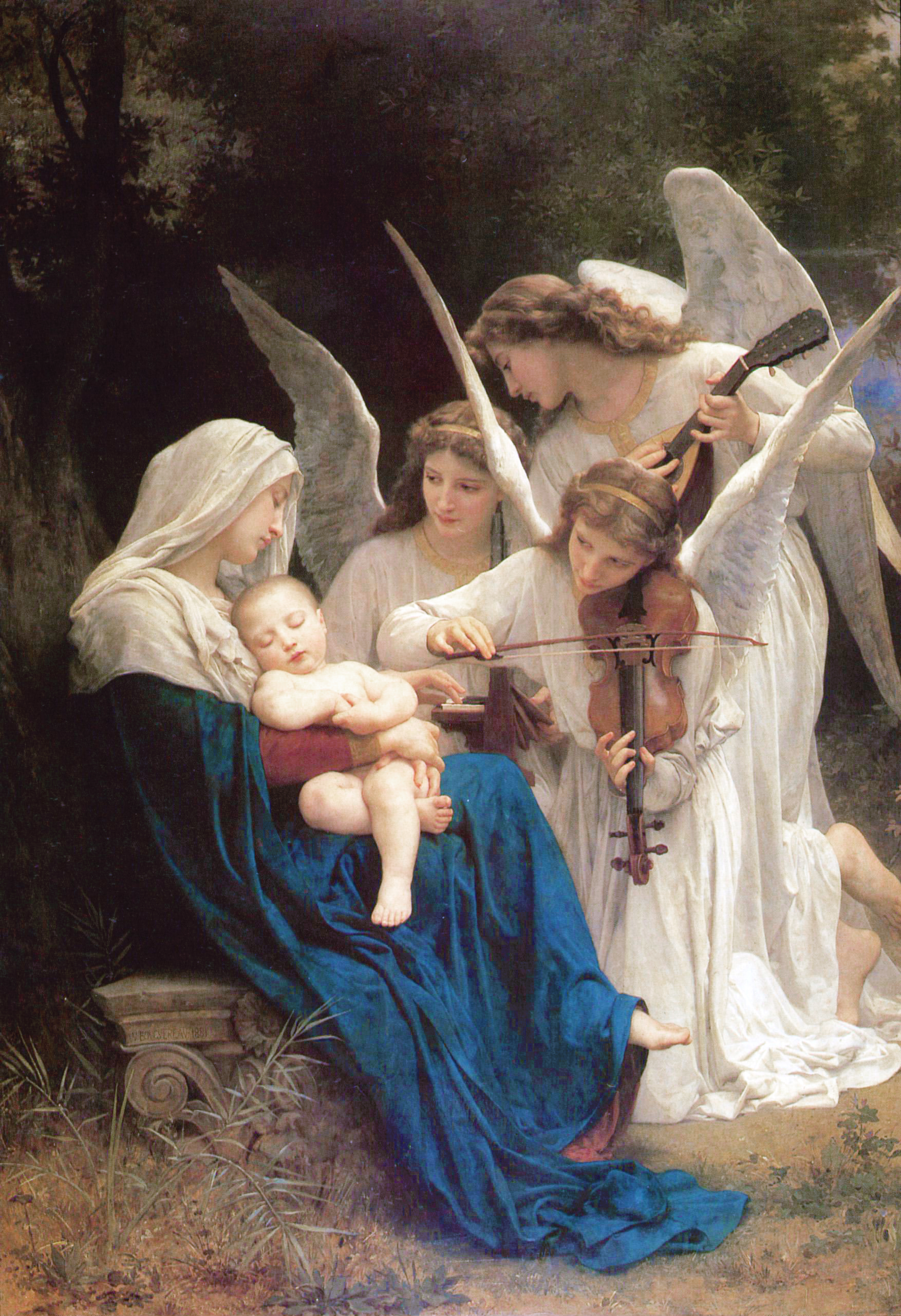
For now, I'll leave you with one deeply alarming thought. If these accounts are correct, then the beings greeting us at the gates of heaven are less like this laughably romantic picture:

And more like Ramiel from Neon Genesis Evangelion:


Goodnight, everyone.

...And flights of angels sing thee to thy rest.

Bwahahaha.

As always, feel free to leave comments, complaints, or, best of all, your own interpretations, or e-mail me at keeperofmanynames@gmail.com . And, if you like what you've read here, share it on Facebook, Google+, Twitter, Xanga, Netscape, or whatever else you crazy kids are using to surf the blogoblag these days.

Sunday, November 13, 2011

Stylistic Freedom


I've noticed an odd tendency among modern--and, in particular, young, inexperienced, and arrogant--artists to use style as a crutch.

For example: I was at the Metropolitan Museum of Art today, like the classy man I am, and I remarked to the first year accompanying me that, "This is how you learn to draw--by studying the masters."

She stuck her nose up at me and said, "What if I don't want to learn to draw?" and walked off.

This would have rattled me a bit more, but it's really nothing new. It's the kind of nonsense that's been plaguing the art world for decades. But it did get me thinking about style and artistic freedom. See, people seem to have gotten it into their heads that true artistic freedom is doing what you want, regardless of the opinions of others. And that's a staggeringly inaccurate idea. A more accurate ethos would be:

True artistic freedom is being able to do what you want.

Yes, I'm playing the semantics game tonight. I know it's tedious, but it really, truly does have a point, and those subtle changes make a huge difference. They make all the difference in the world. They are the thing that separates a genius from a kid that's just cribbing notes from Sailor Moon and Tim Burton.1

And I can think of few artists more deserving of the name "genius" than Pablo Picasso.


The two works above are probably among his most famous, and his most bizarre and abstract, pieces. It might even seem a little odd that I'm showing these works while loudly proclaiming my irritation with people that use particular styles as excuses for laziness. I mean, this isn't exactly traditional anatomy and perspective Picasso is using here, but he's ignoring it to make everything stylized.

But the thing with Picasso is that he wasn't limited to just that style. I mean, when he wanted to he could do pretty much anything.

Like, here's Picasso doing some work oddly similar to some stuff from the same year by Edvard Munch (notice the creepy couple in the background of the Munch painting):


And this seems strangely reminiscent of Toulouse-Lautrec:


And if he really wanted to he could do... this thing:


Which looks like he got bored in Art History and started doodling, but it still looks cool because it's freaking Picasso we're talking about here. He's basically predicting mid-20th century art in spiralbound notebook doodle for.

I mean, listen, this is a man who got together with Braque and invented Cubism because they were bored with being so damn good at everything else. When is the last time the product of your boredom turned out like this:


So, what is it that links all these different styles together? What is that crucial difference between my two starting statements?

I would argue that it is this:


That's a painting Picasso did in his youth. Remember a few paragraphs ago when I said that he invented Cubism because he was bored with succeeding at everything else? I wasn't kidding. He was a brilliant, classically trained painter. And this is the key to understanding my point about being able to do whatever you want. Picasso didn't start out breaking the rules. He learned them, and then he started to screw with them in grand style. And no matter what he was doing, he always had a solid base to go back to. He wasn't limited to just the abstract art, and he went back to semi-realistic art repeatedly in his life. What sets him apart from the modern artist is that he could. It was all up to him.

Picasso had absolute artistic freedom, because no style lay outside his grasp.

He had already learned the highest level of realism and composition, so he could strip that order away as he chose. This is true freedom in art. It isn't the freedom to ignore instructors, or ignore criticism, or to use style as a crutch. All of that comes later, when you've learned the craft. Once you know the right side of the paintbrush, you can start using the wrong one.

And at that point, you can do anything at all.


Yup, anything at all.

As always, feel free to leave comments, complaints, or, best of all, your own interpretations, or e-mail me at keeperofmanynames@gmail.com . And, if you like what you've read here, share it on Facebook, Google+, Twitter, Xanga, Netscape, or whatever else you crazy kids are using to surf the blogoblag these days.

1.  I feel like I'm already a generation off here, aren't I?

Sunday, September 11, 2011

Theater of Cruelty--Some Unpublished Images

Today there was a memorial service on campus. The students and faculty joined together as a sign of unity, arrayed in a circle, all holding hands. It was an attempt torecognize a community that "live[s] as a unified body, while acknowledging our uniqueness as individuals." Or so I hear. When I arrived, the crowd had already begun to disperse. The clouds rolled in, and I walked down the hill by the still-flooded waters and thought.

------------------------------------------------------------------------------------------------

I remember distinctly, as I sat and I typed out the last few citations, formatted the last few images, the sound of the chanting from down below. The letters recited; the anthems all chorused. And, of course, the trumpet. That damn drunken trumpet. It wasn't any sort of majestic sound. It was just a hollow blat, bursting out drunkenly as the player staggered back and forth outside my window. I stared down at an image of a colossal shoe suspended in air, ready to crash down upon New York City. And for the life of me, I could not decide whether to laugh or to cry.

------------------------------------------------------------------------------------------

At the end of the First World War, in the wake of the pillaging, and the futile grind of the trenches, and the epidemics that swept the land, two new schools of art, born of madness, emerged in Europe. They were Dada and Surrealism, and they were both a reaction to the collapse of the system of the world. Dada embraced the idea that meaning had been utterly lost, and that the ideals of the Enlightenment and rational western society had collapsed in upon themselves. It was an expression of madness loosed upon the world. Its greatest artists--people like Marcel Duchamp, Hannah Hoch, and George Grosz--freely attacked any and every target, lampooning everything from sexuality in the age of the machine (Duchamp's "The Bride Stripped Bare By Her Bachelors, Even"), the arbitrary nature of scientific standards (Duchamp, again: "Standard Stoppages" sets up a system of measurement based on randomness), to the shiny new order of consumer culture (Check out virtually anything by Hannah Hoch), or the pathetic weakness of the political regimes of the period between the wars (Grosz's acerbic work fits in here--he really had it in for the Weimar Republic). The great message is that there is no great message, and all art in the face of inhuman tragedy is barbarism.

On the other side of tragedy lurked Surrealism, the warped, basement-dwelling introspective brother of Dada. The surrealists sought to express, unfettered, uncontained, the murky depths of the human subconscious. They dwelled on images of mantises consuming the heads of their lovers, of slit eyeballs, masturbation, hoards of barbarians roiling across nightmare landscapes, dismembered bodies, and on and on. While Dada attacked the external world, Surrealism descended ever inward, seeking the underpinnings of the human mind, drawing from the young science of psychology in their quests.

What the movements shared, then, was a reaction to tragedy, a fragmented and disturbing set of visual tropes, an obsession with the comforting and familiar turned strange and threatening, and a growing disillusionment with the supposedly rational behavior of humans in general, and leaders in particular.

-------------------------------------------------------------------------------------

I cannot remember the attacks myself; not clearly, anyway. I was 10 at the time, and my parents and teachers nobly shielded me from all but the vaguest images and information. I remember just--only--a sense of confusion, a wondering just what the big deal was. Scuffing my shoes in the mulch of the playground, watching movement of those worried faces, I was displaced for the next several years.

--------------------------------------------------------------------------------------

It is 80 years since then. Art Spiegelman has become a famous man. His masterpiece, Maus, has helped to catapult comics out of the scrappy heap--into the critical eye of the world. Amidst all this growing of fame and importance, the comicker, convinced that oblivion is nigh, begins to create a series of plates titled In The Shadow Of No Towers. They're a nightmarish reenactment of his journey through the city of New York on September 11th of 2001, and of the political and personal upheaval. Their central image is a vision of two luminous, skeletal towers. Their targets for satire and anger include everyone from the monstrous perpetrators of the acts, to the political establishment that took advantage of the assault, to anirony-blind media, to complacent citizenry, to Spiegelman's own neurotic persona. In these strange pages, the ghosts of Dada and Surrealism reemerge, specters of the madness of the 20th century, reassembling their skeletons and collages and nightmare visions. Spiegelman is haunted by things that he did not see, and these ghosts fill the void.

-----------------------------------------------------------------------------------------

On the day that Osama bin Laden was announced dead--killed in Pakistan--I sat at my desk typing an essay on Dada, Surrealism, and the echoes of 20th century art within Spiegelman's work. I sought to explain why the work is so difficult, and yet is so resonant. I saw, within its pages, my own confusion, displacement, and ambivalence. And then the news came in. I was floored. The great beast of the desert, avatar of Terror, the monster that we chased for nine long years, was mortal after all. I reeled. I saw, crystalized, suspended in history, the futility and pointless waste of life that was our last nine years.

And, meanwhile, students that at the time of the attacks were six or seven years old--even further removed in understanding than I--celebrated this death with a wild, raucous party. Our team had won.

By pure chance, by dumb luck, I was left sitting, staring down at Spiegelman's text, reading over and over again the panels where he asks, desperately, why the emblem following the attacks had been a flag.

"Why not... a globe?!"

-------------------------------------------------------------------------------------------

Each year I question my own muddy feelings.

I still have not found easy answers, save to take solace in art and its shared experience.

Happy anniversary.

-------------------------------------------------------------------------------------------

If you're interested, the essay on Spiegelman and the 20th Century can be found here. It's a bit of a doorstopper, but I'm rather fond of my analysis, and, hell, Shadow is a work that gets too little credit for its genius. I explain why it gets so little credit in the essay, actually.

I probably don't need to say this, but this essay--or maybe I should call it a prose poem?--is rather personal for me, much more so than my usual works. Please, if you post comments, try to consider my feelings, as scattered and ambivalent as they are.

On Tuesday we'll resume more regular subject matter with another installment of Ways of Reading Gaga. And things will proceed from there.
Support on Patreon
Store
Reader's Guide
Tag Index
Homestuck Articles
Solarpunk Articles
Mastodon/Fediverse
Tumblr
Bluesky
RSS Feed