The Worst Filing System Known To Humans

-Punk (5) A Song of Ice and Fire (2) Affect (9) Alienating My Audience (31) Animation (28) Anime (19) Anonymous (3) Anything Salvaged (15) Art Crit (42) Avatar the Last Airbender (2) Black Lives Matter (1) Bonus Article (1) Children's Media (6) Close Reading (90) Collaboration (1) comics (30) Cyborg Feminism (3) Deconstruction (10) Devin Townsend (2) Discworld (1) Evo Psych (1) Fandom Failstates (7) Fanfiction (28) Feminism (24) Fiction Experiments (13) Food (1) Fragments (11) Games (29) Geek Culture (28) Gender Shit (2) Getting Kicked Off Of TV Tropes For This One (11) Gnostic (6) Guest Posts (5) Guest: Ian McDevitt (2) Guest: Jon Grasseschi (3) Guest: Leslie the Sleepless Film Producer (1) Guest: Sara the Hot Librarian (2) Guest: Timebaum (1) Harry Potter (8) Harry Potter and the Methods of Rationality (3) Has DC Done Something Stupid Today (5) Hauntology (6) Homestuck (18) How Very Queer (35) hyperallthethings (10) hyperanimation (1) Hypercomics (11) I Didn't Ask For Your Life Story Sheesh (24) Illustrated (37) In The Shadow Of No Towers (1) It Just Keeps Tumblring Down Tumblring Down Tumblring Down (9) It's D&D (2) Judeo-Christian (9) Lady Gaga (5) Let's Read Theory (3) Lit Crit (20) Living In The Future Problems (11) Lord of the Rings (4) Mad Max (1) Madoka Magica (1) Magic The Gathering (4) Manos (2) Marvel Cinematic Universe (17) Marx My Words (15) Medium Specificity (15) Meme Hell (1) Metal (2) Movies (33) Music (26) Music Videos (21) NFTs (10) Object Oriented Ontology (4) Occupy Wall Street (3) Pacific Rim (2) Paradise Lost (2) Parafiction (6) Patreon Announcements (15) Phenomenology (4) Poetry (6) Pokemon (3) Politics and Taxes and People Grinding Axes (13) PONIES (9) Pop Art (6) Raising My Pageranks Through Porn (4) Reload The Canons! (7) Remixes (8) Review Compilations (6) Room For You Inside (2) Science Fiction Double Feature (32) Self-Referential Bullshit (23) Semiotics (3) Sense8 (4) Sociology (12) Spooky Stuff (45) Sports (1) Star Wars (6) Steven Universe (3) Surrealism (11) The Net Is Vast (36) Time (1) To Make An Apple Pie (4) Transhumanism (9) Twilight (4) Using This Thing To Explain That Thing (120) Video Response (2) Watchmen (3) Webcomics (2) Who Killed The World? (9)

Reload the Canons!

This series of articles is an attempt to play through The Canon of videogames: your Metroids, your Marios, your Zeldas, your Pokemons, that kind of thing.

Except I'm not playing the original games. Instead, I'm playing only remakes, remixes, and weird fan projects. This is the canon of games as seen through the eyes of fans, and I'm going to treat fan games as what they are: legitimate works of art in their own right that deserve our analysis and respect.

Showing posts with label PONIES. Show all posts

Saturday, June 20, 2020

2x2 Girls: Queer Mirroring in She-Ra

She-Ra and the Princesses of Power ended on a high and very gay note, but the show's queerness goes much deeper than the flashy finale. To understand how the show is constructed around its central lesbian relationship, though, we have to be open to learning the techniques it uses to tell their story.

Friday, January 15, 2016

Announcing: Neighquiem for a Dream--A StIT Collection


Coming Soon from Storming the Ivory Tower:Neighquiem for a Dream

Containing all my articles on My Little Pony: Friendship is Magic and one all new exclusive article, this collection charts the early promise of the show and its fandom, all the way to its slide into ignominy and disaster!

Starting with one of the first articles that put me on the (admittedly fairly small) map as a blogger, this collection covers a long history of StIT articles and will be accompanied by brand new commentary exclusive to this collection. Additionally, the brand new article will explore the recent episode Brotherhooves Social and what its use of the transphobic "Man in a Dress" trope represents from my perspective as someone who began my gender transition alongside the growth of MLP's popularity.

Neighquiem for a Dream will be available as a full PDF collection to $5 subscribers to the Storming the Ivory Tower Patreon, but you can also access the text, including the exclusive bonus article, at lower reward tiers:

$2.00 per article: View the images produced for this collection 
$3.00 per article: Access the audio version of the bonus article
$5.00 per article: Access the full collection in PDF form


Sunday, February 16, 2014

Fluttershyness is Nice

Shyness is nice and
Shyness can stop you
From doing all the things in life you'd like to

I don't think that there's any particular contradiction between aiming a particular narrative at a younger audience and still imparting a slightly more complex, nuanced message, or in transcending the rote lessons that so many children's shows fixate upon. Generally speaking, I think this idea is getting generally accepted by writers on the better children's shows (and it's long been accepted by the best writers of children's stories, of course). Still, it's always wonderful to see a really well put together narrative with a nuanced treatment of what could otherwise be a quite trite issue.

And is there anything more rote, any lower-hanging fruit, than "character deals with stage fright?"

There's probably a few things, but it's got to be in the bottom ten at the very least, to the point where I remember getting quite sick of such episodes when I was a kid. The narratives are straightforward: character admits to having stage fright, zie has to go on stage anyway, zie learns that being on stage isn't so bad after all and sometimes you need to just face your fears head-on to fix them!

But look at the lesson, as relayed by Fluttershy, at the end of the My Little Pony episode "Filli Vanilli:

"Sometimes, being afraid can stop you from doing something that you love, but hiding behind these fears means you're only hiding from your true self. It's much better to face those fears so you can shine and be the best pony you can possibly be."

What a breath of fresh--wait, that's pretty much the usual cliche, isn't it?

In fact, it's a message that actually bothers me a lot, because there's an implicit character judgment in this message, a sense that someone's admission of discomfort or fear is this "hiding from your true self," a deliberate self-hindrance. Taken to extremes it implies that those suffering from more extreme anxieties generating their feelings all on their own, and they can just get over it if they really wanted to.

But I don't think that the message the show claims to be offering is the one that they're actually offering. In fact, I think this episode does a good job of illustrating how a stated moral might be belied by the actual content of a text--in other words, a text can say "This is the message of this story," and we as readers can say, "Yeah, but this that these and those elements of the story directly contradict this claim!" Famously, we could say, just like Blake does, that when Milton writes Paradise Lost and sets out a full explanation of why Satan is an evil, fallen being and God is right to cast him down, he actually ends up writing a story way more sympathetic to Satan than anything else. He is a poet, says Blake, and is of the Devil's part with out knowing it.

This episode, like Milton, is taking another stance (although I think everyone involved is quite aware of the text's implications!) and it's worth shedding some light on just what makes this narrative so different from the norm, what it's really teaching us, and how structurally that lesson is conveyed.

And I think the best way to do so is to frame the lesson not through Fluttershy's moral, but through a song by The Smiths.

My Little Morrissey: Sadness is Magic

Sunday, January 26, 2014

Heywoood Jabrony, or, Notes from the Center of a Fandom's Implosion

There's nothing like a continuous ongoing storm vast enough to dwarf planets to really make a place inhospitable.

This is why I have begun to reconsider my decision to relocate this blog to the center of the Great Red Spot.

It's also why lately it's been harder and harder to shut out the noise and just enjoy My Little Pony: Friendship is Magic. Because the raging storm surrounding Bronydom has gotten so loud I can even hear it over the icy winds of Jupiter.

Pictured: countless, countless terrible decisions.
Things have gotten particularly bad lately, in part due to the shutdown of the heinous rape-joke blog Princess Molestia by Hasbro, and the reactions from within the fandom and without to that event. However, the storm's been raging for quite a while now, largely involving the question of male roles within the fandom, feminism, the systematic suppression of female voices, the relationship between Bronydom and wider questions of women's involvement in geekdom, and the rise of a horrifying reactionary sect of bronies that have positioned themselves as staunch supporters of the masculine supremacy movement that seems to have infiltrated countless web spaces. (See also: fedoras.) The interference of outsiders who condemn the fandom as a whole whipped those winds further into a tempest, resulting in a complex interweaving of zephyrs that make navigating the various problems difficult. It's hard to sit back and assess the problems of a community when you're being buffeted by howling winds of outrage from multiple sides, and no group involved in this ongoing conversation seems inclined to howl less loudly.

I feel compelled to navigate the tempest, though, in part because I want, somehow, to find my way back to a show that I still love but am increasingly alienated from, in part because I feel loyalty toward a show that helped nudge me towards an internal acceptance of my identification as a genderqueer person, and because... well...

Let me put it this way. When the show first came out and Bronydom became a clear, persistent subcultural group on the 'Net, some people thought that, as Tumblr user Rincewitch puts it, "maybe the wider than expected demographic appeal of my little pony is a bellwether for the destigmatization of femininity."

Well, I didn't just think it.

Almost exactly two years ago, I wrote a whole god damn article proclaiming that it was the case, and that My Little Pony would open up a new golden age for feminism as traditional gender roles collapsed like the houses of lies they were!

WHOOPS.

This is, without a doubt, the single biggest critical blunder I've ever made. Worse than that time I accused Sequart of editorial gender bias, without knowing that their archives had crashed prior to me writing my article, resulting in most of the articles (including all of the ones written by women) being lost. Worse than the time I tried to persuade the Lovecraft subreddit that Cthulhu was boring and overused. Worse than my attempts to shoehorn references to Lord Humongous into all my writing.

I literally could go back in time to the middle of the Somme Valley in 1914 and cheerfully proclaim “This will just be a nice summer war!” and in 1919, as we travel to his place of exile, Kaiser Wilhelm will look me in the eye and you know what he’ll say? You know what he’ll find most pertinent to bring up, what he’ll take the greatest issue with?

He’ll say “Man you sure were dead wrong about Bronydom being a bellweather for the destigmatization of femininity, weren’t you?”

So, all of this in mind, I feel a certain amount of responsibility for the clusterfuck that the tempest within the fandom, and the wider climate instability between the fandom as a whole and its detractors, have become.

In honor of the memory of what the fandom could have been--and, frankly, still is when it's at its absolute best!--I want to try to navigate the storm and provide something like a history of how the fandom foundered, what its challenges were at the outset, and where we might go in building a better fandom.

Trigger warnings for sexism, rape culture, and homophobia.


Monday, July 2, 2012

Reflecting on PONIES The Anthology

I was going to write an entire article about all the depressing problems with TV Tropes. It was going to be an amazingly complex analysis, full of critical theory and stern reprimands against a toxic anti-discourse culture.

And then a good friend of mine sent me PONIES The Anthology II.

And I realized that, frankly, I wasn't nearly as interested in my critique of TV Tropes as I was in this silly movie-length collection of clips. It was actually an enormous relief to be away from the sturm und drang of my analysis.

But, being who I am, I had to wonder: what makes this video style so compelling?

Well, first let me give you the video, and then let me give you a bit of a history lesson. Here's PONIES The Anthology I and II:


And here's the video that the creators declared, borrowing a line from the anime Cowboy Bebop, would "become a new genre itself":


You know, looking back on AMV Hell 1, the video that helped to launch a whole genre of immitators, you can see how crude it is. There's some really good jokes, but it's an experimental work, and it doesn't always hold together.

That video came out of the AMV culture--the Anime Music Video creator culture that video sites like Youtube enabled midway through the Aughties. The idea was to take footage from a show and pair it with audio--the goal was to create a music video that related the show's original footage. Here's an example that is often cited as a classic due to its high production values and its blending of song and show:


See how it blends the two media together for a powerful, emotional effect? It's got style, it's got class, it's got serious emotional weight.

AMV Hell tossed all that garbage out the window.

Instead of attempting to find a "serious" emotional commentary in the space between sound and video, the creators of AMV Hell wanted to find humor--whether ironic, pitch black, wordplay-inspired, or just straight up absurdist. And what's more, they put together not one complete AMV but a bunch of fragmentary clips. This meant that the videos had to last only as long as the gag. The commedy was scattershot, rapid, often even of a blink-and-you'll-miss-it pace. A lot of the jokes weren't even dependent upon the shows themselves--although knowing the shows usually made the gags better.

In fact, it had more in common with the other creator subculture given a stage by Youtube: the Youtube Poop genre. These videos used clips of various cartoons and games to piece together absurd, bizarre narratives. The humor, like AMV Hell's, was chaotic, often nonsensical, and could jump from razor sharp wit to pure Dadaist anti-art in literally seconds. These creators shared useful source clips back and forth and tried to find ways to cleverly distort and pervert the original content (So, a character intoning "Snooping as usual, I see!" is clipped to "PINGAS!"--juvenile, perhaps, but pretty funny if you're not expecting it.)

From there, the genre became more refined, the jokes got better, the videos got more self-reflexive and sly, and the fans began to create their own spinoffs in other media--hence PONIES The Anthology.

But none of this explains just why these videos are compelling to me. It often--especially when you're talking about the spiritual successor genre of Youtube Poop--seems like Dumb Internet Humor, the kind of random phrases spammed by /b/tards and people who absorb their culture from a distance.

Well, let me see if I can break down the reasons. I think, if I can beg your tolerance for a moment for what is probably a rather smarmy statement, I think it revolves around Delight.

Reinterpretation

I talk a lot about analysis here, and how Fanfiction can act as a critical lens that recontextualizes works. I've said similar things about the power of remixes. I don't think that's going to be new to longtime readers--those articles have been fairly popular, and I've returned to the idea repeatedly.

Simply put, reframing a work forces the reexamination of that work.

What I've left out previously is that this reframing, this reexamination, doesn't have to be deadly serious. It can be downright hilarious, in fact. But there's no fundamental difference between the act of recontextualizing Harry Potter by making Draco Malfoy one of the "good guys," and the act of recontextualizing My Little Pony by putting the Imperial March to a clip of Princess Celestia walking cheerfully between kneeling subjects.

One is a serious critical commentary on the nature of the characters and their world.

One is a humorous critical commentary on the nature of the characters and their world.

The only difference is between the words "Serious" and "Humorous." The act, the effect, is the same.

Interestingly, the simplest form of that in these videos is the recontextualization of something figurative to something literal. So, the song "I Wanna Rock" is paired with footage of Rarity obsessing over Tom, her boulder, and Twilight's groan of "Oh Fluttershy, not you too!" is paired to music from U2.

This suggests an interesting conclusion to me: wordplay, punning, this kind of wit... perhaps it is simply the most simplified form of critical analysis. It would certainly explain the Deconstructionist obsession with wordplay.

That aside, I think this is the first thing that appeals to me about these videos: it makes me see the material in a totally new way. That's the first aspect of the delight inherent in this work: the delight of something familiar becoming new.

Craft

It's legitimately amazing to see some of what these creators put together. Have you watched the second Anthology video yet?

Yes?

Then you know that it ends with an extended parody of the movie 2001: A Space Odyssey.

Including original animation that is, speaking as someone who has done animation, really freaking impressive animation for a fan project like this.

With pitch-perfect parodies of the source materials.

Wow.

That's really, really impressive. And it's all being done by hobbyists--people who love their shows, and want to do something creative in response.

Listen, as an Art Historian, as a Literary Theorist, I CONSTANTLY have to justify to people why frivolous things of beauty are important. And you know what? Here's a culture that doesn't question the utility of art. They're just that compelled to create. I absolutely abhor the attitude that the computer generation is a generation of lazy consumers, and these sorts of projects are the reason why.

It would be easy to dismiss these efforts as frivolous, but between a frivolous art and no art at all, isn't it better to be a bit frivolous? No, even if the content is humorous and absurd, there's nothing frivolous about this. There's nothing more profoudn than people coming together across the wode expanse of the Net, united by just two things: their love of media, and their desire to Make Something New.

I think perhaps it's a mark of our overacclimation to net culture that prevents us from realizing what a wonder such collaborations are. If I might preach for a moment, we should all feel delight that such a world is ours.

Community

I'm cheating now, because I touched on this before in the previous entry, but I want to elaborate on something I think is important:

These aren't lone creators. They are a community.

Nothing shows that more than PONIES II and AMV Hell 5. The first is dedicated to fideo creator Magnus, the latter to Dio (the movie is even subtitled Dedicated to Dio, and the opening video plays a fantastic triple pun, equating the creator Dio, the metal mmusician Dio, and an anime character Dio). Both video artists died of cancer. Both communities responded by honoring their memory, and the Anthology creators responded by creating a cancer charity.

That's really, really cool.

Shared Experience

I think there's a common perception that reference humor is either lazy or elitist. This is often true, I'm not going to deny that. T.S. Eliot is showing off his brilliance just as much as The Big Bang Theory is showing off its low opinion of its audience's intelligence.

But I don't think this is inherent. In fact, I think obscure jokes can sometimes be the most unifying. Think about it: why do you laugh at an obscure joke, because you're happy that other people don't get it?

Or because you're happy that you do?

You're not happy because you're excluding others, unless you're a complete creep; you're happy because you're included. It's even better when the joke is one you've repeatedly missed before. It took me a second watch to catch the U2 joke, for example. And I also missed the parody versions of Shepard Fairey and Banksy street artworks that first time through. But I loved the gags when I saw them, because I knew I could appreciate the humor.

I would argue that this is actually the opposite of elitist. Those of us who make bizarre jokes that only we understand make those jokes not to feel superior--that's just the sad consolation prize that we buck ourselves up with. What we live for--what really makes us giddy, and fills us with delight--is if someone else Gets It. Because then a sly private joke becomes a shared experience. Humor is contageous, and there's a special joy in knowing that someone, even someone far removed across Cyberspace, shares your disease.


This, I think, really gets to the heart of the matter. All of this is about shared experience--whether its shared aesthetic appreciation, shared senses of humor, shared support and respect, or shared commentary on works that are mutually understood and appreciated. These videos are dependent upon knowing the source material, sure. So, I guess they're exclusive in a way. But they're also great at bringing newcomers into the fold--I can't tell you how many bands and shows I've discovered via AMV Hell's movies--and they're only as exclusive as the viewer makes them. At their core, these videos are about sharing a simple joy:

The delight of laughter.

And that was a whole lot more fun to write than an article about why TV Tropes sucks. You can follow me on Google+ at gplus.to/SamKeeper or on Twitter @SamFateKeeper. As always, you can e-mail me at KeeperofManyNames@gmail.com. If you liked this piece please share it on Facebook, Google+, Twitter, Reddit, Equestria Daily, Xanga, MySpace, or whathaveyou, and leave some thoughts in the comments below.

Monday, April 30, 2012

Reading Their Lips

So, Rainbow Dash and Fluttershy are really cute together, and I'm glad their relationship is canon now.

...

Wait, let me back up a moment.

It took me quite a few tries to get this article--an article that a week ago seemed relatively straightforward--off the ground. The actual ideas are fairly simple, but the presentation stalled me. It didn't, of course, help that in between the article's inception and its completion there was a week of sleep deprivation, hellish workloads, and the emotional roller coaster that is gradschool applications (more on that at the end of the article if you're interested). The possibility of lesbian ponies was somewhat understandably shoved forcefully from my conscious thoughts.

Let me go back, though, to the video that started it all:


I'm not in sync with the online Brony/Pegasister community enough to know just how much trouble this scene has stirred up, but I suspect that it's a non-negligible amount of trouble. My first reaction was, of course, to be downright ecstatic. "Finally," I thought, "we get some non-heterosexual elements in the show! I mean, besides that one dragon..."

But I couldn't shake the feeling that there was more to the video than just the kiss. It wasn't quite enough to say, without a doubt, that these two main characters--Rainbow Dash, the sporty, boastful athlete and Fluttershy, the gentle, caring lover of animals--actually kissed in that clip.

Although I didn't know it at the time, my good friend Yanmato was working on a brilliant guest article that serves as a wonderful introduction to the problem. See, the idea Yanmato discussed--the Umwelt, the individualized, personalized understanding of a work--helps to explain what's going on with that ambiguous kiss.

There's actually quite a useful quote from an anonymous commenter on the MLP Wiki that sums things up fairly well:

"I watch that scean in slow motion. No Rainbow dash does not kiss Fluttershy. They heads do move closely together but they don't touch. I think those who support the disguesting girl on girl shippings see what they want to see here."

Oh, don't look so alarmed, it's just an elephant. No, no, I'll pay for the damages to the room. What? No, it's not important right now, I'll get back to it later.

The part of the quote I want to look at right now is the part where our fine anonymous commentator points out that we "see what [we] want to see here." What can I say, ladies and gentlemen? He's right! This is another example of the Umwelt: those of us that see this as a kiss are translating an ambiguous space into something that fits our perceptions (although, in the spirit of full disclosure, I didn't actually notice the kiss until my friend Timebaum pointed it out to me after the fact).

It's actually a concept that syncs up well with some concepts in the field of Reader Response Criticism. These concepts were articulated by one Wolfgang Iser, in a number of essays that broke with critical tradition at the time to point out the power of subjective spaces in literature. According to Iser, there are aspects of a text that are static. These are things that are undeniably true, and the reader has to negotiate around those things. However, there are also gaps in a text, blank spaces that need to be filled in by the reader. These are ambiguities of everything from motives, to actions, to the way a character looks (keep in mind here, Iser is working to prove the superiority of capitol-L Literature, and one of the ways he does this is by bashing Film's reliance upon the defined image, when Literature can leave depictions of characters or scenery partly up to the individual reader). These ambiguous spaces are fantastically important to a text, because they let the reader take on the role of the writer, allowing for engagement and creativity rather than the dryness of a lecture.

That kiss is a perfect ambiguous space, primed and ready for us to write in exactly what we want to see.
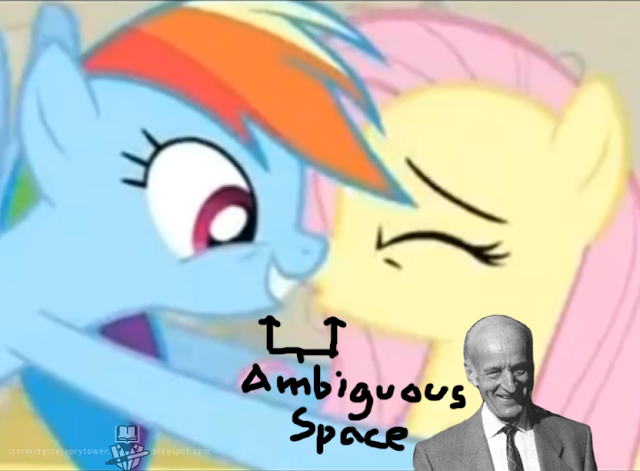
Iser knows what's going on here
Now, part of how this works, though, comes from Iser's version of the Umwelt, something he calls a "repertoire." The text has a repertoire--that's the stuff you have to work around, the static stuff--and you have a repertoire--the stuff you bring to the text. Your understanding of the repertoire of the text changes during reading, and your repertoire is changed by the text as well. So, it's a process of almost creative collaboration between you and the text.

That said, there's stuff in a text that can lead you to a certain conclusion about an ambiguous space. Iser would be right pissed if he knew I was doing this, but I think we might look to Formalism--one of the movements Iser was reacting against--for an explanation of this phenomenon. See, the Formalists (or "New" Critics as they were known in, *ahem*, the 1920s) looked for thematic unity in a text. They wanted everything to line up nicely and neatly, and any part of the text that didn't could sod right off, as far as they were concerned. If it didn't fit their reading, it didn't exist.

While the formalist project is problematic in a lot of ways, it's a good model for what I suspect most of us do unconsciously as we read. We do look for unity. What Iser would say is that this unity is constructed--it's a product not so much of the text but of us--and that can be debated back and forth, but unity is still in a lot of ways what we prize in a text.

From this perspective, the kiss makes a lot of sense. To understand how that works, let's delve into my repertoire a little, shall we?

One of the things I bring to the table (or to the stable, perhaps? Hm.) is the stereotype of the butch/femme lesbian relationship. In this model, you've got one woman who is more masculine and extroverted (is this sounding familiar, pony wheel fans?) paired with a woman who is more feminine and introverted. Rainbow Dash, for better or worse, has been picked up by the queer community as an icon of queer sexuality of... some sort. Just what varies, but the key to it all is A. the rainbow and B. her non-normative gender behavior. And yes, yes, it's unfair to stereotype in that way, but at the same time, the stereotype is still a part of the repertoire, so I'm going to at least openly address it here. I'm baring my soul for you people, for goodness sake!

At any rate, once I started thinking of Rainbow Dash as butch, it wasn't too long before on some level I started looking for a femme.

From there, it's not hard to see reasons to link Fluttershy and Rainbow Dash. They start the series in conflict frequently, but we know Rainbow Dash stuck up for Fluttershy--without any hesitation or prompting, I might add--when they were younger, and by the time we reach "May The Best Pet Win" the two seem to have a fairly strong friendship. The real clincher is certainly the episode "Hurricane Fluttershy" where Rainbow Dash seems to place a surprising amount of hope on Fluttershy's flying ability. She is quite visibly unhappy with her inability to get Fluttershy to help out with the artificial hurricane, despite the fact that she obviously isn't powerful enough to tip the balance substantially. She is far more focused on Fluttershy than even mere friendship could explain. It is hard for me not to see this as an indication of stronger feelings of affection--which fits well into the fact that Rainbow Dash seems to be the initiator of the maybe-kiss.

So, in a search for unity, I tend to read those moments and hints as part of a larger whole. To me, they combine to form a story of a growing friendship and--ultimately--a romantic association.

Of course, there's one last element of my own repertoire pushing me towards this conclusion. For that, I refer you to the elephant over here:

"I watch that scean in slow motion. No Rainbow dash does not kiss Fluttershy. They heads do move closely together but they don't touch. I think those who support the disguesting girl on girl shippings see what they want to see here."

I read it this way because, dammit, I'm sick of queerness being treated as disgusting.

Sorry, wait.

"Disguesting."

Now, I'm not about to suggest that the Brony/Pegasister community as a whole is homophobic. That would be a staggeringly unfair generalization, and it's not something I honestly believe. My interactions with the community have been very positive and supportive.

That said, reading that moment as non-a-kiss is also a choice, and it's a choice that similarly emerges from a repertoire. And I don't think it's unreasonable to suggest that some of that repertoire is, in fact, homophobic in nature. I mean, consider the issue even in its most benign form: this is a kid's show, so of course they can't have lesbians! That's way too racy, right?

The thing is, that association of queerness with deviance and inappropriateness is still a form of homophobia. It's a particularly unfair one when the scene being interpreted takes place in an episode that concludes with a victory through the power of love. Forgive me if I sound a bit rankled by all of this, but this sort of argument, even if it's internalized, unconscious, and totally unvocalized, is still an argument that marginalizes queer love--not queer sexuality, mind you, but the idea of queer affection.

And, of course, there's the readers of the moment who overtly just thing lesbians are gross. I'm going to leave my feelings on that matter up to you, dear reader. See if you can figure out how to fill in that gap.

I really don't want people to come away from this article with the idea that I'm demanding that my interpretation be declared the One True Interpretation. That would be fucking stupid, not to mention absurdly presumptuous of me. Let's be honest, here: what makes this moment interesting is its ambiguity. I certainly wouldn't want to lose that. I'm only suggesting that when we start to look at our Umwelt--at the repertoire we bring to the text--we can start to untangle why we see what we see... and whether we like those reasons. This isn't an accusation, just a suggestion for your consideration. Cool?

There's one other thing that tangles up our understanding of this material quite a bit. Yes, I know, we've tangled things enough, no need to add another layer. I think it's worth pointing out, though, that I can't get too high on my horse. Pony. Elephant? Whatever. You see, Iser would have one problem with my reading here.

He would say that what I'm doing is the mark of a supremely immature reader.

Remember what I said about the act of bringing a repertoire to the text transforms both the text and the reader? Well, there are two different ways of dealing with that fact. You can read a text as I've done--to confirm your repertoire--or you can read against it. Guess which one Iser thinks is the mark of a mature reader?

I can only try to excuse myself by suggesting that the metacritical approach I've taken here absolves me of some guilt. If I'm choosing to read according to my prior beliefs, it's a conscious choice. It doesn't really help that much, but I can only throw myself upon your mercy as a reader and hope that you understand that I'm not perfect, either.

But I'll let you fill in the blanks there.

Besides... aren't they cute together?

Iser thinks so! Yeeeeeeah. (For the record, this may be my favorite image for this blog, ever.)

This was a hell of an article to write, but surprisingly gratifying. If you liked this piece please share it on Facebook, Google+, Twitter, Reddit, Equestria Daily, Xanga, MySpace, or whathaveyou, and leave me, Yanmato, and Wolfgang Iser some kind words in the comments below.

Tuesday, March 20, 2012

Performing Draculinity: Spike the Dragon and Gender Norms


My Little Pony: Friendship is Magic has a strong feminist message. From what I've seen, that reading of the show has become pretty well accepted across The Webtubes, even if there are still some holdouts that aren't picking up on the obvious. The show has one of the most positive range of female characters I've ever seen, with a whole range of occupations and interests that are all considered mutually acceptable. And, of course, the mane characters (oh the puns, the puns) are all shown to be quite capable, sometimes more capable even than their male counterparts. Rainbow Dash, for example, can fly rings around basically everyone, and Applejack, although not, I think, as strong as her brother is consistently shown to be exceptionally physically capable. (The others don't seem to have particularly comparable male counterparts, but they all are regularly shown as exceptionally talented in their areas of interest.)

And, of course, their personalities make for some cool graphic design:
Yes, I'm going to keep milking this one.
Generally, my articles about the show have focused not on these elements (of harmony? Sorry, sorry), which to me seem fairly obvious, but on the subtext and social impact of the show. One of the great results of the show's unintended internet following is the message it sends that it's ok for guys to like girl things, like the show itself. And, that the show's messages are generally, if not universally, being taken genuinely to heart.

But as much as I love the show, and as positive as I think its impact on culture has been, we haven't exactly gotten an explicit analysis in the show of male gender roles--there simply aren't enough prominent male characters. We've gotten a bit of cool, if subtle, commentary with Big Mac, who seems to fit into the stereotype of the Strong, Silent Male but periodically shows an unashamedly emotional side (he clearly deeply loves his sister Applejack, for one thing, and is shown crying when she leaves during her flashback in Cutie Mark Chronicles). And we've gotten some other incidental characters, but besides that there's been a bit of a dearth of male characters, and, as a natural consequence, there hasn't been anything explicitly in the show about performing masculinity.

Until episode 21, that is.

This episode, for those of you who haven't seen it yet, is about Spike the baby dragon going off to seek others of his kind, so that he can better understand how to be a dragon.

Note the way I word that: he's not just going off to learn about dragons, but how to act like one, how to properly perform draculinity.

Now, for those of you unfamiliar with the idea of gender performance, let me run through the concept. According to sort of broadly accepted social convention, people who are of a certain gender--a gender based on their physical, biological sex--are naturally meant to display certain traits, act in certain ways, and dress in certain clothes. But modern queer and feminist theory suggests that this is simply a performance based on social convention--and to a large extent, it is. There's nothing about my penis that prevents me from wearing a skirt, for example. (Well, alright, it can be a bit awkward if the skirt is too tight and you know what let's just scratch this line of thought and move on, yes?)

But it's important to perform properly because people who don't perform their gender correctly are often ostracized, bullied, and sometimes assaulted or even killed. This is why trans* rights are so important: a transsexual in America, and in, I suspect, most other countries across the globe, is under pressure to pass as whatever gender they feel they are. Those who do not pass run the risk of physical assault, sexual assault, discrimination in the workplace, and murder.

So, one of the cornerstones of the theory of gender performance is that these social constructs hurt men and women--sexism negatively impacts both (or all) sexes.

One of the shortcomings of the last few waves of feminism is that the problems with masculinity when applied to men were kind of ignored. And in fairness, we guys honestly do have it significantly easier in most regards. But, as my first article on Ponies and Feminism pointed out, it's an oversight that is starting to be rectified, thankfully, and things like My Little Pony are helping.

So, now that I've gone through that lengthy diversion (sorry, incidentally, to anyone who already knows the theories I'm talking about, I'm just trying to fill any newcomers in) let's get back to that first weird thing I said: what do I mean when I say that Spike is learning to perform draculinity?

Well, Spike knows he's a dragon, and he wants to act like a dragon should act. He wants to be normal. He also knows that if he doesn't perform draculinity correctly he'll get made fun of, both by his pony friends and by other dragons. Heck, some of those dragons are pretty scary, and there's a definite threat in the episode of the bullying becoming violent--and it's not played for laughs, either.

Some of this starting to sound familiar?

The episode really isn't doing a lot to hide its metaphors. The Ponies in this episode, somewhat fittingly, represent "femininity," and the Dragons represent "masculinity." (I put the terms in quotes, like on The Pony Wheel, to signify the fact that they're social constructs, and exaggerated at that.) And once you see that metaphor, a lot of interesting things emerge.

Notice, for example, that it's Rainbow Dash, one of the most "masculine" of the mane six, that first challenges Spike's own dragonhood--his manhood. Rarity, one of the most "feminine" characters, accidentally makes it worse by describing him in feminine or childish ways.

The ponies as a group take on a generally feminine role when juxtaposed with the dragons, with even Rainbow Dash running with the others rather than fighting the teenage dragons.

And, in my favorite sequence, Twilight Sparkle tries, and fails, to find information about the dragons. I wouldn't go so far as to say that the scene is a direct allegory of the difficulties women's studies has with the study of masculinity, but I certainly see echoes of that problem in the scene. Twilight knows all sorts of things about Ponies, but the most she knows about Dragons is that they're scary and dangerous. Not a direct analogy, certainly, but there's a parallel there, to be sure.

Oh, and there's this little exchange:
Rainbow Dash: I'm telling you, we'll never pass for a real dragon!
Rarity: Oh, pish-posh! This costume is fabulous, one of my finer creations.
Twilight Sparkle: Shh! [hushed] We'll never pass if they hear three voices coming out of one dragon! Now come on, let's go! 
[Ahem]

Yep, there's Twilight and Rainbow Dash talking about... passing.

No, I don't think it's seriously a reference to passing as a transexual.

But it is a hilarious coincidence, and I couldn't resist pointing it out.

Anyway, as I've pointed out with other critical analysis, saying "this text is talking about X" is not the same thing as saying "this text is an allegory for X." I wouldn't try to carry the comparison between masculinity and draculinity much further than I have here--it probably won't work past a certain point. After all, dragons mature based on greed, which is pretty weird and not really analogous to how men develop psychologically and biologically. (I know some might disagree, but those people are arguably morons.) It's not really going to work as a one to one mapped parallel.

Still, it works just well enough to lead to a particular moral:
"...Now I realize that who I am is not the same as what I am."

Our performance is not ourselves, nor does it have to be. Spike comes to recognize that he does not have to perform draculinity, he just has to perform himself. It's the message that the rest of the show gears toward girls, but with a male character rather than the normal female cast. The message of the show, sometimes explicit, sometimes just present in the nature of the characters themselves, is that there are lots of different ways to be, and you don't have to perform to someone else's script.

If you like what you've read here, share it on Facebook, Google+, Twitter, Reddit, Equestria Daily, Xanga, MySpace, or whathaveyou, and leave me some kind words in the comments below.

Incidentally, I'm planning on writing another Pony article soon. It will be about the character development of the different characters as described... with SCIENCE! The plan is, I'm going to play a drinking game with some friends, where each time one of the mane six displays a quirk in lieu of actual character development, the person assigned to that character takes a drink. We'll use a breathalyzer and record the results. And I'll write a blog post as we go. In this way, we shall determine the relative character development in the show, get plastered, and get a giant, ridiculous blog post that attempts to approach scientific standards but ends up missing them by a mile.

The trouble is, we need some quirks. So. What are measurable character quirks for each of the mane six cast that we can use to examine the show? Our drinking game rests in your hands, good citizens of The Interblag.

Monday, February 20, 2012

METAPONIES

Dear Princess Celestia,

My Little Pony: Friendship is Magic contains all sorts of wonderful lessons, lessons which I try to take to heart. I realized recently, however, that the lessons do not end when the credits roll. A few weeks ago I wrote an article explaining the importance of My Little Pony to the cause of feminism. And that, I thought, was that. But, to my surprise, the article exploded (well, relatively speaking, anyway) onto the internet. I never expected such a strong response to the article.

Out of that response came a number of lessons. Now, in the spirit of the show, I want to share them with you. To do that, I want to go beyond the show itself to the culture, the responses, and the relevance of ponies to my own experience.

This is Metaponies.

People Believe In Ponies

Really. People pay attention to the message of the show and take it to heart. I've been around The Internet enough to know that it is not exactly a hospitable place, especially for feminists, ESPECIALLY for feminists of a geek persuasion. I actually sent the article in to Equestria Daily with some trepidation. After all, I had no way of knowing what reaction I might get.

The response blew me away. It was overwhelmingly positive. Or at least, overwhelmingly positive in the sense that people started sharing the article around and for the most part commented on it constructively. The comments I received on the blog itself were all quite supportive, ranging from longer responses to simple short "great article" type remarks.

I point all this out not just to brag. (Well, at least, that isn't the only reason I point it out.) I point it out because there was a remarkable difference between the response I got from people within the My Little Pony fan community compared to the response from people largely outside the community. In fact, the only nonconstructive or outright negative comments I received came from places like the CAD forums (where there seems to be some confusion over the appeal of the show--apparently people there were assuming we watch ponies solely as an ironic pleasure) or Reddit boards associated with more general geek culture. (Interestingly, I also got a lot of very positive responses from feminist sources, despite the totally over the top way I started that article. For the most part, it seems that people recognized that as what it was--an attention grabber--rather than taking it as a totally straightfaced declaration).

What this says to me is that people are taking the show's positive message to heart. Bronies and Pegasisters largely seem to be living out the lessons of acceptance that the show relays. There is a willingness to be open minded about new ideas that I haven't seen nearly as strongly in other web communities.

What's more, a lot of the comments were genuinely concerned with the Brony/Pegasister community itself. There is a reflexivity to the comments that I find fascinating, with many people discussing how supportive of women and feminist causes the community at large is. I have noted the knee-jerk reaction to feminist and queer criticism in the comics and video game community, and seeing this community already reflexively considering its own role in creating safe spaces and a feeling of belonging is heartening. And perhaps the community as a whole is less perfect than I am making them out to be, but there still remains that contrast between these fans and the rest of the internet.

Knowing that for every comment that hurt ("Leave it to a man to marginalize all of feminism in favor of his own experience" was my personal favorite--part of me was just insulted that the point of the article was missed so completely, and the rest of me was actually deeply hurt to be written off simply due to my gender) there were 20 or 30 comments on the other side of the spectrum. It showed me that people really do believe in the ideals, even if there are some elements that still retain the tired "Evil Feminazis!" attitudes of wider culture.

My Princess, I learned that people really do believe in Ponies, unironically, genuinely. And, what's more, I learned that I can brush off the insults and cruelties of people if I only remember that I am not alone, even online.

If You Give Someone Toys, They Will Play With Them


This is what happened with The Pony Wheel, at least among my friends. People seem to genuinely be fascinated by new intellectual toys, and when presented with a simple concept that can be applied in different ways they will run with it. A number of conversations in real life about ponies have at some point included the phrase "Well, it's like how on the Pony Wheel..." or some variation.

The Pony Wheel, in case you forgot
This is great. My intention with the blog has always been to create a range of ideas that can be stolen, remixed, and spread. It's the reason everything here is slapped prominently with a Creative Commons licence.

In fact, much of the reaction to the article stands as an excellent rebuttal to the concept of the TL;DR culture. By TL;DR Culture, I mean the culture that looks at long or challenging material and responds with the phrase "Too long; didn't read." In fairness, it is a phrase common on the internet; it was not invented by outside commentators. That said, I think it is a phrase emblematic of the common criticism leveled at our generation: that we are a generation without an attention span or desire to engage the media we eagerly consume.

And that, my dear Princess, is bullshit.

The people reading my article did not respond TL;DR. Far from it: they responded critically and thoughtfully, often suggesting ways of looking at the material and the central conceit of the essay that had not occurred to me. The best comments were those that challenged my ideas in a way that made me pause and consider my argument in more depth. Over the exciting days after the article hit Equestria Daily and Reddit I watched as numerous people dug into the article--into the analytical toys I had presented--and started to play. Nothing could possibly be more gratifying.

I learned, through those comments, not only that The Internet was, in fact, full of quite intelligent people with reasonably long attention spans but also that I could post my long, analytical, somewhat pretentious articles and still attract readers. I did not have to be afraid to explore my strange ideas.

Friendship Really Is Magic


My two biggest sources of traffic (I keep tabs on this stuff) were Reddit and Equestria Daily. So, in a way you could say that I owe the success of my article to those two sites. But I don't think that's really accurate. No, I think the success of that article comes from a quite different, far more powerful source:

My friends.

See, the only reason my article got onto Reddit in the first place is because at least one of my friends put it up there. In fact, he went to the trouble of finding the Pony board and posting the article there so that it would get more attention. Most incredibly of all, he did all this for me when he doesn't even watch the show himself. Wow.

Similarly, the only reason I sent my article in to Equestria Daily is because another of my friends--someone I know from The Internet that I have never met in real life--urged me to do so. It honestly had not even occurred to me to submit the article until he suggested that it was a good idea, and I still might not have done it without him, and a few of my other Internet friends, persuading me that the article was, in fact, good enough to be seen by the public.

From Twitter to Tumblr to Reddit to Equestria Daily, my article spread around the Internet, shared by my friends. Although it has continued to spread around due to random people picking it up and passing it on, the only reason it made its way around the 'net in the first place is because my friends got it out there. Of my most popular articles, most of them owe their success to this sort of thing. Not pageranks, not search engine optimization, just my friends promoting my work.

This, dear Princess, is the greatest lesson from my article. My friends are who I turn to whenever I need help of some sort, and they often appear out of the blue to lend me a hand without me ever asking. Friendship, in that sense, is a kind of magic, working beyond our expectations, and sometimes outside of our awareness.

But, for all of my friends out there, I just want to take a moment to let you know that I am aware of all that you've done for me. Thank you. If it wasn't for you, none of this would have been possible.

But I suppose it shouldn't surprise me. After all, isn't this just what the show has been telling me all along?

Your faithful student,
Sam Keeper

Wednesday, January 11, 2012

My Little Feminist: Cartoons are Magic

My Little Pony: Friendship is Magic has done more for the cause of feminism than anything else in the last ten years.

Wait, no, hold on, let me say that again, because I doubt the absurdity of that statement has really sunk in.

My Little Pony: Friendship is Magic has done more for the cause of feminism than any writer, artist, theorist, activist, or anything or anyone else in the Last. Ten. Years.

I sure hope somebody was shocked by that, because otherwise this is going to be a really freaking boring article. In fact, I'm really hoping your keyboard is covered in coffee that just spewed forth from your mouth in shock. Listen, I've had a trying day and I'm feeling vindictive. But let me go ahead and put my money where my mouth is. And by money I mean overblown prose, because I'm not made of cash.

Let's rewind to some of the basic causes of feminism. Generally speaking, feminism in its modern incarnation is largely concerned with both the physical realities of inequality--whether it be the physical reality of violence or the monetary reality of the continuous economic disenfranchisement of women--and the cultural and psychological impact that our patriarchal, heteronormative society has upon both women and men. Lately there've been quite a number of truly worthy movements--from the slutwalks to the outpouring of support for Planned Parenthood--adding strength to the existing campaigns against violence and inequality. It's tough at times, what with the newsosphere largely proclaiming Mission Accomplished, 1 but generally the movement has continued to make progress in the world.

There's one cause that feminists have never really managed to achieve, though. One victory that has ever eluded us.

And that is the cause of making girl stuff cool, too. In particular, the cause of making girl stuff cool without simply reinforcing particular gender roles for women. After all, it's difficult to say, "Cooking can be really fun," when there are people seemingly crouched by (in? under?) the eves ready to bellow, "...Because women belong in the kitchen!"

I think this comes largely from the priorities of the early modern movement. There's always been a sense running through feminist rhetoric of "everything you can do we can do too" or, hell, better even, maybe. And that's a great, important rhetoric to have when your whole argument is that women and men should be equal. But the problem with that--and this is, let me make clear, in no way a criticism of the feminist movement so much as it is an observation of a fundamental rhetorical limitation--is that it reinforces the idea that what everyone should be aspiring to is boy things.

Then, of course, there's the fact that a lot of stuff marketed towards boys just has traditionally been, well, cooler, and often better put together. Do not ask me why this is the case. But for whatever reason, there just isn't a crossover market for a lot of stuff targeted for girls, even though there is a weird unexpected crossover market for boy's media. (And marketed in a rather patronizing way, as TV Tropes points out.) Hell, look at the dumb toy commercial shows of the 80s and 90s. A lot of the boy's shows, despite being toy commercials, are still remembered fondly. This nostalgia has provided us with the modern horror of Michael Bay movies. But I'm really struggling to remember any girl's shows from the period, partly because I honestly didn't watch a lot of TV but partly because, well, girl stuff just wasn't particularly interesting for the most part. 2

This is the point where I'm floundering a bit because I'm honestly not a historian of cartoons. But either way, the prevailing wisdom has been that girl's stuff can't be cross marketed. And that prevailing wisdom has collided with the rhetorical feminist strategy of "we are worthy of boy stuff too" to lead to a devaluation (if it ever had value in the first place--a lot of "women's work" has been devalued since the Industrial Revolution moved certain types of work outside the home into factories) of Stuff For Girls.

Enter My Little Pony: Friendship is Magic. This show, due to its large tertiary demographic, has succeeded in breaking out of its demographic box and existing as a cross-appreciated, albeit not explicitly cross-marketed, work. This, to me, is hugely revolutionary for a number of reasons.

For one thing, it means that girl stuff isn't inherently stupid to a lot of the guys that like the show. I suspect rather strongly that, by extension, girls might seem a little less inherently stupid too, which is always a good thing. But this strikes me as an important step towards greater acceptance of boys liking "girly" things. It is becoming quite a bit more acceptable for girls to do things like wear boy clothes (although even girl pants tend to be weird lobotomized versions... ever noticed how hard it is to find women's clothes with pockets? Yeah) but for a guy to wear a skirt? Probably not going to go over too well. This makes sense from the Anything You Can Do rhetorical environment: after all, guys have the cool stuff; it makes sense that girls would want to get in on the action. What My Little Pony suggests is that it's ok for guys to get in on the girl stuff as well.

Furthermore, the show provides a great range of female characters for people to follow and empathize with, from the tomboyish Rainbow Dash to the fashion-obsessed artiste Rarity to the quiet friend to all the little animals Fluttershy. And despite the fact that Fluttershy is clearly the best, they all get fairly equal time in the show and their characters and motivations are all complex and well fleshed out.

This means that there is no default way of performing femininity or masculinity in the show. There are just a whole bunch of different characters. Kinda like (this is the part where I blow your mind) real life, huh? And since there is no judgment placed upon the personality types and interests the characters represent (despite their periodic personality conflicts) the viewer isn't pushed to like or empathize with one over another. I ended up empathizing most strongly with the members of the cast that display either "feminine" or introverted characteristics (or both): the bookish workaholic Twilight Sparkle, the nervous and somewhat agoraphobic Fluttershy, and the obsessive aesthete and fashionista Rarity.

In fact, the characters could perhaps be seen as fitting together on a scale that looks something like this:

We Call It... THE PONY WHEEL!
Interestingly, I think you could probably use the same positionings to generate another of oppositions: the order of Twilight Sparkle and Fluttershy vs the chaos of Pinkie Pie and Rainbow Dash, Practicality vs Ornament, and so on. A lot of the more conflicting relationships tend to be on opposite sides of the chart, interestingly enough. However, as I said before, the different aspects here are not privileged over one another. There is, despite Twilight's seemingly central role, no single protagonist.

This is perhaps the greatest key to the whole project, and the final thing that makes it so revolutionary. What this show argues, simply by existing, is that girls deserve well designed media, too. Lauren Faust, the show's mastermind and one of a few individuals now virtually deified, 3 realized that if she made a damn good show, other people outside the original demographic would watch it. I have to wonder how much of this was planned in advance. However intentional it is, it sure does make a clear point that it's much, much easier to say that girl stuff is cool, too when the girl stuff is actually cool, too.

All of this means that My Little Pony: Friendship is Magic has done something few other things have managed in American culture. It's made it ok to like being a girl, no matter who you are.

And that is truly something magic.

I wrote this article while listening to "Bitches" by Mindless Self Indulgence on repeat, at 11PM. My life is strange. As always, feel free to leave comments, complaints, or, best of all, your own interpretations, or e-mail me at keeperofmanynames@gmail.com . And, if you like what you've read here, share it on Facebook, Google+, Twitter, Xanga, Netscape, or whatever else you crazy kids are using to surf the blogoblag these days.


1 We tend to prematurely declare things finished here in America. My European readers may, in fact, quote me on that, in any context.

2 The only one that's really bubbling up in my mind is Totally Spies. I can still remember their idiotic valley girl affectations. Excuse me while I go lobotomize myself with a spoon, y'all. What-evar.

3 Literally virtually deified, actually.


UPDATE ON 1/12:

This has hit Reddit, thanks to my good friend and guest contributor Ian McDevitt. Hello Reddit! I've been reading the commentary there and have a few responses to all of your input:
  1. Yup, I am, in fact, a guy. I do wear skirts, though.
  2. Those of you pointing out that I don't delve into the plots much are exactly correct. That was, to some extent, a conscious decision on my part. I wanted to explore this topic from a perspective that I hadn't really seen anywhere else. This is the reasoning behind focusing on the roles in the show rather than the actions: sure, all the ponies can defeat dragons and David Bowie-referencing cavedwellers, but what interests me is the roles they play. Contrast with the aforementioned Totally Spies--a godawful show, to be sure, but problematic not just in its terrible writing and hideously oversaturated colors but also in the roles the characters take.

    They are all the same character.

    Now, if I was analyzing their actions alone from a feminist perspective, in a way the show is good. It's girls kicking ass! Cool! But the problem is, not only do they all kick ass in exactly the same way, their everyday life is also identical. There is very little way of determining a favorite based on distinct personalities because they all share the same interests, the same speech pattern, the same clothing style, and so on.

    The difference with My Little Pony is that the characters all have distinct interests and personalities that can be easily summarized (they're iconic in personality as well as being, as I've pointed out before, iconic in color) while not coming across as stereotypical.

    So, one of the revolutionary qualities, to me, is the fact that A. it's popular and B. it has a varied set of personalities that are all presented as equally valid forms of femininity.
  3. On the other hand, the action in the show is great. Like I said earlier, there's a reason why it was so appealing: it's really well put together, barring a few episodes here and there. So, yes, I'm probably going to have to do another article eventually about the narrative structure. Will it be what people are asking for on Reddit? Mmm, probably not, since I tend to have a super structuralist approach to art. I like delving beneath the skin to the bones of what holds stuff together. But for what it's worth, People Of Reddit, I agree with you: this article is just the start, and I do need to explore these ideas in more detail. I frankly was not expecting to have so many people find it in such a short amount of time.

    Nice to have you here, though, and I hope to see you around in the future!
UPDATE ON 1/13:

I said this in the comments as well, but I don't want people to miss it.

Thanks to everyone who read the article, and especially thanks to those of you who took the time to leave a comment. I really appreciate it, even if I didn't reply directly to you. It's great to know that there are so many other intelligent people out there on the Blogoblag.

Big wag of my finger, though, to that guy on the Ctrl Alt Del forum who thought this article made no sense because, and I quote, "I really do think that most people watch my little pony ironically for a laugh."

Oh well. You can't win 'em all.

And you folks are the best.

Hope you stick around for a while. I'll be revisiting this topic eventually, I'm sure...
    Support on Patreon
    Store
    Reader's Guide
    Tag Index
    Homestuck Articles
    Solarpunk Articles
    Mastodon/Fediverse
    Tumblr
    Bluesky
    RSS Feed