Isn't it weird how many stories lately feature villains trying to tap into alternate or simulated realities to reunite with loved ones? Let's take a tour of this multiverse full of dead relatives and what they have to say about our cultural moment.
The Worst Filing System Known To Humans
-Punk
(5)
A Song of Ice and Fire
(2)
Affect
(9)
Alienating My Audience
(31)
Animation
(28)
Anime
(19)
Anonymous
(3)
Anything Salvaged
(15)
Art Crit
(42)
Avatar the Last Airbender
(2)
Black Lives Matter
(1)
Bonus Article
(1)
Children's Media
(6)
Close Reading
(90)
Collaboration
(1)
comics
(30)
Cyborg Feminism
(3)
Deconstruction
(10)
Devin Townsend
(2)
Discworld
(1)
Evo Psych
(1)
Fandom Failstates
(7)
Fanfiction
(28)
Feminism
(24)
Fiction Experiments
(13)
Food
(1)
Fragments
(11)
Games
(29)
Geek Culture
(28)
Gender Shit
(2)
Getting Kicked Off Of TV Tropes For This One
(11)
Gnostic
(6)
Guest Posts
(5)
Guest: Ian McDevitt
(2)
Guest: Jon Grasseschi
(3)
Guest: Leslie the Sleepless Film Producer
(1)
Guest: Sara the Hot Librarian
(2)
Guest: Timebaum
(1)
Harry Potter
(8)
Harry Potter and the Methods of Rationality
(3)
Has DC Done Something Stupid Today
(5)
Hauntology
(6)
Homestuck
(18)
How Very Queer
(35)
hyperallthethings
(10)
hyperanimation
(1)
Hypercomics
(11)
I Didn't Ask For Your Life Story Sheesh
(24)
Illustrated
(37)
In The Shadow Of No Towers
(1)
It Just Keeps Tumblring Down Tumblring Down Tumblring Down
(9)
It's D&D
(2)
Judeo-Christian
(9)
Lady Gaga
(5)
Let's Read Theory
(3)
Lit Crit
(20)
Living In The Future Problems
(11)
Lord of the Rings
(4)
Mad Max
(1)
Madoka Magica
(1)
Magic The Gathering
(4)
Manos
(2)
Marvel Cinematic Universe
(17)
Marx My Words
(15)
Medium Specificity
(15)
Meme Hell
(1)
Metal
(2)
Movies
(33)
Music
(26)
Music Videos
(21)
NFTs
(10)
Object Oriented Ontology
(4)
Occupy Wall Street
(3)
Pacific Rim
(2)
Paradise Lost
(2)
Parafiction
(6)
Patreon Announcements
(15)
Phenomenology
(4)
Poetry
(6)
Pokemon
(3)
Politics and Taxes and People Grinding Axes
(13)
PONIES
(9)
Pop Art
(6)
Raising My Pageranks Through Porn
(4)
Reload The Canons!
(7)
Remixes
(8)
Review Compilations
(6)
Room For You Inside
(2)
Science Fiction Double Feature
(32)
Self-Referential Bullshit
(23)
Semiotics
(3)
Sense8
(4)
Sociology
(12)
Spooky Stuff
(45)
Sports
(1)
Star Wars
(6)
Steven Universe
(3)
Surrealism
(11)
The Net Is Vast
(36)
Time
(1)
To Make An Apple Pie
(4)
Transhumanism
(9)
Twilight
(4)
Using This Thing To Explain That Thing
(120)
Video Response
(2)
Watchmen
(3)
Webcomics
(2)
Who Killed The World?
(9)
Reload the Canons!
This series of articles is an attempt to play through The Canon of videogames: your Metroids, your Marios, your Zeldas, your Pokemons, that kind of thing.
Except I'm not playing the original games. Instead, I'm playing only remakes, remixes, and weird fan projects. This is the canon of games as seen through the eyes of fans, and I'm going to treat fan games as what they are: legitimate works of art in their own right that deserve our analysis and respect.
Showing posts with label Sociology. Show all posts
Sunday, April 30, 2023
A Multiverse Around The Corner (Where Your Dead Friends Live)
Monday, September 19, 2016
I'm Crazy But I'm Not Wrong: Stranger Things and Mental Illness
Spoilers for Stranger Things and Hannibal follow; trigger warnings for gaslighting, medical abuse, and narratively satisfying vivisection.
"I'm not crazy!"
It's a line you hear a lot in everything from urban fantasy to horror to paranoid conspiracy thrillers. The idea is to communicate that what's happening is real, and not just a delusion.
As far as throwaway utilitarian lines go, it's fine enough I suppose, but I think we can come up with a better line. Stranger Things, a Netflix original series which is so aggressively 80s that I keep expecting while watching to spontaneously be enveloped in black leather and chrome, might give us a bit of a glimpse of what a better line might be:
"I'm crazy, but I'm not wrong about this."
The basic narrative of Stranger Things follows a group of kids and adults battling against a Sinister Government Conspiracy and the Horrifying Extradimensional Monster that the government creeps have unleashed. And also there's a girl who can flip vans USING MIND BULLETS.
THAT'S TELEKINESIS KYLE.
What's really notable in the series is that major protagonists are, in fact, crazy, in the sense that they struggle with a variety of mental illnesses and traumas predating the start of the story proper. But that doesn't make them wrong. You can be both mentally ill in this show, and a main character, and correct about government forces fucking up your life. This is important to me as someone mentally ill in an exciting variety of ways, and as someone familiar with gaslighting and people taking advantage of my own uncertainty about my perceptions. This show, in setting out a narrative where people are explicitly suffering from various conditions, and who have to fight against those trying to take advantage of them because of this, is doing something important culturally.
A real good starting point for analyzing this is one of the show's absolute best characters: Joyce "Wallfucker" Byers.
Sunday, February 9, 2014
Breaking the Habit RPG
For a long time now I've been fascinated by the way games suggest certain modes of play, modes of behavior, narratives, and, ultimately, ways of understanding the world. As games as a medium grow in cultural prominence, it's always worth taking a step back and analyzing just what games are teaching, not just from a lit crit kind of perspective often mobilized in these conversations but from a purely play-oriented perspective.
It's especially relevant in the case of a game like Habit RPG, which is explicitly built to help you reorder your existence. The game's premise is simple: it provides a framework whereby you can gamify your existence. You create a customized system of tasks to complete and rewards--in multiple forms--that you receive upon fulfilling them. The interface is simple, with three major task classes--repeated habit-formation classes that have simple plus/minus inputs, daily tasks that are checked off (with rewards for completing streaks of those tasks), and one-off to-do tasks that you simply add once and complete once.
The core of the game, however, is the interaction between these three task classes and an RPG-like system whereby you gain experience and level up for completing tasks, and lose health for failing to complete them. There are other bells and whistles--costume upgrades that can be bought, pets that are randomly dropped by defeated tasks--but that's the core gameplay. You complete tasks to level up. The reward system is hooked right into the same system that has been used by diverse entities such as skinnerboxy Facebook games or the maddeningly addictive click and wait games such as Candy Box, Cookieclicker, or A Dark Room: Humans seem to really like big numbers turning into bigger numbers.
The central logic behind the game is that a habit takes, according to the site at least, 21 days to build or break. Thus, built into the system are rewards for streaks of 21 days. Tasks change color as you complete (or don't complete) them, which allows particular interactions with certain abilities (i.e. spells that when clicking on a different colored task provide a different amount of XP). The game thus offers both instant and long-term rewards for adhering to the tasks you set for yourself, which of course contrasts to the often arbitrary, hard to discern, intangible rewards for good behavior in real life.
It's already been quite useful for me, ensuring, among other things, that I actually bother to eat three times every day, no matter how depressed or lethargic I feel. Oh, and I've got a perfect streak of waking up before ten every day, which is pretty remarkable. Even something as seemingly untamable as sleep habits can be rewired if you're provided with an external reward system. It's pretty great! It's even helping me slowly but surely get over my anxieties about actually replying promptly to people's messages.
All in all, it's a good game, and I see no reason to dig deeper into its workings. See you next week!
It's especially relevant in the case of a game like Habit RPG, which is explicitly built to help you reorder your existence. The game's premise is simple: it provides a framework whereby you can gamify your existence. You create a customized system of tasks to complete and rewards--in multiple forms--that you receive upon fulfilling them. The interface is simple, with three major task classes--repeated habit-formation classes that have simple plus/minus inputs, daily tasks that are checked off (with rewards for completing streaks of those tasks), and one-off to-do tasks that you simply add once and complete once.
The core of the game, however, is the interaction between these three task classes and an RPG-like system whereby you gain experience and level up for completing tasks, and lose health for failing to complete them. There are other bells and whistles--costume upgrades that can be bought, pets that are randomly dropped by defeated tasks--but that's the core gameplay. You complete tasks to level up. The reward system is hooked right into the same system that has been used by diverse entities such as skinnerboxy Facebook games or the maddeningly addictive click and wait games such as Candy Box, Cookieclicker, or A Dark Room: Humans seem to really like big numbers turning into bigger numbers.
The central logic behind the game is that a habit takes, according to the site at least, 21 days to build or break. Thus, built into the system are rewards for streaks of 21 days. Tasks change color as you complete (or don't complete) them, which allows particular interactions with certain abilities (i.e. spells that when clicking on a different colored task provide a different amount of XP). The game thus offers both instant and long-term rewards for adhering to the tasks you set for yourself, which of course contrasts to the often arbitrary, hard to discern, intangible rewards for good behavior in real life.
It's already been quite useful for me, ensuring, among other things, that I actually bother to eat three times every day, no matter how depressed or lethargic I feel. Oh, and I've got a perfect streak of waking up before ten every day, which is pretty remarkable. Even something as seemingly untamable as sleep habits can be rewired if you're provided with an external reward system. It's pretty great! It's even helping me slowly but surely get over my anxieties about actually replying promptly to people's messages.
All in all, it's a good game, and I see no reason to dig deeper into its workings. See you next week!
| Yup just look at my cool pixel avatar and don't read further! Nothing to see here folks! |
Sunday, January 26, 2014
Heywoood Jabrony, or, Notes from the Center of a Fandom's Implosion
There's nothing like a continuous ongoing storm vast enough to dwarf planets to really make a place inhospitable.
This is why I have begun to reconsider my decision to relocate this blog to the center of the Great Red Spot.
It's also why lately it's been harder and harder to shut out the noise and just enjoy My Little Pony: Friendship is Magic. Because the raging storm surrounding Bronydom has gotten so loud I can even hear it over the icy winds of Jupiter.
Things have gotten particularly bad lately, in part due to the shutdown of the heinous rape-joke blog Princess Molestia by Hasbro, and the reactions from within the fandom and without to that event. However, the storm's been raging for quite a while now, largely involving the question of male roles within the fandom, feminism, the systematic suppression of female voices, the relationship between Bronydom and wider questions of women's involvement in geekdom, and the rise of a horrifying reactionary sect of bronies that have positioned themselves as staunch supporters of the masculine supremacy movement that seems to have infiltrated countless web spaces. (See also: fedoras.) The interference of outsiders who condemn the fandom as a whole whipped those winds further into a tempest, resulting in a complex interweaving of zephyrs that make navigating the various problems difficult. It's hard to sit back and assess the problems of a community when you're being buffeted by howling winds of outrage from multiple sides, and no group involved in this ongoing conversation seems inclined to howl less loudly.
I feel compelled to navigate the tempest, though, in part because I want, somehow, to find my way back to a show that I still love but am increasingly alienated from, in part because I feel loyalty toward a show that helped nudge me towards an internal acceptance of my identification as a genderqueer person, and because... well...
Let me put it this way. When the show first came out and Bronydom became a clear, persistent subcultural group on the 'Net, some people thought that, as Tumblr user Rincewitch puts it, "maybe the wider than expected demographic appeal of my little pony is a bellwether for the destigmatization of femininity."
Well, I didn't just think it.
Almost exactly two years ago, I wrote a whole god damn article proclaiming that it was the case, and that My Little Pony would open up a new golden age for feminism as traditional gender roles collapsed like the houses of lies they were!
WHOOPS.
This is, without a doubt, the single biggest critical blunder I've ever made. Worse than that time I accused Sequart of editorial gender bias, without knowing that their archives had crashed prior to me writing my article, resulting in most of the articles (including all of the ones written by women) being lost. Worse than the time I tried to persuade the Lovecraft subreddit that Cthulhu was boring and overused. Worse than my attempts to shoehorn references to Lord Humongous into all my writing.
I literally could go back in time to the middle of the Somme Valley in 1914 and cheerfully proclaim “This will just be a nice summer war!” and in 1919, as we travel to his place of exile, Kaiser Wilhelm will look me in the eye and you know what he’ll say? You know what he’ll find most pertinent to bring up, what he’ll take the greatest issue with?
He’ll say “Man you sure were dead wrong about Bronydom being a bellweather for the destigmatization of femininity, weren’t you?”
So, all of this in mind, I feel a certain amount of responsibility for the clusterfuck that the tempest within the fandom, and the wider climate instability between the fandom as a whole and its detractors, have become.
In honor of the memory of what the fandom could have been--and, frankly, still is when it's at its absolute best!--I want to try to navigate the storm and provide something like a history of how the fandom foundered, what its challenges were at the outset, and where we might go in building a better fandom.
Trigger warnings for sexism, rape culture, and homophobia.
This is why I have begun to reconsider my decision to relocate this blog to the center of the Great Red Spot.
It's also why lately it's been harder and harder to shut out the noise and just enjoy My Little Pony: Friendship is Magic. Because the raging storm surrounding Bronydom has gotten so loud I can even hear it over the icy winds of Jupiter.
![]() |
| Pictured: countless, countless terrible decisions. |
I feel compelled to navigate the tempest, though, in part because I want, somehow, to find my way back to a show that I still love but am increasingly alienated from, in part because I feel loyalty toward a show that helped nudge me towards an internal acceptance of my identification as a genderqueer person, and because... well...
Let me put it this way. When the show first came out and Bronydom became a clear, persistent subcultural group on the 'Net, some people thought that, as Tumblr user Rincewitch puts it, "maybe the wider than expected demographic appeal of my little pony is a bellwether for the destigmatization of femininity."
Well, I didn't just think it.
Almost exactly two years ago, I wrote a whole god damn article proclaiming that it was the case, and that My Little Pony would open up a new golden age for feminism as traditional gender roles collapsed like the houses of lies they were!
WHOOPS.
This is, without a doubt, the single biggest critical blunder I've ever made. Worse than that time I accused Sequart of editorial gender bias, without knowing that their archives had crashed prior to me writing my article, resulting in most of the articles (including all of the ones written by women) being lost. Worse than the time I tried to persuade the Lovecraft subreddit that Cthulhu was boring and overused. Worse than my attempts to shoehorn references to Lord Humongous into all my writing.
I literally could go back in time to the middle of the Somme Valley in 1914 and cheerfully proclaim “This will just be a nice summer war!” and in 1919, as we travel to his place of exile, Kaiser Wilhelm will look me in the eye and you know what he’ll say? You know what he’ll find most pertinent to bring up, what he’ll take the greatest issue with?
He’ll say “Man you sure were dead wrong about Bronydom being a bellweather for the destigmatization of femininity, weren’t you?”
So, all of this in mind, I feel a certain amount of responsibility for the clusterfuck that the tempest within the fandom, and the wider climate instability between the fandom as a whole and its detractors, have become.
In honor of the memory of what the fandom could have been--and, frankly, still is when it's at its absolute best!--I want to try to navigate the storm and provide something like a history of how the fandom foundered, what its challenges were at the outset, and where we might go in building a better fandom.
Trigger warnings for sexism, rape culture, and homophobia.
Tuesday, March 13, 2012
Fridgefull of Data: Women, Comics, Sexism, and Sociology
THE SETUP
This one will require some backstory. And quite a few links.
(Backstory that will be redundant to anyone on the Whitechapel forums. Feel free to skip these bits if you've tromped over here from over there.)
It started with a fascinating blog post by Paul Duffield, the brilliant artist of the webcomic Freakangels and all-around swell guy. He happened to post this article to the Whitechapel forums where--
Wait, no, that's not really the place to start, is it?
Arguably, the real beginning of this current saga is with DC comic's relaunch of their entire line of superhero comics earlier in the year. Although the often nasty (as Duffield's piece describes) battle between comics and feminism has raged on for quite a bit longer than that relaunch, it was this relaunch that, as far as I can see, essentially torched what white flags were flying with its laser eyes and signaled the renewal of hostilities. Why? Well, remember the article I wrote on body language and character design, and how fundamental those things are to the message of a work?
DC should have read that article:
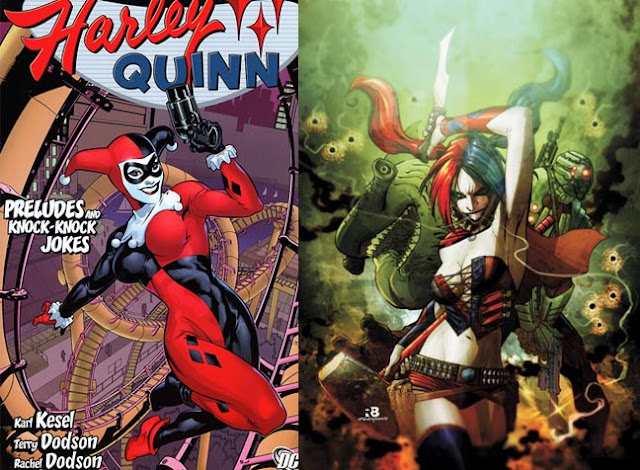
The comparison above is taken from the blog Zannidify (for god's sake, click the link so that I feel less guilty about stealing the image!), and I think it does a good job of expressing some of the myriad ways in which the relaunch has reportedly taken a sledgehammer to the knees of quite a few beloved female characters. (Well, and it restored Batwoman's ability to walk, which was also not particularly well received because you know what let's just move on for now, mnyes?) Issues such as the depiction of the sort-of-villain Catwoman and the hero Starfire rapidly set of a firestorm of criticism, accusations of sexism, counter accusations of a different kind of puritanical sexism, slut shaming, and so on and so forth. It quickly became apparent that the issues that had been so handily codified by DC went far beyond DC itself to the whole comics industry.
Or, well, it sort of became apparent.
If you've met People of The Internet (or, hell, People of The Just About Anywhere, honestly) you'll have noticed the tendency toward anecdotal evidence. Again, I point you to Paul Duffield's article for a more in depth explanation of the phenomenon. Suffice to say that Duffield decided, well, how can I get some actual quantifiable data on this subject?
So, what he did was, he looked through his own collection of comics and the comics collections at two stores in his area, and he recorded the gender distribution of the creators.
I'll let his graphs speak for us both:
Yikes. That is rather dramatic data, wouldn't you say?
Now, I'm going to take another swerve off of the main topic again to briefly go into lecture mode. Again, anyone not in the mood for sociology lectures can go ahead and skip to my own data section below. What Paul Duffield used, when presented with this information, was something called the Sociological Imagination. This is a core idea for the field of Sociology, and although it's not necessarily an easy concept to sum up, I think Duffield's analysis shows it in two ways:
If you haven't read his article yet, (and if not, why the devil haven't you? Get over there, knave, before I tell Lord Humongous to put you in a headlock again) you might be wondering about my second point about data, and about that pie chart for "self-published collection" up there in the graphs.
Well, part of the sociological imagination is the ability to see data and not simply come to a broad conclusion like "Boy, things sure look pretty bad, huh?" but to use data as a source of insight into the deeper mechanics behind things. Just looking at publishing distribution actually doesn't tell us much more than "there is a problem."
But what happens if we compare that data to self-publishing comickers?
That begins to suggest another possibility:
Which means that it's time to come to my side of things.
THE EXPERIMENT
Looking at the information Paul Duffield had uncovered, I wondered to myself just what the gender distribution was in comics theory and criticism. This struck me as important, as theorists do have some sway over how people interact with comics. It might take a while for their attitudes to really seep into culture, but, well, the way literature is taught now essentially consists of New Criticism with a little bit of things like structuralism and deconstruction for flavor, even though generally the methods aren't often taught under those names. Critical theory that emerges now has the potential to shape discourse for the next half century.
If that discourse contains heavy gender bias, we could see the emerging field of academic comics study strongly affected by these ideas, even if the industry and culture make efforts toward gender parity.
To explore the gender distribution, I decided to look at two peer-reviewed journals I was less familiar with (the fascinating ImageTexT and the relatively recent Studies in Comics, which I can't access in full text but which seems similarly intriguing) and the online journal Sequart, which I'm significantly more familiar with. My impression, like Duffield's, was that there were quite a few female authors. I was sure I remembered some on Sequart, in particular! But, memory is faulty, and I wanted to rigorously check my memory against the facts.
To do that, I went through the articles in the journals and recorded several pieces of information about each of them. This information was:
ImageTexT surprised me. Even as I collected data, I got the impression that the writing contained within the journal was fairly equal between genders. The numbers painted a different picture, however. Only 30% of the total pieces were written by women, and of them only about half were theory articles as opposed to reviews, whereas a full 70% of the pieces by men were articles. I'm honestly not sure how important that review/article distinction is, but to me it suggests that not only are women less involved in the journal's writing, they are also less involved in the creation of deeper theory.
This didn't quite satisfy me, though. My impression of equality had to come from somewhere, I thought. (Actually, not a reasonable thought, it turns out, but one that held true for ImageTexT, at least.)
With that thought in mind, I took down the gender distribution within each issue. What I found was quite surprising. The most recent issues have complete, or fairly even, distribution between male and female authors. The earliest issues, on the other hand, are sometimes dominated almost exclusively by men. The one dramatic exception to this trend is the issue on Sex, Gender, and Sexuality, which was dominated almost exclusively by women! The impression I get from this is that ImageTexT is striving for gender parity now, which is, of course, great. But, I have to question their methods somewhat. It worries me a little that the gender and sexuality issue is so strongly tilted in the other direction; it is reminiscent of the tendency toward consulting women on only women's issues, people of color on only racial issues, queer folk on only LGBTQ issues, and so on.
Still, one of the mantras I try to repeat to myself is DO NOT EAT YOUR ALLIES. There's no sense in tearing into them for not being perfect. I think it's clear, from the distribution of the last issues, and from the fact that the editorial board is strikingly inclusive, that ImageTexT is making an effort. I applaud them for it.
The Studies in Comics journal similarly started out abysmally, with only two articles of their first issue being written by women. Overall the journal only has a 27% showing of women, partly because of the low turnout in that first issue and partly because, well, they've only ever gotten to about 35%, so it's not like there's a lot to counterbalance things. I can't speak to the content because I don't have access to the journal, but it generally does not seem to be doing as well as ImageTexT. This is a relatively new journal, though, so we might give it some time to catch up. Interestingly, again women had less theory articles than reviews, but the difference between them was a bit smaller, and both men and women wrote more theory articles overall. I'm honestly not sure what that means about the field as a whole or Studies in Comics in particular.
Which brings us to Sequart.
Hooboy.
I mentioned earlier that I was absolutely sure, totally convinced, that there were a few female writers on staff there, or at least sending in articles to contribute.
Turns out there are two.
Two articles, that is, by two different women. Out of 414 articles. For all time, ever. That's a 00.5% female authorship for this site that is, according to its slogan, dedicated to promoting comics as a form of art. There's no point in even collecting data on that--there is only a sample size of two for women's articles, after all.
That's just inexcusable.
Now, feeling a bit shaken by this, I decided to look a bit more closely at the actual content of the archives. It turns out that all of the earliest pieces are written by one Julian Darius, who seems to have built the site up from his own initial blogging. Not too shabby. But it did get me thinking about the editorial board there and how it might influence the parity of the site in the opposite direction of ImageTexT and Studies in Comics, both of which have more diverse (if not equal) editorial boards.
Now, this is a realm I'm nervous about entering primarily because of Duffield's points earlier about the accusatory nature of much of this discourse, but I have to wonder a little bit about the tenor of some of Darius's articles. I find it interesting, for example, that he did not include gender parity as a possible reason that comics have failed to gain respect in his lengthy (and, honestly, quite good) article on the subject. In fairness to Darius, he's actually done a numerical analysis of DC's relaunch not unlike what I've been doing here, but besides offering the tallies he gives little commentary (remember what I said about sociological imagination?), and he somewhat downplays gender disparity as a problem, what with target audiences and so on.
And, of course, there was that article early in the archives where Darius defends the rape of a female character in DC's big, multi-character crossover event Identity Crisis. The article is pretty problematic. And by problematic I mean that it actually disturbed me quite a bit. There's a certain dismissive flippancy to the article that really is not in any way appropriate to the subject matter. I'm hesitant to mention this, of course, because I'm not sure it's reasonable to use this article, written many years ago, as an indicator of Darius's editorial strategy, but I also can't ignore the fact that since that article was written only two women have ever written for the site. It just seems like an indicator of the basic lack of interest Darius has in gender studies, which would be less problematic if he wasn't the driving force behind an entire comics theory journal.
Even more troubling is the fact that a little less than 5% of the articles on the site deal with sexuality as a primary focus. This isn't gender, even--just the idea of sex, and often the idea of sex in superhero comics. One of the (by my very rough and subjective estimation) 19 articles is Darius's article on the infamous Infinite Crisis rape scene; another is the sole article by one of the two female writers. So, we've got the opposite problem ImageTexT had: women are almost completely absent from the conversation on gender and sexuality in comics.
On the bright side, that one exception is actually a pretty awesome article. It's an excellent piece of analysis on gender normative behavior in comics and the resistance deviation gets from fans whose brains are apparently too ossified to comprehend a woman acting in a "masculine" way, but are still flexible enough to accept people with lazer eyes. It's especially interesting as a four year old analysis from back before the brouhaha surrounding DC's relaunch and its rather -hrm- striking depictions of female characters. Unfortunately I haven't been able to find any other articles by her elsewhere, which again doesn't strike me as a signal of hope. Not that I think she's been stuffed into a refrigerator somewhere, of course, but if women who write about comics tend to write one or two articles and then vanish, well... when you compare that to how prolific Darius and many of the other Sequart writers are, you begin to see how the conversation could become totally dominated by men.
I think what it shows most dramatically, though, is that memories are horribly flawwed things. I was totally convinced that somewhere, sometime I had read a Sequart article by a woman. It was only when I actually checked the hard data that I discovered my error.
This is the revolutionary power of an approach to the liberal arts that blends in scientific ways of looking at information. It can totally overturn your perceptions.
And I think the results show that things are potentially significantly worse than we may have suspected, even if they are getting better over time.
Now, this isn't the end of the discussion, of course. There are a number of other journals which I do not have access to, or which I don't know how to mine for data. I have no idea how to begin syphoning data from The Comics Journal, for example, but it looks fairly promising at a glance (I wasn't familiar with the journal until my lovely assistant Sara found it for me). If anyone has a method for sorting through the data, please let me know. At any rate, I think it's a good sign that one of the first columns I happened upon on the site was this intriguing article about male superhero costumes and homophobia. It's seldom these days that I run across an article on comics and gender that prompts more than a few seconds of analysis--I've seen most of it before, typically. But this article manages to go beyond basic feminism into the only now emerging feminist analysis of masculinity. That's pretty cool. But, again, I don't really have a way of sorting through the site for data.
I also don't know if my numbers are strictly significant, as defined by psychology, sociology, and statistics. You would have to ask someone who actually knows statistics for that. In fact... do any of you know statistics? Are my findings significant?
In fact, let's make this a little bit interactive, shall we? I want to hear from you, my fair readers. What do you think we can do with this information? Is there something I've missed that we should throw onto the spreadsheet? Another journal you have access to? Share it in the comments and, if you have the time, put together some data for yourself. I'll do a follow up article when I think I've accumulated enough interesting information to warrant a return to the ideas we're discussing here.
I've put together two spreadsheets that include my data. One is a base copy that only I can edit (marked STATIC) but the other can be edited by anyone on The Internet. So, although I have a backup in case something goes horrifically wrong or some troglodyte deletes all the information, anyone that wants to add their own information or their own interpretation of the data can easily do so. Wikidiscourse? Perhaps.
The Static Google Doc
The Editable Google Doc
Like I said, this isn't the end of the discussion. But with the standard of sociology in hand we can perhaps enter a new phase of the discussion that breaks information down not by anecdotes but real, tangible facts. From that, all we need is to embrace the sociological imagination and explore what might be going on and, potentially, how we might solve these social problems.
Heaven help me, I really went overboard on this one. If you like what you've read here, share it on Facebook, Google+, Twitter, Reddit, Equestria Daily, Xanga, MySpace, or whathaveyou, and leave me some kind words in the comments below.
This one will require some backstory. And quite a few links.
(Backstory that will be redundant to anyone on the Whitechapel forums. Feel free to skip these bits if you've tromped over here from over there.)
It started with a fascinating blog post by Paul Duffield, the brilliant artist of the webcomic Freakangels and all-around swell guy. He happened to post this article to the Whitechapel forums where--
Wait, no, that's not really the place to start, is it?
Arguably, the real beginning of this current saga is with DC comic's relaunch of their entire line of superhero comics earlier in the year. Although the often nasty (as Duffield's piece describes) battle between comics and feminism has raged on for quite a bit longer than that relaunch, it was this relaunch that, as far as I can see, essentially torched what white flags were flying with its laser eyes and signaled the renewal of hostilities. Why? Well, remember the article I wrote on body language and character design, and how fundamental those things are to the message of a work?
DC should have read that article:
![]() |
| Old Harley Quinn vs New Harley Quinn. Spot The Differences! |
The comparison above is taken from the blog Zannidify (for god's sake, click the link so that I feel less guilty about stealing the image!), and I think it does a good job of expressing some of the myriad ways in which the relaunch has reportedly taken a sledgehammer to the knees of quite a few beloved female characters. (Well, and it restored Batwoman's ability to walk, which was also not particularly well received because you know what let's just move on for now, mnyes?) Issues such as the depiction of the sort-of-villain Catwoman and the hero Starfire rapidly set of a firestorm of criticism, accusations of sexism, counter accusations of a different kind of puritanical sexism, slut shaming, and so on and so forth. It quickly became apparent that the issues that had been so handily codified by DC went far beyond DC itself to the whole comics industry.
Or, well, it sort of became apparent.
If you've met People of The Internet (or, hell, People of The Just About Anywhere, honestly) you'll have noticed the tendency toward anecdotal evidence. Again, I point you to Paul Duffield's article for a more in depth explanation of the phenomenon. Suffice to say that Duffield decided, well, how can I get some actual quantifiable data on this subject?
So, what he did was, he looked through his own collection of comics and the comics collections at two stores in his area, and he recorded the gender distribution of the creators.
I'll let his graphs speak for us both:
Yikes. That is rather dramatic data, wouldn't you say?
Now, I'm going to take another swerve off of the main topic again to briefly go into lecture mode. Again, anyone not in the mood for sociology lectures can go ahead and skip to my own data section below. What Paul Duffield used, when presented with this information, was something called the Sociological Imagination. This is a core idea for the field of Sociology, and although it's not necessarily an easy concept to sum up, I think Duffield's analysis shows it in two ways:
- He went beyond anecdotal evidence to actual data--in other words, he moved beyond personal experience and psychology to a broader picture of a culture as a whole
- When presented with the data, he didn't just pass that data on but came to conclusions about what might be at work--he looked at the underlying mechanics of the information he saw.
If you haven't read his article yet, (and if not, why the devil haven't you? Get over there, knave, before I tell Lord Humongous to put you in a headlock again) you might be wondering about my second point about data, and about that pie chart for "self-published collection" up there in the graphs.
Well, part of the sociological imagination is the ability to see data and not simply come to a broad conclusion like "Boy, things sure look pretty bad, huh?" but to use data as a source of insight into the deeper mechanics behind things. Just looking at publishing distribution actually doesn't tell us much more than "there is a problem."
But what happens if we compare that data to self-publishing comickers?
That begins to suggest another possibility:
"Following up on a suspicion, I dived into my giant pile of self-published comics collected at conventions over the years to find percentages of 47% male, 49% female and 4% ungendered/uncertain – an almost perfectly representational proportion. Are we seeing a picture of equal representation at grass roots, but mostly-male where the money and jobs are? These statistics suggest that the answer is yes, and although the data is limited I made sure to use a sample that, if anything, should provide a more representative image than a true survey might."This isn't a particularly long passage, but it's a great example of what I'm talking about: Duffield took the information he had, added more data, and explored what that suggested. His article goes into quite a bit more detail about what all of this might mean for the industry as a whole, and I won't attempt to summarize it here, but this should give you a taste of how the process works.
Which means that it's time to come to my side of things.
THE EXPERIMENT
Looking at the information Paul Duffield had uncovered, I wondered to myself just what the gender distribution was in comics theory and criticism. This struck me as important, as theorists do have some sway over how people interact with comics. It might take a while for their attitudes to really seep into culture, but, well, the way literature is taught now essentially consists of New Criticism with a little bit of things like structuralism and deconstruction for flavor, even though generally the methods aren't often taught under those names. Critical theory that emerges now has the potential to shape discourse for the next half century.
If that discourse contains heavy gender bias, we could see the emerging field of academic comics study strongly affected by these ideas, even if the industry and culture make efforts toward gender parity.
To explore the gender distribution, I decided to look at two peer-reviewed journals I was less familiar with (the fascinating ImageTexT and the relatively recent Studies in Comics, which I can't access in full text but which seems similarly intriguing) and the online journal Sequart, which I'm significantly more familiar with. My impression, like Duffield's, was that there were quite a few female authors. I was sure I remembered some on Sequart, in particular! But, memory is faulty, and I wanted to rigorously check my memory against the facts.
To do that, I went through the articles in the journals and recorded several pieces of information about each of them. This information was:
- Volume Number.Issue Number
- Number of the article within the issue
- Whether the author was (m)ale, (f)emale, or a (c)ollaboration between people of both genders
- Whether the piece was a theory (a)rticle, a (r)eview, and, in some cases, an (i)ntroduction or an (o)p ed piece (the latter only showed up in Studies in Comics, the former only in ImageTexT.)
- Whether the issue was on a particular topic or not
ImageTexT surprised me. Even as I collected data, I got the impression that the writing contained within the journal was fairly equal between genders. The numbers painted a different picture, however. Only 30% of the total pieces were written by women, and of them only about half were theory articles as opposed to reviews, whereas a full 70% of the pieces by men were articles. I'm honestly not sure how important that review/article distinction is, but to me it suggests that not only are women less involved in the journal's writing, they are also less involved in the creation of deeper theory.
This didn't quite satisfy me, though. My impression of equality had to come from somewhere, I thought. (Actually, not a reasonable thought, it turns out, but one that held true for ImageTexT, at least.)
With that thought in mind, I took down the gender distribution within each issue. What I found was quite surprising. The most recent issues have complete, or fairly even, distribution between male and female authors. The earliest issues, on the other hand, are sometimes dominated almost exclusively by men. The one dramatic exception to this trend is the issue on Sex, Gender, and Sexuality, which was dominated almost exclusively by women! The impression I get from this is that ImageTexT is striving for gender parity now, which is, of course, great. But, I have to question their methods somewhat. It worries me a little that the gender and sexuality issue is so strongly tilted in the other direction; it is reminiscent of the tendency toward consulting women on only women's issues, people of color on only racial issues, queer folk on only LGBTQ issues, and so on.
Still, one of the mantras I try to repeat to myself is DO NOT EAT YOUR ALLIES. There's no sense in tearing into them for not being perfect. I think it's clear, from the distribution of the last issues, and from the fact that the editorial board is strikingly inclusive, that ImageTexT is making an effort. I applaud them for it.
The Studies in Comics journal similarly started out abysmally, with only two articles of their first issue being written by women. Overall the journal only has a 27% showing of women, partly because of the low turnout in that first issue and partly because, well, they've only ever gotten to about 35%, so it's not like there's a lot to counterbalance things. I can't speak to the content because I don't have access to the journal, but it generally does not seem to be doing as well as ImageTexT. This is a relatively new journal, though, so we might give it some time to catch up. Interestingly, again women had less theory articles than reviews, but the difference between them was a bit smaller, and both men and women wrote more theory articles overall. I'm honestly not sure what that means about the field as a whole or Studies in Comics in particular.
Which brings us to Sequart.
Hooboy.
I mentioned earlier that I was absolutely sure, totally convinced, that there were a few female writers on staff there, or at least sending in articles to contribute.
Turns out there are two.
Two articles, that is, by two different women. Out of 414 articles. For all time, ever. That's a 00.5% female authorship for this site that is, according to its slogan, dedicated to promoting comics as a form of art. There's no point in even collecting data on that--there is only a sample size of two for women's articles, after all.
That's just inexcusable.
Now, feeling a bit shaken by this, I decided to look a bit more closely at the actual content of the archives. It turns out that all of the earliest pieces are written by one Julian Darius, who seems to have built the site up from his own initial blogging. Not too shabby. But it did get me thinking about the editorial board there and how it might influence the parity of the site in the opposite direction of ImageTexT and Studies in Comics, both of which have more diverse (if not equal) editorial boards.
Now, this is a realm I'm nervous about entering primarily because of Duffield's points earlier about the accusatory nature of much of this discourse, but I have to wonder a little bit about the tenor of some of Darius's articles. I find it interesting, for example, that he did not include gender parity as a possible reason that comics have failed to gain respect in his lengthy (and, honestly, quite good) article on the subject. In fairness to Darius, he's actually done a numerical analysis of DC's relaunch not unlike what I've been doing here, but besides offering the tallies he gives little commentary (remember what I said about sociological imagination?), and he somewhat downplays gender disparity as a problem, what with target audiences and so on.
And, of course, there was that article early in the archives where Darius defends the rape of a female character in DC's big, multi-character crossover event Identity Crisis. The article is pretty problematic. And by problematic I mean that it actually disturbed me quite a bit. There's a certain dismissive flippancy to the article that really is not in any way appropriate to the subject matter. I'm hesitant to mention this, of course, because I'm not sure it's reasonable to use this article, written many years ago, as an indicator of Darius's editorial strategy, but I also can't ignore the fact that since that article was written only two women have ever written for the site. It just seems like an indicator of the basic lack of interest Darius has in gender studies, which would be less problematic if he wasn't the driving force behind an entire comics theory journal.
Even more troubling is the fact that a little less than 5% of the articles on the site deal with sexuality as a primary focus. This isn't gender, even--just the idea of sex, and often the idea of sex in superhero comics. One of the (by my very rough and subjective estimation) 19 articles is Darius's article on the infamous Infinite Crisis rape scene; another is the sole article by one of the two female writers. So, we've got the opposite problem ImageTexT had: women are almost completely absent from the conversation on gender and sexuality in comics.
On the bright side, that one exception is actually a pretty awesome article. It's an excellent piece of analysis on gender normative behavior in comics and the resistance deviation gets from fans whose brains are apparently too ossified to comprehend a woman acting in a "masculine" way, but are still flexible enough to accept people with lazer eyes. It's especially interesting as a four year old analysis from back before the brouhaha surrounding DC's relaunch and its rather -hrm- striking depictions of female characters. Unfortunately I haven't been able to find any other articles by her elsewhere, which again doesn't strike me as a signal of hope. Not that I think she's been stuffed into a refrigerator somewhere, of course, but if women who write about comics tend to write one or two articles and then vanish, well... when you compare that to how prolific Darius and many of the other Sequart writers are, you begin to see how the conversation could become totally dominated by men.
I think what it shows most dramatically, though, is that memories are horribly flawwed things. I was totally convinced that somewhere, sometime I had read a Sequart article by a woman. It was only when I actually checked the hard data that I discovered my error.
This is the revolutionary power of an approach to the liberal arts that blends in scientific ways of looking at information. It can totally overturn your perceptions.
And I think the results show that things are potentially significantly worse than we may have suspected, even if they are getting better over time.
Now, this isn't the end of the discussion, of course. There are a number of other journals which I do not have access to, or which I don't know how to mine for data. I have no idea how to begin syphoning data from The Comics Journal, for example, but it looks fairly promising at a glance (I wasn't familiar with the journal until my lovely assistant Sara found it for me). If anyone has a method for sorting through the data, please let me know. At any rate, I think it's a good sign that one of the first columns I happened upon on the site was this intriguing article about male superhero costumes and homophobia. It's seldom these days that I run across an article on comics and gender that prompts more than a few seconds of analysis--I've seen most of it before, typically. But this article manages to go beyond basic feminism into the only now emerging feminist analysis of masculinity. That's pretty cool. But, again, I don't really have a way of sorting through the site for data.
I also don't know if my numbers are strictly significant, as defined by psychology, sociology, and statistics. You would have to ask someone who actually knows statistics for that. In fact... do any of you know statistics? Are my findings significant?
In fact, let's make this a little bit interactive, shall we? I want to hear from you, my fair readers. What do you think we can do with this information? Is there something I've missed that we should throw onto the spreadsheet? Another journal you have access to? Share it in the comments and, if you have the time, put together some data for yourself. I'll do a follow up article when I think I've accumulated enough interesting information to warrant a return to the ideas we're discussing here.
I've put together two spreadsheets that include my data. One is a base copy that only I can edit (marked STATIC) but the other can be edited by anyone on The Internet. So, although I have a backup in case something goes horrifically wrong or some troglodyte deletes all the information, anyone that wants to add their own information or their own interpretation of the data can easily do so. Wikidiscourse? Perhaps.
The Static Google Doc
The Editable Google Doc
Like I said, this isn't the end of the discussion. But with the standard of sociology in hand we can perhaps enter a new phase of the discussion that breaks information down not by anecdotes but real, tangible facts. From that, all we need is to embrace the sociological imagination and explore what might be going on and, potentially, how we might solve these social problems.
Heaven help me, I really went overboard on this one. If you like what you've read here, share it on Facebook, Google+, Twitter, Reddit, Equestria Daily, Xanga, MySpace, or whathaveyou, and leave me some kind words in the comments below.
Saturday, March 10, 2012
Mapping Sex in the Stars
Lately I've been toying around with a new way of graphically representing sexuality. I think I've finally hit on something that is at least presentable, but I thought I would present it in a rather novel way. Rather than simply throwing it up and explaining what it all means, I thought I would show the process that led to its creation. This will, I hope, accomplish two goals: exploring how a graphic designer solves design problems, and exposing some of the ways that graphic design decisions can shape an argument, or a worldview, or an identity. The article will therefore have two types of lessons:
Design Lessons--how art gets made
and
Truthiness Lessons--how "truth" gets made
It all started when I posted this article on asexuality on my Google+, with some passing remarks about the difficulty of static, concrete identities. In response to the article, my good friend (and frequent comment writer here on the blog) Timebaum started this little exchange:
Timebaum - Gotta love the little-thought-of third point of the General Sexuality Triangle. And if that isn't already a thing, I suggest you make it in an article.Feb 27, 2012Sam Keeper - It's just tricky because it's hard to decide what to include.... I'm not sure I would be up to the task of sorting it out.Feb 28, 2012 - EditSam Keeper - Especially since "Pansexual" actually doesn't fit very well into any existing scheme...Feb 28, 2012 - EditTimebaum - The way I see it, I think most people probably see the sexuality spectrum as a line, with Homosexual on one side, and Heterosexual on the other. However, I think that it's really either a triangle (with the third point being Asexual) or even a pyramid (with the fourth point being Polyamory). I don't think the 4-point Pyramid really works, though, as I don't know if Polyamory really fits in the the others. Regardless, I think the Triangle works pretty well, and it's at least an improvement.Feb 28, 2012Sam Keeper - Well, but the problem is, something like Pan functionally doesn't fit because the whole point of pansexuality is that it bases sexual attraction on nonsexual personality characteristics. Furthermore, where would you put someone that is romantically attracted to women but sexually attracted to men? They would end up occupying two different points. And yeah, poly is another possibility, as is gender expression.
I have to wonder if Kinsey didn't, in some ways, do more harm than good by passing down to us this spectrum mindset when maybe a better model would be a constellation...
.....
Actually, that's not a bad idea. Hmmmm...
Thus began a project that would only add to my general sleep deprivation. A few snippets from the conversation struck a chord with me: the idea of mapping things on a triangular spectrum, the idea of finding a way of mapping multiple types of sexualities onto the same chart.
And, of course, there was that one word:
"Constellation."
There seemed to be such poignant potential in that one word. Sexuality, I thought, is a beautiful thing. Why not express it as points of light in an imaginary sky? What a great way of moving past simple categorization and scientific measurement to an emotionally resonant expressive model! It's sexuality as expressed not by psychiatric medicine (no offense, Timebaum) but by artistic sentiment.
Of course, not all of this went through my mind in so many words, but it was there nevertheless. It just seemed intuitive to me. But there's an underlying logic to decisions like this that are not necessarily apparent even to the artist making the creative choices, which, I suspect, helps reinforce the myth of the magical creative moment. This is Design Lesson Number 1: Inspiration is a cognitive skill. That flash of an idea came to me because I have worked to strengthen the neural connections that support this particular problem solving heuristic. Non-artists often seem to have this idea that what we do is magical and comes from some secret place in our souls, but really all we've done is strengthened the parts of our brains that enable creative problem solving.
It also introduces Truthiness Lesson 1: Minor decisions can totally reshape our understanding of reality. All it took was Timebaum's suggestion that I add in a third point to prompt me to rethink our conception of sexuality. What if you could be somewhat bisexual but also mostly asexual? Or, to split things up further, what if you could separate other sexual characteristics? These decisions are pernicious because they are also often invisible. I suspect that if you asked someone who wasn't aware of asexuality how they would map sexuality out they would suggest a spectrum with gay at one end and straight at another. (Or straight at one end and hellbound on the other, I suppose.) It's just common sense, after all. But Kinsey made a decision, when he first described sexuality as a spectrum, to label the two ends in that way, and, with that decision, shaped what common sense was.
But enough of this intellectual drivel, let's get to the first pretty picture. Even I'm tired of my own writing by now.
![]() |
| Sexuality Star Chart Version 1 (Click For Larger Version) |
For this chart, the individual would be (apparently) intersexual (note the biological sex is in the middle), slightly more male gendered, polyamorously interested in play, attraction, and romance, all slightly more interested in females and more romantically than sexually interested.
It's not a bad system, I don't think. But something about it didn't quite work for me. This is Design Lesson Number 2: Design is a method for problem solving. The problem solving aspect of art tends to be a bit overlooked in modern artistic discourse, but it's absolutely huge conceptually. I don't care how much of an inspired, creative, emotional person you are, eventually you're going to look at a piece and realize that not only doesn't it look right, you don't know how to fix it.
So, I stared at this design for a while and pondered it over, and noticed a few things:
- The stars are way too varied in their appearance. There's no unity to the piece as a whole because I've got that weird pointed thing, moons, that really large yellow circle and so on. A simple circle and a simple triangle are the major shapes in the work; I need to stick to those.
- The colors are terrible. They just look arbitrary and badly organized and bleh. There's not enough variety for it to be a balanced rainbow (a desirable scheme, considering what this chart represents) but there's too much for there to be visual unity.
- There really aren't enough stars, and they're too big. They don't look like stars, they just look like abstract symbols in a triangle. Thankfully, this can be solved by also solving the next problem:
- There's some stuff I'm missing. For one thing, gender identity isn't necessarily obvious (I don't always wear a skirt, for example) so I should add in gender expression.
But it also catapults me straight into Truthiness Lesson 2: When you lock into a particular model, you blind yourself to what you have excluded. This is true in two ways. First, you blind yourself potentially to people whose needs are different from your own. The lack of unity is ugly, there's no denying it, but it does accomplish one thing:
It makes the chart readable to people who are colorblind.
And that actually didn't even occur to me until I started writing the article. This is a great example of how I became blind, through my design strategies, to the needs of others. And while I think there's some validity to the argument that you can't design based on every single person's needs, my point isn't that I should redesign the piece to be useable to the colorblind, or the blind, or what have you, but that I should have at least made the choice consciously. And, thinking back, that was one of my reasons for designing the chart the way I did originally, but somewhere along the several days of creation I forgot that I had made that choice.
Whoops.
What's more, as I wrapped up this first draft, I happened to run into a friend of mine that's interested in analysis of gender roles and sexuality. I asked this person what else I might include as part of sexuality.
"What age group a person is attracted to."
I was flummoxed. That had never occurred to me. Age attraction is just something that's taken as either normal or not normal--common sense, again. And, I was locked into a chart design that really couldn't effectively incorporate that information. The model I had decided upon, combined with cultural assumptions, had totally blinded me to a whole area of sexuality.
The chart also can't account for: causes of attraction (there's no difference between bisexuality and pansexuality), kinks and fetishes, domination or submission preferences, where you prefer to be touched, how hard, and so on. Again, my point is not that I should have found a way to model all of these--that would probably be impossible, or at least it would be really ugly and cluttered looking. My point is that what I chose to map was largely arbitrary and no more fundamental, in some cases, to aspects of sexuality that I excluded from the star chart. But again, once I was locked into the chart design I was blind to what I had left out.
These stunning failures aside, I slogged forward through the murky marsh of graphic design, and turned out this:
![]() |
| Sexuality Star Chart Version 2 |
It also now includes both interest in forming friendships, and gender expression, which helps fill the chart out a bit more and helps potentially clarify some of the person's sexual nature a bit more. (Incidentally, yes, this is a real person's chart, and no, I'm not telling you who.)
Just for fun, here's mine. I'm sexually the big dipper!
![]() |
| Sexuality Star Chart Version 2 B |
None of this is a definite, last word sort of thing. It's a snapshot of how I was feeling about these issues as I put the chart together--kinda like how our labels of straight, gay, bisexual, asexual and so on can change over time, despite their definite biological basis. The definitions and our understanding of them change, and that is enough to change our understanding of reality. This chart might be a good way of exploring that, so long as people don't start adopting it like some sort of badge that defines them forevermore.
And, of course, that leads me to Design Lesson Number 3: There Will Always Be Something More To Do. Call it the perfectionist impulse. Once you're used to thinking of work in terms of problem solving and analysis, it's really easy to fall into a perfectionist model of behavior. I can think of a number of clever ways to make this
- Lines indicating direction of influence, so interest in friendship could point to physical attraction to indicate a genderqueer disposition, and so on
- An interactive version built in Flash (possibly with the help of guest contributor Ian?) that I could upload for people to play with
- Some sort of, I don't know, orbit line thing for age ranges or...
Although, every once in a while you just get an idea so good that you have to try it out.
What, after all, does a map of space naturally include?
That's right.
Space Invaders.
![]() |
| PEW PEW! PEWPEWPEW! |
Lesson Number 0: Creativity is just a form of madness that has been put to a constructive purpose.
If you like what you've read here, share it on Facebook, Google+, Twitter, Reddit, Equestria Daily, Xanga, MySpace, or whathaveyou, and leave me some kind words in the comments below.
Wednesday, March 7, 2012
Robin Hood and Rosenkreutz
I just got some news today that shook me rather dramatically. So dramatically, in fact, that I decided to shelve the articles I was working on in favor of this one.
It just made surrealist retro 80s pastiche music videos seem... insignificant.
Somehow.
Anyway. I'll get to what that news was by the end of the article, but I'll just say, for now, that it prompted a line of thought about the nature of certain types of resistance heroes.
By resistance heroes I mean popularly admired (and reviled--this is important) individuals that oppose powerholders in society. There are a few different archetypes that came to my mind, but there are two that stand out as particularly relevant to society today.
They are The Robin Hood and The Rosicrucian.
THE ROBIN HOOD
The first of these is pretty recognizable as a folk hero. Robin Hood has worked his way into our culture fairly completely, but on the off chance that I have a reader that hasn't grown up with English folktales, the character is a rogue and an archer that battles the evil Sheriff of Nottingham and the pretender king Prince John. The iconic description is that he "steals from the rich and gives to the poor," and his end goal is to raise the ransom that will allow the true king, Richard, to return triumphantly to England.
The particulars, though, are less important to me than the archetypal construction. Let's look at the main things Robin Hood has going for him as a resistance hero:
THE ROBIN HOOD IS:
The Robin Hood is therefore a figure that fights power by carrying out individual, heroic deeds. This archetype makes for great cinema because it provides a central figure and a supporting cast of similarly minded and talented individuals. It has the heroism of the individual will and the collective strength of a group of likeminded people.
The advantage of this model is that it lends itself to a dramatic narrative that outsiders can latch onto. There is a natural central ideology expressed by the group and a strong entertainment value to the exploits of the individuals involved.
The disadvantages are pretty severe, though. After all, if The Robin Hood or the members of the Merry Band are compromised, the whole movement can be torn down. This makes it a fundamentally unstable system. Its greatest enemy is the Intelligence Agent or the Ruthless Assassin--in other words, individuals (usually part of a larger institution) that can either oppose the Robin Hood on his or her own terms (in the case of the Ruthless Assassin) or can compromise the Robin Hood through manipulation, hostage taking, blackmail, and general mindfuckery (the Intelligence Agent).
Examples might include:
THE ROSICRUCIAN
This is a little weirder and less intuitive. The Order of Rosenkreutz never actually existed--let's get that out of the way first. It was a hoax created by a bunch of drunken students. The idea was that the organization was composed of the finest alchemical minds in Renaissance Europe and was actively working to... well, what they were working towards wasn't exactly clear, but ever since then there's been a certain mania for the Order.
In fact, we can still see some of its influence today in modern conspiracy tales (they're often connected to the Knights Templar or the Illuminati) and, interestingly, in Masonic iconography (even though it was a hoax, the Order had a lot of symbolism associated with it that others adopted quite freely).
The reason I'm including it as a resistance hero is because when the Order of Rosenkreutz appeared on the scene the established powers flipped the proverbial fuck out. The Order represented a manifestation of what a lot of traditionalists feared above all else: the growing popularity of the mystic alchemy that was the precursor to modern science, the threat of a faceless foe united across national and religious boundaries, and the rise of heretical values following the emergence of Protestantism. So, you can see why this organization without a leader, without a structure, and without even a concrete set of goals had just about every literate person in Europe talking.
THE ROSICRUCIAN IS:
That last point is a little odd, perhaps, but if you think of the historical Order it makes a bit more sense. The Rosicrucians that actually existed all existed because they tried to emulate another organization that they had heard of but never interacted with. The fact that this organization was a hoax--a nonexistent original--did not keep them from acting as copies. This means that anyone can be The Rosicrucian regardless of their heroic power. All you need to do is declare yourself The Rosicrucian and act in a way that you think carries out the esoteric goals, as you interpret them.
The great power of the Rosicrucian is that an individual playing The Rosicrucian can be compromised by the two villain archetypes I described earlier, but there will always be more Rosicrucians filling the ranks as people copy the original and the other copies.
The Rosicrucian is particularly weak to the Agent Provocateur--an individual who adopts the role of the Rosicrucian in order to commit atrocities that will discredit the movement.
Examples Might Include:
Now that that's out of the way, let's get to the point, shall we?
THE DEATH OF ROBIN HOOD
The leader of Lulzsec, Sabu, has sold out his organization. Lulzsec is functionally destroyed. What's worse, Sabu sold them out six months ago--he's been working for the FBI for half a year now. I find it difficult to articulate just the level of catastrophe we're seeing here.
What we're seeing is, simply put, the Death of Robin Hood.
Basically, Lulzsec gambled that their Merry Band of pirates could protect itself by hiding on the net while still carrying out the kind of press-making big publicity heroic stunts that made it such a power for its few months of action.
They gambled and they lost.
According to Anons the FBI threatened Sabu with the loss of his children--a claim I'm in no position to corroborate, but that I'm not particularly inclined to dispute. It doesn't seem what I would call implausible. This is the danger to The Robin Hood. If you put Maid Marianne in danger, you may find your Merry Band totally compromised. It's infuriating. It's twisted. But it's really only to be expected.
So, what's left now that Robin Hood is dead?
Well, I think what comes next is the continued move to the Rosicrucian model. The closer a Merry Band is, the more susceptible it is to either dismantling through the removal of key members or the subversion of people within the group. As I mentioned before, The Rosicrucian is less open to compromise due to the decentralized, individual nature of the movement.
This is why I suspect that Anonymous will carry on despite this setback and continue carrying out its raids and DDoS attacks. They are the Order of Rosenkreutz now: a faceless, esoteric mass of individuals fascinated with a shared loose set of ideals and icons. They are more fearful, in a way, than the relatively comfortable Robin Hood, but even in this there is a certain mystique and power. The Rosicrucian is in danger, of course, of falling to Agents Provocateur, but Anonymous has repeatedly shown that it is smart enough not to fall for the bait of people like the Westboro Baptist Church, and members can always splinter off if they disagree with the current targets.
What fascinates me about this is that we are seeing a transition from the model that Guy Fawkes worked under to the model championed by V (at least, championed by the movie version of V). Lulzsec was perhaps always doomed to failure. It is a throwback to an older model of heroic resistance that, frankly, didn't turn out so well for Guy Fawkes, either. We can perhaps take some consolation in that fact.
Robin Hood is dead.
But The Rosicrucian is alive and well in the 21st Century.
It just made surrealist retro 80s pastiche music videos seem... insignificant.
Somehow.
Anyway. I'll get to what that news was by the end of the article, but I'll just say, for now, that it prompted a line of thought about the nature of certain types of resistance heroes.
By resistance heroes I mean popularly admired (and reviled--this is important) individuals that oppose powerholders in society. There are a few different archetypes that came to my mind, but there are two that stand out as particularly relevant to society today.
They are The Robin Hood and The Rosicrucian.
THE ROBIN HOOD
The first of these is pretty recognizable as a folk hero. Robin Hood has worked his way into our culture fairly completely, but on the off chance that I have a reader that hasn't grown up with English folktales, the character is a rogue and an archer that battles the evil Sheriff of Nottingham and the pretender king Prince John. The iconic description is that he "steals from the rich and gives to the poor," and his end goal is to raise the ransom that will allow the true king, Richard, to return triumphantly to England.
The particulars, though, are less important to me than the archetypal construction. Let's look at the main things Robin Hood has going for him as a resistance hero:
THE ROBIN HOOD IS:
- A single heroically talented individual
- With a "Merry Band" of similarly talented followers
- Who takes on powerholders through dramatic deeds
- In order to support broadly populist goals
The Robin Hood is therefore a figure that fights power by carrying out individual, heroic deeds. This archetype makes for great cinema because it provides a central figure and a supporting cast of similarly minded and talented individuals. It has the heroism of the individual will and the collective strength of a group of likeminded people.
The advantage of this model is that it lends itself to a dramatic narrative that outsiders can latch onto. There is a natural central ideology expressed by the group and a strong entertainment value to the exploits of the individuals involved.
The disadvantages are pretty severe, though. After all, if The Robin Hood or the members of the Merry Band are compromised, the whole movement can be torn down. This makes it a fundamentally unstable system. Its greatest enemy is the Intelligence Agent or the Ruthless Assassin--in other words, individuals (usually part of a larger institution) that can either oppose the Robin Hood on his or her own terms (in the case of the Ruthless Assassin) or can compromise the Robin Hood through manipulation, hostage taking, blackmail, and general mindfuckery (the Intelligence Agent).
Examples might include:
- Robin Hood (naturally)
- Captain Jack Sparrow
- Morpheus and Neo
- The Fabulous Killjoys
- Guy Fawkes (this will be important later)
THE ROSICRUCIAN
This is a little weirder and less intuitive. The Order of Rosenkreutz never actually existed--let's get that out of the way first. It was a hoax created by a bunch of drunken students. The idea was that the organization was composed of the finest alchemical minds in Renaissance Europe and was actively working to... well, what they were working towards wasn't exactly clear, but ever since then there's been a certain mania for the Order.
In fact, we can still see some of its influence today in modern conspiracy tales (they're often connected to the Knights Templar or the Illuminati) and, interestingly, in Masonic iconography (even though it was a hoax, the Order had a lot of symbolism associated with it that others adopted quite freely).
The reason I'm including it as a resistance hero is because when the Order of Rosenkreutz appeared on the scene the established powers flipped the proverbial fuck out. The Order represented a manifestation of what a lot of traditionalists feared above all else: the growing popularity of the mystic alchemy that was the precursor to modern science, the threat of a faceless foe united across national and religious boundaries, and the rise of heretical values following the emergence of Protestantism. So, you can see why this organization without a leader, without a structure, and without even a concrete set of goals had just about every literate person in Europe talking.
THE ROSICRUCIAN IS:
- A faceless member of a larger organization
- With esoteric and often vaguely defined goals
- That draws strength from decentralization
- And may be a copy without an original
That last point is a little odd, perhaps, but if you think of the historical Order it makes a bit more sense. The Rosicrucians that actually existed all existed because they tried to emulate another organization that they had heard of but never interacted with. The fact that this organization was a hoax--a nonexistent original--did not keep them from acting as copies. This means that anyone can be The Rosicrucian regardless of their heroic power. All you need to do is declare yourself The Rosicrucian and act in a way that you think carries out the esoteric goals, as you interpret them.
The great power of the Rosicrucian is that an individual playing The Rosicrucian can be compromised by the two villain archetypes I described earlier, but there will always be more Rosicrucians filling the ranks as people copy the original and the other copies.
The Rosicrucian is particularly weak to the Agent Provocateur--an individual who adopts the role of the Rosicrucian in order to commit atrocities that will discredit the movement.
Examples Might Include:
- The Rosicrucians
- The Laughing Man
- Spartacus (by the end, spoiler alert)
- Arguably the Viet Cong (ah, I can already feel the internet rage...)
- V
Now that that's out of the way, let's get to the point, shall we?
THE DEATH OF ROBIN HOOD
![]() |
| Staggeringly, this article was NOT just a filmsy justification for the creation of this image. |
The leader of Lulzsec, Sabu, has sold out his organization. Lulzsec is functionally destroyed. What's worse, Sabu sold them out six months ago--he's been working for the FBI for half a year now. I find it difficult to articulate just the level of catastrophe we're seeing here.
What we're seeing is, simply put, the Death of Robin Hood.
Basically, Lulzsec gambled that their Merry Band of pirates could protect itself by hiding on the net while still carrying out the kind of press-making big publicity heroic stunts that made it such a power for its few months of action.
They gambled and they lost.
According to Anons the FBI threatened Sabu with the loss of his children--a claim I'm in no position to corroborate, but that I'm not particularly inclined to dispute. It doesn't seem what I would call implausible. This is the danger to The Robin Hood. If you put Maid Marianne in danger, you may find your Merry Band totally compromised. It's infuriating. It's twisted. But it's really only to be expected.
So, what's left now that Robin Hood is dead?
Well, I think what comes next is the continued move to the Rosicrucian model. The closer a Merry Band is, the more susceptible it is to either dismantling through the removal of key members or the subversion of people within the group. As I mentioned before, The Rosicrucian is less open to compromise due to the decentralized, individual nature of the movement.
This is why I suspect that Anonymous will carry on despite this setback and continue carrying out its raids and DDoS attacks. They are the Order of Rosenkreutz now: a faceless, esoteric mass of individuals fascinated with a shared loose set of ideals and icons. They are more fearful, in a way, than the relatively comfortable Robin Hood, but even in this there is a certain mystique and power. The Rosicrucian is in danger, of course, of falling to Agents Provocateur, but Anonymous has repeatedly shown that it is smart enough not to fall for the bait of people like the Westboro Baptist Church, and members can always splinter off if they disagree with the current targets.
What fascinates me about this is that we are seeing a transition from the model that Guy Fawkes worked under to the model championed by V (at least, championed by the movie version of V). Lulzsec was perhaps always doomed to failure. It is a throwback to an older model of heroic resistance that, frankly, didn't turn out so well for Guy Fawkes, either. We can perhaps take some consolation in that fact.
Robin Hood is dead.
But The Rosicrucian is alive and well in the 21st Century.
Saturday, February 4, 2012
Hips Don't Lie: Body Language and Character
Let's talk about body language.
No, wait, this is more fun if we talk about something else, first. So let's talk about The Good, The Bad, and The Ugly.
For those of you unfamiliar with the film, The Good, The Bad, and The Ugly is a Spaghetti Western: an Italian cowboy movie that was later dubbed back into English. It is also a profoundly deconstructive work, analyzing the traditional set up of the Western film and introducing a number of ambiguities and grim truths. But none of this would matter if it wasn't for the craft and construction of the film.
Take a look at this scene from the climax of the film. It shouldn't give too much away, so don't worry about spoilers. The set up for this is that the trio of characters (two of which--Blondie, played by Clint Eastwood, and Tuco, played by Eli Wallach--appear in this scene) are looking for a stash of gold in a cemetery. The others know the name of the cemetery, but only Eastwood's character knows the name of the grave where the gold is buried. Recently in the film, however, Wallach and Eastwood have traded information, and now Wallach is after the gold himself.
Got it?
Let's watch:
A lot of things make this little clip extraordinary. The most obvious driving force of the scene is Ennio Morricone's score, which rises in intensity throughout the scene, building to a fever pitch before coming to a sudden halt when Wallach's character finally sees the grave. What's more, the camera work enhances the rising sense of panic by steadily panning faster and faster, until the world is simply a blur. The message here is clear: Tuco's very practical problem of locating one grave among hundreds becomes a way of understanding the awe-inspiring death toll of the Civil War. It is awful in the fullest sense of the word.
But there's one other aspect of this that might be easily overlooked: Tuco's body language throughout this scene. Sure, we get closeups of his face to see his emotions, and that's important, but those wide scenes do more than introduce the viewer to the vastness of the cemetery and, by extension, the devastation of the war. They also allow us a full view of Tuco's body language as he begins his search.
I want you to rewatch that scene, but this time turn off the sound. Ignore the score and let Wallach's acting do the talking.
Done?
Did you notice how he progresses in his movements from an easy (albeit somewhat skulking) confidence to a steadily rising panic? Look at the way he walks as he enters the graveyard. He seems to be at ease--he has gotten the information he wanted, and now he's going to get the gold. As he moves forward, even though his back is turned to us, we can see that he becomes hesitant, picking through the graves in a way that suggests his growing concern. By the time he begins running, he is already beginning to feel overwhelmed and panicked by the task before him.
Of course, these shots are interspersed with closeups that show us his emotions more directly. However, I would argue that these shots augment, rather than supplant, the distant shots. They would not work so well if Wallach wasn't able to convey his character's emotions at a distance through his posture and movements. Hell, look at that last shot of him running compared to the ones before: by the end of the search, he's plowing through the graveyard at a feverish pace, and his head is now darting from side to side, desperately seeking the grave. Even something as simple as that head movement enhances our understanding of the character's predicament, even if we aren't aware of it consciously.
What we can learn from this is that body language greatly enhances characterization. Facial expressions carry things a long way, but even at a distance we can read what a person is feeling by paying attention to how their body moves.
And this is why so much fan art fails utterly in its goals.
...And now my coat is covered in your drink. You really need to stop choking on your beverage each time I suddenly swerve full speed into a totally new argument. Maybe I should stop swerving into new arguments while you're drinking? NONSENSE!
Look, here, let me explain with a link. Check out this little image roundup (it's not even really an article) of female versions of male superheroes. There are a lot of problems with the roundup, I'm not denying that. Everything from the assumptions demonstrated in the language ("...if these superheros were all women, not only would they kick a** [sic] but also look very sexy doing it!" Right, because men can't be sexy, and the primary reason to make a character female is to raise the sex appeal) to the boneheaded ignorance (come on, even I know that She-Hulk is an actual character in her own right. Dumba**es). But most of the individual images are failures in their own right, for quite different reasons.
Take this image of The Riddler, for example:
Now, what do you know about Female!Riddler from this image?
1. She has a nice butt
2. She has good taste in canes
3. ???
That's... about it, honestly. The picture is all about the sexualization of the character. That's really all that matters for this image. The weird thing is, it ultimately defeats the purpose of the sexualization because it totally overwhelms any sense of the character. This is no longer The Riddler. It's a person in a Riddler suit.
Contrast this with the genderswapped version of The Joker:
What a contrast. We know what kind of character Female!Joker is from the pose--the manic laughter, the way she stares at the viewer, the casual hold she has on the gun... I particularly love the contrast between that gun and the cute Batman doll. It actually suggests that Female!Joker has a somewhat different relationship to Batman and to the world--the joke-themed malevolence is still there, but there's something subtly different about her, something almost childish, and more related to Harley Quinn* than to her male counterpart.
*When she isn't being designed by the makers of the recent Arkham games or the DC reboot. I can only assume that those designers are simply giant cocks with hands. That is my only explanation for the staggering, objectifying stupidity of those costumes.
My prizes for most successful and most egregious go, respectively, to the redesign of Indy:
which is sexualized but in a way that actually corresponds well to the sexualization of the original character and manages to convey, through the sexy pose, a sense of Indy's swaggering confidence...
...And to the redesign of Dr Manhattan:
which manages to totally miss the entire point of the character's nudity in the original work (he doesn't care about clothes because he has basically ceased to be human) in favor of LULZ NEKKIDZ. My protip of the day is that if a fan work misses the nuance and purpose of a character's design, that "fan" is actually probably just someone trying to tap into the rest of the fanbase for fame or profit. They are the worst, most utterly disgusting type of artist.
Anyway, my vitriol aside, what I hope this highlights is the fact that an understanding of body language is essential for anyone who wants to tell a story visually. What's more, it's essential to understanding the relationship between art and social justice. You can argue for equality all you want--it ultimately won't matter a smidge as long as the unconscious truth of a character design is actively working against you.
This is the reason why, as this excellent Border House article explains, the following image is... well... let's say that its heart is in the right place, but its still ultimately kinda dumb:
Based on what we've gone over, can you see why there's some problems with the image? It's all in the body posture, folks. Beyond costuming, style, music, or even facial expression, body posture is an incredibly powerful force.
Our job as artists and critics is to be aware of its power and to use it effectively. And not like... well... this:
As always, feel free to leave comments, complaints, or, best of all, your own interpretations, or e-mail me at keeperofmanynames@gmail.com . And, if you like what you've read here, share it on Facebook, Google+, Twitter, Reddit, Equestria Daily, Xanga, Netscape, or whatever else you crazy kids are using to surf the blogoblag these days.
No, wait, this is more fun if we talk about something else, first. So let's talk about The Good, The Bad, and The Ugly.
For those of you unfamiliar with the film, The Good, The Bad, and The Ugly is a Spaghetti Western: an Italian cowboy movie that was later dubbed back into English. It is also a profoundly deconstructive work, analyzing the traditional set up of the Western film and introducing a number of ambiguities and grim truths. But none of this would matter if it wasn't for the craft and construction of the film.
Take a look at this scene from the climax of the film. It shouldn't give too much away, so don't worry about spoilers. The set up for this is that the trio of characters (two of which--Blondie, played by Clint Eastwood, and Tuco, played by Eli Wallach--appear in this scene) are looking for a stash of gold in a cemetery. The others know the name of the cemetery, but only Eastwood's character knows the name of the grave where the gold is buried. Recently in the film, however, Wallach and Eastwood have traded information, and now Wallach is after the gold himself.
Got it?
Let's watch:
A lot of things make this little clip extraordinary. The most obvious driving force of the scene is Ennio Morricone's score, which rises in intensity throughout the scene, building to a fever pitch before coming to a sudden halt when Wallach's character finally sees the grave. What's more, the camera work enhances the rising sense of panic by steadily panning faster and faster, until the world is simply a blur. The message here is clear: Tuco's very practical problem of locating one grave among hundreds becomes a way of understanding the awe-inspiring death toll of the Civil War. It is awful in the fullest sense of the word.
But there's one other aspect of this that might be easily overlooked: Tuco's body language throughout this scene. Sure, we get closeups of his face to see his emotions, and that's important, but those wide scenes do more than introduce the viewer to the vastness of the cemetery and, by extension, the devastation of the war. They also allow us a full view of Tuco's body language as he begins his search.
I want you to rewatch that scene, but this time turn off the sound. Ignore the score and let Wallach's acting do the talking.
Done?
Did you notice how he progresses in his movements from an easy (albeit somewhat skulking) confidence to a steadily rising panic? Look at the way he walks as he enters the graveyard. He seems to be at ease--he has gotten the information he wanted, and now he's going to get the gold. As he moves forward, even though his back is turned to us, we can see that he becomes hesitant, picking through the graves in a way that suggests his growing concern. By the time he begins running, he is already beginning to feel overwhelmed and panicked by the task before him.
Of course, these shots are interspersed with closeups that show us his emotions more directly. However, I would argue that these shots augment, rather than supplant, the distant shots. They would not work so well if Wallach wasn't able to convey his character's emotions at a distance through his posture and movements. Hell, look at that last shot of him running compared to the ones before: by the end of the search, he's plowing through the graveyard at a feverish pace, and his head is now darting from side to side, desperately seeking the grave. Even something as simple as that head movement enhances our understanding of the character's predicament, even if we aren't aware of it consciously.
What we can learn from this is that body language greatly enhances characterization. Facial expressions carry things a long way, but even at a distance we can read what a person is feeling by paying attention to how their body moves.
And this is why so much fan art fails utterly in its goals.
...And now my coat is covered in your drink. You really need to stop choking on your beverage each time I suddenly swerve full speed into a totally new argument. Maybe I should stop swerving into new arguments while you're drinking? NONSENSE!
Look, here, let me explain with a link. Check out this little image roundup (it's not even really an article) of female versions of male superheroes. There are a lot of problems with the roundup, I'm not denying that. Everything from the assumptions demonstrated in the language ("...if these superheros were all women, not only would they kick a** [sic] but also look very sexy doing it!" Right, because men can't be sexy, and the primary reason to make a character female is to raise the sex appeal) to the boneheaded ignorance (come on, even I know that She-Hulk is an actual character in her own right. Dumba**es). But most of the individual images are failures in their own right, for quite different reasons.
Take this image of The Riddler, for example:
| Riddle me this: what the fuck is wrong with people? |
Now, what do you know about Female!Riddler from this image?
1. She has a nice butt
2. She has good taste in canes
3. ???
That's... about it, honestly. The picture is all about the sexualization of the character. That's really all that matters for this image. The weird thing is, it ultimately defeats the purpose of the sexualization because it totally overwhelms any sense of the character. This is no longer The Riddler. It's a person in a Riddler suit.
Contrast this with the genderswapped version of The Joker:
| She seems like a cheerful person |
What a contrast. We know what kind of character Female!Joker is from the pose--the manic laughter, the way she stares at the viewer, the casual hold she has on the gun... I particularly love the contrast between that gun and the cute Batman doll. It actually suggests that Female!Joker has a somewhat different relationship to Batman and to the world--the joke-themed malevolence is still there, but there's something subtly different about her, something almost childish, and more related to Harley Quinn* than to her male counterpart.
*When she isn't being designed by the makers of the recent Arkham games or the DC reboot. I can only assume that those designers are simply giant cocks with hands. That is my only explanation for the staggering, objectifying stupidity of those costumes.
My prizes for most successful and most egregious go, respectively, to the redesign of Indy:
| That whip just took on a whole new--actually, scratch that, I'm sure there's plenty of fanfics that have already made fine use of Indy's iconic accessory. Nevermind. |
which is sexualized but in a way that actually corresponds well to the sexualization of the original character and manages to convey, through the sexy pose, a sense of Indy's swaggering confidence...
...And to the redesign of Dr Manhattan:
| Mmmm, the impossibility of free will in a mechanistic universe gets me soooo hooot. |
which manages to totally miss the entire point of the character's nudity in the original work (he doesn't care about clothes because he has basically ceased to be human) in favor of LULZ NEKKIDZ. My protip of the day is that if a fan work misses the nuance and purpose of a character's design, that "fan" is actually probably just someone trying to tap into the rest of the fanbase for fame or profit. They are the worst, most utterly disgusting type of artist.
Anyway, my vitriol aside, what I hope this highlights is the fact that an understanding of body language is essential for anyone who wants to tell a story visually. What's more, it's essential to understanding the relationship between art and social justice. You can argue for equality all you want--it ultimately won't matter a smidge as long as the unconscious truth of a character design is actively working against you.
This is the reason why, as this excellent Border House article explains, the following image is... well... let's say that its heart is in the right place, but its still ultimately kinda dumb:
| Seriously, what's going on with her feet?! |
Based on what we've gone over, can you see why there's some problems with the image? It's all in the body posture, folks. Beyond costuming, style, music, or even facial expression, body posture is an incredibly powerful force.
Our job as artists and critics is to be aware of its power and to use it effectively. And not like... well... this:
| This is beyond stupid. This is in Insane Clown Posse or Rick Perry territory now. |
Tuesday, January 17, 2012
Ways of Reading Gaga Intermission Chapter--Pop.Sci.Fi Part I
Pop music has a weird relationship to science fiction. Pop, as a genre, sometimes touches on sci fi themes, but I would argue that it's really only recently that pop has fully embraced the stripped down industrial aesthetic of more modern science fiction, as opposed to the more over the top Space Opera aesthetic.
If you've been following this blog for a while, you can guess at just who caused the big shift.
Reading the title might also help.
For your convenience, here's the first three articles in my Ways of Reading Gaga series. Call it the first trilogy perhaps. They're worth looking over before reading this one, if only because it's been a while since I wrote the first one. It's not really a prerequisite, though, I don't think.
While you're doing that, I'm going to go ahead and brush up on some of the precursors to the modern aesthetic that sci fi pop videos are working with. The precursors largely fall into two camps: Pop Positive Space Operas and Industrial Cynical Cyberpunk. Let's check them out:
SPACE POP OPERA POSITIVE
There are two obvious precursors to sci fi in pop. They come out of the 90s, and they're perfect example of the spirit of optimism and fun that characterizes these early modern pop forays into science fiction.
One is the video for "Larger than Life" from The Backstreet Boys:
And the other is Eiffel 65's dance hit "Blue (Da Ba De)," which you'll have to watch at this finely crafted link because the uploader is apparently prone to paranoid delusions. No, sir, allowing embedding will not get you sued. Uploading the video to youtube, though, might. Excuse my deep sigh of aggravation.
Anyway.
These are fun videos. I mean, you can tell that the stars are just having a blast with what they're doing. In particular, "Larger than Life" is totally ridiculous and nonsensical. It runs on an almost Michael Bay-level Rule of Cool. I imagine the creative process for the video revolved around statements like, "Wouldn't it be totally rad if I was, like, a robot? And there were a bunch of robots dancing with me? Rad." Or however the kids talked in the 90s. I think the video ultimately works, though, because they're perfectly comfortable pushing it over the top and running with the craziness of it, what with the space battles and dancing and that robot with the tv screen head.
Similarly, Eiffel 65's "Blue" is also basically just a fun, self-consciously silly video, what with the bandmembers shooting lightening out of their hands and so forth. But the content of the video also nicely encapsulates the era's optimism. Note the key idea in the lyrics: the song's protagonist is living in a blue world because "he ain't got nobody to listen to." In short, he's living a sad life because he doesn't have music. This is the reason why the blue aliens in the video kidnap one of the musicians: they need music. (This is the point where you go "B'awww.") The video ends happily with Eiffel 65 returning to the alien planet to perform, and music is used to bring the two cultures together.
The message of the videos and their accompanying songs, then, is that music has power. It's a force that is truly larger than life. And, what's more, its fun as well, a thing to lift your spirits. This makes the space opera aesthetics perfect. They hearken back to a kind of science fiction driven more by camp and overblown heroics than the kind of dark drama of perhaps more "hard core" sci-fi.
It also strikes me as an excellent summation of the 90s as a whole, at least in the dominant culture here in America. The ideology is ultimately one of optimism, excess, a promise of a triumphant future free of cold war fears.
Of course, every civilization has its discontents...
INDUSTRIAL CYNICAL CYBERPUNK
On the other side of the spectrum, huddled out of the mainstream and picking away at the fascade of hopefulness presented elsewhere in culture, was a whole world of alternative and industrial music, roiling and full of teen angst and disaffection.
The prime example of this, coming at the end of the 90s, is the industrial band Orgy with their video "Stitches":
What a contrast. And what an interesting precursor to "Bad Romance," no? What we've got here, ladies and gentlemen, is an unabashedly science fiction-influenced deconstructive music video. The setting is decidedly cyberpunk, meaning that it's influenced by the grungy, grim meathook future of hackers, corporate hegemony, and technological ubiquity championed by authors William Gibson and, later, Neil Stephenson. 1 Furthermore, we already see some of the stylistic elements that Gaga will use later in her videos: stark whites and blacks, machine cleanliness, and, above all, reference to the conventions of the music video as an art.
Let me just transcribe a bit of the text present on the translucent museum walls:
"This video contains everything every other video has had or will have in the future. Only - this video will never exist as a completed film."
That's right, the museum walls contain an explanation of the setup for the video we're watching. It's mindboggling modernist self-reference at its absolute finest. And, what's more, the video largely consists of satirical analysis of more typical videos. Consider the random flashing lights which we see working but never see actually lighting the band. Or consider the shaky camera work, simulated for the rather unimpressed observer by the hydraulic platform.
And, of course, there's the Obligatory Female. Those shots are probably the best, and most deconstructive, of the video. It is clear that the fetishized woman is there not for any artistic or narrative purpose but because she is, well, "obligatory." These decisions are made solely because someone feels that they are required for this sort of video. And ultimately it's all about commodification and the transformation of the band into a simple object to be bought or sold. I don't think it's a coincidence that the shot of the director's fee, displayed in what seem to be rather large bills, comes directly before the Obligatory Female shot and the wonderful pan shot that moves from the standing woman to the CD single, allowing both the single and the woman to be labeled with the same word: "product." Not all that different from Gaga's Bath Haus, when you think about it.
Interestingly, both this video and the ones above are self-effacing, but in strikingly different ways. The first simply do not take themselves overly seriously and embrace a sense of silliness. The second plays the band members up as less intelligent, with their vague, stumbling requests for more strobe lights and so on. This is, of course, tinged heavily with irony, as the video oozes cleverness. It is clearly not the product of a feeble mind. So, the self-effacement here is actually directed outward at the bands that Orgy is parodying with their deconstruction. Harsh, guys. Harsh.
Pop.Sci.Fi IN THE AUGHTS
The post-Gaga world is largely a synthesis of the two approaches, or at least a far more complex and diverse field of science fiction storytelling than was perhaps previously possible. To some extent this can be explained by the fundamental change in mood between the optimistic 90s and early Aughts and the current late Aughts and early Teens sense of a crazy, unstable world.
In minor form, we can see this in videos like Niki Minaj's Fly or Britney Spears's (herself a pop star of the 90s) Till The World Ends. Let's pick some of those apart to see the changes that have taken place:
Nicki Minaj's video is interesting because it is, in many ways, clearly a follower of the industrial science fiction aesthetic that Gaga uses in Bad Romance and Alejandro. There is the burnt out, dystopian wasteland, the strange outfits, the emphasis on strong black/white contrasts, the strange outfits, the military undertones, and seriously, do all the sane fashionistas die in WWIII? Those are clearly Gaga-influenced clothes, at the very least.
What's interesting is that this video does not have the same kind of narrative or thematic complexity that Gaga's videos do. Whereas Bad Romance is a deconstruction of music videos that also examines binary oppositions of love and destruction, and Alejandro sets up a complex portrait of a dystopian warlord, Minaj's video generally focuses upon a more accessible theme of triumph over adversity. Not a bad theme, but the simplicity of the theme, and the symbolism at the end of the video of the plants growing through the rubble, seems at odds with the complexity of the set pieces and the sense of a narrative waiting just around the corner.
In a way, then, the video is almost a return to the 90s pop model, in that it ditches narrative and complex themes in favor of a broad overall message. This, to me, makes the video somewhat less interesting. It has none of the fun of "Larger than Life" but none of the fascinating complexity of "Stitches." And yeah, it hearkens back to the optimistic outlook of the 90s videos, but only in an almost self-deceptive way, and certainly not in a way that seems particularly original. I'm not sure that its style is enough to carry it. This is particularly interesting to me because it highlights the fact that a fairly good song (I do like Minaj's rapping) doesn't translate necessarily to a strong video.
The exact opposite force is at work in the next video:
This is a pretty generic song. It's not even on the level, really, of her earlier work, and the lyrics are pretty insipid, but the video... ah, now the video works. In fact, it actually works in a very clever way. Its aesthetics are drawn from the modern obsession with dystopian collapse and Mad Max-esque freak styles, of course.
The really wild thing about this is that the apocalyptic imagery is used as a means of justifying the 90s-style hedonistic glee. If the world is falling apart, we might as well party. It's not exactly a productive message, sure, but it certainly fits the zeitgeist. Even though the message is problematic, I can't deny that the song and the video work perfectly to express it.
I just glanced over at the television and saw a commercial for some sort of lobotomized reality TV show and, quite frankly, I'm beginning to wonder if ol' Britney isn't right about the end of Western Civilization...
It's ok, though, because will.i.am has a plan. He's going to fly into space and commune with Mick Jagger (RIP), which will allow him to become the Star Child.
Yes, ladies and gentlemen, wrapping things up neatly is will.i.am's masterpiece of what the fuck T.H.E. The song title itself is amazing for its recursive value: THE becomes THE Hardest Ever becomes THE Hardest Ever Hardest Ever, and so on, ad infinitum, ad nauseum. And the video itself is... well...
It's hard (aha ha ha) to know where to begin with this video, honestly. Perhaps the best place to start would be with the TV Trope known as Beyond The Impossible (note: it's now been renamed Serial Escalation, and Beyond The Impossible means something else. I would humbly offer the suggestion that this sucks/is bullshit. Therefore, I'm just going to go ahead and use the old definition). Taken from the anime Gurren Laggan, the term refers to media that constantly escalates some aspect of itself till you can't quite believe what you're seeing anymore. And THE sure does that, with its steadily more powerful and more ridiculous means of transportation. What's interesting, for our purposes, is that it steadily escalates the ridiculousness in a way that draws on science fiction. What's really wild, in my opinion, is the way it drives back away from the stark blacks and whites of modern science fiction music videos and eventually gets to a kind of explosive absurdity that rivals anything from the 90s. 2
And in the process, it parodies, almost shot for shot in some places, the end of 2001 A Space Odyssey.
Sweet gibbering balls.
I mean, really, the implications of this are staggering. This video binds together both of the other contemporary videos, and finally explains the reason why the mummified remains of Mick Jagger (RIP) have, in the past year, become such a powerful icon. Mick Jagger (RIP) is the alien monolith! Sensing the end of the previous stage of human evolution, and the collapse of traditional civilization (as seen in Britney's video) with the advent of what I've decided to copyright as "the hard men" (as seen in Minaj and will.i.am's videos) The Jaggerlith has come to bring us into the next stage of development!
And with the guest appearances from both J-Lo AND the Jaggerlith, it would not be wrong to say that the video...
...is full of stars.
So, what we've seen, broadly speaking, is two trends in science fiction videos that periodically merge together to form strange hybrid creatures: one focused upon dystopian or deconstructive concerns, the other focused upon fun and a continual push toward an un-self-conscious state of ridiculousness. Lady Gaga seems to be the central focal point of the recent merge and resplintering of the two strands, but who knows where things will go from here.
I have some guesses, though.
Tune in Saturday for the second part of this two part series within a so far six part series, where I delve a bit more deeply into two particularly interesting contemporary videos, including one that is quite possibly my favorite music video of all time.
And maybe by then I'll have figured out why J-Lo is also inside the monolith...
This started as a one part article. Just like Ways of Reading Gaga in general, actually... As always, feel free to leave comments, complaints, or, best of all, your own interpretations, or e-mail me at keeperofmanynames@gmail.com . And, if you like what you've read here, share it on Facebook, Google+, Twitter, Reddit, Equestria Daily, Xanga, Netscape, or whatever else you crazy kids are using to surf the blogoblag these days.
1 One might argue that this science fiction genre somewhere lost track of the word fiction... Other, far better authors than I have noted how Gibson and Stephenson both now find the present day a suitable setting for their novels. I leave it to you to ponder those implications.
2 All credit goes to my girlfriend, Sara the Bibliothecary, for noticing the color changes.
If you've been following this blog for a while, you can guess at just who caused the big shift.
Reading the title might also help.
For your convenience, here's the first three articles in my Ways of Reading Gaga series. Call it the first trilogy perhaps. They're worth looking over before reading this one, if only because it's been a while since I wrote the first one. It's not really a prerequisite, though, I don't think.
While you're doing that, I'm going to go ahead and brush up on some of the precursors to the modern aesthetic that sci fi pop videos are working with. The precursors largely fall into two camps: Pop Positive Space Operas and Industrial Cynical Cyberpunk. Let's check them out:
SPACE POP OPERA POSITIVE
There are two obvious precursors to sci fi in pop. They come out of the 90s, and they're perfect example of the spirit of optimism and fun that characterizes these early modern pop forays into science fiction.
One is the video for "Larger than Life" from The Backstreet Boys:
And the other is Eiffel 65's dance hit "Blue (Da Ba De)," which you'll have to watch at this finely crafted link because the uploader is apparently prone to paranoid delusions. No, sir, allowing embedding will not get you sued. Uploading the video to youtube, though, might. Excuse my deep sigh of aggravation.
Anyway.
These are fun videos. I mean, you can tell that the stars are just having a blast with what they're doing. In particular, "Larger than Life" is totally ridiculous and nonsensical. It runs on an almost Michael Bay-level Rule of Cool. I imagine the creative process for the video revolved around statements like, "Wouldn't it be totally rad if I was, like, a robot? And there were a bunch of robots dancing with me? Rad." Or however the kids talked in the 90s. I think the video ultimately works, though, because they're perfectly comfortable pushing it over the top and running with the craziness of it, what with the space battles and dancing and that robot with the tv screen head.
Similarly, Eiffel 65's "Blue" is also basically just a fun, self-consciously silly video, what with the bandmembers shooting lightening out of their hands and so forth. But the content of the video also nicely encapsulates the era's optimism. Note the key idea in the lyrics: the song's protagonist is living in a blue world because "he ain't got nobody to listen to." In short, he's living a sad life because he doesn't have music. This is the reason why the blue aliens in the video kidnap one of the musicians: they need music. (This is the point where you go "B'awww.") The video ends happily with Eiffel 65 returning to the alien planet to perform, and music is used to bring the two cultures together.
The message of the videos and their accompanying songs, then, is that music has power. It's a force that is truly larger than life. And, what's more, its fun as well, a thing to lift your spirits. This makes the space opera aesthetics perfect. They hearken back to a kind of science fiction driven more by camp and overblown heroics than the kind of dark drama of perhaps more "hard core" sci-fi.
It also strikes me as an excellent summation of the 90s as a whole, at least in the dominant culture here in America. The ideology is ultimately one of optimism, excess, a promise of a triumphant future free of cold war fears.
Of course, every civilization has its discontents...
INDUSTRIAL CYNICAL CYBERPUNK
On the other side of the spectrum, huddled out of the mainstream and picking away at the fascade of hopefulness presented elsewhere in culture, was a whole world of alternative and industrial music, roiling and full of teen angst and disaffection.
The prime example of this, coming at the end of the 90s, is the industrial band Orgy with their video "Stitches":
What a contrast. And what an interesting precursor to "Bad Romance," no? What we've got here, ladies and gentlemen, is an unabashedly science fiction-influenced deconstructive music video. The setting is decidedly cyberpunk, meaning that it's influenced by the grungy, grim meathook future of hackers, corporate hegemony, and technological ubiquity championed by authors William Gibson and, later, Neil Stephenson. 1 Furthermore, we already see some of the stylistic elements that Gaga will use later in her videos: stark whites and blacks, machine cleanliness, and, above all, reference to the conventions of the music video as an art.
Let me just transcribe a bit of the text present on the translucent museum walls:
"This video contains everything every other video has had or will have in the future. Only - this video will never exist as a completed film."
That's right, the museum walls contain an explanation of the setup for the video we're watching. It's mindboggling modernist self-reference at its absolute finest. And, what's more, the video largely consists of satirical analysis of more typical videos. Consider the random flashing lights which we see working but never see actually lighting the band. Or consider the shaky camera work, simulated for the rather unimpressed observer by the hydraulic platform.
And, of course, there's the Obligatory Female. Those shots are probably the best, and most deconstructive, of the video. It is clear that the fetishized woman is there not for any artistic or narrative purpose but because she is, well, "obligatory." These decisions are made solely because someone feels that they are required for this sort of video. And ultimately it's all about commodification and the transformation of the band into a simple object to be bought or sold. I don't think it's a coincidence that the shot of the director's fee, displayed in what seem to be rather large bills, comes directly before the Obligatory Female shot and the wonderful pan shot that moves from the standing woman to the CD single, allowing both the single and the woman to be labeled with the same word: "product." Not all that different from Gaga's Bath Haus, when you think about it.
Interestingly, both this video and the ones above are self-effacing, but in strikingly different ways. The first simply do not take themselves overly seriously and embrace a sense of silliness. The second plays the band members up as less intelligent, with their vague, stumbling requests for more strobe lights and so on. This is, of course, tinged heavily with irony, as the video oozes cleverness. It is clearly not the product of a feeble mind. So, the self-effacement here is actually directed outward at the bands that Orgy is parodying with their deconstruction. Harsh, guys. Harsh.
Pop.Sci.Fi IN THE AUGHTS
The post-Gaga world is largely a synthesis of the two approaches, or at least a far more complex and diverse field of science fiction storytelling than was perhaps previously possible. To some extent this can be explained by the fundamental change in mood between the optimistic 90s and early Aughts and the current late Aughts and early Teens sense of a crazy, unstable world.
In minor form, we can see this in videos like Niki Minaj's Fly or Britney Spears's (herself a pop star of the 90s) Till The World Ends. Let's pick some of those apart to see the changes that have taken place:
Nicki Minaj's video is interesting because it is, in many ways, clearly a follower of the industrial science fiction aesthetic that Gaga uses in Bad Romance and Alejandro. There is the burnt out, dystopian wasteland, the strange outfits, the emphasis on strong black/white contrasts, the strange outfits, the military undertones, and seriously, do all the sane fashionistas die in WWIII? Those are clearly Gaga-influenced clothes, at the very least.
What's interesting is that this video does not have the same kind of narrative or thematic complexity that Gaga's videos do. Whereas Bad Romance is a deconstruction of music videos that also examines binary oppositions of love and destruction, and Alejandro sets up a complex portrait of a dystopian warlord, Minaj's video generally focuses upon a more accessible theme of triumph over adversity. Not a bad theme, but the simplicity of the theme, and the symbolism at the end of the video of the plants growing through the rubble, seems at odds with the complexity of the set pieces and the sense of a narrative waiting just around the corner.
In a way, then, the video is almost a return to the 90s pop model, in that it ditches narrative and complex themes in favor of a broad overall message. This, to me, makes the video somewhat less interesting. It has none of the fun of "Larger than Life" but none of the fascinating complexity of "Stitches." And yeah, it hearkens back to the optimistic outlook of the 90s videos, but only in an almost self-deceptive way, and certainly not in a way that seems particularly original. I'm not sure that its style is enough to carry it. This is particularly interesting to me because it highlights the fact that a fairly good song (I do like Minaj's rapping) doesn't translate necessarily to a strong video.
The exact opposite force is at work in the next video:
This is a pretty generic song. It's not even on the level, really, of her earlier work, and the lyrics are pretty insipid, but the video... ah, now the video works. In fact, it actually works in a very clever way. Its aesthetics are drawn from the modern obsession with dystopian collapse and Mad Max-esque freak styles, of course.
| Lord Humongous can be seen in the background of one shot, according to rumor |
The really wild thing about this is that the apocalyptic imagery is used as a means of justifying the 90s-style hedonistic glee. If the world is falling apart, we might as well party. It's not exactly a productive message, sure, but it certainly fits the zeitgeist. Even though the message is problematic, I can't deny that the song and the video work perfectly to express it.
I just glanced over at the television and saw a commercial for some sort of lobotomized reality TV show and, quite frankly, I'm beginning to wonder if ol' Britney isn't right about the end of Western Civilization...
It's ok, though, because will.i.am has a plan. He's going to fly into space and commune with Mick Jagger (RIP), which will allow him to become the Star Child.
Yes, ladies and gentlemen, wrapping things up neatly is will.i.am's masterpiece of what the fuck T.H.E. The song title itself is amazing for its recursive value: THE becomes THE Hardest Ever becomes THE Hardest Ever Hardest Ever, and so on, ad infinitum, ad nauseum. And the video itself is... well...
It's hard (aha ha ha) to know where to begin with this video, honestly. Perhaps the best place to start would be with the TV Trope known as Beyond The Impossible (note: it's now been renamed Serial Escalation, and Beyond The Impossible means something else. I would humbly offer the suggestion that this sucks/is bullshit. Therefore, I'm just going to go ahead and use the old definition). Taken from the anime Gurren Laggan, the term refers to media that constantly escalates some aspect of itself till you can't quite believe what you're seeing anymore. And THE sure does that, with its steadily more powerful and more ridiculous means of transportation. What's interesting, for our purposes, is that it steadily escalates the ridiculousness in a way that draws on science fiction. What's really wild, in my opinion, is the way it drives back away from the stark blacks and whites of modern science fiction music videos and eventually gets to a kind of explosive absurdity that rivals anything from the 90s. 2
![]() |
| will.i.am: channeler of the cosmic genius. This is the single goofiest graphic I've ever produced. |
And in the process, it parodies, almost shot for shot in some places, the end of 2001 A Space Odyssey.
Sweet gibbering balls.
I mean, really, the implications of this are staggering. This video binds together both of the other contemporary videos, and finally explains the reason why the mummified remains of Mick Jagger (RIP) have, in the past year, become such a powerful icon. Mick Jagger (RIP) is the alien monolith! Sensing the end of the previous stage of human evolution, and the collapse of traditional civilization (as seen in Britney's video) with the advent of what I've decided to copyright as "the hard men" (as seen in Minaj and will.i.am's videos) The Jaggerlith has come to bring us into the next stage of development!
And with the guest appearances from both J-Lo AND the Jaggerlith, it would not be wrong to say that the video...
...is full of stars.
So, what we've seen, broadly speaking, is two trends in science fiction videos that periodically merge together to form strange hybrid creatures: one focused upon dystopian or deconstructive concerns, the other focused upon fun and a continual push toward an un-self-conscious state of ridiculousness. Lady Gaga seems to be the central focal point of the recent merge and resplintering of the two strands, but who knows where things will go from here.
I have some guesses, though.
Tune in Saturday for the second part of this two part series within a so far six part series, where I delve a bit more deeply into two particularly interesting contemporary videos, including one that is quite possibly my favorite music video of all time.
And maybe by then I'll have figured out why J-Lo is also inside the monolith...
This started as a one part article. Just like Ways of Reading Gaga in general, actually... As always, feel free to leave comments, complaints, or, best of all, your own interpretations, or e-mail me at keeperofmanynames@gmail.com . And, if you like what you've read here, share it on Facebook, Google+, Twitter, Reddit, Equestria Daily, Xanga, Netscape, or whatever else you crazy kids are using to surf the blogoblag these days.
1 One might argue that this science fiction genre somewhere lost track of the word fiction... Other, far better authors than I have noted how Gibson and Stephenson both now find the present day a suitable setting for their novels. I leave it to you to ponder those implications.
2 All credit goes to my girlfriend, Sara the Bibliothecary, for noticing the color changes.
Wednesday, January 11, 2012
My Little Feminist: Cartoons are Magic
My Little Pony: Friendship is Magic has done more for the cause of feminism than anything else in the last ten years.
Wait, no, hold on, let me say that again, because I doubt the absurdity of that statement has really sunk in.
My Little Pony: Friendship is Magic has done more for the cause of feminism than any writer, artist, theorist, activist, or anything or anyone else in the Last. Ten. Years.
I sure hope somebody was shocked by that, because otherwise this is going to be a really freaking boring article. In fact, I'm really hoping your keyboard is covered in coffee that just spewed forth from your mouth in shock. Listen, I've had a trying day and I'm feeling vindictive. But let me go ahead and put my money where my mouth is. And by money I mean overblown prose, because I'm not made of cash.
Let's rewind to some of the basic causes of feminism. Generally speaking, feminism in its modern incarnation is largely concerned with both the physical realities of inequality--whether it be the physical reality of violence or the monetary reality of the continuous economic disenfranchisement of women--and the cultural and psychological impact that our patriarchal, heteronormative society has upon both women and men. Lately there've been quite a number of truly worthy movements--from the slutwalks to the outpouring of support for Planned Parenthood--adding strength to the existing campaigns against violence and inequality. It's tough at times, what with the newsosphere largely proclaiming Mission Accomplished, 1 but generally the movement has continued to make progress in the world.
There's one cause that feminists have never really managed to achieve, though. One victory that has ever eluded us.
And that is the cause of making girl stuff cool, too. In particular, the cause of making girl stuff cool without simply reinforcing particular gender roles for women. After all, it's difficult to say, "Cooking can be really fun," when there are people seemingly crouched by (in? under?) the eves ready to bellow, "...Because women belong in the kitchen!"
I think this comes largely from the priorities of the early modern movement. There's always been a sense running through feminist rhetoric of "everything you can do we can do too" or, hell, better even, maybe. And that's a great, important rhetoric to have when your whole argument is that women and men should be equal. But the problem with that--and this is, let me make clear, in no way a criticism of the feminist movement so much as it is an observation of a fundamental rhetorical limitation--is that it reinforces the idea that what everyone should be aspiring to is boy things.
Then, of course, there's the fact that a lot of stuff marketed towards boys just has traditionally been, well, cooler, and often better put together. Do not ask me why this is the case. But for whatever reason, there just isn't a crossover market for a lot of stuff targeted for girls, even though there is a weird unexpected crossover market for boy's media. (And marketed in a rather patronizing way, as TV Tropes points out.) Hell, look at the dumb toy commercial shows of the 80s and 90s. A lot of the boy's shows, despite being toy commercials, are still remembered fondly. This nostalgia has provided us with the modern horror of Michael Bay movies. But I'm really struggling to remember any girl's shows from the period, partly because I honestly didn't watch a lot of TV but partly because, well, girl stuff just wasn't particularly interesting for the most part. 2
This is the point where I'm floundering a bit because I'm honestly not a historian of cartoons. But either way, the prevailing wisdom has been that girl's stuff can't be cross marketed. And that prevailing wisdom has collided with the rhetorical feminist strategy of "we are worthy of boy stuff too" to lead to a devaluation (if it ever had value in the first place--a lot of "women's work" has been devalued since the Industrial Revolution moved certain types of work outside the home into factories) of Stuff For Girls.
Enter My Little Pony: Friendship is Magic. This show, due to its large tertiary demographic, has succeeded in breaking out of its demographic box and existing as a cross-appreciated, albeit not explicitly cross-marketed, work. This, to me, is hugely revolutionary for a number of reasons.
For one thing, it means that girl stuff isn't inherently stupid to a lot of the guys that like the show. I suspect rather strongly that, by extension, girls might seem a little less inherently stupid too, which is always a good thing. But this strikes me as an important step towards greater acceptance of boys liking "girly" things. It is becoming quite a bit more acceptable for girls to do things like wear boy clothes (although even girl pants tend to be weird lobotomized versions... ever noticed how hard it is to find women's clothes with pockets? Yeah) but for a guy to wear a skirt? Probably not going to go over too well. This makes sense from the Anything You Can Do rhetorical environment: after all, guys have the cool stuff; it makes sense that girls would want to get in on the action. What My Little Pony suggests is that it's ok for guys to get in on the girl stuff as well.
Furthermore, the show provides a great range of female characters for people to follow and empathize with, from the tomboyish Rainbow Dash to the fashion-obsessed artiste Rarity to the quiet friend to all the little animals Fluttershy. And despite the fact that Fluttershy is clearly the best, they all get fairly equal time in the show and their characters and motivations are all complex and well fleshed out.
This means that there is no default way of performing femininity or masculinity in the show. There are just a whole bunch of different characters. Kinda like (this is the part where I blow your mind) real life, huh? And since there is no judgment placed upon the personality types and interests the characters represent (despite their periodic personality conflicts) the viewer isn't pushed to like or empathize with one over another. I ended up empathizing most strongly with the members of the cast that display either "feminine" or introverted characteristics (or both): the bookish workaholic Twilight Sparkle, the nervous and somewhat agoraphobic Fluttershy, and the obsessive aesthete and fashionista Rarity.
In fact, the characters could perhaps be seen as fitting together on a scale that looks something like this:
Interestingly, I think you could probably use the same positionings to generate another of oppositions: the order of Twilight Sparkle and Fluttershy vs the chaos of Pinkie Pie and Rainbow Dash, Practicality vs Ornament, and so on. A lot of the more conflicting relationships tend to be on opposite sides of the chart, interestingly enough. However, as I said before, the different aspects here are not privileged over one another. There is, despite Twilight's seemingly central role, no single protagonist.
This is perhaps the greatest key to the whole project, and the final thing that makes it so revolutionary. What this show argues, simply by existing, is that girls deserve well designed media, too. Lauren Faust, the show's mastermind and one of a few individuals now virtually deified, 3 realized that if she made a damn good show, other people outside the original demographic would watch it. I have to wonder how much of this was planned in advance. However intentional it is, it sure does make a clear point that it's much, much easier to say that girl stuff is cool, too when the girl stuff is actually cool, too.
All of this means that My Little Pony: Friendship is Magic has done something few other things have managed in American culture. It's made it ok to like being a girl, no matter who you are.
And that is truly something magic.
I wrote this article while listening to "Bitches" by Mindless Self Indulgence on repeat, at 11PM. My life is strange. As always, feel free to leave comments, complaints, or, best of all, your own interpretations, or e-mail me at keeperofmanynames@gmail.com . And, if you like what you've read here, share it on Facebook, Google+, Twitter, Xanga, Netscape, or whatever else you crazy kids are using to surf the blogoblag these days.
1 We tend to prematurely declare things finished here in America. My European readers may, in fact, quote me on that, in any context.
2 The only one that's really bubbling up in my mind is Totally Spies. I can still remember their idiotic valley girl affectations. Excuse me while I go lobotomize myself with a spoon, y'all. What-evar.
3 Literally virtually deified, actually.
UPDATE ON 1/12:
This has hit Reddit, thanks to my good friend and guest contributor Ian McDevitt. Hello Reddit! I've been reading the commentary there and have a few responses to all of your input:
I said this in the comments as well, but I don't want people to miss it.
Thanks to everyone who read the article, and especially thanks to those of you who took the time to leave a comment. I really appreciate it, even if I didn't reply directly to you. It's great to know that there are so many other intelligent people out there on the Blogoblag.
Big wag of my finger, though, to that guy on the Ctrl Alt Del forum who thought this article made no sense because, and I quote, "I really do think that most people watch my little pony ironically for a laugh."
Oh well. You can't win 'em all.
And you folks are the best.
Hope you stick around for a while. I'll be revisiting this topic eventually, I'm sure...
Wait, no, hold on, let me say that again, because I doubt the absurdity of that statement has really sunk in.
My Little Pony: Friendship is Magic has done more for the cause of feminism than any writer, artist, theorist, activist, or anything or anyone else in the Last. Ten. Years.
I sure hope somebody was shocked by that, because otherwise this is going to be a really freaking boring article. In fact, I'm really hoping your keyboard is covered in coffee that just spewed forth from your mouth in shock. Listen, I've had a trying day and I'm feeling vindictive. But let me go ahead and put my money where my mouth is. And by money I mean overblown prose, because I'm not made of cash.
Let's rewind to some of the basic causes of feminism. Generally speaking, feminism in its modern incarnation is largely concerned with both the physical realities of inequality--whether it be the physical reality of violence or the monetary reality of the continuous economic disenfranchisement of women--and the cultural and psychological impact that our patriarchal, heteronormative society has upon both women and men. Lately there've been quite a number of truly worthy movements--from the slutwalks to the outpouring of support for Planned Parenthood--adding strength to the existing campaigns against violence and inequality. It's tough at times, what with the newsosphere largely proclaiming Mission Accomplished, 1 but generally the movement has continued to make progress in the world.
There's one cause that feminists have never really managed to achieve, though. One victory that has ever eluded us.
And that is the cause of making girl stuff cool, too. In particular, the cause of making girl stuff cool without simply reinforcing particular gender roles for women. After all, it's difficult to say, "Cooking can be really fun," when there are people seemingly crouched by (in? under?) the eves ready to bellow, "...Because women belong in the kitchen!"
I think this comes largely from the priorities of the early modern movement. There's always been a sense running through feminist rhetoric of "everything you can do we can do too" or, hell, better even, maybe. And that's a great, important rhetoric to have when your whole argument is that women and men should be equal. But the problem with that--and this is, let me make clear, in no way a criticism of the feminist movement so much as it is an observation of a fundamental rhetorical limitation--is that it reinforces the idea that what everyone should be aspiring to is boy things.
Then, of course, there's the fact that a lot of stuff marketed towards boys just has traditionally been, well, cooler, and often better put together. Do not ask me why this is the case. But for whatever reason, there just isn't a crossover market for a lot of stuff targeted for girls, even though there is a weird unexpected crossover market for boy's media. (And marketed in a rather patronizing way, as TV Tropes points out.) Hell, look at the dumb toy commercial shows of the 80s and 90s. A lot of the boy's shows, despite being toy commercials, are still remembered fondly. This nostalgia has provided us with the modern horror of Michael Bay movies. But I'm really struggling to remember any girl's shows from the period, partly because I honestly didn't watch a lot of TV but partly because, well, girl stuff just wasn't particularly interesting for the most part. 2
This is the point where I'm floundering a bit because I'm honestly not a historian of cartoons. But either way, the prevailing wisdom has been that girl's stuff can't be cross marketed. And that prevailing wisdom has collided with the rhetorical feminist strategy of "we are worthy of boy stuff too" to lead to a devaluation (if it ever had value in the first place--a lot of "women's work" has been devalued since the Industrial Revolution moved certain types of work outside the home into factories) of Stuff For Girls.
Enter My Little Pony: Friendship is Magic. This show, due to its large tertiary demographic, has succeeded in breaking out of its demographic box and existing as a cross-appreciated, albeit not explicitly cross-marketed, work. This, to me, is hugely revolutionary for a number of reasons.
For one thing, it means that girl stuff isn't inherently stupid to a lot of the guys that like the show. I suspect rather strongly that, by extension, girls might seem a little less inherently stupid too, which is always a good thing. But this strikes me as an important step towards greater acceptance of boys liking "girly" things. It is becoming quite a bit more acceptable for girls to do things like wear boy clothes (although even girl pants tend to be weird lobotomized versions... ever noticed how hard it is to find women's clothes with pockets? Yeah) but for a guy to wear a skirt? Probably not going to go over too well. This makes sense from the Anything You Can Do rhetorical environment: after all, guys have the cool stuff; it makes sense that girls would want to get in on the action. What My Little Pony suggests is that it's ok for guys to get in on the girl stuff as well.
Furthermore, the show provides a great range of female characters for people to follow and empathize with, from the tomboyish Rainbow Dash to the fashion-obsessed artiste Rarity to the quiet friend to all the little animals Fluttershy. And despite the fact that Fluttershy is clearly the best, they all get fairly equal time in the show and their characters and motivations are all complex and well fleshed out.
This means that there is no default way of performing femininity or masculinity in the show. There are just a whole bunch of different characters. Kinda like (this is the part where I blow your mind) real life, huh? And since there is no judgment placed upon the personality types and interests the characters represent (despite their periodic personality conflicts) the viewer isn't pushed to like or empathize with one over another. I ended up empathizing most strongly with the members of the cast that display either "feminine" or introverted characteristics (or both): the bookish workaholic Twilight Sparkle, the nervous and somewhat agoraphobic Fluttershy, and the obsessive aesthete and fashionista Rarity.
In fact, the characters could perhaps be seen as fitting together on a scale that looks something like this:
![]() |
| We Call It... THE PONY WHEEL! |
This is perhaps the greatest key to the whole project, and the final thing that makes it so revolutionary. What this show argues, simply by existing, is that girls deserve well designed media, too. Lauren Faust, the show's mastermind and one of a few individuals now virtually deified, 3 realized that if she made a damn good show, other people outside the original demographic would watch it. I have to wonder how much of this was planned in advance. However intentional it is, it sure does make a clear point that it's much, much easier to say that girl stuff is cool, too when the girl stuff is actually cool, too.
All of this means that My Little Pony: Friendship is Magic has done something few other things have managed in American culture. It's made it ok to like being a girl, no matter who you are.
And that is truly something magic.
I wrote this article while listening to "Bitches" by Mindless Self Indulgence on repeat, at 11PM. My life is strange. As always, feel free to leave comments, complaints, or, best of all, your own interpretations, or e-mail me at keeperofmanynames@gmail.com . And, if you like what you've read here, share it on Facebook, Google+, Twitter, Xanga, Netscape, or whatever else you crazy kids are using to surf the blogoblag these days.
1 We tend to prematurely declare things finished here in America. My European readers may, in fact, quote me on that, in any context.
2 The only one that's really bubbling up in my mind is Totally Spies. I can still remember their idiotic valley girl affectations. Excuse me while I go lobotomize myself with a spoon, y'all. What-evar.
3 Literally virtually deified, actually.
UPDATE ON 1/12:
This has hit Reddit, thanks to my good friend and guest contributor Ian McDevitt. Hello Reddit! I've been reading the commentary there and have a few responses to all of your input:
- Yup, I am, in fact, a guy. I do wear skirts, though.
- Those of you pointing out that I don't delve into the plots much are exactly correct. That was, to some extent, a conscious decision on my part. I wanted to explore this topic from a perspective that I hadn't really seen anywhere else. This is the reasoning behind focusing on the roles in the show rather than the actions: sure, all the ponies can defeat dragons and David Bowie-referencing cavedwellers, but what interests me is the roles they play. Contrast with the aforementioned Totally Spies--a godawful show, to be sure, but problematic not just in its terrible writing and hideously oversaturated colors but also in the roles the characters take.
They are all the same character.
Now, if I was analyzing their actions alone from a feminist perspective, in a way the show is good. It's girls kicking ass! Cool! But the problem is, not only do they all kick ass in exactly the same way, their everyday life is also identical. There is very little way of determining a favorite based on distinct personalities because they all share the same interests, the same speech pattern, the same clothing style, and so on.
The difference with My Little Pony is that the characters all have distinct interests and personalities that can be easily summarized (they're iconic in personality as well as being, as I've pointed out before, iconic in color) while not coming across as stereotypical.
So, one of the revolutionary qualities, to me, is the fact that A. it's popular and B. it has a varied set of personalities that are all presented as equally valid forms of femininity. - On the other hand, the action in the show is great. Like I said earlier, there's a reason why it was so appealing: it's really well put together, barring a few episodes here and there. So, yes, I'm probably going to have to do another article eventually about the narrative structure. Will it be what people are asking for on Reddit? Mmm, probably not, since I tend to have a super structuralist approach to art. I like delving beneath the skin to the bones of what holds stuff together. But for what it's worth, People Of Reddit, I agree with you: this article is just the start, and I do need to explore these ideas in more detail. I frankly was not expecting to have so many people find it in such a short amount of time.
Nice to have you here, though, and I hope to see you around in the future!
I said this in the comments as well, but I don't want people to miss it.
Thanks to everyone who read the article, and especially thanks to those of you who took the time to leave a comment. I really appreciate it, even if I didn't reply directly to you. It's great to know that there are so many other intelligent people out there on the Blogoblag.
Big wag of my finger, though, to that guy on the Ctrl Alt Del forum who thought this article made no sense because, and I quote, "I really do think that most people watch my little pony ironically for a laugh."
Oh well. You can't win 'em all.
And you folks are the best.
Hope you stick around for a while. I'll be revisiting this topic eventually, I'm sure...
Subscribe to:
Comments (Atom)