

Oddball media crit--laying siege to academia's ivory tower from pop culture's gutter
Showing posts with label Self-Referential Bullshit. Show all posts
Showing posts with label Self-Referential Bullshit. Show all posts
Tuesday, August 13, 2019
Wednesday, August 7, 2019
Just Put "Whatever" Down For Gender: Gonzo, the Muppets, and Queerness
Gonzo The Great: famous muppet, cultural icon, and... queer non-binary performance artist? Join us as we attempt the death defying feat of discussing the queerness of the muppets, and Gonzo as modern artistic genius
Co-Written with Juniper Angel Barber
(Note: This piece looks slightly less awesome on Mobile)
Co-Written with Juniper Angel Barber
(Note: This piece looks slightly less awesome on Mobile)
 |
| Art from The Muppet Show Comic Book by Roger Langridge. |

Monday, June 24, 2019
Dubious Forms: The Homestuck Epilogues As Fanfiction
The Homestuck Epilogues position themselves as fanfiction, exploding the typical author/fan binary. But can fandom navigate this new exploded world?
Imagine you're dreaming in anime. A howling hole in reality, in meaning itself, opens, and everything sucks into nothingness, into noncanonicity. As you watch the horrible cosmic sucking, disorganized words flow into your vision. It's like the opening of the first Kingdom Hearts game. You've played that right? It's just like that. The words come:

One phrase stands out: "Tales of dubious authenticity." What could it mean?
Monday, June 17, 2019
Complicated and Messy: Kingdom Hearts, Plot, and Being A Teen Queer
Kingdom Hearts feels like a wild game of pretend played with every random thing the players had lying around. That's also what my experience of being a queer teenager felt like.

Thursday, November 30, 2017
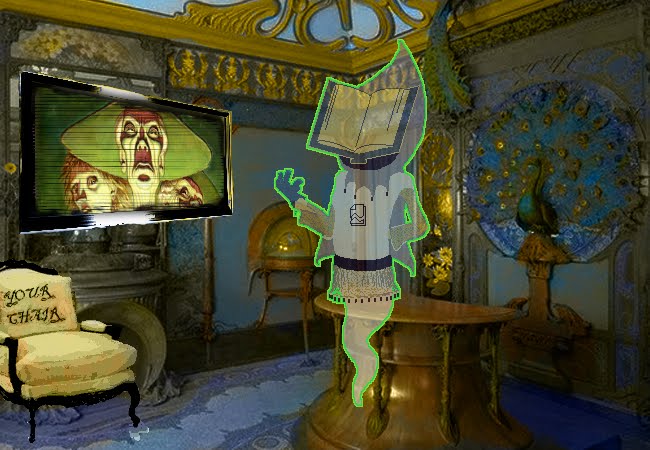
Hauntology/Headology: Carpe Jugulum and Gothic Justice
The vampires in Discworld novel Carpe Jugulum may be modern, but the story is still firmly gothic. So who in the story is the gothic entity haunting the present?
Friday, September 29, 2017
Here's A Follow Up Post About My Immortal and Death of the Author
I wrote about Tara Gilesbie. I podcasted about Death of the Author. Now I'm writing about both together. Because everyone kind of expects me to.

Sunday, April 30, 2017
Nerd-On-Nerd Violence: Why Is Geek Star Wars Crit So Lousy?
"Star Wars fanboys don't know what they're talking about," grouses Mr Plinkett! But aren't all these bad Star Wars theories, Red Letter Media's popular garbage videos included, totally characteristic of fanboy analysis? And does geek culture encourage us to disengage from the empathetic core of the Star Wars franchise?

Thursday, February 16, 2017
An Eternal Golden Helix Fossil: Three Years On, What Can We Say About Twitch Plays Pokemon?
Three years ago I wrote an academic article about Twitch Plays Pokemon. The article was never published anywhere, but despite that blow to its notability TPP continued on, and is still going three years later. This week, I take a look at this article, which in many ways is a predecessor to my Reload the Canons! series, and comment on what I got right, what I got wrong, and how the issues surrounding TPP have shifted and changed over the past three years.
Reload the Canons! is an ongoing Storming the Ivory Tower project where I play through The Canon of videogames. Except I'm not playing the original games. Instead, I'm playing only remakes, remixes, and weird fan projects. This is the canon of games as seen through the eyes of fans, and I'm going to treat fan games as what they are: legitimate works of art in their own right that deserve our analysis and respect. You can support Reload the Canons! and my other projects on the Storming the Ivory Tower Patreon.

Monday, October 10, 2016
Too Much Horseman: The Reset Button vs Continuity in BoJack Horseman
You enter the pub, as you always do, and find that, as always, Sam Keeper is sitting in your chair. They've been sitting in your chair rambling at you for years now about everything under the sun, but mostly media studies. Criticism may be a conversation but it's hard to get a word in edge-wise!
Nevertheless, that's the status quo, and the status quo doesn't change.
Well, except for the fact that there's a bunch of other freaks here now, including the infamous Lord Humongous, and a couple of unicorns. Oh and everyone's wearing horse masks today, that's new.

Not the unicorns, they just look like that. You think they... live here now?
Still. When you get right down to it, everything around here stays pretty much the same and oh, hey, Keeper has started talking about that very subject.
BoJack Horseman, the show that we're all dressed as because it's the 10th of Halloween, is fundamentally a sitcom, and as such it's characterized by stasis. It's a show that is really about things remaining the same over time, returning to their starting points. But unlike similar shows which might hang a lampshade on their constant use of a reset button at the end of every episode, this is a show where cyclicality is welded deep into the narrative skeleton.
The premise of BoJack Horseman is that there's people, and there's also people with animal heads. Like in the video for Blow! It's sorta... post-furry.
Within that very strange context, the actual premise of BoJack Horseman is to follow the attempts of a middle-aged washed up former sitcom star, the titular BoJack, to move forward with his career and interpersonal relationships. Much of the show focuses on his search for meaning in his hollow and decadent existence, as his life and the lives of everyone around him continually are propelled back into old habits and self-destructive behaviors.
It's a comedy!
So this is a show characterized fundamentally by a consistent return to the status quo. This causes problems in the final episode of season 3, due to the problem of continuity.
Ghost Sam Coper: Hah, of course an underdeveloped version of myself would think continuity is the big problem here. I remember when I was so naive!
Sam Keeper: Wow what the heck? You're supposed to be dead!

Oh, yeah, you guess this person IS supposed to be dead. This alternate reality version of Keeper tried to take over the blog and then was murdered by the original, much less well adjusted Sam Keeper. You really didn't expect that continuity to be relevant again.
Sam Keeper: I really didn't expect this continuity to be relevant again! Who could possibly have predicted that there might be consequences to my long series of disastrous decisions!
Ghost Sam Coper: See because unlike me, a person who constantly rises above my past faults, you're constantly bogged down by your unacknowledged mistakes! Just like the characters in BoJack Horseman, actually. See this is REALLY a show characterized most strongly by continuity, and it's primarily continuity that allows the final episode of season 3 to succeed! If anything, it's an over-reliance on the reset button that bogs it down.
Sam Keeper: Well that's just ridiculous.
Oh great. They're clearly going to hash this all out, with you as a captive audience.
Ghost Sam Coper: Clearly we need to hash this all out, since we've got a captive audience!
Sam Keeper: Absolutely. Let's start by digging into the main arc of Season 3.
Nevertheless, that's the status quo, and the status quo doesn't change.
Well, except for the fact that there's a bunch of other freaks here now, including the infamous Lord Humongous, and a couple of unicorns. Oh and everyone's wearing horse masks today, that's new.
Not the unicorns, they just look like that. You think they... live here now?
Still. When you get right down to it, everything around here stays pretty much the same and oh, hey, Keeper has started talking about that very subject.
BoJack Horseman, the show that we're all dressed as because it's the 10th of Halloween, is fundamentally a sitcom, and as such it's characterized by stasis. It's a show that is really about things remaining the same over time, returning to their starting points. But unlike similar shows which might hang a lampshade on their constant use of a reset button at the end of every episode, this is a show where cyclicality is welded deep into the narrative skeleton.
The premise of BoJack Horseman is that there's people, and there's also people with animal heads. Like in the video for Blow! It's sorta... post-furry.
Within that very strange context, the actual premise of BoJack Horseman is to follow the attempts of a middle-aged washed up former sitcom star, the titular BoJack, to move forward with his career and interpersonal relationships. Much of the show focuses on his search for meaning in his hollow and decadent existence, as his life and the lives of everyone around him continually are propelled back into old habits and self-destructive behaviors.
It's a comedy!
So this is a show characterized fundamentally by a consistent return to the status quo. This causes problems in the final episode of season 3, due to the problem of continuity.
Ghost Sam Coper: Hah, of course an underdeveloped version of myself would think continuity is the big problem here. I remember when I was so naive!
Sam Keeper: Wow what the heck? You're supposed to be dead!
Oh, yeah, you guess this person IS supposed to be dead. This alternate reality version of Keeper tried to take over the blog and then was murdered by the original, much less well adjusted Sam Keeper. You really didn't expect that continuity to be relevant again.
Sam Keeper: I really didn't expect this continuity to be relevant again! Who could possibly have predicted that there might be consequences to my long series of disastrous decisions!
Ghost Sam Coper: See because unlike me, a person who constantly rises above my past faults, you're constantly bogged down by your unacknowledged mistakes! Just like the characters in BoJack Horseman, actually. See this is REALLY a show characterized most strongly by continuity, and it's primarily continuity that allows the final episode of season 3 to succeed! If anything, it's an over-reliance on the reset button that bogs it down.
Sam Keeper: Well that's just ridiculous.
Oh great. They're clearly going to hash this all out, with you as a captive audience.
Ghost Sam Coper: Clearly we need to hash this all out, since we've got a captive audience!
Sam Keeper: Absolutely. Let's start by digging into the main arc of Season 3.
Wednesday, April 27, 2016
Homestuck, Destiny, and why Social Constructs are Bullshit
==> StIT Reader: Survey The Mayhem

You enter the pub to find that things are EVEN WORSE THAN USUAL. Most notably, there seem to be MANY SAM KEEPERS. This is a terrible development, you think to yourself. And you are correct. One Sam Keeper was already just about all that you could handle. This is ENTIRELY TOO MANY SAM KEEPERS.
The most agitated looking of the Sam Keepers is PONTIFICATING ABOUT SOME BULLSHIT.
==> StIT Reader: Listen to pontification
Sam Keeper: Oh god, who could have possibly predicted that my extremely nebulously defined and possibly totally bullshit powers as the mythic Page of Paper could have caused so many problems? All the jumping I've done recently between various places has just created all these weird, kind of creepy alternate versions of myself, and now the whole blog is stuck under some mountain... I'll never finish my epic quest at this point and grow up to be a Well Adjusted Adult! And I have this whole article to write about how totally perfect and unassailable every aspect of Troll culture is! What the heck am I going to do???
Hold on, though, it looks like one of the other Keepers has something to say.
==> StIT Reader: Offer to listen to Keeper's excellent theories about quadrant shipping
Hell no. Keeper made her bed and she can sleep in it. Or more specifically she stole your chair and she can sit in it. Yeah, that metaphor scans, kinda. Anyway it's probably just Keeper's intractable destiny to fuck everything up forever.Hold on, though, it looks like one of the other Keepers has something to say.
==> Sam Coper: Sort this mess out

Sam Coper: You know Alternian culture is bullshit though right?
Sam Keeper: What the heck? Who are you?
Sam Coper: I'm you, but way, way calmer. Way calmer. Jesus buddy. I'm the you that actually learned to cope with things instead of doing an acrobatic fucking pirouette off the handle every time something goes wrong. And also I figured out that I can make this God Tier outfit have a cool skirt and shit, look at it!
Anyway, for real though, Alternian culture is bullshit, and so is your destiny, and that's... actually kind of a huge theme within the comic.
Sam Keeper: Ok, look, you're gonna have to break this one down for me a bit more.
Sam Coper: With pleasure.
See, Homestuck, among many other things, reveals that lots of stuff we think is natural or an inescapable fact of reality is actually a social and historical construct! And in fact, Homestuck shows that our identities might be a lot more free and fluid than we think.
==> StIT Reader: Try to understand.
Wednesday, October 7, 2015
Blue Screen of Death
Last week I downloaded 100 viruses to my computer, then downloaded a virus to myself, and then someone downloaded all of Patreon's information to their computer and uploaded it to the Internet.
None of this is an explanation, really, for why I haven't gotten shit done for several weeks--the timeline is wrong for one thing--but I think this hilarious chronicle of mishaps can maybe shed some light into just how precarious a project like Storming the Ivory Tower is, and all the ways that it can all come crashing down unexpectedly--the ways that it can bluescreen.
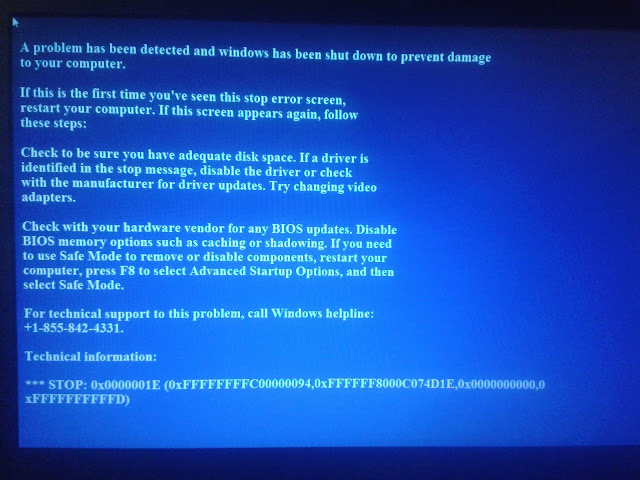
None of this is an explanation, really, for why I haven't gotten shit done for several weeks--the timeline is wrong for one thing--but I think this hilarious chronicle of mishaps can maybe shed some light into just how precarious a project like Storming the Ivory Tower is, and all the ways that it can all come crashing down unexpectedly--the ways that it can bluescreen.

Monday, August 24, 2015
Post Elsewhere: Why Character-In-A-Coma Theories Suck
 |
| [Evanescence plays unironically in background] |
You tap your chin with your magical quill and set it to the paper. To your surprise it begins writing, all on its own! Before your very eyes it spells out these words:
Sometimes I find that ideas for articles drop into my lap. Last week I happened to seea post on Tumblr that facilitated that sort of topic drop: a post about “coma” theories. Wait, wait, that’s the wrong link, hold on, ah here we go, a post about “coma” theories.
If you’re not familiar with that trope of fan analysis the concept is fairly simple to explain:
Take a show, movie, story, whatever. Preferably something fantastical and beloved. Ok?
The story is all some character’s dream while the character is in a coma.
Or the characters are all dead, or they’re all just imaginary friends, or the character is having a psychotic break due to some trauma or other, or… whatever. That mode of explanation for the fantastic elements of a story. All the kids in Ed Edd and Eddy are dead, Ash has been in a coma since episode 1, Steven Universe’s mom died and he’s imagining all the adventures and Connie is his therapist… whatever.
This kind of theory tends to be really... well... bad. When used in canon, it tends to come off as a bit of a bait and switch--you become invested in a narrative that has no meaning, where events have no impact. You get sucked into a story only to have it turn out to be utterly pointless.
This badness carries over to the use of the trope in analysis. Tonight, I want to get into why it’s bad, but also why it’s both kind of lazy and also, sadly, inevitably ubiquitous, but first I want to talk a little bit about the post that prompted my own article.
Hurriedly you cast the quill away from yourself and crumple up the paper. What is this strange writing that haunts you in your definitely real paradise? It has given you an idea, though, for what your amazing, groundbreaking fandom post should be like…
Wednesday, September 11, 2013
A Company of Heroes: Pacific Rim, Iron Man, Cloud Atlas, and the Power of Ensemble Casts
This is it. The end of the line. The strange entity with a book for a head (and what a load of crap that is! You've read all three Monster Manuals and there's no book headed dude in there, and you're going to give the DM an earful next time there's a pizza break) approaches you slowly and raises its hands in preparation for a spell. You have one chance--one saving throw. You gather your die in sweating hands and cast it across the table. It bounces off the DM's soda, and careens to a halt.
A one. Oh for the love of Bahamut.
The creature begins to chant an eldrich summoning spell. A spell that sounds suspiciously like... media analysis? This is the worst quest ever, you conclude grimly, as the spell begins to take hold...I'm bored of heroes but really into heroism right now.
That's kind of the quick, pithy summary of this article, I suppose. I'm bored of, to be more precise, the notion of the Exceptional Hero (nearly always straight, white, male) that a story's arc is built completely around and whose gaze we largely inhabit throughout the text.
I am not, on the other hand, bored of the idea of heroism. As I maybe have hinted obliquely and very subtly before, I'm not too into cynicism and grimdarkness these days, in part because I think it's sometimes used as a lazy way to achieve an illusion of philosophical depth. Protagonists that are genuinely good appeal to me quite a bit, actually, despite the prevailing attitude that such characters are without nuance, boring, or impossible to relate to (see: recent conversations about non-grimdark Superman).
There seems to be a contradiction there, though. Isn't the traditional square-jawed manly, monomythic hero tied intrinsically to the idea of genuine heroism in stories?
Well, no, I don't think so. And I think if you asked most people directly, they would also say that it isn't so. But I'm not sure most people could articulate an alternative--or at least, not quite the kind of alternative I'm looking for. It's not that people think heroism must come in the form of the square-jawed action hero, it's that they have trouble finding another kind of heroism.
One answer we have seen people put forth recently is the diversification of who can be in a lead heroic role. I'm all for that, of course--it's about time we got more women, people of color, and GSD folks as lead heroes!
But my issue isn't just with representation alone (although that's part of it). I think there's a deeper toxicity to the Monomyth--the idea of the Campbellian Hero's Journey that seems to so fully pervade our modern thinking--that's worth addressing. See, the Monomyth, which follows a familiar form involving a Chosen One rising to greatness through a series of trials and becoming a hero, ultimately suggests that heroism is:
- Extremely rare and frequently a product of destiny or a birthright
- Ultimately a symbol of not just righteousness but rightness--i.e. the authority to make decisions unilaterally
- A force of overwhelming gravity upon the plot--i.e. a hero warps the narrative around himself (infrequently herself), and the arcs of other characters are either nonexistent or risk truncation to further the hero's own arc. The pull of the hero's arc hauls everything within its event horizon.
Well, to see where this starts to go wrong, consider what virtues and themes are excluded by the very nature of the hero's journey, at least without a strong conscious effort on the part of a creator to pull the narrative in a different direction:
- Democratic consensus.
- Companionship.
- Teamwork.
- The ability to defer to others.
- The need for multiple intelligences and viewpoints.
- The betterment of society through mass action.
- The ability of anyone to behave heroically.
The strange thing is, none of this is inevitable. In fact, in fantasy, the genre most would associate with the Monomyth, we've long had alternatives. The great progenitor of the genre in its modern form, The Lord of the Rings, is a story with a vast cast of characters whose actions compound across time and space to result in victory. And, of course, there is one other classic arrangement that, while still requiring some amount of gravitational warping around the heroes, is far more profoundly influenced by ideas of cooperation. I'm speaking, of course, of the classic four-player D&D group: Fighter, Rogue, Wizard, and Cleric. Four classes that complement and reinforce one another as a team, all with their own character motivations and arcs, all with their own themes to explore, all forced to work together to achieve a common goal. It's necessary, in fact, for this structure to be present for the gameplay to work. You can't have a single hero and three vague side characters in a game of D&D; it just doesn't work.
"But Sam," you object loudly, throwing your glass at my head (I roll an 18 and dodge, artfully, and the glass shatters against Lord Humongous's giant abs. "You disobey me, little puppy..." he growls), "Tolkien had three books to work with! And you can't just translate a D&D game to a movie screen! They tried! Have you seen that movie? It sucked!"
Oh ho ho ho not so fast my pretty! You see, I am not just a lonely wizard, bearing my trials alone! I have the power to summon a whole team to support my claims, and together we shall complete our quest to bring good storytelling back to these benighted lands!
For my Fighter, I call upon Pacific Rim!
For my Rogue, I call to my side Iron Man III!
And for my Cleric, I summon Cloud Atlas!
AND I'LL BE THE HEAD OH SHIT I FUCKED UP THE METAPHOR DAMMIT DAMMIT DAMMIT QUICK, PACIFIC RIM, ROLL FOR ATTACK!
Pacific Rim: Fighting As One

Consider Newton and Hermann, the two scientists who unlock the secrets of the Kaiju. A number of viewers (and I apologize for continually opening up the conversation on Pacific Rim with these refutations) questioned the point of these characters. I would argue that regardless of your individual enjoyment of them as characters or their segments as parts of the film is secondary to their purpose for the film's themes (and for the sake of wider worldbuilding, but that's another conversation entirely).
To put it another way, you may have gone in expecting nonstop kaiju-crushing action and were annoyed by the scientist segments. And that's ok, I guess, although I'd suggest that it's also reasonable to adapt your expectations as a film proceeds rather than just comparing it to the film that is in your head, but fine, alright, you didn't like them.
That doesn't mean they were unnecessary to the film on a deeper functional level or could be cut out.
See, one of the things their arc does very well, in some ways better than any of the other arcs, is show how victory depends upon a willingness to collaborate despite interpersonal strife or differences of opinion. Newt and Hermann have radically different ways of parsing information and getting results, both quite maniacal in their own ways, but when the chips are down and Newt asks Hermann for help, by god, Hermann steps up to the plate.
It may be worth recalling at this point that "the plate" in this metaphor is a kaiju brain that Newt intends to Drift with via a piece of equipment that literally incorporates a medieval fucking bellows to... I don't know, keep the parts cool maybe? Not a fan. A bellows.
And Hermann agrees to do it anyway.
What interests me about this arc from bitter disagreement to collaboration is that it echoes throughout the wider narrative. Chuck must defend the pilots of Gipsy Danger despite getting into a fist fight with one of them a short time before--and he willingly gives his life in the process. Raleigh learns to be less of a hot shot and trust his commanding officer's decisions (and not to touch Stacker Pentecost again). And, of course, all the characters must open themselves to their drift partners in order to pilot their Jaegers. One of Mako's major developmental arcs is her movement from suspicion for Raleigh to trust--not trust in him in the "I defer to you, Heroic White Dude Hero Man" sense, but trust in their bond, trust in her ability to stay stable in the Drift, trust in his ability to help her to be stable in the Drift, and trust in their collaborative potential.
Those bonds are what ultimately turns out to win the day. The willingness to look beyond difference allows them to destroy the Rift. And here, again, I think there's a great parallel between the overall construction and the story of Newt and Hermann: in the end, their information is not in opposition. Both of the scientists are right, and it is only through the synchronization of their knowledge, rather than their petty squabbling for attention from their benefactors, that the key to the Rift becomes apparent.
Hm, you know, now that I'm typing this up, I can't help but think some academical sorts would be well served by taking note of this part of the film...
This film could have been about Raleigh's heroic journey from the depths of despair back into the height of heroic victory, but it wasn't. It was about all these characters--characters that in another work would be side characters--worked together to achieve victory.
The lesson is quite straightforward, and for that reason, Pacific Rim is my Fighter--straight to the point, a blunt instrument that communicates simply and effectively that there is another way of doing things.
Iron Man III: The Rogue In The Gallery

For a giant blockbuster movie about a playboy billionaire superhero, to put forth a narrative based around coping with severe psychological trauma, the excesses of a military-industrial complex that benefits from the perpetuation of fear and conflict, moral compromise within research, and, ultimately, the simple human act of asking someone else for help and admitting that you can't do everything alone... well, that seems like a roguish act to me, for sure.
And that's what Iron Man III does. It's a film about all these ideas and more. It'd be worth talking about some of the political aspects of the film at some point, but I want to talk about that last idea in particular--Tony Stark's need to ask for help. In a way, this might be one of the most subversive parts of the film, although it's certainly less overtly politically subversive than the Mandarin's ultimate identity.
See, the thing about this movie is that it could easily have involved Tony Stark rising on his own from ruin and clawing his way singlehandedly to victory. It could have involved the removal of all his allies so that he alone would have to face the Mandarin and defeat his diabolical opponent.
That's not what happens, though. Instead, Tony Stark is constantly accompanied, after his fall, by people who he must ask for help and work with to achieve victory. It's only, you'll note, after the fall that this seems to happen--previously, he sets himself up as a target, and a solitary target at that, brashly declaring himself to be the Mandarin's opponent, even though the government (or, hey, I dunno, THE AVENGERS?) would probably be better equipped to deal with a massive terrorist organization.
After his fall, though, not only is he required to ask for help, he's required to beg assistance from a child. A loooot of people assumed this bit was going to suck, due to previous bad experiences with child sidekicks, but the writers of this film knew exactly what they were doing in including Harley. In needing Harley's help, Stark is forced to recognize that there is potential in the people around him for heroism, even where he would not expect to find it. It forces him to reassess his ability to rely on other people, and marks the first step towards recognizing that the obsessive building of alternate suits is, in fact, a way of fleeing further and further into himself. (Note that Harley is the first person who asks him if he should be getting psychological treatment for his PTSD, and Stark finally responds affirmatively, admitting that he has a problem.) He is able to achieve victory only through sacrificing countless suits, and only through relying on Harley, Rhodes, that awkward news team fanboy, and ultimately Pepper Potts.
Hell, look at one of the pivotal scenes in the movie, the plane rescue sequence. That whole scene revolves around the idea that Tony can't save all these people on his own, so he needs to literally bind them together via electrical impulses in order to effect a full rescue. What a perfect metaphor for the film's overarching message.
So, part of the message of the film, like Pacific Rim, is that anyone can be heroic, and the heroism of teamwork is more profound than the heroism of a solitary ubermensch--or the villainy of a man who uses and discards his associates, even literally using his team as human bombs.
Furthermore, it shares a diverse cast with Pacific Rim. It's significant to me that this film passes the Bechdel Test--remember the scene between Potts and Maya Hansen where they discuss the ethics of accepting moral compromise for the sake of research funding? I sure as hell didn't expect to see that kind of question being broached in a blockbuster like this, and I certainly would never have predicted that the conversation would play out not between the two leading men but between the two leading women. The severing of narrative focus from Stark's monomythical quest--the reduction of his narrative's gravity--allows that conversation to take place, and the film is stronger for it. It provides context for Hansen's actions later on that in a lesser film would be explained implicitly through the gravity of Stark's narrative, i.e. she would go good because of his presence rather than because she has been brought to a moment of moral crisis that is finally coming to a head.
This could easily have been a very different film. It could have been a film about the singular brilliance of Tony Stark and his ability to triumph even against a supremely powerful hidden opponent. It could have been, like the second film, another exercise in the claiming of a rich white boy birthright passed on from father to son. It could have been about Stark climbing, alone, from the pit to defeat his opponents and save his whatever. It could have been a film that, as the title suggested, was about Iron Man and Iron Man alone.
It was not those films.
It was, instead, a film about finding strength in others rather than burrowing into a monomaniacal savior complex. It was a film about the heroic potential that humans have within them, if that potential is not rebuffed or eroded (Killian and Hansen are a product of Stark's hubris, remember, and the Mandarin is the product of encouraged addiction).
It is the rogue of this team, a film that appeared to be something other than what it was, and, I think, became an unlikely hero in the battlefield that is media.
Cloud Atlas: The Healing Of Small Cuts In Time

But like the Cleric, the role of this movie, at least in the scheme I'm presenting here, is not to introduce religiosity per se into the discussion. The role of the cleric is to banish evil and, ultimately, to act as a healer.
I don't think you need to believe in reincarnation to feel moved by this film. Rather, you simply need to be open to its core message that the actions we make affect the world far beyond our individual lifespans. This is a view quite compatible with a secular mindset--in fact, quite conducive to a scientific understanding of the world as cause and effect obscured by the complexity of time and space and human action--and it depends upon the kind of ensemble casts that we've been talking about.
The intriguing thing about Cloud Atlas the film is that the stories all channel towards a conclusion at the same time (in contrast to the book, which has a stepped pyramid structure). This means that the tragic ending of one story is counterbalanced and, arguably, undercut by the triumph of another. These moves are wholly intentional, and the film is stronger for this undercutting, because it reinforces the central message of the film: through countless actions, great and small, humanity as a whole moves forward out of ignorance into light. It is the compounding actions of the various characters that ultimately allows the Precients in the future to find a way off of a dying Earth to a new home in the stars. From an abolitionist's conversion, to a tragic love affair, to a battle for the truth, to... alright, The Ghastly Ordeal of Timothy Cavendish is pretty silly but it still inspires, a synthetic human's attempt to spark a revolution, all the stories lead via coincidence and influence toward an ending in triumph.
And what is the opponent in this movie?
Well, in the previous two films, the enemies were certainly symbolic--the Kaiju of the vast challenges that humanity must unite to conquer, and the Mandarin of a covert military-industrial complex threatening to usurp power from the countless regular people that make up Tony Stark's team (as well as a dark product of Stark's own megalomania)--but they were still very much a material set of enemies.
By the end of Cloud Atlas, however, the recurring enemy gradually loses materiality and acquires a purely symbolic, conceptual nature. Hugo Weaving's various characters transform from quite threatening individuals capable of murder and hideous inhumanity gradually transform first into a sadistic nurse--quite deranged, of course, but ultimately somewhat comical in form--then, into a dignitary among countless dignitaries in an authoritarian regime (he is reduced from the role of central evil to functionary of evil), and finally, into a mythological representation of the central character's inner turmoil: Old Georgie. You can see this role as internal doubt here, in the film's climax:
Pretty sure that's the right clip.
Whatever.
The point is, evil over time degrades while good strengthens (and, interestingly in the case of Sonmi, also becomes an abstraction--a goddess figure). An article from Vulture that I consulted while writing this essay puts it quite well, I think:
He's a figure of evil, control, and enslavement who never displays any loyalty or learns anything over time, and eventually devolves until he's just an idea.Because Weaving's characters are unable to see beyond themselves, they degrade through time until they lose substance entirely and become a formless boogieman. This is a fascinating and powerful transformation, as it suggests that the monomythic hero is actually potentially quite weak. If our ability to form attachments to others--loyalties, as the Vulture article puts it--we fail to develop and ultimately devolve.
I'm reminded, actually, of another entity that goes on a similar journey away from knowledge and contact with other beings. I am speaking of Milton's Satan, who manipulates his followers, strikes off alone to Earth to spoil God's creation, and ultimately devolves from heroic titan to crawling serpent.
Cloud Atlas does not exactly promise a hopeful future, but it does assert that the countless small cuts in our history caused by humanity's inhumanity can be bandaged, can be healed, can be restored in time. A single messianic figure cannot, however, heal these cuts on her own. She is accompanied by other agents of change, some coming far before or after her own life, and humanity's ultimate salvation is due not to messiahs but to a collaboration between two lowly humans just trying to get by on a decaying world. It is through the action of all of us, not one of us, that these small cuts are healed.
And for that message of healing, Cloud Atlas will be my cleric.
The Wizard: Possibilities Given Form

...Except, there's more to the wizard than that. The wizard's role in battle is often a support role, warping the battlefield and allowing the different party members to better make use of their talents. It is a role with more to do with coordination than dramatic stardom, although a lot of players might, unfortunately, play them that way.
So, let me try to coordinate this a little bit and explain why I put this article together the way I did.
On their own, these films would be compelling arguments for particular kinds of ensemble casts. Pacific Rim shows that you can create a compelling story from a group of champions fighting side by side against a vast enemy. Iron Man III shows that a film hero can be assisted in countless ways by companions without seeming powerless or extraneous--and that those characters can deeply enrich the film's world. Cloud Atlas shows that you can construct an exceptionally complex film with a staggering number of characters and still have your message come through loud and clear so long as you construct the interweaving of narratives carefully enough.
Each film, on its own, would be an argument that you can make that specific kind of film.
Together, they show that there is a stunning range of storytelling possibility open to writers willing to construct an ensemble-driven story rather than a monomythic story. In fact, while you can certainly get quite a bit of variance within the monomyth, I would argue that these sorts of complex and distributed heroics have much more potential, especially since this structure is somewhat underexplored in recent blockbusters. It certainly seems to force writers out of the narrow and cliche beats of the more slavish adaptations of the monomyth, which is certainly a good thing in my estimation.
So, the films (plus my own attempts to set the battlefield in our favor through the magic of analysis and close reading) are stronger together than on their own. They make a more compelling argument united than they would separate.
Each one is a hero in its own right, a triumphant warrior of the silver screen. Their heroism is in no way diminished by the presence of other heroes. On the contrary, it is compounded, made stronger, and allowed to diversify, just as within the films the ensemble casts allow for far more room for the underrepresented to find a voice, and just as the heroism of individuals is made stronger by unity. As above, so below. The message is clear: heroism can be distributed far more widely, and the benefits to opening our narratives to such distribution are enormous.
I mean, at the very least, my team of epic level monsters pretty much wiped the floor with you just now, Mr Monomythic Strawman.
Serves you right for demanding to play a Chaotic Evil solo game. Maybe if you had invited some other players to our game instead of insisting that there was only room for you and me in the group, this would've gone differently.
Yeah, yeah I'm gonna be that way. Fine. Pick up your dice and go then, you big crybaby! You're just a figment of my imagination, anyway! AND NO ONE LIKES TIEFLINGS ANYWAY!
Ugh.
I'm never playing D&D with Hugo Weaving again.
Freakangels Of Arcadia
The webcomic Freakangels is all about superpowered millennials struggling to build a utopian society in the aftermath of environmental devastation. Topical. But if they want to build Arcadia, they'll have to face down the toughest opponent imaginable: their own emotional hangups.I Want To Connect (But It's Hard To Understand)
For an anime all about connections, Sarazanmai, the new anime from the director of Revolutionary Girl Utena, can be pretty obscure. But its obscurity gives it power, and a space for us to form connections with the show... and with each other.My Superpower is Manpain!
Featuring revised versions of my articles on The Dark Knight Rises, Arrow, and Grant Ward from Agents of SHIELD, My Superpower is Manpain! explores the idea of the male superhero and his power to warp the narrative and the ethics of a story around himself.
Saturday, May 25, 2013
Not Proud To Be A Geek
 |
| This isn't going to be a cheery article. |
What glubbed forth in the precambrian dawn was a lengthy, overwrought explanation of how countless frustrations slowly burned from me my ability to wear the moniker of "Geek" with pride. Yes, ladies and gentlemen, I am renouncing the term "geek." Or, I should say rather, it renounced me.
But I'm getting ahead of myself. Let's trace the evolution of this event.
Starting With The Last Straw: Geek Pride Day
I actually was unaware of Geek Pride Day until this morning, when I awoke to see some mentions of it on... actually, I don't recall now. Probably Google+, which seems to largely be a haven for geeks of all sorts (since, to their credit, geeks are early adopters of weird tech, and the broader Facebook set haven't migrated). Initially, my response was neutral-to-cynical. Geekdom and I haven't been getting along much lately (I'll explore the reasons why later in the article) so while I wasn't really irate at this point, I wasn't really enthused, either.
I decided to do some research, though, and initially found the results quite heartening. The holiday originated in Spain, apparently. Cool! A lot of geekdom seems to be Americocentric in nature, so having the holiday originate in Europe is pretty neat. And what's more, the day is associated with a list of rights and responsibilities. Responsibilities! That's pretty cool! Geeks have a lot of good to offer the world, and acknowledging that openly seems like a reasonable strategy.
Things were looking up.
And then I read a translation of the list.
Rights:How utterly disappointing.
Responsibilities:
- The right to be even geekier.
- The right to not leave your house.
- The right to not like football or any other sport.
- The right to associate with other nerds.
- The right to have few friends (or none at all).
- The right to have as many geeky friends as you want.
- The right to be out of style.
- The right to show off your geekiness.
- The right to take over the world.
- Be a geek, no matter what.
- Try to be nerdier than anyone else.
- If there is a discussion about something geeky, you must give your opinion.
- To save and protect all geeky material.
- Do everything you can to show off geeky stuff as a "museum of geekiness."
- Don’t be a generalized geek. You must specialize in something.
- Attend every nerdy movie on opening night and buy every geeky book before anyone else.
- Wait in line on every opening night. If you can go in costume or at least with a related T-shirt, all the better.
- Don’t waste your time on anything not related to geekdom.
- Try to take over the world!
How disappointing that instead of looking inward and seeing how we can make our community better, instead of looking outward and seeing how we can improve the world, how we can be MORE inclusive, MORE welcoming, MORE passionate in a communal way, these rules detail all the ways in which we should become LESS inclusive, LESS welcoming, and passionate only in the things we can own and control and dominate and use as status symbols. The rights are fairly innocuous--there's some stuff missing (again, I'll get to that) but for the most part they're reasonable--but the responsibilities list represents almost nothing but narrowmindedness, status-obsession, and arrogant exceptionalism.
I find only two of the responsibilities reasonable: the first, which urges a self-determined identity (ironically a sentiment undermined by the rigid social code that follows) and the fourth, which urges artistic preservation, a value desperately needed when the speaker for the new XBOX One can blithely claim, "If you’re backwards-compatible, you’re really backwards."
Two out out ten.
Geeks do have responsibilities, responsibilities derived from the positive qualities people bandy about whenever geek pride as a notion comes up. Geeks have responsibilities that come from their intellects and their status as (former) outsiders.
Had we upheld our end of the bargain--had we acknowledged our important role in culture and reacted accordingly--I would be proud to be a geek.
But we failed.
And I am not proud to be a geek.
The reasons why follow.
WE CLOSED OUR DOORS TO NEWCOMERS AND PASSIONATE AMATEURS
There's an attitude in geekdom that intelligence is best expressed through a kind of arrogant dismissal of those less familiar with geek media, and that attitude is absolutely, incontrovertibly holding us back. It's ok to tell someone that they are wrong if, y'know, they are, but that's not a license to take on an air of absolute superiority over younger or newer enthusiasts who are genuinely just seeking answers, or seeking mentors that can lead them to greater understanding. Yet this is the response to newcomers that I see all the time. When you talk about "being the nerdiest," as though it's a competition, this is the ideology you buy into.
This even extends to the way that we deny certain activities the moniker of "geek." Look at responsibility 9 in the list above: "Don’t waste your time on anything not related to geekdom." That's pretty messed up, if you really think about it. That's the kind of dictum present in the strict fundamentalist religions that a significant number of geeks claim to abhor. Abandon this world of things and come to Geekdom! Yuck.
As a consequence, we impoverish our own existence by denying the value of anything outside our narrow spheres of interests and disparage the people (think of "casual gamers," for example, or people who got into the Teen Titans cartoon when they were too young to read the comics) who we deem to be less fully integrated into the cult of Geek.
If we truly love and appreciate our geek media, why do we hide it from the world? We could enrich the lives of so many--and enrich our own lives--if we opened up more of a dialogue with those not traditionally considered geeks. It was our responsibility to open that door, but we closed it, instead.
Of course, the dividing line between geeks and non-geeks emerges from more than a simple judgment of experience. The fact of the matter is:
WE FAILED TO CONVERT SAFE SPACES FOR GEEKS INTO SAFE SPACES FOR ALL
Women. Queers. People of color. Geeks increasingly embrace a policy of marginalization and exclusion against these groups. I'm sure most of the regular readers of this blog are well aware of the issues, but it bears repeating, I think. If I catalogue the sins of geeks, this is certainly one of the top few.
How does this happen? Ugh, all kinds of different ways. A lot of social justice folks talk about microaggressions, but I'm more concerned with people just straight up being overt, aggressive assholes.
Like, let me give you an example. On the Wizards of the Coast forums, the word "queer" is censored, which I guess makes sense since it can be used as an insult, but which makes it difficult for me to discuss LGBTQ issues as openly as I would like. To get around the problem, I replace the "u" in the word with a "v."
Here's another poster's condescending response:
Why do you keep using a v instead of a w? You're not using real words even if the "community" thinks they are. Now we should definitely take this to another thread but I don't tolerate using fake words to make people feel special.Reread that first sentence a few times. "Instead of a w." Yeah. He then proceeded to misuse the term "asexual" after I had literally just gotten through explaining the fact that "asexual" and "intersexual" don't mean the same things in gender and sexuality studies as they do in biology.
Sigh.
But the unique stupidities aside, what this really tells me is that I should shut up about my queerness, just as women should shut up about their womenness, and people of color should shut up about their weird skin. We don't need diversity, is the message here. You're the REAL racist/sexist/homophobe (how the fuck does that one work?) for wanting more people of color/women/queers in your fiction! And asking for special treatment is just reverse discrimination.
Women who speak out against misogyny within geek culture are slutshamed, harassed, threatened with rape. Casual homophobia seems to be a core part of the First Person Shooter and Fighting Game scenes these days. People straight up flipped shit when they found out that a non-canon parallel universe's Spiderman had died and was to be replaced by a young black boy. They did the same thing when they found out that there was going to be a black Lancelot. Oh, and then there's the Homestuck fandom. Remember when the fandom shit itself because a bunch of assholes used a joke in the comic to harass cosplayers of color and people who drew non-white fan art? And then shit itself further when Andrew Hussie removed the joke and those same fans decided that a horrible crime against artistic genius had been committed? That sure was... peachy.
The story of geekdom of late has been one of a minority of straight white males railing against political correctness, activism gone mad, and the destruction of their last safe space. Men's Rights idiocy spreads like malignant cancer through the body of our culture, and the message I hear again and again--loud and clear though it comes veiled in a pseudo-intellectual cloak--is that I am not welcome here unless I keep my fag mouth shut.
What kills me about this is that I remember a different geekdom. I remember geeks that accepted anyone that was an outcast, because WE were outcasts. If you would associate with us, we would associate with you. For a long time, I thought acceptance and understanding was, albeit imperfectly, woven into the DNA of geeks. Weren't we responsible for the first interracial kiss on American television? Didn't our authors push the boundaries of gender and sexuality (I think of people like Ursula LeGuin in particular, here) further than anyone but the most advanced of ivory tower intellects? Shit, didn't we used to be better than this? I have conversations sometimes with older geeks that are just as disturbed as I am by the current trends. They, too, remember when geekdom represented something more.
We had a responsibility to band together against those who did not understand us, those who found us weird or freaky. We had a responsibility to welcome other outsiders, the dispossessed, with open, if slightly smelly, arms. We failed.
And then we committed an even greater sin:
WE REBUFFED THOSE WHO POINTED OUT OUR FAILINGS
People spoke out. We turned them away, threatened them, called for their heads, declared them collaborators with the enemy. We did that Robespierre shimmy, danced beside the guillotine as, one by one, our former allies lost their heads.
The man who openly sneers at the dispossessed is a danger, sure... but more insidious is the man who reacts to conflict with endless cries for peace and calm!
More insidious is the man who chides the activist for raising a fuss, who scolds the activist for "sinking to their level," who bemoans the activist's constant need to bring up the uncomfortable, push things further than polite conversation allows, or show fury or hurt when attacked, insulted, dragged through the mud, and forced to endure insult after insult.
Where is that man when his fellow geek jeers and mocks the woman, the queer, the man of color? Nowhere to be found, in my experience. Because it takes two to fight and one to bully; when a fight breaks out, it's because the attacked party responds in kind. The fight would be impossible if we would just TAKE IT LIKE A BITCH.
So many speak out against the toxicity of our culture, and we had a responsibility to listen, to stand beside them, to defend them. And we rebuffed them instead, and made them the source of the problem. I see it on, again, the Wizards community forums, when female members react with justified rage to a poster that for six years has stalked, harassed, condescended, and made deeply disturbing sexual advances towards any openly female poster. The mods will not ban him, and more and more I see other posters chiding the women for reacting with anger and disrupting the community.
We rebuff them instead.
And as a consequence,
WE BLINDED OURSELVES TO REAL ISSUES
Listen:
I hate The Big Bang Theory. Everything geeks say about it--that it laughs at us rather than with us, that it relies on shallow stereotypes rather than a deep understanding of geekhood for its humor, that its gender dynamic is frustratingly regressive--is true.
But.
The Big Bang Theory is not "Blackface For Geeks."
In fact, if you think it is, I recommend that you go see an eye doctor immediately, because shit, son, you got to get yourself some fucking perspective.
It is so damn offensive to compare a show about white male geeks that is a little stereotypical to a practice that systematically denied the acting capabilities of people of color while simultaneously reinforcing racist stereotypes that were part of a systematic disenfranchisement and, in some places, an establishment of an economic system that was slavery in all but name.
Similarly:
Male geeks? For fuck's sake, LOSING A GAME OF MAGIC: THE GATHERING IS NOT GETTING RAPED. I don't care how quickly your opponent beat you, I don't care how much damage that spell did in one turn, I don't care, I don't care, I don't care. It's not rape, it's not comparable to rape, and the fact that you are describing yourself as "getting raped" shows that you are at best profoundly insensitive, and at worst profoundly misogynistic.
Geeks pride themselves on their intelligence (this is a point that'll show up later on as well). We pride ourselves on having more adapted imaginations than others, better insight. And yet somewhere along the way, we forgot that with that great power comes great responsibility. We blinded ourselves to the realities of oppression, we lost our sense even of what truly constituted our own exploitation and abuse and transformed trivialities into great crimes.
But it's no surprise we can't even recognize when we're getting fucked over. See,
WE POISONED DISCOURSE
Yeah, now we're getting a bit meta here. See, there's two camps of very vocal geeks these days. There's the people that absolutely cannot be satisfied with anything and work themselves into a frothy-mouthed rage each time something happens that they don't like. And on the flip side of that coin, there's the people who go into a frothy mouthed rage any time someone decides that something new isn't to their taste. "You're raping my childhood!" one side screams. "If you don't like it, get out!" howls the other side.
And in the process we've absolutely slaughtered substantive discourse.
How do you begin to analyze whether or not The Dark Knight Rises or Iron Man 2 were functional films when the voices of critics with actual deep-level understanding of narratives or the broader political implications of certain film ideas are drowned out by people howling that the continuity has been screwed with, or backstories don't work? Or when the response is that anyone criticizing the films on their own terms are simply grognards unable to adjust to changes? Even changes that are legitimately boneheaded and insulting, decisions that legitimately undermine a work or pander to the lowest common denominator, simply cannot be discussed any more because there's so much damn noise. The discourse has been poisoned because we collectively decided that we didn't need theory, we didn't need to find better ways to articulate our complaints, we didn't want to reflect and contemplate and compare our media to other acknowledged masterpieces of literature and film and music, we didn't want to differentiate between unfocused incoherent anger and fully-articulated fury at legitimate slights.
And now that we poisoned our ability to discuss the state of our media,
WE ENSLAVED OURSELVES TO THE INTERESTS OF OTHERS
Remember when Call of Duty was advertised by Oliver North?
You know, the guy who was a part of the clever deal where we sold weapons to Iran to finance far right dictators in South America who were responsible for perpetrating all sorts of atrocities upon their own people?
That Oliver North.
Geeks are being co-opted in all sorts of deeply disturbing ways. One of them is the collusion between Call of Duty and other first person shooter game producers and the American military-industrial complex. Oliver North's endorsement of a shooting game is simply one representation of that. There was also a thing where Call of Duty was selling advertisements for real guns within their games. That's kinda sick, huh?
Another is the constant refrain I discussed above that dismisses any criticism aimed at geek products as illegitimate. This creates an atmosphere where corporations are protected by a loyal meatshield of lapdog fans, eager to explain why their favored product or company is beyond reproach. So, unfair business practices, decisions that reinforce the alienation of minorities from geekdom due to the purported "simple economic necessity" of choices like refusing to include female sprites in multiplayer games or refusing to support any game with a non-sexualized female protagonist... all these things and more are fervently explained away by the devout. In the process, they enslave our culture to people who do not have our best interests--or in some cases, the best interests of the world--at heart.
It is almost fitting, though, that this should be the case. It is almost a karmic fate, because
WE DEMANDED MORE EVEN AS WE ATTAINED THE MANTLE OF LEADERSHIP
Somehow geeks have internalized their outsider status so fucking hard that the mindbendingly huge success of a science fiction movie that features blue aliens as main characters and a movie that is the culmination of a bunch of other movies that bring together a giant green guy, a Norse god, a man in power armor, a superspy, a supersoldier, and a super... uh... archer (poor Hawkeye) is still somehow not evidence that we won. We took over. The world is effectively ours. From the bizarre surrealist and science fiction experiments in pop music videos, to the staggering success of shits like Mike Zuckerberg, to the staggering cultural penetration of weird shows like Adventure Time, geeks have taken over.
And yet we still behave as though we're outsiders, as though we're the underdogs, as though we can't catch a break.
Like, a few days ago I was wading through the maelstrom of stupidity that was the My Little Pony fandom's reaction to Equestria Girls, a movie where Twilight Sparkle goes through a magic mirror to a human high school. Amidst all the generalized stupid, there was one comment that stood out to me. The person was outraged because this was, in his mind, a clear attempt by Hasbro to take My Little Pony and turn it into something for little girls.
Yeah.
Jumping Jesus on a pogo stick.
That's the kind of acquisitiveness I'm talking about. It's like anything not for us is somehow an insult, as though we are all that matters in the world. It's not enough that we should dominate culture, we must utterly absorb it, and anything for anyone else is an abomination. Here's our weird geekdom religiosity rearing it's head again... in the dumbest way possible.
I guess this is just a variation of what I said earlier about our blindness, with a touch of my points about the pervasive racism, sexism, and homophobia in the culture mixed in for flavor, but I think it's worth saying as its own sort of point. We had a responsibility, once we finally won, once we got the respect we deserved, to rule wisely. We had a right to conquer the world! And we had a responsibility to recognize what winning looked like it. But somehow we missed it, and we kept demanding more. Eventually we're gonna do that King Midas thing, I think. We'll demand the world turned to gold. And in our glorious golden palace, we'll starve.
Which leaves us, I guess, with the elephant in the room. The final sin. The final great failure that underlies all the others.
WE EXPLOITED OUR INTELLIGENCE AS A STATUS SYMBOL, NOT A TOOL
We decided we were brilliant, and that we deserved to rule, and that the world should dance to our tune.
And then instead of using that intelligence, instead of using our sight, and our thoughts, and our hands, and our hearts, we erected greater and greater monuments to our own genius--sterile and perfect, reaching upward to the sky.
Seeing the ivory towers of those who had spurned us, we did not use our minds--our greatest gifts--to build a new kind of dwelling for culture, a new kind of fortress with walls to protect, not to exclude. We built, instead, our own towers and cried, "Look, we are surely gods! We have surpassed all those who spurned us, all those who sought to limit or exclude us!" We built our own Babels, our language degraded as we increasingly shouted out liturgies to our own egos, and now the animals look back and forth between the humans and the geeky, nearsighted pigs, and they just can't quite tell the difference.
We cry that pop culture exploits us, while we exploit ourselves. We turn ourselves into cultural commodities, scrabbling for every ounce of respect we can get, acquiring flunkies and moochers and fans of our own. We built high and lost sight of the dirt from which we climbed, and we keep building with our own hands, enslaving ourselves to our intellects rather than enslaving our intellects to a deeper purpose.
Geekdom is a failed experiment. Every responsibility that we had, we failed to fulfill. We did not keep up our end of the bargain.
The towers we built did not lead to God at all.
They just led straight up our own asses.
Don't Call Me Geek
I'm not a geek anymore. I was, but the culture has changed, and it's made it clear to me that I'm not welcome. Because I'm a critic and a theorist, and because I'm a social justice advocate, and because I'm a pansexual genderqueer, I'm not welcome.
My girlfriend, my sister, my other female friends... unwelcome.
My friends who are black and Latino... unwelcome.
Hell, a lot of the people I love and respect, simply by virtue of their particular opinions, or their acceptance of and interest in broader culture, are... unwelcome.
So, don't call me geek. I'm not that, not anymore, not just by my own choice, not just by my own disgust and anger, but because I am a storm unwelcome in these new towers.
Sometimes I bandy the idea about with my friends of starting a parallel geek culture--a fork of geek culture, if you will--that takes on the mantle of responsibility, that embraces the roles I lay out here and adds some more rights--the right to be protected from misogyny and homophobia, the right to articulate arguments of like and dislike without dismissal, the right to blend high and low culture, maybe. I'm not sure what you would call us. Maybe nothing at all. Maybe fans of our respected geek things--fans of The Avengers, fans of Tolkien, fans of Homestuck, Adventure Time, My Little Pony, but also James Joyce, Beethoven, hip hop, goth rock, whatever we like, whatever we want to geek out about.
Part of me wants to call us "Grangers." I like Hermione, ok? And her demotion to second in command maybe is a good symbol of the kind of problems we seek to solve.
But probably you don't call us anything at all. We're the geeks of geekdom, the new dispossessed.
And maybe I can be proud of being that kind of geek, after all.
Circle me on Google+ at gplus.to/SamKeeper. Follow stormingtheivory.tumblr.com for updates, random thoughts, artwork, and news about articles. As always, you can e-mail me at KeeperofManyNames@gmail.com. If you liked this piece please share it on Facebook, Google+, Twitter, Reddit, Equestria Daily, Xanga, MySpace, or whathaveyou, and leave some thoughts in the comments below.
Thursday, January 3, 2013
99 Bottles Of Beer On The Wall
So here I am, sitting in your chair on New Year's Eve Eve with a pounding headache and a pounding set of anxieties to match. (It took me a few days to get all the images together for this article.) In the morning I'm going to be finalizing the list of Grad-level Media Studies programs I'll be applying to, and then starting as many applications as I can before I pass out once more. (Note from the future: it wasn't many.) Between seasonal depression, panic over the application process, and the always nightmarish portfolio composition process, I'm feeling like a bit of a basket case at the moment.
And in the back of my mind I'm thinking, "Oh god, it's been weeks since I posted a StIT article."
You want to know something for absolutely free (as opposed to the subscription fee you need to pay to access the rest of the site)? I kinda hate that I can see my pageview information. Don't get me wrong, it's damn useful in some respects since I can figure out exactly who is reading what articles from what traffic sources, and it's forced me to up my quality and write for a general audience.
But that information is a ruler. It's a tool, an aide, a crutch. It's great for helping you draw straight lines, but it holds you back because you aren't forced to draw straight lines freehand. And you sure as hell aren't going to be able to draw nice fluid curves that match the quality of your other lines. What I'm saying, before this analogy that I'm outlining gets too smudgy, is that a ruler is just as much a curse as it is a blessing.
And I'm feeling pretty ruled these days.
Which is part of why I'm cutting loose here and composing this drawn-out metaphor that's full of sketchy puns. It's been a while since I wrote an article that was completely self indulgent, that really had the chance of making sense to myself and myself alone.
And hell, this is my 99th article, and it's coming right at the beginning of a new year, so I decided I might as well wander down memory lane and ponder aloud about my work so far. There's a bunch of articles that didn't get quite the same dramatic reaction as, say, my My Little Pony or Homestuck or Avatar pieces, and you know what? I had a lot more fun writing them than quite a few of my big blockbuster pieces. So what the hell, let's give them a spotlight, huh?
Sing it with me folks:
99 Bottles of Beer on a Tow'r
99 Bottles of Beer
Storm the wall
Guzzle 'em all
98 Bottles of Beer on a Tow'r
So the basic premise of this article is that the early 20th century poet TS Eliot is a mix master, a sampling fiend, and a hell of a DJ. I still love this article. It might be my all time favorite, actually. The premise is so ludicrous (or... Ludacris maybe?) and yet I think it ultimately works really well as a comparison. The article for a while actually was among the most popular on the site, too, before the My Little Pony articles dethroned it. My only regret is that I wrote it before I started photoshopping goofy images to illustrate my articles.
And you know what? I think my argument still holds true. Check out DJ Earworm's compilation for 2012:
There's a clear throughline here, similar to the one I talked about in my Pop.Sci.Fi articles (which both also probably deserve a place on this list) where the reaction to the collapse of dreams and hope results in the speakers taking solace in pop culture. It's honestly weird to hear this coming from Earworm. In a way it seems like he's channeling Eliot in more than just methodology.
So hey, I'm going to go ahead and make a resolution for the new year: I'm going to do an article on Earworm's latest song and how it all fits together. And, in fact, I'm going to look at some of these older articles from my early days and see if they deserve to be dredged up and expanded upon. Sound good?
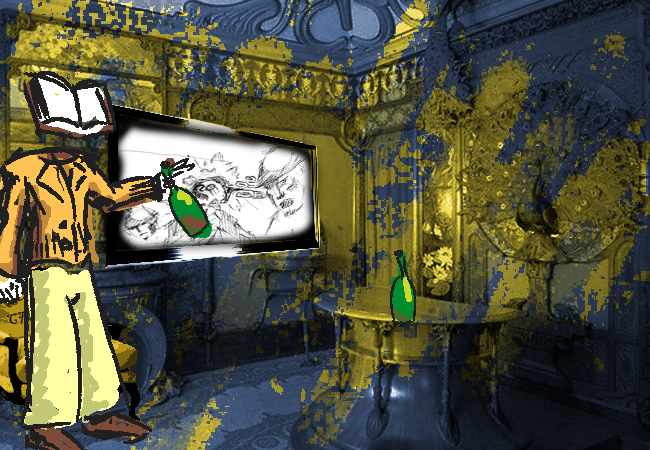
So, I wanted to write a poem that had sci fi subject matter. I think I succeeded, personally. This isn't what I would call perfect or fully polished but damn, there's some things here I still really enjoy. Like:
Not to sound too full of myself but I still really enjoy that play on the "Thou shalt not suffer a witch to live" thing, with the implication that the genetic engineers that allowed the race of superhumans to conquer the world are now hiding in exile on the blasted surface of the abandoned Earth, having acquired a magical status among the downtrodden lowbloods.
Not that any of that is necessarily clear from the weird modernist cadence of the piece, but that's the idea, anyway.
And it's an idea I want to explore further. That's my second resolution: I want to write A. more weird experimental poetry like this and B. more stuff about this particular setting. This world is intriguing to me, and the idea of expressing a semi-cyberpunk, post-apocalyptic distopia through non-standard media appeals to me quite a bit. So expect to see some more experiments of this sort.
Some people actually believed that Golden Dusk, the spin off sequel to the Twilight series, was real, and was as awesome as I was making it out to be in this article. They were pissed when they got to the end of the article and found out I was yanking their proverbial chain.
I love doing this kind of thing. Not just because I'm a troll and I live to alienate my audience, either. There's something about a review of a fake work of art that tickles the same fancy that's tickled by cyberpunk poetry. There's something really great about plotting out a whole alternate trajectory for Art History. I mean, there's a whole field dedicated to alternate history full stop, and Steampunk and its spin offs are essentially alternate science, so why not alternate art history or alternate media studies?
Besides, I hear Randolf Giorgi Jaffe is hard at work on a sequel, despite the fandom's explosive reaction to the first one. And when that novel finally comes out, I'll be there to review it. That's resolution number 3.
I keep forgetting that this story exists. The idea was essentially to look at what the final Biblical Plague would look like from the perspective of an ordinary Egyptian slave. Historical inaccuracies abound, I'm sure, but I really like the notion of using the whole thing as an allegory for how the vying of religious powers often ends up catching the dispossessed and downtrodden in the crossfire.
Honestly, part of me is disappointed that I didn't get more of a reaction to this. I mean, I'm basically calling out the whole "Kill the firstborn sons of Egypt" thing as a dick move on God's part, but maybe everyone already figured that out and the concept of an Old Testament God that is actually kind of an asshole is old news?
Anyway, I actually really like writing fiction. It's just interesting to take a break from the usual essay format and put together an argument in the form of a narrative. And I love the idea of writing fanfiction about traditionally unfanfictionable stories--the Bible certainly being at the top of the list.
So, I'm planning on doing a bit more of that in the new year. I don't think it'll get as much attention as my articles, particularly since some of the stuff I'll be posting will probably be material for the Magic: The Gathering Expanded Multiverse project and will therefore be totally inaccessible to most people.
But damn it, I enjoy doing it so I'm gonna do it anyway!
[smashes wine glass]
Oh my god I still have so many FEELINGS about the game Bastion. It's such an incredible piece of work, and I'm actually super pleased with how this analysis of it turned out.
You know, I don't play a whole lot of games, and I think it's time I changed that. I just picked up Minecraft from a friend and despite how glitchy it is I'm finding it to be an incredible artistic experience on a lot of levels. So, I might as well write about it, no? It's interesting to me that I've ended up kinda gravitating towards bitesized media for the most part--TV shows, music videos, shorter comics, poems--rather than these longer, open ended games that demand more time and are harder for me to pretend-multitask to. But really, games are an important emergent art form, and it's stupid of me to ignore them. Especially since, like, I enjoy playing them.
And I'm sure there's more games like Bastion out there, games that have such fantastic story arcs, such great synergy between gameplay and story, such beautiful art and music...
So, resolution number 5 is to find those games and write about them.
I could talk about how I'm really happy with this argument, and I think this is another great way of exploring the esoteric with the popular, and really I'm hoping that you take note of that stuff if you go back and read the article now, but...
...Honestly, the main reason this is here is because I just love that image of Kanye with George Melies's big, goofy looking head photoshopped onto it.
That's my sixth resolution. No really, we're doing this. I hereby solemnly resolve to add in more silly photoshopped pictures to my articles. How's that for a resolution? NO ONE MAN SHOULD HAVE ALL THAT POWER!
ALIEN SEX!
This article, that started out being about a weird video for an obscure sort-of-goth avant garde band, turned into an article about music video history and French music videos in particular. I kind of love how that happened, and again, I'm really pleased with the result even though not many people ended up reading it. (For the record, my sister is not among the people who ended up reading it. Dammit.)
I really love digging up this kind of thing. I do a lot of work with modern music videos but there's all kinds of old, great videos that have fallen by the wayside over the years, and I think I'm going to devote some time to digging those sorts of things up. So, my seventh resolution is to do some more digging around in the histories of things like webcomics, music videos, flash games, and so on--things that haven't had their history written just yet.
I really hate the title of this article. That said, it's another one of those articles that was just a blast to write. The premise is simply that the video for Bittersweet Symphony is an ironic parody of the song's lyrics. And once you see it you pretty much can't unsee it, judging by the reactions I got to the article. It's as pernicious as the song's string sample. Just try to get those violins out of your head.
I loved writing this because it was a quick article about a relatively small subject matter that I thought was fairly easy to explain but that had a high relative impact on the reader's understanding of the work. Call it minimal force, maximal output writing, maybe. It took less thought for me to put together but it was still something I could be proud of.
Either way, I want to do more pieces like this in the new year--short, sweet, to the point kinda pieces that are easy for me to write and edit but aren't really fluff. I actually don't think it'll be that hard, I just have to start willing myself to put those together rather than agonizing over the big blockbuster works.
I'm honestly not sure this article makes sense to anyone but me. Which is sort of the reason I like it so much. It's just such a bizarrely wandering metaphor that ties together way too many things, and I love it to death. And what's more, it's about this strange German band that sets medieval lyrics to electro-goth music. It's just a giant mass of inaccessibility.
And you know, I like big masses of inaccessibility, it turns out. Communication is important, of course, and clarity is kind of the name of the game when I'm explaining Liberal Arts concepts, but sometimes my tastes are, well, inaccessible. I truly do love strange works of art, but I've often chosen not to write about them because, well, less people care about Ingres and Goya and the contrasts between their style as reflective of their thematic preoccupations than they do about My Little Pony or Avatar. Unfortunately.
I suppose the final resolution I have is that I'm going to start writing about some more of the weirder things that I love. I mean, if I like this stuff, surely it's worth sharing, no? And perhaps if I build upon the ideas I've already established through other articles, I can get some other readers enthused about the weird stuff I watch and read and listen to. Then it won't be so inaccessible anymore.
Here's to a new year, full of the most ridiculous articles I can come up with. Here's to more tortured pub metaphors, more photoshop collages, more fawning adoration of Mad Max Road Warrior, more fake reviews and avant garde poetry.
Here's to the 99 articles on that ivory wall, and many, many more.
You can follow me on Google+ at gplus.to/SamKeeper or on Twitter @SamFateKeeper. As always, you can e-mail me at KeeperofManyNames@gmail.com. If you liked this piece please share it on Facebook, Google+, Twitter, Reddit, Equestria Daily, Xanga, MySpace, or whathaveyou, and leave some thoughts in the comments below.
Incidentally, if you want to see my REAL artwork, through a sequence of events too idiotic to describe I now have a YouTube-based portfolio. Check it out here. In particular, check out that last piece. Does that look familiar?
And in the back of my mind I'm thinking, "Oh god, it's been weeks since I posted a StIT article."
You want to know something for absolutely free (as opposed to the subscription fee you need to pay to access the rest of the site)? I kinda hate that I can see my pageview information. Don't get me wrong, it's damn useful in some respects since I can figure out exactly who is reading what articles from what traffic sources, and it's forced me to up my quality and write for a general audience.
But that information is a ruler. It's a tool, an aide, a crutch. It's great for helping you draw straight lines, but it holds you back because you aren't forced to draw straight lines freehand. And you sure as hell aren't going to be able to draw nice fluid curves that match the quality of your other lines. What I'm saying, before this analogy that I'm outlining gets too smudgy, is that a ruler is just as much a curse as it is a blessing.
And I'm feeling pretty ruled these days.
Which is part of why I'm cutting loose here and composing this drawn-out metaphor that's full of sketchy puns. It's been a while since I wrote an article that was completely self indulgent, that really had the chance of making sense to myself and myself alone.
And hell, this is my 99th article, and it's coming right at the beginning of a new year, so I decided I might as well wander down memory lane and ponder aloud about my work so far. There's a bunch of articles that didn't get quite the same dramatic reaction as, say, my My Little Pony or Homestuck or Avatar pieces, and you know what? I had a lot more fun writing them than quite a few of my big blockbuster pieces. So what the hell, let's give them a spotlight, huh?
Sing it with me folks:
99 Bottles of Beer on a Tow'r
99 Bottles of Beer
Storm the wall
Guzzle 'em all
98 Bottles of Beer on a Tow'r
1. MODERN MUSIC, MODERNIST POETRY
 |
| "H3Y TOM 1S TH1S YOU?" |
And you know what? I think my argument still holds true. Check out DJ Earworm's compilation for 2012:
There's a clear throughline here, similar to the one I talked about in my Pop.Sci.Fi articles (which both also probably deserve a place on this list) where the reaction to the collapse of dreams and hope results in the speakers taking solace in pop culture. It's honestly weird to hear this coming from Earworm. In a way it seems like he's channeling Eliot in more than just methodology.
So hey, I'm going to go ahead and make a resolution for the new year: I'm going to do an article on Earworm's latest song and how it all fits together. And, in fact, I'm going to look at some of these older articles from my early days and see if they deserve to be dredged up and expanded upon. Sound good?
2. APPROACH
So, I wanted to write a poem that had sci fi subject matter. I think I succeeded, personally. This isn't what I would call perfect or fully polished but damn, there's some things here I still really enjoy. Like:
God does not suffer a Gene Witch to live. Not anymore. Only the Witchminds,
Bred from the vats of
Angels, live in the core of
God, closest to His light and heat.
Not to sound too full of myself but I still really enjoy that play on the "Thou shalt not suffer a witch to live" thing, with the implication that the genetic engineers that allowed the race of superhumans to conquer the world are now hiding in exile on the blasted surface of the abandoned Earth, having acquired a magical status among the downtrodden lowbloods.
Not that any of that is necessarily clear from the weird modernist cadence of the piece, but that's the idea, anyway.
And it's an idea I want to explore further. That's my second resolution: I want to write A. more weird experimental poetry like this and B. more stuff about this particular setting. This world is intriguing to me, and the idea of expressing a semi-cyberpunk, post-apocalyptic distopia through non-standard media appeals to me quite a bit. So expect to see some more experiments of this sort.
3. SOME FASCINATING HIGHLIGHTS FROM GOLDEN DUSK
 |
| I'm still super proud of that cover, personally. |
I love doing this kind of thing. Not just because I'm a troll and I live to alienate my audience, either. There's something about a review of a fake work of art that tickles the same fancy that's tickled by cyberpunk poetry. There's something really great about plotting out a whole alternate trajectory for Art History. I mean, there's a whole field dedicated to alternate history full stop, and Steampunk and its spin offs are essentially alternate science, so why not alternate art history or alternate media studies?
Besides, I hear Randolf Giorgi Jaffe is hard at work on a sequel, despite the fandom's explosive reaction to the first one. And when that novel finally comes out, I'll be there to review it. That's resolution number 3.
4. THE PASSED OVER
 |
| Yeah, I'm looking at engravings on my widescreen TV in a pub. This image makes sense on every conceivable level. |
Honestly, part of me is disappointed that I didn't get more of a reaction to this. I mean, I'm basically calling out the whole "Kill the firstborn sons of Egypt" thing as a dick move on God's part, but maybe everyone already figured that out and the concept of an Old Testament God that is actually kind of an asshole is old news?
Anyway, I actually really like writing fiction. It's just interesting to take a break from the usual essay format and put together an argument in the form of a narrative. And I love the idea of writing fanfiction about traditionally unfanfictionable stories--the Bible certainly being at the top of the list.
So, I'm planning on doing a bit more of that in the new year. I don't think it'll get as much attention as my articles, particularly since some of the stuff I'll be posting will probably be material for the Magic: The Gathering Expanded Multiverse project and will therefore be totally inaccessible to most people.
But damn it, I enjoy doing it so I'm gonna do it anyway!
[smashes wine glass]
5. I DIG MY HOLE, YOU BUILD A WALL
 |
| I AM A SOMEWHAT EMOTIONAL DRUNK |
You know, I don't play a whole lot of games, and I think it's time I changed that. I just picked up Minecraft from a friend and despite how glitchy it is I'm finding it to be an incredible artistic experience on a lot of levels. So, I might as well write about it, no? It's interesting to me that I've ended up kinda gravitating towards bitesized media for the most part--TV shows, music videos, shorter comics, poems--rather than these longer, open ended games that demand more time and are harder for me to pretend-multitask to. But really, games are an important emergent art form, and it's stupid of me to ignore them. Especially since, like, I enjoy playing them.
And I'm sure there's more games like Bastion out there, games that have such fantastic story arcs, such great synergy between gameplay and story, such beautiful art and music...
So, resolution number 5 is to find those games and write about them.
6. THE IMPOSSIBLE IS POSSIBLE TONIGHT
 |
| Dammit, Melies gets all the strange semi-human girls. |
...Honestly, the main reason this is here is because I just love that image of Kanye with George Melies's big, goofy looking head photoshopped onto it.
That's my sixth resolution. No really, we're doing this. I hereby solemnly resolve to add in more silly photoshopped pictures to my articles. How's that for a resolution? NO ONE MAN SHOULD HAVE ALL THAT POWER!
ALIEN SEX!
7. FERTILE GROUND
 |
| AAAH SCARY DEMONICALLY POSSESSED FRENCHWOMAN |
I really love digging up this kind of thing. I do a lot of work with modern music videos but there's all kinds of old, great videos that have fallen by the wayside over the years, and I think I'm going to devote some time to digging those sorts of things up. So, my seventh resolution is to do some more digging around in the histories of things like webcomics, music videos, flash games, and so on--things that haven't had their history written just yet.
8. IS THE VIDEO FOR BITTERSWEET SYMPHONY MAKING FUN OF ITSELF?
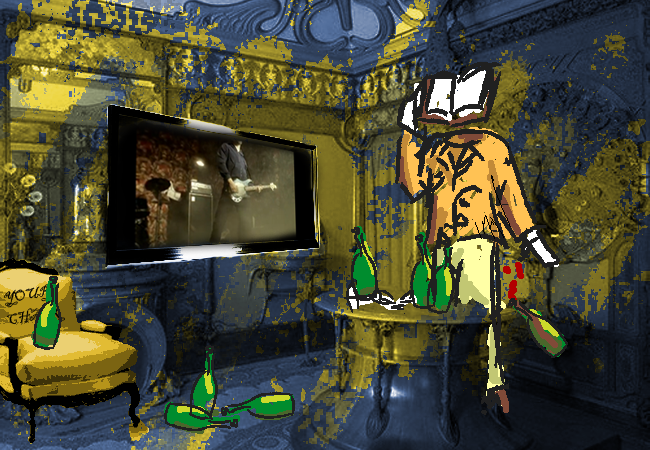 |
| I think I drank too much. Everything is a Blur. Haha. Blur. Geddit?? |
I loved writing this because it was a quick article about a relatively small subject matter that I thought was fairly easy to explain but that had a high relative impact on the reader's understanding of the work. Call it minimal force, maximal output writing, maybe. It took less thought for me to put together but it was still something I could be proud of.
Either way, I want to do more pieces like this in the new year--short, sweet, to the point kinda pieces that are easy for me to write and edit but aren't really fluff. I actually don't think it'll be that hard, I just have to start willing myself to put those together rather than agonizing over the big blockbuster works.
9. SING IN THE NEW YEAR
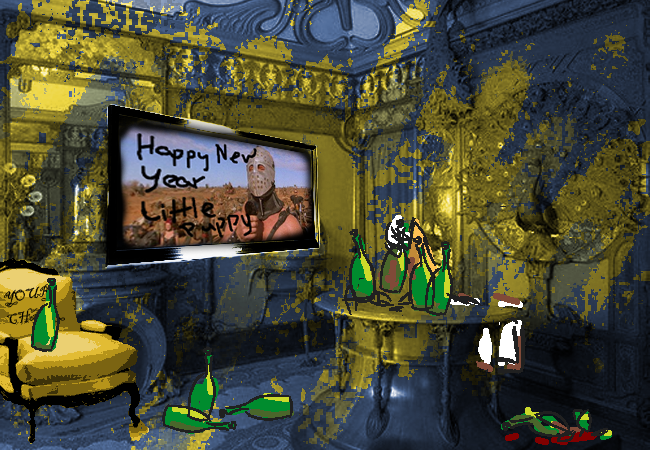 |
| Happy New Year to you too, Ayatolla of Rock And Rolla. |
And you know, I like big masses of inaccessibility, it turns out. Communication is important, of course, and clarity is kind of the name of the game when I'm explaining Liberal Arts concepts, but sometimes my tastes are, well, inaccessible. I truly do love strange works of art, but I've often chosen not to write about them because, well, less people care about Ingres and Goya and the contrasts between their style as reflective of their thematic preoccupations than they do about My Little Pony or Avatar. Unfortunately.
I suppose the final resolution I have is that I'm going to start writing about some more of the weirder things that I love. I mean, if I like this stuff, surely it's worth sharing, no? And perhaps if I build upon the ideas I've already established through other articles, I can get some other readers enthused about the weird stuff I watch and read and listen to. Then it won't be so inaccessible anymore.
Here's to a new year, full of the most ridiculous articles I can come up with. Here's to more tortured pub metaphors, more photoshop collages, more fawning adoration of Mad Max Road Warrior, more fake reviews and avant garde poetry.
Here's to the 99 articles on that ivory wall, and many, many more.
You can follow me on Google+ at gplus.to/SamKeeper or on Twitter @SamFateKeeper. As always, you can e-mail me at KeeperofManyNames@gmail.com. If you liked this piece please share it on Facebook, Google+, Twitter, Reddit, Equestria Daily, Xanga, MySpace, or whathaveyou, and leave some thoughts in the comments below.
Incidentally, if you want to see my REAL artwork, through a sequence of events too idiotic to describe I now have a YouTube-based portfolio. Check it out here. In particular, check out that last piece. Does that look familiar?
Subscribe to:
Comments (Atom)