

Oddball media crit--laying siege to academia's ivory tower from pop culture's gutter
Showing posts with label Fragments. Show all posts
Showing posts with label Fragments. Show all posts
Tuesday, August 13, 2019
Wednesday, June 13, 2012
Fragment Poetics: Elegy for the People's Library
I am burning, burning, burning. O Lord, I burn with fury. Inside and outside I burn, and the hot winds kick up fragments, these charred leaves from the Tree of Knowledge. On hot winds of anger they rise and form a text suspended in air--an Elegy like a ransom note, like Dada collage, like a thousand voices chanting out of sync.
Let me tell you why I burn.
-----------------------------------------------------------------------------------------
Early in my academic career, I happened to experience a lecture that would, if you will please excuse the cliche, alter the course of my life. This lecture so stunned and engaged me that I knew, in a flash, that I was called to know and to teach and to pass on its lesson.
The lecture stalked up on the class without warning, like a flash brushfire. Our lecturer--an unfamiliar professor filling in that day--first presented us with a History Channel documentary on the Roman empire. When it was finished, he spent some time critiquing the documentary's errors. Out of the ordinary, certainly, but not exactly life altering.
However, at the conclusion of his prolonged criticism, our lecturer produced a piece of paper.
It was a list of names.
He began to read.
-----------------------------------------------------------------------------------------
The Poetics (second volume)
Babylonians
Proagon
Phoenician Women
Most of Bellerophon
Most of Andromeda
Zeno's writing on paradoxes
Androgynos
Homopatrioi
-----------------------------------------------------------------------------------------
Koneiazomenai
All of Heraclitus
Medea (countless versions, countless authors)
Conics
Porisms
On Pneumatics
Sulla's Memoirs
Caesar's Oedipus
-----------------------------------------------------------------------------------------
-----------------------------------------------------------------------------------------
On Sphere-Making
Ab Urbe Condita
Cypria
Aethiopis
Iliou persis
-----------------------------------------------------------------------------------------
-----------------------------------------------------------------------------------------
Nostoi
Arzhang
Book of the Wars of the Lord
Book of Eve
Book of the Covenant
-----------------------------------------------------------------------------------------
-----------------------------------------------------------------------------------------
Gospel of the Twelve
The Gospel of the Lord
Inventio Fortunata
Countless Byzantine mosaics
Most Anglo Saxon works
-----------------------------------------------------------------------------------------
-----------------------------------------------------------------------------------------
Love's Labour's Won
Cardenio
The Battle of Anghiari
Medusa
Adam Unparadiz'd
Byron's Memoirs
Les Journées de Florbelle
-----------------------------------------------------------------------------------------
-----------------------------------------------------------------------------------------
The Stone Breakers
The University of Vienna paintings
Many of Melies's films
Much of Metropolis (until recently)
The Book of Lehi
Man at the Crossroads
-----------------------------------------------------------------------------------------
-----------------------------------------------------------------------------------------
The Irish Public Record Office
Double Exposure
The Centaurs
The Thief and the Cobbler
The Buddhas of Bamyan
The Pearl Roundabout...
The People's Library.
My list is not the same as the list recited to us in class. It is my own list, the record of my own sorrow, my own burning. It is a wishlist for an alternate world where these works--books, artwork, films, and so on--lost and destroyed throughout history.
But still, it is a list that has its roots in that lecture.
When our speaker finished his list he looked up at us and said:
"These books are all lost. We know they existed. We know their names and something of what they said, but they were destroyed. Many of them were destroyed by the Christians. Many were destroyed by the Muslims. Many were destroyed in the burning of the Library of Alexandria.
We know they existed, but we cannot get them back. They are lost to us forever.
Never burn a book.
Never destroy a book."
We have lost so much. I weep as I write, as overly dramatic as that sounds, for all the beauty gone out of the world simply because these works were deemed evil... or worse, were simply deemed unimportant and disposable.
Never, never burn a book.
Never melt a film.
Never bomb a statue, rip and tear a canvas, shatter a mosaic.
Do not fail to preserve the precious and ephemeral art of the digital age.
Never burn a book.
Never destroy a book.
Never allow others to destroy a book.
We have lost so much, and if we do not oppose them, the Firemen, the Book Burners, the Iconoclasts will tear more from us, tear it from our hands, tear it from our lives, tear it from our history. Books--and art in general--can be a fragmentary guide in times of trouble that leads us back to ourselves and helps us to understand our struggles. These fragments shore up our ruins and give us the key to a better future. To destroy them is to destroy that future.
This is why we Occupy.
This is why we burn, in our hearts, in our minds.
Because monsters burn books. And, though we tilt at windmills, though our task seems impossible, we must fight our monsters or our heritage, our art, the immortal part that carries on beyond us through time... well, that part of us will burn in our stead.
This was more overwrought than I intended, but ah well, sometimes the muse takes me, whether I say yes or not. This is the spiritual sequel to Some Unpublished Images, incidentally. You can follow me on Google+ at gplus.to/SamKeeper or on Twitter @SamFateKeeper. As always, you can e-mail me at KeeperofManyNames@gmail.com. If you liked this piece please share it on Facebook, Google+, Twitter, Reddit, Equestria Daily, Xanga, MySpace, or whathaveyou, and leave some thoughts in the comments below.
Let me tell you why I burn.
-----------------------------------------------------------------------------------------
Early in my academic career, I happened to experience a lecture that would, if you will please excuse the cliche, alter the course of my life. This lecture so stunned and engaged me that I knew, in a flash, that I was called to know and to teach and to pass on its lesson.
The lecture stalked up on the class without warning, like a flash brushfire. Our lecturer--an unfamiliar professor filling in that day--first presented us with a History Channel documentary on the Roman empire. When it was finished, he spent some time critiquing the documentary's errors. Out of the ordinary, certainly, but not exactly life altering.
However, at the conclusion of his prolonged criticism, our lecturer produced a piece of paper.
It was a list of names.
He began to read.
-----------------------------------------------------------------------------------------
The Poetics (second volume)
Babylonians
Proagon
Phoenician Women
Most of Bellerophon
Most of Andromeda
Zeno's writing on paradoxes
Androgynos
Homopatrioi
-----------------------------------------------------------------------------------------
(Something more than a week ago, the author Ray Bradbury passed away. He was a man who understood burning. He understood that it is not the burning itself that destroys, it is the willingness to let the burning happen. When we embrace dogmas that lead to the destruction of knowledge, or simply the abandonment of knowledge and beauty for disposable things, discardable trinkets, we no longer need the villainous Firemen to come and burn things down. We are already clean.)-----------------------------------------------------------------------------------------
Koneiazomenai
All of Heraclitus
Medea (countless versions, countless authors)
Conics
Porisms
On Pneumatics
Sulla's Memoirs
Caesar's Oedipus
-----------------------------------------------------------------------------------------
(In total, roughly a century of Byzantine history is dominated by the battle over Iconoclasm--the destruction of images. The Iconoclasts, the image destroyers, considered the mosaics of the Byzantines, the glittering, shining monuments that were not simply pictures but true manifestations of the glory of God and the Saints, brought to life through the skilled artisan, abhorant symbols of idolatry.
They responded accordingly, and an uncountable number of icons were destroyed--paint washed from walls, mosaics smashed with hammers, walls plastered over. We have lost many, too many, early Byzantine works through the iconoclasts among the Christians and the iconoclasts among invading Muslims, who also considered the images sacrilegious.
It must be said, however, that when Byzantium was taken, the mosaics in the great church of the Hagia Sophia were deemed too beautiful to destroy. Sultan Mehmet's forces plastered over the mosaics, allowing their later recovery and preservation.
The Crusaders were less kind. They stripped mosaics off of the wall for their gold.
Less kind, too, are the modern iconoclasts within the Taliban. In the early part of this century, they carried out the dynamiting of the two monumental Buddhas of Bamiyan. It is unknown whether the enormous statues can be restored.)
-----------------------------------------------------------------------------------------
On Sphere-Making
Ab Urbe Condita
Cypria
Aethiopis
Iliou persis
-----------------------------------------------------------------------------------------
(On November 15th of last year, the New York police department stormed the Occupy Wall Street camp in Liberty Park. In the process, the People's Library, a collection of thousands of works donated to the cause, available for borrowing under an honor system, was destroyed.
Not disbanded.
Not dismantled.
Destroyed.
The books were tossed into crusher trucks and removed. Days later, the Librarians were told that their books--the books of the people, some rare or unique, many signed--were in storage.
This was a lie.
Only 23 boxes were recovered, a fraction of the total number of books. Of that number, a fraction again were salvageable, the rest bent, brutalized, broken, drenched in water, crushed, destroyed.
The NYPD and the authoritarian government of New York had made their position clear:
They were on the side of the book-burners.)
-----------------------------------------------------------------------------------------
Nostoi
Arzhang
Book of the Wars of the Lord
Book of Eve
Book of the Covenant
-----------------------------------------------------------------------------------------
(We have lost perhaps 90%--a horrifying majority--of the first films. They are simply gone, this vast part of our heritage, the legacy of the artists of our past. Most were not destroyed for political reasons, of course. They were simply destroyed because no one could be bothered to preserve them. They were burned because the studios were not interested in keeping the negatives, and their creators often had lost ownership.
Many, containing valuable chemicals, were melted down for conversion into plastics. Decades of dreaming, documentation, imagination, and labor, boiled down in minutes to create shoe heels.
Fritz Lang's Metropolis was, in each country, hacked apart and put back together to better fit what the studios imagined the audience desired. There was no original preserved, only these fragments, these pieces floating in the hot wind of time. Scenes were cut, discarded, and lost forever--until recently a nearly complete print of the film was rediscovered. With this print, we now have nearly all of Lang's masterpiece.
And yet... it is still only nearly all.
And most films were not so lucky.)
-----------------------------------------------------------------------------------------
Gospel of the Twelve
The Gospel of the Lord
Inventio Fortunata
Countless Byzantine mosaics
Most Anglo Saxon works
-----------------------------------------------------------------------------------------
(Shortly after news of Ray Bradbury's death swept the internet like an oncoming storm, this tweet was sent out by Occupy Wall Street:
One of the @OWSLibrary books destroyed by #Bloomberg & the #NYPD was a copy of #Fahrenheit451. #Irony RIP #RayBradbury http://ow.ly/i/G6Fs
Attached was this picture:
Slightly above the wrecked computer, actually--which is another whole realm of symbolism in and of itself
You can see, in the image, the most iconic cover for Bradbury's book. It depicts a Don Quixote figure, dressed in armor of pages, standing atop a pile of books, despairing, burning, burning.
Occupy Wall Street had dared to tilt at windmills, and although they could not be destroyed, their books could.)

-----------------------------------------------------------------------------------------
Love's Labour's Won
Cardenio
The Battle of Anghiari
Medusa
Adam Unparadiz'd
Byron's Memoirs
Les Journées de Florbelle
-----------------------------------------------------------------------------------------
(Hypercomics are a modern wonder. They can exist only in digital space--they cannot be printed--either due to their size, their irregular shape and design, their use of moving graphics and interactivity, or their changeable and fluid nature.
Most of the early Hypercomic experiments have been lost or exist only in fragments within the Internet Archive. They simply were not interesting enough to preserve when the websites hosting them were sold or abandoned.
Each generation of gaming consoles pushes us further away from our early games. Some of the most important games for the SNES and the like have been preserved. But who has the time to port the less known games? The less loved games? If a game is awful but historically important, will it still exist within a few decades? The heritage of an entire generation is being lost.)
-----------------------------------------------------------------------------------------
The Stone Breakers
The University of Vienna paintings
Many of Melies's films
Much of Metropolis (until recently)
The Book of Lehi
Man at the Crossroads
-----------------------------------------------------------------------------------------
(In late May the People's Library filed a lawsuit against New York demanding reparations for the destruction of their books. The suit demands money, to be sure, but the librarians seek more than money. They seek acknowledgement that to destroy a book is to commit a beastly act. The American Library Association agrees, and fellow librarians and book lovers from across the nation have cried out in anger. We burn with fury, and smoulder with sorrow.
Because no money can cause us to forgive the destruction of the People's Library.
For each book is unique. And no reparation money can restore them once they are destroyed.
They are much like people, in that way.)
-----------------------------------------------------------------------------------------
The Irish Public Record Office
Double Exposure
The Centaurs
The Thief and the Cobbler
The Buddhas of Bamyan
The Pearl Roundabout...
The People's Library.
My list is not the same as the list recited to us in class. It is my own list, the record of my own sorrow, my own burning. It is a wishlist for an alternate world where these works--books, artwork, films, and so on--lost and destroyed throughout history.
But still, it is a list that has its roots in that lecture.
When our speaker finished his list he looked up at us and said:
"These books are all lost. We know they existed. We know their names and something of what they said, but they were destroyed. Many of them were destroyed by the Christians. Many were destroyed by the Muslims. Many were destroyed in the burning of the Library of Alexandria.
We know they existed, but we cannot get them back. They are lost to us forever.
Never burn a book.
Never destroy a book."
We have lost so much. I weep as I write, as overly dramatic as that sounds, for all the beauty gone out of the world simply because these works were deemed evil... or worse, were simply deemed unimportant and disposable.
Never, never burn a book.
Never melt a film.
Never bomb a statue, rip and tear a canvas, shatter a mosaic.
Do not fail to preserve the precious and ephemeral art of the digital age.
Never burn a book.
Never destroy a book.
Never allow others to destroy a book.
We have lost so much, and if we do not oppose them, the Firemen, the Book Burners, the Iconoclasts will tear more from us, tear it from our hands, tear it from our lives, tear it from our history. Books--and art in general--can be a fragmentary guide in times of trouble that leads us back to ourselves and helps us to understand our struggles. These fragments shore up our ruins and give us the key to a better future. To destroy them is to destroy that future.
This is why we Occupy.
This is why we burn, in our hearts, in our minds.
Because monsters burn books. And, though we tilt at windmills, though our task seems impossible, we must fight our monsters or our heritage, our art, the immortal part that carries on beyond us through time... well, that part of us will burn in our stead.
 | |
| I intend to do an Illustrator version of this later. I'll post it when done. Obviously, available under Creative Commons and all that, like everything here. |

Sunday, June 3, 2012
Some Minor Updates
As you may have noticed, the schedule here has been rather sporadic of late. I'm honestly still recovering from the end of the semester (physically, psychologically, intellectually) and trying to find ways to support myself economically. I hope that things won't be so scattered soon, as I find my feet, but I have to say, with sad, puppydog eyes and heavy heart, that I'm going to have to miss another update this week. Things should, if I can actually sort my damn self out, get back on track by Tuesday. I have four different articles about half-written now, it's just a matter of figuring out what they're missing and then sending them out.
On the roster:
Part of the difficulty here is that I'm having trouble persuading myself that this material is actually of interest to anyone other than myself. So, if any of these topics would just bore you to tears, let me know, and I'll consider whether I want to actually put them up.
In the meantime, I have a few updates on older articles, and older topics, that might be of interest to you.
Robin Hood and Rosenkreutz, and the Internet Declaration of Independence
It is with great fascination that I share the news that Lulzsec has returned. They seem, however, to be operating more like I predicted in my article Robin Hood and Rosenkreutz--i.e., as a Rosecrucian order, a more secretive, low profile (from an individual perspective), and fluid organization. This is also of particular interest given my last article, which was on the Declaration of Independence of Cyberspace.
But what really caught my attention was the fact that the Louise Lulz Boat returned with a rather interesting video:
I like a lot of what they're doing here. The text, you will note, is far weaker than the Declaration was. These people are coders and media freaks, not writers. And yet, the message gets across. You've been around here before, you know the drill, so while I'm busy self destructing, how about you take what you've learned and share, in the comments, what you think makes this video work. How does it function?
More People You Should Follow
Games are a largely spectator sport for me. I'm interested in games sort of peripherally based on my interest in new media and how it's starting to gain acceptance as an art form.
I've already linked to Extra Credits before, of course, but recently I've been feeding my hunger for analysis with the Game Overthinker. As with so many of the other modern media theorists that I respect, he's got a bit of a schtick--in this case, a persona based around the idea of patrolling the boundary between the real world and the world of Games as a sort of gumshoe superhero type. It's a little weird to get used to at first, but the persona is mostly separate from the analysis itself, and damn is that analysis good. His most recent video, for example, examined the way the most recent generation of consoles, the Wii in particular, failed to live up to their promise and propel games into the realm of art.
Does this kind of analysis sound familiar? It's very in line with my interests here, naturally, but more importantly it's exactly the kind of thing that Scott McCloud was doing back in the early 1990s for comics. This is how the move from junk culture to respected art begins, folks. Keep tabs on this one.
Also keep tabs on Free Thought Blogger Crommunist. I'm finding him to be a fascinating analyst of race issues, in particular, but also issues of class oppression, sexism, science, politics, and how all this stuff intersects. Check him out.
And that's about what I've got for tonight, ladies and gentlemen. Sorry again about the sporadic updates and the lack of content. I'll try to get my head screwed on right soon.
On the roster:
- How to interpret Surrealist art, by way of a Scissor Sisters music video
- Uncovering some of the structural problems in Harry Potter and the Methods of Rationality
- Defining and then recomplicating the terms "Genre" and "Media"
- Why the Modern Art references in Iron Man are actually rather thematically important
- My attempt to classify and define an art movement that carries from H R Giger all the way up to the opening animation for Girl with the Dragon Tattoo
- Time Signatures and what they do for the meaning of music
- Maybe something about why children's books are awesome?
- Something about why destroying media--and books in particular--is truly heinous
- And some sort of analysis on the latest Kanye West video.
And much, much more, all for the price of only $19.95!!! CALL NOW TO ORDER
Part of the difficulty here is that I'm having trouble persuading myself that this material is actually of interest to anyone other than myself. So, if any of these topics would just bore you to tears, let me know, and I'll consider whether I want to actually put them up.
In the meantime, I have a few updates on older articles, and older topics, that might be of interest to you.
Robin Hood and Rosenkreutz, and the Internet Declaration of Independence
It is with great fascination that I share the news that Lulzsec has returned. They seem, however, to be operating more like I predicted in my article Robin Hood and Rosenkreutz--i.e., as a Rosecrucian order, a more secretive, low profile (from an individual perspective), and fluid organization. This is also of particular interest given my last article, which was on the Declaration of Independence of Cyberspace.
But what really caught my attention was the fact that the Louise Lulz Boat returned with a rather interesting video:
I like a lot of what they're doing here. The text, you will note, is far weaker than the Declaration was. These people are coders and media freaks, not writers. And yet, the message gets across. You've been around here before, you know the drill, so while I'm busy self destructing, how about you take what you've learned and share, in the comments, what you think makes this video work. How does it function?
More People You Should Follow
Games are a largely spectator sport for me. I'm interested in games sort of peripherally based on my interest in new media and how it's starting to gain acceptance as an art form.
I've already linked to Extra Credits before, of course, but recently I've been feeding my hunger for analysis with the Game Overthinker. As with so many of the other modern media theorists that I respect, he's got a bit of a schtick--in this case, a persona based around the idea of patrolling the boundary between the real world and the world of Games as a sort of gumshoe superhero type. It's a little weird to get used to at first, but the persona is mostly separate from the analysis itself, and damn is that analysis good. His most recent video, for example, examined the way the most recent generation of consoles, the Wii in particular, failed to live up to their promise and propel games into the realm of art.
Does this kind of analysis sound familiar? It's very in line with my interests here, naturally, but more importantly it's exactly the kind of thing that Scott McCloud was doing back in the early 1990s for comics. This is how the move from junk culture to respected art begins, folks. Keep tabs on this one.
Also keep tabs on Free Thought Blogger Crommunist. I'm finding him to be a fascinating analyst of race issues, in particular, but also issues of class oppression, sexism, science, politics, and how all this stuff intersects. Check him out.
And that's about what I've got for tonight, ladies and gentlemen. Sorry again about the sporadic updates and the lack of content. I'll try to get my head screwed on right soon.
Thursday, December 22, 2011
Modes of Storytelling
Modes of Storytelling
When we think of storytelling we tend to focus on a certain set of standard models. Generally speaking, a story has a beginning, a middle and an end, with a number of changes or beats throughout that propel the plot forward. There's the possibility, of course, that these sections are arranged out of order, but generally speaking there's still a beginning middle and end, and there's still a set of beats that--even if they aren't chronological--move the reader to some sort of understanding.
And then we have something like this:
An alternate version tossed around is:
According to legend, Hemingway turned this sucker out on a bet that he couldn't create a story with a beginning, middle, and end in less than ten words. In a way, he seems to have succeeded.
But on further analysis he really hasn't.
Not strictly, at least.
See, the interesting thing about this passage is that it actually does not contain a beginning a middle and an end within the text itself. The story is there, but it is generated due to the reader's interactions with the text--not in the text itself. It is making us--the audience--do the extra work.
This might seem like a dumb, finnicky thing to say, and to some extent it is, but it's worth considering due to the possibilities it opens up. Namely, the idea that you can encapsulate the suggestion of an entire story of hope, tragedy, and loss within a single moment. This means that a single scene, a single message, a single image can contain within itself the catalytic power that prompts the reader to generate the rest of the story. Let's look at a few new storytelling modes that this opens up, shall we?
Implied Narrative
I've actually already explored one mode of this sort of implied storytelling in my article on mechanical horror. Remember our friend Cloistered Youth? I would argue that the storytelling there is very similar to what Hemingway is using in the tale above. The card really just represents two separate states of being. The story comes from the fact that you are the one in charge of the transformation, and that the transformation takes place within the context of a wizarding duel in which you apparently are capable of making some pretty foul bargains. The story is ultimately a product of the player reading the mechanics as indicative of a wider story, just as the Hemingway take depends upon the reader interpreting a classified ad as indicative of a narrative.
There are a few other good examples of this in recent Magic: The Gathering sets. Again, I've tried to pick out stuff that is easily grokkable by a general audience. Check out, for example, this interesting piece:

This card is pretty straightforward. You give a temporary boost to one of your creatures so that it's better in combat. But the flavor of the card is particularly interesting from a narrative perspective because of the implications it sets up. Look at the bravado of that flavor text! Look at those glowing weapons! Look at that stat bonus!
...Now look at the seemingly endless crowd of zombies the guy in the art is jumping into.
And then look again at that last bit of text: "till end of turn."
Yep, this heroism is just a momentary thing. Eventually this faith that our hero prizes so highly is going to start to fade. And when that happens... well... tell me, do you think it's likely that he'll have taken down all of those zombies? Or even most of them?
Yes, what's interesting about this card is that it implies a beginning, middle, and end using only the middle section. The beginning and end are going to be a highly individual thing, but I suspect that the start is in the midst of a desperate last ditch attempt to stave off the forces of darkness, and the end... well, let's just say it won't be pretty.
Implied History
Drawing further away from Hemingway's model is this card:

It's also a card that moves away from my mechanical horror idea, because the mechanics of the card don't really matter all that much. In fact, the only thing that matters is that flavor text:
Underling Ethu's 263rd report read simply "Yes, my lord. Overwhelmingly, my lord." This marked the end of the Mirran-Phyrexian War.
Let me give you some backstory. This card comes from the third set of cards relating the story of the Mirran War mentioned above--a war between the natives of the strange metal plane of Mirrodin and the horrific colonizing and corrupting force of Phyrexia. The Phyrexians are beings that will restructure, reprocess, debase, corrode, and corrupt anything in the name of progress and improvement. They are the personified nightmare of technology in the hands of utter monsters.
And they won.
Not only did they win, they won without mercy, without quarter, without anything other than a simple mechanistic impetus to purify.
Now, this flavor text does not, on its own, say much of anything. But with this backstory of desperate survival it suddenly creates an evocative picture that an actual description could never create. It is a picture of a final desperate battle for survival on the planet's surface, a last ditch attempt to avoid extinction. And not only did the Mirrans fail, they failed overwhelmingly. I love, in particular, that this failure is relayed not with dramatic, tragic language, but with the simple, curt efficiency of these utterly inhuman victors. The horror and the tragedy of this loss blows me away, and part of the impact comes from the fact that the entire scene is created by my own mind. I'm not translating someone else's vision. It's all my own, prompted by the chemical catalyst of this text and what I already knew of the wider history and storyline.
This is actually a technique that I've seen used to great effect in short fanfiction. Consider this little piece by LessWrong, author of Harry Potter and the Methods of Rationality:
Ahyup. We can, from there, imagine a whole potential range of conflict and adventure, all generated from this text colliding with the original idea.
Implied Character and Emotion
But what if we don't want a full narrative arc? I mean, that last category certainly seems to be drawing rapidly away from the idea of a narrative anyway. Do we need it at all?
Strictly speaking, I guess we do if we want to tell a story, but it can be just as valuable, I think, to express a powerful emotion or a sense of a characterization within a single moment. And it can certainly be just as difficult, because it still requires taking a basically two dimensional work and plugging it into a reader's mind to create a three dimensional impression.
This card does that well:

Look at that flavor text. Just... really, try to read that without grinning just a little bit. The sense of self-awe is palpable. You can practically hear the realization dawning upon Oglor that he is a being of immense power... but that this power is actually totally secondary to that of his Frankensteinian master. It's delicious.
So, from this small line of text, and the context given by the name and the setting, we can construct in our minds a whole characterization for Oglor. It's not a strict beginning-middle-end story, but it's still a whole scene and predictable set of characteristics drawn from our own interactions with people and our familiarity with the Igor archetype in scifi-horror.
This category is actually exemplified best, I think, in poetry and image-based art. I think my favorite example of this kind of storytelling through a single moment is Alfons Mucha's Star and Siberia:
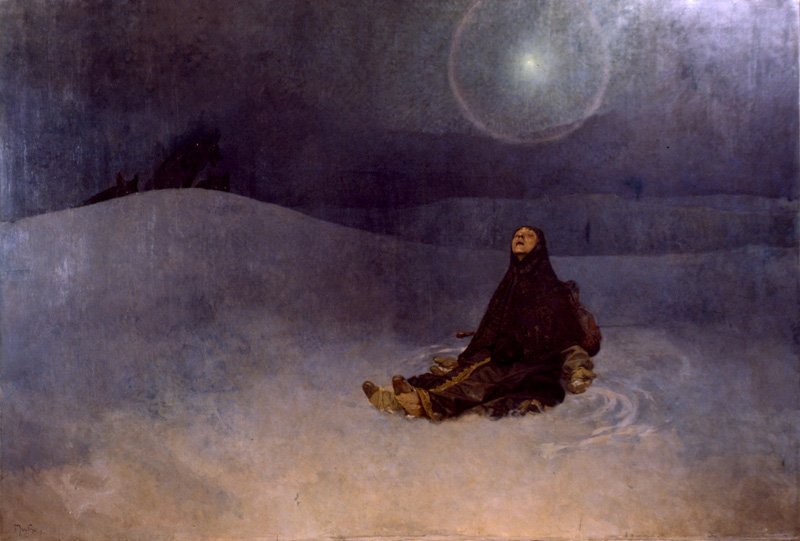
This is just stunning. Absolutely stunning. I started attempting to describe everything that makes this painting brilliant, and I just could not come up with a description that didn't sound like utter bullshit. I think the painting speaks for itself anyway. This is why I find this storytelling technique so effective--it forces the viewer to put the pieces together, and fill in the blanks in their own mind. The future and the past are simply products of our projection, triggered by the fleeting moment and what it signifies. It is an art, ultimately, of the suggestion--a kind of sleight of hand which convinces the audience to see what it wants to see.
And in the depths of our mind, our desire for narrative creates a sensation of an art that surpasses direct truth and enters into the sublime.
I'll be doing a followup article on this sometime next week. Remember my Shunga paper? It might have something to do with that. As always, feel free to leave comments, complaints, or, best of all, your own interpretations, or e-mail me at keeperofmanynames@gmail.com . And, if you like what you've read here, share it on Facebook, Google+, Twitter, Xanga, Netscape, or whatever else you crazy kids are using to surf the blogoblag these days.
When we think of storytelling we tend to focus on a certain set of standard models. Generally speaking, a story has a beginning, a middle and an end, with a number of changes or beats throughout that propel the plot forward. There's the possibility, of course, that these sections are arranged out of order, but generally speaking there's still a beginning middle and end, and there's still a set of beats that--even if they aren't chronological--move the reader to some sort of understanding.
And then we have something like this:
"Classified: Baby Goods. For sale, baby shoes, never worn."
An alternate version tossed around is:
"For sale. Baby shoes. Never worn."
According to legend, Hemingway turned this sucker out on a bet that he couldn't create a story with a beginning, middle, and end in less than ten words. In a way, he seems to have succeeded.
But on further analysis he really hasn't.
Not strictly, at least.
See, the interesting thing about this passage is that it actually does not contain a beginning a middle and an end within the text itself. The story is there, but it is generated due to the reader's interactions with the text--not in the text itself. It is making us--the audience--do the extra work.
This might seem like a dumb, finnicky thing to say, and to some extent it is, but it's worth considering due to the possibilities it opens up. Namely, the idea that you can encapsulate the suggestion of an entire story of hope, tragedy, and loss within a single moment. This means that a single scene, a single message, a single image can contain within itself the catalytic power that prompts the reader to generate the rest of the story. Let's look at a few new storytelling modes that this opens up, shall we?
Implied Narrative
I've actually already explored one mode of this sort of implied storytelling in my article on mechanical horror. Remember our friend Cloistered Youth? I would argue that the storytelling there is very similar to what Hemingway is using in the tale above. The card really just represents two separate states of being. The story comes from the fact that you are the one in charge of the transformation, and that the transformation takes place within the context of a wizarding duel in which you apparently are capable of making some pretty foul bargains. The story is ultimately a product of the player reading the mechanics as indicative of a wider story, just as the Hemingway take depends upon the reader interpreting a classified ad as indicative of a narrative.
There are a few other good examples of this in recent Magic: The Gathering sets. Again, I've tried to pick out stuff that is easily grokkable by a general audience. Check out, for example, this interesting piece:
This card is pretty straightforward. You give a temporary boost to one of your creatures so that it's better in combat. But the flavor of the card is particularly interesting from a narrative perspective because of the implications it sets up. Look at the bravado of that flavor text! Look at those glowing weapons! Look at that stat bonus!
...Now look at the seemingly endless crowd of zombies the guy in the art is jumping into.
And then look again at that last bit of text: "till end of turn."
Yep, this heroism is just a momentary thing. Eventually this faith that our hero prizes so highly is going to start to fade. And when that happens... well... tell me, do you think it's likely that he'll have taken down all of those zombies? Or even most of them?
Yes, what's interesting about this card is that it implies a beginning, middle, and end using only the middle section. The beginning and end are going to be a highly individual thing, but I suspect that the start is in the midst of a desperate last ditch attempt to stave off the forces of darkness, and the end... well, let's just say it won't be pretty.
Implied History
Drawing further away from Hemingway's model is this card:
It's also a card that moves away from my mechanical horror idea, because the mechanics of the card don't really matter all that much. In fact, the only thing that matters is that flavor text:
Underling Ethu's 263rd report read simply "Yes, my lord. Overwhelmingly, my lord." This marked the end of the Mirran-Phyrexian War.
Let me give you some backstory. This card comes from the third set of cards relating the story of the Mirran War mentioned above--a war between the natives of the strange metal plane of Mirrodin and the horrific colonizing and corrupting force of Phyrexia. The Phyrexians are beings that will restructure, reprocess, debase, corrode, and corrupt anything in the name of progress and improvement. They are the personified nightmare of technology in the hands of utter monsters.
And they won.
Not only did they win, they won without mercy, without quarter, without anything other than a simple mechanistic impetus to purify.
Now, this flavor text does not, on its own, say much of anything. But with this backstory of desperate survival it suddenly creates an evocative picture that an actual description could never create. It is a picture of a final desperate battle for survival on the planet's surface, a last ditch attempt to avoid extinction. And not only did the Mirrans fail, they failed overwhelmingly. I love, in particular, that this failure is relayed not with dramatic, tragic language, but with the simple, curt efficiency of these utterly inhuman victors. The horror and the tragedy of this loss blows me away, and part of the impact comes from the fact that the entire scene is created by my own mind. I'm not translating someone else's vision. It's all my own, prompted by the chemical catalyst of this text and what I already knew of the wider history and storyline.
This is actually a technique that I've seen used to great effect in short fanfiction. Consider this little piece by LessWrong, author of Harry Potter and the Methods of Rationality:
UTILITARIAN TWILIGHT
(Note: Written after I heard Alicorn was writing a Twilight fanfic, but before I read Luminosity. It's obvious if you're one of us.)
"Edward," said Isabella tenderly. She reached up a hand and stroked his cold, sparkling cheek. "You don't have to protect me from anything. I've listed out all the upsides and all the downsides, assigned them consistent relative weights, and it's just really obvious that the benefits of becoming a vampire outweigh the drawbacks."
"Bella," Edward said, and swallowed desperately. "Bella -"
"Immortality. Perfect health. Awakening psychic powers. Easy enough to survive on animal blood once you do it. Even the beauty, Edward, there are people who would give their lives to be pretty, and don't you dare call them shallow until you've tried being ugly. Do you think I'm scared of the word 'vampire'? I'm tired of your arbitrary deontological constraints, Edward. The whole human species ought to be in on your fun, and people are dying by the thousands even as you hesitate."
The gun in his lover's hand was cold against his forehead. It wouldn't kill him, but it would disable him for long enough -
Ahyup. We can, from there, imagine a whole potential range of conflict and adventure, all generated from this text colliding with the original idea.
Implied Character and Emotion
But what if we don't want a full narrative arc? I mean, that last category certainly seems to be drawing rapidly away from the idea of a narrative anyway. Do we need it at all?
Strictly speaking, I guess we do if we want to tell a story, but it can be just as valuable, I think, to express a powerful emotion or a sense of a characterization within a single moment. And it can certainly be just as difficult, because it still requires taking a basically two dimensional work and plugging it into a reader's mind to create a three dimensional impression.
This card does that well:
Look at that flavor text. Just... really, try to read that without grinning just a little bit. The sense of self-awe is palpable. You can practically hear the realization dawning upon Oglor that he is a being of immense power... but that this power is actually totally secondary to that of his Frankensteinian master. It's delicious.
So, from this small line of text, and the context given by the name and the setting, we can construct in our minds a whole characterization for Oglor. It's not a strict beginning-middle-end story, but it's still a whole scene and predictable set of characteristics drawn from our own interactions with people and our familiarity with the Igor archetype in scifi-horror.
This category is actually exemplified best, I think, in poetry and image-based art. I think my favorite example of this kind of storytelling through a single moment is Alfons Mucha's Star and Siberia:
This is just stunning. Absolutely stunning. I started attempting to describe everything that makes this painting brilliant, and I just could not come up with a description that didn't sound like utter bullshit. I think the painting speaks for itself anyway. This is why I find this storytelling technique so effective--it forces the viewer to put the pieces together, and fill in the blanks in their own mind. The future and the past are simply products of our projection, triggered by the fleeting moment and what it signifies. It is an art, ultimately, of the suggestion--a kind of sleight of hand which convinces the audience to see what it wants to see.
And in the depths of our mind, our desire for narrative creates a sensation of an art that surpasses direct truth and enters into the sublime.
I'll be doing a followup article on this sometime next week. Remember my Shunga paper? It might have something to do with that. As always, feel free to leave comments, complaints, or, best of all, your own interpretations, or e-mail me at keeperofmanynames@gmail.com . And, if you like what you've read here, share it on Facebook, Google+, Twitter, Xanga, Netscape, or whatever else you crazy kids are using to surf the blogoblag these days.
Sunday, October 30, 2011
The Last Bones of October
It's snowing here, for whatever freak reason. The night is settling down like a portcullis. It looks like the last true article of this season (an essay on silent horror films) is going to be delayed indefinitely--my partner in crime on that one is, unfortunately, without power, as are so many of my friends.
But, despite missing one article, I've rolled out 11 this month--not a bad number, if I do say so myself. We've covered everything from music videos to novels to games, everything from tragedy to fear to campy transgression. There is always more to be said, but rather than write a whole new topic, I thought I would wrap things up with a selection of other interesting reading and viewing materials that didn't make its way into my other articles.
You're wet.
I think you'd better... come inside.
HORROR AND POETRY
There are several poets worth delving into a bit with horror poetry in addition to the ones described in my article. One is Anne Carson, a fairly contemporary poet who has the habit of taking a fairly mundane (in the sense of something related, at least, to normal human experience) concept and linking it to some manner of terrifying, hallucinatory vision. Take this bit from The Glass Essay:
Speaking of terrifying and incomprehensible... check out this little piece of work from Ross Gay:
Of the various poems I was considering for this, this is clearly one of the less terrifying. Still, it has an unnerving kind of thwack to it as you jolt from line ending to line ending, from disjunction to disjunction. It's a disturbing kind of poem. And, of course, Gay can definitely do worse. If you desperately want to feel like your soul is composed of writhing maggots, I urge you to check out his poem "Nursery". I contemplated including that here, for a brief moment. Then I reread the first few lines and decided that if I couldn't stomach reading through it a second time, I wasn't going to make all of you poor saps read it at all. "Bringing The Shovel Down" is also quite an alarming little work that starts out so innocuous seeming--very Stephen King, all things considered.
And, of course, it's always worth going back and reviewing Sylvia Plath. There are certainly enough poems about horrific death in her collected works to keep a horror fan satisfied for a long time.
HORROR VIDEOS
These didn't exactly fit into the article on techno and horror, but I felt like they were worth mentioning anyway.
Came across this little gem while looking up videos for another upcoming article. I've never heard of the artist before, but I'm very impressed with the way the video is set up, and how the sludgy tone of the music mirrors the slow, gloomy video itself. At first it seems that the protagonist is only dimly aware of what's going on--note the way his head seems to have turned before the blood splatter in the car early on, for example. Then we see him openly observing events with a sort of detached resignation, a horrible sort of heartsick acceptance. This really sets the end of the video--which for once I won't spoil--up perfectly.
This fellow isn't a Stoker or a King protagonist. He's not going to march through Salem's Lot dedicated to eradicating his foes.
No, there's really only one option.
It's a wonderful blend of horror with overwhelming sadness.
That kid is going to be traumatized, guarantee it.
This video... what to say about this video? It almost works. It really almost does. There are some legitimately terrifying moments. But those moments work because they legitimately do remind me of my own childhood horrors. But the band absolutely must appear in the video, of course, for no real narrative or symbolic purpose, as far as I can see. And the video ends up with what is--let's be perfectly frank here--a really shitty animated sequence that screams "We Ran Out Of Money For This Video!" Come on, guys. I've watched Neon Genesis Evangelion. I know what happens when you get halfway through a story and suddenly no longer have cash. It's frustrating because they seem to transition from something that is deeply disturbing, and very in line with childhood horror, to something that resembles an adult's poor understanding of what a childhood horror might be. It Just. Doesn't. Work.
That said, the disjunction between the happy, poppy sound of the song and the terror of the video is quite nice, and I really have to admire the scene where the traumatized child actor/future serial killer wanders down a monster-infested street. There's some good stuff to work with here.
You may note that I haven't mentioned Thriller at all.
That is because dancing zombies simply aren't scary. Sorry, but it's true.
They are, however, awesome, and very in line with Transgressive and Monstrous Horror.
So here, have some Thriller.
OH HOLY CRAP I FORGOT ABOUT THE WEREFOLF SCENE.
[pants]
Alright, so Thriller is actually a lot scarier than I remembered. Whoops. Uh. Moving on...
ODDS AND ENDS
For those of you that tasted blood and want more... who want to stay the distance... who have an itch to scratch and need assistance... might I recommend, for your enjoyment, one last classic, and one modern marvel.
The first is The Dionaea House, a hypertext work that precedes and in many ways predicts the second of the offerings. I won't give too much away, but it involves a house that seems to be in two places--or more--at once, a house that has a habit of turning people into deadened shells of themselves... if it leaves anything left of them at all. Check it out. It's a distinctly alarming little tale, and part of the long tradition both of correspondence-based horror and modern haunting house stories. (Yes, haunting. You'll see what I mean.)
The second is the ongoing chronicle Marble Hornets, an alternate reality... well, not game, really... simulation, perhaps? Set up as a video log of protagonist Jay's attempt to sift through footage given to him (for burning) by his former friend Alex. What he finds on the tapes is a strange record of a stalking that slowly escalates into something far more sinister and uncanny. These videos make a lot of use of the Uncanny. They're worth checking out, if you can stand it. But be warned--they keep getting worse.
Oh, and if you really just need something to keep you awake for the entire night, check out the reply videos from totheark.
We will wait for you no more.
That's it for our celebration of Halloween, folks. I hope you've enjoyed the content. I've had a lot of fun writing it. This week I'll be taking a break to catch up both on articles and on school work (and on sleep--which means no Marble Hornets for me, I suppose).
Rejoin me in or around the seventh...
On the moon-drenched shores of Transylvania...
When together...
We'll do the Time Warp again!
As always, feel free to leave comments, complaints, or, best of all, your own interpretations, or e-mail me at keeperofmanynames@gmail.com . And, if you like what you've read here, share it on Facebook, Google+, Twitter, Xanga, Netscape, or whatever else you crazy kids are using to surf the blogoblag these days.
Happy Halloween! Heeee eeee eee eee eeee eee!
But, despite missing one article, I've rolled out 11 this month--not a bad number, if I do say so myself. We've covered everything from music videos to novels to games, everything from tragedy to fear to campy transgression. There is always more to be said, but rather than write a whole new topic, I thought I would wrap things up with a selection of other interesting reading and viewing materials that didn't make its way into my other articles.
You're wet.
I think you'd better... come inside.
HORROR AND POETRY
There are several poets worth delving into a bit with horror poetry in addition to the ones described in my article. One is Anne Carson, a fairly contemporary poet who has the habit of taking a fairly mundane (in the sense of something related, at least, to normal human experience) concept and linking it to some manner of terrifying, hallucinatory vision. Take this bit from The Glass Essay:
This is one of those times where I would encourage the reader not to read the poetry as symbolism. It's clear from the (much, much longer) poem that Carson is, herself, in some ways baffled by the visions appearing before her. And, after all, isn't reducing these visions by stating, "Ah yes, this represents her emotional suffering after a bad breakup!" just another way of attempting to pin down and rationalize some vast, terrifying, incomprehensible thing?I am my own Nude.
And Nudes have a difficult sexual destiny.I have watched this destiny disclose itselfin its jerky passage from girl to woman to who I am now,
from love to anger to this cold marrow,from fire to shelter to fire.What is the opposite of believing in Thou—
merely not believing in Thou? No. That is too simple.That is to prepare a misunderstanding.I want to speak more clearly.
Perhaps the Nudes are the best way.Nude #5. Deck of cards.Each card is made of flesh.
The living cards are days of a woman’s life.I see a great silver needle go flashing right through the deck once from end toend.Nude #6 I cannot remember.
Nude #7. White room whose walls,having neither planes nor curves nor angles,are composed of a continuous satiny white membrane
like the flesh of some interior organ of the moon.It is a living surface, almost wet.Lucency breathes in and out.
Rainbows shudder across it.And around the walls of the room a voice goes whispering,Be very careful. Be very careful.
Speaking of terrifying and incomprehensible... check out this little piece of work from Ross Gay:
Love, You Got Me Good
Honeybunny, for you, I've got a mouthful
of soot. Sweetpea, for you, I always smell
like blood. Everything that touches me, Lovemuffin,
turns to salt. When I think of you
I see fire. When I dream of you
I hear footsteps on bones. When I see you
I can feel the scythe's smooth handle
in my palm. Love, you got me
standing at attention.
Clutching my heart. Polishing guns.
Love, I got a piggy bank
painted like a flag. I got a flag
in the shape of a piggy bank. For you,
Sugarfoot, I've been dancing
the waterboard. You're under
my skin, Love. Don't know
what I'd do without you,
Love.
Of the various poems I was considering for this, this is clearly one of the less terrifying. Still, it has an unnerving kind of thwack to it as you jolt from line ending to line ending, from disjunction to disjunction. It's a disturbing kind of poem. And, of course, Gay can definitely do worse. If you desperately want to feel like your soul is composed of writhing maggots, I urge you to check out his poem "Nursery". I contemplated including that here, for a brief moment. Then I reread the first few lines and decided that if I couldn't stomach reading through it a second time, I wasn't going to make all of you poor saps read it at all. "Bringing The Shovel Down" is also quite an alarming little work that starts out so innocuous seeming--very Stephen King, all things considered.
And, of course, it's always worth going back and reviewing Sylvia Plath. There are certainly enough poems about horrific death in her collected works to keep a horror fan satisfied for a long time.
HORROR VIDEOS
These didn't exactly fit into the article on techno and horror, but I felt like they were worth mentioning anyway.
This fellow isn't a Stoker or a King protagonist. He's not going to march through Salem's Lot dedicated to eradicating his foes.
No, there's really only one option.
It's a wonderful blend of horror with overwhelming sadness.
This video... what to say about this video? It almost works. It really almost does. There are some legitimately terrifying moments. But those moments work because they legitimately do remind me of my own childhood horrors. But the band absolutely must appear in the video, of course, for no real narrative or symbolic purpose, as far as I can see. And the video ends up with what is--let's be perfectly frank here--a really shitty animated sequence that screams "We Ran Out Of Money For This Video!" Come on, guys. I've watched Neon Genesis Evangelion. I know what happens when you get halfway through a story and suddenly no longer have cash. It's frustrating because they seem to transition from something that is deeply disturbing, and very in line with childhood horror, to something that resembles an adult's poor understanding of what a childhood horror might be. It Just. Doesn't. Work.
That said, the disjunction between the happy, poppy sound of the song and the terror of the video is quite nice, and I really have to admire the scene where the traumatized child actor/future serial killer wanders down a monster-infested street. There's some good stuff to work with here.
You may note that I haven't mentioned Thriller at all.
That is because dancing zombies simply aren't scary. Sorry, but it's true.
They are, however, awesome, and very in line with Transgressive and Monstrous Horror.
So here, have some Thriller.
[pants]
Alright, so Thriller is actually a lot scarier than I remembered. Whoops. Uh. Moving on...
ODDS AND ENDS
For those of you that tasted blood and want more... who want to stay the distance... who have an itch to scratch and need assistance... might I recommend, for your enjoyment, one last classic, and one modern marvel.
The first is The Dionaea House, a hypertext work that precedes and in many ways predicts the second of the offerings. I won't give too much away, but it involves a house that seems to be in two places--or more--at once, a house that has a habit of turning people into deadened shells of themselves... if it leaves anything left of them at all. Check it out. It's a distinctly alarming little tale, and part of the long tradition both of correspondence-based horror and modern haunting house stories. (Yes, haunting. You'll see what I mean.)
The second is the ongoing chronicle Marble Hornets, an alternate reality... well, not game, really... simulation, perhaps? Set up as a video log of protagonist Jay's attempt to sift through footage given to him (for burning) by his former friend Alex. What he finds on the tapes is a strange record of a stalking that slowly escalates into something far more sinister and uncanny. These videos make a lot of use of the Uncanny. They're worth checking out, if you can stand it. But be warned--they keep getting worse.
Oh, and if you really just need something to keep you awake for the entire night, check out the reply videos from totheark.
We will wait for you no more.
That's it for our celebration of Halloween, folks. I hope you've enjoyed the content. I've had a lot of fun writing it. This week I'll be taking a break to catch up both on articles and on school work (and on sleep--which means no Marble Hornets for me, I suppose).
Rejoin me in or around the seventh...
On the moon-drenched shores of Transylvania...
When together...
We'll do the Time Warp again!
As always, feel free to leave comments, complaints, or, best of all, your own interpretations, or e-mail me at keeperofmanynames@gmail.com . And, if you like what you've read here, share it on Facebook, Google+, Twitter, Xanga, Netscape, or whatever else you crazy kids are using to surf the blogoblag these days.
Happy Halloween! Heeee eeee eee eee eeee eee!
Tuesday, September 27, 2011
If You Hadn't Noticed
We're in the midst of another skip week, folks. I discovered one week ago that there were four scholarships that I absolutely, positively must apply to, apparently. This has resulted in panic, sleep deprivation, gibbering lunacy, and the eventual opening within my head of a door to the far realm beyond time and space where the demon god Azathoth knaws hungrily amidst chaos and the fluting and pounding of the mindless Outer Gods whose soul and messenger is Nyarlathotep. Ia! Ia!
At any rate, I hope to return sometime next week, when I'll be kicking off a month long focus on the horrible, the spooky, the macabre, and the just plain unnerving. It's a tad cliche, but I'm sure they'll be advertising for Christmas soon, and we heathens can't let our holiday get second billing to all that ho ho ho nonsense!
So join me next week when I begin lighting up the bone fires and singing the praises of Dark Gods. I've got two more parts of Ways of Reading Gaga coming up, two attempts to revive some rather... lackluster examples, of horror, some more music video exploration, possibly an alarmist guest article about the film industry and the upcoming Mayan Armageddon, and many even more absurd things.
If this week continues the way it has been, I may even add to the ambiance by joining you... from beyond the grave.
...Say!
Any of you folks know how to Madison?
At any rate, I hope to return sometime next week, when I'll be kicking off a month long focus on the horrible, the spooky, the macabre, and the just plain unnerving. It's a tad cliche, but I'm sure they'll be advertising for Christmas soon, and we heathens can't let our holiday get second billing to all that ho ho ho nonsense!
So join me next week when I begin lighting up the bone fires and singing the praises of Dark Gods. I've got two more parts of Ways of Reading Gaga coming up, two attempts to revive some rather... lackluster examples, of horror, some more music video exploration, possibly an alarmist guest article about the film industry and the upcoming Mayan Armageddon, and many even more absurd things.
If this week continues the way it has been, I may even add to the ambiance by joining you... from beyond the grave.
...Say!
Any of you folks know how to Madison?
Wednesday, September 21, 2011
Approach
A white burst of lightning strobes downward and God rears His head in the sky.
He is colossal,
Implacable, steel and
Thunder.
Within him ride Angels, quick for the hunt.
Do you recall a time when they were as we are?
--Humans?
--Mortals?
As we trade our guns, so they traded numbers, on vast howling engines in our once great cities. And they traded their numbers to the ancient Gene Witches. They trialed and they errored and a whole generation of beautiful beings was born--
Beautiful boys--
Beautiful girls--
Their faces were unmarked as ours, their minds were so quick like the vast howling engines in our once great cities, their bodies so strong and so slender.
Ah, and here are their eyes, open to us now, as their colossal god eclipses the sky. Their eyes shine down rays of God's love to his children.
Their eyes shine like the sun.
Do you recall the sun? Once all the sky was alight with a warmth that let our crops grow.
Now deep beneath our old city
Moloch
Breaths his fire and the plants of the Gene Witches feed from his warmth.
Look, how the Gene Witch's hut sinks into its mire. God does not suffer a Gene Witch to live. Not anymore. Only the Witchminds,
Bred from the vats of
Angels, live in the core of
God, closest to His light and heat.
And see, the Capital sinks as well, protected from the Angels.
Do you recall music from before the Gods rose into the sky and we were left here to our once great city, and the Old Gods beneath the earth, and the old howling engines and Gene Witches?
Music before the Blessed Mixers found their beats of calamity and the Bravers fought angels? They music they played says nothing to us about our lives,
And so they mixed a new beat for our scattered tribes.
See, all the eyes are sinking to earth, and the ships of the Angels approach, bringing the
Witchminds, and the
Huntsmen, and the
Threshing dogs, and the
Whip guns. And the
Blessed Mixer will mix his beats, and the
Bravers will Brave against the Angels, and if
We are lucky and the
Howling engines bless us, we may
Capture a whip gun
For ourselves.
But now me must go in and hide, or be harvested for our Stems.
Lead me inside, girl,
Out of this storm.
And tomorrow, if the Bravers do not win, we will hang the Blessed Mixer.
So tell me again why there isn't more Science Fiction Poetry? As always, feel free to leave comments, complaints, or, best of all, your own interpretations, or e-mail me at keeperofmanynames@gmail.com . And, if you like what you've read here, share it on Facebook, Google+, Twitter, Xanga, Netscape, or whatever else you crazy kids are using to surf the blogoblag these days.
He is colossal,
Implacable, steel and
Thunder.
Within him ride Angels, quick for the hunt.
Do you recall a time when they were as we are?
--Humans?
--Mortals?
As we trade our guns, so they traded numbers, on vast howling engines in our once great cities. And they traded their numbers to the ancient Gene Witches. They trialed and they errored and a whole generation of beautiful beings was born--
Beautiful boys--
Beautiful girls--
Their faces were unmarked as ours, their minds were so quick like the vast howling engines in our once great cities, their bodies so strong and so slender.
Ah, and here are their eyes, open to us now, as their colossal god eclipses the sky. Their eyes shine down rays of God's love to his children.
Their eyes shine like the sun.
Do you recall the sun? Once all the sky was alight with a warmth that let our crops grow.
Now deep beneath our old city
Moloch
Breaths his fire and the plants of the Gene Witches feed from his warmth.
Look, how the Gene Witch's hut sinks into its mire. God does not suffer a Gene Witch to live. Not anymore. Only the Witchminds,
Bred from the vats of
Angels, live in the core of
God, closest to His light and heat.
And see, the Capital sinks as well, protected from the Angels.
Do you recall music from before the Gods rose into the sky and we were left here to our once great city, and the Old Gods beneath the earth, and the old howling engines and Gene Witches?
Music before the Blessed Mixers found their beats of calamity and the Bravers fought angels? They music they played says nothing to us about our lives,
And so they mixed a new beat for our scattered tribes.
See, all the eyes are sinking to earth, and the ships of the Angels approach, bringing the
Witchminds, and the
Huntsmen, and the
Threshing dogs, and the
Whip guns. And the
Blessed Mixer will mix his beats, and the
Bravers will Brave against the Angels, and if
We are lucky and the
Howling engines bless us, we may
Capture a whip gun
For ourselves.
But now me must go in and hide, or be harvested for our Stems.
Lead me inside, girl,
Out of this storm.
And tomorrow, if the Bravers do not win, we will hang the Blessed Mixer.
So tell me again why there isn't more Science Fiction Poetry? As always, feel free to leave comments, complaints, or, best of all, your own interpretations, or e-mail me at keeperofmanynames@gmail.com . And, if you like what you've read here, share it on Facebook, Google+, Twitter, Xanga, Netscape, or whatever else you crazy kids are using to surf the blogoblag these days.
Sunday, September 11, 2011
Theater of Cruelty--Some Unpublished Images
Today there was a memorial service on campus. The students and faculty joined together as a sign of unity, arrayed in a circle, all holding hands. It was an attempt torecognize a community that "live[s] as a unified body, while acknowledging our uniqueness as individuals." Or so I hear. When I arrived, the crowd had already begun to disperse. The clouds rolled in, and I walked down the hill by the still-flooded waters and thought.
------------------------------------------------------------------------------------------------
I remember distinctly, as I sat and I typed out the last few citations, formatted the last few images, the sound of the chanting from down below. The letters recited; the anthems all chorused. And, of course, the trumpet. That damn drunken trumpet. It wasn't any sort of majestic sound. It was just a hollow blat, bursting out drunkenly as the player staggered back and forth outside my window. I stared down at an image of a colossal shoe suspended in air, ready to crash down upon New York City. And for the life of me, I could not decide whether to laugh or to cry.
------------------------------------------------------------------------------------------
At the end of the First World War, in the wake of the pillaging, and the futile grind of the trenches, and the epidemics that swept the land, two new schools of art, born of madness, emerged in Europe. They were Dada and Surrealism, and they were both a reaction to the collapse of the system of the world. Dada embraced the idea that meaning had been utterly lost, and that the ideals of the Enlightenment and rational western society had collapsed in upon themselves. It was an expression of madness loosed upon the world. Its greatest artists--people like Marcel Duchamp, Hannah Hoch, and George Grosz--freely attacked any and every target, lampooning everything from sexuality in the age of the machine (Duchamp's "The Bride Stripped Bare By Her Bachelors, Even"), the arbitrary nature of scientific standards (Duchamp, again: "Standard Stoppages" sets up a system of measurement based on randomness), to the shiny new order of consumer culture (Check out virtually anything by Hannah Hoch), or the pathetic weakness of the political regimes of the period between the wars (Grosz's acerbic work fits in here--he really had it in for the Weimar Republic). The great message is that there is no great message, and all art in the face of inhuman tragedy is barbarism.
On the other side of tragedy lurked Surrealism, the warped, basement-dwelling introspective brother of Dada. The surrealists sought to express, unfettered, uncontained, the murky depths of the human subconscious. They dwelled on images of mantises consuming the heads of their lovers, of slit eyeballs, masturbation, hoards of barbarians roiling across nightmare landscapes, dismembered bodies, and on and on. While Dada attacked the external world, Surrealism descended ever inward, seeking the underpinnings of the human mind, drawing from the young science of psychology in their quests.
What the movements shared, then, was a reaction to tragedy, a fragmented and disturbing set of visual tropes, an obsession with the comforting and familiar turned strange and threatening, and a growing disillusionment with the supposedly rational behavior of humans in general, and leaders in particular.
-------------------------------------------------------------------------------------
I cannot remember the attacks myself; not clearly, anyway. I was 10 at the time, and my parents and teachers nobly shielded me from all but the vaguest images and information. I remember just--only--a sense of confusion, a wondering just what the big deal was. Scuffing my shoes in the mulch of the playground, watching movement of those worried faces, I was displaced for the next several years.
--------------------------------------------------------------------------------------
It is 80 years since then. Art Spiegelman has become a famous man. His masterpiece, Maus, has helped to catapult comics out of the scrappy heap--into the critical eye of the world. Amidst all this growing of fame and importance, the comicker, convinced that oblivion is nigh, begins to create a series of plates titled In The Shadow Of No Towers. They're a nightmarish reenactment of his journey through the city of New York on September 11th of 2001, and of the political and personal upheaval. Their central image is a vision of two luminous, skeletal towers. Their targets for satire and anger include everyone from the monstrous perpetrators of the acts, to the political establishment that took advantage of the assault, to anirony-blind media, to complacent citizenry, to Spiegelman's own neurotic persona. In these strange pages, the ghosts of Dada and Surrealism reemerge, specters of the madness of the 20th century, reassembling their skeletons and collages and nightmare visions. Spiegelman is haunted by things that he did not see, and these ghosts fill the void.
-----------------------------------------------------------------------------------------
On the day that Osama bin Laden was announced dead--killed in Pakistan--I sat at my desk typing an essay on Dada, Surrealism, and the echoes of 20th century art within Spiegelman's work. I sought to explain why the work is so difficult, and yet is so resonant. I saw, within its pages, my own confusion, displacement, and ambivalence. And then the news came in. I was floored. The great beast of the desert, avatar of Terror, the monster that we chased for nine long years, was mortal after all. I reeled. I saw, crystalized, suspended in history, the futility and pointless waste of life that was our last nine years.
And, meanwhile, students that at the time of the attacks were six or seven years old--even further removed in understanding than I--celebrated this death with a wild, raucous party. Our team had won.
By pure chance, by dumb luck, I was left sitting, staring down at Spiegelman's text, reading over and over again the panels where he asks, desperately, why the emblem following the attacks had been a flag.
"Why not... a globe?!"
-------------------------------------------------------------------------------------------
Each year I question my own muddy feelings.
I still have not found easy answers, save to take solace in art and its shared experience.
Happy anniversary.
-------------------------------------------------------------------------------------------
If you're interested, the essay on Spiegelman and the 20th Century can be found here. It's a bit of a doorstopper, but I'm rather fond of my analysis, and, hell, Shadow is a work that gets too little credit for its genius. I explain why it gets so little credit in the essay, actually.
I probably don't need to say this, but this essay--or maybe I should call it a prose poem?--is rather personal for me, much more so than my usual works. Please, if you post comments, try to consider my feelings, as scattered and ambivalent as they are.
On Tuesday we'll resume more regular subject matter with another installment of Ways of Reading Gaga. And things will proceed from there.
------------------------------------------------------------------------------------------------
I remember distinctly, as I sat and I typed out the last few citations, formatted the last few images, the sound of the chanting from down below. The letters recited; the anthems all chorused. And, of course, the trumpet. That damn drunken trumpet. It wasn't any sort of majestic sound. It was just a hollow blat, bursting out drunkenly as the player staggered back and forth outside my window. I stared down at an image of a colossal shoe suspended in air, ready to crash down upon New York City. And for the life of me, I could not decide whether to laugh or to cry.
------------------------------------------------------------------------------------------
At the end of the First World War, in the wake of the pillaging, and the futile grind of the trenches, and the epidemics that swept the land, two new schools of art, born of madness, emerged in Europe. They were Dada and Surrealism, and they were both a reaction to the collapse of the system of the world. Dada embraced the idea that meaning had been utterly lost, and that the ideals of the Enlightenment and rational western society had collapsed in upon themselves. It was an expression of madness loosed upon the world. Its greatest artists--people like Marcel Duchamp, Hannah Hoch, and George Grosz--freely attacked any and every target, lampooning everything from sexuality in the age of the machine (Duchamp's "The Bride Stripped Bare By Her Bachelors, Even"), the arbitrary nature of scientific standards (Duchamp, again: "Standard Stoppages" sets up a system of measurement based on randomness), to the shiny new order of consumer culture (Check out virtually anything by Hannah Hoch), or the pathetic weakness of the political regimes of the period between the wars (Grosz's acerbic work fits in here--he really had it in for the Weimar Republic). The great message is that there is no great message, and all art in the face of inhuman tragedy is barbarism.
On the other side of tragedy lurked Surrealism, the warped, basement-dwelling introspective brother of Dada. The surrealists sought to express, unfettered, uncontained, the murky depths of the human subconscious. They dwelled on images of mantises consuming the heads of their lovers, of slit eyeballs, masturbation, hoards of barbarians roiling across nightmare landscapes, dismembered bodies, and on and on. While Dada attacked the external world, Surrealism descended ever inward, seeking the underpinnings of the human mind, drawing from the young science of psychology in their quests.
What the movements shared, then, was a reaction to tragedy, a fragmented and disturbing set of visual tropes, an obsession with the comforting and familiar turned strange and threatening, and a growing disillusionment with the supposedly rational behavior of humans in general, and leaders in particular.
-------------------------------------------------------------------------------------
I cannot remember the attacks myself; not clearly, anyway. I was 10 at the time, and my parents and teachers nobly shielded me from all but the vaguest images and information. I remember just--only--a sense of confusion, a wondering just what the big deal was. Scuffing my shoes in the mulch of the playground, watching movement of those worried faces, I was displaced for the next several years.
--------------------------------------------------------------------------------------
It is 80 years since then. Art Spiegelman has become a famous man. His masterpiece, Maus, has helped to catapult comics out of the scrappy heap--into the critical eye of the world. Amidst all this growing of fame and importance, the comicker, convinced that oblivion is nigh, begins to create a series of plates titled In The Shadow Of No Towers. They're a nightmarish reenactment of his journey through the city of New York on September 11th of 2001, and of the political and personal upheaval. Their central image is a vision of two luminous, skeletal towers. Their targets for satire and anger include everyone from the monstrous perpetrators of the acts, to the political establishment that took advantage of the assault, to anirony-blind media, to complacent citizenry, to Spiegelman's own neurotic persona. In these strange pages, the ghosts of Dada and Surrealism reemerge, specters of the madness of the 20th century, reassembling their skeletons and collages and nightmare visions. Spiegelman is haunted by things that he did not see, and these ghosts fill the void.
-----------------------------------------------------------------------------------------
On the day that Osama bin Laden was announced dead--killed in Pakistan--I sat at my desk typing an essay on Dada, Surrealism, and the echoes of 20th century art within Spiegelman's work. I sought to explain why the work is so difficult, and yet is so resonant. I saw, within its pages, my own confusion, displacement, and ambivalence. And then the news came in. I was floored. The great beast of the desert, avatar of Terror, the monster that we chased for nine long years, was mortal after all. I reeled. I saw, crystalized, suspended in history, the futility and pointless waste of life that was our last nine years.
And, meanwhile, students that at the time of the attacks were six or seven years old--even further removed in understanding than I--celebrated this death with a wild, raucous party. Our team had won.
By pure chance, by dumb luck, I was left sitting, staring down at Spiegelman's text, reading over and over again the panels where he asks, desperately, why the emblem following the attacks had been a flag.
"Why not... a globe?!"
-------------------------------------------------------------------------------------------
Each year I question my own muddy feelings.
I still have not found easy answers, save to take solace in art and its shared experience.
Happy anniversary.
-------------------------------------------------------------------------------------------
If you're interested, the essay on Spiegelman and the 20th Century can be found here. It's a bit of a doorstopper, but I'm rather fond of my analysis, and, hell, Shadow is a work that gets too little credit for its genius. I explain why it gets so little credit in the essay, actually.
I probably don't need to say this, but this essay--or maybe I should call it a prose poem?--is rather personal for me, much more so than my usual works. Please, if you post comments, try to consider my feelings, as scattered and ambivalent as they are.
On Tuesday we'll resume more regular subject matter with another installment of Ways of Reading Gaga. And things will proceed from there.
Saturday, September 3, 2011
Technical Difficulties
Let me be honest. At this point, I'm having trouble getting articles together. I'm having trouble getting my life together. Between power outages, computer crashes, whole articles vanishing instantly into oblivion when I'm a few sentences away from completing them, exploding lamps, paperwork, and the like, I'm getting far less work done than I had hoped.
With that in mind, I'm going to be taking the pressure off of myself by taking leave for another week. I suspect rather strongly that no one will be here when I get back. It's difficult, at this point, to rationally justify continuing at all. But, well, I have these drafts put together. We'll see where things go.
Of course, I could always use this down time to post a few guest articles. If anyone is interested in throwing some material together to post, let me know. It would be far better than leaving this space dead, and there are a number of people that I've been wanting to hear from. But, until further notice, stay tuned for new articles on Sunday, September 11th.
With that in mind, I'm going to be taking the pressure off of myself by taking leave for another week. I suspect rather strongly that no one will be here when I get back. It's difficult, at this point, to rationally justify continuing at all. But, well, I have these drafts put together. We'll see where things go.
Of course, I could always use this down time to post a few guest articles. If anyone is interested in throwing some material together to post, let me know. It would be far better than leaving this space dead, and there are a number of people that I've been wanting to hear from. But, until further notice, stay tuned for new articles on Sunday, September 11th.
Saturday, August 27, 2011
Too Much Wine, Perhaps?
I'm about to pass out, ladies and gentlemen. Although I have only updated twice, not thrice as promised, I simply can't string together a coherent sentence to save my life.
But let me make it up to you. First, drinks are on me. Second, in the morning I'll bring out a shiny new Ways Of Reading Gaga installment. And, this week I will update the blog not twice, not thrice, but fouice! Will that suffice?
Goodnight, and god bleiss.
But let me make it up to you. First, drinks are on me. Second, in the morning I'll bring out a shiny new Ways Of Reading Gaga installment. And, this week I will update the blog not twice, not thrice, but fouice! Will that suffice?
Goodnight, and god bleiss.
Friday, August 19, 2011
Some Snippets
Ladies and Gentlemen, as I have a bunch of essays I need to work on (yes, I know school hasn't started yet. You don't have to rub it in) I'm going to be dropping in here a number of small snippets and notes that wouldn't make a whole article, but together almost resemble one if you squint. And are drunk. Very drunk.
The first order of business is that Storming the Ivory Tower is now licensed under Creative Commons. This means that you can share the ideas, spread them around, fiddle with them, and so on, as long as you aren't trying to make any money off of it. That seems reasonable to me. Individual guest posters here will probably operate under the same system; if not, I'll make sure to note any differences.
If one of my ideas strikes you as somehow marketable (HAH!) you may buy the rights by getting lunch for me sometime. I like lunch. Yes, I'm serious about this.
As for why I'm paying so much attention to this, when I'm just some fool with a Blogspot account, well, I've watched recently as various creative types duked it out with publishers over things like this, and duked it out with each other, and with the general public, and so on and so forth, and I figured why wait--might as well start up with my wishes already solidly spelled out. Besides, I want to make it easy for people to share these ideas. That's what they're for, after all.
Heavens, that was dull.
-------------------------------------------------------------------------------------
This does lead handily into the next segment of this not-really-an-article: my current list of People You Really Ought To Be Paying Attention To.
First up is Extra Credits. Er, uh, Extra Credits. Hm. Extra Credits? The show doesn't really have a home at this point, what with the Escapist not paying them for several months (see my above comments about legal snafus). The program itself is a video series that does what we do here--looks critically at things that haven't been critically analyzed much yet. In their case, it's video games. It's an incredible show, and might do for games what Scott McCloud did for comics.
Of particular note to readers here is their video Art Is Not The Opposite Of Fun.
Speaking of Scott McCloud--and if you haven't read Understanding Comics yet, you really should--it's always worth checking his blog, just because of the interesting comics he plugs.
Are you interested in gender, sexuality, and feminism? Ha ha ha, of course you are, don't be silly. Check out The Pervocracy, a wonderful blog about all the strange wonderfulness of human sexuality.
Interested at all in horror and movies? I highly recommend looking up Son of Danse Macabre, a sequel to the Stephen King book of essays Danse Macabre. Even for people like me that aren't particular fans of horror, there is plenty of critical analysis and interesting theorizing to sink your teeth into.
Have any other items along these lines that people should be reading or watching? Share them in the comments.
-----------------------------------------------------------------------------------------------
As a general rule, I tend to prefer a dangerous failure to a safe success. There's something really marvelous about watching a failed experiment. Even as the flaming windmill collapses on you, the author, and the concept of the piece, I feel like there's still a moment of exhilaration as it all crashes down. It's a thrill that something competent but ultimately generic can't really ever pull off. And it's the reason why you'll often see me praising things that perhaps don't deserve as much attention as I'm giving them.
There are some variants on this rule of thumb. I'm not impressed by people that manage to pull off half a success if they clearly have no bloody idea what they're doing. It's just disappointing to know that the artist in question is making things up as they go along, so they'll have no way of repeating what successful images they create.
And, there's always plenty of room in my heart for a truly masterful work that doesn't push any boundaries beyond the simple boundaries of craft. (I'm thinking of Anya's Ghost, in particular.)
But still, I love looking at an absolute trainwreck of a film or a book or a comic and finding those little glimpses of brilliance. I really do think that there is some kernel of glorious, bright vision in nearly everything. Part of the work of the critic should be to hack away at the dreck--not to completely decimate a work, but to cut the dead flesh away from those hidden gems.
Of course, sometimes people just make shit art.
Like this article.
For example.
The first order of business is that Storming the Ivory Tower is now licensed under Creative Commons. This means that you can share the ideas, spread them around, fiddle with them, and so on, as long as you aren't trying to make any money off of it. That seems reasonable to me. Individual guest posters here will probably operate under the same system; if not, I'll make sure to note any differences.
If one of my ideas strikes you as somehow marketable (HAH!) you may buy the rights by getting lunch for me sometime. I like lunch. Yes, I'm serious about this.
As for why I'm paying so much attention to this, when I'm just some fool with a Blogspot account, well, I've watched recently as various creative types duked it out with publishers over things like this, and duked it out with each other, and with the general public, and so on and so forth, and I figured why wait--might as well start up with my wishes already solidly spelled out. Besides, I want to make it easy for people to share these ideas. That's what they're for, after all.
Heavens, that was dull.
-------------------------------------------------------------------------------------
This does lead handily into the next segment of this not-really-an-article: my current list of People You Really Ought To Be Paying Attention To.
First up is Extra Credits. Er, uh, Extra Credits. Hm. Extra Credits? The show doesn't really have a home at this point, what with the Escapist not paying them for several months (see my above comments about legal snafus). The program itself is a video series that does what we do here--looks critically at things that haven't been critically analyzed much yet. In their case, it's video games. It's an incredible show, and might do for games what Scott McCloud did for comics.
Of particular note to readers here is their video Art Is Not The Opposite Of Fun.
Speaking of Scott McCloud--and if you haven't read Understanding Comics yet, you really should--it's always worth checking his blog, just because of the interesting comics he plugs.
Are you interested in gender, sexuality, and feminism? Ha ha ha, of course you are, don't be silly. Check out The Pervocracy, a wonderful blog about all the strange wonderfulness of human sexuality.
Interested at all in horror and movies? I highly recommend looking up Son of Danse Macabre, a sequel to the Stephen King book of essays Danse Macabre. Even for people like me that aren't particular fans of horror, there is plenty of critical analysis and interesting theorizing to sink your teeth into.
Have any other items along these lines that people should be reading or watching? Share them in the comments.
-----------------------------------------------------------------------------------------------
As a general rule, I tend to prefer a dangerous failure to a safe success. There's something really marvelous about watching a failed experiment. Even as the flaming windmill collapses on you, the author, and the concept of the piece, I feel like there's still a moment of exhilaration as it all crashes down. It's a thrill that something competent but ultimately generic can't really ever pull off. And it's the reason why you'll often see me praising things that perhaps don't deserve as much attention as I'm giving them.
There are some variants on this rule of thumb. I'm not impressed by people that manage to pull off half a success if they clearly have no bloody idea what they're doing. It's just disappointing to know that the artist in question is making things up as they go along, so they'll have no way of repeating what successful images they create.
And, there's always plenty of room in my heart for a truly masterful work that doesn't push any boundaries beyond the simple boundaries of craft. (I'm thinking of Anya's Ghost, in particular.)
But still, I love looking at an absolute trainwreck of a film or a book or a comic and finding those little glimpses of brilliance. I really do think that there is some kernel of glorious, bright vision in nearly everything. Part of the work of the critic should be to hack away at the dreck--not to completely decimate a work, but to cut the dead flesh away from those hidden gems.
Of course, sometimes people just make shit art.
Like this article.
For example.
Subscribe to:
Comments (Atom)