

Oddball media crit--laying siege to academia's ivory tower from pop culture's gutter
Showing posts with label Magic The Gathering. Show all posts
Showing posts with label Magic The Gathering. Show all posts
Monday, September 9, 2019
Batmen vs Supermen: Expanded Universes Beyond The "Event"
So you've decided your story needs a dramatic cataclysm to electrify the fans. You've marshaled the qualities of the Expanded Universe to bring it about, and will sacrifice anything for the drama. But is that really such a good idea? Is there another way?


Tuesday, April 29, 2014
Night of the Living Fandom
I've been in a very pro-fanfic mood lately, in part because I've been wrapping up work on an anthology of fanfiction based on the trading card game Magic: The Gathering. It's a pretty big project, so the actual production values have certainly occupied my mind, but I've also been thinking quite a bit about the larger picture of what this project means for the way we interact with media in the digital age.
I want to talk a little bit about that kind of changing field of production and consumption, what it means for fans, and how transformative works can be cultivated and encouraged, but first let me give a bit of background for the anthology itself. The anthology is part of a much larger and more complex project called the Magic: Expanded Multiverse, which I jumpstarted a few years ago on Wizards of the Coast's online forums. The idea was to take the setting of Magic and create a massive, internally consistent, fan-generated expanded canon that could exist alongside the main canon. Magic, despite being a card game, actually is perfect for this type of project because the game takes place in a massive multiverse of countless worlds, and stars characters who can travel between these worlds. My friend Jon of Everyday Abnormal has described the game as having a setting that is every setting. I think it's pretty obvious why that would be appealing to creatively-minded fans.
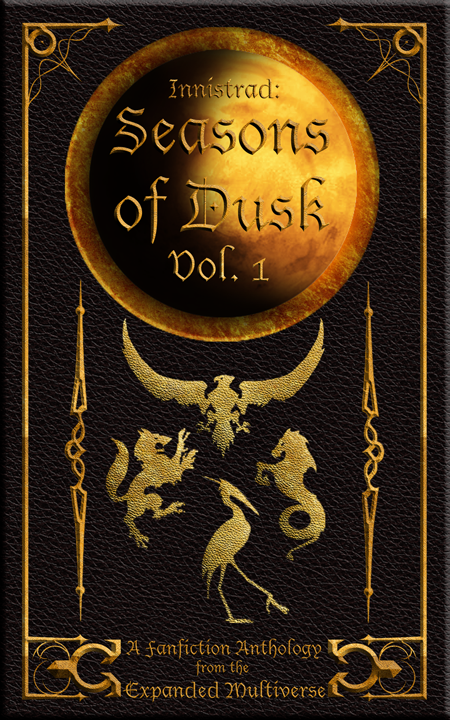
The anthology, Seasons of Dusk, takes place on the world called Innistrad, a dark world beset by monsters. It's basically a Gothic Horror world, and the design of the anthology, created by me and the current head of the M:EM, Barinellos, reflects that aesthetic:
But rather than talk about the setting, I want to talk about the fact that this anthology wasn't (just) posted on a message board or AO3, but actually produced in two different formats: a PDF book, and an ebook that is compatible with most e-readers. This format is significant because Wizards of the Coast, the makers of Magic, now only publish the novels for Magic in digital formats--there is no print novel line now. And while we do state openly that we're a fan project, at least a few of our social media followers assumed that this was one of those real virtual publications.
The fact that we were able to create something that as far as visuals and content are concerned at least can temporarily confuse someone as to the reality of what they're seeing suggests some interesting things about the way the tech we used to compose the anthology--largely open source tech--can disrupt the hierarchies of what is "legitimate" art. In the interests of furthering that disruption and helping to further similar projects, let's talk a bit about how we produced this anthology.
I want to talk a little bit about that kind of changing field of production and consumption, what it means for fans, and how transformative works can be cultivated and encouraged, but first let me give a bit of background for the anthology itself. The anthology is part of a much larger and more complex project called the Magic: Expanded Multiverse, which I jumpstarted a few years ago on Wizards of the Coast's online forums. The idea was to take the setting of Magic and create a massive, internally consistent, fan-generated expanded canon that could exist alongside the main canon. Magic, despite being a card game, actually is perfect for this type of project because the game takes place in a massive multiverse of countless worlds, and stars characters who can travel between these worlds. My friend Jon of Everyday Abnormal has described the game as having a setting that is every setting. I think it's pretty obvious why that would be appealing to creatively-minded fans.
The anthology, Seasons of Dusk, takes place on the world called Innistrad, a dark world beset by monsters. It's basically a Gothic Horror world, and the design of the anthology, created by me and the current head of the M:EM, Barinellos, reflects that aesthetic:
But rather than talk about the setting, I want to talk about the fact that this anthology wasn't (just) posted on a message board or AO3, but actually produced in two different formats: a PDF book, and an ebook that is compatible with most e-readers. This format is significant because Wizards of the Coast, the makers of Magic, now only publish the novels for Magic in digital formats--there is no print novel line now. And while we do state openly that we're a fan project, at least a few of our social media followers assumed that this was one of those real virtual publications.
The fact that we were able to create something that as far as visuals and content are concerned at least can temporarily confuse someone as to the reality of what they're seeing suggests some interesting things about the way the tech we used to compose the anthology--largely open source tech--can disrupt the hierarchies of what is "legitimate" art. In the interests of furthering that disruption and helping to further similar projects, let's talk a bit about how we produced this anthology.
Thursday, December 22, 2011
Modes of Storytelling
Modes of Storytelling
When we think of storytelling we tend to focus on a certain set of standard models. Generally speaking, a story has a beginning, a middle and an end, with a number of changes or beats throughout that propel the plot forward. There's the possibility, of course, that these sections are arranged out of order, but generally speaking there's still a beginning middle and end, and there's still a set of beats that--even if they aren't chronological--move the reader to some sort of understanding.
And then we have something like this:
An alternate version tossed around is:
According to legend, Hemingway turned this sucker out on a bet that he couldn't create a story with a beginning, middle, and end in less than ten words. In a way, he seems to have succeeded.
But on further analysis he really hasn't.
Not strictly, at least.
See, the interesting thing about this passage is that it actually does not contain a beginning a middle and an end within the text itself. The story is there, but it is generated due to the reader's interactions with the text--not in the text itself. It is making us--the audience--do the extra work.
This might seem like a dumb, finnicky thing to say, and to some extent it is, but it's worth considering due to the possibilities it opens up. Namely, the idea that you can encapsulate the suggestion of an entire story of hope, tragedy, and loss within a single moment. This means that a single scene, a single message, a single image can contain within itself the catalytic power that prompts the reader to generate the rest of the story. Let's look at a few new storytelling modes that this opens up, shall we?
Implied Narrative
I've actually already explored one mode of this sort of implied storytelling in my article on mechanical horror. Remember our friend Cloistered Youth? I would argue that the storytelling there is very similar to what Hemingway is using in the tale above. The card really just represents two separate states of being. The story comes from the fact that you are the one in charge of the transformation, and that the transformation takes place within the context of a wizarding duel in which you apparently are capable of making some pretty foul bargains. The story is ultimately a product of the player reading the mechanics as indicative of a wider story, just as the Hemingway take depends upon the reader interpreting a classified ad as indicative of a narrative.
There are a few other good examples of this in recent Magic: The Gathering sets. Again, I've tried to pick out stuff that is easily grokkable by a general audience. Check out, for example, this interesting piece:

This card is pretty straightforward. You give a temporary boost to one of your creatures so that it's better in combat. But the flavor of the card is particularly interesting from a narrative perspective because of the implications it sets up. Look at the bravado of that flavor text! Look at those glowing weapons! Look at that stat bonus!
...Now look at the seemingly endless crowd of zombies the guy in the art is jumping into.
And then look again at that last bit of text: "till end of turn."
Yep, this heroism is just a momentary thing. Eventually this faith that our hero prizes so highly is going to start to fade. And when that happens... well... tell me, do you think it's likely that he'll have taken down all of those zombies? Or even most of them?
Yes, what's interesting about this card is that it implies a beginning, middle, and end using only the middle section. The beginning and end are going to be a highly individual thing, but I suspect that the start is in the midst of a desperate last ditch attempt to stave off the forces of darkness, and the end... well, let's just say it won't be pretty.
Implied History
Drawing further away from Hemingway's model is this card:

It's also a card that moves away from my mechanical horror idea, because the mechanics of the card don't really matter all that much. In fact, the only thing that matters is that flavor text:
Underling Ethu's 263rd report read simply "Yes, my lord. Overwhelmingly, my lord." This marked the end of the Mirran-Phyrexian War.
Let me give you some backstory. This card comes from the third set of cards relating the story of the Mirran War mentioned above--a war between the natives of the strange metal plane of Mirrodin and the horrific colonizing and corrupting force of Phyrexia. The Phyrexians are beings that will restructure, reprocess, debase, corrode, and corrupt anything in the name of progress and improvement. They are the personified nightmare of technology in the hands of utter monsters.
And they won.
Not only did they win, they won without mercy, without quarter, without anything other than a simple mechanistic impetus to purify.
Now, this flavor text does not, on its own, say much of anything. But with this backstory of desperate survival it suddenly creates an evocative picture that an actual description could never create. It is a picture of a final desperate battle for survival on the planet's surface, a last ditch attempt to avoid extinction. And not only did the Mirrans fail, they failed overwhelmingly. I love, in particular, that this failure is relayed not with dramatic, tragic language, but with the simple, curt efficiency of these utterly inhuman victors. The horror and the tragedy of this loss blows me away, and part of the impact comes from the fact that the entire scene is created by my own mind. I'm not translating someone else's vision. It's all my own, prompted by the chemical catalyst of this text and what I already knew of the wider history and storyline.
This is actually a technique that I've seen used to great effect in short fanfiction. Consider this little piece by LessWrong, author of Harry Potter and the Methods of Rationality:
Ahyup. We can, from there, imagine a whole potential range of conflict and adventure, all generated from this text colliding with the original idea.
Implied Character and Emotion
But what if we don't want a full narrative arc? I mean, that last category certainly seems to be drawing rapidly away from the idea of a narrative anyway. Do we need it at all?
Strictly speaking, I guess we do if we want to tell a story, but it can be just as valuable, I think, to express a powerful emotion or a sense of a characterization within a single moment. And it can certainly be just as difficult, because it still requires taking a basically two dimensional work and plugging it into a reader's mind to create a three dimensional impression.
This card does that well:

Look at that flavor text. Just... really, try to read that without grinning just a little bit. The sense of self-awe is palpable. You can practically hear the realization dawning upon Oglor that he is a being of immense power... but that this power is actually totally secondary to that of his Frankensteinian master. It's delicious.
So, from this small line of text, and the context given by the name and the setting, we can construct in our minds a whole characterization for Oglor. It's not a strict beginning-middle-end story, but it's still a whole scene and predictable set of characteristics drawn from our own interactions with people and our familiarity with the Igor archetype in scifi-horror.
This category is actually exemplified best, I think, in poetry and image-based art. I think my favorite example of this kind of storytelling through a single moment is Alfons Mucha's Star and Siberia:
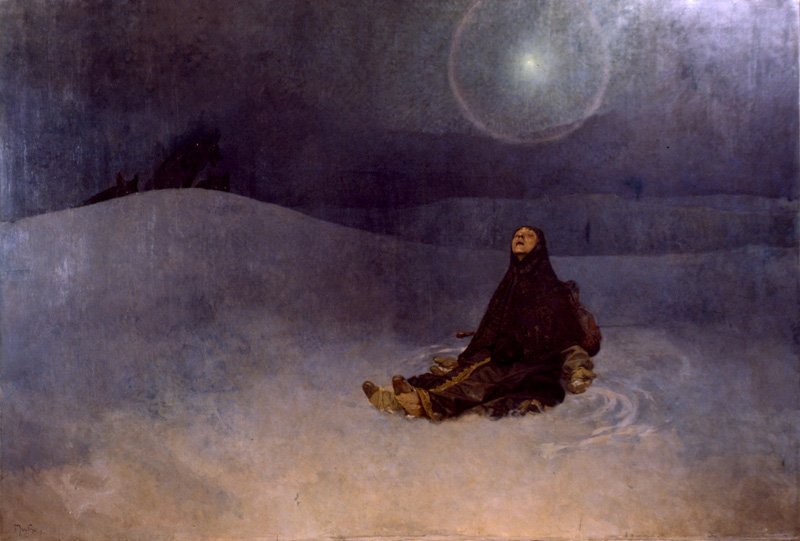
This is just stunning. Absolutely stunning. I started attempting to describe everything that makes this painting brilliant, and I just could not come up with a description that didn't sound like utter bullshit. I think the painting speaks for itself anyway. This is why I find this storytelling technique so effective--it forces the viewer to put the pieces together, and fill in the blanks in their own mind. The future and the past are simply products of our projection, triggered by the fleeting moment and what it signifies. It is an art, ultimately, of the suggestion--a kind of sleight of hand which convinces the audience to see what it wants to see.
And in the depths of our mind, our desire for narrative creates a sensation of an art that surpasses direct truth and enters into the sublime.
I'll be doing a followup article on this sometime next week. Remember my Shunga paper? It might have something to do with that. As always, feel free to leave comments, complaints, or, best of all, your own interpretations, or e-mail me at keeperofmanynames@gmail.com . And, if you like what you've read here, share it on Facebook, Google+, Twitter, Xanga, Netscape, or whatever else you crazy kids are using to surf the blogoblag these days.
When we think of storytelling we tend to focus on a certain set of standard models. Generally speaking, a story has a beginning, a middle and an end, with a number of changes or beats throughout that propel the plot forward. There's the possibility, of course, that these sections are arranged out of order, but generally speaking there's still a beginning middle and end, and there's still a set of beats that--even if they aren't chronological--move the reader to some sort of understanding.
And then we have something like this:
"Classified: Baby Goods. For sale, baby shoes, never worn."
An alternate version tossed around is:
"For sale. Baby shoes. Never worn."
According to legend, Hemingway turned this sucker out on a bet that he couldn't create a story with a beginning, middle, and end in less than ten words. In a way, he seems to have succeeded.
But on further analysis he really hasn't.
Not strictly, at least.
See, the interesting thing about this passage is that it actually does not contain a beginning a middle and an end within the text itself. The story is there, but it is generated due to the reader's interactions with the text--not in the text itself. It is making us--the audience--do the extra work.
This might seem like a dumb, finnicky thing to say, and to some extent it is, but it's worth considering due to the possibilities it opens up. Namely, the idea that you can encapsulate the suggestion of an entire story of hope, tragedy, and loss within a single moment. This means that a single scene, a single message, a single image can contain within itself the catalytic power that prompts the reader to generate the rest of the story. Let's look at a few new storytelling modes that this opens up, shall we?
Implied Narrative
I've actually already explored one mode of this sort of implied storytelling in my article on mechanical horror. Remember our friend Cloistered Youth? I would argue that the storytelling there is very similar to what Hemingway is using in the tale above. The card really just represents two separate states of being. The story comes from the fact that you are the one in charge of the transformation, and that the transformation takes place within the context of a wizarding duel in which you apparently are capable of making some pretty foul bargains. The story is ultimately a product of the player reading the mechanics as indicative of a wider story, just as the Hemingway take depends upon the reader interpreting a classified ad as indicative of a narrative.
There are a few other good examples of this in recent Magic: The Gathering sets. Again, I've tried to pick out stuff that is easily grokkable by a general audience. Check out, for example, this interesting piece:
This card is pretty straightforward. You give a temporary boost to one of your creatures so that it's better in combat. But the flavor of the card is particularly interesting from a narrative perspective because of the implications it sets up. Look at the bravado of that flavor text! Look at those glowing weapons! Look at that stat bonus!
...Now look at the seemingly endless crowd of zombies the guy in the art is jumping into.
And then look again at that last bit of text: "till end of turn."
Yep, this heroism is just a momentary thing. Eventually this faith that our hero prizes so highly is going to start to fade. And when that happens... well... tell me, do you think it's likely that he'll have taken down all of those zombies? Or even most of them?
Yes, what's interesting about this card is that it implies a beginning, middle, and end using only the middle section. The beginning and end are going to be a highly individual thing, but I suspect that the start is in the midst of a desperate last ditch attempt to stave off the forces of darkness, and the end... well, let's just say it won't be pretty.
Implied History
Drawing further away from Hemingway's model is this card:
It's also a card that moves away from my mechanical horror idea, because the mechanics of the card don't really matter all that much. In fact, the only thing that matters is that flavor text:
Underling Ethu's 263rd report read simply "Yes, my lord. Overwhelmingly, my lord." This marked the end of the Mirran-Phyrexian War.
Let me give you some backstory. This card comes from the third set of cards relating the story of the Mirran War mentioned above--a war between the natives of the strange metal plane of Mirrodin and the horrific colonizing and corrupting force of Phyrexia. The Phyrexians are beings that will restructure, reprocess, debase, corrode, and corrupt anything in the name of progress and improvement. They are the personified nightmare of technology in the hands of utter monsters.
And they won.
Not only did they win, they won without mercy, without quarter, without anything other than a simple mechanistic impetus to purify.
Now, this flavor text does not, on its own, say much of anything. But with this backstory of desperate survival it suddenly creates an evocative picture that an actual description could never create. It is a picture of a final desperate battle for survival on the planet's surface, a last ditch attempt to avoid extinction. And not only did the Mirrans fail, they failed overwhelmingly. I love, in particular, that this failure is relayed not with dramatic, tragic language, but with the simple, curt efficiency of these utterly inhuman victors. The horror and the tragedy of this loss blows me away, and part of the impact comes from the fact that the entire scene is created by my own mind. I'm not translating someone else's vision. It's all my own, prompted by the chemical catalyst of this text and what I already knew of the wider history and storyline.
This is actually a technique that I've seen used to great effect in short fanfiction. Consider this little piece by LessWrong, author of Harry Potter and the Methods of Rationality:
UTILITARIAN TWILIGHT
(Note: Written after I heard Alicorn was writing a Twilight fanfic, but before I read Luminosity. It's obvious if you're one of us.)
"Edward," said Isabella tenderly. She reached up a hand and stroked his cold, sparkling cheek. "You don't have to protect me from anything. I've listed out all the upsides and all the downsides, assigned them consistent relative weights, and it's just really obvious that the benefits of becoming a vampire outweigh the drawbacks."
"Bella," Edward said, and swallowed desperately. "Bella -"
"Immortality. Perfect health. Awakening psychic powers. Easy enough to survive on animal blood once you do it. Even the beauty, Edward, there are people who would give their lives to be pretty, and don't you dare call them shallow until you've tried being ugly. Do you think I'm scared of the word 'vampire'? I'm tired of your arbitrary deontological constraints, Edward. The whole human species ought to be in on your fun, and people are dying by the thousands even as you hesitate."
The gun in his lover's hand was cold against his forehead. It wouldn't kill him, but it would disable him for long enough -
Ahyup. We can, from there, imagine a whole potential range of conflict and adventure, all generated from this text colliding with the original idea.
Implied Character and Emotion
But what if we don't want a full narrative arc? I mean, that last category certainly seems to be drawing rapidly away from the idea of a narrative anyway. Do we need it at all?
Strictly speaking, I guess we do if we want to tell a story, but it can be just as valuable, I think, to express a powerful emotion or a sense of a characterization within a single moment. And it can certainly be just as difficult, because it still requires taking a basically two dimensional work and plugging it into a reader's mind to create a three dimensional impression.
This card does that well:
Look at that flavor text. Just... really, try to read that without grinning just a little bit. The sense of self-awe is palpable. You can practically hear the realization dawning upon Oglor that he is a being of immense power... but that this power is actually totally secondary to that of his Frankensteinian master. It's delicious.
So, from this small line of text, and the context given by the name and the setting, we can construct in our minds a whole characterization for Oglor. It's not a strict beginning-middle-end story, but it's still a whole scene and predictable set of characteristics drawn from our own interactions with people and our familiarity with the Igor archetype in scifi-horror.
This category is actually exemplified best, I think, in poetry and image-based art. I think my favorite example of this kind of storytelling through a single moment is Alfons Mucha's Star and Siberia:
This is just stunning. Absolutely stunning. I started attempting to describe everything that makes this painting brilliant, and I just could not come up with a description that didn't sound like utter bullshit. I think the painting speaks for itself anyway. This is why I find this storytelling technique so effective--it forces the viewer to put the pieces together, and fill in the blanks in their own mind. The future and the past are simply products of our projection, triggered by the fleeting moment and what it signifies. It is an art, ultimately, of the suggestion--a kind of sleight of hand which convinces the audience to see what it wants to see.
And in the depths of our mind, our desire for narrative creates a sensation of an art that surpasses direct truth and enters into the sublime.
I'll be doing a followup article on this sometime next week. Remember my Shunga paper? It might have something to do with that. As always, feel free to leave comments, complaints, or, best of all, your own interpretations, or e-mail me at keeperofmanynames@gmail.com . And, if you like what you've read here, share it on Facebook, Google+, Twitter, Xanga, Netscape, or whatever else you crazy kids are using to surf the blogoblag these days.
Wednesday, October 26, 2011
Playing the Devil: Mechanical Horror In Tabletop Games
Horror in games is a fairly well covered topic here on The Blogoblag.1 Son of Danse Macabre, in particular, just recently spat out a wonderful little article about how horror functions in games, both Zero Punctuation and Extra Credits have touched on the topic, and a number of games have come to fairly striking prominence in the past few year. (I'm thinking in particular of Amnesia: The Dark Descent, which is terrifying even to watch.)
But that's all video games. What about the venerable tabletop game? Can you express horror in a board game, or a card game, or a pen and pencil role playing game like Cthulhu Tech or Bliss Stage or even the venerable old Dungeons & Dragons?
It seems like a difficult proposition. After all, one of the advantages of a video game is that the calculations happen in the dark and murky depths of your computer or console. You don't have to think in strict statistical terms, "Ah, well, my guy has more defense than my opponent's power, so I can take this specific number of hits, and then if I draw this card..." The thought process is something more along the lines of, "AAAAH run run run run I'M SORRY I DIDN'T MEAN TO MESS YOUR CHAIRS UP--OH PISSING BLIMEY THERE'S JAM COMING OUT OF THE WALLS!" You are, in short, too busy panicking and either trying to fight or run for dear life from whatever horrible thing is loping toward you with it's jaw hanging off and its eyes derping out like it's been hit over the head a few too many times with a crowbar to notice the underlying specific mechanics whereby you are fighting or running &c. You can't really get away from this in a tabletop game, though. No matter what your level of complexity is, ultimately you have to deal with the mechanical reality of the game all on your own, regardless of the flavor of the game itself.2 (check the footnote for a definition of that term "flavor").
There are a few different ways to get around this problem. I generally see them as dividing into one of two categories: effects that happen within the game, and effects that happen within the game world. One is fundamentally nonimmersive: you are afraid, overjoyed, empassioned, whatever, because of specific things happening in the game that directly relate to whether or not you're beating your opponent's face. The other is immersive in that it causes you to perceive the mechanics of the game not as mechanics but as representations of something real, and something that is emotionally resonant. You feel things based on the implications of their mechanics, not on the actual results in game terms.
The first category is easiest to both explain and capture. To explain, I'm going to use some examples from the trading card game Magic: The Gathering. Don't flee just yet, though, I'm going to try to break this down in simple terms that even someone who does not play the game can understand.
Check out this card, from one of Magic's recent releases:

Yeah, I know. That text doesn't look super accessible, does it? It's full of technical jargon, really. But I'll sum it up for you. Basically, in Magic, in addition to losing if your life goes down to zero, you can also lose if you run out of cards in your deck.
So, what Grindclock does is it builds up the ability over time to destroy more and more of your opponent's deck. Eventually, you'll have ground down their library to nothing, and you'll win. What makes this card a horror card--albeit a not particularly strong or visceral one--is the fact that your opponent has a time limit. They now have a fairly specific number of turns before Grindclock starts destroying their deck. This is when the game gets a lot more visceral, because suddenly you're in a race against time to destroy this diabolical machine before it destroys you. So, when this card hits the field, the first instinct is the one described above.
Er... minus the bit about the jam.

So, alright, that's horror in fairly weak, nonimmersive form. How about something that starts to move toward our second category? What we've got here, even if you don't understand the exact numbers and whatnot, is pretty standard Lovecraftian fare. This is a creature that's big, noneuclidean, horrific, and capable of decimating your opponent's armies. What makes this a horror card is the way it really screws over your opponent in grand form. See, each time it steps up to the plate, your opponent's creatures start simply dropping dead. And, what's more, your opponent has to choose which of their creatures goes to the chopping block. And then, on top of that, as soon as your opponent condemns their loyal armies to hideous sanity wrenching death, the fallen soldiers rise again and start killing their former comrades zombie style.
What makes this card wonderful is the fact that not only do you get the clock effect of the above--your opponent ABSOLUTELY MUST ANSWER THIS THREAT or they are utterly screwed--you also get the immersive flavorful horror of the fact that this is an eldrich abomination that creates hoards of clearly tormented zombies. I mean, look at that art. That's not pleasant art.
But all of this is about making your opponent miserable. Is there a way of mechanically representing horror that affects anyone just looking at the card?
 Here's another interesting little fact about Magic's mechanics. Each creature has a race and class in its creature type. The race is something like Human, Elf, Werewolf, Goblin, and the class is a job like Cleric, Soldier, Warrior, and so on. Not every creature has a job--a class--but every creature has a race.
Unless you're talking about a Priest of Norn. Because those things... well... let me borrow a description from friend of the blog and guest contributor Yanmato:
So, that's one example of horror that is just inherent in some of the mechanics and flavor of a single card, horror that has less to do with what the card does once its in play and more to do with what it implies and depicts. But is there a way to mechanically represent something that, if you play it, will be more horrifying to you that to your opponent?

I think Cloistered Youth is a good example of this. See, this is a card with two sides. At certain points in the game, you can make the decision to flip it from the "good" side to... the other side. And... well...
That's what she turns into.
A lot of the horror comes from the art and flavor text. Look at the transformed flavor text: "The fiend tormented them by recounting the girl's memories, as if some part of her remained inside that twisted shell." That's some of the most horrific imagery I've ever come across, partly because it's a horror tinged heavily with despair--this isn't just "OH GOD SHE'S TURNED INTO A MONSTER," it's "Oh god, she might still be trapped in there, and there is nothing we can do to save her."
But that isn't enough for this card. Oh no. This card goes one step further with it. Look at the mechanical trigger for her transformation. "At the beginning of your upkeep, you may transform Cloistered Youth."
"...you may transform Cloistered Youth."
"...you may transform..."
Yeah. Think about that. That little girl that's trapped inside of a possessed horror? That sweet little doomed girl? Guess what?
You are the one that doomed her.
You are the one that chose to let her be consumed and devoured by the Thing inside of her, so that you could get a bigger, scarier monster. All so that you could win some stupid duel.
And you know, you could read the transformed ability as her taking chunks out of your life. Sure. That's pretty standard. But I prefer to think of that one damage you receive each turn as self-inflicted. This is the pennace you do--the suffering you inflict upon you own mind--in response to the horrible bargain you have struck.
This card tells a story each time you cast it and flip it. It tells a story about the dark depths to which you, yourself, can sink in the pursuit of power.
That's mechanical horror.
Thanks to the incredible posters over at the Wizards of the Coast Flavor and Storyline board. This article simply would not exist without your amazing help and input. I know I didn't do all the topics the justice they deserve, but maybe I can do a followup article at some point. As always, feel free to leave comments, complaints, or, best of all, your own interpretations, or e-mail me at keeperofmanynames@gmail.com . And, if you like what you've read here, share it on Facebook, Google+, Twitter, Xanga, Netscape, or whatever else you crazy kids are using to surf the blogoblag these days. Oh, and I'm looking for guest entries this month, so if you have something interesting to say about things that generally fit the theme, send them my way.
1. i.e. The Internet
2. "Flavor" is a term that refers to any of the nonmechanical aspects of a game. So, something like art style (or even the presence of art) is flavor, as is little text on a card or in a monster's description in an RPG that tells us what the creature looks and acts like, or what a spell does. The names of spells and creatures fall into this category, and even something that has a mechanical effect--a creature being a Dragon type, for example, or a certain spell being characterized as Ice Magic, or a weapon in a fighting game being counted as bladed rather than bludgeoning or whatever--can be considered "flavorful" effects, even though they have a mechanical side.
But that's all video games. What about the venerable tabletop game? Can you express horror in a board game, or a card game, or a pen and pencil role playing game like Cthulhu Tech or Bliss Stage or even the venerable old Dungeons & Dragons?
It seems like a difficult proposition. After all, one of the advantages of a video game is that the calculations happen in the dark and murky depths of your computer or console. You don't have to think in strict statistical terms, "Ah, well, my guy has more defense than my opponent's power, so I can take this specific number of hits, and then if I draw this card..." The thought process is something more along the lines of, "AAAAH run run run run I'M SORRY I DIDN'T MEAN TO MESS YOUR CHAIRS UP--OH PISSING BLIMEY THERE'S JAM COMING OUT OF THE WALLS!" You are, in short, too busy panicking and either trying to fight or run for dear life from whatever horrible thing is loping toward you with it's jaw hanging off and its eyes derping out like it's been hit over the head a few too many times with a crowbar to notice the underlying specific mechanics whereby you are fighting or running &c. You can't really get away from this in a tabletop game, though. No matter what your level of complexity is, ultimately you have to deal with the mechanical reality of the game all on your own, regardless of the flavor of the game itself.2 (check the footnote for a definition of that term "flavor").
There are a few different ways to get around this problem. I generally see them as dividing into one of two categories: effects that happen within the game, and effects that happen within the game world. One is fundamentally nonimmersive: you are afraid, overjoyed, empassioned, whatever, because of specific things happening in the game that directly relate to whether or not you're beating your opponent's face. The other is immersive in that it causes you to perceive the mechanics of the game not as mechanics but as representations of something real, and something that is emotionally resonant. You feel things based on the implications of their mechanics, not on the actual results in game terms.
The first category is easiest to both explain and capture. To explain, I'm going to use some examples from the trading card game Magic: The Gathering. Don't flee just yet, though, I'm going to try to break this down in simple terms that even someone who does not play the game can understand.
Check out this card, from one of Magic's recent releases:
Yeah, I know. That text doesn't look super accessible, does it? It's full of technical jargon, really. But I'll sum it up for you. Basically, in Magic, in addition to losing if your life goes down to zero, you can also lose if you run out of cards in your deck.
So, what Grindclock does is it builds up the ability over time to destroy more and more of your opponent's deck. Eventually, you'll have ground down their library to nothing, and you'll win. What makes this card a horror card--albeit a not particularly strong or visceral one--is the fact that your opponent has a time limit. They now have a fairly specific number of turns before Grindclock starts destroying their deck. This is when the game gets a lot more visceral, because suddenly you're in a race against time to destroy this diabolical machine before it destroys you. So, when this card hits the field, the first instinct is the one described above.
Er... minus the bit about the jam.
So, alright, that's horror in fairly weak, nonimmersive form. How about something that starts to move toward our second category? What we've got here, even if you don't understand the exact numbers and whatnot, is pretty standard Lovecraftian fare. This is a creature that's big, noneuclidean, horrific, and capable of decimating your opponent's armies. What makes this a horror card is the way it really screws over your opponent in grand form. See, each time it steps up to the plate, your opponent's creatures start simply dropping dead. And, what's more, your opponent has to choose which of their creatures goes to the chopping block. And then, on top of that, as soon as your opponent condemns their loyal armies to hideous sanity wrenching death, the fallen soldiers rise again and start killing their former comrades zombie style.
What makes this card wonderful is the fact that not only do you get the clock effect of the above--your opponent ABSOLUTELY MUST ANSWER THIS THREAT or they are utterly screwed--you also get the immersive flavorful horror of the fact that this is an eldrich abomination that creates hoards of clearly tormented zombies. I mean, look at that art. That's not pleasant art.
 |
| Note, in particular, the dude with a spear sticking out of him, covering his mouth in clearly self aware horror. [shudder] |
Unless you're talking about a Priest of Norn. Because those things... well... let me borrow a description from friend of the blog and guest contributor Yanmato:
"...When I first saw the art for Priests of Norn , I got cold. Almost from the art alone. Although, the fact that the card's creature types was just "cleric" helped. Not "human cleric" or "elf cleric" or "mutant cleric" or "construct cleric" or even "horror cleric." Cleric. There is no word for what they are. But we do have a somewhat poetic way of describing what they will do to you. They will cleanse you, purify you, and make you holy. They are... clerics. Of a sort."This is the part where you start shivering uncontrollably. Or is that just me?
So, that's one example of horror that is just inherent in some of the mechanics and flavor of a single card, horror that has less to do with what the card does once its in play and more to do with what it implies and depicts. But is there a way to mechanically represent something that, if you play it, will be more horrifying to you that to your opponent?
I think Cloistered Youth is a good example of this. See, this is a card with two sides. At certain points in the game, you can make the decision to flip it from the "good" side to... the other side. And... well...
 |
| Yeah. |
A lot of the horror comes from the art and flavor text. Look at the transformed flavor text: "The fiend tormented them by recounting the girl's memories, as if some part of her remained inside that twisted shell." That's some of the most horrific imagery I've ever come across, partly because it's a horror tinged heavily with despair--this isn't just "OH GOD SHE'S TURNED INTO A MONSTER," it's "Oh god, she might still be trapped in there, and there is nothing we can do to save her."
But that isn't enough for this card. Oh no. This card goes one step further with it. Look at the mechanical trigger for her transformation. "At the beginning of your upkeep, you may transform Cloistered Youth."
"...you may transform Cloistered Youth."
"...you may transform..."
Yeah. Think about that. That little girl that's trapped inside of a possessed horror? That sweet little doomed girl? Guess what?
You are the one that doomed her.
You are the one that chose to let her be consumed and devoured by the Thing inside of her, so that you could get a bigger, scarier monster. All so that you could win some stupid duel.
And you know, you could read the transformed ability as her taking chunks out of your life. Sure. That's pretty standard. But I prefer to think of that one damage you receive each turn as self-inflicted. This is the pennace you do--the suffering you inflict upon you own mind--in response to the horrible bargain you have struck.
This card tells a story each time you cast it and flip it. It tells a story about the dark depths to which you, yourself, can sink in the pursuit of power.
That's mechanical horror.
Thanks to the incredible posters over at the Wizards of the Coast Flavor and Storyline board. This article simply would not exist without your amazing help and input. I know I didn't do all the topics the justice they deserve, but maybe I can do a followup article at some point. As always, feel free to leave comments, complaints, or, best of all, your own interpretations, or e-mail me at keeperofmanynames@gmail.com . And, if you like what you've read here, share it on Facebook, Google+, Twitter, Xanga, Netscape, or whatever else you crazy kids are using to surf the blogoblag these days. Oh, and I'm looking for guest entries this month, so if you have something interesting to say about things that generally fit the theme, send them my way.
1. i.e. The Internet
2. "Flavor" is a term that refers to any of the nonmechanical aspects of a game. So, something like art style (or even the presence of art) is flavor, as is little text on a card or in a monster's description in an RPG that tells us what the creature looks and acts like, or what a spell does. The names of spells and creatures fall into this category, and even something that has a mechanical effect--a creature being a Dragon type, for example, or a certain spell being characterized as Ice Magic, or a weapon in a fighting game being counted as bladed rather than bludgeoning or whatever--can be considered "flavorful" effects, even though they have a mechanical side.
Subscribe to:
Comments (Atom)