The Worst Filing System Known To Humans

-Punk (5) A Song of Ice and Fire (2) Affect (9) Alienating My Audience (31) Animation (28) Anime (19) Anonymous (3) Anything Salvaged (15) Art Crit (42) Avatar the Last Airbender (2) Black Lives Matter (1) Bonus Article (1) Children's Media (6) Close Reading (90) Collaboration (1) comics (30) Cyborg Feminism (3) Deconstruction (10) Devin Townsend (2) Discworld (1) Evo Psych (1) Fandom Failstates (7) Fanfiction (28) Feminism (24) Fiction Experiments (13) Food (1) Fragments (11) Games (29) Geek Culture (28) Gender Shit (2) Getting Kicked Off Of TV Tropes For This One (11) Gnostic (6) Guest Posts (5) Guest: Ian McDevitt (2) Guest: Jon Grasseschi (3) Guest: Leslie the Sleepless Film Producer (1) Guest: Sara the Hot Librarian (2) Guest: Timebaum (1) Harry Potter (8) Harry Potter and the Methods of Rationality (3) Has DC Done Something Stupid Today (5) Hauntology (6) Homestuck (18) How Very Queer (35) hyperallthethings (10) hyperanimation (1) Hypercomics (11) I Didn't Ask For Your Life Story Sheesh (24) Illustrated (37) In The Shadow Of No Towers (1) It Just Keeps Tumblring Down Tumblring Down Tumblring Down (9) It's D&D (2) Judeo-Christian (9) Lady Gaga (5) Let's Read Theory (3) Lit Crit (20) Living In The Future Problems (11) Lord of the Rings (4) Mad Max (1) Madoka Magica (1) Magic The Gathering (4) Manos (2) Marvel Cinematic Universe (17) Marx My Words (15) Medium Specificity (15) Meme Hell (1) Metal (2) Movies (33) Music (26) Music Videos (21) NFTs (10) Object Oriented Ontology (4) Occupy Wall Street (3) Pacific Rim (2) Paradise Lost (2) Parafiction (6) Patreon Announcements (15) Phenomenology (4) Poetry (6) Pokemon (3) Politics and Taxes and People Grinding Axes (13) PONIES (9) Pop Art (6) Raising My Pageranks Through Porn (4) Reload The Canons! (7) Remixes (8) Review Compilations (6) Room For You Inside (2) Science Fiction Double Feature (32) Self-Referential Bullshit (23) Semiotics (3) Sense8 (4) Sociology (12) Spooky Stuff (45) Sports (1) Star Wars (6) Steven Universe (3) Surrealism (11) The Net Is Vast (36) Time (1) To Make An Apple Pie (4) Transhumanism (9) Twilight (4) Using This Thing To Explain That Thing (120) Video Response (2) Watchmen (3) Webcomics (2) Who Killed The World? (9)

Reload the Canons!

This series of articles is an attempt to play through The Canon of videogames: your Metroids, your Marios, your Zeldas, your Pokemons, that kind of thing.

Except I'm not playing the original games. Instead, I'm playing only remakes, remixes, and weird fan projects. This is the canon of games as seen through the eyes of fans, and I'm going to treat fan games as what they are: legitimate works of art in their own right that deserve our analysis and respect.

Showing posts with label Music Videos. Show all posts

Monday, June 21, 2021

In Search Of More Applause: 'Inside' And The World Neoliberalism Promised

Bo Burnham's movie "Inside" stretches the term "comedy special" till it shatters. Why does its clutter of fragments cut so deep? Maybe because of how it reflects the world neoliberalism promised us...

content include: spoilers for Inside, neoliberalism, suicide, jokes about suicide, jokes about jokes about suicide, self-referentiality, audience hostility, alienation.


Wednesday, August 19, 2020

Room For You Inside: Pink Floyd In Quarantine

You barricade yourself in your hotel room; it becomes a fascist rally. You write a concept album about your alienation; it becomes the Thatcherite Revolution. You live in modern luxury; it becomes a mad haunted house. This is a story about Pink Floyd's The Wall and the culmination of half a century of No Alternative.

Content warnings for discussion of quarantine, isolation, apartment horror, drug abuse, mental breakdowns, neoliberalism and its brother, fascism.

Monday, July 18, 2016

Sweetest of Sounds Turned to Raging Thunder: Silverthorn and Ghostly Trauma

It's no secret my musical taste is pretty questionable. And part of that deeply questionable taste is an abiding love for symphonic metal concept albums. But there's concept albums and there's concept albums--not everything can sustain an entire article. You have to have a really compelling story, like say, an alien on a galaxy-spanning rampage in search of the perfect cup of coffee.

Kamelot's album Silverthorn is such a story. I'm continually fascinated with this album, in fact, because of the concepts it's particularly preoccupied with, and the way its recurring symbols haunt it, lurking within a twin(n)ing and reflexive narrative. Silverthorn is really an album about trauma and how the failure to grapple with trauma leads to further violence and trauma, all in the context of a Victorian gothic setting. This is interesting to me because it feels like a departure to me from the kind of masculine posturing present in so much metal, and it's also deeply engaged with a kind of hauntological tradition, a tradition of gothic ghost stories in which the repressed returns with a vengeance and the boundaries between the natural and supernatural are hazy at best.

Now, critical to the album is one particular motif which haunts the contents, a set of notes that I'll call the Silverthorn theme--not Silverthorn the album but its namesake, a beautiful silver-tipped cello bow.

It is this cello bow that in the climactic scene of the narrative becomes a murder weapon.

Yeah, I wasn't kidding when I called this a gothic story. This is a story where extended families die out in mysterious circumstances, characters chase ghosts through labyrinthine churches, and people get stabbed through the heart with musical instruments as part of sinister plots. And part of the reason I love this, like I love most metal really, is that it's simultaneously ridiculous in the extreme while also being carefully composed and deeply compelling. This is the space that the Gothic at its best tends to inhabit. Think of Bill Sikes being chased by the ghost of the murdered Nancy in Oliver Twist, ultimately being driven by this possibly imagined pursuit and the very real pursuit of an angry mob to an accidental self-hanging. This is our domain for this album and core to understanding it, I think, is this interplay between the over the top and the emotionally resonant, as well as the ambiguous status of the haunting.

Anyway, the Silverthorn motif, which can be found in the chorus of the title track ("Pale in the moonlight, the bringer of pain...") haunts the album, weaving back and forth across its narrative as the reverberations of the story's central trauma rattle an entire family to pieces. If this is a somewhat ambiguous ghost story, the ghost just might be the Silverthorn motif itself, a melody that the main characters can never seem to escape.

Now I don't think this is necessarily an album where you have to understand the story in detail to understand the music. The album gives enough details to help you puzzle out some of the basic story, and the very compressed narrative of the (shockingly pretty damn good) video for Angel of Afterlife provides an overview, albeit one that has an odd relationship to both the album itself and the written story of the album (more on this momentarily). The basic thrust though is that this is a story about a tragedy that befalls a family and how they fail spectacularly to grapple with that tragedy. Which of course I love, people failing spectacularly to deal with the world is kinda my bread and butter; it's why I'm an Evangelion fan. So this family of nice Victorians has two twin sons, Robert and an unnamed narrator, and one younger daughter, Jolee, and the story starts with an accident involving the three children where the sister is dragged by a kite that the three of them are playing with into a river and is swept away. The boys, blaming themselves for her death, and terrified of punishment, hide their knowledge of how the accident occurred, but mark their skin with a word to remind them of their involvement in her death:

"Veritas".

Truth.


Tuesday, February 9, 2016

Stars Are Never Sleeping: David Bowie's Last Albums and Cosmic Horror


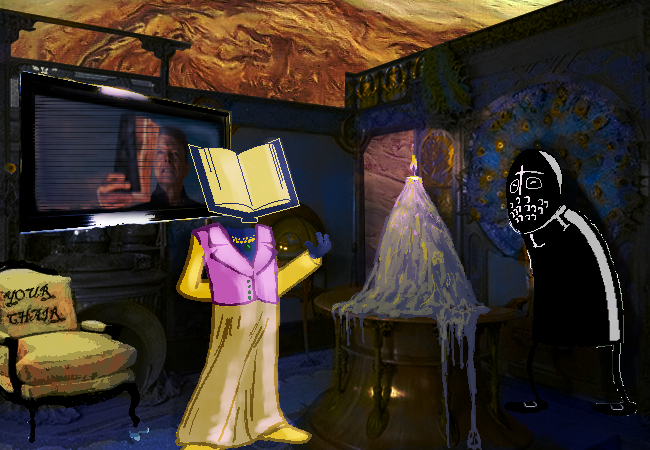
You arrive at the pub to find it strangely transformed. Not the gaping hole providing you with a view of the tempestuous heart of Jupiter's great red spot, no, that was already there. The dim lighting is new though, as is the giant, dripping candle standing on the table... and is that David Bowie on the screen over there? It is, it's a music video from that album he put out right before he died! Just what is going on here?

Sensing another dire misadventure, you begin to edge out the door. But Abraxas the Hideous Armchair Rat and Lord Humongous block your way! Curses.

Your captor looks up from your chair and claps their hands together happily. "Ah, you're here!" they say cheerfully. "Finally, the ritual can begin! But first, let's talk about David Bowie and the use of weird horror tropes in his albums. I think that will help to clarify what's going on here...

I had a dream the other night about David Bowie.

It wasn’t as exciting as it sounds. He was giving me an art critique. Not… not what I hoped from a David Bowie dream, frankly. Particularly since he didn’t like my painting very much.

But the thing was that within the dream I knew that David Bowie had died, but there he was, still telling me with sadness in his eyes that my paintings just weren’t very good. And my rationalization of this within the dream was that the reality of David Bowie’s death had yet to reach this part of the world, this backwater in which I live (Canada). The news of his death preceded the gravitational wave of its reality--news traveling faster than the sluggish transmutations of matter.


Tuesday, June 17, 2014

Janelle Monae: Contemporary Queen of Science Fiction

Science fiction is just an exciting and new way of telling universal stories and it allows the reader to come to the conclusion and draw parallels between the present and the future. I don’t think we enjoy when people remind us, today, this is what’s going on in the world. You know, sometimes we’re so used to hearing that this is what’s happening right now that we become numb to it. So when you take it out of this world, [people] will come to the conclusions themselves.
I think it’s important: whatever way you can get the audience’s attention to listen to your message, a strong message at that, then by any means. I think science fiction does that. --Janelle Monae 
I imagined many moons in the sky lighting the way to freedom. --Cindi Mayweather

My second article ever for Storming the Ivory Tower was about Lady Gaga--specifically about the video for Bad Romance and the implications of its science fiction stylings. It pretty much set the tone, framing narrative/persona, and purpose of the blog, and it also led to a whole string of articles on Gaga over the next few years--what her videos have to say symbolically, narratively, and thematically, and how they fit into wider popular culture.

But I'm bringing it up today not because of any of that nonsense but because of the particular conversation I spun out of it on pop music and science fiction which arguably spanned across these four articles. See, I was partly inspired in my analysis by an article (which I can't find now, unfortunately) that suggested that Gaga was one of the most significant voices in contemporary science fiction. That notion fascinated me because up till that point I had generally seen different media treated as fundamentally segregated from each other--you wouldn't see a list of the best Sci Fi stories of all time including a concept album, a short story, a novel, a live action movie, a TV series, and an anime all listed together. You still wouldn't, I think.

That segregation might go a long way to explaining why rapper and R&B musician Janelle Monae is not known to more fans of speculative fiction. Explains, but not excuses, because Monae should probably be crowned High Queen of the Geeks. How can I justify a statement that hyperbolic when a whole segment of my audience has almost certainly never heard of Monae? Well, just for starters, literally everything she's put out has involved a lengthy story involving this character:


Meet Cindi Mayweather, the Alpha Platinum 9000 android: your new Queen.

Wednesday, September 18, 2013

Our Love Is Synthesis: Muse, Marx, and "Madness"


Let's talk about Madness.

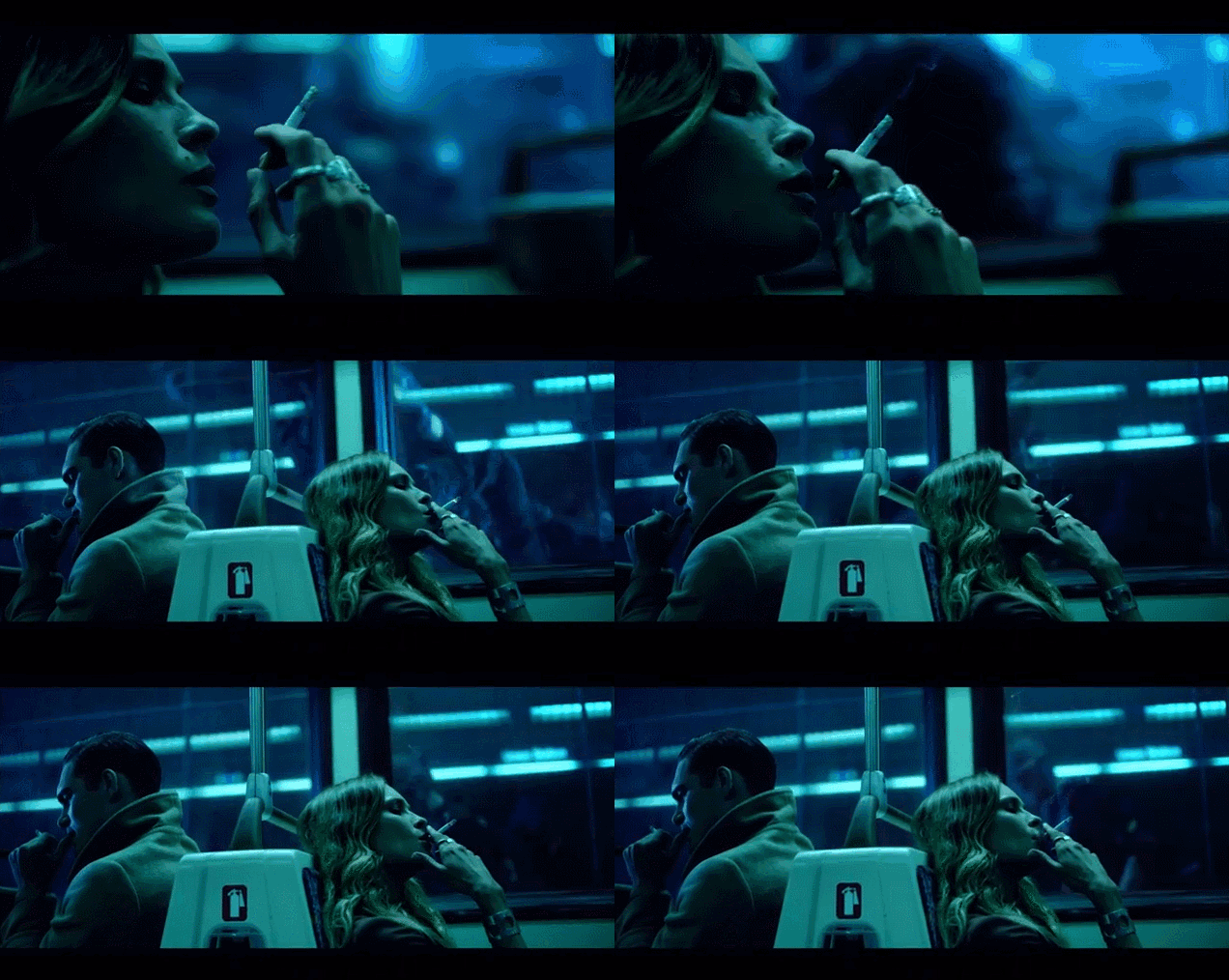
Specifically, the song Madness by Muse and its accompanying music video.

It's actually a favorite of mine, as is the song. Muse on this track really shows off their versatility--they're a band that's often been compared to a mashup of Queen and Radiohead, but here they sample stylistic elements from Dubstep to pretty excellent effect. You can never say, of Muse, that they don't push their boundaries.

In a way, that's kind of what I want to talk about tonight. I think the idea of pushing and finally shattering boundaries is essential to a lot of what Muse does, and is certainly central to what's going on in this video. The video is fairly simple in construction--it shows a man and a woman in a subway station, circling around each other and finally sharing a pretty intense kiss. This is intercut with images of the band, and images of a riot. Now, we could read this simplistically as just Muse's attempt to build energy throughout the song by using these images of violence--as an adrenaline-boosting strategy--but (surprise, surprise) I think there's a lot more to these juxtapositions than simple appropriation of images we've seen frequently in the media over the last four years.

To get at what Muse is saying with this video, though, we've got to turn (again, surprise, surprise) to some theory.

Specifically, we need to understand the idea of the Hegelian Dialectic... or at least, the Hegelian Dialectic as interpreted through interpreters of Marx. Yeah, already things are getting a bit dense. Look, the problem here is that Hegel, the philosopher that came up with the notion we're going to discuss, isn't necessarily the most important person to write on these ideas. Rather, it's his ideas interpreted through Marx (essentially the father of Communist thought) and through Engels (Marx's collaborator), and then filtered through other thinkers, that we're most interested in. Honestly, some of what I'm going to be discussing is also filtered through my own interpretation of what other scholars have told me, so this is pretty far removed from the source.

This actually works in our favor, though, because what comes out the other side is a highly symbolic, highly romanticized understanding of Hegel's ideas, which fits well with a reading of an emotionally-charged piece of art.

"Get to the point!" you howl and wave your flagon in my general direction!

Don't be impatient! You can't start being an Antithesis until I present my Thesis! You're jumping ahead!

Which is really what the Hegelian Dialectic--or, for Marx, the Dialectical Materialism--is about.

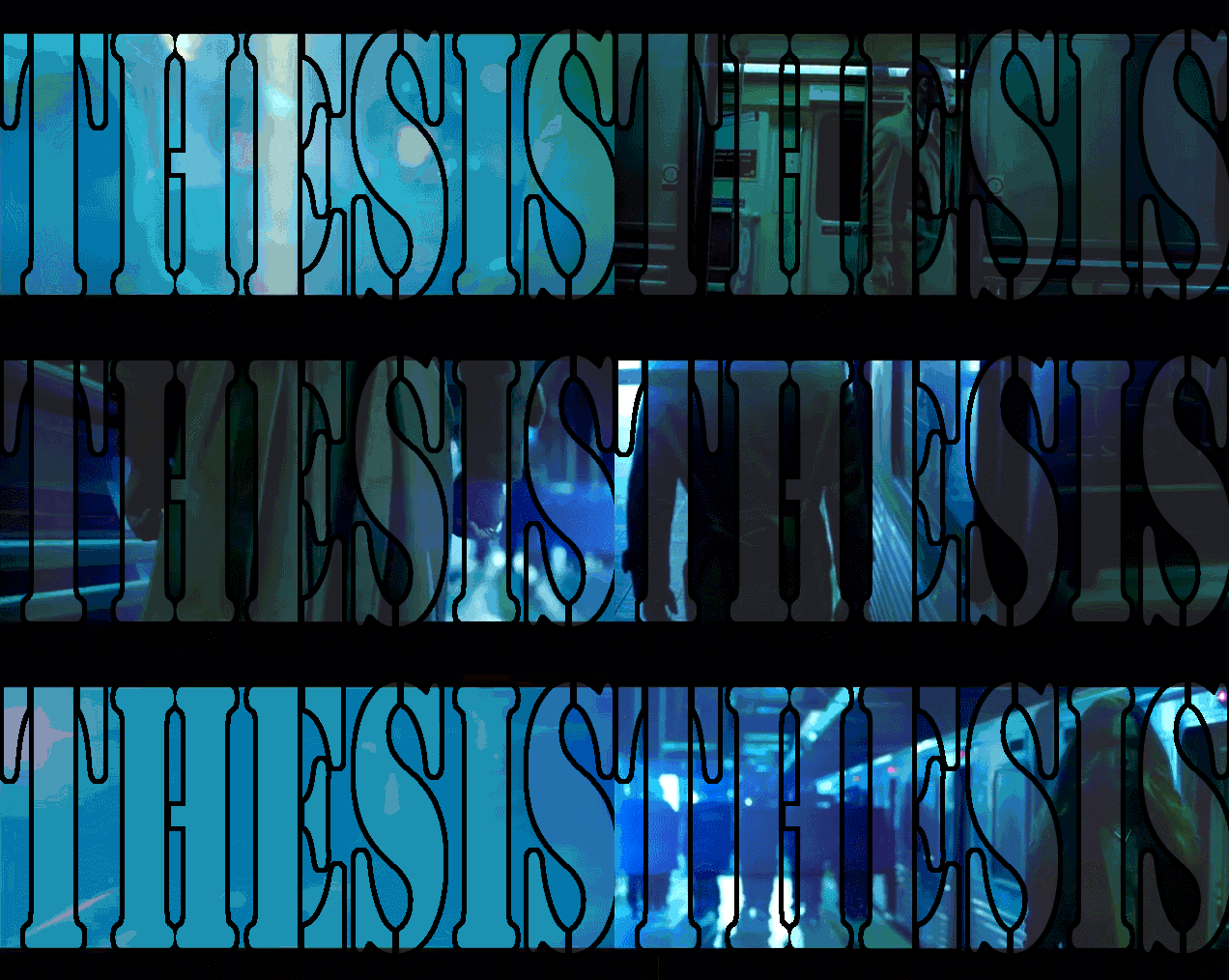
There's a Thesis--this is a state of being, a power structure, a dominant idea.

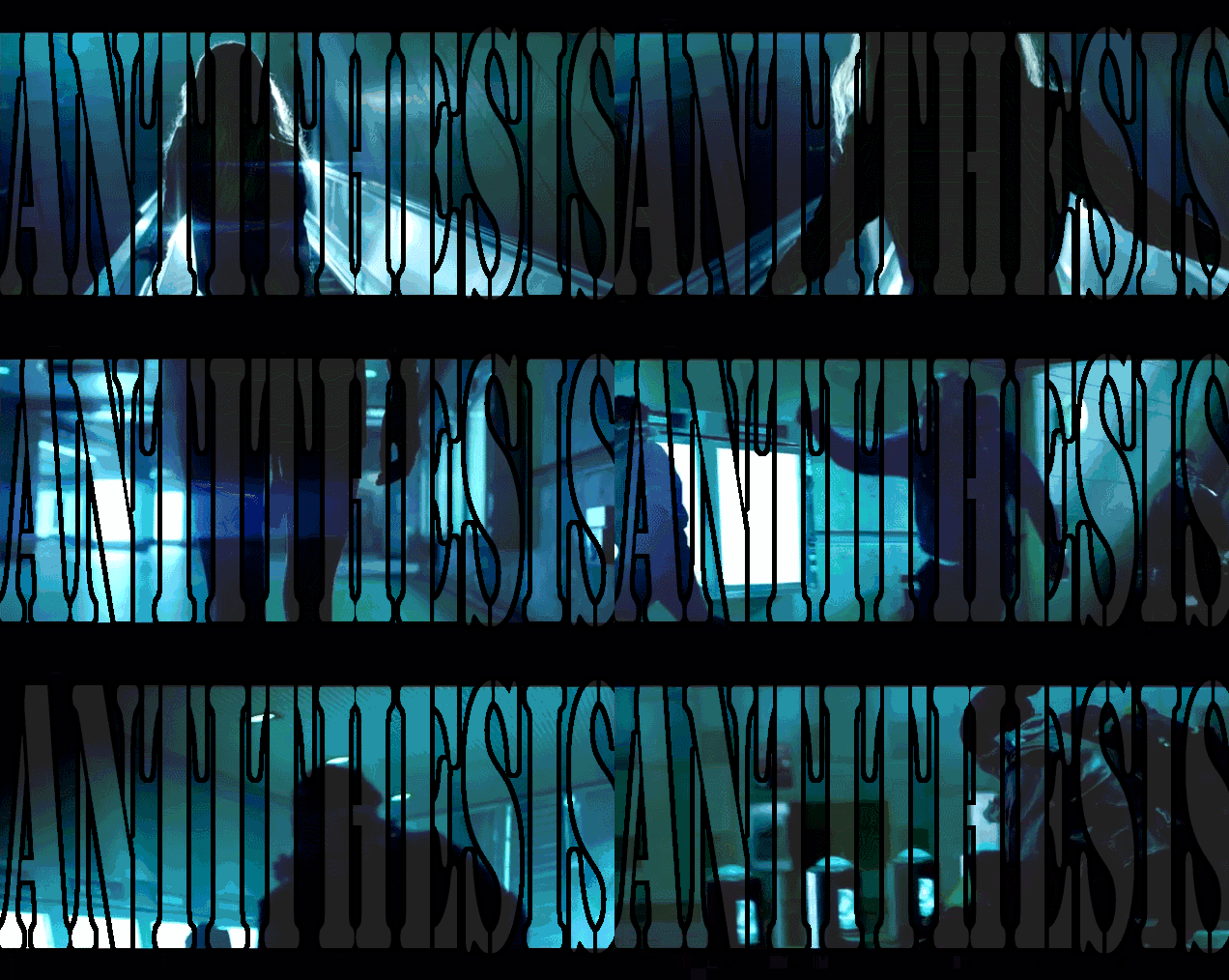
Then there's an Anthithesis--the alienations and contradictions and things left disenfranchised by the Thesis.

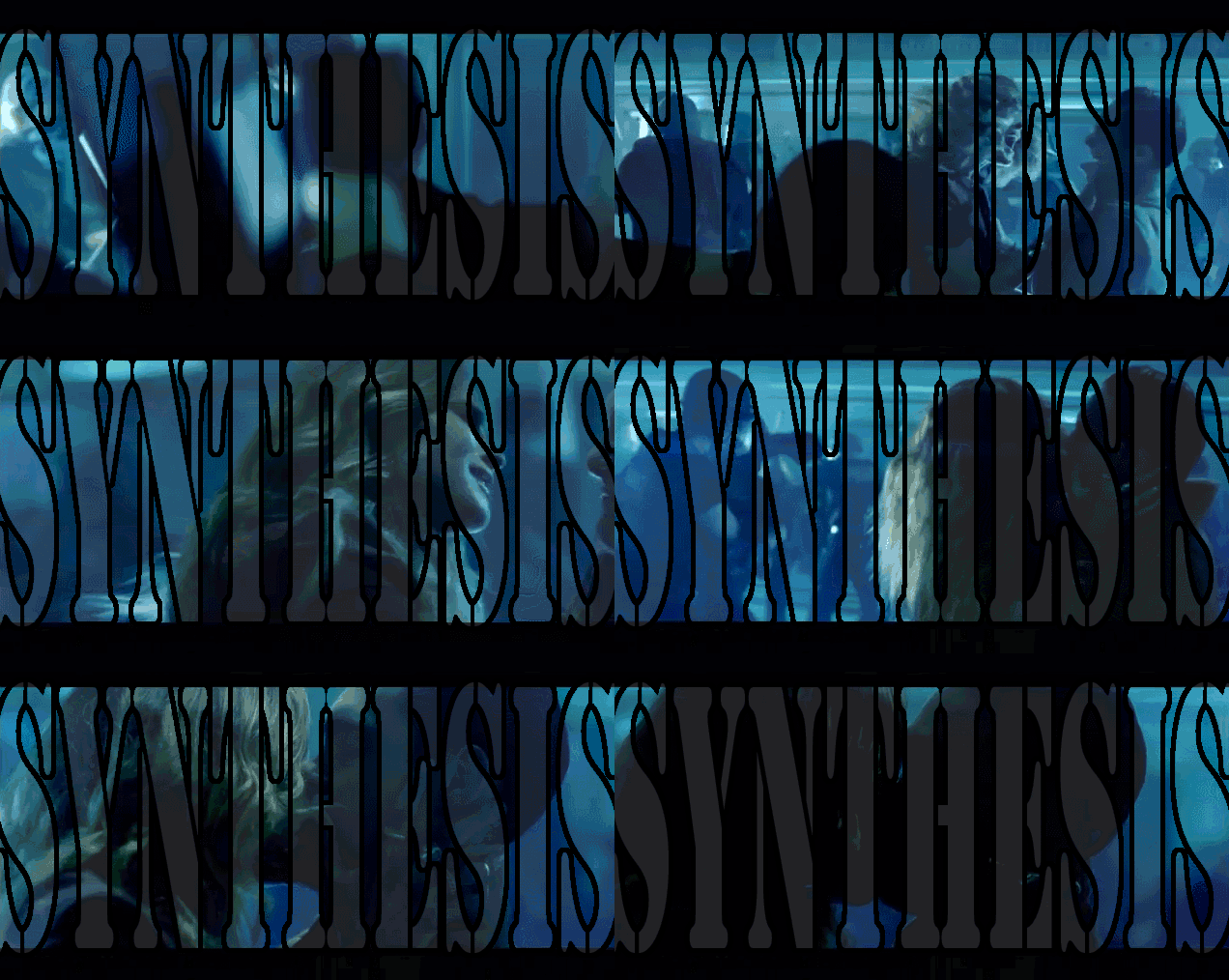
And then, when the two ideas come together, as when your beer sloshes into my wine while you're waving your cup around angrily, they create a Synthesis, an new form that arises from the clashing of a state of being and its contradictions. For Marx, who's going to be important for this essay, these referred to material states of being--i.e. the thesis is a way of ordering society that leads to a series of problems and people who have been disenfranchised--antithesis--resulting in a revolution of the ordering of society. The synthesized society then becomes a new thesis with its own contradictions.

Of course, no one actually agrees on anything about the Dialectic. Some scholars even claim that Thesis-Antithesis-Synthesis has nothing to do with Hegel's real ideas! It's basically a giant, hideous mess.

But we don't care about any of that, because regardless of their source, the Dialectic is a powerful, powerful meme, with resonances built deep in Western history (compare, for example, William Blake's idea that you need to merge Heaven and Hell in order to create something new). It's less important to me what Marx or Hegel really, truly said and more important to see this powerful notion of a thing smashed against its opposite in order to create a new thing.

What does this have to do with "Madness?"

Only everything.

Let's talk dialectics.


"Madness" is really not a song about madness alone.

It's a song about an opposition.

Love... and Madness.

That structure is repeated everywhere throughout the video and song.

First, we have the lyrics themselves:
And now I need to know is this real love,
Or is it just madness keeping us afloat?
And when I look back at all the crazy fights we had,
Like some kind of madness was taking control
Here's where the opposition is most explicitly stated, but the other verse has a similar structure to it--a state is posited, and then madness is reintroduced into the song. The states of being are worth examining though. Most significant, of course, is the suggestion that one of the two possibilities is "real love." This, to me, seems like the dominant idea or Thesis. We could extrapolate a bit here and suggest that this is a traditional, stable, picture-perfect relationship. It is easily understood, orderly, and genuine.

This notion is paired in the video with two major things: the male character (notionally linked to the male singer) and the militant police state. Look at the header for this section: the video makes heavy use of the "montage" technique, which is widely known in pop culture as "that thing where they show a bunch of clips of people doing stuff really fast so that it seems like lots of stuff is getting done," but which really means a series of cuts between different footage meant to draw out associations between the things depicted. It's a major feature of early Russian cinema (sometime I'll have to get Sara to write something with me on that--she's done research in this area), incidentally, while we're on the subject of Marx. Here, the montaging is used to draw a connection between the man and the riot police. As he walks down the side of the subway car, his motions are intercut with shots of the marching riot police, and finally the sequence concludes with a shot of the woman followed by the police.

So, the thesis here is both the male figure, and the spectre of state power and repression.

This is pretty wild, actually. "Love" being linked to an army of riot police marching in time to crack the heads of the proletariat, or to a guy following a woman through a subway station? Kind of Orwellian, and more than a little creepy, no?

Well, maybe. There's more going on here than what's apparent on the surface, though. First of all, the suggestion in the song is that the concept of "real love" has become a constraint, a box within which the implied relationship is not fitting comfortably. Love is an absolute ideal, a perfect state, just like the state of law and order upheld by the noble police force. The video and song paired together, then, suggest that the Thesis here has started to crumble due to its own rigidity and inability to deal with... what? Well, the Antithesis, in its tripartite form.


The Antithesis is Madness. Here, the comparisons fit a little more readily. Madness can be seen as disorder, chaos, disruption. It is commonly linked to artistry in part because of its potential to upset expectations and preconceptions. It is the entity that won't fit comfortably within an established box like "Love" and "Law" and "Order."

And in this video, it is the disenfranchised rising up from a state of poverty and repression and just straight up wrecking shit.

But what's interesting to me is the fact that the Antithesis is given subjective privilege within this song. The speaker is the Thesis, the Male, the State, Love, but the subject of the song, the driving force within the song and within the video, is the Antithesis, the Woman, the Proletariat, Madness. The word "love" only appears in the second verse. Before that, the idea of love exists only as an implication, a prior assumed state, just as the society we exist within is an unexamined entity that is only given form when it is contrasted with its shortcomings. Similarly, the man and his stated doppleganger is given focus in the second verse. The scenes in the clip above come from the first segment of the song, where, again, montage is used to link the woman notionally with the rioters, passing through the subway backdrop (and what a perfect image of the dream of order opposed by the material reality of crowding, poverty, and refuse!) as a primal storm of upheaval.

It would be easy to read the interactions between the man and the woman here quite shallowly as a creepy dude following a hot chick, but she is, quite explicitly, flirting with him constantly, daring him to come closer while simultaneously seeming threatening. The song, the speaker, the man, and the State, are all overwhelmed and driven by this force that they don't fully understand and don't know how to react to.

Muse's sympathies clearly lie with the antithesis--fitting, for artists. The antithesis offers the possibility of something new and unexplored (like, say, the possibilities of using dubstep techniques within the context of an anthemic Queen-esque rock band's ensemble?) and, rather than a sign of things going horribly wrong, it is a captivating force.

And it is this captivating force that will ultimately take control of the song, the video, and the world.


Can we just take a moment here to talk about how great the structure of this song is? The dubstep qualities to it set up this really excellent sense of expectation which is continually deferred. Normally, in a dubstep song you expect to have some sort of buildup until the bass is proverbially dropped and Skrillex is out another Italian Upright. But in this song, we wait around perpetually for the climax. Just when we think it's finally maybe about to start after the second verse, we get shunted off again as the music tones down again for a stripped back sounding and relatively simple (especially compared to some of their other work) guitar solo. This is in stark contrast to Follow Me, another track on this album that has a much more traditional buildup and break structure including dropped bass and all.

For this song, then, Muse wants to tease us.

For this song, they're drawing the foreplay out... just as the aggressive flirting is drawn out throughout the video, until we finally reach the climax:
But now I have finally seen the end
And I'm not expecting you to care
But I have finally seen the light
I have finally realized
I need to love
I need to love
The confusion throughout the song and video are finally getting resolved, as the woman grabs the man by the jacket and the riot police finally clash with the protesters. Form itself becomes distorted at this point as blurred figures merge into one another. Here, again, love reappears, but it seems to be undergoing some process of redefinition that makes the early question of whether or not it is "real love" immaterial or irrelevant. The singer needs to love, regardless of how it is interpreted.

And in that moment, synthesis occurs.
Come to me
Just in a dream.
Come on and rescue me.
Yes I know, I can be wrong,
Maybe I'm too headstrong.
Our love is Madness
Not, "our love is like madness" or even the earlier "is our love madness," "our love IS madness." I love, love, love that in the video at this point it's very clear that the woman is pulling the man into the kiss. She is the one with all the power here, and it's... it's not even just sexy, it's downright breathtaking. At this point the sexual subtext of the video is barely even subtext anymore. It's basically just straight up text. I mean, the video ends with:


...Which I'm pretty sure is basically the universal movie signifier for "We just fucked." And in the background someone gets hurled against the wall of the subway car. Alright.

The suggestion, then, is that the social upheaval seen in the video is analogous to the kind of emotional turmoil experienced in the song, where the singer has to reconcile himself to a love that doesn't fit within his narrow understanding. Love IS Madness in the end, and the singer acknowledges, as the state ultimately must, that it "could be wrong" and may be "too headstrong," too in love with authority, too tied to existing power structures.

We have here nothing less than a romanticization and eroticization of revolution and uprising. By drawing these notions parallel to one another, Muse suggests that social disorder like we are experiencing now should be seen as an exhilarating start of a confusing, as yet undefined state of being. In that sense, despite the heterosexual pairing in the video, I might even suggest that the video is queering revolution by comparing it to the kind of unstable, rough, contentious power dynamics that you might find in BDSM (not without precedent in theory, incidentally--theory writers, it turns out, are kinky as fuck).

Synthesis is therefore both threatening and compelling, a creative force that we should welcome rather than fear, as the Thesis might.

I really can't quite express just how brilliant I think this video is. It's working on so many levels at once, and it's impossible to say just which is supposed to be the metaphor and which is supposed to be the thing represented. Every set of notions can be switched and jumbled around with another set in a kind of orgiastic mating of symbols. And, of course, it's hot as hell. God, that moment when she just sort of digs her hand into his shoulder... [bites lip]

The point is, this video and song are built entirely upon the Dialectic--the Thesis is confronted by an Antithesis that it can't easy absorb back into its prior state, so it needs to adapt and be changed in order to reach a new stable point. These individual components, though, are reflected across an array of symbols and actors within the narrative, to the point where the nature of the song itself becomes indeterminate and suggestive of new possibilities.

It is in that uneasy territory between opposing things that both art and interpretation hover, finding unity and opposition again and again, madness keeping it afloat.

Human theorists would never be able to adequately diagnose the relationship between the Antithesis and her Thesis. But troll theorists could immediately place it as a dead ringer for kismesissitude. They would think we were all pretty stupid for not getting it. And they would be right. Follow stormingtheivory.tumblr.com for updates, random thoughts, artwork, and news about articles. As always, you can e-mail me at KeeperofManyNames@gmail.com. Circle me on Google+ at gplus.to/SamKeeperIf you liked this piece please share it on Facebook, Google+, Twitter, Reddit, Equestria Daily, Xanga, MySpace, or whathaveyou, and leave some thoughts in the comments below.

Tuesday, June 25, 2013

[S]A6:A6:I1: Homestuck vs Tech Demos, or How To Write Hypercomics Like A Boss

So, for those who haven't heard, Homestuck, Andrew Hussie's mindbending, ultra-dense epic about friendship and tentacle sex (note: the last one may be only in the minds of fans), just came out of the Year Four Megahiatus--a months-long pause in the narrative that Hussie used to prepare for the conclusion of the story and the creation of the video game that fans gave him several million dollars to fund. And, true to form, it came out of the hiatus first with what I can only call a prolonged satire of the worst parts of Homestuck's hatedom and fandom alike, followed by...

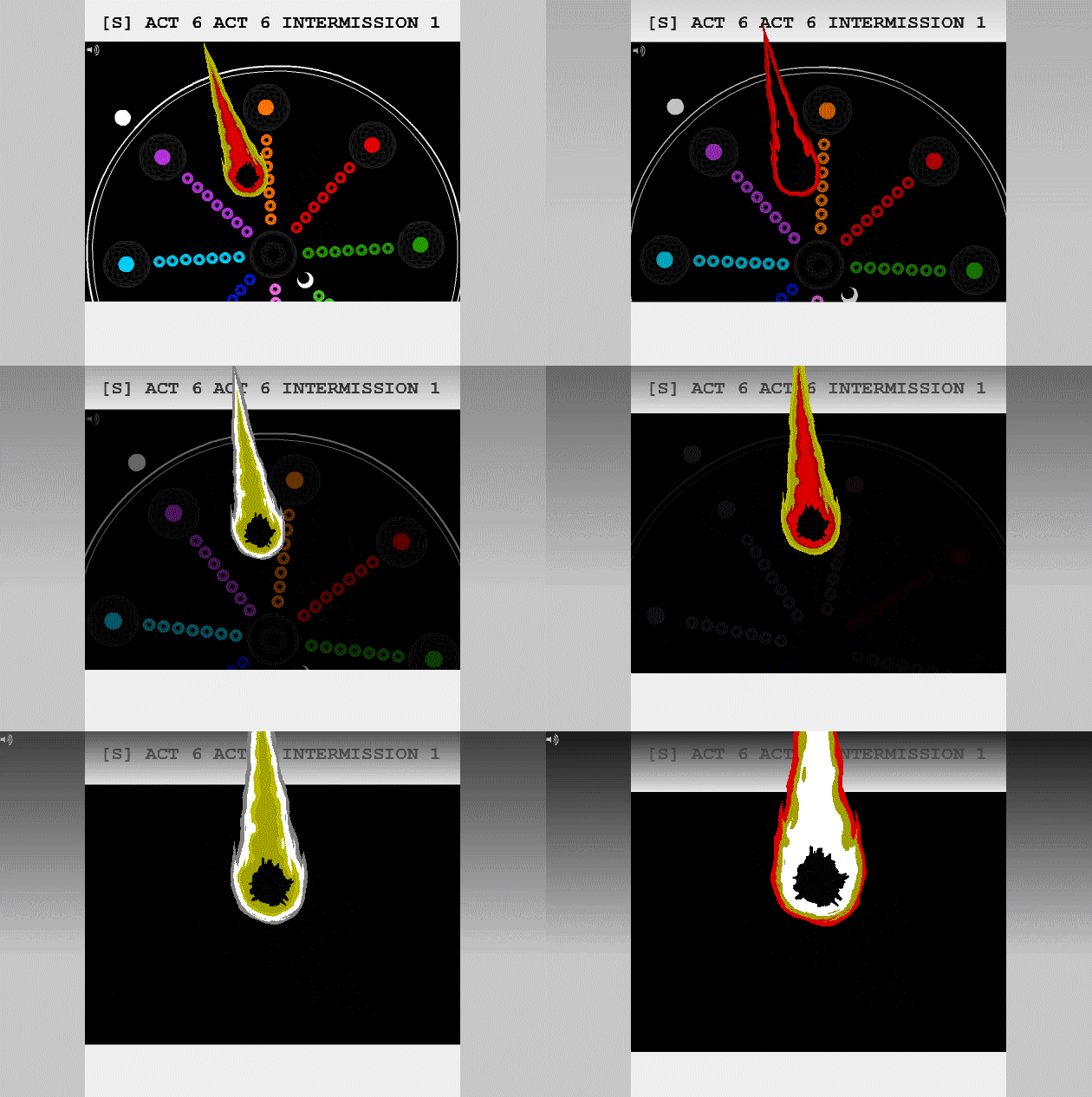
Well, here's where things get tricky, actually. I'm not quite sure how to describe [S] Act 6: Act 6: Intermission 1. I've used the term "hypercomic" to describe Homestuck before. That's a bit of a contentious point right there--Alycia Shedd, another hypercomic theorist I'm acquainted with, suggested to me the other day that it's more like an illustrated novel than a comic, and there's maybe some truth to that. Even if we do accept it as a comic, there's definitely some individual elements that jump fully into other media--animation, games of various types, and, at one point, historical romance novels. [S] A6:A6:I1 is one of those points--it's undeniably an animated sequence (images juxtaposed temporally), not a comic.

And yet... there's a number of elements that are more akin to hypercomic technology than anything else I've seen. So, maybe what we're looking at here is a hyperanimation?

This is a big deal because it gives Homestuck yet another You Were Number One achievement badge to sew on its kiddy camper handysash. A hypercomic that's already broken so many other boundaries is, apparently, gleefully breaking new ones with every few updates these days. Hell, this comes shortly after an update that turned Homestuck into a type of hypercomic that up till now was almost purely theoretical. (I'll explain more about that in a moment.)

The most notable part of this, however, is that it again underscores Homestuck's unique qualities--the things that set it apart from other formalist experiments.

[S]A6:A6:I1 isn't powerful because of its formal, experimental elements.

It's powerful because those elements are used to express a powerful, dramatic moment in the story.

I want to try to get at why, which is going to necessitate some discussion of the narrative. For those of you who haven't read any of Homestuck, this surprisingly makes for an ideal element to discuss, as the events are weird enough (and short enough) that by the time you return to this point in the comic it'll be a surprise all over again. (Homestuck's looping narrative actually makes for a great natural spoiler-baffle because it takes so long to read and there's so many twists and turns). I DON'T recommend continuing if you're almost caught up, however--there's just enough visual information that you can piece together some of what's happened in the last few acts. Anyway, the point is that this article should be comprehensible even to those of you who haven't read the comic while not going old information for those of you who have kept up with these recent updates.

I should also warn you that while the first half has lots of juicy textual analysis, the second half is application of the lessons learned to some other stuff, so I'm gonna drift away from Homestuck for a bit. If you're just here for the analysis of [S]A6:A6:I1, you can check out that that point, it's cool, although I'd be most obliged if you stuck around.

Cool?

Cool.

Let's begin.

What Is It Doing

Part of what makes this video so interesting is its relationship to Homestuck as a whole. Before we start analyzing, let's take note of the dimensions of the starting screen. That's the standard layout for Homestuck, the norm from which panels sometimes (or, recently, frequently) deviate from. If you've been following this blog for a while, you might recall that I find such deviations to be particularly interesting, because they often work viscerally on a reader, emphasizing certain emotions, sensations, or narrative elements through their structure. (The only reason I haven't discussed it more is because I'm turning this idea into my grad thesis, so I want to keep it just a little under wraps for now. Well, that, and the actual nitty gritty underlying theory would probably be a huge snoozefest for most anyone that isn't me.)

Keep this idea of norms and deviations in mind as we start watching:

[S] Act 6: Act 6: Intermission 1

Did it take a moment to realize that the comet was breaking the panel border?

The first time, it caught me off guard. I wasn't expecting that transition at all, and it crept up on me, partly because it was so smooth:


I love the way this video begins, actually. It starts with a purely symbolic representation of the universe that the game encompasses--eight planets connected by seven gateways to the central entity known as Skaia, and through that abstract space flies a massive meteor... a meteor which then breaks the panel border.

So, let's start there. What is Hussie trying to show us through that strange breaking of form? Why shatter the established page boundaries here?

Well, first of all, notice how there are four planets to start with, with four more appearing. This is a symbolic representation instantly understandable to fans--it signifies that two universes are finally, after a three year wait in-comic, being merged together. This is an interesting choice, I think. Hussie could have depicted this by actually showing the four new planets materializing in this reality... but instead he simply indicated the titanic shift iconically. This allows him to indicate to the reader what is happening in a way that is still chill-inducing, especially when paired with the ambient cross-speaker pulse of the music, but keeps this event from drawing focus from what he considers the main action to be.

And in fact, the symbols of the planets dissolve into blackness just as the meteor starts growing and breaks the panel borders, and just as the music picks up. This indicates a transition from a symbolic reality to a literal one, and the literal reality of the meteor cannot be contained. There is a very conscious, consistent visual language at work here, actually, that isn't unique to Hussie--the ability to break the restrictions of the panel or page is an indicator, in countless media, of power beyond normal mortals. This is why Rococo angels and putti spill out of heaven onto the molding of churches, why Jack Kirby's gutter-breaking action is so dynamic, why Alphonse Mucha adds borders onto his religious paintings only to have his gods and angels and spirits break those established bounds... heck, it's why Planeswalker cards in Magic the Gathering, which represent beings on the same level as players rather than servile summoned creatures, break out of their art boxes:

Venser, the SojournerTezzeret the SeekerChandra Nalaar

Hussie is no stranger to the use of such structural indicators. In fact, there are moments in the comic where the entire layout of the website is reworked to indicate the presence of a being powerful enough to reshape the narrative to its own will and vision.

So, what we get out of this is that A. the meteor is real, not part of the symbolic world represented by the starting panel, B. it's the subject of this video--the important thing we should be focusing on, and C. this meteor is, in some way, too powerful to be contained by the comic's typical dimensions. This is extremely strong storytelling, because it uses simple elements to convey a LOT of information, much of which flashes past instantly without your brain having to really ponder it. This is why writing articles like this can be tricky--this stuff seems kind of obvious when you spell it out, but most of it is happening on an unconscious level. You're not constantly assailed by a voice spelling all this out like I'm doing, you just "read" it and understand. I suspect some of this is even going to be accessible to people unfamiliar with the astrological symbols invoked here, and unfamiliar with the narrative, because the structure is simply that strong.

As hypermedia, then, this is already a raging success, primarily because it uses hyperelements like the breaking of the previously sacrosanct page--a mark of Infinite Canvas techniques--for a specific informational purpose. The techniques are cool, for sure. Part of the experience comes just from the sheer element of, "woah, I've never seen anything quite like that before!" But that element complements rather than distracts from the actual information--factual and experiential--being conveyed. This is an area where other hypercomics have traditionally struggled, so this page is important from the perspective of pointing toward a way of making use of hypertech. This is what I mean when I describe Homestuck as a successful tech demo: it shows not just what you can do but why the new tech is useful and powerful. It's not just showing off a bunch of disconnected mechanisms, it's showing why we, as creators, might be interested in utilizing similar techniques, and why we, as consumers, should get excited about where the comic is headed.

There's one more thing the first section does well, actually. It leaves us wondering about conclusion C: why is this meteor powerful enough to break page borders?

We keep watching, expecting an answer... and in a moment, we get it:


The meteor is being piloted by a powerful figure. It's not the meteor in and of itself that breaks the boundaries of the comic, it's this dark looking being. (Those of you who have been keeping up with the comic know what's going on, those of you who haven't read any of it should be comfortably baffled and spoiler-immune at this point, and those of you who have read past Act 5 but haven't gotten further now know why I told them not to read this damn article. Too late now, ha ha!)

We have, here, the same techniques that we saw before being used to convey this character's power. Her presence extends beyond the confines of the established page, setting up her later actions as plausible.

And actually, we're starting to see some of the hyperanimation elements that I mentioned earlier. Right now, Hussie is using techniques that couldn't work effectively in a traditional video format, because they depend on the establishment of a small window, followed by the breaking of that window. While it's hard to imagine TV audiences accepting a work that regularly uses just one sixth or so of their viewing screen, such things are perfectly acceptable to computer audiences. What's more, the fact that Hussie is uploading flash constructions himself allows him to do things impossible on sites like YouTube (unless you somehow hack the website and install a bunch of java stuff, which I think Google wouldn't appreciate, the putzes).

What we're seeing here is Hussie utilizing only the parts of the screen he needs, but simultaneously eschewing the arbitrary constraints of single shots, spacial continuity, or set aspect ratios. This is all shit straight out of the Infinite Canvas playbook--when you don't have to worry about paying for blank space on a printed page, you have unlimited freedom of panel size, shape, and spacing. Hussie is using a technique previously reserved for hypercomics and applying it to animation. Thus, hyperanimation. And, like I keep stressing, the techniques are used here for a concrete purpose--here, for A. showing the figure's power and B. establishing a three dimensional spacial relationship between the meteor and the portal above Skaia while also giving us a dramatic closeup on the figure. Hussie is showing us what is possible, but always in the context of the larger purposes of the narrative.

And actually, there's another interesting hypertechnique at work both here and in the next bit:


(For those feeling a bit lost, the meteor just went through a protective portal around Skaia, redirecting it to Earth. What we're seeing here is the meteor leaving that portal and blasting off toward our planet... oh, which is also about to be destroyed by those red things which are tearing the universe apart because a homicidal middle-managing bureaucrat was given omnipotence and decided to take out his anger on the frog that is the universe and DAMMIT THIS EXPLANATION JUST MADE EVERYTHING MORE CONFUSING DIDN'T IT?)

One of the things Ian McDevitt and I discussed in the alpha of Understanding Hypercomics (which is woefully out of date but still pretty astute in a LOT of ways of I do say so myself and I do) was that hypercomics could emulate other media more easily than traditional media, because the web is more mutable than, say, the printed page.

This, it seems, extends to other hypermedia. The video here, for example, is emulating comics. This is possible for two reasons. First, Hussie has, as I mentioned above, decided to ignore traditional boundaries and fill the space or leave it blank as the content demands. Second, this hyperanimation comes in the context of a comic. Since we're already primed for comic panel reading (where not everything has to relate spacially) we understand that the meteor is traveling between one close up panel into a much wider shot--not literally, of course, but this transition helps us understand the layout of the event without losing any of the detail. It blends the best elements of comic and animation. It's an animation within a comic emulating a comic.

Homestuck: so meta you'll want to punch something.

This actually brings up another interesting fact about Homestuck: it's constantly doing stuff that we knew was theoretically conceivable, but hadn't been explored in practice.

Want a more tangible example? Ok. Let's take a brief diversion here and talk about Time Variable Hypercomics.

So, one of the things that we realized when writing Understanding Hypercomics was that the editable, reviseable nature of the web meant a comic could stay in one state up to a certain point and then, after it progressed past that point, the previous existing content could change to reflect new information. We came across just one semi-example during our research, and we're still pretty sure the author has no idea of the significance of his experiment. Besides that, and our own tech demo, there was no proof that this could be used as anything other than a gimmick. We had some ideas about using it to show a change in the reader's understanding--like, you could totally do a Fight Club hypercomic where the scenes with Tyler after you read to a certain point would be revised to show just one person fighting with himself, or a 1984 comic where you literally always would have been at war with East Asia... right up until the point where you would always have been at war with Eurasia--but again, we had no concrete implementations.

Or, we didn't, anyway, until John stuck his hand through something weird and suddenly appeared all over the timeline in Homestuck in various panels... and Hussie actually edited those panels to show John's hand materializing inexplicably.

Time. Fucking. Variable.

This blew me away completely, because it was not only an implementation of a previously purely theoretical (and often kind of difficult to explain or understand) class of hypercomics, it also served a strong narrative purpose. As a technique, it both resulted in a humorous circumstance (the slapstick of John's hand showing up in the background of random panels in midair)... and an indication that for the first time ever, the temporal rules of Homestuck were being totally busted. Something that should not have been possible became possible, and the medium itself bent to accommodate. It was a fantastic blending of form and function, made all the more significant by the fact that it was something no one else, to my knowledge, had ever done for a deliberate, in-narrative, not-a-retconny reason.

HUSSIIIIIIIIEEEEEEEE!

Anyway, that's what I'm talking about when I say that Hussie does stuff in Homestuck that otherwise is purely in the realm of the theoretical. And again, it's always pushing boundaries not at the expense of the narrative but to its benefit.

I don't actually have a lot to say about this next bit, so let's just take a moment to appreciate how cool it is:

I love the dynamism at work here. Stuff is flying all around at this point. Panels transform into stylistic elements (love the way the green of the figure is backed by that thinning red line, for example), we get some more of that cool spacial shifting... nnf. It's just good stuff.

And then, suddenly, everything breaks:


The video that is the comic that is the game Homestuck glitches right the hell out and we're left with an incomplete video. But look how slick that is--the music is written to accommodate that sudden structural break, it glitches in time and in tone in a way that's still intriguing to listen to, before finally breaking apart completely as the video comes to an end. And what's more, the glitching comes as a shock because we've already gotten used to the smooth flowing animation used in the video. Hussie has established a NEW baseline, only to immediately deviate from it once more to indicate...

Well, what's going on here? This might, again, for those of you who aren't caught up, just make things more confusing, but let me try to explain. Homestuck is played on two game disks. We ran out of game disks recently, but there's an expansion pack that continues the narrative, in the form of an old school game cartridge. Only, some asshole decided to fill the game cartridge with sugar and candy corn, like the obnoxious little shit he is. Asshole cherubs. Anyway, currently the narrative itself is glitching because the game has been damaged by the presence of sugary bullshit in its delicate inner workings.

So, all this sliding and panel breaking and stuff has really just been a red herring. It's a setup to get us excited about what's coming... only to bust up the animation at the last moment as the screen is taken over by broken image files that hint tantalizingly at the content of the rest of the video, but keep any semblance of meaning hidden.

And then, to really drive the point home, on the next page we get this message:

The cool Flash animation is unexpectedly cut short due a critical stardust clog. What a shame. Those exciting new gameplay features were looking real slick, too. You think it was pretty neat how the panels were sliding around like that. Oh well, you probably didn't miss all that much. 

Nevertheless, on a hunch you navigate once again to your trusty bandcamp page, and check the length of the song in question. Your fears are confirmed. It seems you missed four solid minutes of footage. You wonder if you'll ever find out what happened? 
HUSSIIIIIIIIEEEEEEEE!!!!!!!!

We've been pranked.

But we could only have been pranked so severely in the context of a masterful use of this medium.

This gag only works because everything that comes before it is so expertly put together. This is the strength of what Hussie is doing: he's making you really and truly want more. As a tech demo, this is perfect because it stirs interest while leaving the audience hanging and wanting satisfaction. It's advertising 101. And to add insult to injury, it's all an unintended, incidental consequence--Hussie isn't trying to market his game engine or anything like that, he's just doing what's best for the narrative.

So, that leaves us to pick up where he left off.

What Can We Do With What It's Doing

This is the bit where Homestuck fans here just for Homestuck stuff can feel free to check out, although of course I'd be glad to have you stick around. I want to talk about what we can take away from the techniques at work here, and how simple exposure to competent experiments can spark other experimentation.

To do that, I want to talk a bit about an idea this sparked in me. To do so, I'm going to have you watch this clip from the show So You Think You Can Dance:


So, this is actually a pretty sweet dance. I don't watch So You Think You Can Dance (I find the premise of reality shows--the idea of artists competing and getting ranked and voted off and told to go do something else--to be really distasteful on a deep kind of gut level) but my girlfriend, who is a dancer, sent this along to me because she knew I'd dig it. It's got the odd kind of off-kilter rhythms and unexpected controlled movements that I like in other media on a more metaphorical or structural level. It's control and release, you know? Just like what I've been ranting about for the last several thousand words or so. My girl knows what I'm into.

But what does this have to do with Homestuck?

Well, as I was watching, it occurred to me, as the camera focused on the judges and their reactions to the dance, that there was absolutely no one in the omniverse at that moment that I gave less of a shit about THAN THE FUCKING JUDGES.

I wanted to see the damn dance, for goodness sake!

And I thought, ok, wait, some people probably do give a shit about those people even though I don't, because some people watch this for the competition rather than the dances alone and they want to see the body language indicators that signify success or failure. Cool, I dig that. But this way we're both getting a fraction of what we want--I'm getting a hamstrung experience and they're missing the flow of body language in response to the other body's movement. To shrink down one screen and split the existing screen would be pretty cumbersome, I think, even with wide screen TVs that not everyone has.

But there's nothing besides the fact that no one has tried it yet to stop a whole other screen from getting added to the mix here. Look at it as a blank border section that you can use, or can leave as empty canvas--just like Homestuck uses the sides and tops of its panels when it needs to. Can you imagine a multiscreen rig that had variable-dimensioned, poseable screens that could be put into use if necessary? I suppose this could be done with a large enough single screen but perhaps not as elegantly or as interestingly. And maybe this is the kind of thing that can only work in specialized spaces with specialized media. That's ok! Shit, we already buy whole gaming systems that run games exclusive to their hardware, and with blu-ray in existence now we've also got multiple hardware types for movies (leaving aside the benighted VHS, which I still use thankyewverymuch). Is it that much of a stretch to say that this has potential?

I don't think so (or at least I didn't a couple of days ago but now it's sounding pretty dumb, actually), but I'd need some sort of demonstration.

And that's where the idea threatens to fall flat on its face.

See, something like this, especially for an idea that arguably could be solved far more easily and economically by hiring some better fucking film editors (seriously, who decided that concerts and dances and comedy performances needed to show the audience's reactions every 12 seconds? I don't care about those unwashed peasants, if I want to see them I'll leave my darksom and odorous room-den), can't stand on its own strength alone. Otherwise it's just glitz. It's just a trained dancing bear and has roughly the same resonant appeal.

That's where so many tech demos fall flat. That's why so much in AAA game design is mindbendingly wrongheaded. You can't tech demo your way to emotion, no matter how many pretty wrinkles you put on the face of your sad old man sprite! Emotion isn't higher resolution, you're not saying anything more profound with those pixels! You say profound things with a marriage of form and content, a blending of experimentation and sound communication techniques.

In other words, you do exactly what Hussie is doing--you write a story, then you bend the tech around that story to accommodate your message.

Wait, I've got one more example:


So. I guess this is impressive? Somehow? Like, it's probably a pretty big deal that it's running real time on the PS3 rather than being prerendered. Alright.

But.

I just.

Don't care?

I just can't work up the will to give a shit about this tech demo or anything it's trying to show me, because the story is a flat, sexist, overdone box-checking exercise. Press [Female In Vulnerable Position] button! Receive protective sympathy lizard brain response! It's rote, it's unimaginative, and it's really kind of gross and male-gazey... I mean, wow, what an explicit power fantasy--only you can protect the naked sexbot! You have the power, insubstantiated male off screen voice implied to be the viewer!

Yuck. Yuck all around.

There's nothing in this video to show why the technology in play here is necessary. Our stupid lizard brains would react regardless of the relative high or low resolution of the figures. This opens no doors, shows us nothing that we haven't seen before, gives me no reason to want to know more.

Basically, this video is everything that [S]A6:A6:I1 is not: dull, closed-ended, and saddled with a narrative ineffectually trying to show of tech, rather than supported by tech designed to effectively show off narrative.

If I wanted naked robots, Bjork already pulled this off in a way that's more compelling, better shot, and way, way sexier.


More like all is full of academic nerd rage!

Anyway, the point I'm driving at here is that as far as Homestuck takes us when it comes to tech, the tech alone can't carry us forward into the future of hypermedia. For that, we need to take the lesson of Homestuck's narrative. We need to see how the tech is used to serve the story, rather than the other way around. And above all else, we need identical lesbian makeo-


NO, no, wait, sorry, got sidetracked there for a moment. Ah, the point is, we're on the verge, culturally, of exploring some really cool stuff. Stuff that busts the boundaries of media wide open. The way forward is to be conscious of how we are putting these ideas out there. We want to see them succeed and grow and change. We want them to inspire people to apply them elsewhere, in surprising new ways.

To accomplish that, we have to move beyond the tech demo. We have to move beyond the tech-driven demo, and create narrative demos. Because ultimately, no matter what the technology looks like, it exists to serve a purpose as old as human thought: telling a tale.

Circle me on Google+ at gplus.to/SamKeeper. Follow stormingtheivory.tumblr.com for updates, random thoughts, artwork, and news about articles. As always, you can e-mail me at KeeperofManyNames@gmail.com. If you liked this piece please share it on Facebook, Google+, Twitter, Reddit, Equestria Daily, Xanga, MySpace, or whathaveyou, and leave some thoughts in the comments below.

Sunday, May 5, 2013

Awake and Unafraid, Asleep or Dead: My Chemical Romance, In Memoriam


You only live forever in the lights you make
When we were young we used to say
That you only hear the music when your heart begins to break
Now we are the kids from yesterday
 --My Chemical Romance, "The Kids from Yesterday" 
Wild men who caught and sang the sun in flight,
And learn, too late, they grieved it on its way,
Do not go gentle into that good night. 
--Dylan Thomas, "Do Not Go Gentle Into That Good Night"
Unfortunately a bunch of random distractions and a broken laptop kept me from getting my elegy out in as timely a fashion as I would like, but despite my tardyness, I'm going to plow ahead with this piece, because, well, when an era comes to an end you mark its passing, yeah?

And it's hard for me to imagine a moment of greater artistic upheaval than the breakup of My Chemical Romance.

I'm not really going to apologize for that statement, as absurd as it might sound to folks who only know the band casually or are part of the sometimes vocally misguided hatedom. Hell, it probably would seem pretty strange to most of my fellow scholars as well, given MCR's reputation for adolescent theatrics and emotionally-charged hysterics.

"I'm so overcome by emotion I'm just going to languish here on this car hood, ok?"
But you know what? MCR was one of the most vital and dynamic bands of my generation, and they deserve a sendoff that acknowledges the heights to which they climbed in their best moments. Even if Gerard Way, the multitalented frontman of the band, wanted the music to speak for itself, I wouldn't be doing right--I wouldn't be doing the proper observances--if I didn't say a few words.

So come one, come all to this tragic affair: let's talk about why My Chemical Romance is, was, and forever will be an incredible band.


Your Shadow Lives On Without You

Alright, so that previous statement was kind of a lie. I'm really going to only talk about one specific aspect of what makes My Chem incredible. There's just too much else to look at, so I'm going to narrow it down. I want to take a particular look, actually, at the way they grapple with mortality. The breakup drew that theme into focus for me in a striking way. Suddenly a lot of their music was recontextualized, and the blazing gun fights and dramatic deaths that conclude Danger Days, their last album, felt a lot more like a big honking metaphor for the band's existence and final blazing glory.

The thing about MCR is that their songs are about death, more often than not. Which is, like, duh, totally obvious and all that. They have a whole concept album completely about death, for goodness sake. But there's a particular treatment of the idea of mortality that I want to dig into here, and that I think explains a lot of the persistent power of the band.

See, that phrase "grapple with mortality" wasn't accidental--part of what makes the band so interesting is the fact that they confront Death and vie with it for dominance. Losing to death involves going out fighting, going out in a blaze of glory in a hail of gunfire, or sometimes even just shouting, to the last, their desire to live. They do not go gentle into that good night, as Dylan Thomas says.

Pictured: Gerard Way staring death in the face, here personified by comic writer Grant Morrison. Fittingly? Probably.
And really, this is quite a tough set of steps to dance to. Most artists, in my experience, end up stumbling in one way or another, largely because we still have this dopey idea in our culture that death is something we should accept as natural.

Look: I'm a transhumanist. I object to Death in the strongest possible terms. I can't support it politically or ethically.

But that sometimes puts me in a bit of a quandary, because if one of the functions of art is to speak to the human experience in a cathartic and consoling way, you've got to find some way artistically of easing the sheer mindbending horror that is mortality--especially for those of us who ARE doomed, who are NOT going to be part of the statistical few who manage to live long enough for medicine to advance faster than the entropy of our failing meat engines.

Luckily for us, Way is not the singer that we wanted, but a dancer--and MCR manages to dance this knife edge without stumbling, as so many artists do, into the idea that eventually we need to passively accept death--that we must, to borrow Way's own expression, become victims.

Welcome to the Black Parade is actually a great example of this; possibly the best example in the bands repertoire, when you get right down to it.

Check it out:


Now, for those who don't know, the concept here is that when a person dies, they meet a psychopomp wearing the visage of their fondest memory. In other words, they're carried off to oblivion by the thing that will most comfort them in their time of need.

Wow.

What an incredible concept. I mean, really, that's an idea brilliant enough to carry a whole series of comics. If Gaiman and others could get a number of comics and graphic novels out of just the basic concept of Death anthropomorphised as a perky goth girl, surely this idea could carry the same weight.

And it's actually quite a comforting idea, I think. The prospect of ascending to the void in a triumphant parade of your greatest joy, coming to take away your final pain... yeah, for someone who has no other way out, that'd be a comfort, I think.

But.

While the visuals depict this notion of the Black Parade coming to take you away, take you today (and it's no coincidence, folks, that the band is borrowing imagery here from the Beatles! They're literally wearing their influences on their sleeves here, and this whole album is a psychadelic journey just as much as Magical Mystery Tour or Pink Floyd's The Wall was.) the lyrics tell a somewhat different story. Here, the consolation prize offered isn't just the prospect of a nice last hallucination as your brain slowly shudders to a halt.


No, the consolation is that you fought.

Defiant to the end, you fought for your life, and in some way you met death on your own terms.

And though you're dead and gone, believe me, your memory will carry on, because you will be an example for us of someone who refused to be a victim.

I'll Tell You All How The Story Ends

The whole song is built on that triumphant framework. Hell, the whole ALBUM is built on that triumphant framework. I remember seeing someone on TV Tropes--my go-to place for misreadings--remarking that the storyline is incredibly sad if you put it in chronological order, because the last song (Famous Last Words), which signals the resolution of some of the protagonist's turmoil, seems to come directly before the final diagnosis and accompanying death sentence. And yes, it's sad in the sense of that wasted potential, but the album is set up in that order for a reason, and it's worth talking about why that order is so important.

See, the anachronistic order of the timeline allows the band to explore the character's experiences in a way that is emotionally rather than literally ordered. This technique has, of course, been used in other media quite a bit, often with the result that the work is hailed as a masterpiece. Slaughterhouse Five is a great example of this technique's use in literature, for example. I think, though, that it is a technique uniquely suited to music, which is already frequently broken into disconnected fragments. Our acceptance of that framework allows us to more readily accept the experience of our narrator's life flashing before his eyes. Each song is a snapshot of how he's feeling at a particular moment.

And at the moment the album begins, he's not feeling so swell.

The repeated question in the album's two-song opening sequence is "Did you get what you deserve?"--a not unreasonable question for someone dying young of a dumb genetic lottery. The songs are cynical and have a cabaret-esque sense of nihilistic fun. What's the point if I'm going to die? What was it all for? If life ain't just a joke, then why am I dead?

What we have, then, is someone not just on the brink of his own unmaking but on the precipice of existential despair. And it's no coincidence, I think, that we see the album's next two songs take us to a similar place further back in the character's timeline. In "The Sharpest Lives" and "This Is How I Disappear" we get a sense of a character who is undead--a vampire, a zombie, a corpse shambling around, alienated from the world by the very life of chaotic debauchery that he embraces. This undercuts the nihilism of the opening songs, because it shows that the character's existential crisis originated not with his diagnosis of heart cancer but with a more metaphorical kind of heartbreak. Importantly, here we have the first indication of what's eating our protagonist: he disappears without the presence of another person, or perhaps without the presence of a larger supporting group of friends.

And then, just as the album threatens to sink completely into despair, we come to the song's anthem: "Welcome to the Black Parade."


In the scheme of the album's timeline, Welcome is fascinating because it occupies two positions: on the one hand, it represents the character's passing into death, but on the other, it represents an event long ago in the character's childhood. What's more, it represents a kind of optimism thus far absent from the album. In fact, if we're going to look for the thesis of this album--the point the album is trying to argue--it's almost certainly this song, with it's urging to overcome both external and internal opposition ("will you/defeat them/your demons/and all the nonbelievers"--internal flaws are grouped together with external opponents as scheming enemies) in order not just to find satisfaction in your own life but in order to stand as a symbol to others.

For a band born in the trauma of the World Trade Center attack of September 11th, this is incredibly significant. I would even suggest--and we're in dangerous territory here, folks!--that this song is in some ways autobiographical. This is a band that refuses to be victimized and urges its fans to embrace the same inner strength.

Rather than going through the rest of the album point by point (since I'm sure you've heard quite enough of my blather already, and we've still got a ways to go) I'll just pick out a few highlights before speeding to the inevitable end. The two songs after "Welcome" are interesting to me because they both take some of the themes from earlier in the album and place them in a more adversarial context. "I Don't Love You" takes the heartbreak theme and adds in a new accusatory spin: "when you go/would you have the guts to say/'I don't love you like I did yesterday.'" "House of Wolves" similarly takes some of the cynicism and turns it externally on the hypocritically religious, simultaneously bringing the touchstone of damnation and the afterlife into the conversation. (Oh, and I love the way the "S I N I S I N" chant places an extra "I"--the personal pronoun--into the repeated spelling of sin. The character is surrounded by sin, quite literally. Intentional? Who cares! It's cool!)

"Teenagers" is the album's second major anthem, and it comes late in the story despite coming early in the character's life. It's another part of the progression toward a sense of survival as opposed to victimhood. 

For me, though, it's not as cathartic or emotionally important as "Sleep," which is probably one of the best expressions of nightmarishly self-destructive depression I've ever come across, outside maybe of End of Evangelion. It's one of the most disturbing songs on the album, too, because it is the closest the protagonist comes to accepting death. The horror of existence is enough that he seems ready to turn willingly to annihilation.

The brilliance of this, of course, is that the album can make its argument that the acceptance of death is unnatural by putting us through the visceral despair of this song. If this is the moment where the album comes close to acceptance, acceptance doesn't look too great by association!

And finally we come to the end again, as the album grinds toward its inevitable conclusion. I find it kind of funny that the basic concept of the album is only explicitly described in the second to last song, "Disenchanted:" "And when the lights all went out/we watched our lives on the screen;/I hate the ending, myself,/but it started with an alright scene." Nice metaphor you've got there, guys. And really, it works pretty well as a closing for the album. It's got just the right amount of the cynicism from earlier, but it's now directed outward at a society that ultimately failed the protagonist in a whole host of ways.

But that bitterness ultimately gives way to the final song on the album. And given the album's setup thus far, we can assume this is meant to be the final closing thoughts of the protagonist; the notional end of the psychedelic journey through time. Where has that journey taken him? Well, listen for yourself:


I am not afraid to keep on living. Nothing you could say could stop me going home.

I will not be a victim.

The protagonist has gone through the events of his life, in anachronistic order, and come to the conclusion that even at the end of his life, even in the face of powerlessness, and hopelessness, and even pointlessness, he will not let someone else dictate to him whether he is saved or damned, whether he is worthy of life, whether he can live without another person's affirmation.

So, no, random troper, I don't think this is a downer ending at all. It's an incredibly affirming ending, one that speaks to the power of an individual to overcome external and internal doubts and stand proud even in the face of death.

He does not go gentle into that good night.

Awake And Unafraid

There's actually a movement within activist groups, and within the psychological community as well, I believe, to refer to those who have experienced abuse as not "victims" but "survivors." The idea--one that I find compelling, as a student of language--is that the word "victim" suggests passivity and helplessness while the word "survivor" suggests power, autonomy, and an ability to overcome.

It is this change in language that My Chemical Romance have captured in their music. It is why, I suspect, they have achieved such popularity, and why so many are distraught at their end as a group. They are a symbol of hope and strength in the face of adversity--sometimes even overwhelming adversity, adversity that will, in the end, be impossible to overcome.

It is for that reason that we should not despair at the end of My Chemical Romance, no matter how important the band is to us. Ultimately, if their songs do mean something to us--something more than just a sad song with nothing to say--the best homage to the band would be to integrate their ideals into our everyday life.

And for artists, I think we can take their work as a lesson: you can find a way of responding to death without falling back on old cliches, stale wisdom, and dull mantras about some cosmic plan or a passive acceptance of an end that is, for the time being, inevitable. The best art should help us come to terms with death--and pain, and suffering, and alienation, and depression, oppression, and repression, and so on--without accepting those things as somehow necessary or even desirable.

So, the lights are out and the party's over. There's more to say, but I'll leave it to someone else to say it. Way's farewell essay is a good place to start. And of course there's always the songs themselves. They probably say all of this better than a hundred essays could. That's part of what makes art so vital.

Let's raise one last glass to MCR in the great cosmic pub of the 'Net.

A toast for heroes who may be gone...

But out here in the desert, their shadow lives on without them.


Circle me on Google+ at gplus.to/SamKeeper. As always, you can e-mail me at KeeperofManyNames@gmail.com. If you liked this piece please share it on Facebook, Google+, Twitter, Reddit, Equestria Daily, Xanga, MySpace, or whathaveyou, and leave some thoughts in the comments below.

Sunday, February 10, 2013

Gold Trans Am: Ride Through Ke$ha's Parody Career

A guest article by David Timebaum

You sit in your chair. It has been some time since the strange bearded man has come to take it, forcing you to sit in the other chair, and you intend to enjoy it. You crack open another drink, enjoying the comfort that has been so often taken from you. You briefly wonder where the strange, usurping man is, but you can’t keep up with everyone in the world. And it is such a busy world.

And so you sit, enjoying relaxation that you truly feel you deserve. But what’s that sound? A loud, thumping bass. You actually feel it in the floor before you hear it. Suddenly, the bar is alight with panic. The front door bursts open, and inside pours an unusual assortment of characters. In pour men in suits with rubber unicorn heads, teen ravers leaving trails of glitter and colored dust behind them, people in fursuits (some dressed in outlandish attire, others naked), and at the head of the crew is a... man. A man dressed in a skimpy, sparkling jacket covered by a blue, fuzzy vest. A man wearing a blonde wig that goes down past his shoulders. A man wearing a pair of high heels that look absolutely fabulous, though incredibly uncomfortable A man wearing... the shortest jean shorts you have ever seen. 
The leader is the party, the party is the leader's mind. Timebaum had no clue I was doing this drawing, incidentally...                 --Keeper

He heads straight for you, party in tow. He grabs you, says something you don’t quite catch (“Wham, bam, thank you ma’am”?) and drags you outside, clearly saying, “Get inside my fuckin’ gold Trans Am.” It takes you a moment for you to raise your head and realize he’s serious. You get inside the car. He jumps in the driver’s seat and waits. You wonder what's happening, when suddenly the car starts slowly moving forward. Of course. It's a solid gold Trans Am. There's no engine. It's being pulled by the previously mentioned crew of furries and ravers, dragging it with gold chains attached to... solid gold bicycles.

The man turns to you (no sense paying attention to the road while being dragged) and asks “So, what is your opinion on Ke$ha?” Before you have a chance to respond, he begins what sounds like a lecture. 

Oh god, he’s no better than the last one.

Let's start by talking about music videos. Name some of the common tropes of pop music videos now, particularly those of female musicians. Sexualization? Zany outfits? Rave/club scene? Furries? (Seriously, it’s more common than you think.) Religious references? Bright/psychedelic colors? Dark, color-filter scenes? Choreographed dancing?

Passenger, I present to you the ultimate modern pop music video:


The dashboard of this gold car also plays music videos.

So let's look at that video scene-by-scene, shall we? So how does it begin? Our protagonist, Ke$ha herself, is late to her job at Awful House, a diner operated by a man named Ri¢hard. This man's kind of a scumbag, as he slaps her ass as he passes her behind the counter. An older gentleman starts asking for coffee, despite the fact that his cup clearly has some in it.

If it's an empty cup, it won't splash.
She quits. Ri¢hard says she can't quit, being fired (has that ever actually happened in reality?), and she walks out. Then things get fun. She sits on a bench, lightning strikes and spits out the "Dream Maker," a neon green van driven by a man (presumably) in a cat suit. He pops a tape in, the trippy colors start, and the music part of the video begins. So, what were the things we said before?

Oh right. Sexualization, for starters. Well, we had that earlier with Di¢k slapping her ass, showing the negative sides of it. But now we also have it in a more, well, consenting light. Here it's her acting sexy, laying on the bed and playing with bubbles in the tub. Before, it was someone taking advantage of her. The lyrics also go along with the general theme of sexualization.

Hot 'cause the party don't stop,
 I'm in a crop top like I'm working at Hooters.
We been keepin' it PG
But I wanna get a little frisky.

So she's dressed seductively, like a Hooters waitress, but has been keeping her actions clean. Now, however, she's actually consenting and actively wanting to take part in non-PG activities. Sounds like a good message to me.

What was the next one? Zany outfits? I think that one speaks for itself. Same with Furries, really.

Ah, next is the Rave/Club scene. I love how Ke$ha does this. See, she doesn't do it in the traditional way. Instead, she and her furry compatriots have an impromptu rave. Well, two, actually. One in a convenience store they're tearing up, and one in the Awful House.


In case you missed it, the pinata is our good friend Dick.
The "rave" scene is also very different from the typical music video rave of recent Pop. This is a much more lighthearted affair. It's bright, colorful, simple, and small. And it takes place in a diner, primarily. Here we see the bright, psychedelic colors come back, too.

The last two things, Religious stuff and dark color filters only come up briefly, but they do certainly make an appearance. Behind the counter of the store they trash is a large crucifix, and there are a number of them hanging for sale.


She also turns the clerk into a cat, which is clearly a reference to when Jesus turned into a cat.
That happened, right?


The dark color filter, which is generally used to show edgier, more dangerous scenes appears immediately after a clawed hand slaps a big, red button labelled "Engage Dance Mode." She then uses the dramatic lighting to smash some bottles with a baseball bat.

So, my captive audience, what does all this mean? That Ke$ha is capable of copying what everyone else is doing? Does she have no creativity of her own? Is she simply a parrot, mimicking what she sees and hears, albeit in a squawkier accent?

No, I'd say.  Instead, Ke$ha is doing all of this deliberately. She copies what others are doing not for lack of creativity, but to point out that everyone else is doing the same thing. Put simply, she's mocking Pop Music, herself included.

Let's take a look at another of her videos. Personally, I like this one a bit better, both for video and song. It also shows her self-mocking a bit better.


Let me give you a moment for that to sink in.

Ok, moment over. What the hell was that? Genius, that's what. Let's take this step-by-step.
The video starts, once again, without any music. It starts with a disclaimer, saying that no mythological creatures were harmed while making this video. I don't know about you, but my interest is immediately piqued.

So then it cuts to our protagonist, Ke$ha, talking to two very well-dressed unicorns at what appears to be a classy party. She's telling the story of how she was elected to Parliament of Uzbekistan.

Of course.

So, she laughs, a bit psychotically, and the music starts. A waiter comes up and offers her a very small piece of cheese, apparently sent from the only other human at the party, played by James Van Der Beek.

The video then alternates between Ke$ha singing the song and her walking towards the mysterious other human. During this walk over, she takes time to make out with a few of the unicorns along the way. The mysterious man also takes the time to pretty himself up for the oncoming encounter (I have to say that my favorite part of that bit is when he rips the sleeves off of his jacket, making it a vest, and then rips off the vest). Ke$ha, likewise, prepares by ripping out her bra (an act immediately copied by the mysterious man, causing a confused look from out female lead).

Finally, the two meet, and the song takes a backseat to the dialogue. They both make fun of the other's name ("James Van Der Douche" and "Ke Dollar-Sign Ha"), before Ke$ha sarcastically thanks him for the cheese, muenster, which he describes as "like edible, lactose gold." They then begin to "dance," which, naturally, involves them having a laser battle. Many of the unicorns are hit in the process, and they begin bleeding rainbows everywhere. James gets hit in the shoulder, then gets capped by Ke$ha, who mounts his head on the wall on a plaque which states "James Van Der Dead." She and the unicorns laugh, and the video ends.

So what have we learned from this video? Well, simply put, Ke$ha doesn't really care about being serious. In fact, I'd say she actively goes out of her way to make fun of stuff and be absurd and silly.

I believe that finally brings me to what all this has been leading up to: Ke$ha is a parody artist. She parodies not like Weird Al does, by parodying specific songs, but instead makes fun of the whole genre of Pop Music. And she does so in a way that nobody notices without actually analyzing it. To the average person, Ke$ha is a party-girl Pop music singer-songwriter. However, to someone who takes the time to analyze her work, or someone strapped in and unable to escape a lecture, she is a brilliant parody artist. Her work takes on an additional, sarcastic and critical tone. She mocks the genre, but she still enjoys it and has fun with it.

Let's look at another video while that sinks in. This one's for the song "Take It Off."


There's a place downtown in the middle of the desert.

Let's look at this video along side its lyrics, shall we?

"When the dark of the night comes around, that's the time that the animal comes alive, looking for something wild."

This video starts in the evening. The sun is clearly out, and shining bright. There isn't even a cloud in the sky.

"And now we lookin' like pimps in my gold Trans Am. Got a water bottle full of whisky in my handbag. Got my drunk text on. I'll regret it in the morning. But tonight, I don't give a - I don't give a - I don't give"

I don't know how I'd describe the rag-tag assortment of people shown, but none of them are what I'd think of as looking like a pimp. Gold Trans Am? Only car I'm seeing is clearly ancient. It's rusting, and it's missing several windows and tires. Also, she clearly doesn't have any sort of bag, let alone one containing a water bottle full of whisky. She's also phoneless, and seemingly rather sober.

"There's a place downtown where the freaks all come around. It's a hole in the wall, it's a dirty free-for-all. And they turn me on when they take it off. When they take it off. Everybody take it off. There's a place I know if you're looking for a show. Where they go hardcore and there's glitter on the floor. And they turn me on when they take it off. When they take it off. Everybody take it off."

I'm curious to see what the uptown looks like if this is the downtown. This seems to be a motel in the middle of a desert in the middle of nowhere. If I didn't know any better (and given that this is a Ke$ha video, I guess I don't), I'd expect a tire to roll in and start blowing people's heads up. I guess the people could be considered freaks, especially when you keep watching the video. I can kind of see how it's a "dirty free-for-all," and I suppose the motel could be described as a "hole in the wall." I can definitely say, though, that nobody at this point is taking anything off. In fact, they're doing a remarkable job keeping everything on, seeing how loose all of it is. If you're looking for a show, I'd probably keep away from this place, as it seems rather dull and uneventful, really. The only "hardcore" probably only goes on behind the doors, and while I'm sure the floors aren't clean, I highly doubt there's much glitter anywhere. And, again, everyone's keeping their clothes on.

"Lose your mind, lose it now. Lose your clothes in the crowd. We're delirious. Tear it down. 'Til the sun comes back around."

Everyone seems to be holding on to at least most of their sanity, as well as their clothes. Delirious, I think-


Ok, yeah, that... I'm willing to grant you "Delirious."


I guess "tear it down" could refer to the fence, but they seem to be more than happy to just climb over it. But, again, the sun hasn't even gone down yet, let alone come "back around."

"And now we gettin' so smashed. Knockin' over trash cans. Everybody breakin' bottles. It's a filthy, hot mess. Gonna get faded (I can't actually discern the lyrics for that line, but that's what the lyrics site I use says). I'm not the designated driver so I don't give a - I don't give a - I don't give"

They're getting a little smashed, mostly by kind of moshing with each other. Knocking over trash cans... That guy just threw a single trash can for no reason.

ANARCHY!

Looks like nobody's breaking bottles at all, and while the place is rather filthy, I doubt I'd call it a "hot mess" at this point. Wanna get faded? Provided those are the actual lyrics (again, I'm not sure for that line), I guess you could turn to... dust... or whatever, like that guy kind of did. Also, designated driver? Ke$ha, from what I can tell, you all either live there, walked there, or rode there in cabs.

"There's a place downtown where the freaks all come around. It's a hole in the wall, it's a dirty free-for-all. And they turn me on when they take it off. When they take it off. Everybody take it off. There's a place I know if you're looking for a show. Where they go hardcore and there's glitter on the floor. And they turn me on when they take it off. When they take it off. Everybody take it off."

Ok then! Still arguing about the "downtown" bit, but yeah, freaks coming around, I can see that. I can see where that glitter you mentioned before might have come from, too... Hole in the wall and dirty free-for-all? Yeah, I can see that now. My god, why didn't I listen to you before? Definitely see some stripping, too. And... exploding. Quite the show, I'd say, yeah. Hardcore? Yes. Glitter on the floor? Yeah. I'm sorry I doubted you earlier.

"Everybody take it off! Everybody take it off! Right now. Take it off! Right now. Take it off! Right now. Take it off! Right now. Take it off! Everybody take it off!"

Ke$ha strips her coat, which she never had before this scene. She also... opens her chest... revealing the glitter inside.


Someone's gonna look through my computer, find "Ke$hasglitterhole.png" and get the wrong idea.


I'm pretty sure we all suspected she was full of glitter for years anyway. So at this point, everyone's rolling around, running around, spinning, and exploding into glitter and colored dust. It's even night now.

"There's a place downtown where the freaks all come around. It's a hole in the wall, it's a dirty free-for-all. And they turn me on when they take it off. When they take it off. Everybody take it off. There's a place I know if you're looking for a show. Where they go hardcore and there's glitter on the floor. And they turn me on when they take it off. When they take it off. Everybody take it off."

Ke$ha, I'm sorry I doubted you. You were right the whole time.

So, what did we learn? Don't give me that face! Come'on, what was the lesson of this music video? No, not that Ke$ha is made of glitter. We already knew that. Come'on!

This video shows her self-mocking tendencies. Up until the end, she's pretty much saying the opposite of what the video's actually showing. And, seriously, the trash can thing. You have to admit that was hilarious, and it was obviously intentional. She deliberately made this video to contradict most of what the song says. Based on the lyrics, I'd say the song's about a big rave/nightclub in NYC or something, somewhat trashy but a lot of fun. The video's about a motel in the middle of nowhere with a dried-up pool that people made of colored dust go to explode in. And yet, in many cases, the lyrics sync up with the song. It's clear that this wasn't like some music videos where the song and video are completely unrelated. This was all intentional.

And there we have it. All that Ke$ha does is deliberately self-mocking, or deliberately mocking the genre, or deliberately mocking the party-boy/girl culture. It's all intentional, and it's all rather brilliant.

Alright, so, before you go (Sit down. I know you're eager to get back to your precious chair, but we've only gone, like, a block and a half), I want you to listen to one last song. Sadly, this one doesn't have a music video. Not yet, anyway. Hopefully it will soon, but whatever. I feel like this song on its own perfectly shows Ke$ha's parody nature.


I don't know how anyone could take this song seriously. Ever.

Alright, there you are. You're free to go. Get back to your chair. Good night, and party on.

And while you party on, be sure to check out Timebaum's own strange little blog, where he writes all kinds of odd things. And check me out on Google+ at gplus.to/SamKeeper or on Twitter @SamFateKeeper. As always, you can e-mail me at KeeperofManyNames@gmail.com. If you liked this piece please share it on Facebook, Google+, Twitter, Reddit, Equestria Daily, Xanga, MySpace, or whathaveyou, and leave some thoughts in the comments below. Sorry this wasn't an article on 101 Dalmations.
Support on Patreon
Store
Reader's Guide
Tag Index
Homestuck Articles
Solarpunk Articles
Mastodon/Fediverse
Tumblr
Bluesky
RSS Feed