The Worst Filing System Known To Humans

-Punk (5) A Song of Ice and Fire (2) Affect (9) Alienating My Audience (31) Animation (28) Anime (19) Anonymous (3) Anything Salvaged (15) Art Crit (42) Avatar the Last Airbender (2) Black Lives Matter (1) Bonus Article (1) Children's Media (6) Close Reading (90) Collaboration (1) comics (30) Cyborg Feminism (3) Deconstruction (10) Devin Townsend (2) Discworld (1) Evo Psych (1) Fandom Failstates (7) Fanfiction (28) Feminism (24) Fiction Experiments (13) Food (1) Fragments (11) Games (29) Geek Culture (28) Gender Shit (2) Getting Kicked Off Of TV Tropes For This One (11) Gnostic (6) Guest Posts (5) Guest: Ian McDevitt (2) Guest: Jon Grasseschi (3) Guest: Leslie the Sleepless Film Producer (1) Guest: Sara the Hot Librarian (2) Guest: Timebaum (1) Harry Potter (8) Harry Potter and the Methods of Rationality (3) Has DC Done Something Stupid Today (5) Hauntology (6) Homestuck (18) How Very Queer (35) hyperallthethings (10) hyperanimation (1) Hypercomics (11) I Didn't Ask For Your Life Story Sheesh (24) Illustrated (37) In The Shadow Of No Towers (1) It Just Keeps Tumblring Down Tumblring Down Tumblring Down (9) It's D&D (2) Judeo-Christian (9) Lady Gaga (5) Let's Read Theory (3) Lit Crit (20) Living In The Future Problems (11) Lord of the Rings (4) Mad Max (1) Madoka Magica (1) Magic The Gathering (4) Manos (2) Marvel Cinematic Universe (17) Marx My Words (15) Medium Specificity (15) Meme Hell (1) Metal (2) Movies (33) Music (26) Music Videos (21) NFTs (10) Object Oriented Ontology (4) Occupy Wall Street (3) Pacific Rim (2) Paradise Lost (2) Parafiction (6) Patreon Announcements (15) Phenomenology (4) Poetry (6) Pokemon (3) Politics and Taxes and People Grinding Axes (13) PONIES (9) Pop Art (6) Raising My Pageranks Through Porn (4) Reload The Canons! (7) Remixes (8) Review Compilations (6) Room For You Inside (2) Science Fiction Double Feature (32) Self-Referential Bullshit (23) Semiotics (3) Sense8 (4) Sociology (12) Spooky Stuff (45) Sports (1) Star Wars (6) Steven Universe (3) Surrealism (11) The Net Is Vast (36) Time (1) To Make An Apple Pie (4) Transhumanism (9) Twilight (4) Using This Thing To Explain That Thing (120) Video Response (2) Watchmen (3) Webcomics (2) Who Killed The World? (9)

Reload the Canons!

This series of articles is an attempt to play through The Canon of videogames: your Metroids, your Marios, your Zeldas, your Pokemons, that kind of thing.

Except I'm not playing the original games. Instead, I'm playing only remakes, remixes, and weird fan projects. This is the canon of games as seen through the eyes of fans, and I'm going to treat fan games as what they are: legitimate works of art in their own right that deserve our analysis and respect.

Showing posts with label Music. Show all posts

Monday, June 21, 2021

In Search Of More Applause: 'Inside' And The World Neoliberalism Promised

Bo Burnham's movie "Inside" stretches the term "comedy special" till it shatters. Why does its clutter of fragments cut so deep? Maybe because of how it reflects the world neoliberalism promised us...

content include: spoilers for Inside, neoliberalism, suicide, jokes about suicide, jokes about jokes about suicide, self-referentiality, audience hostility, alienation.


Wednesday, September 30, 2020

I Don't Ever Wanna Talk That Way Again: Transfemme Singers and the Dissonant Body

Shouting and howling. Pitching up and clipping out. Smothering in soundscapes of sighs. From 100 Gecs to Against Me! to Ada Rook, trans women push vocal technology to the breaking point--and in the process expose how we think of gender.

Wednesday, August 19, 2020

Room For You Inside: Pink Floyd In Quarantine

You barricade yourself in your hotel room; it becomes a fascist rally. You write a concept album about your alienation; it becomes the Thatcherite Revolution. You live in modern luxury; it becomes a mad haunted house. This is a story about Pink Floyd's The Wall and the culmination of half a century of No Alternative.

Content warnings for discussion of quarantine, isolation, apartment horror, drug abuse, mental breakdowns, neoliberalism and its brother, fascism.

Monday, June 10, 2019

Evil Be Thou My Good, or Why Dirk Strider Is Literally Satan

Homestuck was a Gnostic story. The Homestuck Epilogues are a satanic one. Dirk Strider is the devil. To understand, we'll have to consult a poet who's of the devil's part: John Milton.

Monday, January 9, 2017

Video Killed The Yurio Star: Why Is Yuri On Ice's Soundtrack So Weak?

The homoerotic skating anime Yuri On Ice places great importance on the choice of music for performance. But can its soundtrack live up to its own implicit standards? And what does that say about the rest of the show's creative direction?


Wednesday, December 21, 2016

Monday, July 18, 2016

Sweetest of Sounds Turned to Raging Thunder: Silverthorn and Ghostly Trauma

It's no secret my musical taste is pretty questionable. And part of that deeply questionable taste is an abiding love for symphonic metal concept albums. But there's concept albums and there's concept albums--not everything can sustain an entire article. You have to have a really compelling story, like say, an alien on a galaxy-spanning rampage in search of the perfect cup of coffee.

Kamelot's album Silverthorn is such a story. I'm continually fascinated with this album, in fact, because of the concepts it's particularly preoccupied with, and the way its recurring symbols haunt it, lurking within a twin(n)ing and reflexive narrative. Silverthorn is really an album about trauma and how the failure to grapple with trauma leads to further violence and trauma, all in the context of a Victorian gothic setting. This is interesting to me because it feels like a departure to me from the kind of masculine posturing present in so much metal, and it's also deeply engaged with a kind of hauntological tradition, a tradition of gothic ghost stories in which the repressed returns with a vengeance and the boundaries between the natural and supernatural are hazy at best.

Now, critical to the album is one particular motif which haunts the contents, a set of notes that I'll call the Silverthorn theme--not Silverthorn the album but its namesake, a beautiful silver-tipped cello bow.

It is this cello bow that in the climactic scene of the narrative becomes a murder weapon.

Yeah, I wasn't kidding when I called this a gothic story. This is a story where extended families die out in mysterious circumstances, characters chase ghosts through labyrinthine churches, and people get stabbed through the heart with musical instruments as part of sinister plots. And part of the reason I love this, like I love most metal really, is that it's simultaneously ridiculous in the extreme while also being carefully composed and deeply compelling. This is the space that the Gothic at its best tends to inhabit. Think of Bill Sikes being chased by the ghost of the murdered Nancy in Oliver Twist, ultimately being driven by this possibly imagined pursuit and the very real pursuit of an angry mob to an accidental self-hanging. This is our domain for this album and core to understanding it, I think, is this interplay between the over the top and the emotionally resonant, as well as the ambiguous status of the haunting.

Anyway, the Silverthorn motif, which can be found in the chorus of the title track ("Pale in the moonlight, the bringer of pain...") haunts the album, weaving back and forth across its narrative as the reverberations of the story's central trauma rattle an entire family to pieces. If this is a somewhat ambiguous ghost story, the ghost just might be the Silverthorn motif itself, a melody that the main characters can never seem to escape.

Now I don't think this is necessarily an album where you have to understand the story in detail to understand the music. The album gives enough details to help you puzzle out some of the basic story, and the very compressed narrative of the (shockingly pretty damn good) video for Angel of Afterlife provides an overview, albeit one that has an odd relationship to both the album itself and the written story of the album (more on this momentarily). The basic thrust though is that this is a story about a tragedy that befalls a family and how they fail spectacularly to grapple with that tragedy. Which of course I love, people failing spectacularly to deal with the world is kinda my bread and butter; it's why I'm an Evangelion fan. So this family of nice Victorians has two twin sons, Robert and an unnamed narrator, and one younger daughter, Jolee, and the story starts with an accident involving the three children where the sister is dragged by a kite that the three of them are playing with into a river and is swept away. The boys, blaming themselves for her death, and terrified of punishment, hide their knowledge of how the accident occurred, but mark their skin with a word to remind them of their involvement in her death:

"Veritas".

Truth.


Monday, May 30, 2016

StIT Reviews: The Gnostic and the Satanic

Many of my articles are driven, to a greater or lesser extent, by necessity. I have to weigh writing an article against considerations like: can I fill out a full 3000-4000 word piece on this topic? Or: does anyone but me give a shit about this thing? Or: has anyone but me even HEARD of this thing?

So, frustratingly, I often find that there's stuff I'd like to write about that just doesn't fit the usual format of StIT. Nevertheless, there's loads of stuff I want to cover, and I have enough of a readership now that I want to make people aware of smaller projects that they might otherwise miss.

With that in mind, I'm going to start putting out articles like the one you're about to read: articles that are composed of smaller reviews or spitballing about particular topics, linked by some sort of loose theme. These are articles not intended to scoop up new readers but as something for longer-term readers of the blog, stuff designed not to get hits but to open up space for me to explore stuff I'm passionate about in a fairly off-the-cuff way.

The following reviews are just four of a nine that I've written so far. The rest can be viewed by my backers on Patreon starting at the $1 tier. I'll be adding more reviews periodically, but right now this exclusive body of work contains writing on Grant Morrison's Action Comics, a summary of China Mieville's theories of Weird and Hauntological horror, some discussion of squid people, and a review of the first two books in the Song of the Lioness quartet from my perspective as a transgender person.

If this stuff seems interesting, I welcome you to become a backer to see all the reviews.

It's kinda like a direct line into my brain as I respond to what I'm reading.

Oh, and hey, you know what I have banging around in my brain a lot?

Gnostic Christianity.

Particularly since Homestuck just ended with a conclusion that was, as I predicted four years ago, Gnostic as fuck.

So let's talk about some stuff that's engaged with Gnosticism in interesting ways.

Panel from Lady of the Shard

Tuesday, February 9, 2016

Stars Are Never Sleeping: David Bowie's Last Albums and Cosmic Horror


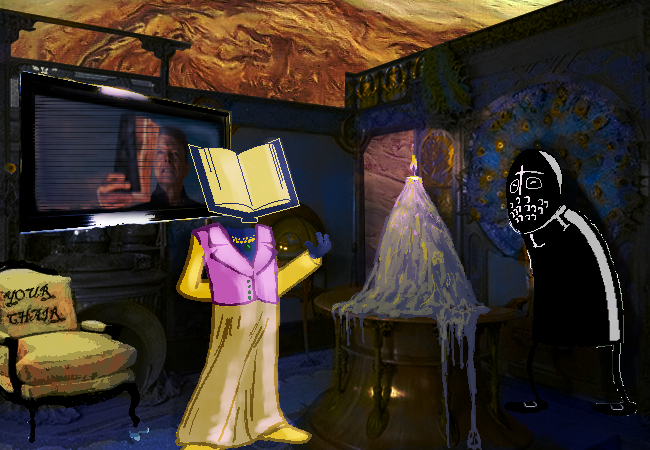
You arrive at the pub to find it strangely transformed. Not the gaping hole providing you with a view of the tempestuous heart of Jupiter's great red spot, no, that was already there. The dim lighting is new though, as is the giant, dripping candle standing on the table... and is that David Bowie on the screen over there? It is, it's a music video from that album he put out right before he died! Just what is going on here?

Sensing another dire misadventure, you begin to edge out the door. But Abraxas the Hideous Armchair Rat and Lord Humongous block your way! Curses.

Your captor looks up from your chair and claps their hands together happily. "Ah, you're here!" they say cheerfully. "Finally, the ritual can begin! But first, let's talk about David Bowie and the use of weird horror tropes in his albums. I think that will help to clarify what's going on here...

I had a dream the other night about David Bowie.

It wasn’t as exciting as it sounds. He was giving me an art critique. Not… not what I hoped from a David Bowie dream, frankly. Particularly since he didn’t like my painting very much.

But the thing was that within the dream I knew that David Bowie had died, but there he was, still telling me with sadness in his eyes that my paintings just weren’t very good. And my rationalization of this within the dream was that the reality of David Bowie’s death had yet to reach this part of the world, this backwater in which I live (Canada). The news of his death preceded the gravitational wave of its reality--news traveling faster than the sluggish transmutations of matter.


Tuesday, June 17, 2014

Janelle Monae: Contemporary Queen of Science Fiction

Science fiction is just an exciting and new way of telling universal stories and it allows the reader to come to the conclusion and draw parallels between the present and the future. I don’t think we enjoy when people remind us, today, this is what’s going on in the world. You know, sometimes we’re so used to hearing that this is what’s happening right now that we become numb to it. So when you take it out of this world, [people] will come to the conclusions themselves.
I think it’s important: whatever way you can get the audience’s attention to listen to your message, a strong message at that, then by any means. I think science fiction does that. --Janelle Monae 
I imagined many moons in the sky lighting the way to freedom. --Cindi Mayweather

My second article ever for Storming the Ivory Tower was about Lady Gaga--specifically about the video for Bad Romance and the implications of its science fiction stylings. It pretty much set the tone, framing narrative/persona, and purpose of the blog, and it also led to a whole string of articles on Gaga over the next few years--what her videos have to say symbolically, narratively, and thematically, and how they fit into wider popular culture.

But I'm bringing it up today not because of any of that nonsense but because of the particular conversation I spun out of it on pop music and science fiction which arguably spanned across these four articles. See, I was partly inspired in my analysis by an article (which I can't find now, unfortunately) that suggested that Gaga was one of the most significant voices in contemporary science fiction. That notion fascinated me because up till that point I had generally seen different media treated as fundamentally segregated from each other--you wouldn't see a list of the best Sci Fi stories of all time including a concept album, a short story, a novel, a live action movie, a TV series, and an anime all listed together. You still wouldn't, I think.

That segregation might go a long way to explaining why rapper and R&B musician Janelle Monae is not known to more fans of speculative fiction. Explains, but not excuses, because Monae should probably be crowned High Queen of the Geeks. How can I justify a statement that hyperbolic when a whole segment of my audience has almost certainly never heard of Monae? Well, just for starters, literally everything she's put out has involved a lengthy story involving this character:


Meet Cindi Mayweather, the Alpha Platinum 9000 android: your new Queen.

Sunday, February 16, 2014

Fluttershyness is Nice

Shyness is nice and
Shyness can stop you
From doing all the things in life you'd like to

I don't think that there's any particular contradiction between aiming a particular narrative at a younger audience and still imparting a slightly more complex, nuanced message, or in transcending the rote lessons that so many children's shows fixate upon. Generally speaking, I think this idea is getting generally accepted by writers on the better children's shows (and it's long been accepted by the best writers of children's stories, of course). Still, it's always wonderful to see a really well put together narrative with a nuanced treatment of what could otherwise be a quite trite issue.

And is there anything more rote, any lower-hanging fruit, than "character deals with stage fright?"

There's probably a few things, but it's got to be in the bottom ten at the very least, to the point where I remember getting quite sick of such episodes when I was a kid. The narratives are straightforward: character admits to having stage fright, zie has to go on stage anyway, zie learns that being on stage isn't so bad after all and sometimes you need to just face your fears head-on to fix them!

But look at the lesson, as relayed by Fluttershy, at the end of the My Little Pony episode "Filli Vanilli:

"Sometimes, being afraid can stop you from doing something that you love, but hiding behind these fears means you're only hiding from your true self. It's much better to face those fears so you can shine and be the best pony you can possibly be."

What a breath of fresh--wait, that's pretty much the usual cliche, isn't it?

In fact, it's a message that actually bothers me a lot, because there's an implicit character judgment in this message, a sense that someone's admission of discomfort or fear is this "hiding from your true self," a deliberate self-hindrance. Taken to extremes it implies that those suffering from more extreme anxieties generating their feelings all on their own, and they can just get over it if they really wanted to.

But I don't think that the message the show claims to be offering is the one that they're actually offering. In fact, I think this episode does a good job of illustrating how a stated moral might be belied by the actual content of a text--in other words, a text can say "This is the message of this story," and we as readers can say, "Yeah, but this that these and those elements of the story directly contradict this claim!" Famously, we could say, just like Blake does, that when Milton writes Paradise Lost and sets out a full explanation of why Satan is an evil, fallen being and God is right to cast him down, he actually ends up writing a story way more sympathetic to Satan than anything else. He is a poet, says Blake, and is of the Devil's part with out knowing it.

This episode, like Milton, is taking another stance (although I think everyone involved is quite aware of the text's implications!) and it's worth shedding some light on just what makes this narrative so different from the norm, what it's really teaching us, and how structurally that lesson is conveyed.

And I think the best way to do so is to frame the lesson not through Fluttershy's moral, but through a song by The Smiths.

My Little Morrissey: Sadness is Magic

Sunday, February 2, 2014

Across the Sea of Faces: Music and the Roar of the Crowd


For one reason and another I've been pondering crowds quite a bit over the last week or so. I'm fascinated, actually, by the dynamic, present in various art forms, where a crowd is used not as a symbol of accompaniment but of isolation. Like, check out Will Eisner's iconic cover for his graphic novel Invisible People:


I love everything about this cover. The stark lights and darks, the way everyone is turned away from you... it's a perfect indicator of the isolation and inhumanity present through the rest of the comic.

This is nothing new, of course, but when it's done well it can be a quite powerful effect. In particular, if you can convey the sensation of being a part of a crowd and isolated, rather than simply talking about the sensation of being alone in the crowd... well, that's a powerful effect.

It's hardest to pull off, I think, in music. Oh, it's easy to convey the sensation of being in a crowd--we have a long history of live recordings that are specifically designed to put you in the audience. In rock music, in particular, the goal is to capture the sensation of being in that mass of humanity, galvanized by the performance on the stage.

So how do you take those techniques and use them to make the individual listener feel isolated somehow?

Let's dig into that question and look at the way the roar of the crowd adds to a song's atmosphere and message.

Strapping Young Lad--Hope

Hope by Strapping Young Lad on Grooveshark

Let's start heavy.

Strapping Young Lad's "Hope" only uses the sound of the crowd briefly at the beginning, but the use of the crowd sets the tone for the rest of the song's content. In fact, this is a song where the sonic qualities are far more important to its overall effects than the fairly simple lyrics.

The two things the song hinges upon are that crowd roar at the beginning accompanied by that opening riff, and the long section in the middle of the song of just relentless, repetitive grinding. This is a song of palpable rage and bitterness, and the roar of the crowd highlights that bitterness by highlighting the alienation from that crowd.

The constant binary set up in the song is one of the singer (Devin Townsend, of Ziltoid fame) from an unspecified "you," although the crowd sounds at the beginning suggest that the "you" is meant to be the crowd itself. It's certainly in keeping with other songs on the album--most notably "You Suck," an energetic and catchy song all about, surprisingly, how much you suck (and also how much your band sucks, your girlfriend sucks, SYL sucks, and just about everything else sucks).

There's a kind of all-encompassing fury here at the plight of the speaker, who seems to be at once caged and omnipresent, a thing of compressed, diamond-hard anger. "I am what I am," he screams, "because I have no hope, no faith in your hope!" It's a weird thing to sing after the opening. It feels like a song about isolation, but it's juxtaposed with the crowd noises and the melodic intro that sounds like it was custom made for live shows. The scene seems to be one of a band telling its audience to its face how revolting it is.

There's a real antipathy here. And that antipathy emerges in the grinding midsection of the song. This bit goes on for far too long. It's repetitive, sonically torturous, a musical equivalent of a repetitive stress injury. It's perfect. Like the long outro for The Beatles' "I Want You (She's So Heavy)" it goes on for an agonizing time frame, abusing its audience, pushing the listener to the breaking point.

The combination of this sensation, completed with the disorderly conclusion of the song juxtaposed with the the earlier crowd-pleasing, singalong melody bits, creates a sense of alienation between band and audience, a codependent, destructive relationship that, paradoxically, you have to be invested in--you have to perceive yourself as fitting somewhere in the dynamic between crowd and band--in order for the song to have the greatest impact.

The sound of the crowd is the vehicle for finding yourself somewhere in the song's logic, precisely so that you can find yourself pushed away by it once more, and away from other humans as well.  

Collide--Human

  Human by Collide on Grooveshark

The crowd flows throughout "Human" as a kind of backing drone. It is a muted roar, accompanied by muted humming tones that carry the whole piece. The effect is one of constant accompaniment.

This accompaniment has the effect, though, of emphasizing the overriding sense of desolation and emptiness in the song. The constant refrain in the song, the recurring question, is who will fix you when you're broken, who will catch you when you fall?

The oncoming personal crisis is inevitable, a given in the logic of the lyrics. It's not a matter of "if" you fall but "when"--that word choice seems very deliberate. And it's described in universal terms--we're only human, the singer whispers, we're all only human. The crowd responds, bringing to the fore the notion of that unity, the shared experience of isolation.

But to share isolation is a paradox, just like the paradox in "Hope" of being pulled into the dynamic of the song only to be rebuffed. It is to know that others feel what you feel but to find no comfort or consolation in it. There is no answer to the question posed by the song. No one steps forward, offering to mend your broken heart. There is only the acknowledgment of that experience of collapse.

Against this lyrical backdrop, the crowd emphasizes not the unity between singer, crowd, and individual, but the isolation between the three members of the trinity. This divide is most apparent halfway through the song, as the singer melodically moans, drawing the last word out at length: "Say goodbye, human." As her voice fades, you are left hearing only the muted hum of the crowd. The rhetorical "you" of the earlier lines has been, by the admonition to say goodbye, transformed to a very personal, and more than a little threatening, "you." By rhetorical I mean that replacing the "you" of the first few lines with "one"--i.e. who's gonna catch one when one falls--makes for... well admittedly an extremely awkward sentence, for sure. But it still makes sense as a thing to say as an abstract consideration of the human condition.

But there's no way to transform the imperative language of that last line into an abstraction. It is directed at the individual listener. The creepiness of that line is emphasized by the slightly metallic, inhuman sound of the vocals. Collide's music is often on the verge of the inhuman, filtered, manipulated, and sometimes overwhelmed by digital stylings. It is music that seems to be on the threshold of a radical break with the biological. In the context of "Human," that break feels deeply alienating, because it suggests that you have been abandoned not just in personal life but in the course of human evolution.

You are "only human."

And you have been left behind.
 
Pink Floyd--In the Flesh 

In The Flesh? by Pink Floyd/The Wall CD 01 on Grooveshark
Pink Floyd by In The Flesh on Grooveshark

Really two songs, "In the Flesh" is the logical predecessor to both the previous examples. For Collide, the influence is tangible in their other homages to Pink Floyd's work (covers of "Breathe" and "Comfortably Numb," references in song titles like "Tongue Tied and Twisted"); for SYL the shared preoccupations are obvious. The same antipathy for the audience that drives "Hope" drives these songs. For Pink Floyd, however, there's a deeper political and philosophical statement being made about rock music itself.

"In the Flesh" roughly bookends the narrative of Pink Floyd's ambitious concept album The Wall. The first version introduces the central conceit of the album (and film). The story is of the rockstar Pink, and the album follows his slow descent into alienation from his audience and everyone else around him. Ultimately, this dramatic pulling away from humanity results in him adopting a sociopathic, fascist fantasy persona--the disguise that the audience must claw through if they want to find the genuine, wounded individual locked beneath a mask of authoritarian posturing.

The second version of the song represents the emergence of this new persona and the beginning of the violence the newly minted Hammer Army--his fans, now reenvisioned as a mob of violent authoritarian thugs--all too eagerly unleashes upon the world. The use of the roar of the crowd here is obvious. It is at once galvanizing and repulsive, echoing some of the latent contempt of SYL but still drawing the listener in via the draw of the roaring mass of humanity. It is all too easy--especially after an album's worth of misery for the lead character--to find the omnicidal rage on display here darkly alluring, even while being repelled by the fascist message.

And that's largely the point of the song and the point of the album. It's widely accepted that certain works can deconstruct the genre of which they are a part, exposing its dark underbelly and taking the logic of the genre to horrifying conclusions. The Wall is, among other things, a deconstruction of the entire rock genre, exposing the way in which the roar of the crowd and the charismatic figure of the rock star can combine to form a noxious, authoritarian dynamic.

The song must be engaging in its overblown theatricality for it to work. We might compare it to, say, "Be Prepared:"


I mean, I'm sure I'm going to horrify both Disney and Pink Floyd fans with this comparison, but I think it's important to recognize that both songs only function because they're at once horrifying in their violence and compelling in their actual musicality. They must be engaging for their threat to seem real, for the draw of the despot to seem believable.

And that's the fascinating line that the use of the roar of the crowd in the beginning of "In the Flesh" walks. The song invites us at once to feel the alienation that drives Pink's tortured psyche, the internal revolt against the logic of the crowd, and the draw of that roar, the seductive sensation of being swept away by something vaster than oneself. By using the same sounds as live concert recordings (not to mention actual live concerts!) Pink Floyd here deconstructs the entire scene, exposing the dark potentiality within.


Each of these pieces, then, makes use of the roar of the crowd in subtly different ways, but each uses the sound to highlight gaps of association between individuals and masses. None of them are particularly optimistic about the ways in which those gaps might be filled--one fills the gap with rage, another simply languishes in despair, and the last fills the void with a destructive, self-absorbed fantasy of autocratic power. Oh well. Not all narratives have happy endings, and this is just as true of music as any other medium.

But what these examples demonstrate is that any effect that can be introduced into a medium or genre can be modulated and manipulated by the savvy artist, precisely because these effects gain particular connotations that can be, with some work, upset and even reversed completely. When these games of reversal and overthrown expectations are played well, the results are deeply engaging.

Circle me on Google+ at gplus.to/SamKeeper. Follow stormingtheivory.tumblr.com for updates, random thoughts, artwork, and news about articles. As always, you can e-mail me at KeeperofManyNames@gmail.com. If you liked this piece please share it on Facebook, Google+, Twitter, Reddit, Equestria Daily, Xanga, MySpace, or whathaveyou, and leave some thoughts in the comments below.

Thursday, October 24, 2013

The Children of the Night, What Music They Make: Horror in Music

I want to talk a bit about horror in music and how it's a thing that exists. This is kind of an odd way of framing this exploration, but I'm doing it this way because some people seem to think it DOESN'T exist--i.e., that horror can't be effectively expressed in music alone.

People like Charles Darwin.

So look, I like Darwin. I think he's a smart guy. But he's said some pretty stupid things, and I want to take this opportunity to talk about one and why it's so silly. Check it out:

"Music arouses in us various emotions, but not the more terrible ones of horror, fear, rage, &c. It awakens the gentler feelings of tenderness and love, which readily pass into devotion. In the Chinese annals it is said, "Music hath the power of making heaven descend upon the earth." It likewise stirs up in us the sense of triumph and the glorious ardour for war. These powerful and mingled feelings may well give rise to the sense of sublimity."

Oh Charlie, Charlie, Charlie. What the fuck were you thinking.

Now, to me, this is a pretty self-evidently stupid statement--hell, I've already written an article on horror in electronic music, even, which probably stands on its own as proof against this concept. It's stupid largely because of the absolutist terms in which he's working. Music simply does not express horror and fear, full stop. Also, wanting to go slaughter a bunch of other humans has nothing to do with rage, apparently. Ok, if you say so Charlie.

But maybe it's not fair for me to start an article on horror in music by picking on Darwin. After all, he was writing in an earlier, barbaric era--a time before humanity developed its pinnacle of artistic brilliance, Marilyn Manson.

This is the face of the apex of human evolution.
Horror, that logic runs, has developed quite a bit over the past century or so, especially in darker genres of music, and it's anachronistic to subject Darwin's theories to an analysis dependent upon cultural products of the present era.

Well, I'd at least acknowledge some validity to that claim if not for the fact that I pulled this quote from Denis Dutton's The Art Instinct, a text that argues, broadly, that it is possible to understand human artistic endeavor from the perspective of evolutionary psychology and biology. I'm not unsympathetic to that claim! I think there's a lot of potential for the understanding of art practice through the lens of biological models of vision, for example, and that necessitates at least a passing understanding of how evolution has generated particular kinds of eyes.

I take issue, though, when the obsession with a Darwinian model of sexual selection as the sole driving power behind human achievement leads people to say shit that's just fucking stupid!

For example:

"Darwin would not deny, presumably, that a musical soundtrack could be appropriate for a horror movie; he is only claiming that the raw horror a dramatic story might incite could never be produced by music, any more than anger or fear could be produced by music. Music's natural ground is--as you would expect from an adaptation of sexual selection--romance." (Dutton 213)

Uuuugh. It's actually difficult to know where to start with this quote. It's such a mess of nonsensical ideas tossed together. And it's not taken out of context, either--Dutton is legitimately arguing here and elsewhere in the book that music is obviously a product of sexual selection and therefore obviously incapable on its own of expressing certain emotions. Now, the fact that he and Darwin are willing to accept calls to war as allowable despite the fact that unless you're going to the battlefield to find your Kismessis I suspect strongly that boning is not on your mind when you're trudging out to lop the heads off the barbarian hordes should suggest how ridiculous an assertion this really is. In fairness, later in the same chapter he blithely states that "Annexing music wholly to the procreative interests in the way that sexual selection suggests misses a great deal of the art itself as we understand it today" (Dutton 218). If that's the case, though, why frame music this way from the beginning, and why leave Darwin's nonsense so completely unexamined critically? Why not take a moment to consider the obvious contradictions inherent in sectioning off a seemingly arbitrary set of emotions as incapable of musical expression?

So, what I want to do here is talk about a few expressions of fear and horror in music--Gothic music, in particular--and how it most emphatically can match other media in terms of expressing horror.

The Gothic Poet

If you're familiar with my article on poetry and horror from a few years back (which is actually, unlike much of my work from those early days, probably still worth re-reading) you know I'm not satisfied with the presence alone of creepy things. There's gotta be something more to a horror poem than just mention of vampires and zombies. Narratives take advantage of horrific events for their power, movies and comics and paintings take advantage of uncanny visuals, and to my mind the greatest advantage poetry--and music!--has is the modulation of expectation and language and the complex disclosure of information.

This is part of why I'm focusing on gothic music in this article. The other reason is that I really love goth, and I think it deserves sort of a wider visibility than it's gotten despite "gothic" stores like Spensers and Hot Topic. So, if this article gets a bit gushy, step back and try not to let the gushing get on your shoes.

Anyway, it's worth taking a moment to talk about the poetic focus of a lot of early bands sort of broadly gathered under the umbrella of goth, deathrock, and dark romantic postpunk whatever. I think this genre is particularly useful here given the way that many of the bands, particularly the early bands, use more than simply the subject matter to carry the meaning and mood of the music.

This isn't horror, really, but it's a good example of the kind of poetry games that these bands like to play:


I love the careful threading of meaning through the song. Particularly the second stanza:

God knows everybody needs
A hand in their decision
Some of us are not so sure
I seen his own held out
For a ride on television
I think he's still in Baltimore

The slow delivery masks the meaning quite a bit, actually. It took me an actual reading of the lyrics to get that the "he" of the fourth line there is God--God knows that we all need a hand; his own is held out to pick up a ride. He's going nowhere fast, though...

These are the kind of games these gothic poets play with the lyrical structures. The movement from line to line, and the way those lines are delayed and separated by the vocal treatment and the structure of the song, demands attention and forces the audience to put the pieces together.

Which is quite powerful when used to create a sense of uncertainty, foreboding, and fear.

Check out the song "The Dog's a Vapour" by Bauhaus:


I love, love, love the gradual escalation of the song toward the possessed, mantra-like conclusion, building up from that toned down beginning to its repetitive, screeching climax. Can't express fear in music my ass. This song is deeply, deeply disturbing, at least to me. And part of that comes from the way the lyrics are paired with the music and broken apart into a series of audible stanzas. In fact, let's break up the lyrics according to their auditory stanzas:

The moon sheds light
when all is dark
the dog's reaction
is to bark.
Is that the moon's fault?
Tell me true

Tis the dog's nature
So to do.
The moonlight fills all heaven with mirth
The dog's a vapour
Belched by earth

No matter how you break the song (and I've sometimes seen it broken after "mirth") there's an odd looping discontinuity between the end rhymes. The first stanza seems to end with "true," a rhyme without a pair, unlike "dark" and "bark." Then we complete the rhyme in the next stanza with "do," but that in turn is followed by the "mirth" line, which again leaves us hanging, waiting for a resolution. And finally we receive it in the form of the titular line: "The dog's a vapour belched by earth."

This creates a sense of winding and weaving, incompleteness, occlusion. Even though we could write the lines thus:

The moon sheds light when all is dark
the dog's reaction is to bark.
Is that the moon's fault? Tell me true
Tis the dog's nature so to do.
The moonlight fills all heaven with mirth
The dog's a vapour belched by earth

which produces a kind of sing-song, nursery rhyme quality to the lyrics, we're still left with the strange meter that begins with regularized iambic tetrameter (the MOON sheds LIGHT when ALL is DARK/the DOG'S reACtion IS to BARK), collapses in the middle before finally pulling its shit together at the climactic final line. It never quite comes together in a regular way. And when it is sung, the line endings and stanza endings break the poem even more, disguise its meter. The song is thus unsettling not just for its dark, surrealist subject matter, but for its very structure, which is fraught with fissures of discontinuity. It is unsettling because any resolution that we find is then counterbalanced by another misstep.

And, in fact, even when we think we've come to the end of the rhymed couplets, we receive one last line that throws everything out of balance once more:

The dog's a vapour
Belched by earth
The dog's a vapour
Belched by earth.

There's something in you.

Tis the dog's nature
So to do
The moonlight fills all heaven with mirth
The dog's a vapour
There's something in you

The dog's a vapour
The dog's a vapour
Belched by earth

The dog's in you

Now instead of rhymed couplets, we've got one rhymed triplet--the ominous declaration that "There's something in you!" paired with "true" and "do." Now, on top of the anxiety of unbalanced lines, we have another irresolution: just what is within us? Why is this line being drawn into the couplet describing the dog's nature? The song begins to break down even further at this point, with previous stanzas repeated irregularly, divorced from their actual rhyme schemes, and each time the final rhyme with "mirth" is deferred, pushed back and superseded by this strange interloping new line, held in anxious tension...

Until the final climax of the music, when they repeat the earlier statement: "The dog's a vapour belched by Earth." And then, the resolution that we know is coming finally arrives, and the seeming triplet is resolved once more with the eighth unique line of the poem:

The dog's in you.


Ha ha ha holy fuck.

I don't know about you but that gives me the willies. I don't even know for sure what it means--that's part of the fear, in fact, that the meaning of the song as a whole is occluded like the meaning of the individual lines are occluded by their strange placement--but it sure doesn't sound like it means anything good. If I could take a stab at it I'd say it has something to do with humankind's dark, bestial nature breaking out and asserting itself--not exactly an unheard of theme in horror, right? And when these lyrics are paired with the cataclysmic finale of the song, I really do think it reaches a level of terror matching your average horror film.

But, ok, you might say, this is still working on the level of lyrics rather than sensation. It's not, like, really music. Now, granted, that's a bullshit argument because love songs have lyrics too, but sure, I'll indulge this train of thought for a moment.

Horrible Structures

If one side of early goth is the darkly poetic, the other side is just straight up bonkers, and derives its dark edge less from comprehensible lyricism than from deeply unsettling abstraction--there's a lot of affinity between goth and surrealism--and dissonant composition. I'm just going to speed through a few examples here for the sake of time. Check out this track by Christian Death:


This is another example that isn't necessarily fear-inspiring, but is illustrative of the kind of games these bands play. The dominant mood here is one of tension and anxiety, and it's not, I think, caused (just) by the hoarse vocals and the organ and bass combo... no, it's the weird time signature.

This'll take a bit of explanation for those unversed in time signatures. A time signature is just the number of beats it takes for you to get back to the beginning of a repeated musical phrase. Think of it like this: if you tap your foot along with the high hat or bass drum on this track, you'll tap your foot a certain number of times between the beginning of a line of lyrics and the beginning of the next line of lyrics. Normally, this will be four or sometimes three taps.

Here, it's seven.

Roughly mapped out it's sort of like:

1         2         3      4         5      6     7        
Growing with time growing with fear [pause]
1           2     3          4    5   6     7      
Growing all alone to disa......ppear [pause]

This is an unsettling kind of structure because it feels truncated. We're used to simple four beat measures, and multiples of four like eight, so when you drop down to seven the rhythm feels off-kilter and unresolved. Paired with the alternately raspy and screaming vocals and you have a recipe for a jarring, somewhat unpleasant but, in my opinion, quite captivating song.

You can push this even further into the realm of what the fuck if you embrace even more dissonance and unnerving sampling:


Yeah, gotta love that clip from The Exorcist at the beginning. It sort of turns Dutton's statement on its head--rather than music backing a horror movie, a horror movie backs music. I kind of love that, in a way. And I think it kind of shows why that statement is so silly--it's not that the music becomes creepy because it's the score of a horror movie, the horror movie is creepy because of the score--a score that is often shrill, dissonant, and unnerving in its own right (think of the music from Psycho, for example).

In this case, the song is... I don't know, it doesn't hit me on a visceral level the way, say, The Dog's A Vapour does, but there's something about the sheer incomprehensibility of the song, the madness of it, that's creepy for sure. The tone of the song, and the lack of comprehensible lyrics, create a sort of blankness into which you stare, hoping for meaning. And then, of course, there's the elated howls at the end of "My body begins to burn!" What the hell is that about? Jesus christ goths are weird. Anyway, yeah, unnerving compositions, how 'bout that.

Gothic Love

There's one last kind of interesting wrinkle to this, and that's gothic love songs. This is the place where I think the argument most obviously falls apart, because there's quite a lot of romantic gothic music that draws its power from a mediation of sexuality and fear. It's the adrenaline rush of those combined emotions that makes the music so sexy.

For example, here's this track from gothic metal band Type O Negative:


Apparently this song is about deceased frontman Peter Steele's desire to make a woman orgasm so hard she passes out. Which. All I can say to that is. Yes please? Peteeeer why are you dead? [cries over old copies of the Playgirl in which Steele posed naked]

BUT I DIGRESS

The song draws its power from the dark, animalistic lust--threatening, fearful--paired with intensely passionate eroticism. It's the interplay between fear and desire that gives it power. This wouldn't be successful as a song about procreation--the all important subject matter for evolutionary psychologists--without tapping into an emotion that music, according to Darwin and Dutton, can't express in the first place.

You're good enough for me, Peter Steele. You're good enough for me.

Too bad you were a raging homophobe. And are now dead.

Anyway, the point of all this is that there's some rich potential for horror in music that shouldn't be overlooked, there's some really incredible gothic music out there that you might not be familiar with, and you should never get so carried away with a singular theory that you are forced to warp the history of art and music in a really nonsensical way in order to make your theory work.

I mean, goths don't like it when you ignore their entire genre of music. And we've got bats. So many bats. RELEASE THE BATS! RELEASE THE BATS!


AAAAUUUGH! BITE! AAAAUUUUUUUUGH! BITE! Follow stormingtheivory.tumblr.com for updates, random thoughts, artwork, and news about articles. As always, you can e-mail me at KeeperofManyNames@gmail.com. Circle me on Google+ at gplus.to/SamKeeperIf you liked this piece please share it on Facebook, Google+, Twitter, Reddit, Equestria Daily, Xanga, MySpace, or whathaveyou, and leave some thoughts in the comments below.

Wednesday, September 18, 2013

Our Love Is Synthesis: Muse, Marx, and "Madness"


Let's talk about Madness.

Specifically, the song Madness by Muse and its accompanying music video.

It's actually a favorite of mine, as is the song. Muse on this track really shows off their versatility--they're a band that's often been compared to a mashup of Queen and Radiohead, but here they sample stylistic elements from Dubstep to pretty excellent effect. You can never say, of Muse, that they don't push their boundaries.

In a way, that's kind of what I want to talk about tonight. I think the idea of pushing and finally shattering boundaries is essential to a lot of what Muse does, and is certainly central to what's going on in this video. The video is fairly simple in construction--it shows a man and a woman in a subway station, circling around each other and finally sharing a pretty intense kiss. This is intercut with images of the band, and images of a riot. Now, we could read this simplistically as just Muse's attempt to build energy throughout the song by using these images of violence--as an adrenaline-boosting strategy--but (surprise, surprise) I think there's a lot more to these juxtapositions than simple appropriation of images we've seen frequently in the media over the last four years.

To get at what Muse is saying with this video, though, we've got to turn (again, surprise, surprise) to some theory.

Specifically, we need to understand the idea of the Hegelian Dialectic... or at least, the Hegelian Dialectic as interpreted through interpreters of Marx. Yeah, already things are getting a bit dense. Look, the problem here is that Hegel, the philosopher that came up with the notion we're going to discuss, isn't necessarily the most important person to write on these ideas. Rather, it's his ideas interpreted through Marx (essentially the father of Communist thought) and through Engels (Marx's collaborator), and then filtered through other thinkers, that we're most interested in. Honestly, some of what I'm going to be discussing is also filtered through my own interpretation of what other scholars have told me, so this is pretty far removed from the source.

This actually works in our favor, though, because what comes out the other side is a highly symbolic, highly romanticized understanding of Hegel's ideas, which fits well with a reading of an emotionally-charged piece of art.

"Get to the point!" you howl and wave your flagon in my general direction!

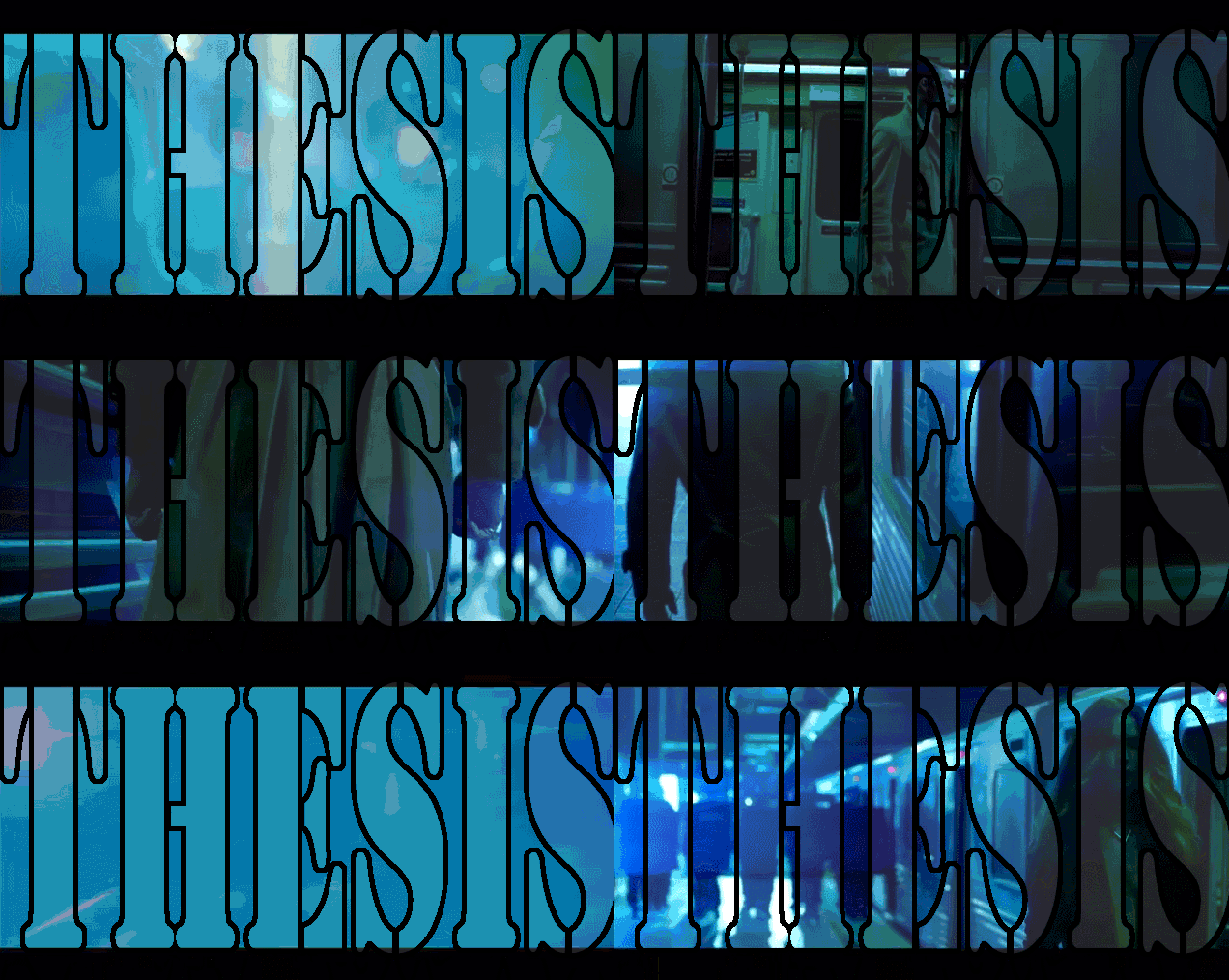
Don't be impatient! You can't start being an Antithesis until I present my Thesis! You're jumping ahead!

Which is really what the Hegelian Dialectic--or, for Marx, the Dialectical Materialism--is about.

There's a Thesis--this is a state of being, a power structure, a dominant idea.

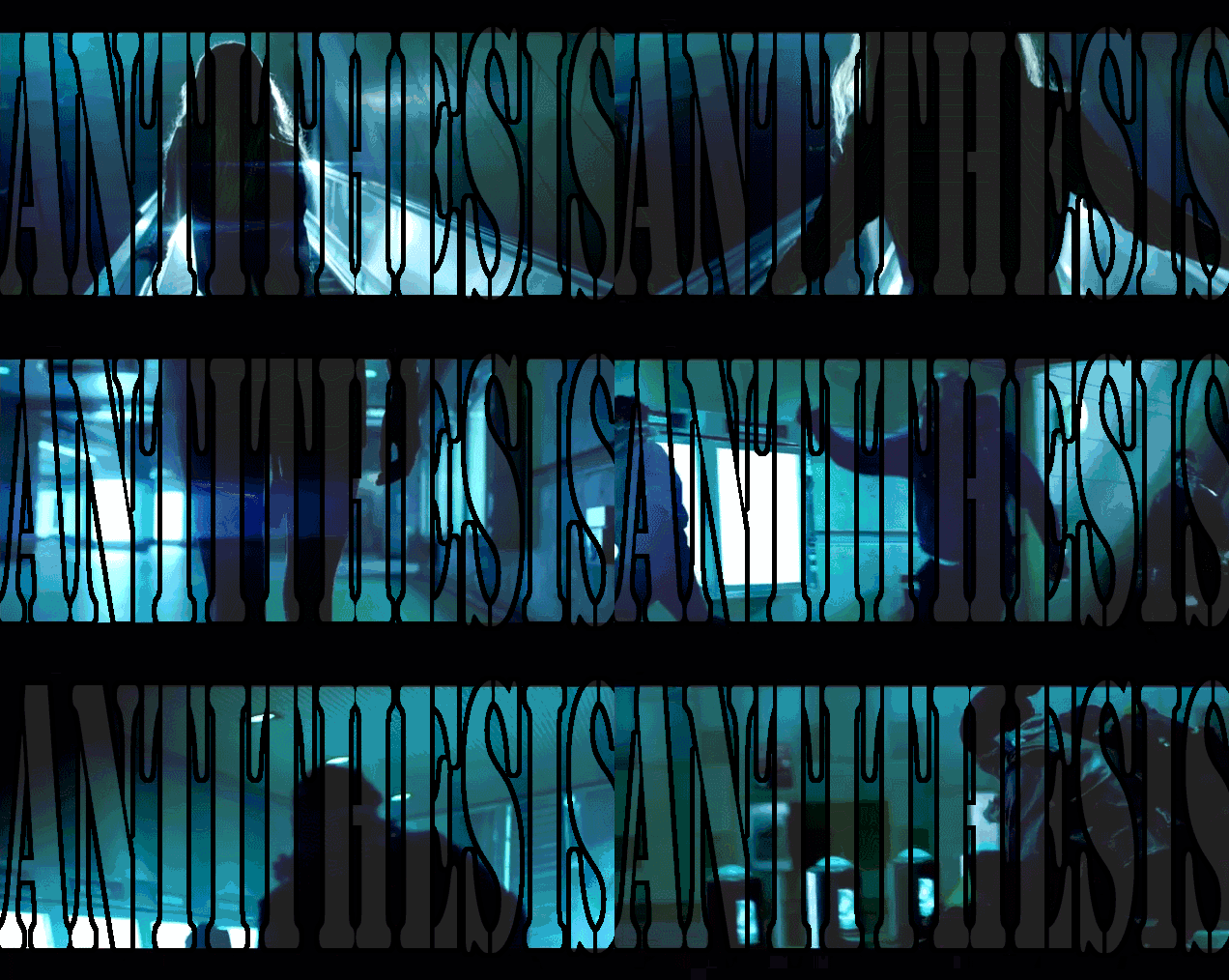
Then there's an Anthithesis--the alienations and contradictions and things left disenfranchised by the Thesis.

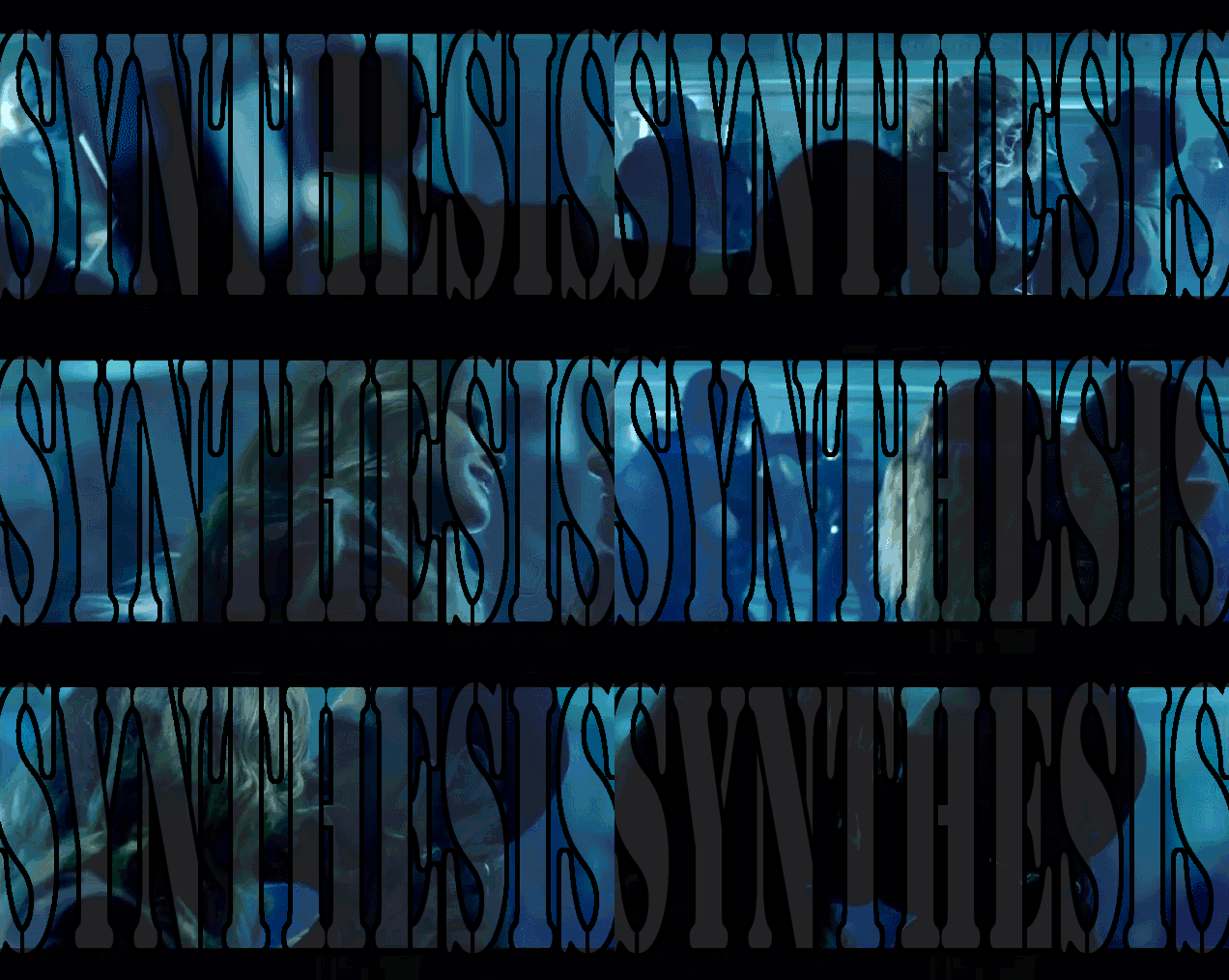
And then, when the two ideas come together, as when your beer sloshes into my wine while you're waving your cup around angrily, they create a Synthesis, an new form that arises from the clashing of a state of being and its contradictions. For Marx, who's going to be important for this essay, these referred to material states of being--i.e. the thesis is a way of ordering society that leads to a series of problems and people who have been disenfranchised--antithesis--resulting in a revolution of the ordering of society. The synthesized society then becomes a new thesis with its own contradictions.

Of course, no one actually agrees on anything about the Dialectic. Some scholars even claim that Thesis-Antithesis-Synthesis has nothing to do with Hegel's real ideas! It's basically a giant, hideous mess.

But we don't care about any of that, because regardless of their source, the Dialectic is a powerful, powerful meme, with resonances built deep in Western history (compare, for example, William Blake's idea that you need to merge Heaven and Hell in order to create something new). It's less important to me what Marx or Hegel really, truly said and more important to see this powerful notion of a thing smashed against its opposite in order to create a new thing.

What does this have to do with "Madness?"

Only everything.

Let's talk dialectics.


"Madness" is really not a song about madness alone.

It's a song about an opposition.

Love... and Madness.

That structure is repeated everywhere throughout the video and song.

First, we have the lyrics themselves:
And now I need to know is this real love,
Or is it just madness keeping us afloat?
And when I look back at all the crazy fights we had,
Like some kind of madness was taking control
Here's where the opposition is most explicitly stated, but the other verse has a similar structure to it--a state is posited, and then madness is reintroduced into the song. The states of being are worth examining though. Most significant, of course, is the suggestion that one of the two possibilities is "real love." This, to me, seems like the dominant idea or Thesis. We could extrapolate a bit here and suggest that this is a traditional, stable, picture-perfect relationship. It is easily understood, orderly, and genuine.

This notion is paired in the video with two major things: the male character (notionally linked to the male singer) and the militant police state. Look at the header for this section: the video makes heavy use of the "montage" technique, which is widely known in pop culture as "that thing where they show a bunch of clips of people doing stuff really fast so that it seems like lots of stuff is getting done," but which really means a series of cuts between different footage meant to draw out associations between the things depicted. It's a major feature of early Russian cinema (sometime I'll have to get Sara to write something with me on that--she's done research in this area), incidentally, while we're on the subject of Marx. Here, the montaging is used to draw a connection between the man and the riot police. As he walks down the side of the subway car, his motions are intercut with shots of the marching riot police, and finally the sequence concludes with a shot of the woman followed by the police.

So, the thesis here is both the male figure, and the spectre of state power and repression.

This is pretty wild, actually. "Love" being linked to an army of riot police marching in time to crack the heads of the proletariat, or to a guy following a woman through a subway station? Kind of Orwellian, and more than a little creepy, no?

Well, maybe. There's more going on here than what's apparent on the surface, though. First of all, the suggestion in the song is that the concept of "real love" has become a constraint, a box within which the implied relationship is not fitting comfortably. Love is an absolute ideal, a perfect state, just like the state of law and order upheld by the noble police force. The video and song paired together, then, suggest that the Thesis here has started to crumble due to its own rigidity and inability to deal with... what? Well, the Antithesis, in its tripartite form.


The Antithesis is Madness. Here, the comparisons fit a little more readily. Madness can be seen as disorder, chaos, disruption. It is commonly linked to artistry in part because of its potential to upset expectations and preconceptions. It is the entity that won't fit comfortably within an established box like "Love" and "Law" and "Order."

And in this video, it is the disenfranchised rising up from a state of poverty and repression and just straight up wrecking shit.

But what's interesting to me is the fact that the Antithesis is given subjective privilege within this song. The speaker is the Thesis, the Male, the State, Love, but the subject of the song, the driving force within the song and within the video, is the Antithesis, the Woman, the Proletariat, Madness. The word "love" only appears in the second verse. Before that, the idea of love exists only as an implication, a prior assumed state, just as the society we exist within is an unexamined entity that is only given form when it is contrasted with its shortcomings. Similarly, the man and his stated doppleganger is given focus in the second verse. The scenes in the clip above come from the first segment of the song, where, again, montage is used to link the woman notionally with the rioters, passing through the subway backdrop (and what a perfect image of the dream of order opposed by the material reality of crowding, poverty, and refuse!) as a primal storm of upheaval.

It would be easy to read the interactions between the man and the woman here quite shallowly as a creepy dude following a hot chick, but she is, quite explicitly, flirting with him constantly, daring him to come closer while simultaneously seeming threatening. The song, the speaker, the man, and the State, are all overwhelmed and driven by this force that they don't fully understand and don't know how to react to.

Muse's sympathies clearly lie with the antithesis--fitting, for artists. The antithesis offers the possibility of something new and unexplored (like, say, the possibilities of using dubstep techniques within the context of an anthemic Queen-esque rock band's ensemble?) and, rather than a sign of things going horribly wrong, it is a captivating force.

And it is this captivating force that will ultimately take control of the song, the video, and the world.


Can we just take a moment here to talk about how great the structure of this song is? The dubstep qualities to it set up this really excellent sense of expectation which is continually deferred. Normally, in a dubstep song you expect to have some sort of buildup until the bass is proverbially dropped and Skrillex is out another Italian Upright. But in this song, we wait around perpetually for the climax. Just when we think it's finally maybe about to start after the second verse, we get shunted off again as the music tones down again for a stripped back sounding and relatively simple (especially compared to some of their other work) guitar solo. This is in stark contrast to Follow Me, another track on this album that has a much more traditional buildup and break structure including dropped bass and all.

For this song, then, Muse wants to tease us.

For this song, they're drawing the foreplay out... just as the aggressive flirting is drawn out throughout the video, until we finally reach the climax:
But now I have finally seen the end
And I'm not expecting you to care
But I have finally seen the light
I have finally realized
I need to love
I need to love
The confusion throughout the song and video are finally getting resolved, as the woman grabs the man by the jacket and the riot police finally clash with the protesters. Form itself becomes distorted at this point as blurred figures merge into one another. Here, again, love reappears, but it seems to be undergoing some process of redefinition that makes the early question of whether or not it is "real love" immaterial or irrelevant. The singer needs to love, regardless of how it is interpreted.

And in that moment, synthesis occurs.
Come to me
Just in a dream.
Come on and rescue me.
Yes I know, I can be wrong,
Maybe I'm too headstrong.
Our love is Madness
Not, "our love is like madness" or even the earlier "is our love madness," "our love IS madness." I love, love, love that in the video at this point it's very clear that the woman is pulling the man into the kiss. She is the one with all the power here, and it's... it's not even just sexy, it's downright breathtaking. At this point the sexual subtext of the video is barely even subtext anymore. It's basically just straight up text. I mean, the video ends with:


...Which I'm pretty sure is basically the universal movie signifier for "We just fucked." And in the background someone gets hurled against the wall of the subway car. Alright.

The suggestion, then, is that the social upheaval seen in the video is analogous to the kind of emotional turmoil experienced in the song, where the singer has to reconcile himself to a love that doesn't fit within his narrow understanding. Love IS Madness in the end, and the singer acknowledges, as the state ultimately must, that it "could be wrong" and may be "too headstrong," too in love with authority, too tied to existing power structures.

We have here nothing less than a romanticization and eroticization of revolution and uprising. By drawing these notions parallel to one another, Muse suggests that social disorder like we are experiencing now should be seen as an exhilarating start of a confusing, as yet undefined state of being. In that sense, despite the heterosexual pairing in the video, I might even suggest that the video is queering revolution by comparing it to the kind of unstable, rough, contentious power dynamics that you might find in BDSM (not without precedent in theory, incidentally--theory writers, it turns out, are kinky as fuck).

Synthesis is therefore both threatening and compelling, a creative force that we should welcome rather than fear, as the Thesis might.

I really can't quite express just how brilliant I think this video is. It's working on so many levels at once, and it's impossible to say just which is supposed to be the metaphor and which is supposed to be the thing represented. Every set of notions can be switched and jumbled around with another set in a kind of orgiastic mating of symbols. And, of course, it's hot as hell. God, that moment when she just sort of digs her hand into his shoulder... [bites lip]

The point is, this video and song are built entirely upon the Dialectic--the Thesis is confronted by an Antithesis that it can't easy absorb back into its prior state, so it needs to adapt and be changed in order to reach a new stable point. These individual components, though, are reflected across an array of symbols and actors within the narrative, to the point where the nature of the song itself becomes indeterminate and suggestive of new possibilities.

It is in that uneasy territory between opposing things that both art and interpretation hover, finding unity and opposition again and again, madness keeping it afloat.

Human theorists would never be able to adequately diagnose the relationship between the Antithesis and her Thesis. But troll theorists could immediately place it as a dead ringer for kismesissitude. They would think we were all pretty stupid for not getting it. And they would be right. Follow stormingtheivory.tumblr.com for updates, random thoughts, artwork, and news about articles. As always, you can e-mail me at KeeperofManyNames@gmail.com. Circle me on Google+ at gplus.to/SamKeeperIf you liked this piece please share it on Facebook, Google+, Twitter, Reddit, Equestria Daily, Xanga, MySpace, or whathaveyou, and leave some thoughts in the comments below.

Monday, August 5, 2013

You Don't Have To Read That Text Tonight

One of the big parts of being a critic of media is paying attention. Like, there's this whole attitude on the Internet at least that theorists and close readers like moi's truly are "reading too much into things." See, for example, the crap about the teacher that thinks the blue curtains are symbolic and the students who are far more clever and obviously realized that the curtains are just blue curtains lol aren't people with multiple degrees so stupid compared to us teenagers, &c. &c. That crap.

And in fairness, yeah, sometimes that's the sort of thing we do. I don't think it's wrong or bad to do that, though. I mean, we fill in blanks as a natural part of reading, for one thing, so we might as well be open about the process, and for another thing, the arguments against this mode of criticism are usually pretty trite, unimaginative, and ignorant.

But that's not always what we do. Sometimes all we do is... well... pay attention and actually focus on what we're listening to or reading or watching is, like, actually saying. We're talking kinda basic level comprehension here. It's listening to Sweet Home Alabama and noting the fact that A. a whole verse of the song is spent whining about a Neil Young song criticizing Jim Crow laws and segregation, B. Lynyrd Skynyrd's reply is "A Southern man don't need him [i.e. Young] around, anyhow," which as burns go barely rates as Brush With A Birthday Candle, and C. the song is therefore both absolutely racist and absolutely laughable. Like, this isn't rocket science. It's literally just listening to the lyrics and saying, oh, wait, these lyrics consist of words that have actual meanings.

Anyway, I'm running short on time so today's article is just a brief walkthrough of this arcane process known as Actually Paying Attention To The Media You Consume, And Drawing Conclusions From Said Media. I don't think you really need a whole lot of Theory to do this, you just have to think kind of critically about the implications of things. I think, though, that it'll highlight the way thinking critically brings the reader around to Theory in the end. Alright?

So, here's another one of those songs that I don't think people really pay a lot of attention to:


The song has a pretty straightforward narrative. The speaker falls in love with a prostitute (a worker in the "red light" district, in the song's terms) and vows to save her from her degrading work. She no longer has to sell her body, he's here to save her! Aww. How sweet.

Alright, alright, I know that you know where this is going. You've probably read an article like the one I did about The Verve and Bittersweet Symphony, and you know how I love to flip interpretation on its head, and you want me to get to the thesis before you get too far into your drink.

Fine.

The song is actually really about female disempowerment and male jealousy.

Listen closely to the lyrics again--there's a decidedly controlling and demanding bent to the speaker's ostensibly romantic and heroic arguments. Consider the second verse:

Roxanne
You don't have to wear that dress tonight
Walk the streets for money
You don't care if it's wrong or if it's right

That last line is interesting to me because of the moral judgment it places upon Roxanne. She is described as an amoral being, and her actions are met with disapproval. If we take it one step further, the speaker is asserting Roxanne's ability to make a moral decision, but choice not to. This can mean one of two things:

Either Roxanne is in a position where economically and socially she is choosing sex work rather than being forced into it, and the speaker is commenting upon that and disapproving...

Or the speaker is just kind of self-righteously asserting that Roxanne is lacking in morals when really she is lacking in economic or physical autonomy.

Neither of these options really endears me to the speaker, but the second one is actually pretty vile, if you think about it. We've had centuries worth of this sort of moral judgment, generally entailing all sorts of pearl-clutching about "fallen women," while no one makes a move to actually alter the conditions under which lower-class women worked and often suffered. And the rest of the song pretty much continues in that fashion: the main reasons given for "saving" Roxanne from prostitution are that the speaker "won't share [her] with another boy" and that "it's a bad way." There's one line about love, the rest are either orders or judgments.

So... yeah, so much for romance.

Since we're doing this whole Paying Attention thing, let's look closely at that second possibility for what position Roxanne is in. This interpretation is, I think, the most common assumption: that Roxanne is helplessly enmeshed in a life of sin and needs to be rescued. Alright, I'm not exactly comfortable with the implications of that reading but sex work often can be a very coercive system. That's a historical and political reality, so it basically must be laid on the table as an interpretive possibility, even if I object to the idea that the solution is to save fallen women with monogamous marriage.

But look how the speaker reacts to that reality: he judges Roxanne furiously and behaves as though her shitty life is an affront to his honor or something. Yikes. That's pretty skeevy behavior.

The thing about this analysis, though, is that it's not super original. Others have pointed it out before, so I'm kind of late to the party, even if I did formulate the analysis independently. Which means that, yes, it's time for another twist!

Which is that I'm less interested in the different interpretive possibilities of what Roxanne's life is really like and more interested in the fact that there ARE different interpretive possibilities, and what that reveals about the song. The fact that the song is entirely from the male perspective, and about the male's desires and experiences, is very telling. It suggests that the female experience is subordinate to the male experience.

This is actually quite common in media. Male speakers are given greater attention and authority than female speakers, when females are allowed to speak at all. I think to a recent occurrence in my own life, when my sister and I were chatting in the college art gallery where she works. A tour group for the college happened to come in to check out the gallery, and twice, on the way in and on the way out, the (male) tour guide made a great show of deference to me as he led the group in, despite the fact that I had fuckall to do with the gallery. He even thanked me on the way out, for standing there and not throwing things I guess. This was a day when I was marching off to work on a sculpture, so I was dressed in clothing that was literally caked with mud. And yet, it was assumed that I was in charge.

That's the kind of force at work in this song--the female voice and presence is subsumed by the male voice and presence. We can go beyond an analysis of the dynamic between the two characters based on alternate interpretations of Roxanne's life and acknowledge the fact that she never gets a chance to tell us just what that life is. We have to piece things together from what scant clues the speaker lets slip between the recrimations. It's less interesting to me, in short, to consider the alternate readings than to analyze what the presence of alternate readings suggests, because their presence suggests that everyone from singer to audience is collectively ignoring Roxanne's thoughts and opinions and choices. They aren't paying attention to what she has to say, or even given the opportunity to pay attention to what she has to say.

So, what we've done, you may have noticed, is arrive right back at a feminist theoretical reading of this text.

But we got there not by starting with feminist theory (although, in fairness, I wrote this knowing about feminist theory) but by simply asking a series of questions:

  • What is this song about?
  • What might be Roxanne's actual life situation? What does that imply about the singer?
  • What does it mean that we never hear Roxanne's side of the story?
These are basic questions that you can arrive at simply through critical thought about the song's content, plus a little outside knowledge of what a "red light" is. This isn't "reading too much into" a text, it's just paying attention to the text and being willing to ask questions about its setting and characters, rather than letting it all pour in one ear and out the other like a big torrenting program blithely shuttling the song's data from The Pirate Bay to your mom's desktop.

This suggests to me that much of Theory simply consists of treating media like one half of a dialogue. Really, what I'm trying to get at here isn't so much that this is a terrible song and you should feel bad for liking it (I mean, hell, it's a catchy song, even if the lyrical content squicks me out). It's that you don't have to just accept whatever food is being forced down your throat via the airwaves from moment to moment. You can actually stop and ponder what you're chewing, and make judgments about whether or not it's really healthy to be eating today's fifth bowl of caramel-coated whale blubber. This isn't about teaching you to hate the stuff you loved, it's about teaching you that you don't have to just unthinkingly love everything while understanding nothing! It's about your freedom as a consumer of media, basically.

And while it certainly helps to have some training courtesy of a book-headed, chair-stealing, wine-swilling blowhard (i.e. me) the first step is always to make the choice to pay attention.

Sweet Home Alabama is basically a terrible song. Follow stormingtheivory.tumblr.com for updates, random thoughts, artwork, and news about articles. As always, you can e-mail me at KeeperofManyNames@gmail.com. Circle me on Google+ at gplus.to/SamKeeperIf you liked this piece please share it on Facebook, Google+, Twitter, Reddit, Equestria Daily, Xanga, MySpace, or whathaveyou, and leave some thoughts in the comments below.

Monday, June 17, 2013

Ziltoid the Omniscient and the Power of Metal

It's difficult, I think, to write about Devin Townsend, the musician from Canada who, for a couple of decades now, has been putting out some of the most consistently mindbending metal ever. Part of the problem is that Devin's music is all over the map, from the pure distilled rage cut with over the top comedy of his band Strapping Young Lad, to the weird broadway theatrics of the album Synchestra, to the stunning progressive rock soundscapes of Terria, to the dark folk rock of Ki, at turns sounding like it's choking on bitterness or dissolving in melancholy, to the triumphant, optimistic anthems of Epicloud, to the blistering, radiant thrash of Physicist, an album that started as a collaboration with Metallica's Jason Newsted (until James Hetfield found out and, predictably, threw a hissy fit), to... whatever the fuck this is.

In writing about Devin, then, I have to figure out where in his extensive and varied discography I want to begin. Knowing that I may introduce quite a few of my readers to Devin for the first time causes me to hesitate whenever I set out to write about him. There's so much difference between his tracks that I'm never sure where to best begin.

Which, in part, stems from a place of insecurity. I relate strongly to this music, and as a result I invest a lot of myself into the question of whether or not others accept or reject this music. I get defensive, get caught up in the act of proving that what I like has value, proving that I have NOTHING TO BE INSECURE ABOUT, DAMMIT! Metal is totally legitimate, and Devin is a wonderful artist, and no I'm not touchy about this at all! Pussy! I'll fight you!

I was pondering this, and the hypermasculinity that shows up a lot these days in geek culture (gamer culture, in particular), and the hypermasculine posturing in Metal, and I finally hit on the best way to approach Devin's music in an article here.

I'm going to write an article on an album about an alien who destroys the Earth when we give him a sub par cup of coffee.

No wait, wait, wait, I promise this will make sense by the end of the article, trust me. The thing is, Ziltoid the Omniscient, the album in question, is kind of semi-secretly about insecurity and power fantasies and how metal fans like me, faced with the threat of scorn or mockery for our admittedly often quite goofy music with bravado and rage. But at the same time, it's nothing as simple as a straight deconstruction or mockery of the genre. There's a lot in this album that reaffirms what makes metal great, despite or even because of its occasional goofiness.

That interplay between sincerity and self-effacing humor is what I want to get at with this article, and I think the best way I can do that is to lead you through the album and pick apart what's going on, and, as they say, what's REALLY going on.

Luckily, this whole album is on YouTube (and should be easy to find elsewhere if the video I'm embedding here ever gets taken down) so let's listen together as Ziltoid the Omniscient searches the Omniverse for the ultimate cup of coffee.


I love the beginning of this album. It's the best possible signal of where the album is going to go. Remember that formalists like me (when I'm wearing my formalist hat, anyway) really dig beginnings and endings, because they give the most pronounced signals to the reader of where the themes and ideas are going or have ended up. This is a concept at least a century old but I think there's quite a bit of scientific validity to it. I haven't done the extensive reading on this subject that I should (I'll save that for when I'm actually attending Grad School and it's my job, effectively, to do those sorts of literature reviews) but last I heard, we were finding that people remember not just endings but beginnings much better than they do middles. First and last performances tend to have an edge in competitions.

Anyway, we start with this giant, bombastic opening heralding Ziltoid's greatness, accompanied by the ludicrously over the top scream that punctuates the first metal growl of his name, and a declaration of his demand:

"Greetings humans, I am Ziltoid...the omniscient.
I have come from far across the omniverse.
You shall fetch me your universes ultimate cup of coffee...
Black!
You have five Earth minutes,
Make it perfect!"

All of this is intoned totally straightfaced, with a whispered reverb to give special emphasis to "BLACK," the color of METAL.

...Which is then followed by Ziltoid's cheery "Make it perfect!" You can practically hear the smilyface emoticon there.

That pretty much sets the stage for the album's bipolar tone--it jumps between totally sincere progressive metal epic affectations and ridiculous parody at a moment's notice. It's an album constantly undercutting itself, divided in focus. And unlike, say, The Dark Knight Rises, it's this interplay of humor and sincerity--these contradictory elements--that give the album its power.

I think it might be best summarized as an exploration of how absurd metal posturing can emerge out of, ultimately, a very real sense of pain and anger--narm that masks deep sincerity and struggle. It's about how we put on these airs of badassery to cope with pain.

And that comes out in the ostensibly triumphant first song, "By Your Command." This is sort of Ziltoid's great villain song where he declares his perfection to the weak and puny humans. Listen, though, to his monologue:

My command!
My dominion!
Memory, heart and all opinion,
Hide me, guide me,
Dry my tears,
Slowly taking back the years,
By your command,
By your command!
So, that's kind of weird. We start with the same self-aggrandizing bluster that we heard in the album's overture, but the screamed first lines are undercut by the melodically sung (internal?) monologue: "Hide me, guide me/dry my tears/slowly taking back the years..." Ziltoid here is already kind of tipping his hand as to what's to come. He's imploring, here, to an unknown listener for a way to hide or ignore his own emotional distress. He's suppressing that which makes him uncomfortable, and asserting his own dominance in a way that makes up for what apparently he considers wasted time.

Which results in him being the shittiest customer ever. Long story short, the humans give him the coffee he asks for, he hates it, and the result is a giant space battle ending with the destruction of the planet.

Yeah.

This is another place where the album should be totally ridiculous, but the music is actually poundingly engaging. It's forceful, bombastic, energetic, and catchy as hell. If this was just about being goofy it wouldn't be listenable more than a handful of times, but I can put this album on and rock out any time I want to, because the metal really is solid, headbanging stuff.

But again, Devin can't get too far in here without undercutting the epic atmosphere. Ziltoid, during all of this, makes two gloriously silly declarations:

"You have not convinced mighty Ziltoid,
I am so omniscient; if there were to be two omnisciences
I would be both!"

"Check this out!
I am the greatest guitar player ever to have lived! I am Ziltoid!"

The second bit there is accompanied by a gratuitously shreddy guitar solo. Ziltoid is just showing off his wanking powers, essentially (I'm getting that term from Devin himself--it's helpful to note here, probably, that Devin tends to not have a lot of respect for extraneous ostensibly impressive guitar solos). The sheer epicness of his solo cows the people of earth and the Ziltoidian Overlords are able to invade and conquer the planet, easily wiping out the stunned population.

This is kind of the ultimate metal power fantasy, right? The ability to destroy shit simply by shredding, to see all stand in awe, powerless before your ability to run a pick across a bunch of metal strings at dizzying speeds? And thrown in there is that refrain of "We're coming to your town!" Better be scared of us, squares! We're METAL! And we will fucking OWN YOU!

Like I said above, this wouldn't really work if the songs weren't legitimately entertaining to listen to. There's credibility to the power fantasy, in a way, because Devin plays so well. If he wasn't capable of pulling off that solo or writing a legitimately danceable metal tune, it would just sound like he's making fun of more talented people, or that Ziltoid is just a strawman parody with no depth. Ziltoid plays well, so it feels much more meaningful when he spouts something idiotic like the bit about being two omnisciences. It's kind of like Meat Loaf--if I didn't have some respect for the guy's music (at one point in his career anyway) it wouldn't have been so groan-worthy when he started incoherently spouting pro-Romney conspiracy bullshit. If you want to bring your hero low, you gotta build zir up a bit, yeah?

And Ziltoid's about to be brought low for sure.

See, it turns out that not everyone is awed by Ziltoid. Captain Spectacular, and his intreped crew, know Ziltoid's secret: he's a total nerd. He's a dork! A dweeb!

And once they know that, his guitar powers lose their strength.

The lesson here is that no matter how epic you are, no matter how badass of a metalhead you are, ANYTHING can undercut your power. ANYTHING can turn you into a wuss or a nerd. In fact, this is how masculinity reinforces itself: if the nonmasculine is seen as lesser, any display of nonmasculine traits becomes a sign of lesser personal value. Masculinity thus becomes a self-perpetuating spiral of shitty posturing and one-upmanship as each participant attempts to secure their identities against all threat. Being a metalhead works much the same way.

"Words are used for weapons," indeed.

This is another of those parts that weirdly fluctuates between sincerity and absurdity. It's hard to take the space opera declarations of Captain Spectacular too seriously, but on the other hand the music here is genuinely stirring and fascinating, no matter how many times I listen to it. (I must have listened to it at least 15 times or more in the past weeks while working on this article off and on...)

It's no coincidence, I think, that some of the most emotional moments on this moment are the ones that show the greatest vulnerability and weakness. Beneath this song about the destruction of the planet there's a cryptic kind of musing about time as an uncontrollable, destructive thing... interesting, considering Ziltoid is supposedly a "fourth-dimensional guitar hero," able ostensibly to escape time's clutches. And once more, as Ziltoid's fleet closes in on Captain Spectacular, we hear his menacing declarations undercut by a hint of needyness: "Comfort me, you know I'm right!"

Hyperdrive's meaning eludes me, no matter how often I listen, partly because I have a hard time figuring out who is meant to be speaking here. It almost seems like a transitional song, meant to build the mood, like an overture to the album's second act, as though the whole thing is a musical. (That'll be important in a moment).

Ziltoid confronts Captain Spectacular at the Benevolent Hive Mind of Nebulo 9 (which is fifth dimensional, if you're keeping track... not that I'm sure it means a whole lot). This isn't my favorite track on the album, but it does have an important impact on the album's overarching narrative. First, it marks Ziltoid's first true defeat--he is rebuffed by the benevolent hive mind and forced into retreat. Second, the nature of the defeat is significant. Ziltoid is essentially made to feel emotionally vulnerable. As before with Captain Spectacular, once you strip away Ziltoid's fascade there's a whole world of discomfort and adolescent awkwardness.

So, Ziltoid does exactly what you'd expect.

He decides to destroy shit.

What follows is one of the most intense songs on the album, and one of my favorites. Ziltoid awakens The Planet Smasher, and engages in what turns into a kind of battle of wills as the Smasher gives a long, somewhat abstract lecture, which concludes with his angry growl:

"Tell me what you want from me!"

The tension builds to this moment and then bursts as Ziltoid, with a brutal blast of drum beats, declares his aspirations for absolute power. The two begin a truly epic battle back and forth, as Ziltoid screams out demands for destruction and domination while the Smasher replies with the koan-like "bow to the valley below!" Initially in sync, they eventually sing over one another in a jumble of violent and increasingly frenzied outbursts. Ziltoid seems to get the last word, with the prolonged howl of the Smasher's name, followed by a repeat of Ziltoid's declaration of power...

...And then the song comes to a close with the Smasher revealing that his name is Herman (Ziltoid apparently never bothered to ask, the prick) and that he hates musicals. Ziltoid has overplayed his hand again, and revealed to yet another being that he sought to dominate that he is, in fact, a nerd. This is the most brutal part of the album, and the fact that the bringer of that brutality--Herman, who seems to take on the mantle of Metal effortlessly--can so easily dismiss Ziltoid is crushing.

Ziltoid, plagued with doubt, seeks out the Omnidimensional Creator, who turns out to be a totally self-assured, stoned-sounding bro. Note the difference here between Ziltoid's ridiculous statements (like his "two omnisciences" bit earlier) and the Omnidimensional Creator's ("Long time no see! ...Although I see everything"). There's a hint of the self-aware in the Creator's dialogue, a hint that he's not taking himself too seriously, whereas for Ziltoid everything is deadly serious, even though to others he appears absurd.

Anyway, Ziltoid flips the fuck out and the Creator tells him to settle down, not unreasonably.

What follows is the album's moment of crisis, its great climax. The Creator unveils Ziltoid's past and true nature. And what we find is... well, effectively what we've been talking about all along. The lyrics are poetic and not as literal as maybe we would find useful, but we can suss out some meaning if we take careful note of some of the recurring themes. Once more we seem to be receeding back in time as the origins of Ziltoid's bluster becomes apparent. Initially, of course, he resists and we get another sort of battle of wills as Ziltoid rejects the clarity brought on by the Creator. In the midst of all that is one of my favorite lines (one that my sister and I recite to ourselves when frustrated or irate) in the entire album: "I'm Ziltoid! I don't give a shit! I live above Earth in a big rocketship!" I love the off-rhyme here, particularly. This is Ziltoid's attempt to secure his own performative identity against all encroachment--he repeats his name again and again, hanging desperately onto it as a signifier of his own power, but as the repetition of "The horror, the horror!" suggests, even that identity has become deeply uncomfortable and suffocating (as such identities must).

Unable to resist any longer, we see into Ziltoid's vulnerable, emotional core--the part of him that fears harm. Over top of this pleading voice we hear an echo, gentle at first and then forceful, of the recitation of his name and title that begins the album. In vulnerability, the music suggests, are the roots of bravado.

While the music goes instrumental here, let's talk a bit more about the sincerity of the album. This album would be dramatically different as a deconstruction if this section wasn't so gentle, so sympathetic toward Ziltoid. But it is, ultimately. Devin, as a metalhead, understands the plight of Ziltoid as someone hurt by the world, someone who needs the posturing swagger of metal to armor himself. Ultimately, the fact that his need becomes a trap does not discredit the need itself, exactly--his emotions are understandable and portrayed as such.

So, having been revealed as a nerd, revealed as an individual who fears harm, who needs comfort, the Creator reveals the final truth of the album:

We're all puppets. Puppets to our neuroses, to our weaknesses, to the roles and personas we design for ourselves to compensate for our perceived shortcomings...

Oh, and Ziltoid is also a literal puppet.

Yeah, he's a hand puppet.

"INDEED."
Devin, even here, can't help but add that element of self-aware humor into the album. Even at the point of highest emotional resonance, he can't resist adding in one more joke. Which I guess we can read two ways--as another kind of self-deprecating mask ("Don't hit me, I'll hit me," maybe), or as a way of lightening the mood and telling us all, as the Creator does, to maybe chill out a bit.

I'll leave that up to you to decide for yourself, though.

And actually, I don't want to over-interpret this last song. There's some part of me that resists reading this section too closely, some part of me that sees this last song, "The Greys," as fundamentally personal. You've got to decide what to take away from this album, and how to view Ziltoid at the end, whether with mockery or sympathy.

There's one last thing to consider though, one last plot twist.

The last song fades out, we hear a babble of voices, and a voice, now singing to itself, is interrupted as another voice cuts in and begins berating the singer (a waiter at some high-end coffee shop) for not working harder.

Hm.

This album ranks for me among the most compelling metal albums of all time, mainly because of the mutability of that ending. In some ways, it seems a deconstruction and satire of metal, but, like much of Devin's other work, it is so successfully heavy, so engagingly brutal, that it's hard not to see it as a celebration of the very thing it seems to deconstruct. (And I'm using deconstruct both in the pop term of breaking the genre down to its component parts to show where it falls short, and the more literary sense of the discovery of oppositions and their reversal within the narrative.) I don't think it's a coincidence that this album, fraught with uncertainty, came immediately after Devin released the very last ever Strapping Young Lad album, and directly before the creation of the Devin Townsend Project, a series of four albums exploring different musical interests and influenced. (One of the four is the dark folk album Ki and another is the soft, new-agey Ghost; neither, clearly, is particularly metal.)

It might be best to judge Ziltoid alongside Devin's most recent album, actually--Epicloud, which is stuffed full of songs about emotion and vulnerability, but marries that emotion with the bombast and authority of metal:


"Time has come to forget all the bullshit and ROCK." Sounds like a reconstruction to me. And it sounds like a pretty good way of closing off this exploration of an album that can't seem to quite make up its mind, but is paradoxically all the stronger for its indecision. Because ultimately this isn't an album trying to reconcile disparate, contradictory ideas and failing, it's an album about the act of trying to reconcile disparate, contradictory ideas and failing. The fact that the album can explore those ideas while still remaining engaging, brutal, entertaining, hilarious, and a blast to sing along with confirms for me the lasting power of Metal.

Circle me on Google+ at gplus.to/SamKeeper. Follow stormingtheivory.tumblr.com for updates, random thoughts, artwork, and news about articles. As always, you can e-mail me at KeeperofManyNames@gmail.com. If you liked this piece please share it on Facebook, Google+, Twitter, Reddit, Equestria Daily, Xanga, MySpace, or whathaveyou, and leave some thoughts in the comments below.
Support on Patreon
Store
Reader's Guide
Tag Index
Homestuck Articles
Solarpunk Articles
Mastodon/Fediverse
Tumblr
Bluesky
RSS Feed