The Worst Filing System Known To Humans

-Punk (5) A Song of Ice and Fire (2) Affect (9) Alienating My Audience (31) Animation (28) Anime (19) Anonymous (3) Anything Salvaged (15) Art Crit (42) Avatar the Last Airbender (2) Black Lives Matter (1) Bonus Article (1) Children's Media (6) Close Reading (90) Collaboration (1) comics (30) Cyborg Feminism (3) Deconstruction (10) Devin Townsend (2) Discworld (1) Evo Psych (1) Fandom Failstates (7) Fanfiction (28) Feminism (24) Fiction Experiments (13) Food (1) Fragments (11) Games (29) Geek Culture (28) Gender Shit (2) Getting Kicked Off Of TV Tropes For This One (11) Gnostic (6) Guest Posts (5) Guest: Ian McDevitt (2) Guest: Jon Grasseschi (3) Guest: Leslie the Sleepless Film Producer (1) Guest: Sara the Hot Librarian (2) Guest: Timebaum (1) Harry Potter (8) Harry Potter and the Methods of Rationality (3) Has DC Done Something Stupid Today (5) Hauntology (6) Homestuck (18) How Very Queer (35) hyperallthethings (10) hyperanimation (1) Hypercomics (11) I Didn't Ask For Your Life Story Sheesh (24) Illustrated (37) In The Shadow Of No Towers (1) It Just Keeps Tumblring Down Tumblring Down Tumblring Down (9) It's D&D (2) Judeo-Christian (9) Lady Gaga (5) Let's Read Theory (3) Lit Crit (20) Living In The Future Problems (11) Lord of the Rings (4) Mad Max (1) Madoka Magica (1) Magic The Gathering (4) Manos (2) Marvel Cinematic Universe (17) Marx My Words (15) Medium Specificity (15) Meme Hell (1) Metal (2) Movies (33) Music (26) Music Videos (21) NFTs (10) Object Oriented Ontology (4) Occupy Wall Street (3) Pacific Rim (2) Paradise Lost (2) Parafiction (6) Patreon Announcements (15) Phenomenology (4) Poetry (6) Pokemon (3) Politics and Taxes and People Grinding Axes (13) PONIES (9) Pop Art (6) Raising My Pageranks Through Porn (4) Reload The Canons! (7) Remixes (8) Review Compilations (6) Room For You Inside (2) Science Fiction Double Feature (32) Self-Referential Bullshit (23) Semiotics (3) Sense8 (4) Sociology (12) Spooky Stuff (45) Sports (1) Star Wars (6) Steven Universe (3) Surrealism (11) The Net Is Vast (36) Time (1) To Make An Apple Pie (4) Transhumanism (9) Twilight (4) Using This Thing To Explain That Thing (120) Video Response (2) Watchmen (3) Webcomics (2) Who Killed The World? (9)

Reload the Canons!

This series of articles is an attempt to play through The Canon of videogames: your Metroids, your Marios, your Zeldas, your Pokemons, that kind of thing.

Except I'm not playing the original games. Instead, I'm playing only remakes, remixes, and weird fan projects. This is the canon of games as seen through the eyes of fans, and I'm going to treat fan games as what they are: legitimate works of art in their own right that deserve our analysis and respect.

Showing posts with label Getting Kicked Off Of TV Tropes For This One. Show all posts

Thursday, February 15, 2018

Freakangels Of Arcadia

Solarpunk already has some solid foundational texts. This might be a problem for Solarpunk, particularly since both sources--a classic short story and a decade-old webcomic--predate Solarpunk... and they don't exactly get along.

Friday, July 7, 2017

You Didn't Get Rogue One: A Monograph of Essays on Star Wars RELEASE


Despite its box office and critical success, Rogue One: A Star Wars Story faces an astounding number of misinterpretations. Rogue One is a controversial film, inspiring some with its improbably radical politics, while seeming to distress as many others with its unconventional storytelling and seeming break from the tone of Star Wars. Misreadings range from the well intentioned ("It was fun but the characters had no agency!") to the insidious ("Is the Empire really so bad?"), but they share one quality: for one reason or another, their writers just didn't get Rogue One.

Featuring revised and expanded versions of Storming the Ivory Tower's Star Wars articles alongside essays exclusive to this collection, the new monograph "You Didn't Get Rogue One" lays out not just a defense of Rogue One but a defense of the more radical potential lurking in the ostensibly thoroughly corporate Star Wars franchise. In order to do so, though, the essays have to take down decades of misreadings by everyone from Catholic pundits, Internet shoutymen, and even... George Lucas himself! The Dark Side clouds everything, but this collection takes a step towards bringing Rogue One and Star Wars into a new light.

You Didn't Get Rogue One can be read through Storming the Ivory Tower's Patreon:

Monday, April 17, 2017

Film Theory Theory: MatPat's Star Wars Theories Are Nazi Garbage

"Save the Death Star!" shouts MatPat, "because destroying it would make the money sad!" How does someone argue himself into supporting Space Nazis? Why do fandoms eat it up? And might Star Wars itself have something to say about the way that the culture we live in clouds our vision, preventing us from seeing the stories in front of us?


Monday, January 9, 2017

Video Killed The Yurio Star: Why Is Yuri On Ice's Soundtrack So Weak?

The homoerotic skating anime Yuri On Ice places great importance on the choice of music for performance. But can its soundtrack live up to its own implicit standards? And what does that say about the rest of the show's creative direction?


Thursday, June 30, 2016

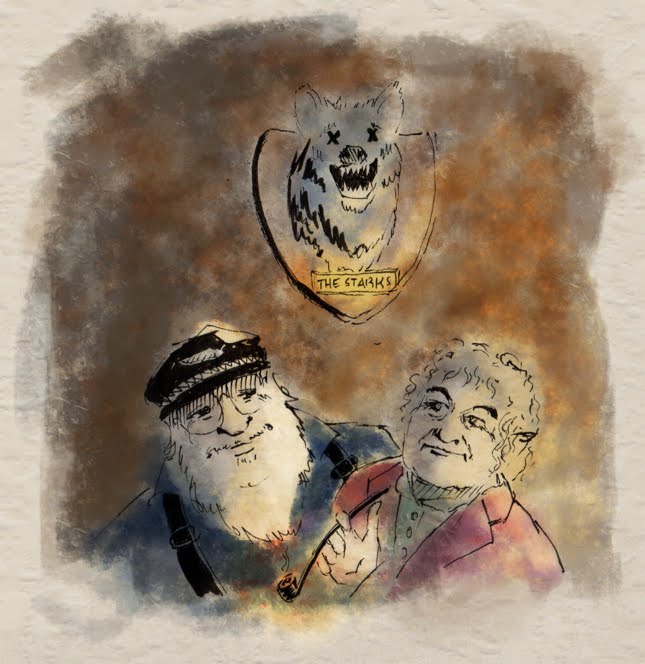
Not All Who Wander Are Lost: George RR Martin and Tolkien as Fellow Travelers

My first introduction to A Song of Ice and Fire was as a deconstruction of fantasy. George RR Martin's epic (now a "daring" and "brave" television series which you can see on HBO if you turn the brightness and contrast on your TV way, way, WAY up!!!) is, I was told, dark fantasy, with lots of shades of grey and violence and sex and so on.

It is, the subtext and sometimes the explicit text ran, not like Lord of the Rings. Or at least not like the traditions of Tolkienesque fantasy. This review of a recent episode of the (brave! genius! award winning!) tv show for example takes umbrage at the fact that the ending of a battle "has replaced that deconstruction with a blatant lift from Tolkien’s book, with the Vale forces riding in to save the day like Gandalf riding in to save Helm’s Deep." The notion of Tolkien and Martin as in some sort of competition or stark (hah) contrast is in the zeitgeist, is what I'm saying.

Having recently read the books, though, and also recently revisited The Lord of the Rings, I can't help but see this as more a product of a very narrow reading of Tolkien, and of Martin.


Some of this reading is possibly derived less from the source texts themselves but from Peter Jackson's adaptation. Look, I'm not gonna pretend that I haven't been deeply frustrated with The Lord of the Rings films since I was like 12. A lot of the stuff that most resonated with me as a kid ended up weirdly flattened, sensationalized, cut apart, or altered beyond recognition. And in the process everything got a lot more simple. I'm personally never going to forgive The Two Towers for introducing some fucking nonsense Aragorn Falls Off A Cliff subplot only to make up for it by hacking huge holes in the plot of Faramir, one of my absolute favorite characters. And others have written about some of the ways that in Jackson's hands characters like Saruman lose their thematic reason-to-be, becoming one note villains rather than complex and tragic figures.

Martin has suffered some of the same problems from the "brave" adaptation of his books, an adaptation I can't claim to have seen much of but which on a basic stylistic level seems to be run by people who don't understand that "dark fantasy" doesn't literally mean that all the sets should be chronically underlit and the characters should all wear the most drab clothing possible. I mean given that in the original text the Others are described basically as evil elves and the show develops them into ice orcs, and given that no one is walking around in the show with dyed-green beards like they commonly do in the book, it's pretty clear that they're more interested their sense of a "grim and gritty" aesthetic than what the text is trying to actually say.

Unfair? Not really. The critically lauded masterminds behind the "adaptation" literally once stated: "Themes are for eighth-grade book reports.” 

My contempt, I'd say, is well earned.

As a result perhaps of these less than stellar adaptations that have overtaken the originals, and as a result no doubt of Tolkien's many far lesser imitators, and probably to some extent as just a result of overexposure and fan discourses sort of overwhelming the original texts, a pretty remarkable fact has become obscured:

Lord of the Rings and A Song of Ice and Fire are much more a part of the same thematic tradition than in opposition. Basically, on a lot of levels, Tolkien and Martin are interested in the same stuff, and talking about the same things, and traveling on the same paths. And in fact some of their same formal "stumbling blocks"--things that people find particularly infuriating--parallel each other and do similarly important work within their respective narratives.

And to explain just how this makes sense, I want to talk a little bit about a book called The Worm Ouroboros.

Wednesday, May 4, 2016

Just Peachy: Homestuck, Act 6, and Difficulty

==> Storming the Ivory Tower Writer: Fondly Observe Libations


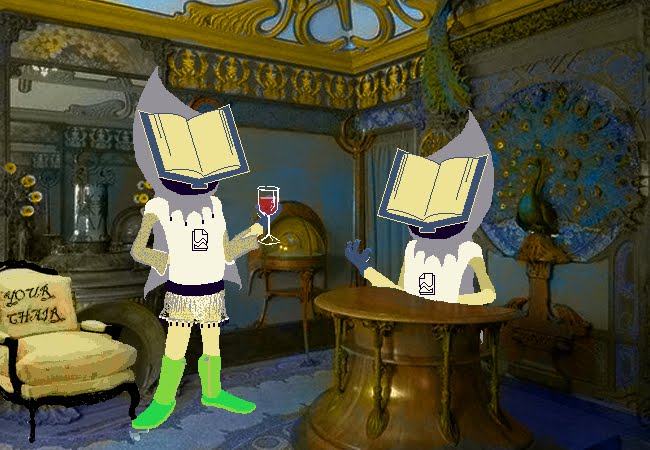
You, which is to say I, observe your, which is to say my, IMMACULATE DOMAIN, containing my IMMACULATE CHAIR and IMMACULATE SELF. You (read: I) have cleared away all those EXTRA SAM KEEPERS which were clogging up the joint, repaired the roof that's been busted for SEVERAL YEARS, and finally gotten some NICE WINE which you (still me) are currently fondly regarding.

You (I) have achieved the absolute apex of God Tier powers, which includes among other things fixing roofs, ushering extraneous versions of people gently but firmly out of the narrative so they don't clutter up things for the real, true versions, and to make absolute pronouncements with assured certainty, which everyone will accept automatically you're sure (which is to say I am sure).

==> StIT Writer: Demonstrate Abilities.

Act 6 and Act 7 do a much better job of addressing and resolving character arcs than [s] Cascade does.

Boom. See that?

Staggering in its radical brilliance but fundamentally undeniable in its accuracy.

(Sam Keeper): What? You can't just say something like that and pat yourself on the back! There's loads of stuff you'd have to explain to make that make sense to people.

==> StIT Writer: Ignore Unwelcome Intrusion


(Sam Keeper): Are you listening to me? You're leaving out so much important information, like even ignoring the fact that you haven't explained why you're even MAKING that comparison, the comparison is only interesting if you talk about a bunch of other stuff that Act 6 is doing. I mean yeah the whole act is basically about experiencing difficulty and working through that difficulty rather than expecting flashy magical solutions, and that APPLIES to this comparison, but the comparison really isn't interesting unless you talk about all that stuff first!

(Sam Keeper): In fact, even people that seem to agree with me that the end of Homestuck was pretty great take as given the idea that [s] Cascade resolved a load of stuff, and they position [s] Act 7 in opposition to this.

(Sam Keeper): Look, just, fill people in a bit! Act 6 is difficult but that difficulty is really interesting and worth talking about, so let's talk about it!

==> StIT Writer: Indulge This Walking Narrative Cul-De-Sac


Wednesday, April 27, 2016

Homestuck, Destiny, and why Social Constructs are Bullshit

==> StIT Reader: Survey The Mayhem


You enter the pub to find that things are EVEN WORSE THAN USUAL. Most notably, there seem to be MANY SAM KEEPERS. This is a terrible development, you think to yourself. And you are correct. One Sam Keeper was already just about all that you could handle. This is ENTIRELY TOO MANY SAM KEEPERS.

The most agitated looking of the Sam Keepers is PONTIFICATING ABOUT SOME BULLSHIT.

==> StIT Reader: Listen to pontification

Sam Keeper: Oh god, who could have possibly predicted that my extremely nebulously defined and possibly totally bullshit powers as the mythic Page of Paper could have caused so many problems? All the jumping I've done recently between various places has just created all these weird, kind of creepy alternate versions of myself, and now the whole blog is stuck under some mountain... I'll never finish my epic quest at this point and grow up to be a Well Adjusted Adult! And I have this whole article to write about how totally perfect and unassailable every aspect of Troll culture is! What the heck am I going to do???

==> StIT Reader: Offer to listen to Keeper's excellent theories about quadrant shipping

Hell no. Keeper made her bed and she can sleep in it. Or more specifically she stole your chair and she can sit in it. Yeah, that metaphor scans, kinda. Anyway it's probably just Keeper's intractable destiny to fuck everything up forever.

Hold on, though, it looks like one of the other Keepers has something to say.

==> Sam Coper: Sort this mess out


Sam Coper: You know Alternian culture is bullshit though right?

Sam Keeper: What the heck? Who are you?

Sam Coper: I'm you, but way, way calmer. Way calmer. Jesus buddy. I'm the you that actually learned to cope with things instead of doing an acrobatic fucking pirouette off the handle every time something goes wrong. And also I figured out that I can make this God Tier outfit have a cool skirt and shit, look at it!

Anyway, for real though, Alternian culture is bullshit, and so is your destiny, and that's... actually kind of a huge theme within the comic.

Sam Keeper: Ok, look, you're gonna have to break this one down for me a bit more.

Sam Coper: With pleasure.

See, Homestuck, among many other things, reveals that lots of stuff we think is natural or an inescapable fact of reality is actually a social and historical construct! And in fact, Homestuck shows that our identities might be a lot more free and fluid than we think.

==> StIT Reader: Try to understand.


Monday, August 24, 2015

Post Elsewhere: Why Character-In-A-Coma Theories Suck

[Evanescence plays unironically in background]
You find yourself in a beautiful garden, a garden lush with flowery growth, marble statues peaking through the verdant leaves. You shake your head, still sleepy from your nap. Where were you? Oh, yes, you were trying to come up with an idea for an article on your favorite show… Something shocking, something original, something that would really turn the setting on its head… But what?

You tap your chin with your magical quill and set it to the paper. To your surprise it begins writing, all on its own! Before your very eyes it spells out these words:

Sometimes I find that ideas for articles drop into my lap. Last week I happened to seea post on Tumblr that facilitated that sort of topic drop: a post about “coma” theories. Wait, wait, that’s the wrong link, hold on, ah here we go, a post about “coma” theories.

If you’re not familiar with that trope of fan analysis the concept is fairly simple to explain:

Take a show, movie, story, whatever. Preferably something fantastical and beloved. Ok?

The story is all some character’s dream while the character is in a coma.

Or the characters are all dead, or they’re all just imaginary friends, or the character is having a psychotic break due to some trauma or other, or… whatever. That mode of explanation for the fantastic elements of a story. All the kids in Ed Edd and Eddy are dead, Ash has been in a coma since episode 1, Steven Universe’s mom died and he’s imagining all the adventures and Connie is his therapist… whatever.

This kind of theory tends to be really... well... bad. When used in canon, it tends to come off as a bit of a bait and switch--you become invested in a narrative that has no meaning, where events have no impact. You get sucked into a story only to have it turn out to be utterly pointless.

This badness carries over to the use of the trope in analysis. Tonight, I want to get into why it’s bad, but also why it’s both kind of lazy and also, sadly, inevitably ubiquitous, but first I want to talk a little bit about the post that prompted my own article.

Hurriedly you cast the quill away from yourself and crumple up the paper. What is this strange writing that haunts you in your definitely real paradise? It has given you an idea, though, for what your amazing, groundbreaking fandom post should be like…

Thursday, July 5, 2012

Storming the Tower of Babel (Why TV Tropes is DoublePlusUnGood)

i reley dont wan to say this (but I have to now)

I would like to say that midway through the article you're about to read, I realized that it was falling apart on me.

Unfortunately, that moment of realization actually came as I stared at the blank page in front of me. The blinking cursor had become a symbol whose meaning was all too clear: I couldn't find the words to express what I wanted to say.

All of which is fitting. You see, this is an article about the Tower of Babel.

Well, that's not quite true. Really, this is an article about some of the major structural problems with TV Tropes, the repository of narrative terminology. But we're going to get there by way of Babel, because, well, why walk in a straight line when you can wander all over the map?

I'm bringing up Babel because of a very specific bit of cultural history illuminated by Umberto Eco. Basically, in Judeo-Christian mythology, humankind originally spoke the same tongue--the language of Eden, a perfect language with perfect correspondences between object and word. From a semiotic perspective, we would say that the Signifier (the word uttered or written) has a perfect relationship to the Signified (what that utterance represents)--it is not arbitrary or subject to ambiguity like normal language.

Now, humans, as they do, decided they wanted to reach the Heavens and become gods themselves. To do so, they came from all around the world to construct a massive tower--the Tower of Babel.

If you're familiar at all with the Abrahamaic God you can probably see where this is going.

Yes, ladies and gentlemen, the old sourpuss in the sky decided that he didn't particularly appreciate the humans building their Sumerian Space Elevator and, like a kindergartener affronted by another child's sandcastle, kicked that shit over. But, more importantly, God realized that if humans were able to communicate perfectly, they could basically do whatever the hell they wanted to. (This is another of those places where the Gnostic idea of a God bent on keeping humans from achieving their true potential starts to make a whole lot more sense, incidentally). So, he used his confuse ray and the humans forgot how to talk to one another. The languages split apart into countless fragmentary tongues, now arbitrary in nature, and the tower was abandoned.

Now, fast forward to the Renaissance and the dawn of the Age of Reason. This idea of Babel is still firmly in the minds of the great thinkers of this period. After all, it is a time of many language-based upheavals: there is the invention of new mathematical languages for interpreting the universe, there is the unification of formerly scattered towns under the banner of single nations, there is a growing interest in dead languages, and so on. All of this occurred (although not necessarily in that order) within a few centuries.

In the midst of this upheaval, scholars hit on an intriguing possibility:

What if they could reclaim the language of Eden, the perfect language before Babel?

What if our discourse was so perfect that we could determine Truth simply by laying out language like a calculation, and leave the table convinced of the divine perfection of our conclusions?

What if we could revolutionize language, clean it up, perfect it, make it better?

Why, is there anything we could not achieve?

This quest is, of course, impossible. We know now that language is a construct, and words have meaning that derives arbitrarily from their context within a system of utterances. And, what's more, there are some really problematic concepts inherent in this quest, but we'll get to that a bit later.

The important idea here is that TV Tropes, like its ancestor Wikipedia, and arguably all encyclopedias and dictionaries, is an iteration of this attempt to reclaim the Edenic language--to get back to before Babel.

Think about it. You've got a project that is trying to be the full, encyclopedic, comprehensive list of all tropes in fiction. It is attempting to set down in print a perfect set of categories that can, when assembled properly, can construct any and all fiction. This is no different, fundamentally, from Leibniz's dream of a language that would operate like mathematics, a language that could be used to calculate Truth itself. And, like Leibniz's dream, it's a utopian fantasy, to be sure, but Leibniz ended up inventing Formal Logic, and TV Tropes has similarly helped to spread and popularize a whole bunch of important terms.

But, any quest like this has the possibility of going horribly, horribly wrong. There is, after all, one other cautionary tale of top-down Perfect Language creation... but again, let's let that rest for the moment. First, I want to start talking about where TV Tropes is starting to run off the rails. In particular, I want to talk about the recent scandal where every trope that included the word "rape" in the name was removed from the site.

Yeah.

It was pretty bad.

After all, language helps to enable thought, right? This is actually something we can demonstrate with psychological science: things like whether or not a civilization has access to number words drastically and dramatically alter whether they can perform tasks of spacial rearrangement that we would find simple, for example. I ran into this problem when I was working with my collaborator Ian McDevitt on a large analysis of Hypercomics--we had to invent a whole series of terms before we could effectively discuss the techniques we were analyzing. Oh, and the difference between "mankind" and "humankind?" Yeah, that's another good example of this sort of thing--it's easier to think of men as the default and women as the deviation in part because the continued use, in English, of male-specific words to represent all of humanity.

So, when we remove all the terms dealing with rape from one of the most important cultural repositories on the web, we are essentially hamstringing our ability to discuss the issue of rape. In a culture of silence and victim-shaming, that is catastrophic.

Now, all of this came about because Google suddenly pulled their ads--which TV Tropes depends upon for survival--from the whole site due to complaints about the rape tropes. So, to some extent, this isn't the fault of TV Tropes, per se--but it is evidence of a fault running through the site's structure.

Still, I think a lot of commentary on this, while good, (there's been plenty of criticism of the totally botched handling of the whole crisis by TV Tropes--you can see some of the boneheaded decisions in the article linked to above, and I don't feel like digging into those issues too deeply here) has missed what I think is that deeper faultline I mentioned, a fault running through the endeavors of what promises to be the most important source of media discourse in the beginning of our century.

Let's dig into some of the executive decisions over there and what their implications are, shall we?

TV Tropes Is A Perfect Language Model

I've already described why this is true--TV Tropes is attempting to put together a set of words that are more perfect in their descriptive power, and that are of an almost scientific value--they can be used to construct narratives as we use the symbols of chemistry to form compounds or the symbols of mathematics to form new theorems.

There are some problematic implications of this when taken to the extreme, however. After all, a perfect language has to be as close to exact as possible, right? Well, TV Tropes has, relatively recently, been embarking on a campaign of generalization and simplification. That's perfectly in keeping with the quest for a perfect language--it's actually probably inevitable. The problem with this is that each time the terminology is better changed to reflect a more perfect form--a task that, as I've already pointed out, is an ultimately hopeless quest--a greater level of confusion is introduced into the system. It's not that different from the French revolutionary calendar, which attempted to create a decimal system of minutes, hours, and weeks, or the unified Italian that originated with Dante and eventually became the common language of the nation. Both of these methods--one assuredly more successful than the other--ultimately were not completely adopted by the common people. They represented an external order imposed upon the native tongues--the native system of symbols--and were thus never fully accepted as true language.

So, this is one of the more misguided aspects of TV Tropes. But it's not quite as problematic as some of the other decisions, on the face of it. Shall we explore further?

A Perfect Language Allows No Ambiguity

Is a trope subjective? Well, better put it in its own separate page on the site, because subjectivity spurs debate.

Is a particular instance of a trope or an example debatable? Well, now we've got an Analysis page for that, because we don't want "Natter" on the main page.

Ambiguity is Scary.

Now we're starting to get into the more problematic aspects of how TV Tropes is run. See, if TV Tropes is going to be a perfect language, it can't allow debate. Now, the moderators have largely claimed that they want a clean set of pages that don't include "natter"--i.e. endless back and forth debates about a particular entry. The result of this, though, is a quashing of discourse. For a site that claims to not be a "stuffy encyclopedic wiki" (remember when this actually just said "Wikipedia?") this is a surprising suppression of conversation.

This is where we start to see the contradictory nature of the quest for a perfect language. It is prompted, after all, by a desire for improved communication. But to establish its nature as a PERFECT language, it can't allow for the complex ambiguities of discourse that naturally arise from interpretation and the arbitrary nature of signs.

Wait, let me put it in a way that has less Theory.

TV Tropes wants to help us communicate, but ONLY ON ITS TERMS.

Now, if you're starting to get a vague sense of deja vu, I won't be surprised. If language controls thought, language can be actively used to control thought. But again, let's let this go for a moment and move on to the next stage in our analysis.

The Perfect Language Is Ideologically Compromised

And here we get into why the google ads scandal was not just possible, not just probable, but inevitable. See, the Perfect Language is a reflection of reality, right? But some aspects of reality have been deemed Unspeakable--explicit sex, nonconsentual sex, paedophilia, and so on. This is not just a problem with TV Tropes, of course--it is a simple result of Google's attempt to control language. And it is a decidedly Orwellian control.

Yes, this is what I've been driving at. We've made our way from the perfect language of Babel to the perfect language of INGSOC. We have catapulted through conceptual time from 2000 years after the creation of Adam to 1984.

If language is constricted according to what is "appropriate," it functions as a means of control. This is the purpose of the new language of Orwell's 1984: the goal is to simplify language so much that it becomes impossible to discuss potentially revolutionary ideas. Here, Google and TV Tropes have worked in concert, however accidentally, to achieve what even the Victorians (if you believe Foucault) weren't able to accomplish: they've answered the incitement to discourse about sexuality with a responding total ban. Wow. It's actually staggeringly ambitious, if sickening. It's its own sort of Tower of Babel--an impossible task of godlike control.

And it's not just because of Google's ad interventions, either:

The Perfect Language Is A Beautiful Language

The language of birds. The language of God. The language of Adam from before the Fall. The quest for the Perfect Language has always been one of beauty. And TV Tropes has followed suit by transforming itself from a site that once was capable of critically analyzing art, to one that now can only celebrate art.

TV Tropes has become the gaggle of seraphim that float around God's throne singing "Holy! Holy! Holy! Holy!"

Except that they accept any throne as the throne of God. Because the perfect language is the language of the celebration of beauty.

Which of course all makes sense on a metaphorical level. I'm sure the surface level reasons simply involve the mods being unwilling to sort out criticism--which is interesting in and of itself, since you would think that a wiki would be self correcting. I would even suggest that this is evidence either of an unreasonable obsession with control, or evidence that the concept of the Wiki is inherently, irreparably flawed. I'll let you chew over that on your own, though.

What particularly grates about this state of being is the fact that this was NOT the way TV Tropes used to be. In fact, the front page originally read:

We are not Wikipedia. We're a buttload more informal. There Is No Such Thing As Notability, and no citations are needed. If your entry cannot gather any evidence by the Wiki Magic, it will just wither and die. Until then, though, it will be available through the Main Tropes Index. We encourage breezy language and original thought (and won't object to the occasional snarky comment, either).

By 2011, the front page sported this line:

"We are also not a wiki for bashing things. Once again, we're about celebrating fiction, not showing off how snide and sarcastic we can be."

The site has since done its damnedest to bury this snarky past. The Perfect Language cannot allow for the disputes that emerge from real critical thought.

Only Perfect Things Can Be Described By The Perfect Language

This is the culmination of all of the principles described above, and basically explains why TV Tropes is on a collision course with obsoletion.

See, if the Perfect Language is a language of Beauty, if it cannot allow ambiguity, if it allows for the existence only of that which is acceptable socially, the Perfect Language inevitably must purge itself of entries from the Devil's Dictionary:

Unlike Wikipedia, we have a policy of non-negativity and non-notability, which if left unchecked enables the writing of articles about obscure, offensive works, which gives them publicity. Since listing criticisms of the works we trope is both negative and off-mission, we are unable to present a truly neutral perspective on these works, which creates the impression that we endorse them. This is not a problem Wikipedia has to concern itself with.

That disgusting passage was from the announcement that the site would be purged of works that a specialized council of moderators decided was pornographic. Here we have, plain to see, the INGSOC project in its infancy. Look at the way this author describes things as being "off-mission," as though TV Tropes is a political party that must maintain a unified message so as to sway the voting public. Let me be frank. This makes me furious. This passage takes a bunch of premises that are already shot through with rot, accepts them as fundamental to the project, and then, rather than abandoning them when they cease to work, establishes further stillborn statutes in order to effect ever greater control!

TV Tropes is on the path toward an impoverishment rather than an enrichment of language, make no mistake. These incidents will continue, and perhaps even increase, and more and more of the site will inevitably be bowdlerized until what is deemed "fiction" is reduced to a highly problematic fraction of what that word can and should encompass. Hell, on a personal level, as someone that has already argued for the storytelling power of pornography, this is an affront to everything I believe.

And it is infuriating, above all, because it leads to the inevitable final death sentence of a conclusion:

The Perfect Language Is Perfectly Useless

I already touched on this a bit when I described how the project fundamentally contradicts itself in its aims, due to its attempts to both promote and stifle discourse simultaneously, but it's worth describing in greater detail. As long as TV Tropes continues to go down the path of censorship, restriction, removal of discussion, and suppression of ambiguity, it will continue to diminish its usefulness, because it will become increasingly archaic and artificial. It will support particular sociopolitical goals without being able to reflect upon its own intrinsic support.

It will become ossified, the lifegiving fertile mud transformed into a hard, unyielding brick, all in the service of a tower that elevates a select set of texts to the level of Godhood. No Such Thing As Notability, huh? I would say it is ironic, but irony is a concept that TV Tropes is doing its best to remove from its ranks.

Isn't it amazing how all the bricks fall into place?

I can see only one solution here to this ossification. The Tower has to fall. The Perfect Language has to be rescattered. here are, of course, multiple ways of going about such a confusing of tongues. There could be a radical change in the moderation of the site--this is, perhaps, the best method. But, if there isn't a change in how they run things, there has to be an alternative, a counter tongue that helps to confuse the discourse. A rival wiki? Perhaps. Perhaps simply the regular storming of the Tower of TV Tropes with the goal of changing and fucking with as much as possible is called for.

But as much as it pains me to say it, we can no longer rely on TV Tropes for our language.

Because (Beacuase?) this site, always unabashedly anti-academic to the point of being obnoxious about its window-smashing rebelliousness, has become another Ivory Tower, and if we aren't careful, our discourse is going to start to become as whited-out, as barren, as its snowy slopes--as blank as a page with a single cursor blinking within, no words available to articulate the author's designs.

I would like to thank Pinnacle Whipped Vodka for making this article possible. Heaven knows I wasn't getting through this without being a little bit buzzed. You can follow me on Google+ at gplus.to/SamKeeper or on Twitter @SamFateKeeper. As always, you can e-mail me at KeeperofManyNames@gmail.com. If you liked this piece please share it on Facebook, Google+, Twitter, Reddit, Equestria Daily, Xanga, MySpace, or whathaveyou, and leave some thoughts in the comments below.

Tuesday, June 26, 2012

Come Into The Light: Getting Mindfucked by Surrealism

Chicken a la Croix, the dish we'll be making here on Surrealist Baking.
Surrealism is weird.

Wait, sorry, that's a totally banal way of starting a conversation. It's like saying discomfort is uncomfortable, or water is watery, or your chair is now my chair; it's basically inherent in the definition.

Or is it?

"Surreal"certainly tends to be used by folks nowadays as a simple synonym for "weird." I don't think anyone would balk at describing that image above as surreal--it's certainly a weird image, and that, in and of itself, seems to be enough to merit the use of the term "Surreal". I wouldn't balk at using the term here either, but not just because it's a strange image. No, I'm interested in using the term because it doesn't just fit the typical connotation of weird, it also fits the more specific artistic and literary definition. In fact, the video that the previous image is from, the Scissor Sisters' song "Invisible Light," is an absolute masterpiece of surrealism, a wonderful blend of early 20th century methods with 80s symbolism. 1880s, that is: see, the video is--

Well, hold on, I'm getting ahead of myself.

See, I can't start explaining how the video works until I talk a little bit about what makes Surrealism tick as a method of making art. Part of what makes Surrealism weird is that its resistant to normal forms of criticism. It's not the kind of thing where you can simply jump from symbol to symbol and directly read the secret message. In fact, you shouldn't do that ANYWAY, but it's something you have to be particularly careful of here, since it's so tempting. There's so many strange objects here! you might think. They have to stand for something. And if they don't, well, it's just a mindfuck, the author didn't give me anything to work with, and there's no point in exploring it further!

Surrealism is weird in two ways, then. First, it's weird because the images and juxtapositions are weird. Second, it's weird because if you try to untangle those images the way you might be used to, you'll get totally snarled up in the surrealist web. You've got to learn to navigate surrealism with something more than your intellect alone.

See, surrealism asserts that there are realms that can only be realized through techniques designed to make the unseen visible. You need a kind of amber spyglass or thermal goggles to see into this realm. What's more, this reality is more real than reality itself--a surreality--and it exists closer than you might expect.

It is the reality within the unconscious mind.

The surrealist project emerges from the idea that art can express what is locked away deep within the human unconscious. It comes, conceptually, from the birth of modern psychoanalysis in the late 19th century. The surrealists adored Freud, in particular, because they saw, in his analysis of dreams and his ideas of sexual and death drives, a mirror that they could hold up to the, if I may be so bold, totally fucked up mess that was Europe in the 20th Century.

Have you ever tried to navigate through the realm of dreams? Or, for that matter, have you read Alice in Wonderland or watched Jim Henson's The Labyrinth? These aren't strictly surreal works, I wouldn't say, but they should give you a sense of the underlying irrationality of this kind of art. You can't attack it the way you would other art, because it is resistant to conscious interpretation the same way dreams are resistant to normal world logic.

Want an example?

Think of Dali, one of the absolute masters of surrealism. He had all kind of clever symbolism in his work, all sorts of recurring signs for various ideas, and his work was all capable of being unlocked by studying it as a whole and reading his autobiography.

Except that his autobiography was all bullshit.

Dali lied through his teeth constantly.

And that makes perfect sense for surrealism! Because you're essentially trying to force the unconscious mind to the surface by confusing the crap out of the surface mind, through automatic associations outside of your control, through the emerging patterns in an inkblot test, the patterns created when you drizzle glue on paper, the Exquisite Corpse, and so on. And the more you can fuck with your audience, the closer to their own hidden thoughts and desires they get. Ever had a Freudian slip, where you try to say something banal and blurt out something dirty instead? Yeah, that's your Id--the deep animal desires--making itself known, and it's a proto-surrealist act.

In accident, in chaos, in confusion, in hallucination, in the juxtaposition of elements, in the twisting of reality, the warping of perspective, the blending of night and day... in all of this lies the Surreal.

So, how do we tackle the Surreal critically?

The same way you do Inception.

You've got to go deeper.


Before we begin, I should warn you that this video is:


So, what makes this video surreal?

Well, for one thing it's using a bunch of stuff straight from an older Surrealist film--Dali's An Andalusian Dog:


Now wasn't that just a thing?

But did you catch some of the similarities?

The image of the Stigmata in the hand, for example?

I actually made these wallpaper sized, in case you want a closeup of the ants going in and out of the dude's hand

Yeah, that's culled straight from An Andalusian Dog, and it's a good sign that the creators of this video were thinking of surrealism when they put it together. We can also note things like the fact that the female lead is undergoing hypnosis as a sign that the creators of this video may just possibly have had Freudian psychology on the brain. You know, maybe.

But there's a deeper similarity. Sure, they share the use of grotesque, bizarre, and at times impossible or fantastic images (like the crucified chicken thing at the beginning of this article, for example) but these images aren't presented just on their own. Rather, they're presented within a system of juxtapositions.

Remember the eye-slitting part?

Yeah, you'll remember that for a while, I suspect.

But there's something really interesting going on in that shot. It's not just a sequence of someone slitting an eye, it's a sequence of the eye slitting juxtaposed with a cloud traveling across a moon:

It's actually a cow's eye, but I bet you didn't realize that at first, did you? Hehehe.
What we've got there is a juxtaposition of different concepts, and it's up to the viewer to piece together what--if anything--that juxtaposition means. Now, personally, I'm at a bit of a loss here. I'm not exactly an expert in dream interpretation, and I suspect that without a dialogue with the artists here we wouldn't get far, anyway.

I do have a better idea of what to do with this juxtaposition, though:

And that's what the NSFW image was for, folks.
Ever heard someone talk about being made to feel like a piece of meat?

Ayup. This is about as literal as you can get--it's the transformation of a human into a sexual object--and here, literally, a piece of meat, very similar to the plucked and crucified bird in an earlier image (which itself calls to mind the woman chained to the wall, no?).

Except here there's a sense of the repressed sexuality coming not just from without but from within--it's the Id breaking through to the real world. What's more that chicken is constantly used to suggest--not to represent, exactly, but to bring to mind--a violent sexuality that is at once threatened by the wolf--or, perhaps, the powerful man--but also lusts after that wolf. It is the burning bed, the wild beast kept in a cage within the daughter's room, it is the screaming creature in the cage.

But there's another beast prowling around--a horse. Not just a horse but a stallion, a stud. As the female figure fears and lusts after the fierce masculinity of the wolf, she also seeks the free, forceful masculinity of that horse. But, not only does that horse carry connotations of the free spirit (and escape, perhaps, from the cage that is Civilization?), it also is an animal that can be trained... broken... and ridden.

There's other ways of fighting back against these urges, though. One of them is hinted at in the band's name: Scissor Sisters. It's a reference to the idea of Scissoring--a lesbian sex act--hence the band's logo of the woman's legs becoming sheers. And what weapon does the female character wield in an effort to protect herself from the violent masculine wolf's sexuality? That's right. Scissors.

Now, I just typed that out through free association. You'll note that I didn't say any of those images stood for the ideas I'm bringing up, I'm just wandering through my own associations and what I'm inclined to see in the piece. In a way, this is a deeply personal analysis, because I'm really exploring my own unconscious mind. And my mind is, apparently, Full Of Fuck. Isn't that an interestingly Freudian bit of slang in and of itself? It's very similar to how surreal pieces of art are often described as a Mindfuck--we're associating the confusion of the images with the confusion and chaos of sex. As the Ego and Superego lose their way, the Id asserts itself and our primal desires come out.

And that's really what a lot of surrealism ultimately is: you're "opening up your joy and letting the sailors climb the walls"--you're spilling the seed of your unconscious mind on the ground, as it were. Surrealism is ultimately the intrusion of that hidden space into our reality, and it's something that ultimately you have to personally experience. I suspect that the best way of going about a surrealist analysis would be to embrace Reader Response criticism and the idea of the Gestalt--you're muscling in and filling all the gaps (sorry, is this getting to be excessive?) with your own innermost drives.


Surrealism is, for that reason, far more than just weirdness. It's not something you can just immediately dismiss if it doesn't make sense. It may never make sense. It doesn't matter. What matters is that you're engaging in it, and through that engagement you engage with your own deeply cloistered mind.


Surrealism is a light that is invisible, intangible, but that leads you to an internal vision that your conscious mind could never condone or imagine.


Come into the light.


Into the light.


The Invisible Light.


There are SO MANY DOUBLE ENTENDRES in this article, and not all of them are deliberate! That's Freud, always sticking his... nose into other people's business! That dick. You can follow me on Google+ at gplus.to/SamKeeper or on Twitter @SamFateKeeper. As always, you can e-mail me at KeeperofManyNames@gmail.com. If you liked this piece please share it on Facebook, Google+, Twitter, Reddit, Equestria Daily, Xanga, MySpace, or whathaveyou, and leave some thoughts in the comments below.
Support on Patreon
Store
Reader's Guide
Tag Index
Homestuck Articles
Solarpunk Articles
Mastodon/Fediverse
Tumblr
Bluesky
RSS Feed