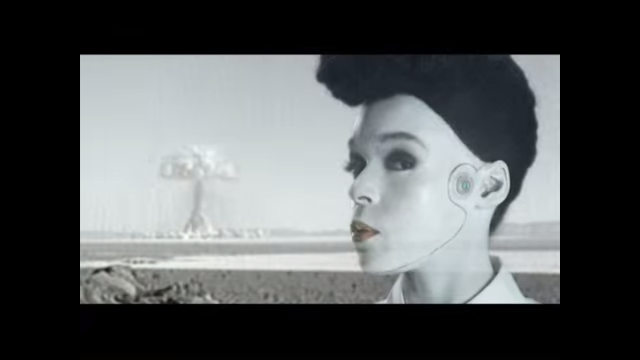
Nightbitch, a film about a frustrated housewife who starts turning into a were-dog, actually resonated a lot with me as a trans woman... until it defanged itself and got weirdly domesticated.
The Worst Filing System Known To Humans
-Punk
(5)
A Song of Ice and Fire
(2)
Affect
(9)
Alienating My Audience
(31)
Animation
(28)
Anime
(19)
Anonymous
(3)
Anything Salvaged
(15)
Art Crit
(42)
Avatar the Last Airbender
(2)
Black Lives Matter
(1)
Bonus Article
(1)
Children's Media
(6)
Close Reading
(90)
Collaboration
(1)
comics
(30)
Cyborg Feminism
(3)
Deconstruction
(10)
Devin Townsend
(2)
Discworld
(1)
Evo Psych
(1)
Fandom Failstates
(7)
Fanfiction
(28)
Feminism
(24)
Fiction Experiments
(13)
Food
(1)
Fragments
(11)
Games
(29)
Geek Culture
(28)
Gender Shit
(2)
Getting Kicked Off Of TV Tropes For This One
(11)
Gnostic
(6)
Guest Posts
(5)
Guest: Ian McDevitt
(2)
Guest: Jon Grasseschi
(3)
Guest: Leslie the Sleepless Film Producer
(1)
Guest: Sara the Hot Librarian
(2)
Guest: Timebaum
(1)
Harry Potter
(8)
Harry Potter and the Methods of Rationality
(3)
Has DC Done Something Stupid Today
(5)
Hauntology
(6)
Homestuck
(18)
How Very Queer
(35)
hyperallthethings
(10)
hyperanimation
(1)
Hypercomics
(11)
I Didn't Ask For Your Life Story Sheesh
(24)
Illustrated
(37)
In The Shadow Of No Towers
(1)
It Just Keeps Tumblring Down Tumblring Down Tumblring Down
(9)
It's D&D
(2)
Judeo-Christian
(9)
Lady Gaga
(5)
Let's Read Theory
(3)
Lit Crit
(20)
Living In The Future Problems
(11)
Lord of the Rings
(4)
Mad Max
(1)
Madoka Magica
(1)
Magic The Gathering
(4)
Manos
(2)
Marvel Cinematic Universe
(17)
Marx My Words
(15)
Medium Specificity
(15)
Meme Hell
(1)
Metal
(2)
Movies
(33)
Music
(26)
Music Videos
(21)
NFTs
(10)
Object Oriented Ontology
(4)
Occupy Wall Street
(3)
Pacific Rim
(2)
Paradise Lost
(2)
Parafiction
(6)
Patreon Announcements
(15)
Phenomenology
(4)
Poetry
(6)
Pokemon
(3)
Politics and Taxes and People Grinding Axes
(13)
PONIES
(9)
Pop Art
(6)
Raising My Pageranks Through Porn
(4)
Reload The Canons!
(7)
Remixes
(8)
Review Compilations
(6)
Room For You Inside
(2)
Science Fiction Double Feature
(32)
Self-Referential Bullshit
(23)
Semiotics
(3)
Sense8
(4)
Sociology
(12)
Spooky Stuff
(45)
Sports
(1)
Star Wars
(6)
Steven Universe
(3)
Surrealism
(11)
The Net Is Vast
(36)
Time
(1)
To Make An Apple Pie
(4)
Transhumanism
(9)
Twilight
(4)
Using This Thing To Explain That Thing
(120)
Video Response
(2)
Watchmen
(3)
Webcomics
(2)
Who Killed The World?
(9)
Reload the Canons!
This series of articles is an attempt to play through The Canon of videogames: your Metroids, your Marios, your Zeldas, your Pokemons, that kind of thing.
Except I'm not playing the original games. Instead, I'm playing only remakes, remixes, and weird fan projects. This is the canon of games as seen through the eyes of fans, and I'm going to treat fan games as what they are: legitimate works of art in their own right that deserve our analysis and respect.
Showing posts with label Feminism. Show all posts
Tuesday, December 30, 2025
Wednesday, September 30, 2020
I Don't Ever Wanna Talk That Way Again: Transfemme Singers and the Dissonant Body
Shouting and howling. Pitching up and clipping out. Smothering in soundscapes of sighs. From 100 Gecs to Against Me! to Ada Rook, trans women push vocal technology to the breaking point--and in the process expose how we think of gender.
Saturday, June 20, 2020
2x2 Girls: Queer Mirroring in She-Ra
She-Ra and the Princesses of Power ended on a high and very gay note, but the show's queerness goes much deeper than the flashy finale. To understand how the show is constructed around its central lesbian relationship, though, we have to be open to learning the techniques it uses to tell their story.

Monday, July 29, 2019
Eve Laughed At Their Decision
Yes, the Christian symbols in Neon Genesis Evangelion mean something. Rei Ayanami is the key... but does the word of her creating god give us enough room to find our own meaning?
Wednesday, January 27, 2016
Contrived Conflict: Supergirl Still Isn't Feminist!
Supergirl doesn't have conflicts that matter.
Supergirl instead, as I mentioned in my last article, has manufactured conflict. My issue with the show is basically...
Well, actually, my issue with the show is stuff like the ha ha I'm not a lesbian no homo gag in the pilot episode. Stuff that's just fucking inexcusable in 2K16, basically. But while that stuff is sort of, I suppose, death by a thousand cuts, it's not the kind of thing I can dig into for a full article. It's more like... listicle material. Top 50 things I Loathe About Supergirl. That sort of thing. Or, you know, something suitable for angry liveblogging.
Character conflict, though, is juicy and interesting and something we can dig into more deeply.
Thursday, January 21, 2016
Monday, August 11, 2014
Tony Stark in the Integrated Circuit: The Iron Man films and Cyborg Feminism
In Iron Man 2, Tony Stark describes his suit, the Iron Man suit, as a prosthesis. Now, granted, he's describing it that way in order to flummox a congressional committee who assert that his suit is, in fact, a weapon. The scene as a whole is full of uncomfortable, almost Randian grand standingone. It's a problematic scene, to be sure.
The wild thing about Tony's claim, though, is that the films are almost calculated to back him up and support his claim. Iron Man--or, later, the Iron Men--is/are an extension of Tony's being. They are a prosthetic not in the sense that they restore him to some idealized "normal" human functionality but in the sense that they are a tool that acts as an extension of the human body in order to facilitate a human's aims.
It should be obvious that Tony Stark is a cyborg, though not a conventional one. His most obvious cybernetic feature is the power core embedded in his chest, but his suit, in the way it extends both his body and will, is also a part of his cybernetic being. The films consistently portray the Suit as a second self for Tony, an eventually unlimited tangle of extra limbs that transform his body into a fluidly-bounded and ambiguous mass.
Why am I bringing all this obvious stuff up?
Well, because these concepts aren't just of interest to transhumanists and science fiction fans, they're also of interest to a particular strand of contemporary critical theory--Cyborg Feminism. And the films don't just have a veneer of cyberization, they also can serve as an access point to these ideas and the deconstructive power they level at the existing power structures of the world.
Let's talk about Tony Stark the Cyborg.
The wild thing about Tony's claim, though, is that the films are almost calculated to back him up and support his claim. Iron Man--or, later, the Iron Men--is/are an extension of Tony's being. They are a prosthetic not in the sense that they restore him to some idealized "normal" human functionality but in the sense that they are a tool that acts as an extension of the human body in order to facilitate a human's aims.
It should be obvious that Tony Stark is a cyborg, though not a conventional one. His most obvious cybernetic feature is the power core embedded in his chest, but his suit, in the way it extends both his body and will, is also a part of his cybernetic being. The films consistently portray the Suit as a second self for Tony, an eventually unlimited tangle of extra limbs that transform his body into a fluidly-bounded and ambiguous mass.
Why am I bringing all this obvious stuff up?
Well, because these concepts aren't just of interest to transhumanists and science fiction fans, they're also of interest to a particular strand of contemporary critical theory--Cyborg Feminism. And the films don't just have a veneer of cyberization, they also can serve as an access point to these ideas and the deconstructive power they level at the existing power structures of the world.
Let's talk about Tony Stark the Cyborg.
![]() |
| I'm on a Giacometti kick after last article. |
Tuesday, June 24, 2014
Janelle Monae: Sci Fi Queen Yet Uncrowned

Last week I rambled for a bit about Janelle Monae and the epic science fiction story that she's weaving across multiple albums and videos, and discussed some of the ways in which this particular project has succeeded where other concept albums, in particular, fall short. To recap, Monae's story follow the android Cindi Mayweather, on the run from Droid Control after falling in love with the human Anthony Greendown. She becomes a symbol of resistance for the oppressed droids and eventually becomes the Archandroid, a savior-figure destined to... well, we're not quite sure what she's destined to do yet, because we've got at least one more album to go before the story is complete.
I'm surprised at the lack of attention Monae's gotten in geek circles. I've been surprised, too, at the lack of attention from folks interested in social justice, despite the complex commentaries on race, gender, and queer sexuality present within her works. She's gotten a little bit of geek press, and a bit more queer press, but much of the recurring interest I see in her work comes from folks who are already interested in the particular subgenre in which she's arguably working: Afrofuturism.
I can't speak too much to the significance of Afrofuturism or its history, as I am in many ways very peripheral to the whole thing and haven't done the minimum requisite reading that'd make me comfortable talking in more detail, but the basic idea is to blend African and African-American experiences and traditions with the tropes and ideas of science fiction, often in order to reimagine current and future conditions and sometimes in order to challenge white supremacist beliefs. This is, at least, my broad understanding of what isn't exactly a unified movement but a broader cluster of particular interests within the realm of science fiction.
What I do feel reasonable saying is that some of the most exciting work happening in sci fi and fantasy spheres is coming not just from Afrofuturism but from wide ranges of voices that we just haven't heard a whole lot from in the US sci fi/fantasy scene: women, people of color, queer folk, &c. So, it's worth considering Monae's work as a case study for the possible reasons why some of this work is being frustratingly ignored, or at least under-covered in comparison to, say, the latest giant blockbuster franchise.
Thursday, May 22, 2014
Everybody Hates Grant Ward: Woobie, Destroyer of Worlds
Now I'm about as sick as Grant Ward as you are at this point, so this will be the last article on how much we all hate him. The last till season 2 comes out, at least.
Still, there's just a bit more worth saying about Ward in relation to ideas about sympathetic villains and how we as an audience react to the pain that particular characters suffer.
If you haven't been following along at home, last week I wrote two articles describing the many shortcomings of Agent Grant Ward, a man that Marvel's Agents of SHIELD seemed to be positioning as the brooding antihero of the team, only to dramatically subvert both expectations and our understanding of Ward's character archetype when he turned out to be an actual Nazi.
The first talked about how Ward as the Lone White Male Antihero would, in many stories, get a free pass to determine his own morality. The narrative and theme would warp around him to make his actions and judgements correct, often at the cost of the actions and judgements of female characters. In Agents of SHIELD that logic is turned on its head, and the whole dynamic is revealed to be chauvinistic, patronizing, and ultimately subtly fascistic.
The second article talks about Agent Coulson and Agent Garrett and their respective ideologies. Garrett raises Ward on a steady diet of rightist rhetoric: Ward has no one to depend on but himself, people only get what they can take, and if your life is a nightmare maelstrom of abuse and violence you are solely responsible for it, even if you're a child. This is contrasted dramatically with Coulson's belief in the symbolism of SHIELD: that humanity is worth saving and protecting. Ultimately, Ward doesn't so much lift himself by his own bootstraps as hoist himself by his own petard, wandering around for much of the latter episodes without a sense of purpose, identity, or control, whereas Skye, Coulson's protege, runs circles around him, made confident by both the knowledge that she is not alone, and in the belief in a right and wrong external to her own immediate animal needs--something Ward critically lacks.
In this way, both the antihero archetype and the world in which he operates are shown to be hollow falsehoods, pathetic power fantasies that ultimately amount to nothing.
But there's one more aspect to Ward's character that's worth examining: his angst. Yes, poor Grant Ward has a lot of Feelings and those Feelings justify, in his own mind, any and all actions. The first two parts of the series touched on this a bit but it's worth examining in more detail, so let's talk about poor Grant Ward and his many struggles. (Trigger warnings for discussion of abuse, and some discussion of sexual assault.)
Still, there's just a bit more worth saying about Ward in relation to ideas about sympathetic villains and how we as an audience react to the pain that particular characters suffer.
If you haven't been following along at home, last week I wrote two articles describing the many shortcomings of Agent Grant Ward, a man that Marvel's Agents of SHIELD seemed to be positioning as the brooding antihero of the team, only to dramatically subvert both expectations and our understanding of Ward's character archetype when he turned out to be an actual Nazi.
The first talked about how Ward as the Lone White Male Antihero would, in many stories, get a free pass to determine his own morality. The narrative and theme would warp around him to make his actions and judgements correct, often at the cost of the actions and judgements of female characters. In Agents of SHIELD that logic is turned on its head, and the whole dynamic is revealed to be chauvinistic, patronizing, and ultimately subtly fascistic.
The second article talks about Agent Coulson and Agent Garrett and their respective ideologies. Garrett raises Ward on a steady diet of rightist rhetoric: Ward has no one to depend on but himself, people only get what they can take, and if your life is a nightmare maelstrom of abuse and violence you are solely responsible for it, even if you're a child. This is contrasted dramatically with Coulson's belief in the symbolism of SHIELD: that humanity is worth saving and protecting. Ultimately, Ward doesn't so much lift himself by his own bootstraps as hoist himself by his own petard, wandering around for much of the latter episodes without a sense of purpose, identity, or control, whereas Skye, Coulson's protege, runs circles around him, made confident by both the knowledge that she is not alone, and in the belief in a right and wrong external to her own immediate animal needs--something Ward critically lacks.
In this way, both the antihero archetype and the world in which he operates are shown to be hollow falsehoods, pathetic power fantasies that ultimately amount to nothing.
But there's one more aspect to Ward's character that's worth examining: his angst. Yes, poor Grant Ward has a lot of Feelings and those Feelings justify, in his own mind, any and all actions. The first two parts of the series touched on this a bit but it's worth examining in more detail, so let's talk about poor Grant Ward and his many struggles. (Trigger warnings for discussion of abuse, and some discussion of sexual assault.)
Monday, May 12, 2014
Everybody Hates Grant Ward: Agents of Chauvinism
Isn't Grant Ward awful? I mean, what a guy. You almost have to kind of love him, in that it's so easy to love to hate him. A lot of fans of Marvel's Agents of SHIELD, the television component of the Marvel Cinematic Universe and the property most currently related to the titanic events of Captain America: The Winter Soldier, have been a part of the Ward hatedom for a long time, so the revelation that he's actually an agent of evil Nazi science conspiracy Hydra came as a shock, but not necessarily as unwelcome a one as you might expect.
What's fascinating to me about this hatedom is how totally strange it is within the context of wider media culture. Ward is, after all, the perfect grim antiheroic masculine figure, present in media everywhere: a brooding loner, with multiple romantic prospects, a tendency to buck authority, a powerful fighter... Ward could have been transplanted from just about any action film.
But the thing is, Ward's been transplanted into a show about some stuff that doesn't fit so well with his character archetype: teamwork, openness with your allies, the power of god damn friendship of all things, and the need to carry the responsibility of power carefully and not cross the line into world-policing authority and authoritarianism. These are ideas dramatically opposed to the singular authority of the male antihero and Ward feels out of place to some extent in the show's narrative. For a while it seemed like the team would succeed in changing him, but in the end it's turned out that he's been playing them all along in a weirdly metatextual game of tropes and expectations.
And that's what makes this reveal so successful, ultimately. It's a metatextual move, not just a textual one, because our understanding of Ward's character is partly a construct in-show by Ward in accordance with some of these tropes, as he revealed in a lengthy speech a few episodes ago.
So what I'm going to do, over the course of a series of shorter (by my standards) articles over the next week, is analyze all the ways in which Grant Ward sucks, and what his status as the ultimate heel of the Marvel Cinematic Universe, what his place as the guy we love to hate, says about the MCU's place in culture and take on other action movie narratives.
And what better place to start than with an idea I've complained about before: the authority of the male antihero above that of female characters.
What's fascinating to me about this hatedom is how totally strange it is within the context of wider media culture. Ward is, after all, the perfect grim antiheroic masculine figure, present in media everywhere: a brooding loner, with multiple romantic prospects, a tendency to buck authority, a powerful fighter... Ward could have been transplanted from just about any action film.
But the thing is, Ward's been transplanted into a show about some stuff that doesn't fit so well with his character archetype: teamwork, openness with your allies, the power of god damn friendship of all things, and the need to carry the responsibility of power carefully and not cross the line into world-policing authority and authoritarianism. These are ideas dramatically opposed to the singular authority of the male antihero and Ward feels out of place to some extent in the show's narrative. For a while it seemed like the team would succeed in changing him, but in the end it's turned out that he's been playing them all along in a weirdly metatextual game of tropes and expectations.
And that's what makes this reveal so successful, ultimately. It's a metatextual move, not just a textual one, because our understanding of Ward's character is partly a construct in-show by Ward in accordance with some of these tropes, as he revealed in a lengthy speech a few episodes ago.
So what I'm going to do, over the course of a series of shorter (by my standards) articles over the next week, is analyze all the ways in which Grant Ward sucks, and what his status as the ultimate heel of the Marvel Cinematic Universe, what his place as the guy we love to hate, says about the MCU's place in culture and take on other action movie narratives.
And what better place to start than with an idea I've complained about before: the authority of the male antihero above that of female characters.
![]() |
| Pictured: A Toolbag. |
Sunday, March 9, 2014
Love Me, I'm A Liberal: Arrow and Faux Leftism Pt. 2
Last week on Storming the Ivory Tower, the evil villain with a tragic backstory Penstroke the Terminator, having gathered a team of supervillains, was attempting to use the dread power of close reading and critical analysis to destroy Arrow. The show, not the character. Having explored the various ways in which the character Brother Blood serves as a representation of more radical leftism on the show to be attacked in favor of at best weak centrism and at worst pro-corporate, pro-1% ideological positions, Penstroke the Terminator now brings forth two more villains in order to demonstrate, once and for all, the failures of The Arrow Show!
Can anyone stop this madman?!
Stay tuned after these messages from our corporate masters!
Can anyone stop this madman?!
Stay tuned after these messages from our corporate masters!
![]() |
| BWAAAAOOOOM SERIOUS JOURNALISM FOR SERIOUS MODERN SUPERHEROES |
Sunday, January 26, 2014
Heywoood Jabrony, or, Notes from the Center of a Fandom's Implosion
There's nothing like a continuous ongoing storm vast enough to dwarf planets to really make a place inhospitable.
This is why I have begun to reconsider my decision to relocate this blog to the center of the Great Red Spot.
It's also why lately it's been harder and harder to shut out the noise and just enjoy My Little Pony: Friendship is Magic. Because the raging storm surrounding Bronydom has gotten so loud I can even hear it over the icy winds of Jupiter.
Things have gotten particularly bad lately, in part due to the shutdown of the heinous rape-joke blog Princess Molestia by Hasbro, and the reactions from within the fandom and without to that event. However, the storm's been raging for quite a while now, largely involving the question of male roles within the fandom, feminism, the systematic suppression of female voices, the relationship between Bronydom and wider questions of women's involvement in geekdom, and the rise of a horrifying reactionary sect of bronies that have positioned themselves as staunch supporters of the masculine supremacy movement that seems to have infiltrated countless web spaces. (See also: fedoras.) The interference of outsiders who condemn the fandom as a whole whipped those winds further into a tempest, resulting in a complex interweaving of zephyrs that make navigating the various problems difficult. It's hard to sit back and assess the problems of a community when you're being buffeted by howling winds of outrage from multiple sides, and no group involved in this ongoing conversation seems inclined to howl less loudly.
I feel compelled to navigate the tempest, though, in part because I want, somehow, to find my way back to a show that I still love but am increasingly alienated from, in part because I feel loyalty toward a show that helped nudge me towards an internal acceptance of my identification as a genderqueer person, and because... well...
Let me put it this way. When the show first came out and Bronydom became a clear, persistent subcultural group on the 'Net, some people thought that, as Tumblr user Rincewitch puts it, "maybe the wider than expected demographic appeal of my little pony is a bellwether for the destigmatization of femininity."
Well, I didn't just think it.
Almost exactly two years ago, I wrote a whole god damn article proclaiming that it was the case, and that My Little Pony would open up a new golden age for feminism as traditional gender roles collapsed like the houses of lies they were!
WHOOPS.
This is, without a doubt, the single biggest critical blunder I've ever made. Worse than that time I accused Sequart of editorial gender bias, without knowing that their archives had crashed prior to me writing my article, resulting in most of the articles (including all of the ones written by women) being lost. Worse than the time I tried to persuade the Lovecraft subreddit that Cthulhu was boring and overused. Worse than my attempts to shoehorn references to Lord Humongous into all my writing.
I literally could go back in time to the middle of the Somme Valley in 1914 and cheerfully proclaim “This will just be a nice summer war!” and in 1919, as we travel to his place of exile, Kaiser Wilhelm will look me in the eye and you know what he’ll say? You know what he’ll find most pertinent to bring up, what he’ll take the greatest issue with?
He’ll say “Man you sure were dead wrong about Bronydom being a bellweather for the destigmatization of femininity, weren’t you?”
So, all of this in mind, I feel a certain amount of responsibility for the clusterfuck that the tempest within the fandom, and the wider climate instability between the fandom as a whole and its detractors, have become.
In honor of the memory of what the fandom could have been--and, frankly, still is when it's at its absolute best!--I want to try to navigate the storm and provide something like a history of how the fandom foundered, what its challenges were at the outset, and where we might go in building a better fandom.
Trigger warnings for sexism, rape culture, and homophobia.
This is why I have begun to reconsider my decision to relocate this blog to the center of the Great Red Spot.
It's also why lately it's been harder and harder to shut out the noise and just enjoy My Little Pony: Friendship is Magic. Because the raging storm surrounding Bronydom has gotten so loud I can even hear it over the icy winds of Jupiter.
![]() |
| Pictured: countless, countless terrible decisions. |
I feel compelled to navigate the tempest, though, in part because I want, somehow, to find my way back to a show that I still love but am increasingly alienated from, in part because I feel loyalty toward a show that helped nudge me towards an internal acceptance of my identification as a genderqueer person, and because... well...
Let me put it this way. When the show first came out and Bronydom became a clear, persistent subcultural group on the 'Net, some people thought that, as Tumblr user Rincewitch puts it, "maybe the wider than expected demographic appeal of my little pony is a bellwether for the destigmatization of femininity."
Well, I didn't just think it.
Almost exactly two years ago, I wrote a whole god damn article proclaiming that it was the case, and that My Little Pony would open up a new golden age for feminism as traditional gender roles collapsed like the houses of lies they were!
WHOOPS.
This is, without a doubt, the single biggest critical blunder I've ever made. Worse than that time I accused Sequart of editorial gender bias, without knowing that their archives had crashed prior to me writing my article, resulting in most of the articles (including all of the ones written by women) being lost. Worse than the time I tried to persuade the Lovecraft subreddit that Cthulhu was boring and overused. Worse than my attempts to shoehorn references to Lord Humongous into all my writing.
I literally could go back in time to the middle of the Somme Valley in 1914 and cheerfully proclaim “This will just be a nice summer war!” and in 1919, as we travel to his place of exile, Kaiser Wilhelm will look me in the eye and you know what he’ll say? You know what he’ll find most pertinent to bring up, what he’ll take the greatest issue with?
He’ll say “Man you sure were dead wrong about Bronydom being a bellweather for the destigmatization of femininity, weren’t you?”
So, all of this in mind, I feel a certain amount of responsibility for the clusterfuck that the tempest within the fandom, and the wider climate instability between the fandom as a whole and its detractors, have become.
In honor of the memory of what the fandom could have been--and, frankly, still is when it's at its absolute best!--I want to try to navigate the storm and provide something like a history of how the fandom foundered, what its challenges were at the outset, and where we might go in building a better fandom.
Trigger warnings for sexism, rape culture, and homophobia.
Monday, August 12, 2013
Hermione Granger Versus the Methods of Rationality
It's always difficult, I think, to broach the subject of flaws within Harry Potter and the Methods of Rationality, the scientifically-focused Harry Potter fanfic that seems to have taken the Internet by storm. Regardless of the intent (and that, folks, is a phrase you're going to be hearing a lot more in this article) Eliezer Yudkowsky exudes an aura of almost unassailable wisdom. That, perhaps, is part of the problem: it's easy to fall into the trap, ironically, of not thinking critically about this text in part because the presentation suggests a reading of the text that accept Rationalist!Harry as both author surrogate and sole voice of reason.
I actually talked about this issue over a year ago in a frankly pretty shitty article that nevertheless made some good points. Let me try to isolate them here quickly:
...[R]ead the conversation with McGonagall after Harry accidentally causes a shop keeper to remember what are implied to be rather traumatic memories. Note the way the conversation transforms into a lecture on pessimism and accurate predictions of the future. It's fascinating stuff, to be sure, but narratively it means that even though we are told that Harry feels bad, his behavior is reinforced because A. he's temporarily transformed into the mouthpiece of rationality and B. he still gets what he bloody well wants in the end!
Harry needs to lose here--he needs to be wrong here--because these early chapters grant him too much infallibility. He wins so often that we assume that he is always right. This actually works in direct opposition to the skills that the story is teaching us--after all, as long as we can comfortably rely upon Harry as a guide, we don't have to analyze his actions from a standpoint of rational skepticism.
...
I think, if nothing else, this demonstrates the fact that the narrative and the themes or purposes of a work have to be carefully set into balance, and it's very easy for one to get in the way of the other if they are not carefully arranged. It also shows that the transmission of ideas cannot rely upon an understanding of the ideas themselves alone. Communication is, by its nature, interdisciplinary, and understanding narrative from a liberal arts perspective can help even a staunchly scientific piece of writing.I stand by that assertion, incidentally. I think the text often works at cross-purposes with itself, because while the conscious meaning of the text promotes one attitude, the unconscious response encourages another. Texts train their readers how to read them, and this text has a recurring difficulty in telegraphing its intentions. And while you could, I suppose, simply shrug your shoulders and assert that people should be clever enough to listen only to the conscious meaning, frankly I would consider that an unartful and lazy response. If you're going to write, you may as well do it with a whole rather than a halved ass.
This is why Yudkowski's response to some recent plot events rubbed me in rather the wrong way. If you're caught up on the story you can probably guess what I'm talking about: (spoilers, obviously, from hereon out--not that I should have to say that at this point)
Hermione Granger is dead, and people aren't happy.
Which is to be expected, of course, when a beloved character dies. The issue here, however, is that many of the reactions I've seen are not what I'll call immersive reactions. I.E., they are not reactions that involve people saying, "This character that I love is dead, and it hits me hard emotionally!"
They are metatextual reactions: "This character that I love is dead, and it's a sexist choice!"
Metatextual reactions, of course, are not bad at all. It's a good sign of critical reading. However, when you have a bunch of (largely female, I think) readers responding to a major emotional moment in your story by calling you a sexist asshole... well, that suggests to me that there's been a major disconnect between the story you're attempting to tell and the story that people are reading.
So, I want to try to unpack, at least somewhat, why this was a foreseeable problem if you are aware of feminist pop media criticism, and why Yudkowski's reply was more than a little ham-fisted.
The first big problem, of course, that needs to be tackled is Yudkowski's suggestion that it is "unfair" to analyze an unfinished text. This is... well, I guess I can see how from a Formalist perspective this is accurate--after all, a Formalist criticism, as I've said before, BEGINS AT THE BEGINNING and ENDS AT THE END, as God ordains, forever and ever and ever Amen. It's a fine way of working because it allows you to examine how a theme develops and possibly turns on its head by the end of a narrative. But it is not accurate to how people react to a text. You do not read a text feeling completely neutral about it until the end, when you pass judgment. You do not read a text ignoring the theme until the end, when you pass judgment. For goodness sake, this is why people stop reading books or leave movie theaters.
Yet, Yudkowski presents this basic, totally predictable and frankly quite human reaction as not just a question of fairness or unfairness but almost as some strange, alien reaction unique to Feminist critics:
There is, I think, a very great divergence between feminists who try to be fair, and feminists who do not try to be fair.
Attacking someone who cannot defend themselves, even in possible worlds where they possess a defense, is not fair.
Authors of unfinished stories cannot defend themselves in the possible worlds where your accusation is unfair.Let me be frank.
This is a shitty response to criticism.
And it's also kind of a sexist response to criticism.
It's part of a long tradition of white, straight, cismales dividing activists (frequently feminists) into two camps: good activists and bad activists. It is no coincidence that the good activists are those whose message is most appealing to said white, straight, cismales. It's a good way of breeding division within a movement and stifling radicalism--after all, the stigma of being grouped in with The Bad Camp is a powerful swayer of behaviors, considering how much humans want to be accepted rather than persecuted. And, of course, Yudkowski here could easily have used the word "readers" and conveyed largely the same point, but he did not. He defaulted to "feminists," and regardless of the intent, the result is a singling out of feminism as a movement and an establishment of Good and Bad camps that others may use to tar and label literally anyone who has a problem with HPMOR from a feminist standpoint.
I'm sorry, were we talking about unfairness? Somehow, a male author singling out readers with a sociological stance that frequently elicits responses ranging from insults and harassment all the way up to physical and sexual assault as being particularly prone towards Bad Camp behaviors does not, to me, fit under the definition of "fairness," or "good forethought," or "really any kind of self awareness whatsoever." Regardless of the intent, this is punching downward. It is a weapon in the hands of misogynists--who, and I know this will come as a staggering shock, aren't exactly unheard of in the Hard Sciences and Atheist circles.
This is a concern, to me, largely because there ARE a number of problems with the text on a Feminist level, and Yudkowski effectively addresses none in his post here. He has, however, established a field of discourse where first a feminist theorist must prove her fairness and goodness before she can even begin to discuss the text itself!
I, however, will not be doing that, because sod that. The reason I'm bringing all this up is not to establish my own fairness, but to establish that Yudkowski fucked up here, wittingly or otherwise, and it makes the whole wider conversation a whole lot more difficult to have.
What is that wider conversation?
Well, let's start with the issue of Theme. On the one hand, I think Yudkowski is right to assert that MacGonnagal has a tight thematic arc. I really do agree with that assertion! Seeing the whole thing come together was actually pretty cool, because it was quite well plotted.
Well... mostly.
There's two problems with this defense, though.
First, just because a theme is present and coherent does not make that theme defensible from other critical standpoints. Like, it might make perfect sense thematically for MacGonnagal to go from a stern disciplinarian to a more flexible thinker, but if that arc is fundamentally a story of how she learned that Rationalist!Harry Ubermensch Potter was right about everything all along, that's not exactly going to make her a better character in the eyes of a feminist critic--nor should it!
This is an opposition as old as these two forms of criticism. Formalism--the New Criticism that sought to find deep themes in everything--always positioned itself as fundamentally universal and above such petty things as the status of non-white, non-straight, non-men in texts. Feminist theory, queer theory, colonial and race theory... this stuff all emerges in part as a critique of that purported universality, and the message frequently boils down to this idea: "If the champions of your themes are always straight, white, upper middle class, cismen, and every other narrative arc in the story bends around them, then you DON'T really have a universal experience or truth, do you? You have a narrow perspective that tells readers outside that narrow band that they should just be more like those straight white uppermiddleclass cismen."
So, saying that the theme was planned from the start, even from the perspective of whether or not MacGonnagal achieves agency in the text (which can be debated, of course), does not automatically remove any complaint of feminist criticism.
For example, a feminist might question why, exactly, MacGonnagal's character arc requires her to become rigid to the point of disaster, when other characters are quite openly altered for various purposes.
This is the problem, ultimately, with Yudkowski's veiled assertion that his choices with MacGonnagal and Hermione were, in fact, out of his control:
J. K. Rowling created certain roles and assigned them genders. The story of HPMOR is built around the parallel-universe versions of those roles, and those roles (with one exception) retain whichever genders they had in canon. HPMOR is not deliberately feminist literature. S.P.H.E.W. is ultimately there because it is what Hermione Granger would do in that situation, not to balance gender scales.This is nothing short of complete and utter nonsense.
Yudkowski happily has manipulated and altered characters as he saw fit. He altered everyone from Quirrell to Dumbledore to Snape to Sirius Black to Peter Pettigrew when the story, in one way or another, called for it.
S.P.H.E.W. is ultimately there because Elizer Yudkowski wished for it to be there, not because it was mysteriously preordained in the stars that it should be so, or because J.K. Rowling tied his hands. In fact, placing the blame (I mean, he says he isn't placing the blame, but let's be honest, he totally is) on Rowling is somewhat disingenuous considering the actual source material. There is nothing in the world to say that Harry Potter should, with the proper application of Oxford Professors, turn into a rationalist supergenius, but there is likewise nothing in the world to say that, should an author wish it, Hermione Granger should grow to meet Harry Potter. In fact, it seems incredible to me that she and Draco Malfoy should be put on equal terms, when Draco shows none of her ingenuity, wit, determination, and raw problemsolving ladygrit in the source material! And yet, in this text, she is the third wheel in the wonderful communion that is Harry//Draco. Not to say that I don't ship it of course but LOOK WE'RE GETTING SIDETRACKED HERE The point is that giving Harry the opportunity so constantly to win, then giving Hermione a chance to shine only to end up turning it into another game move between Harry and his opponent, is...
Well, it sucks.
It feels like bait and switch.
And worse, the message seems to be that ultimately, the voices of sexism in the story were correct: there is no role for Hermione to be her own hero. She is always the child watched from a distanced by cool, intellectual Harry, the logical male who sees beyond the girl's silly concerns.
For gibberflipping fuck's sake, Yudkowsky fabricated an entire core plot point--the Interdict of Merlin--because it suited him, but we are to accept at face value this statement:
I am building off J. K. Rowling’s canon, in which, as Professor Quirrell observes in Ch. 70, “It is futile to count the witches among Ministers of Magic and other such ordinary folk leading ordinary existences, when Grindelwald and Dumbledore and He-Who-Must-Not-Be-Named were all men.”What utter nonsense! There is a vast, unexplored range of open space here, and Yudkowski apparently cannot imagine anything other than these three men! I would normally have been quite charitable here and pointed out that this assertion comes from an evil character, BUT YUDKOWSKI IS AGREEING WITH HIM! And then he goes on to graciously assert that we should not blame Rowling for this state of affairs.
Well, no, we should not, because in canon, Voldemort's most feared lieutenant was a woman, a woman who, upon breaking out of Azkaban, immediately starts hexing everything in sight, cackling all the while...
...A woman who, in Yudkowski's world, is reduced to a barely-sapient, brainwashed girl and subjected to repeated rape at the hands of Voldemort's other followers.
In canon, MacGonnagal fights furiously for her students' well-being, even if it means refusing them the freedom they wish for, and frequently comes across as an extremely clever, extremely capable woman, a highly worthy successor to Albus Dumbledore...
...While in Yudkowski's world, any disagreement she might have with Harry Ubermensch Potter is portrayed as being the result of her own stubbornness, lack of insight, and inability to keep up with Dumbledore and Harry in their manbrilliance.
In canon, Ginny and Luna are heroic characters who are fundamental both to the victory of the main trio, and are fundamental to Harry's struggle to maintain his own sanity and his own humanity...
...While in Yudkowski's world, Luna is just a punchline in a single joke and Ginny is Sir Not Appearing In This Film.
In canon, Hermione Granger is the smartest witch of her year, an equal with Harry and Ron, part of a trio of three powerful young mages who ultimately save the world...
...While in Yudkowski's world, her ultimate role is to become Harry's friend so that she can die.
And she dies in order to motivate Harry to action.
She is not his equal, the companion that sticks with him through everything and helps him right up until the end to defeat his opponent.
She is, at the end of the day, a plot device, to be used and discarded as Harry goes on alone.
And perhaps that will change. Perhaps I am being "Unfair." But I don't think that the last few chapters of this story will suddenly redeem the other characters that Yudkowski has treated so poorly.
Nor do I believe that the presence of the other SPHEW members truly balances out the other issues with the portrayal of women in the text. They are jokes. They are the comic relief squad. Like it or not, they are not there to be serious heroes or to have any potential of rising beyond their rather shallow characterization, because HPMOR is ultimately about the triumph of rationality, and Yudkowski does not see fit to elevate these characters, to bring them into his ideal mindset.
The theme of the tale and its presentation is fundamentally at odds with a feminist reading of the text, and to suggest that the text is that way simply because it is realistic or it is how the characters would act is an unsatisfying, disingenuous answer. For the latter, it should be clear by now that there is no action of the characters outside the scope of the will of the writer--if he makes choices to manipulate the text elsewhere, he could make choices to manipulate here. For the former... well, I'll let you ponder on that. Perhaps you can see, without too much prompting, why asserting that the lack of Rational women that can come close to the male ubermenschen in the story is realistic would come across as just a leeeettle eensie weensie bit sexist.
I stand by my conclusion in my other shitty article. Rationalism as a doctrine is not, in and of itself, able to make up for a fundamental lack of understanding of other disciplines.
Ultimately, I cannot get behind any sentiment that scolds and chides and derides readers for reacting to a text. It's one thing to say that some strategies within feminist criticism are bad. It's quite another to say that some feminists are bad, solely because they are mildly frustrated (read, again, the post Yudkowski singles out--how uncharitable is that post being, truly? Does it really deserve the reaction it gets). And I think it's important to recognize where a text fails. This, for many readers, was such a moment of failure, and it behooves us as critics and authors to try to understand why there was a communication breakdown, and how other elements of this text led, cumulatively, to a reading that caused this reaction.
And I mean really...
When you kill off a character that to a whole lot of women is a symbol of female strength and intelligence...
You're really gonna play it like you can't understand why some people get upset?
| Now now, Hermione, let's not get personal here. |
Follow stormingtheivory.tumblr.com for updates, random thoughts, artwork, and news about articles. As always, you can e-mail me at KeeperofManyNames@gmail.com. Circle me on Google+ at gplus.to/SamKeeper. If you liked this piece please share it on Facebook, Google+, Twitter, Reddit, Equestria Daily, Xanga, MySpace, or whathaveyou, and leave some thoughts in the comments below.
Monday, August 5, 2013
You Don't Have To Read That Text Tonight
One of the big parts of being a critic of media is paying attention. Like, there's this whole attitude on the Internet at least that theorists and close readers like moi's truly are "reading too much into things." See, for example, the crap about the teacher that thinks the blue curtains are symbolic and the students who are far more clever and obviously realized that the curtains are just blue curtains lol aren't people with multiple degrees so stupid compared to us teenagers, &c. &c. That crap.
And in fairness, yeah, sometimes that's the sort of thing we do. I don't think it's wrong or bad to do that, though. I mean, we fill in blanks as a natural part of reading, for one thing, so we might as well be open about the process, and for another thing, the arguments against this mode of criticism are usually pretty trite, unimaginative, and ignorant.
But that's not always what we do. Sometimes all we do is... well... pay attention and actually focus on what we're listening to or reading or watching is, like, actually saying. We're talking kinda basic level comprehension here. It's listening to Sweet Home Alabama and noting the fact that A. a whole verse of the song is spent whining about a Neil Young song criticizing Jim Crow laws and segregation, B. Lynyrd Skynyrd's reply is "A Southern man don't need him [i.e. Young] around, anyhow," which as burns go barely rates as Brush With A Birthday Candle, and C. the song is therefore both absolutely racist and absolutely laughable. Like, this isn't rocket science. It's literally just listening to the lyrics and saying, oh, wait, these lyrics consist of words that have actual meanings.
Anyway, I'm running short on time so today's article is just a brief walkthrough of this arcane process known as Actually Paying Attention To The Media You Consume, And Drawing Conclusions From Said Media. I don't think you really need a whole lot of Theory to do this, you just have to think kind of critically about the implications of things. I think, though, that it'll highlight the way thinking critically brings the reader around to Theory in the end. Alright?
So, here's another one of those songs that I don't think people really pay a lot of attention to:
The song has a pretty straightforward narrative. The speaker falls in love with a prostitute (a worker in the "red light" district, in the song's terms) and vows to save her from her degrading work. She no longer has to sell her body, he's here to save her! Aww. How sweet.
Alright, alright, I know that you know where this is going. You've probably read an article like the one I did about The Verve and Bittersweet Symphony, and you know how I love to flip interpretation on its head, and you want me to get to the thesis before you get too far into your drink.
Fine.
The song is actually really about female disempowerment and male jealousy.
Listen closely to the lyrics again--there's a decidedly controlling and demanding bent to the speaker's ostensibly romantic and heroic arguments. Consider the second verse:
That last line is interesting to me because of the moral judgment it places upon Roxanne. She is described as an amoral being, and her actions are met with disapproval. If we take it one step further, the speaker is asserting Roxanne's ability to make a moral decision, but choice not to. This can mean one of two things:
Either Roxanne is in a position where economically and socially she is choosing sex work rather than being forced into it, and the speaker is commenting upon that and disapproving...
Or the speaker is just kind of self-righteously asserting that Roxanne is lacking in morals when really she is lacking in economic or physical autonomy.
Neither of these options really endears me to the speaker, but the second one is actually pretty vile, if you think about it. We've had centuries worth of this sort of moral judgment, generally entailing all sorts of pearl-clutching about "fallen women," while no one makes a move to actually alter the conditions under which lower-class women worked and often suffered. And the rest of the song pretty much continues in that fashion: the main reasons given for "saving" Roxanne from prostitution are that the speaker "won't share [her] with another boy" and that "it's a bad way." There's one line about love, the rest are either orders or judgments.
So... yeah, so much for romance.
Since we're doing this whole Paying Attention thing, let's look closely at that second possibility for what position Roxanne is in. This interpretation is, I think, the most common assumption: that Roxanne is helplessly enmeshed in a life of sin and needs to be rescued. Alright, I'm not exactly comfortable with the implications of that reading but sex work often can be a very coercive system. That's a historical and political reality, so it basically must be laid on the table as an interpretive possibility, even if I object to the idea that the solution is to save fallen women with monogamous marriage.
But look how the speaker reacts to that reality: he judges Roxanne furiously and behaves as though her shitty life is an affront to his honor or something. Yikes. That's pretty skeevy behavior.
The thing about this analysis, though, is that it's not super original. Others have pointed it out before, so I'm kind of late to the party, even if I did formulate the analysis independently. Which means that, yes, it's time for another twist!
Which is that I'm less interested in the different interpretive possibilities of what Roxanne's life is really like and more interested in the fact that there ARE different interpretive possibilities, and what that reveals about the song. The fact that the song is entirely from the male perspective, and about the male's desires and experiences, is very telling. It suggests that the female experience is subordinate to the male experience.
This is actually quite common in media. Male speakers are given greater attention and authority than female speakers, when females are allowed to speak at all. I think to a recent occurrence in my own life, when my sister and I were chatting in the college art gallery where she works. A tour group for the college happened to come in to check out the gallery, and twice, on the way in and on the way out, the (male) tour guide made a great show of deference to me as he led the group in, despite the fact that I had fuckall to do with the gallery. He even thanked me on the way out, for standing there and not throwing things I guess. This was a day when I was marching off to work on a sculpture, so I was dressed in clothing that was literally caked with mud. And yet, it was assumed that I was in charge.
That's the kind of force at work in this song--the female voice and presence is subsumed by the male voice and presence. We can go beyond an analysis of the dynamic between the two characters based on alternate interpretations of Roxanne's life and acknowledge the fact that she never gets a chance to tell us just what that life is. We have to piece things together from what scant clues the speaker lets slip between the recrimations. It's less interesting to me, in short, to consider the alternate readings than to analyze what the presence of alternate readings suggests, because their presence suggests that everyone from singer to audience is collectively ignoring Roxanne's thoughts and opinions and choices. They aren't paying attention to what she has to say, or even given the opportunity to pay attention to what she has to say.
So, what we've done, you may have noticed, is arrive right back at a feminist theoretical reading of this text.
But we got there not by starting with feminist theory (although, in fairness, I wrote this knowing about feminist theory) but by simply asking a series of questions:
And in fairness, yeah, sometimes that's the sort of thing we do. I don't think it's wrong or bad to do that, though. I mean, we fill in blanks as a natural part of reading, for one thing, so we might as well be open about the process, and for another thing, the arguments against this mode of criticism are usually pretty trite, unimaginative, and ignorant.
But that's not always what we do. Sometimes all we do is... well... pay attention and actually focus on what we're listening to or reading or watching is, like, actually saying. We're talking kinda basic level comprehension here. It's listening to Sweet Home Alabama and noting the fact that A. a whole verse of the song is spent whining about a Neil Young song criticizing Jim Crow laws and segregation, B. Lynyrd Skynyrd's reply is "A Southern man don't need him [i.e. Young] around, anyhow," which as burns go barely rates as Brush With A Birthday Candle, and C. the song is therefore both absolutely racist and absolutely laughable. Like, this isn't rocket science. It's literally just listening to the lyrics and saying, oh, wait, these lyrics consist of words that have actual meanings.
Anyway, I'm running short on time so today's article is just a brief walkthrough of this arcane process known as Actually Paying Attention To The Media You Consume, And Drawing Conclusions From Said Media. I don't think you really need a whole lot of Theory to do this, you just have to think kind of critically about the implications of things. I think, though, that it'll highlight the way thinking critically brings the reader around to Theory in the end. Alright?
So, here's another one of those songs that I don't think people really pay a lot of attention to:
The song has a pretty straightforward narrative. The speaker falls in love with a prostitute (a worker in the "red light" district, in the song's terms) and vows to save her from her degrading work. She no longer has to sell her body, he's here to save her! Aww. How sweet.
Alright, alright, I know that you know where this is going. You've probably read an article like the one I did about The Verve and Bittersweet Symphony, and you know how I love to flip interpretation on its head, and you want me to get to the thesis before you get too far into your drink.
Fine.
The song is actually really about female disempowerment and male jealousy.
Listen closely to the lyrics again--there's a decidedly controlling and demanding bent to the speaker's ostensibly romantic and heroic arguments. Consider the second verse:
Roxanne
You don't have to wear that dress tonight
Walk the streets for money
You don't care if it's wrong or if it's right
That last line is interesting to me because of the moral judgment it places upon Roxanne. She is described as an amoral being, and her actions are met with disapproval. If we take it one step further, the speaker is asserting Roxanne's ability to make a moral decision, but choice not to. This can mean one of two things:
Either Roxanne is in a position where economically and socially she is choosing sex work rather than being forced into it, and the speaker is commenting upon that and disapproving...
Or the speaker is just kind of self-righteously asserting that Roxanne is lacking in morals when really she is lacking in economic or physical autonomy.
Neither of these options really endears me to the speaker, but the second one is actually pretty vile, if you think about it. We've had centuries worth of this sort of moral judgment, generally entailing all sorts of pearl-clutching about "fallen women," while no one makes a move to actually alter the conditions under which lower-class women worked and often suffered. And the rest of the song pretty much continues in that fashion: the main reasons given for "saving" Roxanne from prostitution are that the speaker "won't share [her] with another boy" and that "it's a bad way." There's one line about love, the rest are either orders or judgments.
So... yeah, so much for romance.
Since we're doing this whole Paying Attention thing, let's look closely at that second possibility for what position Roxanne is in. This interpretation is, I think, the most common assumption: that Roxanne is helplessly enmeshed in a life of sin and needs to be rescued. Alright, I'm not exactly comfortable with the implications of that reading but sex work often can be a very coercive system. That's a historical and political reality, so it basically must be laid on the table as an interpretive possibility, even if I object to the idea that the solution is to save fallen women with monogamous marriage.
But look how the speaker reacts to that reality: he judges Roxanne furiously and behaves as though her shitty life is an affront to his honor or something. Yikes. That's pretty skeevy behavior.
The thing about this analysis, though, is that it's not super original. Others have pointed it out before, so I'm kind of late to the party, even if I did formulate the analysis independently. Which means that, yes, it's time for another twist!
Which is that I'm less interested in the different interpretive possibilities of what Roxanne's life is really like and more interested in the fact that there ARE different interpretive possibilities, and what that reveals about the song. The fact that the song is entirely from the male perspective, and about the male's desires and experiences, is very telling. It suggests that the female experience is subordinate to the male experience.
This is actually quite common in media. Male speakers are given greater attention and authority than female speakers, when females are allowed to speak at all. I think to a recent occurrence in my own life, when my sister and I were chatting in the college art gallery where she works. A tour group for the college happened to come in to check out the gallery, and twice, on the way in and on the way out, the (male) tour guide made a great show of deference to me as he led the group in, despite the fact that I had fuckall to do with the gallery. He even thanked me on the way out, for standing there and not throwing things I guess. This was a day when I was marching off to work on a sculpture, so I was dressed in clothing that was literally caked with mud. And yet, it was assumed that I was in charge.
That's the kind of force at work in this song--the female voice and presence is subsumed by the male voice and presence. We can go beyond an analysis of the dynamic between the two characters based on alternate interpretations of Roxanne's life and acknowledge the fact that she never gets a chance to tell us just what that life is. We have to piece things together from what scant clues the speaker lets slip between the recrimations. It's less interesting to me, in short, to consider the alternate readings than to analyze what the presence of alternate readings suggests, because their presence suggests that everyone from singer to audience is collectively ignoring Roxanne's thoughts and opinions and choices. They aren't paying attention to what she has to say, or even given the opportunity to pay attention to what she has to say.
So, what we've done, you may have noticed, is arrive right back at a feminist theoretical reading of this text.
But we got there not by starting with feminist theory (although, in fairness, I wrote this knowing about feminist theory) but by simply asking a series of questions:
- What is this song about?
- What might be Roxanne's actual life situation? What does that imply about the singer?
- What does it mean that we never hear Roxanne's side of the story?
These are basic questions that you can arrive at simply through critical thought about the song's content, plus a little outside knowledge of what a "red light" is. This isn't "reading too much into" a text, it's just paying attention to the text and being willing to ask questions about its setting and characters, rather than letting it all pour in one ear and out the other like a big torrenting program blithely shuttling the song's data from The Pirate Bay to your mom's desktop.
This suggests to me that much of Theory simply consists of treating media like one half of a dialogue. Really, what I'm trying to get at here isn't so much that this is a terrible song and you should feel bad for liking it (I mean, hell, it's a catchy song, even if the lyrical content squicks me out). It's that you don't have to just accept whatever food is being forced down your throat via the airwaves from moment to moment. You can actually stop and ponder what you're chewing, and make judgments about whether or not it's really healthy to be eating today's fifth bowl of caramel-coated whale blubber. This isn't about teaching you to hate the stuff you loved, it's about teaching you that you don't have to just unthinkingly love everything while understanding nothing! It's about your freedom as a consumer of media, basically.
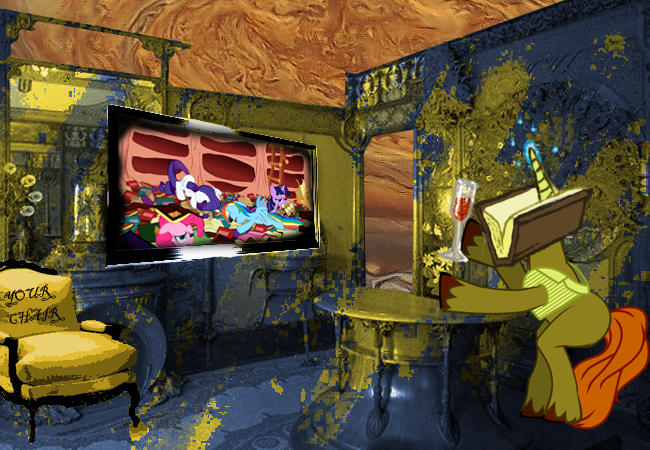
And while it certainly helps to have some training courtesy of a book-headed, chair-stealing, wine-swilling blowhard (i.e. me) the first step is always to make the choice to pay attention.
Sweet Home Alabama is basically a terrible song. Follow stormingtheivory.tumblr.com for updates, random thoughts, artwork, and news about articles. As always, you can e-mail me at KeeperofManyNames@gmail.com. Circle me on Google+ at gplus.to/SamKeeper. If you liked this piece please share it on Facebook, Google+, Twitter, Reddit, Equestria Daily, Xanga, MySpace, or whathaveyou, and leave some thoughts in the comments below.
Monday, July 22, 2013
The Visual Intelligence of Pacific Rim
I want to talk about Pacific Rim, and why it is not, as I've seen a frustrating number of commentators claim, a "dumb" movie, or a movie that "knows that it's dumb," or anything like that, but first I want to talk about my girlfriend, and you're going to let me because you've already clicked through and given me the pageview, so you may as well stick around. Besides, I think it will help provide a reference point for some of the ideas I'm talking about.
Alright?
Let's talk about my girlfriend.

My girlfriend Sara (who has given me the okay to talk about her case, in the name of supporting this movie that she's fallen head over heels in love with) has a learning disability. I'm honestly not sure what the clinical name for it is (if it has one), but one of the things she has trouble with is processing language on a non-literal level. In other words, metaphors, figures of speech, and some humor that depends on incongruities, sort of doesn't interface quite right with her brain.
However, there's no "metaphor" sector of the brain. There's nothing that interprets figurative information across media. There's brainmatter that deals with language... and brainmatter that deals with visuals.
So, while my girlfriend struggles with linguistic metaphor, she takes to visual metaphor like a fish takes to water. I have to admit, sometimes she gets comics or movies, for example, in ways that I don't, despite my training in media. She can look at a weird background motif in a Manga panel and immediately list off for me its significance, or pick out recurring color schemes used to signify something about a particular character, or decipher wordless sequences that I find confusing or disorienting and (embarrassingly) explain them back to me like it's no big thing and I'm kinda silly for not getting it.
This is obviously fascinating to me as a student of media and how it interfaces with the human mind. We have very different ways of reacting to media, sometimes, because I tend to struggle when it comes to remembering faces, whereas she struggles with following complex, fast-paced dialogue (or, to put it another way, I excel at analyzing spoken/written language and she excels at analyzing visual language). To some extent, then, it's tempting to look at this as a cool quirk and study it in the abstract as two equally viable ways of exploring media.
However, we do not exist within a culture that views the two ways of analyzing things as equal, and that's why I'm writing this article.
See, critical theory, from what I've observed, is highly linguistic in focus and scope. In fact, even casual critics on Tumblr tend to fall into a linguistic mode of criticism when discussing movies--they talk, in short, about the dialogue of a film or show primarily, and talk actions and plot secondarily. This is encouraged by an education system that has students read the plays of Shakespeare and Ibsen and Miller and so on, with the movie version as the reward once they're done reading. We consistently devalue the depth of visual communication in our culture--I mean, this isn't anything revolutionary to say, it's just the big dumb elephant in the room of media studies, that we have an overwhelmingly visual society that has no clue how to read images.
When confronted with a text that primarily relies on images, therefore, our response is to write that text off as dumb or lacking depth, because we're interpreting the text on a linguistic level rather than on the level that it's working. I mean, for goodness sake, look at the kind of language I'm using to describe this phenomenon! "Text." "Write off." Our mode of criticism, a century old, is wedded to the idea of communication through the typed or spoken word.
That's where Pacific Rim comes in. It's very easy, if you are confronting the movie with a linguistic bias, to see the film as "dumb," or, maybe even worse, a movie that's good because it "knows it's dumb" and doesn't aspire to be more. And yes, the dialogue isn't brilliant. Granted! You can totally watch the film and say "There's not a lot going on here as far as witty reparte is concerned, and the plot is pretty simple, so on that level, it's kind of a simplistic movie." You can take that away with you after watching Pacific Rim.
But that's not what my girlfriend took away from it.
She took away this:
"I thought it was really cool how Mako dyed her hair to match her jacket that she wore in the flashback scene. It was like she was still thinking about that day and carrying it with her."
I'm paraphrasing, of course, but that was one of the first things she said to me when the credits were rolling and we were freaking out together over how cool the movie was. She followed that up by talking about how expressive and cool the Kaidanovskys--the pilots of Cherno Alpha--were. These are, remember, two characters with effectively zero dialogue, beyond a few shouted commands during their fight scene, and yet they stood out dramatically within her mind as well rounded characters. And the conversation pretty much proceeded like that--sometimes with me echoing her thoughts, but often with her picking out details that I had missed completely.
She was responding to the film as a visual learner. She was reacting not as a traditionally trained--and traditionally, we might say, constrained--theorist, but as someone that interprets media according to images, body language, design symbolism, and color cues.
She was doing it right.
The rest of us are doing it wrong.
Pacific Rim is not a dumb movie at all. It is a visually intelligent movie.
Let's talk about some specific elements of the film, though, and why they operate quite differently when you view them as primarily things to be, you know, viewed.
Mako Mori is Not A Shallow, Timid, or Weak Character
One of the arguments I've seen repeatedly from multiple feminist critics can be summed up thus:
Mako Mori is not a strong, well developed female character, because she only has a few lines.
In a way, I feel the whole basic problem with our current discourse can be boiled down to just that one phrase. The character's relative depth is entirely contingent on how many lines of dialogue she gets. That, right there, is the devaluation of nonverbal, visual communication in favor of a... well, I'm not even sure what to call this. It's certainly no critical method that I've ever seen. Counting the number of lines a character gets is... well, kind of a bizarre standard, because it utterly divorces the actual content of those lines from their quantity.
The thing about Mako Mori, though, is that while her lines may be few, they pack a punch. In fact, they have strength in part due to how quiet she typically is--when she does speak, she is direct and forceful, and you know she's not speaking trivially.
But that's not exactly what I'm here to talk about. I want to talk about the visual cues surrounding this character. Mako's character development is actually almost entirely visual in nature--no one talks through her memories or explains her motivations aloud. What's more, her personality and character arc is defined strongly by color symbolism. So, while she doesn't have a huge number of lines, that doesn't make her shallow.
Let's talk about that color symbolism my girlfriend picked up on. Mako's colors in the film are blue and dark grey. The blue is, actually, the brightest spot of color that we see on her initially, and we are drawn to the blue highlight in her hair because it contrasts in saturation with the rest of her character design.
Now, this is a good example of how a text trains or creates its ideal reader. The film is giving us a striking cue that both makes her highly identifiable as an individual, and sets us up to recall that cue later. It's telling us that we should be thinking about Mako's colors and her character design.
This pays off once we finally see into her memories and recognize that the blue which in later life occupies her hair is the blue of the coat she wore on the day she was orphaned by Onibaba's attack on Tokyo. So, while this is never articulated, it is clear that she carries the memory of that day with her--deliberately, in fact, unless someone is actively dying her hair without her knowing, which seems improbable. This lends a certain air of truth to Stacker's claim that she is highly focused on vengeance.
One of the other interesting aspects of the flashback is the way Stacker Pentecost appears idealized. He ascends from Coyote Tango backlit, like some mythic hero or demigod. And this actually makes perfect sense when you recall that we are seeing the scene through child!Mako's eyes--Stacker is quite literally colored (colored a heroic gold) by her emotions on that day. This vision provides the context for all of her interactions with Stacker throughout the film, and, again, augments her brief speech to Raleigh about "respect." The moments where she opposes Stacker's judgment involve her standing up not only to the man who raised her, but to a man that she views as a larger than life idol.
And yet, she still is adamant in her desire to pilot, and is not shy or demur about demanding her chance to seek her revenge against the alien invaders. This is a woman who knows exactly what she wants, know exactly how to get it, and is willing even to butt heads with the person she loves more than anyone on Earth for that chance.
Wow.
There's more to Mako than just this scene and its impact on the rest of the film, of course, but I think the flashback and its visual language serves to demonstrate two things: first, Mako is a complex, wholly admirable female protagonist that probably has more depth than the male protagonist (which actually isn't all that new--holla at my fellow Hermione and Eowyn fans), and second, the film is capable of saying complex things, but it says those things through visual symbolism. (CONSCIENCE EDIT: And just in case it's not clear, I don't want to sound like I'm bashing feminist criticism--I'm a feminist critic myself--I'm just suggesting that if we're evaluating female characters, number of lines in this context is kind of a myopic way of going about it. There are other feminist criticisms of the film--like the overall number of women in the ground crew, for example--that are totally on point, I think. I just think Mako isn't given nearly the credit she really deserves as a female protagonist.)
Oh, and while talking intention is always risky for a theorist (death of the author and all that) I think it's worth noting that reading the film this way does go along with del Toro's designs for the audience experience. Now, keep in mind that Sara picked out Mako's hair color and its symbolic significance on a first viewing, without assistance from any sort of word of god interpreting the film for her... and check out this quote from del Toro:
Speaking of which:
The Kaidanovskys
Meet the Kaidanovskys:
The Kaidanovskys are basically the best.
I already kind of loved them for the fact that they pilot Cherno Alpha, a Jaeger that literally has its head transposed with a god damn cooling tower. But they're actually pretty fabulous even beyond having the hottest ride of them all.
For one thing, there's the fact that Sasha Kaidanovsky is, you know, another female pilot, which is pretty notable and cool. What's more, she's the member of her team that is constantly shouting information and orders. She seems to take the dominant role as far as interacting with the outside world, analogous to the dominant roles Raleigh and Stacker take when they pilot (although it's worth noting the complexity of that dynamic in Pacific Rim--the pilots are two parts of a whole, after all). In a way, her relationship with her husband is the mirror of Raleigh's with Mako: she is the expressive, somewhat more dynamic figure to her far more restrained husband who, like Mako, is less vocal and has an air about him of the coiled spring--force held carefully in balance.
Again, my reaction here is kind of colored by my shared experience of the movie with Sara, who is a huge Cherno Alpha fangirl. (Sidenote: this is why I always try, if possible, to watch movies with someone else. A shared experience, I find, is so much more meaningful. I love theaters for this reason.) One of the things we both noticed while watching was the way the two characters are given depth and personality through their body language. Look at the above images: Sasha's movements are lithe and determined... and more than a little lusty. She loves her husband and is quite open about expressing it. A simple gesture meant to beckon him to the place she's found in the mess hall thus becomes a sultry gesture. This is pretty cool, actually, as an affirmation, once more, of a female character's desire.
What's more, she puts an arm around her man protectively, baring her teeth at Raleigh to warn him away! I love this so, so much, because this kind of attitude is sort of stereotypically masculine, but here we've got the lithe, sexy female positioning herself as the protector of the big burly man. It's a funny moment, but it's also cool, because it writes, if not a novel, then certainly a god damn short story about these two characters and their relationship and their love and their connection as pilots, all through the power of body language.
No, Sasha does not get any lines of consequence.
But when the Kaidanovsky's finally decide to get out of the way of the plasma canon that threatens to blow up half the shatterdome, she's the second to start moving along the catwalk, and her body language oozes derision for the bullshit she's being subjected to, like she's doing the plasma fist a fucking favor by not just staring it down until it breaks down and cries.
And when Leatherback crushes the cockpit of Cherno Alpha, it's her scream--a scream not of pain or fear but of hate, pure hate, and boundless fury--that we hear.
Sasha Kaidanovsky is a badass, and she doesn't need to speak for us to know it. Every movement she makes speaks volumes. The Kaidanovskys have a voice in this film. Their voices are their bodies, their movements their words, their gestures their punctuation. If Mako speaks through color--if she speaks through pigment like a painter--the Kaidanovsky's speak through the dance they do together, a beautiful, loving, protective, forceful dance that continues even to the moment of their deaths.
Optimism: A Parting Thought
There's more to say, but I'm realizing first that this article is reaching Kaijulike proportions already, and second that I really need to watch the film once more before digging into some of the ideas more easily. This is by no means a comprehensive catalog of the various visual language/metaphor components of Pacific Rim. It barely even scratches the surface, in fact. Like, we could talk about:
Alright?
Let's talk about my girlfriend.
My girlfriend Sara (who has given me the okay to talk about her case, in the name of supporting this movie that she's fallen head over heels in love with) has a learning disability. I'm honestly not sure what the clinical name for it is (if it has one), but one of the things she has trouble with is processing language on a non-literal level. In other words, metaphors, figures of speech, and some humor that depends on incongruities, sort of doesn't interface quite right with her brain.
However, there's no "metaphor" sector of the brain. There's nothing that interprets figurative information across media. There's brainmatter that deals with language... and brainmatter that deals with visuals.
So, while my girlfriend struggles with linguistic metaphor, she takes to visual metaphor like a fish takes to water. I have to admit, sometimes she gets comics or movies, for example, in ways that I don't, despite my training in media. She can look at a weird background motif in a Manga panel and immediately list off for me its significance, or pick out recurring color schemes used to signify something about a particular character, or decipher wordless sequences that I find confusing or disorienting and (embarrassingly) explain them back to me like it's no big thing and I'm kinda silly for not getting it.
This is obviously fascinating to me as a student of media and how it interfaces with the human mind. We have very different ways of reacting to media, sometimes, because I tend to struggle when it comes to remembering faces, whereas she struggles with following complex, fast-paced dialogue (or, to put it another way, I excel at analyzing spoken/written language and she excels at analyzing visual language). To some extent, then, it's tempting to look at this as a cool quirk and study it in the abstract as two equally viable ways of exploring media.
However, we do not exist within a culture that views the two ways of analyzing things as equal, and that's why I'm writing this article.
See, critical theory, from what I've observed, is highly linguistic in focus and scope. In fact, even casual critics on Tumblr tend to fall into a linguistic mode of criticism when discussing movies--they talk, in short, about the dialogue of a film or show primarily, and talk actions and plot secondarily. This is encouraged by an education system that has students read the plays of Shakespeare and Ibsen and Miller and so on, with the movie version as the reward once they're done reading. We consistently devalue the depth of visual communication in our culture--I mean, this isn't anything revolutionary to say, it's just the big dumb elephant in the room of media studies, that we have an overwhelmingly visual society that has no clue how to read images.
When confronted with a text that primarily relies on images, therefore, our response is to write that text off as dumb or lacking depth, because we're interpreting the text on a linguistic level rather than on the level that it's working. I mean, for goodness sake, look at the kind of language I'm using to describe this phenomenon! "Text." "Write off." Our mode of criticism, a century old, is wedded to the idea of communication through the typed or spoken word.
That's where Pacific Rim comes in. It's very easy, if you are confronting the movie with a linguistic bias, to see the film as "dumb," or, maybe even worse, a movie that's good because it "knows it's dumb" and doesn't aspire to be more. And yes, the dialogue isn't brilliant. Granted! You can totally watch the film and say "There's not a lot going on here as far as witty reparte is concerned, and the plot is pretty simple, so on that level, it's kind of a simplistic movie." You can take that away with you after watching Pacific Rim.
But that's not what my girlfriend took away from it.
She took away this:
"I thought it was really cool how Mako dyed her hair to match her jacket that she wore in the flashback scene. It was like she was still thinking about that day and carrying it with her."
I'm paraphrasing, of course, but that was one of the first things she said to me when the credits were rolling and we were freaking out together over how cool the movie was. She followed that up by talking about how expressive and cool the Kaidanovskys--the pilots of Cherno Alpha--were. These are, remember, two characters with effectively zero dialogue, beyond a few shouted commands during their fight scene, and yet they stood out dramatically within her mind as well rounded characters. And the conversation pretty much proceeded like that--sometimes with me echoing her thoughts, but often with her picking out details that I had missed completely.
She was responding to the film as a visual learner. She was reacting not as a traditionally trained--and traditionally, we might say, constrained--theorist, but as someone that interprets media according to images, body language, design symbolism, and color cues.
She was doing it right.
The rest of us are doing it wrong.
Pacific Rim is not a dumb movie at all. It is a visually intelligent movie.
Let's talk about some specific elements of the film, though, and why they operate quite differently when you view them as primarily things to be, you know, viewed.
Mako Mori is Not A Shallow, Timid, or Weak Character
One of the arguments I've seen repeatedly from multiple feminist critics can be summed up thus:
Mako Mori is not a strong, well developed female character, because she only has a few lines.
In a way, I feel the whole basic problem with our current discourse can be boiled down to just that one phrase. The character's relative depth is entirely contingent on how many lines of dialogue she gets. That, right there, is the devaluation of nonverbal, visual communication in favor of a... well, I'm not even sure what to call this. It's certainly no critical method that I've ever seen. Counting the number of lines a character gets is... well, kind of a bizarre standard, because it utterly divorces the actual content of those lines from their quantity.
The thing about Mako Mori, though, is that while her lines may be few, they pack a punch. In fact, they have strength in part due to how quiet she typically is--when she does speak, she is direct and forceful, and you know she's not speaking trivially.
But that's not exactly what I'm here to talk about. I want to talk about the visual cues surrounding this character. Mako's character development is actually almost entirely visual in nature--no one talks through her memories or explains her motivations aloud. What's more, her personality and character arc is defined strongly by color symbolism. So, while she doesn't have a huge number of lines, that doesn't make her shallow.
Let's talk about that color symbolism my girlfriend picked up on. Mako's colors in the film are blue and dark grey. The blue is, actually, the brightest spot of color that we see on her initially, and we are drawn to the blue highlight in her hair because it contrasts in saturation with the rest of her character design.
| It's a small splash of blue, but look how bold it is. It screams "Pay Attention To Me." |
This pays off once we finally see into her memories and recognize that the blue which in later life occupies her hair is the blue of the coat she wore on the day she was orphaned by Onibaba's attack on Tokyo. So, while this is never articulated, it is clear that she carries the memory of that day with her--deliberately, in fact, unless someone is actively dying her hair without her knowing, which seems improbable. This lends a certain air of truth to Stacker's claim that she is highly focused on vengeance.
![]() |
| Grey and blue. |
And yet, she still is adamant in her desire to pilot, and is not shy or demur about demanding her chance to seek her revenge against the alien invaders. This is a woman who knows exactly what she wants, know exactly how to get it, and is willing even to butt heads with the person she loves more than anyone on Earth for that chance.
Wow.
There's more to Mako than just this scene and its impact on the rest of the film, of course, but I think the flashback and its visual language serves to demonstrate two things: first, Mako is a complex, wholly admirable female protagonist that probably has more depth than the male protagonist (which actually isn't all that new--holla at my fellow Hermione and Eowyn fans), and second, the film is capable of saying complex things, but it says those things through visual symbolism. (CONSCIENCE EDIT: And just in case it's not clear, I don't want to sound like I'm bashing feminist criticism--I'm a feminist critic myself--I'm just suggesting that if we're evaluating female characters, number of lines in this context is kind of a myopic way of going about it. There are other feminist criticisms of the film--like the overall number of women in the ground crew, for example--that are totally on point, I think. I just think Mako isn't given nearly the credit she really deserves as a female protagonist.)
Oh, and while talking intention is always risky for a theorist (death of the author and all that) I think it's worth noting that reading the film this way does go along with del Toro's designs for the audience experience. Now, keep in mind that Sara picked out Mako's hair color and its symbolic significance on a first viewing, without assistance from any sort of word of god interpreting the film for her... and check out this quote from del Toro:
Yeah. There it is, ladies and gentlemen, in black and white for all to see. Sara picked out the symbolism and together we sussed out its meaning without the aid of del Toro. This says to me that if you accept the film's language and read the film the way it quite openly prompts you to read it, you get results that are far more nuanced, valuable, and functional than if you read in opposition to the text. If you read with the film, you uncover the film's--and the character's--secrets.It’s impossible to condense because every single decision counts. And as I often say, I don’t do eye candy, I do eye protein because all of these design choices are telling the story.I’ll give you one example. Mako is defined by the grey colour and the blue colour. As we go through the movie we find out that she’s defined by those colours because in her childhood we have a blue memory, a memory that’s all just in blue with splashes of red. I show her holding her heart, or a symbolic object that represents her heart. The memory has left a stain on her hair that is blue, and she’s carrying that memory with her. The introductory sequence of Mako is very significant.
Speaking of which:
The Kaidanovskys
Meet the Kaidanovskys:
| Via |
| Look at Sasha creepin' there oh my god |
I already kind of loved them for the fact that they pilot Cherno Alpha, a Jaeger that literally has its head transposed with a god damn cooling tower. But they're actually pretty fabulous even beyond having the hottest ride of them all.
For one thing, there's the fact that Sasha Kaidanovsky is, you know, another female pilot, which is pretty notable and cool. What's more, she's the member of her team that is constantly shouting information and orders. She seems to take the dominant role as far as interacting with the outside world, analogous to the dominant roles Raleigh and Stacker take when they pilot (although it's worth noting the complexity of that dynamic in Pacific Rim--the pilots are two parts of a whole, after all). In a way, her relationship with her husband is the mirror of Raleigh's with Mako: she is the expressive, somewhat more dynamic figure to her far more restrained husband who, like Mako, is less vocal and has an air about him of the coiled spring--force held carefully in balance.
Again, my reaction here is kind of colored by my shared experience of the movie with Sara, who is a huge Cherno Alpha fangirl. (Sidenote: this is why I always try, if possible, to watch movies with someone else. A shared experience, I find, is so much more meaningful. I love theaters for this reason.) One of the things we both noticed while watching was the way the two characters are given depth and personality through their body language. Look at the above images: Sasha's movements are lithe and determined... and more than a little lusty. She loves her husband and is quite open about expressing it. A simple gesture meant to beckon him to the place she's found in the mess hall thus becomes a sultry gesture. This is pretty cool, actually, as an affirmation, once more, of a female character's desire.
What's more, she puts an arm around her man protectively, baring her teeth at Raleigh to warn him away! I love this so, so much, because this kind of attitude is sort of stereotypically masculine, but here we've got the lithe, sexy female positioning herself as the protector of the big burly man. It's a funny moment, but it's also cool, because it writes, if not a novel, then certainly a god damn short story about these two characters and their relationship and their love and their connection as pilots, all through the power of body language.
No, Sasha does not get any lines of consequence.
But when the Kaidanovsky's finally decide to get out of the way of the plasma canon that threatens to blow up half the shatterdome, she's the second to start moving along the catwalk, and her body language oozes derision for the bullshit she's being subjected to, like she's doing the plasma fist a fucking favor by not just staring it down until it breaks down and cries.
And when Leatherback crushes the cockpit of Cherno Alpha, it's her scream--a scream not of pain or fear but of hate, pure hate, and boundless fury--that we hear.
Sasha Kaidanovsky is a badass, and she doesn't need to speak for us to know it. Every movement she makes speaks volumes. The Kaidanovskys have a voice in this film. Their voices are their bodies, their movements their words, their gestures their punctuation. If Mako speaks through color--if she speaks through pigment like a painter--the Kaidanovsky's speak through the dance they do together, a beautiful, loving, protective, forceful dance that continues even to the moment of their deaths.
Optimism: A Parting Thought
There's more to say, but I'm realizing first that this article is reaching Kaijulike proportions already, and second that I really need to watch the film once more before digging into some of the ideas more easily. This is by no means a comprehensive catalog of the various visual language/metaphor components of Pacific Rim. It barely even scratches the surface, in fact. Like, we could talk about:
- The way costuming is used to portray character
- The fact that the Australians are the only pilots to mark their kills on their armor
- The crazy closing sequence in the rift
- The red shoe and the symbolism there
- Moving beyond images, the fact that Mako's freakout in the first test run happened because she was forced to experience Raleigh's brother's death both from Raleigh's perspective and his own perspective and how she would have been fine if she wasn't hit by a double dose of Raleigh's bad memories
- The images we see of Herman and Newt's memories when they drift together
And a whole lot of other stuff besides. Some of this stuff, it's worth noting, didn't come out of my own head--it's stuff I came across on Tumblr that people picked out, or, predictably, more stuff that Sara caught and I missed. There's this whole conversation going on right now, basically, about the visual language of the movie and how we can pull out the film's messages and the character arcs from sometimes very subtle cues or momentary flashes of information.
Now...
Think about that for a moment.
If this film really, truly was "dumb," or knew enough to just be dumb and not aspire to anything greater...
...Would that conversation really, earnestly be possible?
No.
You could have a complex conversation, sure--fans do all the time. But that conversation would be built largely around the exercise of speculation and fanfiction/fan art production, not the exercise of interpretation and the evaluation of symbols within the text. It would not be the conversation we are having right now.
And really, that's what I want you to come away from this article understanding. We CAN and SHOULD delve into this work. We can do more than simply lazily write it off. For god's sake, isn't it obvious that a work that hints at character arcs is more intellectually engaging than one that spells those arcs out directly through dialogue? This film offers us an opportunity to engage a text that challenges us critically because it goes against our cultural and academic training. The proper response is to allow that text to change us, to recognize the challenge for what it is.
And really, if the film has taught us anything, this is a challenge we can overcome, in part by coming together as a community of viewers and thinkers and theorists and lovers of giant robots. There's an attitude present in a lot of "professional" reviews--usually not stated directly, but certainly present--that this sort of film, with its message of coming together as a whole planet to defeat a seemingly unstoppable opponent, and with its appeal to the flashy, the visually indulgent, and the almost aggressively upbeat, makes this film a lesser summer movie.
Fuck.
That.
Noise.
Look, I've not exactly been shy about my disaffection towards the modern grimdarkness of media. As a choice, though, I can at least understand and accept it. What bothers me more is the critical attitude that reads a film like Dark Knight Rises as nuanced or complex due to its moral ambiguity... rather than, you know, a film that contradicts itself on literally every conceivable thematic level, to the point where the film is a giant grimdark mess of growling and posturing, sound and fury saying nothing. The flip side of that, of course, is that a film like Pacific Rim is treated as somehow naive or insignificant because it dares, gasp!, to have not just a unified message, but a quite positive, affirmative message, spoken not in the language of Lifetime movies or this year's crop of Oscar-bait, but in the language of Metal, the language of force and bombast and people in giant fucking robots punching Godzilla in the face.
We have reached a point, and really let this one sink in because it gets more flooring the more you think about it, where it's more radical and unacceptable to say, "Humans can accomplish amazing things when we set aside our differences and disagreements and work together to make the world a better place," than to say something sour and bitter and cynical.
Cynicism used to be the radical thing.
Now it's as mainstream as Greenday.
So, what I'm asking is that you give the film a second look, if you're not already one of us fanatics who loved it the first time through. Give it a chance to speak to you in its own language. Be the Raleigh in this situation--just as he surprised Mako by knowing and speaking Japanese to her, undermining her skepticism, enter a dialogue with the film that speaks in images. Open yourself to alternate ways of thinking and understanding.
There's a place by the fire here, and we've kept your second favorite chair warm for you.
Won't you join the conversation?
Circle me on Google+ at gplus.to/SamKeeper. Follow stormingtheivory.tumblr.com for updates, random thoughts, artwork, and news about articles. As always, you can e-mail me at KeeperofManyNames@gmail.com. If you liked this piece please share it on Facebook, Google+, Twitter, Reddit, Equestria Daily, Xanga, MySpace, or whathaveyou, and leave some thoughts in the comments below.
Saturday, May 25, 2013
Not Proud To Be A Geek
| This isn't going to be a cheery article. |
What glubbed forth in the precambrian dawn was a lengthy, overwrought explanation of how countless frustrations slowly burned from me my ability to wear the moniker of "Geek" with pride. Yes, ladies and gentlemen, I am renouncing the term "geek." Or, I should say rather, it renounced me.
But I'm getting ahead of myself. Let's trace the evolution of this event.
Starting With The Last Straw: Geek Pride Day
I actually was unaware of Geek Pride Day until this morning, when I awoke to see some mentions of it on... actually, I don't recall now. Probably Google+, which seems to largely be a haven for geeks of all sorts (since, to their credit, geeks are early adopters of weird tech, and the broader Facebook set haven't migrated). Initially, my response was neutral-to-cynical. Geekdom and I haven't been getting along much lately (I'll explore the reasons why later in the article) so while I wasn't really irate at this point, I wasn't really enthused, either.
I decided to do some research, though, and initially found the results quite heartening. The holiday originated in Spain, apparently. Cool! A lot of geekdom seems to be Americocentric in nature, so having the holiday originate in Europe is pretty neat. And what's more, the day is associated with a list of rights and responsibilities. Responsibilities! That's pretty cool! Geeks have a lot of good to offer the world, and acknowledging that openly seems like a reasonable strategy.
Things were looking up.
And then I read a translation of the list.
Rights:How utterly disappointing.
Responsibilities:
- The right to be even geekier.
- The right to not leave your house.
- The right to not like football or any other sport.
- The right to associate with other nerds.
- The right to have few friends (or none at all).
- The right to have as many geeky friends as you want.
- The right to be out of style.
- The right to show off your geekiness.
- The right to take over the world.
- Be a geek, no matter what.
- Try to be nerdier than anyone else.
- If there is a discussion about something geeky, you must give your opinion.
- To save and protect all geeky material.
- Do everything you can to show off geeky stuff as a "museum of geekiness."
- Don’t be a generalized geek. You must specialize in something.
- Attend every nerdy movie on opening night and buy every geeky book before anyone else.
- Wait in line on every opening night. If you can go in costume or at least with a related T-shirt, all the better.
- Don’t waste your time on anything not related to geekdom.
- Try to take over the world!
How disappointing that instead of looking inward and seeing how we can make our community better, instead of looking outward and seeing how we can improve the world, how we can be MORE inclusive, MORE welcoming, MORE passionate in a communal way, these rules detail all the ways in which we should become LESS inclusive, LESS welcoming, and passionate only in the things we can own and control and dominate and use as status symbols. The rights are fairly innocuous--there's some stuff missing (again, I'll get to that) but for the most part they're reasonable--but the responsibilities list represents almost nothing but narrowmindedness, status-obsession, and arrogant exceptionalism.
I find only two of the responsibilities reasonable: the first, which urges a self-determined identity (ironically a sentiment undermined by the rigid social code that follows) and the fourth, which urges artistic preservation, a value desperately needed when the speaker for the new XBOX One can blithely claim, "If you’re backwards-compatible, you’re really backwards."
Two out out ten.
Geeks do have responsibilities, responsibilities derived from the positive qualities people bandy about whenever geek pride as a notion comes up. Geeks have responsibilities that come from their intellects and their status as (former) outsiders.
Had we upheld our end of the bargain--had we acknowledged our important role in culture and reacted accordingly--I would be proud to be a geek.
But we failed.
And I am not proud to be a geek.
The reasons why follow.
WE CLOSED OUR DOORS TO NEWCOMERS AND PASSIONATE AMATEURS
There's an attitude in geekdom that intelligence is best expressed through a kind of arrogant dismissal of those less familiar with geek media, and that attitude is absolutely, incontrovertibly holding us back. It's ok to tell someone that they are wrong if, y'know, they are, but that's not a license to take on an air of absolute superiority over younger or newer enthusiasts who are genuinely just seeking answers, or seeking mentors that can lead them to greater understanding. Yet this is the response to newcomers that I see all the time. When you talk about "being the nerdiest," as though it's a competition, this is the ideology you buy into.
This even extends to the way that we deny certain activities the moniker of "geek." Look at responsibility 9 in the list above: "Don’t waste your time on anything not related to geekdom." That's pretty messed up, if you really think about it. That's the kind of dictum present in the strict fundamentalist religions that a significant number of geeks claim to abhor. Abandon this world of things and come to Geekdom! Yuck.
As a consequence, we impoverish our own existence by denying the value of anything outside our narrow spheres of interests and disparage the people (think of "casual gamers," for example, or people who got into the Teen Titans cartoon when they were too young to read the comics) who we deem to be less fully integrated into the cult of Geek.
If we truly love and appreciate our geek media, why do we hide it from the world? We could enrich the lives of so many--and enrich our own lives--if we opened up more of a dialogue with those not traditionally considered geeks. It was our responsibility to open that door, but we closed it, instead.
Of course, the dividing line between geeks and non-geeks emerges from more than a simple judgment of experience. The fact of the matter is:
WE FAILED TO CONVERT SAFE SPACES FOR GEEKS INTO SAFE SPACES FOR ALL
Women. Queers. People of color. Geeks increasingly embrace a policy of marginalization and exclusion against these groups. I'm sure most of the regular readers of this blog are well aware of the issues, but it bears repeating, I think. If I catalogue the sins of geeks, this is certainly one of the top few.
How does this happen? Ugh, all kinds of different ways. A lot of social justice folks talk about microaggressions, but I'm more concerned with people just straight up being overt, aggressive assholes.
Like, let me give you an example. On the Wizards of the Coast forums, the word "queer" is censored, which I guess makes sense since it can be used as an insult, but which makes it difficult for me to discuss LGBTQ issues as openly as I would like. To get around the problem, I replace the "u" in the word with a "v."
Here's another poster's condescending response:
Why do you keep using a v instead of a w? You're not using real words even if the "community" thinks they are. Now we should definitely take this to another thread but I don't tolerate using fake words to make people feel special.Reread that first sentence a few times. "Instead of a w." Yeah. He then proceeded to misuse the term "asexual" after I had literally just gotten through explaining the fact that "asexual" and "intersexual" don't mean the same things in gender and sexuality studies as they do in biology.
Sigh.
But the unique stupidities aside, what this really tells me is that I should shut up about my queerness, just as women should shut up about their womenness, and people of color should shut up about their weird skin. We don't need diversity, is the message here. You're the REAL racist/sexist/homophobe (how the fuck does that one work?) for wanting more people of color/women/queers in your fiction! And asking for special treatment is just reverse discrimination.
Women who speak out against misogyny within geek culture are slutshamed, harassed, threatened with rape. Casual homophobia seems to be a core part of the First Person Shooter and Fighting Game scenes these days. People straight up flipped shit when they found out that a non-canon parallel universe's Spiderman had died and was to be replaced by a young black boy. They did the same thing when they found out that there was going to be a black Lancelot. Oh, and then there's the Homestuck fandom. Remember when the fandom shit itself because a bunch of assholes used a joke in the comic to harass cosplayers of color and people who drew non-white fan art? And then shit itself further when Andrew Hussie removed the joke and those same fans decided that a horrible crime against artistic genius had been committed? That sure was... peachy.
The story of geekdom of late has been one of a minority of straight white males railing against political correctness, activism gone mad, and the destruction of their last safe space. Men's Rights idiocy spreads like malignant cancer through the body of our culture, and the message I hear again and again--loud and clear though it comes veiled in a pseudo-intellectual cloak--is that I am not welcome here unless I keep my fag mouth shut.
What kills me about this is that I remember a different geekdom. I remember geeks that accepted anyone that was an outcast, because WE were outcasts. If you would associate with us, we would associate with you. For a long time, I thought acceptance and understanding was, albeit imperfectly, woven into the DNA of geeks. Weren't we responsible for the first interracial kiss on American television? Didn't our authors push the boundaries of gender and sexuality (I think of people like Ursula LeGuin in particular, here) further than anyone but the most advanced of ivory tower intellects? Shit, didn't we used to be better than this? I have conversations sometimes with older geeks that are just as disturbed as I am by the current trends. They, too, remember when geekdom represented something more.
We had a responsibility to band together against those who did not understand us, those who found us weird or freaky. We had a responsibility to welcome other outsiders, the dispossessed, with open, if slightly smelly, arms. We failed.
And then we committed an even greater sin:
WE REBUFFED THOSE WHO POINTED OUT OUR FAILINGS
People spoke out. We turned them away, threatened them, called for their heads, declared them collaborators with the enemy. We did that Robespierre shimmy, danced beside the guillotine as, one by one, our former allies lost their heads.
The man who openly sneers at the dispossessed is a danger, sure... but more insidious is the man who reacts to conflict with endless cries for peace and calm!
More insidious is the man who chides the activist for raising a fuss, who scolds the activist for "sinking to their level," who bemoans the activist's constant need to bring up the uncomfortable, push things further than polite conversation allows, or show fury or hurt when attacked, insulted, dragged through the mud, and forced to endure insult after insult.
Where is that man when his fellow geek jeers and mocks the woman, the queer, the man of color? Nowhere to be found, in my experience. Because it takes two to fight and one to bully; when a fight breaks out, it's because the attacked party responds in kind. The fight would be impossible if we would just TAKE IT LIKE A BITCH.
So many speak out against the toxicity of our culture, and we had a responsibility to listen, to stand beside them, to defend them. And we rebuffed them instead, and made them the source of the problem. I see it on, again, the Wizards community forums, when female members react with justified rage to a poster that for six years has stalked, harassed, condescended, and made deeply disturbing sexual advances towards any openly female poster. The mods will not ban him, and more and more I see other posters chiding the women for reacting with anger and disrupting the community.
We rebuff them instead.
And as a consequence,
WE BLINDED OURSELVES TO REAL ISSUES
Listen:
I hate The Big Bang Theory. Everything geeks say about it--that it laughs at us rather than with us, that it relies on shallow stereotypes rather than a deep understanding of geekhood for its humor, that its gender dynamic is frustratingly regressive--is true.
But.
The Big Bang Theory is not "Blackface For Geeks."
In fact, if you think it is, I recommend that you go see an eye doctor immediately, because shit, son, you got to get yourself some fucking perspective.
It is so damn offensive to compare a show about white male geeks that is a little stereotypical to a practice that systematically denied the acting capabilities of people of color while simultaneously reinforcing racist stereotypes that were part of a systematic disenfranchisement and, in some places, an establishment of an economic system that was slavery in all but name.
Similarly:
Male geeks? For fuck's sake, LOSING A GAME OF MAGIC: THE GATHERING IS NOT GETTING RAPED. I don't care how quickly your opponent beat you, I don't care how much damage that spell did in one turn, I don't care, I don't care, I don't care. It's not rape, it's not comparable to rape, and the fact that you are describing yourself as "getting raped" shows that you are at best profoundly insensitive, and at worst profoundly misogynistic.
Geeks pride themselves on their intelligence (this is a point that'll show up later on as well). We pride ourselves on having more adapted imaginations than others, better insight. And yet somewhere along the way, we forgot that with that great power comes great responsibility. We blinded ourselves to the realities of oppression, we lost our sense even of what truly constituted our own exploitation and abuse and transformed trivialities into great crimes.
But it's no surprise we can't even recognize when we're getting fucked over. See,
WE POISONED DISCOURSE
Yeah, now we're getting a bit meta here. See, there's two camps of very vocal geeks these days. There's the people that absolutely cannot be satisfied with anything and work themselves into a frothy-mouthed rage each time something happens that they don't like. And on the flip side of that coin, there's the people who go into a frothy mouthed rage any time someone decides that something new isn't to their taste. "You're raping my childhood!" one side screams. "If you don't like it, get out!" howls the other side.
And in the process we've absolutely slaughtered substantive discourse.
How do you begin to analyze whether or not The Dark Knight Rises or Iron Man 2 were functional films when the voices of critics with actual deep-level understanding of narratives or the broader political implications of certain film ideas are drowned out by people howling that the continuity has been screwed with, or backstories don't work? Or when the response is that anyone criticizing the films on their own terms are simply grognards unable to adjust to changes? Even changes that are legitimately boneheaded and insulting, decisions that legitimately undermine a work or pander to the lowest common denominator, simply cannot be discussed any more because there's so much damn noise. The discourse has been poisoned because we collectively decided that we didn't need theory, we didn't need to find better ways to articulate our complaints, we didn't want to reflect and contemplate and compare our media to other acknowledged masterpieces of literature and film and music, we didn't want to differentiate between unfocused incoherent anger and fully-articulated fury at legitimate slights.
And now that we poisoned our ability to discuss the state of our media,
WE ENSLAVED OURSELVES TO THE INTERESTS OF OTHERS
Remember when Call of Duty was advertised by Oliver North?
You know, the guy who was a part of the clever deal where we sold weapons to Iran to finance far right dictators in South America who were responsible for perpetrating all sorts of atrocities upon their own people?
That Oliver North.
Geeks are being co-opted in all sorts of deeply disturbing ways. One of them is the collusion between Call of Duty and other first person shooter game producers and the American military-industrial complex. Oliver North's endorsement of a shooting game is simply one representation of that. There was also a thing where Call of Duty was selling advertisements for real guns within their games. That's kinda sick, huh?
Another is the constant refrain I discussed above that dismisses any criticism aimed at geek products as illegitimate. This creates an atmosphere where corporations are protected by a loyal meatshield of lapdog fans, eager to explain why their favored product or company is beyond reproach. So, unfair business practices, decisions that reinforce the alienation of minorities from geekdom due to the purported "simple economic necessity" of choices like refusing to include female sprites in multiplayer games or refusing to support any game with a non-sexualized female protagonist... all these things and more are fervently explained away by the devout. In the process, they enslave our culture to people who do not have our best interests--or in some cases, the best interests of the world--at heart.
It is almost fitting, though, that this should be the case. It is almost a karmic fate, because
WE DEMANDED MORE EVEN AS WE ATTAINED THE MANTLE OF LEADERSHIP
Somehow geeks have internalized their outsider status so fucking hard that the mindbendingly huge success of a science fiction movie that features blue aliens as main characters and a movie that is the culmination of a bunch of other movies that bring together a giant green guy, a Norse god, a man in power armor, a superspy, a supersoldier, and a super... uh... archer (poor Hawkeye) is still somehow not evidence that we won. We took over. The world is effectively ours. From the bizarre surrealist and science fiction experiments in pop music videos, to the staggering success of shits like Mike Zuckerberg, to the staggering cultural penetration of weird shows like Adventure Time, geeks have taken over.
And yet we still behave as though we're outsiders, as though we're the underdogs, as though we can't catch a break.
Like, a few days ago I was wading through the maelstrom of stupidity that was the My Little Pony fandom's reaction to Equestria Girls, a movie where Twilight Sparkle goes through a magic mirror to a human high school. Amidst all the generalized stupid, there was one comment that stood out to me. The person was outraged because this was, in his mind, a clear attempt by Hasbro to take My Little Pony and turn it into something for little girls.
Yeah.
Jumping Jesus on a pogo stick.
That's the kind of acquisitiveness I'm talking about. It's like anything not for us is somehow an insult, as though we are all that matters in the world. It's not enough that we should dominate culture, we must utterly absorb it, and anything for anyone else is an abomination. Here's our weird geekdom religiosity rearing it's head again... in the dumbest way possible.
I guess this is just a variation of what I said earlier about our blindness, with a touch of my points about the pervasive racism, sexism, and homophobia in the culture mixed in for flavor, but I think it's worth saying as its own sort of point. We had a responsibility, once we finally won, once we got the respect we deserved, to rule wisely. We had a right to conquer the world! And we had a responsibility to recognize what winning looked like it. But somehow we missed it, and we kept demanding more. Eventually we're gonna do that King Midas thing, I think. We'll demand the world turned to gold. And in our glorious golden palace, we'll starve.
Which leaves us, I guess, with the elephant in the room. The final sin. The final great failure that underlies all the others.
WE EXPLOITED OUR INTELLIGENCE AS A STATUS SYMBOL, NOT A TOOL
We decided we were brilliant, and that we deserved to rule, and that the world should dance to our tune.
And then instead of using that intelligence, instead of using our sight, and our thoughts, and our hands, and our hearts, we erected greater and greater monuments to our own genius--sterile and perfect, reaching upward to the sky.
Seeing the ivory towers of those who had spurned us, we did not use our minds--our greatest gifts--to build a new kind of dwelling for culture, a new kind of fortress with walls to protect, not to exclude. We built, instead, our own towers and cried, "Look, we are surely gods! We have surpassed all those who spurned us, all those who sought to limit or exclude us!" We built our own Babels, our language degraded as we increasingly shouted out liturgies to our own egos, and now the animals look back and forth between the humans and the geeky, nearsighted pigs, and they just can't quite tell the difference.
We cry that pop culture exploits us, while we exploit ourselves. We turn ourselves into cultural commodities, scrabbling for every ounce of respect we can get, acquiring flunkies and moochers and fans of our own. We built high and lost sight of the dirt from which we climbed, and we keep building with our own hands, enslaving ourselves to our intellects rather than enslaving our intellects to a deeper purpose.
Geekdom is a failed experiment. Every responsibility that we had, we failed to fulfill. We did not keep up our end of the bargain.
The towers we built did not lead to God at all.
They just led straight up our own asses.
Don't Call Me Geek
I'm not a geek anymore. I was, but the culture has changed, and it's made it clear to me that I'm not welcome. Because I'm a critic and a theorist, and because I'm a social justice advocate, and because I'm a pansexual genderqueer, I'm not welcome.
My girlfriend, my sister, my other female friends... unwelcome.
My friends who are black and Latino... unwelcome.
Hell, a lot of the people I love and respect, simply by virtue of their particular opinions, or their acceptance of and interest in broader culture, are... unwelcome.
So, don't call me geek. I'm not that, not anymore, not just by my own choice, not just by my own disgust and anger, but because I am a storm unwelcome in these new towers.
Sometimes I bandy the idea about with my friends of starting a parallel geek culture--a fork of geek culture, if you will--that takes on the mantle of responsibility, that embraces the roles I lay out here and adds some more rights--the right to be protected from misogyny and homophobia, the right to articulate arguments of like and dislike without dismissal, the right to blend high and low culture, maybe. I'm not sure what you would call us. Maybe nothing at all. Maybe fans of our respected geek things--fans of The Avengers, fans of Tolkien, fans of Homestuck, Adventure Time, My Little Pony, but also James Joyce, Beethoven, hip hop, goth rock, whatever we like, whatever we want to geek out about.
Part of me wants to call us "Grangers." I like Hermione, ok? And her demotion to second in command maybe is a good symbol of the kind of problems we seek to solve.
But probably you don't call us anything at all. We're the geeks of geekdom, the new dispossessed.
And maybe I can be proud of being that kind of geek, after all.
Circle me on Google+ at gplus.to/SamKeeper. Follow stormingtheivory.tumblr.com for updates, random thoughts, artwork, and news about articles. As always, you can e-mail me at KeeperofManyNames@gmail.com. If you liked this piece please share it on Facebook, Google+, Twitter, Reddit, Equestria Daily, Xanga, MySpace, or whathaveyou, and leave some thoughts in the comments below.
Subscribe to:
Comments (Atom)