

Oddball media crit--laying siege to academia's ivory tower from pop culture's gutter
Showing posts with label Marvel Cinematic Universe. Show all posts
Showing posts with label Marvel Cinematic Universe. Show all posts
Monday, September 9, 2019
Batmen vs Supermen: Expanded Universes Beyond The "Event"
So you've decided your story needs a dramatic cataclysm to electrify the fans. You've marshaled the qualities of the Expanded Universe to bring it about, and will sacrifice anything for the drama. But is that really such a good idea? Is there another way?


Tuesday, September 3, 2019
Batmen vs Supermen: Expanded Universes and the Ultimate Warrior
Superman. Batman. Titans of their fictional universe. Who would win in a fight? To truly master this question we can't just smash the two together like dumb action figures. We need to dive deep into the qualities of the Expanded Universe genre.

Monday, August 26, 2019
Save Spidey! Into the Spider-Verse's Failure and Promise
Can Spider-Man matter outside of the Marvel Cinematic Universe? Sony, Disney, #SaveSpidey, and Into the Spider-Verse.

Thursday, November 23, 2017
The Trash World of Ideology: Thor Ragnarok Wants You To Destroy America
It's a StIT Thorsgiving Special! Feeling harried by your racist relatives? Hide in the bathroom, pull up this essay, and talk turkey with me about how Thor: Ragnarok really does seem to think Marvel, Disney, and America all need to be destroyed!
 |
| Image extremely helpfully provided by EssayofThoughts |
Thursday, October 12, 2017
So Bad It's Good: The Inhumans
The Inhumans can really only be enjoyed ironically... but is it possible to sincerely enjoy something ironically?

Tuesday, February 28, 2017
Starkitecture: Should We Be Worried About Black Panther's Concept Art?
A few weeks ago we got our first glimpse of the MCU's Black Panther in the form of several concept art pieces. The images look cool at first glance, but does Wakanda's setting design suggest some deeper limitations to the Marvel imagination, and the potential for this film to give us something really original? And what does a movement called The International Style have to do with it?

Tuesday, November 15, 2016
Populism, Politics, People and Superpeople: Luke Cage and This Fucking Election
Luke Cage is a narrative drawing heavily on popular antiracist politics, so why is it so suspicious, narratively, of populism? And how did the Democratic ruling class's own contempt for populism cost them an entire election and usher in four to eight years of proto-fascist stoogery? This article's two interwoven threads explore these questions and freely allows Perfect to be the enemy of Good, because sometimes "good" doesn't translate to "good enough," and god dammit, there's a whole lot of things that just aren't good enough anymore.
This article is basically a 4500 word primal scream and it is not designed to make anyone feel better about anything at all. Instead of reading this deeply bitter article you could play this as loud as possible. The experience is probably roughly the same.
 |
Monday, October 24, 2016
Tangled in Tentacles: The Hauntological and the Weird
China Mieville posits two types of horror: the Weird and the Hauntological. But the boundaries between the two are sometimes hard to make out, and it's possible to mistake one for the other. This review roundup looks at three different mergers of the Weird and the Hauntological--the Rubbery Men of Fallen London, the skulltopus that is HYDRA, and the phenomenon of Global Warming, and asks: just what is the core of the horror here?
Sunday, May 22, 2016
"We're Still Friends Right?" Fanfictional Trauma and Captain America: Civil War
"Forty million readers follow the Gumps. ... If I could prove it I would say there are exactly 16,847,915 3/4 people writing to Sidney Smith, care of the Chicago Tribune, with suggestions as to what he should do with the Gumps next. And inasmuch as most of us take the Gumps seriously and expect to have our suggestions followed, the problem of these suggestions is a real one, after all."
--William Fleming French, describing an example of the problem of fannish engagement for newspaper comic The Gumps, quoted in Jared Gardner's Projections
There are really only two places you can have the villain of one major franchise sing a song from another major franchise. One of those places is in fanfiction.
But hold that thought while we talk about this image from Age of Ultron and what it can tell us about Captain America: Civil War.

Sunday, May 24, 2015
Fitzskimmons Lament Part 2: Satisfaction
Last week I posted my article, part one of this series, to the Marvel subreddit, mostly because I am a little shit and like to tweak the noses of overly fawning fans.
Before the article was predictably downvoted to oblivion I did get one comment useful not so much for its contents, which were predictably terrible, but for the interesting irony that it presented. This redditor simply dismissed my article as "the babblings of a patreon-begger." Interesting. The claim there seems to be that my article can be safely ignored because I'm merely out to grab cash off of Marvel's success.
True!
I'll own up to it proudly! In fact, I'll encourage you all to donate to my Patreon today! I'm absolutely shameless. In fact, it's a little off theme, but is it time to bring back the supervillain suit? I think it is!
But you know, I'm no more shameless than Marvel and Disney are, and a whole hell of a lot more honest. If I'm a hood at least I'm an honest one, with no illusions about why massively successful franchises frequently turn out to be the subjects for my articles. They're the subjects because when I write about my real loves, like fanfiction of a children's trading card game for example, nobody reads my articles.
These are concessions I MUST make, to a certain extent, if I want to make this blogging thing work for me. Marvel is in no such position. Anything they do seems to turn into a megahit, even if it's, say, Thor 2. Marvel fans will even get a little bit smug about this, proclaiming that DC can't make a movie with a female lead while Marvel can make a movie about a raccoon and a tree in space.
Ay, Marvel fans? You know who else can't make a movie with a female lead?
Marvel Studios.
So let's take this week to talk about the various ways in which Marvel, a studio that seemingly can do anything, continues to do, in a myriad of ways, absolutely nothing to support its queer fans.
Before the article was predictably downvoted to oblivion I did get one comment useful not so much for its contents, which were predictably terrible, but for the interesting irony that it presented. This redditor simply dismissed my article as "the babblings of a patreon-begger." Interesting. The claim there seems to be that my article can be safely ignored because I'm merely out to grab cash off of Marvel's success.
True!
I'll own up to it proudly! In fact, I'll encourage you all to donate to my Patreon today! I'm absolutely shameless. In fact, it's a little off theme, but is it time to bring back the supervillain suit? I think it is!
 |
| I know what I am. |
These are concessions I MUST make, to a certain extent, if I want to make this blogging thing work for me. Marvel is in no such position. Anything they do seems to turn into a megahit, even if it's, say, Thor 2. Marvel fans will even get a little bit smug about this, proclaiming that DC can't make a movie with a female lead while Marvel can make a movie about a raccoon and a tree in space.
Ay, Marvel fans? You know who else can't make a movie with a female lead?
Marvel Studios.
So let's take this week to talk about the various ways in which Marvel, a studio that seemingly can do anything, continues to do, in a myriad of ways, absolutely nothing to support its queer fans.
Tuesday, May 19, 2015
Fitzskimmons Lament Part One: Marvel and the Endlessly Straight Path
The Marvel Cinematic Universe is a lot of things. Among them, the MCU is very, very straight. Aggressively straight. Obnoxiously straight, I might even suggest.
It's straight to the point where, after 11 movies and three-and-a-half-sum-total seasons of 45 minute episodes of various tv spin offs from said movies, the lack of any queer representation whatsoever has finally crossed the borderline from "minor stain on an otherwise remarkable record" to "holy shit this is indefensible and appalling."
Marvel and Disney apparently can make a movie about a talking raccoon and his tree friend but can't introduce a single queer character. Or make a movie starring a woman. But that's a rant for another day.
For a while now I've been lamenting the effect that's had on a number of my ships in the MCU--ships being fan parlance for preferred romantic relationships. I tend to gravitate towards queer ships because, well, in our modern media landscape they just don't happen that often in canon, so I have an inclination to stubbornly ship everything queer, which just results in me getting more irate when none of my queer pairings become canon, which just causes me to be more obstinate, until the next thing you know I'm up at three AM reading Draco/Neville/Hermione BDSM fanfic instead of writing Storming the Ivory Tower articles.
In fact that's precisely where I've been for the past eight months!
But no ship has suffered quite as much as Fitzskimmons, the ship that put the "One" and "True" and "The Numeral Three" in OT3, my one true poly triad, the relationship of my dreams. This is a ship that joins the Agents of SHIELD characters Fitz, Simmons, and Skye into a beautiful poly trio.
It will never happen, and I know it will never happen, but by god I can write an entire article lamenting the fact that I'll never see this group get together.
That's what this article is in the broadest sense: a lament for Fitzskimmons. But I don't want to just sit here and babble about how great they'd be together (even though they would be) or how much more heartwrenching the events of season 2 are in the context of a poly romance between the three characters (though wow can you imagine it?). Ultimately this isn't about the worthiness or unworthiness of one particular ship. It's about the wider way in which the compulsory heterosexuality in an entire serialized and shared fictional universe leads to sub-optimal story decisions and lost opportunities.
It's about how restrictions on the range of possible relationships leads to bad writing.
It's straight to the point where, after 11 movies and three-and-a-half-sum-total seasons of 45 minute episodes of various tv spin offs from said movies, the lack of any queer representation whatsoever has finally crossed the borderline from "minor stain on an otherwise remarkable record" to "holy shit this is indefensible and appalling."
Marvel and Disney apparently can make a movie about a talking raccoon and his tree friend but can't introduce a single queer character. Or make a movie starring a woman. But that's a rant for another day.
For a while now I've been lamenting the effect that's had on a number of my ships in the MCU--ships being fan parlance for preferred romantic relationships. I tend to gravitate towards queer ships because, well, in our modern media landscape they just don't happen that often in canon, so I have an inclination to stubbornly ship everything queer, which just results in me getting more irate when none of my queer pairings become canon, which just causes me to be more obstinate, until the next thing you know I'm up at three AM reading Draco/Neville/Hermione BDSM fanfic instead of writing Storming the Ivory Tower articles.
In fact that's precisely where I've been for the past eight months!
But no ship has suffered quite as much as Fitzskimmons, the ship that put the "One" and "True" and "The Numeral Three" in OT3, my one true poly triad, the relationship of my dreams. This is a ship that joins the Agents of SHIELD characters Fitz, Simmons, and Skye into a beautiful poly trio.
It will never happen, and I know it will never happen, but by god I can write an entire article lamenting the fact that I'll never see this group get together.
 |
| Pictured: more like GAYgents of SHIELD |
It's about how restrictions on the range of possible relationships leads to bad writing.
Monday, August 11, 2014
Tony Stark in the Integrated Circuit: The Iron Man films and Cyborg Feminism
In Iron Man 2, Tony Stark describes his suit, the Iron Man suit, as a prosthesis. Now, granted, he's describing it that way in order to flummox a congressional committee who assert that his suit is, in fact, a weapon. The scene as a whole is full of uncomfortable, almost Randian grand standingone. It's a problematic scene, to be sure.
The wild thing about Tony's claim, though, is that the films are almost calculated to back him up and support his claim. Iron Man--or, later, the Iron Men--is/are an extension of Tony's being. They are a prosthetic not in the sense that they restore him to some idealized "normal" human functionality but in the sense that they are a tool that acts as an extension of the human body in order to facilitate a human's aims.
It should be obvious that Tony Stark is a cyborg, though not a conventional one. His most obvious cybernetic feature is the power core embedded in his chest, but his suit, in the way it extends both his body and will, is also a part of his cybernetic being. The films consistently portray the Suit as a second self for Tony, an eventually unlimited tangle of extra limbs that transform his body into a fluidly-bounded and ambiguous mass.
Why am I bringing all this obvious stuff up?
Well, because these concepts aren't just of interest to transhumanists and science fiction fans, they're also of interest to a particular strand of contemporary critical theory--Cyborg Feminism. And the films don't just have a veneer of cyberization, they also can serve as an access point to these ideas and the deconstructive power they level at the existing power structures of the world.
Let's talk about Tony Stark the Cyborg.
The wild thing about Tony's claim, though, is that the films are almost calculated to back him up and support his claim. Iron Man--or, later, the Iron Men--is/are an extension of Tony's being. They are a prosthetic not in the sense that they restore him to some idealized "normal" human functionality but in the sense that they are a tool that acts as an extension of the human body in order to facilitate a human's aims.
It should be obvious that Tony Stark is a cyborg, though not a conventional one. His most obvious cybernetic feature is the power core embedded in his chest, but his suit, in the way it extends both his body and will, is also a part of his cybernetic being. The films consistently portray the Suit as a second self for Tony, an eventually unlimited tangle of extra limbs that transform his body into a fluidly-bounded and ambiguous mass.
Why am I bringing all this obvious stuff up?
Well, because these concepts aren't just of interest to transhumanists and science fiction fans, they're also of interest to a particular strand of contemporary critical theory--Cyborg Feminism. And the films don't just have a veneer of cyberization, they also can serve as an access point to these ideas and the deconstructive power they level at the existing power structures of the world.
Let's talk about Tony Stark the Cyborg.
 |
| I'm on a Giacometti kick after last article. |
Tuesday, July 29, 2014
Stark Modernism: Fine Art and Iron Man
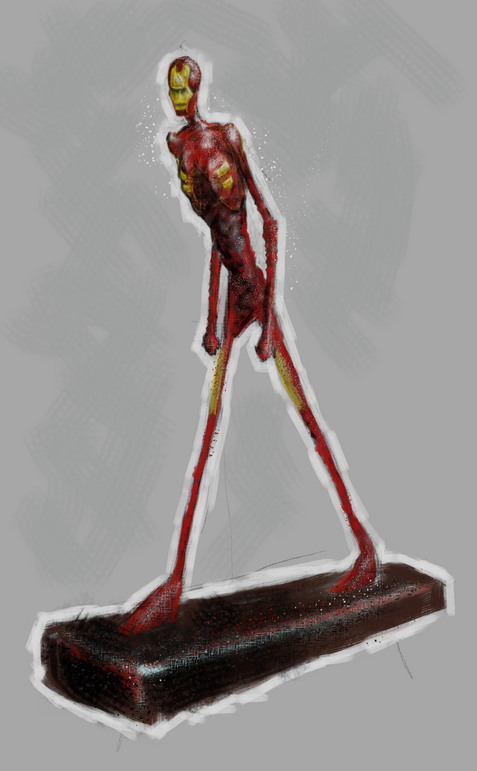
Iron Man has an Alberto Giacometti statue in his living room.
Let's talk about that.
Let's talk about that.
 |
| Iron Walking Man |
Thursday, May 22, 2014
Everybody Hates Grant Ward: Woobie, Destroyer of Worlds
Now I'm about as sick as Grant Ward as you are at this point, so this will be the last article on how much we all hate him. The last till season 2 comes out, at least.
Still, there's just a bit more worth saying about Ward in relation to ideas about sympathetic villains and how we as an audience react to the pain that particular characters suffer.
If you haven't been following along at home, last week I wrote two articles describing the many shortcomings of Agent Grant Ward, a man that Marvel's Agents of SHIELD seemed to be positioning as the brooding antihero of the team, only to dramatically subvert both expectations and our understanding of Ward's character archetype when he turned out to be an actual Nazi.
The first talked about how Ward as the Lone White Male Antihero would, in many stories, get a free pass to determine his own morality. The narrative and theme would warp around him to make his actions and judgements correct, often at the cost of the actions and judgements of female characters. In Agents of SHIELD that logic is turned on its head, and the whole dynamic is revealed to be chauvinistic, patronizing, and ultimately subtly fascistic.
The second article talks about Agent Coulson and Agent Garrett and their respective ideologies. Garrett raises Ward on a steady diet of rightist rhetoric: Ward has no one to depend on but himself, people only get what they can take, and if your life is a nightmare maelstrom of abuse and violence you are solely responsible for it, even if you're a child. This is contrasted dramatically with Coulson's belief in the symbolism of SHIELD: that humanity is worth saving and protecting. Ultimately, Ward doesn't so much lift himself by his own bootstraps as hoist himself by his own petard, wandering around for much of the latter episodes without a sense of purpose, identity, or control, whereas Skye, Coulson's protege, runs circles around him, made confident by both the knowledge that she is not alone, and in the belief in a right and wrong external to her own immediate animal needs--something Ward critically lacks.
In this way, both the antihero archetype and the world in which he operates are shown to be hollow falsehoods, pathetic power fantasies that ultimately amount to nothing.
But there's one more aspect to Ward's character that's worth examining: his angst. Yes, poor Grant Ward has a lot of Feelings and those Feelings justify, in his own mind, any and all actions. The first two parts of the series touched on this a bit but it's worth examining in more detail, so let's talk about poor Grant Ward and his many struggles. (Trigger warnings for discussion of abuse, and some discussion of sexual assault.)
Still, there's just a bit more worth saying about Ward in relation to ideas about sympathetic villains and how we as an audience react to the pain that particular characters suffer.
If you haven't been following along at home, last week I wrote two articles describing the many shortcomings of Agent Grant Ward, a man that Marvel's Agents of SHIELD seemed to be positioning as the brooding antihero of the team, only to dramatically subvert both expectations and our understanding of Ward's character archetype when he turned out to be an actual Nazi.
The first talked about how Ward as the Lone White Male Antihero would, in many stories, get a free pass to determine his own morality. The narrative and theme would warp around him to make his actions and judgements correct, often at the cost of the actions and judgements of female characters. In Agents of SHIELD that logic is turned on its head, and the whole dynamic is revealed to be chauvinistic, patronizing, and ultimately subtly fascistic.
The second article talks about Agent Coulson and Agent Garrett and their respective ideologies. Garrett raises Ward on a steady diet of rightist rhetoric: Ward has no one to depend on but himself, people only get what they can take, and if your life is a nightmare maelstrom of abuse and violence you are solely responsible for it, even if you're a child. This is contrasted dramatically with Coulson's belief in the symbolism of SHIELD: that humanity is worth saving and protecting. Ultimately, Ward doesn't so much lift himself by his own bootstraps as hoist himself by his own petard, wandering around for much of the latter episodes without a sense of purpose, identity, or control, whereas Skye, Coulson's protege, runs circles around him, made confident by both the knowledge that she is not alone, and in the belief in a right and wrong external to her own immediate animal needs--something Ward critically lacks.
In this way, both the antihero archetype and the world in which he operates are shown to be hollow falsehoods, pathetic power fantasies that ultimately amount to nothing.
But there's one more aspect to Ward's character that's worth examining: his angst. Yes, poor Grant Ward has a lot of Feelings and those Feelings justify, in his own mind, any and all actions. The first two parts of the series touched on this a bit but it's worth examining in more detail, so let's talk about poor Grant Ward and his many struggles. (Trigger warnings for discussion of abuse, and some discussion of sexual assault.)
Wednesday, May 14, 2014
Everyone Hates Grant Ward: Strung Up By Your Own Bootstraps
"You didn't tell me he was this crazy."
"He's really stepped it up a notch..."
There's a fascinating contrast in episode 21 of Marvel's Agents of SHIELD between big bad John Garrett and big... good Agent Coulson that effectively conveys the basic messages of SHIELD and Hydra. These messages are worth considering in light of the wider conversation I highlighted on Monday about how utterly loathsome Agent Grant Ward is. After all, Grant Ward wasn't "born evil" as the show has put it over the last few episodes, he was made that way by Garrett. Understanding the ideology that Garrett instilled in his subordinate, and what that suggests about SHIELD and Hydra, is essential to understanding--although not necessarily forgiving!--Ward's actions and character motivations and how they relate to the show's wider themes.
There will be some mild spoilers here for the show's finale, which debuted last night, but I'm trying to keep them largely to a minimum, and none of the really major moments will be spoiled, just some of the kicker lines (of which, because this is a Whedon project, there are many). Still, if you haven't seen the finale yet, you may want to hold off reading this article till you get a chance to get caught up.
"He's really stepped it up a notch..."
There's a fascinating contrast in episode 21 of Marvel's Agents of SHIELD between big bad John Garrett and big... good Agent Coulson that effectively conveys the basic messages of SHIELD and Hydra. These messages are worth considering in light of the wider conversation I highlighted on Monday about how utterly loathsome Agent Grant Ward is. After all, Grant Ward wasn't "born evil" as the show has put it over the last few episodes, he was made that way by Garrett. Understanding the ideology that Garrett instilled in his subordinate, and what that suggests about SHIELD and Hydra, is essential to understanding--although not necessarily forgiving!--Ward's actions and character motivations and how they relate to the show's wider themes.
There will be some mild spoilers here for the show's finale, which debuted last night, but I'm trying to keep them largely to a minimum, and none of the really major moments will be spoiled, just some of the kicker lines (of which, because this is a Whedon project, there are many). Still, if you haven't seen the finale yet, you may want to hold off reading this article till you get a chance to get caught up.
Monday, May 12, 2014
Everybody Hates Grant Ward: Agents of Chauvinism
Isn't Grant Ward awful? I mean, what a guy. You almost have to kind of love him, in that it's so easy to love to hate him. A lot of fans of Marvel's Agents of SHIELD, the television component of the Marvel Cinematic Universe and the property most currently related to the titanic events of Captain America: The Winter Soldier, have been a part of the Ward hatedom for a long time, so the revelation that he's actually an agent of evil Nazi science conspiracy Hydra came as a shock, but not necessarily as unwelcome a one as you might expect.
What's fascinating to me about this hatedom is how totally strange it is within the context of wider media culture. Ward is, after all, the perfect grim antiheroic masculine figure, present in media everywhere: a brooding loner, with multiple romantic prospects, a tendency to buck authority, a powerful fighter... Ward could have been transplanted from just about any action film.
But the thing is, Ward's been transplanted into a show about some stuff that doesn't fit so well with his character archetype: teamwork, openness with your allies, the power of god damn friendship of all things, and the need to carry the responsibility of power carefully and not cross the line into world-policing authority and authoritarianism. These are ideas dramatically opposed to the singular authority of the male antihero and Ward feels out of place to some extent in the show's narrative. For a while it seemed like the team would succeed in changing him, but in the end it's turned out that he's been playing them all along in a weirdly metatextual game of tropes and expectations.
And that's what makes this reveal so successful, ultimately. It's a metatextual move, not just a textual one, because our understanding of Ward's character is partly a construct in-show by Ward in accordance with some of these tropes, as he revealed in a lengthy speech a few episodes ago.
So what I'm going to do, over the course of a series of shorter (by my standards) articles over the next week, is analyze all the ways in which Grant Ward sucks, and what his status as the ultimate heel of the Marvel Cinematic Universe, what his place as the guy we love to hate, says about the MCU's place in culture and take on other action movie narratives.
And what better place to start than with an idea I've complained about before: the authority of the male antihero above that of female characters.
What's fascinating to me about this hatedom is how totally strange it is within the context of wider media culture. Ward is, after all, the perfect grim antiheroic masculine figure, present in media everywhere: a brooding loner, with multiple romantic prospects, a tendency to buck authority, a powerful fighter... Ward could have been transplanted from just about any action film.
But the thing is, Ward's been transplanted into a show about some stuff that doesn't fit so well with his character archetype: teamwork, openness with your allies, the power of god damn friendship of all things, and the need to carry the responsibility of power carefully and not cross the line into world-policing authority and authoritarianism. These are ideas dramatically opposed to the singular authority of the male antihero and Ward feels out of place to some extent in the show's narrative. For a while it seemed like the team would succeed in changing him, but in the end it's turned out that he's been playing them all along in a weirdly metatextual game of tropes and expectations.
And that's what makes this reveal so successful, ultimately. It's a metatextual move, not just a textual one, because our understanding of Ward's character is partly a construct in-show by Ward in accordance with some of these tropes, as he revealed in a lengthy speech a few episodes ago.
So what I'm going to do, over the course of a series of shorter (by my standards) articles over the next week, is analyze all the ways in which Grant Ward sucks, and what his status as the ultimate heel of the Marvel Cinematic Universe, what his place as the guy we love to hate, says about the MCU's place in culture and take on other action movie narratives.
And what better place to start than with an idea I've complained about before: the authority of the male antihero above that of female characters.
 |
| Pictured: A Toolbag. |
Wednesday, September 11, 2013
A Company of Heroes: Pacific Rim, Iron Man, Cloud Atlas, and the Power of Ensemble Casts
This is it. The end of the line. The strange entity with a book for a head (and what a load of crap that is! You've read all three Monster Manuals and there's no book headed dude in there, and you're going to give the DM an earful next time there's a pizza break) approaches you slowly and raises its hands in preparation for a spell. You have one chance--one saving throw. You gather your die in sweating hands and cast it across the table. It bounces off the DM's soda, and careens to a halt.
A one. Oh for the love of Bahamut.
The creature begins to chant an eldrich summoning spell. A spell that sounds suspiciously like... media analysis? This is the worst quest ever, you conclude grimly, as the spell begins to take hold...I'm bored of heroes but really into heroism right now.
That's kind of the quick, pithy summary of this article, I suppose. I'm bored of, to be more precise, the notion of the Exceptional Hero (nearly always straight, white, male) that a story's arc is built completely around and whose gaze we largely inhabit throughout the text.
I am not, on the other hand, bored of the idea of heroism. As I maybe have hinted obliquely and very subtly before, I'm not too into cynicism and grimdarkness these days, in part because I think it's sometimes used as a lazy way to achieve an illusion of philosophical depth. Protagonists that are genuinely good appeal to me quite a bit, actually, despite the prevailing attitude that such characters are without nuance, boring, or impossible to relate to (see: recent conversations about non-grimdark Superman).
There seems to be a contradiction there, though. Isn't the traditional square-jawed manly, monomythic hero tied intrinsically to the idea of genuine heroism in stories?
Well, no, I don't think so. And I think if you asked most people directly, they would also say that it isn't so. But I'm not sure most people could articulate an alternative--or at least, not quite the kind of alternative I'm looking for. It's not that people think heroism must come in the form of the square-jawed action hero, it's that they have trouble finding another kind of heroism.
One answer we have seen people put forth recently is the diversification of who can be in a lead heroic role. I'm all for that, of course--it's about time we got more women, people of color, and GSD folks as lead heroes!
But my issue isn't just with representation alone (although that's part of it). I think there's a deeper toxicity to the Monomyth--the idea of the Campbellian Hero's Journey that seems to so fully pervade our modern thinking--that's worth addressing. See, the Monomyth, which follows a familiar form involving a Chosen One rising to greatness through a series of trials and becoming a hero, ultimately suggests that heroism is:
- Extremely rare and frequently a product of destiny or a birthright
- Ultimately a symbol of not just righteousness but rightness--i.e. the authority to make decisions unilaterally
- A force of overwhelming gravity upon the plot--i.e. a hero warps the narrative around himself (infrequently herself), and the arcs of other characters are either nonexistent or risk truncation to further the hero's own arc. The pull of the hero's arc hauls everything within its event horizon.
Well, to see where this starts to go wrong, consider what virtues and themes are excluded by the very nature of the hero's journey, at least without a strong conscious effort on the part of a creator to pull the narrative in a different direction:
- Democratic consensus.
- Companionship.
- Teamwork.
- The ability to defer to others.
- The need for multiple intelligences and viewpoints.
- The betterment of society through mass action.
- The ability of anyone to behave heroically.
The strange thing is, none of this is inevitable. In fact, in fantasy, the genre most would associate with the Monomyth, we've long had alternatives. The great progenitor of the genre in its modern form, The Lord of the Rings, is a story with a vast cast of characters whose actions compound across time and space to result in victory. And, of course, there is one other classic arrangement that, while still requiring some amount of gravitational warping around the heroes, is far more profoundly influenced by ideas of cooperation. I'm speaking, of course, of the classic four-player D&D group: Fighter, Rogue, Wizard, and Cleric. Four classes that complement and reinforce one another as a team, all with their own character motivations and arcs, all with their own themes to explore, all forced to work together to achieve a common goal. It's necessary, in fact, for this structure to be present for the gameplay to work. You can't have a single hero and three vague side characters in a game of D&D; it just doesn't work.
"But Sam," you object loudly, throwing your glass at my head (I roll an 18 and dodge, artfully, and the glass shatters against Lord Humongous's giant abs. "You disobey me, little puppy..." he growls), "Tolkien had three books to work with! And you can't just translate a D&D game to a movie screen! They tried! Have you seen that movie? It sucked!"
Oh ho ho ho not so fast my pretty! You see, I am not just a lonely wizard, bearing my trials alone! I have the power to summon a whole team to support my claims, and together we shall complete our quest to bring good storytelling back to these benighted lands!
For my Fighter, I call upon Pacific Rim!
For my Rogue, I call to my side Iron Man III!
And for my Cleric, I summon Cloud Atlas!
AND I'LL BE THE HEAD OH SHIT I FUCKED UP THE METAPHOR DAMMIT DAMMIT DAMMIT QUICK, PACIFIC RIM, ROLL FOR ATTACK!
Pacific Rim: Fighting As One

Consider Newton and Hermann, the two scientists who unlock the secrets of the Kaiju. A number of viewers (and I apologize for continually opening up the conversation on Pacific Rim with these refutations) questioned the point of these characters. I would argue that regardless of your individual enjoyment of them as characters or their segments as parts of the film is secondary to their purpose for the film's themes (and for the sake of wider worldbuilding, but that's another conversation entirely).
To put it another way, you may have gone in expecting nonstop kaiju-crushing action and were annoyed by the scientist segments. And that's ok, I guess, although I'd suggest that it's also reasonable to adapt your expectations as a film proceeds rather than just comparing it to the film that is in your head, but fine, alright, you didn't like them.
That doesn't mean they were unnecessary to the film on a deeper functional level or could be cut out.
See, one of the things their arc does very well, in some ways better than any of the other arcs, is show how victory depends upon a willingness to collaborate despite interpersonal strife or differences of opinion. Newt and Hermann have radically different ways of parsing information and getting results, both quite maniacal in their own ways, but when the chips are down and Newt asks Hermann for help, by god, Hermann steps up to the plate.
It may be worth recalling at this point that "the plate" in this metaphor is a kaiju brain that Newt intends to Drift with via a piece of equipment that literally incorporates a medieval fucking bellows to... I don't know, keep the parts cool maybe? Not a fan. A bellows.
And Hermann agrees to do it anyway.
What interests me about this arc from bitter disagreement to collaboration is that it echoes throughout the wider narrative. Chuck must defend the pilots of Gipsy Danger despite getting into a fist fight with one of them a short time before--and he willingly gives his life in the process. Raleigh learns to be less of a hot shot and trust his commanding officer's decisions (and not to touch Stacker Pentecost again). And, of course, all the characters must open themselves to their drift partners in order to pilot their Jaegers. One of Mako's major developmental arcs is her movement from suspicion for Raleigh to trust--not trust in him in the "I defer to you, Heroic White Dude Hero Man" sense, but trust in their bond, trust in her ability to stay stable in the Drift, trust in his ability to help her to be stable in the Drift, and trust in their collaborative potential.
Those bonds are what ultimately turns out to win the day. The willingness to look beyond difference allows them to destroy the Rift. And here, again, I think there's a great parallel between the overall construction and the story of Newt and Hermann: in the end, their information is not in opposition. Both of the scientists are right, and it is only through the synchronization of their knowledge, rather than their petty squabbling for attention from their benefactors, that the key to the Rift becomes apparent.
Hm, you know, now that I'm typing this up, I can't help but think some academical sorts would be well served by taking note of this part of the film...
This film could have been about Raleigh's heroic journey from the depths of despair back into the height of heroic victory, but it wasn't. It was about all these characters--characters that in another work would be side characters--worked together to achieve victory.
The lesson is quite straightforward, and for that reason, Pacific Rim is my Fighter--straight to the point, a blunt instrument that communicates simply and effectively that there is another way of doing things.
Iron Man III: The Rogue In The Gallery

For a giant blockbuster movie about a playboy billionaire superhero, to put forth a narrative based around coping with severe psychological trauma, the excesses of a military-industrial complex that benefits from the perpetuation of fear and conflict, moral compromise within research, and, ultimately, the simple human act of asking someone else for help and admitting that you can't do everything alone... well, that seems like a roguish act to me, for sure.
And that's what Iron Man III does. It's a film about all these ideas and more. It'd be worth talking about some of the political aspects of the film at some point, but I want to talk about that last idea in particular--Tony Stark's need to ask for help. In a way, this might be one of the most subversive parts of the film, although it's certainly less overtly politically subversive than the Mandarin's ultimate identity.
See, the thing about this movie is that it could easily have involved Tony Stark rising on his own from ruin and clawing his way singlehandedly to victory. It could have involved the removal of all his allies so that he alone would have to face the Mandarin and defeat his diabolical opponent.
That's not what happens, though. Instead, Tony Stark is constantly accompanied, after his fall, by people who he must ask for help and work with to achieve victory. It's only, you'll note, after the fall that this seems to happen--previously, he sets himself up as a target, and a solitary target at that, brashly declaring himself to be the Mandarin's opponent, even though the government (or, hey, I dunno, THE AVENGERS?) would probably be better equipped to deal with a massive terrorist organization.
After his fall, though, not only is he required to ask for help, he's required to beg assistance from a child. A loooot of people assumed this bit was going to suck, due to previous bad experiences with child sidekicks, but the writers of this film knew exactly what they were doing in including Harley. In needing Harley's help, Stark is forced to recognize that there is potential in the people around him for heroism, even where he would not expect to find it. It forces him to reassess his ability to rely on other people, and marks the first step towards recognizing that the obsessive building of alternate suits is, in fact, a way of fleeing further and further into himself. (Note that Harley is the first person who asks him if he should be getting psychological treatment for his PTSD, and Stark finally responds affirmatively, admitting that he has a problem.) He is able to achieve victory only through sacrificing countless suits, and only through relying on Harley, Rhodes, that awkward news team fanboy, and ultimately Pepper Potts.
Hell, look at one of the pivotal scenes in the movie, the plane rescue sequence. That whole scene revolves around the idea that Tony can't save all these people on his own, so he needs to literally bind them together via electrical impulses in order to effect a full rescue. What a perfect metaphor for the film's overarching message.
So, part of the message of the film, like Pacific Rim, is that anyone can be heroic, and the heroism of teamwork is more profound than the heroism of a solitary ubermensch--or the villainy of a man who uses and discards his associates, even literally using his team as human bombs.
Furthermore, it shares a diverse cast with Pacific Rim. It's significant to me that this film passes the Bechdel Test--remember the scene between Potts and Maya Hansen where they discuss the ethics of accepting moral compromise for the sake of research funding? I sure as hell didn't expect to see that kind of question being broached in a blockbuster like this, and I certainly would never have predicted that the conversation would play out not between the two leading men but between the two leading women. The severing of narrative focus from Stark's monomythical quest--the reduction of his narrative's gravity--allows that conversation to take place, and the film is stronger for it. It provides context for Hansen's actions later on that in a lesser film would be explained implicitly through the gravity of Stark's narrative, i.e. she would go good because of his presence rather than because she has been brought to a moment of moral crisis that is finally coming to a head.
This could easily have been a very different film. It could have been a film about the singular brilliance of Tony Stark and his ability to triumph even against a supremely powerful hidden opponent. It could have been, like the second film, another exercise in the claiming of a rich white boy birthright passed on from father to son. It could have been about Stark climbing, alone, from the pit to defeat his opponents and save his whatever. It could have been a film that, as the title suggested, was about Iron Man and Iron Man alone.
It was not those films.
It was, instead, a film about finding strength in others rather than burrowing into a monomaniacal savior complex. It was a film about the heroic potential that humans have within them, if that potential is not rebuffed or eroded (Killian and Hansen are a product of Stark's hubris, remember, and the Mandarin is the product of encouraged addiction).
It is the rogue of this team, a film that appeared to be something other than what it was, and, I think, became an unlikely hero in the battlefield that is media.
Cloud Atlas: The Healing Of Small Cuts In Time

But like the Cleric, the role of this movie, at least in the scheme I'm presenting here, is not to introduce religiosity per se into the discussion. The role of the cleric is to banish evil and, ultimately, to act as a healer.
I don't think you need to believe in reincarnation to feel moved by this film. Rather, you simply need to be open to its core message that the actions we make affect the world far beyond our individual lifespans. This is a view quite compatible with a secular mindset--in fact, quite conducive to a scientific understanding of the world as cause and effect obscured by the complexity of time and space and human action--and it depends upon the kind of ensemble casts that we've been talking about.
The intriguing thing about Cloud Atlas the film is that the stories all channel towards a conclusion at the same time (in contrast to the book, which has a stepped pyramid structure). This means that the tragic ending of one story is counterbalanced and, arguably, undercut by the triumph of another. These moves are wholly intentional, and the film is stronger for this undercutting, because it reinforces the central message of the film: through countless actions, great and small, humanity as a whole moves forward out of ignorance into light. It is the compounding actions of the various characters that ultimately allows the Precients in the future to find a way off of a dying Earth to a new home in the stars. From an abolitionist's conversion, to a tragic love affair, to a battle for the truth, to... alright, The Ghastly Ordeal of Timothy Cavendish is pretty silly but it still inspires, a synthetic human's attempt to spark a revolution, all the stories lead via coincidence and influence toward an ending in triumph.
And what is the opponent in this movie?
Well, in the previous two films, the enemies were certainly symbolic--the Kaiju of the vast challenges that humanity must unite to conquer, and the Mandarin of a covert military-industrial complex threatening to usurp power from the countless regular people that make up Tony Stark's team (as well as a dark product of Stark's own megalomania)--but they were still very much a material set of enemies.
By the end of Cloud Atlas, however, the recurring enemy gradually loses materiality and acquires a purely symbolic, conceptual nature. Hugo Weaving's various characters transform from quite threatening individuals capable of murder and hideous inhumanity gradually transform first into a sadistic nurse--quite deranged, of course, but ultimately somewhat comical in form--then, into a dignitary among countless dignitaries in an authoritarian regime (he is reduced from the role of central evil to functionary of evil), and finally, into a mythological representation of the central character's inner turmoil: Old Georgie. You can see this role as internal doubt here, in the film's climax:
Pretty sure that's the right clip.
Whatever.
The point is, evil over time degrades while good strengthens (and, interestingly in the case of Sonmi, also becomes an abstraction--a goddess figure). An article from Vulture that I consulted while writing this essay puts it quite well, I think:
He's a figure of evil, control, and enslavement who never displays any loyalty or learns anything over time, and eventually devolves until he's just an idea.Because Weaving's characters are unable to see beyond themselves, they degrade through time until they lose substance entirely and become a formless boogieman. This is a fascinating and powerful transformation, as it suggests that the monomythic hero is actually potentially quite weak. If our ability to form attachments to others--loyalties, as the Vulture article puts it--we fail to develop and ultimately devolve.
I'm reminded, actually, of another entity that goes on a similar journey away from knowledge and contact with other beings. I am speaking of Milton's Satan, who manipulates his followers, strikes off alone to Earth to spoil God's creation, and ultimately devolves from heroic titan to crawling serpent.
Cloud Atlas does not exactly promise a hopeful future, but it does assert that the countless small cuts in our history caused by humanity's inhumanity can be bandaged, can be healed, can be restored in time. A single messianic figure cannot, however, heal these cuts on her own. She is accompanied by other agents of change, some coming far before or after her own life, and humanity's ultimate salvation is due not to messiahs but to a collaboration between two lowly humans just trying to get by on a decaying world. It is through the action of all of us, not one of us, that these small cuts are healed.
And for that message of healing, Cloud Atlas will be my cleric.
The Wizard: Possibilities Given Form
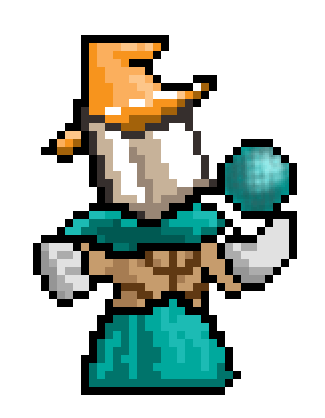
...Except, there's more to the wizard than that. The wizard's role in battle is often a support role, warping the battlefield and allowing the different party members to better make use of their talents. It is a role with more to do with coordination than dramatic stardom, although a lot of players might, unfortunately, play them that way.
So, let me try to coordinate this a little bit and explain why I put this article together the way I did.
On their own, these films would be compelling arguments for particular kinds of ensemble casts. Pacific Rim shows that you can create a compelling story from a group of champions fighting side by side against a vast enemy. Iron Man III shows that a film hero can be assisted in countless ways by companions without seeming powerless or extraneous--and that those characters can deeply enrich the film's world. Cloud Atlas shows that you can construct an exceptionally complex film with a staggering number of characters and still have your message come through loud and clear so long as you construct the interweaving of narratives carefully enough.
Each film, on its own, would be an argument that you can make that specific kind of film.
Together, they show that there is a stunning range of storytelling possibility open to writers willing to construct an ensemble-driven story rather than a monomythic story. In fact, while you can certainly get quite a bit of variance within the monomyth, I would argue that these sorts of complex and distributed heroics have much more potential, especially since this structure is somewhat underexplored in recent blockbusters. It certainly seems to force writers out of the narrow and cliche beats of the more slavish adaptations of the monomyth, which is certainly a good thing in my estimation.
So, the films (plus my own attempts to set the battlefield in our favor through the magic of analysis and close reading) are stronger together than on their own. They make a more compelling argument united than they would separate.
Each one is a hero in its own right, a triumphant warrior of the silver screen. Their heroism is in no way diminished by the presence of other heroes. On the contrary, it is compounded, made stronger, and allowed to diversify, just as within the films the ensemble casts allow for far more room for the underrepresented to find a voice, and just as the heroism of individuals is made stronger by unity. As above, so below. The message is clear: heroism can be distributed far more widely, and the benefits to opening our narratives to such distribution are enormous.
I mean, at the very least, my team of epic level monsters pretty much wiped the floor with you just now, Mr Monomythic Strawman.
Serves you right for demanding to play a Chaotic Evil solo game. Maybe if you had invited some other players to our game instead of insisting that there was only room for you and me in the group, this would've gone differently.
Yeah, yeah I'm gonna be that way. Fine. Pick up your dice and go then, you big crybaby! You're just a figment of my imagination, anyway! AND NO ONE LIKES TIEFLINGS ANYWAY!
Ugh.
I'm never playing D&D with Hugo Weaving again.
Freakangels Of Arcadia
The webcomic Freakangels is all about superpowered millennials struggling to build a utopian society in the aftermath of environmental devastation. Topical. But if they want to build Arcadia, they'll have to face down the toughest opponent imaginable: their own emotional hangups.I Want To Connect (But It's Hard To Understand)
For an anime all about connections, Sarazanmai, the new anime from the director of Revolutionary Girl Utena, can be pretty obscure. But its obscurity gives it power, and a space for us to form connections with the show... and with each other.My Superpower is Manpain!
Featuring revised versions of my articles on The Dark Knight Rises, Arrow, and Grant Ward from Agents of SHIELD, My Superpower is Manpain! explores the idea of the male superhero and his power to warp the narrative and the ethics of a story around himself.
Subscribe to:
Comments (Atom)