The Worst Filing System Known To Humans

-Punk (5) A Song of Ice and Fire (2) Affect (9) Alienating My Audience (31) Animation (28) Anime (19) Anonymous (3) Anything Salvaged (15) Art Crit (42) Avatar the Last Airbender (2) Black Lives Matter (1) Bonus Article (1) Children's Media (6) Close Reading (90) Collaboration (1) comics (30) Cyborg Feminism (3) Deconstruction (10) Devin Townsend (2) Discworld (1) Evo Psych (1) Fandom Failstates (7) Fanfiction (28) Feminism (24) Fiction Experiments (13) Food (1) Fragments (11) Games (29) Geek Culture (28) Gender Shit (2) Getting Kicked Off Of TV Tropes For This One (11) Gnostic (6) Guest Posts (5) Guest: Ian McDevitt (2) Guest: Jon Grasseschi (3) Guest: Leslie the Sleepless Film Producer (1) Guest: Sara the Hot Librarian (2) Guest: Timebaum (1) Harry Potter (8) Harry Potter and the Methods of Rationality (3) Has DC Done Something Stupid Today (5) Hauntology (6) Homestuck (18) How Very Queer (35) hyperallthethings (10) hyperanimation (1) Hypercomics (11) I Didn't Ask For Your Life Story Sheesh (24) Illustrated (37) In The Shadow Of No Towers (1) It Just Keeps Tumblring Down Tumblring Down Tumblring Down (9) It's D&D (2) Judeo-Christian (9) Lady Gaga (5) Let's Read Theory (3) Lit Crit (20) Living In The Future Problems (11) Lord of the Rings (4) Mad Max (1) Madoka Magica (1) Magic The Gathering (4) Manos (2) Marvel Cinematic Universe (17) Marx My Words (15) Medium Specificity (15) Meme Hell (1) Metal (2) Movies (33) Music (26) Music Videos (21) NFTs (10) Object Oriented Ontology (4) Occupy Wall Street (3) Pacific Rim (2) Paradise Lost (2) Parafiction (6) Patreon Announcements (15) Phenomenology (4) Poetry (6) Pokemon (3) Politics and Taxes and People Grinding Axes (13) PONIES (9) Pop Art (6) Raising My Pageranks Through Porn (4) Reload The Canons! (7) Remixes (8) Review Compilations (6) Room For You Inside (2) Science Fiction Double Feature (32) Self-Referential Bullshit (23) Semiotics (3) Sense8 (4) Sociology (12) Spooky Stuff (45) Sports (1) Star Wars (6) Steven Universe (3) Surrealism (11) The Net Is Vast (36) Time (1) To Make An Apple Pie (4) Transhumanism (9) Twilight (4) Using This Thing To Explain That Thing (120) Video Response (2) Watchmen (3) Webcomics (2) Who Killed The World? (9)

Reload the Canons!

This series of articles is an attempt to play through The Canon of videogames: your Metroids, your Marios, your Zeldas, your Pokemons, that kind of thing.

Except I'm not playing the original games. Instead, I'm playing only remakes, remixes, and weird fan projects. This is the canon of games as seen through the eyes of fans, and I'm going to treat fan games as what they are: legitimate works of art in their own right that deserve our analysis and respect.

Showing posts with label Deconstruction. Show all posts

Saturday, October 31, 2020

Galaxy Brained: Annihilation and Queer Cosmic Horror

Annihilation: The Ending Explained!!!

content warning: body horror, spoilers for Annihilation, cosmic horror, mad ravings, closetedness and detransitioning, homophobia, slurs


Thursday, June 30, 2016

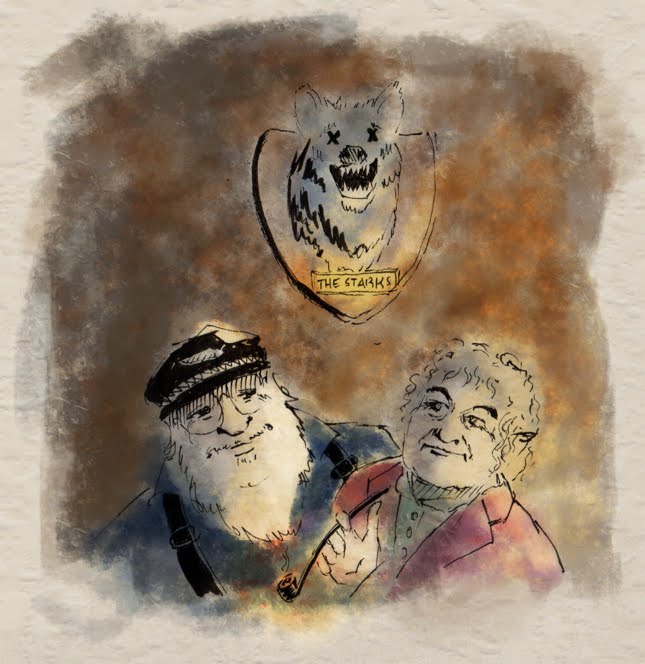
Not All Who Wander Are Lost: George RR Martin and Tolkien as Fellow Travelers

My first introduction to A Song of Ice and Fire was as a deconstruction of fantasy. George RR Martin's epic (now a "daring" and "brave" television series which you can see on HBO if you turn the brightness and contrast on your TV way, way, WAY up!!!) is, I was told, dark fantasy, with lots of shades of grey and violence and sex and so on.

It is, the subtext and sometimes the explicit text ran, not like Lord of the Rings. Or at least not like the traditions of Tolkienesque fantasy. This review of a recent episode of the (brave! genius! award winning!) tv show for example takes umbrage at the fact that the ending of a battle "has replaced that deconstruction with a blatant lift from Tolkien’s book, with the Vale forces riding in to save the day like Gandalf riding in to save Helm’s Deep." The notion of Tolkien and Martin as in some sort of competition or stark (hah) contrast is in the zeitgeist, is what I'm saying.

Having recently read the books, though, and also recently revisited The Lord of the Rings, I can't help but see this as more a product of a very narrow reading of Tolkien, and of Martin.


Some of this reading is possibly derived less from the source texts themselves but from Peter Jackson's adaptation. Look, I'm not gonna pretend that I haven't been deeply frustrated with The Lord of the Rings films since I was like 12. A lot of the stuff that most resonated with me as a kid ended up weirdly flattened, sensationalized, cut apart, or altered beyond recognition. And in the process everything got a lot more simple. I'm personally never going to forgive The Two Towers for introducing some fucking nonsense Aragorn Falls Off A Cliff subplot only to make up for it by hacking huge holes in the plot of Faramir, one of my absolute favorite characters. And others have written about some of the ways that in Jackson's hands characters like Saruman lose their thematic reason-to-be, becoming one note villains rather than complex and tragic figures.

Martin has suffered some of the same problems from the "brave" adaptation of his books, an adaptation I can't claim to have seen much of but which on a basic stylistic level seems to be run by people who don't understand that "dark fantasy" doesn't literally mean that all the sets should be chronically underlit and the characters should all wear the most drab clothing possible. I mean given that in the original text the Others are described basically as evil elves and the show develops them into ice orcs, and given that no one is walking around in the show with dyed-green beards like they commonly do in the book, it's pretty clear that they're more interested their sense of a "grim and gritty" aesthetic than what the text is trying to actually say.

Unfair? Not really. The critically lauded masterminds behind the "adaptation" literally once stated: "Themes are for eighth-grade book reports.” 

My contempt, I'd say, is well earned.

As a result perhaps of these less than stellar adaptations that have overtaken the originals, and as a result no doubt of Tolkien's many far lesser imitators, and probably to some extent as just a result of overexposure and fan discourses sort of overwhelming the original texts, a pretty remarkable fact has become obscured:

Lord of the Rings and A Song of Ice and Fire are much more a part of the same thematic tradition than in opposition. Basically, on a lot of levels, Tolkien and Martin are interested in the same stuff, and talking about the same things, and traveling on the same paths. And in fact some of their same formal "stumbling blocks"--things that people find particularly infuriating--parallel each other and do similarly important work within their respective narratives.

And to explain just how this makes sense, I want to talk a little bit about a book called The Worm Ouroboros.

Wednesday, May 4, 2016

Just Peachy: Homestuck, Act 6, and Difficulty

==> Storming the Ivory Tower Writer: Fondly Observe Libations


You, which is to say I, observe your, which is to say my, IMMACULATE DOMAIN, containing my IMMACULATE CHAIR and IMMACULATE SELF. You (read: I) have cleared away all those EXTRA SAM KEEPERS which were clogging up the joint, repaired the roof that's been busted for SEVERAL YEARS, and finally gotten some NICE WINE which you (still me) are currently fondly regarding.

You (I) have achieved the absolute apex of God Tier powers, which includes among other things fixing roofs, ushering extraneous versions of people gently but firmly out of the narrative so they don't clutter up things for the real, true versions, and to make absolute pronouncements with assured certainty, which everyone will accept automatically you're sure (which is to say I am sure).

==> StIT Writer: Demonstrate Abilities.

Act 6 and Act 7 do a much better job of addressing and resolving character arcs than [s] Cascade does.

Boom. See that?

Staggering in its radical brilliance but fundamentally undeniable in its accuracy.

(Sam Keeper): What? You can't just say something like that and pat yourself on the back! There's loads of stuff you'd have to explain to make that make sense to people.

==> StIT Writer: Ignore Unwelcome Intrusion


(Sam Keeper): Are you listening to me? You're leaving out so much important information, like even ignoring the fact that you haven't explained why you're even MAKING that comparison, the comparison is only interesting if you talk about a bunch of other stuff that Act 6 is doing. I mean yeah the whole act is basically about experiencing difficulty and working through that difficulty rather than expecting flashy magical solutions, and that APPLIES to this comparison, but the comparison really isn't interesting unless you talk about all that stuff first!

(Sam Keeper): In fact, even people that seem to agree with me that the end of Homestuck was pretty great take as given the idea that [s] Cascade resolved a load of stuff, and they position [s] Act 7 in opposition to this.

(Sam Keeper): Look, just, fill people in a bit! Act 6 is difficult but that difficulty is really interesting and worth talking about, so let's talk about it!

==> StIT Writer: Indulge This Walking Narrative Cul-De-Sac


Thursday, May 22, 2014

Everybody Hates Grant Ward: Woobie, Destroyer of Worlds

Now I'm about as sick as Grant Ward as you are at this point, so this will be the last article on how much we all hate him. The last till season 2 comes out, at least.

Still, there's just a bit more worth saying about Ward in relation to ideas about sympathetic villains and how we as an audience react to the pain that particular characters suffer.

If you haven't been following along at home, last week I wrote two articles describing the many shortcomings of Agent Grant Ward, a man that Marvel's Agents of SHIELD seemed to be positioning as the brooding antihero of the team, only to dramatically subvert both expectations and our understanding of Ward's character archetype when he turned out to be an actual Nazi.

The first talked about how Ward as the Lone White Male Antihero would, in many stories, get a free pass to determine his own morality. The narrative and theme would warp around him to make his actions and judgements correct, often at the cost of the actions and judgements of female characters. In Agents of SHIELD that logic is turned on its head, and the whole dynamic is revealed to be chauvinistic, patronizing, and ultimately subtly fascistic.

The second article talks about Agent Coulson and Agent Garrett and their respective ideologies. Garrett raises Ward on a steady diet of rightist rhetoric: Ward has no one to depend on but himself, people only get what they can take, and if your life is a nightmare maelstrom of abuse and violence you are solely responsible for it, even if you're a child. This is contrasted dramatically with Coulson's belief in the symbolism of SHIELD: that humanity is worth saving and protecting. Ultimately, Ward doesn't so much lift himself by his own bootstraps as hoist himself by his own petard, wandering around for much of the latter episodes without a sense of purpose, identity, or control, whereas Skye, Coulson's protege, runs circles around him, made confident by both the knowledge that she is not alone, and in the belief in a right and wrong external to her own immediate animal needs--something Ward critically lacks.

In this way, both the antihero archetype and the world in which he operates are shown to be hollow falsehoods, pathetic power fantasies that ultimately amount to nothing.

But there's one more aspect to Ward's character that's worth examining: his angst. Yes, poor Grant Ward has a lot of Feelings and those Feelings justify, in his own mind, any and all actions. The first two parts of the series touched on this a bit but it's worth examining in more detail, so let's talk about poor Grant Ward and his many struggles. (Trigger warnings for discussion of abuse, and some discussion of sexual assault.)

Monday, May 12, 2014

Everybody Hates Grant Ward: Agents of Chauvinism

Isn't Grant Ward awful? I mean, what a guy. You almost have to kind of love him, in that it's so easy to love to hate him. A lot of fans of Marvel's Agents of SHIELD, the television component of the Marvel Cinematic Universe and the property most currently related to the titanic events of Captain America: The Winter Soldier, have been a part of the Ward hatedom for a long time, so the revelation that he's actually an agent of evil Nazi science conspiracy Hydra came as a shock, but not necessarily as unwelcome a one as you might expect.

What's fascinating to me about this hatedom is how totally strange it is within the context of wider media culture. Ward is, after all, the perfect grim antiheroic masculine figure, present in media everywhere: a brooding loner, with multiple romantic prospects, a tendency to buck authority, a powerful fighter... Ward could have been transplanted from just about any action film.

But the thing is, Ward's been transplanted into a show about some stuff that doesn't fit so well with his character archetype: teamwork, openness with your allies, the power of god damn friendship of all things, and the need to carry the responsibility of power carefully and not cross the line into world-policing authority and authoritarianism. These are ideas dramatically opposed to the singular authority of the male antihero and Ward feels out of place to some extent in the show's narrative. For a while it seemed like the team would succeed in changing him, but in the end it's turned out that he's been playing them all along in a weirdly metatextual game of tropes and expectations.

And that's what makes this reveal so successful, ultimately. It's a metatextual move, not just a textual one, because our understanding of Ward's character is partly a construct in-show by Ward in accordance with some of these tropes, as he revealed in a lengthy speech a few episodes ago.

So what I'm going to do, over the course of a series of shorter (by my standards) articles over the next week, is analyze all the ways in which Grant Ward sucks, and what his status as the ultimate heel of the Marvel Cinematic Universe, what his place as the guy we love to hate, says about the MCU's place in culture and take on other action movie narratives.

And what better place to start than with an idea I've complained about before: the authority of the male antihero above that of female characters.

Pictured: A Toolbag.

Sunday, February 2, 2014

Across the Sea of Faces: Music and the Roar of the Crowd


For one reason and another I've been pondering crowds quite a bit over the last week or so. I'm fascinated, actually, by the dynamic, present in various art forms, where a crowd is used not as a symbol of accompaniment but of isolation. Like, check out Will Eisner's iconic cover for his graphic novel Invisible People:


I love everything about this cover. The stark lights and darks, the way everyone is turned away from you... it's a perfect indicator of the isolation and inhumanity present through the rest of the comic.

This is nothing new, of course, but when it's done well it can be a quite powerful effect. In particular, if you can convey the sensation of being a part of a crowd and isolated, rather than simply talking about the sensation of being alone in the crowd... well, that's a powerful effect.

It's hardest to pull off, I think, in music. Oh, it's easy to convey the sensation of being in a crowd--we have a long history of live recordings that are specifically designed to put you in the audience. In rock music, in particular, the goal is to capture the sensation of being in that mass of humanity, galvanized by the performance on the stage.

So how do you take those techniques and use them to make the individual listener feel isolated somehow?

Let's dig into that question and look at the way the roar of the crowd adds to a song's atmosphere and message.

Strapping Young Lad--Hope

Hope by Strapping Young Lad on Grooveshark

Let's start heavy.

Strapping Young Lad's "Hope" only uses the sound of the crowd briefly at the beginning, but the use of the crowd sets the tone for the rest of the song's content. In fact, this is a song where the sonic qualities are far more important to its overall effects than the fairly simple lyrics.

The two things the song hinges upon are that crowd roar at the beginning accompanied by that opening riff, and the long section in the middle of the song of just relentless, repetitive grinding. This is a song of palpable rage and bitterness, and the roar of the crowd highlights that bitterness by highlighting the alienation from that crowd.

The constant binary set up in the song is one of the singer (Devin Townsend, of Ziltoid fame) from an unspecified "you," although the crowd sounds at the beginning suggest that the "you" is meant to be the crowd itself. It's certainly in keeping with other songs on the album--most notably "You Suck," an energetic and catchy song all about, surprisingly, how much you suck (and also how much your band sucks, your girlfriend sucks, SYL sucks, and just about everything else sucks).

There's a kind of all-encompassing fury here at the plight of the speaker, who seems to be at once caged and omnipresent, a thing of compressed, diamond-hard anger. "I am what I am," he screams, "because I have no hope, no faith in your hope!" It's a weird thing to sing after the opening. It feels like a song about isolation, but it's juxtaposed with the crowd noises and the melodic intro that sounds like it was custom made for live shows. The scene seems to be one of a band telling its audience to its face how revolting it is.

There's a real antipathy here. And that antipathy emerges in the grinding midsection of the song. This bit goes on for far too long. It's repetitive, sonically torturous, a musical equivalent of a repetitive stress injury. It's perfect. Like the long outro for The Beatles' "I Want You (She's So Heavy)" it goes on for an agonizing time frame, abusing its audience, pushing the listener to the breaking point.

The combination of this sensation, completed with the disorderly conclusion of the song juxtaposed with the the earlier crowd-pleasing, singalong melody bits, creates a sense of alienation between band and audience, a codependent, destructive relationship that, paradoxically, you have to be invested in--you have to perceive yourself as fitting somewhere in the dynamic between crowd and band--in order for the song to have the greatest impact.

The sound of the crowd is the vehicle for finding yourself somewhere in the song's logic, precisely so that you can find yourself pushed away by it once more, and away from other humans as well.  

Collide--Human

  Human by Collide on Grooveshark

The crowd flows throughout "Human" as a kind of backing drone. It is a muted roar, accompanied by muted humming tones that carry the whole piece. The effect is one of constant accompaniment.

This accompaniment has the effect, though, of emphasizing the overriding sense of desolation and emptiness in the song. The constant refrain in the song, the recurring question, is who will fix you when you're broken, who will catch you when you fall?

The oncoming personal crisis is inevitable, a given in the logic of the lyrics. It's not a matter of "if" you fall but "when"--that word choice seems very deliberate. And it's described in universal terms--we're only human, the singer whispers, we're all only human. The crowd responds, bringing to the fore the notion of that unity, the shared experience of isolation.

But to share isolation is a paradox, just like the paradox in "Hope" of being pulled into the dynamic of the song only to be rebuffed. It is to know that others feel what you feel but to find no comfort or consolation in it. There is no answer to the question posed by the song. No one steps forward, offering to mend your broken heart. There is only the acknowledgment of that experience of collapse.

Against this lyrical backdrop, the crowd emphasizes not the unity between singer, crowd, and individual, but the isolation between the three members of the trinity. This divide is most apparent halfway through the song, as the singer melodically moans, drawing the last word out at length: "Say goodbye, human." As her voice fades, you are left hearing only the muted hum of the crowd. The rhetorical "you" of the earlier lines has been, by the admonition to say goodbye, transformed to a very personal, and more than a little threatening, "you." By rhetorical I mean that replacing the "you" of the first few lines with "one"--i.e. who's gonna catch one when one falls--makes for... well admittedly an extremely awkward sentence, for sure. But it still makes sense as a thing to say as an abstract consideration of the human condition.

But there's no way to transform the imperative language of that last line into an abstraction. It is directed at the individual listener. The creepiness of that line is emphasized by the slightly metallic, inhuman sound of the vocals. Collide's music is often on the verge of the inhuman, filtered, manipulated, and sometimes overwhelmed by digital stylings. It is music that seems to be on the threshold of a radical break with the biological. In the context of "Human," that break feels deeply alienating, because it suggests that you have been abandoned not just in personal life but in the course of human evolution.

You are "only human."

And you have been left behind.
 
Pink Floyd--In the Flesh 

In The Flesh? by Pink Floyd/The Wall CD 01 on Grooveshark
Pink Floyd by In The Flesh on Grooveshark

Really two songs, "In the Flesh" is the logical predecessor to both the previous examples. For Collide, the influence is tangible in their other homages to Pink Floyd's work (covers of "Breathe" and "Comfortably Numb," references in song titles like "Tongue Tied and Twisted"); for SYL the shared preoccupations are obvious. The same antipathy for the audience that drives "Hope" drives these songs. For Pink Floyd, however, there's a deeper political and philosophical statement being made about rock music itself.

"In the Flesh" roughly bookends the narrative of Pink Floyd's ambitious concept album The Wall. The first version introduces the central conceit of the album (and film). The story is of the rockstar Pink, and the album follows his slow descent into alienation from his audience and everyone else around him. Ultimately, this dramatic pulling away from humanity results in him adopting a sociopathic, fascist fantasy persona--the disguise that the audience must claw through if they want to find the genuine, wounded individual locked beneath a mask of authoritarian posturing.

The second version of the song represents the emergence of this new persona and the beginning of the violence the newly minted Hammer Army--his fans, now reenvisioned as a mob of violent authoritarian thugs--all too eagerly unleashes upon the world. The use of the roar of the crowd here is obvious. It is at once galvanizing and repulsive, echoing some of the latent contempt of SYL but still drawing the listener in via the draw of the roaring mass of humanity. It is all too easy--especially after an album's worth of misery for the lead character--to find the omnicidal rage on display here darkly alluring, even while being repelled by the fascist message.

And that's largely the point of the song and the point of the album. It's widely accepted that certain works can deconstruct the genre of which they are a part, exposing its dark underbelly and taking the logic of the genre to horrifying conclusions. The Wall is, among other things, a deconstruction of the entire rock genre, exposing the way in which the roar of the crowd and the charismatic figure of the rock star can combine to form a noxious, authoritarian dynamic.

The song must be engaging in its overblown theatricality for it to work. We might compare it to, say, "Be Prepared:"


I mean, I'm sure I'm going to horrify both Disney and Pink Floyd fans with this comparison, but I think it's important to recognize that both songs only function because they're at once horrifying in their violence and compelling in their actual musicality. They must be engaging for their threat to seem real, for the draw of the despot to seem believable.

And that's the fascinating line that the use of the roar of the crowd in the beginning of "In the Flesh" walks. The song invites us at once to feel the alienation that drives Pink's tortured psyche, the internal revolt against the logic of the crowd, and the draw of that roar, the seductive sensation of being swept away by something vaster than oneself. By using the same sounds as live concert recordings (not to mention actual live concerts!) Pink Floyd here deconstructs the entire scene, exposing the dark potentiality within.


Each of these pieces, then, makes use of the roar of the crowd in subtly different ways, but each uses the sound to highlight gaps of association between individuals and masses. None of them are particularly optimistic about the ways in which those gaps might be filled--one fills the gap with rage, another simply languishes in despair, and the last fills the void with a destructive, self-absorbed fantasy of autocratic power. Oh well. Not all narratives have happy endings, and this is just as true of music as any other medium.

But what these examples demonstrate is that any effect that can be introduced into a medium or genre can be modulated and manipulated by the savvy artist, precisely because these effects gain particular connotations that can be, with some work, upset and even reversed completely. When these games of reversal and overthrown expectations are played well, the results are deeply engaging.

Circle me on Google+ at gplus.to/SamKeeper. Follow stormingtheivory.tumblr.com for updates, random thoughts, artwork, and news about articles. As always, you can e-mail me at KeeperofManyNames@gmail.com. If you liked this piece please share it on Facebook, Google+, Twitter, Reddit, Equestria Daily, Xanga, MySpace, or whathaveyou, and leave some thoughts in the comments below.
Monday, February 18, 2013

Saint George and the Death of the Author

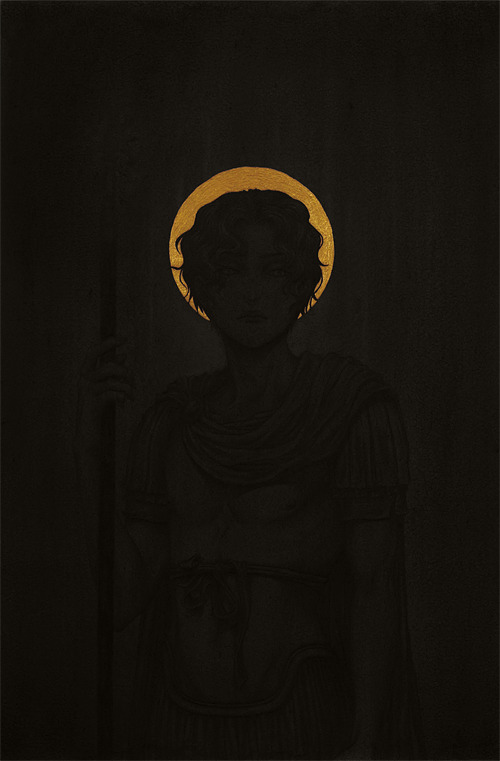
So, I happened upon this piece of art on Tumblr recently, and my immediate thought was, "Wow, there's so much to analyze here; this is fantastic:"

This piece is a portrait of Saint George, and is by an artist going by the name Casey. If you want to check out more of her gorgeous art, see: http://cparris.tumblr.com. The original piece can be found at http://cparris.tumblr.com/post/3909497389/saint-george-if-you-can-hardly-see-it-then-you

Then my second thought was, "I wonder how much of what I'm seeing here was intentional."

And my third was, naturally, that it was time to write a new article.

I actually get asked a lot of questions about a postmodernist concept known as Death of the Author. It's a concept that, if we're talking strict definitions, comes from a guy named Roland Barthes, and describes a very particular type of metacriticism aimed at taking those damn Formalists (the New Critics, remember? I've talked about them before) down a few pegs. It marks a transition from discussion of "Works"--masterpieces from a single author that contain a prime theme of universal human relevance--to "Texts"--collections of signs that combine and contrast to form their own meanings. The Death of the Author is the death of the Work, and also, Barthes gleefully points out, the death of the Critic and the rise of the Reader.

But it's also paradoxically a pretty good description of the moves a lot of modern theorists made. The Formalists, for example, opened the floodgates to begin with, ironically enough, by suggesting that meaning resides in the text. They suggested that we had to interpret based not on historical details or the author's biography but rather on the elements contained within a work. Barthes and other Semiologists extended that logic further to the point where the author had virtually no control over interpretation, and everything took place on the level of signs. Reader Response critics asserted that meaning actually came from the reader rather than the text, and any act of interpretation actually was an act of self-reflection and should be explored as such. I'm a bit less familiar with the psychoanalytic critics, but even there the impression I've gotten is that they are interested in how the text reveals the intentions not of the conscious mind of the artist but of some deeper force (whether an Id or a Jungian collective unconscious asserting itself).

Whew.

Anyway, I don't want to dwell on the history of criticism here, I just want to give you a sense of how Death of the Author is an enduring concept common to most modern criticism, even if it doesn't go by that name. Same actor, different parts, yeah?

But what I'm driving at with all this is that there's lots of ways in which meaning can be constructed without the artist's direct intervention. In fact, what I want to at least attempt to demonstrate today is that these constructions are totally impossible to avoid. In other words, this isn't just a bunch of theory mumbo jumbo of interest only to scholars, this is something that happens in your head every time you confront a work of art.

Watch.

The first thing I'm confronted with in this illustration is its simple structural qualities--namely, the fact that it low key to the point of being barely comprehensible, save for the saint's gold halo. It's so dark than on some of your monitors it may actually be completely black. Uh, if that's the case, do adjust the brightness accordingly; it's really worth being able to see properly.

So, already there's a kind of magic going on as my brain has to react to the visual stimuli and start to compose a narrative of what it's seeing. The main thing I'm getting is that the halo is the most important point. I'm articulating that here because I've got the training and language to do so, but really that recognition of the halo's importance happens on a level below your conscious awareness before you can consciously process what it means--we see that bright yellow jump out at us, while the rest of the picture recedes into the background. The same principle is true even when such contrast isn't quite so glaringly obvious. (Huh, it's almost like I chose this example specifically because of how clear its formal components are. Crazy!)

Then, once I'm over how beautiful that thing crescent of gold is on that black background (and really, if you simplified it down to just its geometry, this is a gorgeous composition) I start to take in the features of the figure. The first thing I notice there is that it's, well, really damn good. It's a nice drawing. But it's also somewhat roughly done--elements like the spear are left unfinished as though this is just a study. Again we get the impression that it's the halo that is important, not the figure: the rough study quality suggests both that this is a quick portrait sketch, almost like a study for a larger work, and that the soft lines of the figure are of lower order concern, despite their beauty, than the strongly defined contours of the halo.

The figure is also somewhat feminine looking. This is perhaps surprising, given that it is a portrait of Saint George. In the very unlikely chance that anyone is unfamiliar with that particular saint, George was a slayer of dragons. Yeah. This youthful, effeminate fellow is Saint George the Dragon Slayer. I'll get to what all of that suggests in a moment, but let's just quickly note the posture of the figure--there are strong verticals throughout the piece and the composition as a whole sits within a fairly tall and narrow rectangle. All of this gives the figure a kind of regal authority and solidity. The figure is like a sturdy column.

So, we've reacted viscerally to the physical qualities and their aesthetic power. Now we start to piece together a story of what's going on, based on what signifiers we observe, and what associations they bring to mind.

Now, keep in mind that I'm laying all this out in detail but all of this is happening within the span of a few seconds in my mind, automatically. This is what I mean by these acts of interpretation being out of our control--I'm not willing myself to react to this stuff, I'm just taking it in, processing it, and spitting it back out.

But if I articulate the thought process what I get is this:

The halo, as the most important element of the piece compositionally, signifies the prime importance of the celestial, of the holy, in this picture. In fact, the figure is overshadowed (literally?) by the presence of the holy, and the picture suggests through color and value that Saint George and his heroic deeds are less important than the divine strength behind his power. What's more, instead of showing St George as a burly heroic figure of legend, as we might expect, or a proverbial Knight in Shining Armor, St George is depicted as a youth--unbowed and unflinching from our gaze, to be sure, but a youthful, almost delicate creature all the same. This subverts our expectation of what a St George should look like, and in response we are once again brought back to that heavenly strength that empowers the saint. Oh, but don't get too caught up in the androgynous gorgeousness of St George, because remember, that beauty is shrouded in shadow. Even as we contemplate the aesthetic qualities of the figure we are stymied and frustrated by the darkness of the image, doubly reprimanded by the upsetting of our expectations and desires, and finally forced to set aside our desire to sanctify the man, leaving us only with the contemplation of God.

Which is, like I said, not what consciously went through my mind when I saw this picture.

Lemme try to transcribe that quickly, I think it went something like:

"Holy fuck this is a pretty picture."

Aw yeah, nothing like the eloquence of the conscious mind.

But that's kind of the point--I reacted aesthetically and then semiotically before I reacted consciously. My mind's will to interpret took over before my mind's respect for Authorial Vision And Intent could take over and tell me to stop. Remember, I can't know whether any of that was intentional on the part of the artist. ("But what if you asked her, doofus? She's got a tumblr!" I'll get to that in a moment, Oh Ye of Little Faith.) I only take what I know--or have programmed into me by evolution--and spit out a reaction and a reading, and that composes my best guess at what the picture is attempting to tell me. The picture. Not the artist.

But... what if you just ask the artist? Why can't you do that?

Well, first of all, artists are liars. No, really, listen, I speak as an artist and writer here, and trust me, we're all liars at heart. I mean, most of what you do in fine art is a carefully constructed lie--even artists that work from life in an illusionistic style distort reality to better fit the way the human eye and mind interpret visual stimuli. And fiction writers... man, do I even need to get into how heavily fiction writers distort reality?

So, knowing all that... why do you expect an artist to suddenly start telling the truth when they put the keyboard or pencil down?

But alright, that is a snarky response, I admit it. Not all artists are out to dupe you. (Just most of the ones that win the Turner Prize.) But even then, we're left with this problem: if we already know how powerful the unconscious mind, the little homunculus that pushes the aesthetic and semiotic buttons in our heads, is... why should we elevate even the author's conscious mind over their own homunculus? How can we conclude that even an artist is fully aware of all the aesthetic gears and cogs in their own work, when so much goes into a piece? We have so little control over our initial interpretive efforts; it seems strange to me that we should give a single individual sole interpretive power just because that individual has an authorial claim.

And I mean, what artist, when given a complex, clever analysis of their work is going to say, "Nope, all that happened totally by chance"? The answer, of course, is an artist with more integrity than I have, because if any of you suckers come to me with a brilliant insight into my work, I fully intend to nod my head and say, in a sagely tone, "Ah yes, my child, you have understood well."

Artists: the snake oil salesmen of high culture.

Aaaanyway, I don't want to cast aspersion on Casey here with all this rambling, I just want to address some of the fundamental problems with relying on an authorial voice to guide your interpretation, since that voice is often unavailable, and often unreliable. That's not even to say that you must never agree with an authorial interpretation; that would be really goofy and kind of a dumb critical stance to take. I'm just saying that we have some power here, and that power comes from how interpretation happens automatically.

In fact, I have one more thing to say about how Death of the Author is conceptually unavoidable, and it has to do with the application of semiotic associations on a metatextual level.

I am so, so sorry for subjecting you to that sentence.

What I'm saying, in simple terms, is that there are associations that happen not just between signs in a text and other external signs, but associations between a text as a whole and other texts. There's kind of an interesting idea in the further weirder reaches of critical theory that texts talk to one another, and the more texts you read the more they all start to babble back and forth. And again, this is something you can't really turn off.

To stick with St George here, for example, I immediately associated it with two very different schools of work: Byzantine icons, and the ultraminimalist black on black paintings of Ad Reinhardt.

Remember how I ranted a few paragraphs ago about being a liar? Well, I may have tweaked the truth somewhat when I talked about how the piece compositionally suggests that St George is of lower concern than the holy power behind him. I say "may" because I'm not completely sure--this stuff happens all in a big, rapid jumble, remember? But I think I may have been influenced not just by my understanding of the composition but by my familiarity with the constant struggle in Eastern Orthodoxy over whether or not Icons count as Idols. The problem is that when you've got what is pretty much straight up a graven image--something the Bible explicitly forbids--representing saints that you pray to, it's always going to occur to someone that maybe, just maybe, the icons should be smashed like the heathen idols they actually are.

The way the Byzantines got around this was by constructing a rather complex and strange line of reasoning that, put simply, claimed the icons WERE the saints! They couldn't be graven images because they weren't images at all--they were literal manifestations through the artist's paint or mosaic tile of a heavenly being.

When I look at this piece, I can't stop knowing what I know about the Byzantines. I can't unlearn what I know about that conflict.

So when I look at this piece, I think to myself, "Wow, it's a depiction of a saint that remains an icon in form but devalues the person in favor of the holy ideal he represents. That's a clever solution to the Iconoclasm problem."

And really, I wouldn't want to turn off that bit of my mind even if I could. See, my understanding of the piece is greatly enriched by my knowledge of history, and even if Casey is not a Byzantine scholar, I need not limit my own understanding of the piece's historical context and what it says within that context to correspond to that limit.

In fact, I would go so far as to call this very specifically a kind of modernist icon, the kind of piece that could only exist at this historical moment in time. That's where Ad Reinhardt comes in. I've talked a bit about him before; he's the cat that started painting all black canvases that were actually complex slight variations on black in specific patterns. He was trying to achieve ultimate subtlety with his works, and I think some of that impulse is present in St George. There is the same interest in very subtle contrasts and in delicacy, and ultimately they have a similar effect: they invite deep, almost meditative contemplation. When combined with religious subject matter and iconography you get an icon that can only exist in a time of postmodern experimentation with form, but that ultimately calls back to a long tradition of religious art.

And those conclusions, whether consciously derived or not, begin with the confrontation between the text--the portrait of St George--and the repertoire in my head, the signifieds, signifiers, and associations, and the evolved or learned response to deep compositional structures.

We can argue theory all we want but in my mind the author is already dead. And in that death, just as Barthes suggested, the reader is given new life through the ability to interpret expressively and creatively. It's not a denegration of the author, it's just a recognition that there is a sphere beyond an author's intentions, and that's the sphere that we access in that first moment when, confronted by an object of stunning beauty, our minds spit out the primal interpretive insight:

"Holy fuck that's a pretty picture!"

Hahahaha this was supposed to be a short piece. Whoops. Check me out on Google+ at gplus.to/SamKeeper or on Twitter @SamFateKeeper. As always, you can e-mail me at KeeperofManyNames@gmail.com. If you liked this piece please share it on Facebook, Google+, Twitter, Reddit, Equestria Daily, Xanga, MySpace, or whathaveyou, and leave some thoughts in the comments below. Oh, and really, check out Casey's stuff. It's so cool.

Friday, July 13, 2012

Recrossing the Rainbow Bridge

I'm sitting here, on what has been a distinctly gloomy day, watching night fall, realizing that I'm not that excited for Dark Knight Rises.
I know, I know. I'm also wondering if there's something wrong with me. Perhaps it's simply the clouds getting to me. Perhaps its the lingering depression that I've been battling off and on for the last two months. And hey, perhaps it's the creeping, crawling apprehension, shared by many other left-leaning media theorists, that this movie is going to be, well, disturbingly right wing. The fact that the script writer is also behind a new Call of Duty game who's villain is the "leader of the 99%" has, astonishingly, done little to alleviate those fears that that this final movie will be an invective against the greedy poor, kept barely at bay by the noble and courageous upper class.

But there's something deeper at work here, I suspect, and I think it has to do with Snow White and the Huntsman.

Yes, yes, we'll wait while all the people who didn't watch it because "Eeeew, Kristen Stewaaaart!" exit the room.

That's better.

Now, I watched that movie a few weeks ago at a little late Deco era theater. I happened to enjoy it quite a bit. I can see where there were flaws, but I largely overlooked them because I was so captivated by the sheer imaginative force of the film. The film was absolutely full of downright gorgeous imagery.

And, even better, all of that imagery was essential to the themes within the film. Now, I'm not sure how overt this was to others watching, but there's a very interesting commentary within the film on our own tendency to shape the world according to our perceptions of the world. This concept absolutely saturates the film, from the way the Dark Forest generates horrors in response to your fears (the Huntsman even directly states that the forest preys on mental weakness), to the Queen's claim that she is simply giving the world what it deserves. The world responds to one's expectations, and if one expects the world to be filled with despair... well, that's what the world will become. (I want to do a longer treatment of this movie and why it's so fascinating, so keep an eye out for that).

Now, what really fascinates me about all this is that so many of the visuals--especially the ones used for the trailer, incidentally--seem to fit the modern aesthetic of Grim, Realistic Fantasy. We've seen it in everything from Game of Thrones, to Nolan's Batman trilogy, to the now seemingly omnipresent Grey First Person Shooters, to action movies, to bla bla bla, on and on and on the list runs, ad infinitum, ad nauseum.

It's an aesthetic that is getting really, really boring.

At least, I certainly am getting a bit weary of it it, and I doubt I'm the only one. After all, the grey or blue washed out aesthetic is, literally, dull. That's what dull means in color terms--desaturated, dark, dim, lacking shine or lustre. It is Kansas in The Wizard of Oz. It is the Elements of Harmony, driven to the point of despair by Discord in My Little Pony.

It is the world robbed of wonder.

And in any medium where color is viable, that greyness can be and frequently has been used to indicate dullness. And yet, it's become the dominant aesthetic in so much of our media. Why is that?

Well, one thing that seems common to these gritty, realistic, down-to-earth (which often seems to mean "covered in dirt") works is the embracing of the surprisingly low power. Oh, sure, Batman flips trucks and so on, yes, yes, but his fights are really hand to hand punchups. They're not the amazing, superhuman feats of strength of, well, Superman, or Thor, or The Incredible Hulk. The fantasy settings that use this aesthetic are stripped of magic. Sure, the wizards in Lord of the Rings sling quite a few spells, but the world itself is strangely devoid of the fairytale magic that seemed to saturate the pages of Tolkien's works. The elves have pretty buildings and lots of soft filter, but there's something tired about the larger world, something desolate that I, growing up with the illustrations of the Brothers Hildebrandt, found unsettling.

As I was typing this up, those terms--low-power and low-magic--triggered a memory. I thought back to an old, exceptionally useful series of posts on Dungeons & Dragons entitled Lessons from DMing with my Girlfriend. In the very first post, the author, Oakspar, describes how he has his players select the type of campaign they want to play before the game actually begins. Two of the options are a high vs low magic game, and a high vs low power game. Here's what Oakspar has to say about that:

You will probably be surprised by what your group picks. You will be amazed at how few players really want to play in that gritty low fantasy, low magic, low power campaign you have drawn up. After all, isn't that just another way to make your PCs more fragile, giving you more control to stroke your fragile ego with?

At the time I first read this, his conclusions raised my hackles a bit, and to some extent it still does. Who is Oakspar to judge me?! How dare he judge the intentions of the great and powerful DM! WHY IF I HAD MY ARMY OF ORCS HANDY I'D--

...Oh. Oh wait.

Yeah, there's some definite truth here, I think. Lowering the power of your characters, gritting up your setting, making it more "realistic," sure does boost the power of the author, doesn't it? It increases their power not just over the characters but, arguably, the audience as well. We're forced to sit there and watch the torments that the author dreams up, knowing that there can be no miracle, no Superman, no sudden, literal Deus Ex Machina like Odin Allfather, riding in to save the day.

And fine, maybe that's what you're going for.

But for goodness sake, let's please cut the crap.

This doesn't make a work more intellectual, nor more emotionally resonant, nor more artistically valuable, nor even darker, grimmer, and more seriously deconstructive, even. That last one is important, in particular, because I think it's becoming almost common sense that you have to use a grim, gray color scheme to tell a grim story that deconstructs traditional narratives, but it's simply not so.

The proof of that is in Snow White and the Huntsman.

Yeah, I almost forgot that we were talking about that, too.

See, the movie doesn't stick with that aesthetic. In fact, that aesthetic is explicitly a reflection of a world darkened by black magic. Once our protagonists reach the primordial faerie realms, well...


Yeah, not exactly what the badass dark fantasy trailers suggested, is it? There's fairies buzzing around, there's magic mushrooms, there's the Forest Spirit--


...Wait, am I watching the right movie?

Well, nevermind, the point is, all that grittiness is there for a reason: to set up the alternative, the glowing, bright world that is hidden, but not totally inaccessible to humanity.

This suggests a stunning possibility: perhaps this film isn't a dark deconstruction of a beloved fairy tale, but a deconstruction of dark deconstructions of beloved fairy tales.

It is, in essence, a reconstruction--it is taking what we know of the genre now that we've broken it down and deconstructed it, and it's using those fragments to build something better, something that is aware of the darkness of the Dark Forest, but is also capable of embracing the light of the Old Wood.

And that's something I think we're long overdue for. I think it's time for a Renaissance of Wonder--a resurrection of the idea of delight, as it were. To some extent, this is already happening--what are Iron Man, Thor, and the Avengers, if not heralds of bright, stunning, imaginative possibility that is still aware of the lessons of Nolan's Batman trilogy or, going back even further, The Dark Knight Returns or Watchmen? What is Rebuild of Evangelion but an assertion of the human will, that retains the cruelty of the original Neon Genesis Evangelion but counterpoints it with a new vitality, a new vibrancy, and a new determination that even someone who seems totally broken can still overcome the odds? What is the end of Madoka Magica but--oh, wait, no, I shouldn't give this one away. Suffice to say, what seems slated to become the darkest of deconstructions might have a very different message, in the end.

In fact, it looks like our culture is ready to go back to the ur-example:


There it is, folks, the dullness of the world being flooded with color. And it doesn't have to be, as Neil Gaiman asserts, Delirium that we find in this wash of color. It can be Delight.

That's the world I'm finding, more and more, that I want to keep coming back to.

And sure, I'll watch The Dark Knight Rises. In theaters? Certainly. And will I enjoy it? It's Christopher Nolan, so probably.

But as geekdom around me is gearing up to return to that world, I'm looking out at the gray skies, and realizing that I'm just not so sure I want to go back. After all, it's not that different from home, and in my heart I think I want someplace that is... well...

No Place Like Home.

You can follow me on Google+ at gplus.to/SamKeeper or on Twitter @SamFateKeeper. As always, you can e-mail me at KeeperofManyNames@gmail.com. If you liked this piece please share it on Facebook, Google+, Twitter, Reddit, Equestria Daily, Xanga, MySpace, or whathaveyou, and leave some thoughts in the comments below.
Thursday, July 5, 2012

Storming the Tower of Babel (Why TV Tropes is DoublePlusUnGood)

i reley dont wan to say this (but I have to now)

I would like to say that midway through the article you're about to read, I realized that it was falling apart on me.

Unfortunately, that moment of realization actually came as I stared at the blank page in front of me. The blinking cursor had become a symbol whose meaning was all too clear: I couldn't find the words to express what I wanted to say.

All of which is fitting. You see, this is an article about the Tower of Babel.

Well, that's not quite true. Really, this is an article about some of the major structural problems with TV Tropes, the repository of narrative terminology. But we're going to get there by way of Babel, because, well, why walk in a straight line when you can wander all over the map?

I'm bringing up Babel because of a very specific bit of cultural history illuminated by Umberto Eco. Basically, in Judeo-Christian mythology, humankind originally spoke the same tongue--the language of Eden, a perfect language with perfect correspondences between object and word. From a semiotic perspective, we would say that the Signifier (the word uttered or written) has a perfect relationship to the Signified (what that utterance represents)--it is not arbitrary or subject to ambiguity like normal language.

Now, humans, as they do, decided they wanted to reach the Heavens and become gods themselves. To do so, they came from all around the world to construct a massive tower--the Tower of Babel.

If you're familiar at all with the Abrahamaic God you can probably see where this is going.

Yes, ladies and gentlemen, the old sourpuss in the sky decided that he didn't particularly appreciate the humans building their Sumerian Space Elevator and, like a kindergartener affronted by another child's sandcastle, kicked that shit over. But, more importantly, God realized that if humans were able to communicate perfectly, they could basically do whatever the hell they wanted to. (This is another of those places where the Gnostic idea of a God bent on keeping humans from achieving their true potential starts to make a whole lot more sense, incidentally). So, he used his confuse ray and the humans forgot how to talk to one another. The languages split apart into countless fragmentary tongues, now arbitrary in nature, and the tower was abandoned.

Now, fast forward to the Renaissance and the dawn of the Age of Reason. This idea of Babel is still firmly in the minds of the great thinkers of this period. After all, it is a time of many language-based upheavals: there is the invention of new mathematical languages for interpreting the universe, there is the unification of formerly scattered towns under the banner of single nations, there is a growing interest in dead languages, and so on. All of this occurred (although not necessarily in that order) within a few centuries.

In the midst of this upheaval, scholars hit on an intriguing possibility:

What if they could reclaim the language of Eden, the perfect language before Babel?

What if our discourse was so perfect that we could determine Truth simply by laying out language like a calculation, and leave the table convinced of the divine perfection of our conclusions?

What if we could revolutionize language, clean it up, perfect it, make it better?

Why, is there anything we could not achieve?

This quest is, of course, impossible. We know now that language is a construct, and words have meaning that derives arbitrarily from their context within a system of utterances. And, what's more, there are some really problematic concepts inherent in this quest, but we'll get to that a bit later.

The important idea here is that TV Tropes, like its ancestor Wikipedia, and arguably all encyclopedias and dictionaries, is an iteration of this attempt to reclaim the Edenic language--to get back to before Babel.

Think about it. You've got a project that is trying to be the full, encyclopedic, comprehensive list of all tropes in fiction. It is attempting to set down in print a perfect set of categories that can, when assembled properly, can construct any and all fiction. This is no different, fundamentally, from Leibniz's dream of a language that would operate like mathematics, a language that could be used to calculate Truth itself. And, like Leibniz's dream, it's a utopian fantasy, to be sure, but Leibniz ended up inventing Formal Logic, and TV Tropes has similarly helped to spread and popularize a whole bunch of important terms.

But, any quest like this has the possibility of going horribly, horribly wrong. There is, after all, one other cautionary tale of top-down Perfect Language creation... but again, let's let that rest for the moment. First, I want to start talking about where TV Tropes is starting to run off the rails. In particular, I want to talk about the recent scandal where every trope that included the word "rape" in the name was removed from the site.

Yeah.

It was pretty bad.

After all, language helps to enable thought, right? This is actually something we can demonstrate with psychological science: things like whether or not a civilization has access to number words drastically and dramatically alter whether they can perform tasks of spacial rearrangement that we would find simple, for example. I ran into this problem when I was working with my collaborator Ian McDevitt on a large analysis of Hypercomics--we had to invent a whole series of terms before we could effectively discuss the techniques we were analyzing. Oh, and the difference between "mankind" and "humankind?" Yeah, that's another good example of this sort of thing--it's easier to think of men as the default and women as the deviation in part because the continued use, in English, of male-specific words to represent all of humanity.

So, when we remove all the terms dealing with rape from one of the most important cultural repositories on the web, we are essentially hamstringing our ability to discuss the issue of rape. In a culture of silence and victim-shaming, that is catastrophic.

Now, all of this came about because Google suddenly pulled their ads--which TV Tropes depends upon for survival--from the whole site due to complaints about the rape tropes. So, to some extent, this isn't the fault of TV Tropes, per se--but it is evidence of a fault running through the site's structure.

Still, I think a lot of commentary on this, while good, (there's been plenty of criticism of the totally botched handling of the whole crisis by TV Tropes--you can see some of the boneheaded decisions in the article linked to above, and I don't feel like digging into those issues too deeply here) has missed what I think is that deeper faultline I mentioned, a fault running through the endeavors of what promises to be the most important source of media discourse in the beginning of our century.

Let's dig into some of the executive decisions over there and what their implications are, shall we?

TV Tropes Is A Perfect Language Model

I've already described why this is true--TV Tropes is attempting to put together a set of words that are more perfect in their descriptive power, and that are of an almost scientific value--they can be used to construct narratives as we use the symbols of chemistry to form compounds or the symbols of mathematics to form new theorems.

There are some problematic implications of this when taken to the extreme, however. After all, a perfect language has to be as close to exact as possible, right? Well, TV Tropes has, relatively recently, been embarking on a campaign of generalization and simplification. That's perfectly in keeping with the quest for a perfect language--it's actually probably inevitable. The problem with this is that each time the terminology is better changed to reflect a more perfect form--a task that, as I've already pointed out, is an ultimately hopeless quest--a greater level of confusion is introduced into the system. It's not that different from the French revolutionary calendar, which attempted to create a decimal system of minutes, hours, and weeks, or the unified Italian that originated with Dante and eventually became the common language of the nation. Both of these methods--one assuredly more successful than the other--ultimately were not completely adopted by the common people. They represented an external order imposed upon the native tongues--the native system of symbols--and were thus never fully accepted as true language.

So, this is one of the more misguided aspects of TV Tropes. But it's not quite as problematic as some of the other decisions, on the face of it. Shall we explore further?

A Perfect Language Allows No Ambiguity

Is a trope subjective? Well, better put it in its own separate page on the site, because subjectivity spurs debate.

Is a particular instance of a trope or an example debatable? Well, now we've got an Analysis page for that, because we don't want "Natter" on the main page.

Ambiguity is Scary.

Now we're starting to get into the more problematic aspects of how TV Tropes is run. See, if TV Tropes is going to be a perfect language, it can't allow debate. Now, the moderators have largely claimed that they want a clean set of pages that don't include "natter"--i.e. endless back and forth debates about a particular entry. The result of this, though, is a quashing of discourse. For a site that claims to not be a "stuffy encyclopedic wiki" (remember when this actually just said "Wikipedia?") this is a surprising suppression of conversation.

This is where we start to see the contradictory nature of the quest for a perfect language. It is prompted, after all, by a desire for improved communication. But to establish its nature as a PERFECT language, it can't allow for the complex ambiguities of discourse that naturally arise from interpretation and the arbitrary nature of signs.

Wait, let me put it in a way that has less Theory.

TV Tropes wants to help us communicate, but ONLY ON ITS TERMS.

Now, if you're starting to get a vague sense of deja vu, I won't be surprised. If language controls thought, language can be actively used to control thought. But again, let's let this go for a moment and move on to the next stage in our analysis.

The Perfect Language Is Ideologically Compromised

And here we get into why the google ads scandal was not just possible, not just probable, but inevitable. See, the Perfect Language is a reflection of reality, right? But some aspects of reality have been deemed Unspeakable--explicit sex, nonconsentual sex, paedophilia, and so on. This is not just a problem with TV Tropes, of course--it is a simple result of Google's attempt to control language. And it is a decidedly Orwellian control.

Yes, this is what I've been driving at. We've made our way from the perfect language of Babel to the perfect language of INGSOC. We have catapulted through conceptual time from 2000 years after the creation of Adam to 1984.

If language is constricted according to what is "appropriate," it functions as a means of control. This is the purpose of the new language of Orwell's 1984: the goal is to simplify language so much that it becomes impossible to discuss potentially revolutionary ideas. Here, Google and TV Tropes have worked in concert, however accidentally, to achieve what even the Victorians (if you believe Foucault) weren't able to accomplish: they've answered the incitement to discourse about sexuality with a responding total ban. Wow. It's actually staggeringly ambitious, if sickening. It's its own sort of Tower of Babel--an impossible task of godlike control.

And it's not just because of Google's ad interventions, either:

The Perfect Language Is A Beautiful Language

The language of birds. The language of God. The language of Adam from before the Fall. The quest for the Perfect Language has always been one of beauty. And TV Tropes has followed suit by transforming itself from a site that once was capable of critically analyzing art, to one that now can only celebrate art.

TV Tropes has become the gaggle of seraphim that float around God's throne singing "Holy! Holy! Holy! Holy!"

Except that they accept any throne as the throne of God. Because the perfect language is the language of the celebration of beauty.

Which of course all makes sense on a metaphorical level. I'm sure the surface level reasons simply involve the mods being unwilling to sort out criticism--which is interesting in and of itself, since you would think that a wiki would be self correcting. I would even suggest that this is evidence either of an unreasonable obsession with control, or evidence that the concept of the Wiki is inherently, irreparably flawed. I'll let you chew over that on your own, though.

What particularly grates about this state of being is the fact that this was NOT the way TV Tropes used to be. In fact, the front page originally read:

We are not Wikipedia. We're a buttload more informal. There Is No Such Thing As Notability, and no citations are needed. If your entry cannot gather any evidence by the Wiki Magic, it will just wither and die. Until then, though, it will be available through the Main Tropes Index. We encourage breezy language and original thought (and won't object to the occasional snarky comment, either).

By 2011, the front page sported this line:

"We are also not a wiki for bashing things. Once again, we're about celebrating fiction, not showing off how snide and sarcastic we can be."

The site has since done its damnedest to bury this snarky past. The Perfect Language cannot allow for the disputes that emerge from real critical thought.

Only Perfect Things Can Be Described By The Perfect Language

This is the culmination of all of the principles described above, and basically explains why TV Tropes is on a collision course with obsoletion.

See, if the Perfect Language is a language of Beauty, if it cannot allow ambiguity, if it allows for the existence only of that which is acceptable socially, the Perfect Language inevitably must purge itself of entries from the Devil's Dictionary:

Unlike Wikipedia, we have a policy of non-negativity and non-notability, which if left unchecked enables the writing of articles about obscure, offensive works, which gives them publicity. Since listing criticisms of the works we trope is both negative and off-mission, we are unable to present a truly neutral perspective on these works, which creates the impression that we endorse them. This is not a problem Wikipedia has to concern itself with.

That disgusting passage was from the announcement that the site would be purged of works that a specialized council of moderators decided was pornographic. Here we have, plain to see, the INGSOC project in its infancy. Look at the way this author describes things as being "off-mission," as though TV Tropes is a political party that must maintain a unified message so as to sway the voting public. Let me be frank. This makes me furious. This passage takes a bunch of premises that are already shot through with rot, accepts them as fundamental to the project, and then, rather than abandoning them when they cease to work, establishes further stillborn statutes in order to effect ever greater control!

TV Tropes is on the path toward an impoverishment rather than an enrichment of language, make no mistake. These incidents will continue, and perhaps even increase, and more and more of the site will inevitably be bowdlerized until what is deemed "fiction" is reduced to a highly problematic fraction of what that word can and should encompass. Hell, on a personal level, as someone that has already argued for the storytelling power of pornography, this is an affront to everything I believe.

And it is infuriating, above all, because it leads to the inevitable final death sentence of a conclusion:

The Perfect Language Is Perfectly Useless

I already touched on this a bit when I described how the project fundamentally contradicts itself in its aims, due to its attempts to both promote and stifle discourse simultaneously, but it's worth describing in greater detail. As long as TV Tropes continues to go down the path of censorship, restriction, removal of discussion, and suppression of ambiguity, it will continue to diminish its usefulness, because it will become increasingly archaic and artificial. It will support particular sociopolitical goals without being able to reflect upon its own intrinsic support.

It will become ossified, the lifegiving fertile mud transformed into a hard, unyielding brick, all in the service of a tower that elevates a select set of texts to the level of Godhood. No Such Thing As Notability, huh? I would say it is ironic, but irony is a concept that TV Tropes is doing its best to remove from its ranks.

Isn't it amazing how all the bricks fall into place?

I can see only one solution here to this ossification. The Tower has to fall. The Perfect Language has to be rescattered. here are, of course, multiple ways of going about such a confusing of tongues. There could be a radical change in the moderation of the site--this is, perhaps, the best method. But, if there isn't a change in how they run things, there has to be an alternative, a counter tongue that helps to confuse the discourse. A rival wiki? Perhaps. Perhaps simply the regular storming of the Tower of TV Tropes with the goal of changing and fucking with as much as possible is called for.

But as much as it pains me to say it, we can no longer rely on TV Tropes for our language.

Because (Beacuase?) this site, always unabashedly anti-academic to the point of being obnoxious about its window-smashing rebelliousness, has become another Ivory Tower, and if we aren't careful, our discourse is going to start to become as whited-out, as barren, as its snowy slopes--as blank as a page with a single cursor blinking within, no words available to articulate the author's designs.

I would like to thank Pinnacle Whipped Vodka for making this article possible. Heaven knows I wasn't getting through this without being a little bit buzzed. You can follow me on Google+ at gplus.to/SamKeeper or on Twitter @SamFateKeeper. As always, you can e-mail me at KeeperofManyNames@gmail.com. If you liked this piece please share it on Facebook, Google+, Twitter, Reddit, Equestria Daily, Xanga, MySpace, or whathaveyou, and leave some thoughts in the comments below.

Tuesday, May 29, 2012

The Revolution Will Be Deconstructed

A few years back I happened to read an essay by the famed Italian semiologist and historian Umberto Eco  entitled "The Style of the Communist Manifesto." For me, this essay was a revelation. The possibilities it opened up were stunning.

See, Eco was taking all sorts of ideas from literary criticism and applying it to a revolutionary political document, analyzing it almost as though it was a novel or poem.

For the first time, I realized that any form of media--any form of communication--could be read like a narrative or poetic work, and that the hidden messages in literature weren't just in literature. They were in everything else, too. However, as we aren't taught to look at structures, not in any sort of depth, anyway, they are largely invisible to us.

Eco actually touches upon the problems with this when remarking that there has been little literary analysis of the Communist Manifesto:
"This is a pity, [Eco writes], for it is an astonishing text that skilfully alternates apocalyptic and ironic tones, powerful slogans, and clear explanations, and (if capitalist society really does want to seek revenge for the upheavals these few pages have caused it) even today it should be read like a sacred text in advertising agencies.”
And it's true. What makes a clever literary construction powerful is the fact that it is invisible. Literary technique is a hidden technique, and it can be used just as easily to support a corporation as to support a revolution, especially if we are not aware of its mechanisms.

Now, the other day I came upon a recently revised version of a document known as the Declaration of Independence of Cyberspace. Reading through it, I was struck, like Eco, with the rhetorical structuring of the text. Naturally, because I am a hack, I decided to steal Eco's schtick and do my own analysis of the document. I want to try and delve into some of the hidden functions of the document and how they shift the argument in largely hidden ways. This isn't an attempt to diminish the importance of the document. I find myself agreeing intellectually with much of the document, to be honest. However, as I said above, these techniques can be used both to declare the Internet's freedom... or ensure its shackling.

Now, if you're familiar with my article style (and if you're not... well, you will be shortly) you know that I can't help but add an extra layer of complication to whatever I do. And sure enough, there's one extra fact that makes this exercise a lot weirder:

There are actually TWO Declarations.

One was written in 1996, in the early days of the 'net's spread, and the other was written just a few weeks ago by some members of Anonymous. The Anonymous version of the document is a revision of the original, which was written by one John Perry Barlow, and has a few minor changes worth analyzing as we go along. In order to better explore this double text, I'll be introducing Barlow's original in normal font color, excised and changed passages in blue, and the Anonymous revisions in red (while leaving out some minor recurring changes such as the change of all Barlow's "I"s to Anonymous's "We"s). As we go through, I'll give a play by play analysis.

Shall we begin?


A Declaration of the Independence of Cyberspace
Already we have a reason to halt our analysis temporarily! And what a better place to start analyzing than the title? This is a great title, actually, because it already signals the revolutionary nature of the passage simply due to its association with the American Declaration of Independence (and other such documents throughout history). Let's dig into the semiotics of that. As I've described in other articles, one of the keys to semiotic theory is that signs--the units of information that convey meaning--exist within networks of association. This means that we can trace the associations throughout the whole document. So, what do we think of when we think of Declarations of Independence, the first major sign here?

Well, there's the implication of a colonized entity fighting back against a colonialist entity. That's going to be important later.

This is also a document associated with Enlightenment ideals--things like the triumph of reason, egalitarianism (well, for a few people--this is a whitewashed interpretation of the American Revolution, but for our purposes I think its safe to say that the idea here is All Humans Are Equal), and revolution--potentially violent revolution--against oppressive establishments.

What's more, it's a very clever rhetorical move. There's a hidden assumption here that the authors are using to their advantage to shape the argument.

Can you see it?

This title takes as granted that The Internet is an entity capable of declaring its independence from material governments! I'm sorry, did you want to argue that the Internet, or Cyberspace depending on whether or not you're still living in the 90s, can't actually declare independence? Well too bad, because it just fucking did!


This is, quite frankly, a stunning coup for the authors, on the same level as the conservative branding of the abortion debate as "Choice vs Life." By simply putting a title to an idea, the writer of a text sets the argumentative ground in their own home turf, which, if you've studied speech and debate, is always a whole lot more advantageous. Anything you can get your opponent to agree too implicitly by embedding it in the description of the debate itself is another point for your side.

But wait, it gets better.
Governments of the Industrial World, you weary giants of flesh and steel, I come from Cyberspace [we come from the Internet], the new home of Mind. On behalf of the future, I ask you of the past to leave us alone. You are not welcome among us. You have no sovereignty where we gather.
Let's take a moment and admire the poetry here. "You weary giants of flesh and steel" is an incredible description for the modern industrial world. It's an evocative and in many ways disturbing image, an image strongly inspired by science fiction and the concept of the Cyborg. But here the cyborgs have grown huge, ancient, grotesque. These are not elegant mergers of flesh and metal, but entities weighed down by the material world.

This image is then answered by an opposing image, the image of the Internet as "the new home of Mind." Not "the Mind," mind you--just "Mind." When put in those terms, it seems a weighty archetypal force, elemental, fundamental, and divorced from the clunky ancient past. What's more, this strange, mythic entity is from the future, a future that deserves to be free. And here's another implicit little association: if the the old world is weighed down, weary, tied to the earth, what is the Internet? Light, airy, fluid, electric... something flowing like thought itself. And yet, none of that is typed up here, is it? It's all just generated in our minds. And once an idea takes hold, as Inception is fond of noting, it's damn hard to get rid of.


There are some modern critical theories that actually address the way this works. Deconstruction, for example, loves pointing out the way texts create systems of binaries. So, if you've got your lead character as a logical, strong, forceful Male, your female lead must, in binary opposition, be ______? If you've got Venice set up as civilization, order, structure, and rationalism, then Othello the Moor must, in binary opposition, be _____? Are you beginning to see how this works?
We have no elected government, nor are we likely to have one, /so I address you with no greater authority than that with which liberty itself always speaks/ [therefore we address you with no greater authority than that with which liberty it always speaks]. I declare the global social space we are building to be naturally independent of the tyrannies you seek to impose on us. You have no moral right to rule us nor do you possess any methods of enforcement we have true reason to fear. [You are toothless wolves among rams, reminiscing of days when you ruled the hunt, seeking a return of your bygone power.]

Governments derive their just powers from the consent of the governed. You have neither solicited nor received ours. We did not invite you. You do not know us, nor do you know our world. Cyberspace does not lie within your borders. Do not think that you can build it, as though it were a public construction project. You cannot. It is an act of nature and it grows itself through our collective actions.
This is largely an expansion on the last line of the first paragraph, with a strong emphasis placed upon the political theory of the movement. Here's where we start to move away from the poetry and into the real message of the call to revolution. I'm interested in this passage for two reasons. One is the way it predicts the anarcho-collectivist tendencies of Anonymous and Occupy Wall Street. Look at that second paragraph: "Governments derive their just powers from the consent of the governed." Oh, sure, this is a pretty common idea in political theory, but consider what this meant in 1996.

Now consider what it means in 2012, after V for Vendetta.

Interesting shift, isn't it? That line, although present in the original, has far more power now because it has a whole new range of associations drawn from V for Vendetta and Anonymous. This is a good example of the way that changes in culture can change the meaning of a document like this, not simply because definitions change, but because broader cultural associations change. And, once more, its an implicit association. They aren't drawing a little Guy Fawkes mask next to the statement, but anyone reading it who knows anything about Anonymous is going to recognize that as one of the most important revolutionary slogans of our era. The only way it could possibly be more on the nose is if they argued that governments should be afraid of their people--and don't worry, that's coming later on.

The other interesting aspect of this passage is the changes actively made by Anonymous. One of them isn't so impressive--they manage to take the first line here and utterly mangle it grammatically for no good reason I can see--but another one is rather interesting. It's that line about the wolves in there. Remember how I said that now we're moving away from the poetry and sitting down at the negotiation table? Anonymous has taken this primarily message-based passage and added in an element of poetic metaphor. This is one of their most successful changes, because it paves the way for the next totally new passage:
[We have watched as you remove our rights, one by one, like choice pieces of meat from a still struggling carcass, and we have collectively cried out against these actions of injustice. You have neither usage nor purpose in the place we hold sacred. If you come, you will be given no more and no less power than any other single person has, and your ideas will be given the same consideration anyone else would receive You are neither special, righteous, nor powerful here.]
Here, ladies and gentlemen, is Anonymous at its finest. This reads quite differently from the rest of the document. Barlow's poetry is rather distant and almost fantastic, as seen in his image of giants of fused flesh and metal. Anonymous, however, goes right for the jugular, as it were. Their beef is with the carving up of internet rights, and they want the reader to understand viscerally that it's something they can't stomach. (God, I'm sorry for that last sentence, but I just couldn't resist spicing things up. I'll stop chewing the scenery now.) 1 They use violent metaphors of wolves who long to rip the flesh of the herd (although there's a bit of a mixing of metaphors here as in one paragraph the old world is toothless, and in another it is actively eating its victim alive) and generally portray the struggle in overtly violent terms that Barlow tends to keep more understated. Interestingly, Anonymous also offers a concession: these wolves can join the flock, if only they consent to enter as equals, just as all others in the culture of the Internet, to be judged as individuals.

Anonymous, taking its cues from Barlow, is forcefully establishing a moral high ground. This isn't just a revolutionary document. This is a lecture to entities that Anonymous and Barlow alike hold in contempt. They consider their enemies odious, but demand only freedom, while their enemies are ravenous monsters threatening the Internet's very existence. Now, keep that binary in mind: the Internet is reasonable, the industrial governments are ravenous and irrational.

We're going to see it again, but not in that form.
You have not engaged in our great and gathering conversation, nor did you create the wealth of our marketplaces. You do not know our culture, our ethics, or the unwritten codes that already provide our society more order than could be obtained by any of your impositions.

You claim there are problems among us that you need to solve. You use this claim as an excuse to invade our precincts. [This claim has been used throughout the centuries by many an invading kingdom, and your claims are no different, nor do they ring any less hollow.] /Many of these problems don't exist./ [Your so called problems do not exist.] Where there are real conflicts, where there are wrongs, we will identify them and address them by our means. We are forming our own Social Contract . This governance will arise according to the conditions of our world, not yours. /Our world is different./ [--This last line was removed from the Anon version]
This is one of my favorite places in the text, partly because of the line that Anonymous added, which makes far more explicit some of the implicit associations in Barlow's piece. Remember how I said the idea of colonies was important? Well, here's where it becomes crucial.

There's a fairly recent movement in literary theory known as Colonial Theory. This field got its start with Edward Said's examination of the concept of "Orientalism." He was picking apart literature and examining how Western authors created and drew upon a tradition of Othering the East--in other words, making it fundamentally not just foreign but actually deviant from the "normal" society of the West. Components of this process include the establishment of non-Western inferiority, the need for European powers to colonize and educate unschooled natives, and the construction of non-Western civilizations as simultaneously repellant and alluringly exotic. It's those binaries again, remember?

What the authors are setting up here is an idea of the Internet as a similarly colonized and Othered entity being shackled by imperial powers that consider the natives incapable of ruling themselves. They're implicitly putting themselves in what is currently a critically advantageous position of a foreign power being invaded and culturally suppressed by a larger entity. What's more, this colonizer does not understand the colonized, but creates a simple binary understanding where the colonizer is a force of order and the colonized an unruly mob incapable of productive thought.


But wait! That's oddly familiar. A rational entity juxtaposed with an irrational entity. But the last time we saw that the positions were reversed!


Let's see if this happens elsewhere.
Cyberspace consists of transactions, relationships, and thought itself,[;] arrayed like a standing wave in the web of our communications. [It is the last truly free place in this world, and you seek to destroy even that freedom.] Ours is a world that is both everywhere and nowhere, but it is not where bodies live.
Here's another Anon addition that makes a lot of sense. Not the semicolon, that's actually Anonymous not understanding grammar again. No, it's that second sentence there that wasn't in the original. That line ups the ante of the text. This is no longer an ideological struggle between a colonial power and a native people, but a struggle for the very idea of freedom itself! I'm not sure it's totally fitting here, though. Think about it. Barlow is waxing poetic again, with the kind of starry-eyed Cyberpunk idealism common to 90s nerds. Adding that line here disrupts that poetry in a way that doesn't particularly work for me. That said, it creates a rather interesting implication: perhaps the internet is the last free place because it is the only free place possible. It is, after all, "not where bodies live," and bodies can never be truly free of the constraints of material life.

The logical endpoint of this is the ultimate Futurist dream: permanent and final ascension into the Net as an electronic consciousness.
We are creating a world that all may enter without privilege or prejudice accorded by race, economic power, military force, or station of birth. [A place where anyone, at any time, is as free to come and go, to say and be silent, and to think however they wish, without fear, as anyone else. There is no status beyond the merit of your words and the strength of your ideas.]

We are creating a world where anyone, anywhere may express his or her beliefs, no matter how singular, without fear of being coerced into silence or conformity.

Your legal concepts of property, expression, identity, movement, and context do not apply to us. They are all based on matter, and there is no matter here. [There are only ideas and information, and they are free.]

Our identities have no bodies, so, unlike you, we cannot obtain order by physical coercion. We believe that from ethics, enlightened self-interest, and the commonweal, our governance will emerge . Our identities may be distributed across many of your jurisdictions. The only law that all our constituent cultures would generally recognize is the Golden Rule. We hope we will be able to build our particular solutions on that basis. But we cannot accept the solutions you are attempting to impose.

Again, not to complain too much, but I actually think Anonymous should have kept their hands off of this section. Read it without the red text. Try reading it, for example, with your 3D glasses.


...You didn't get any 3D Glasses?

Oh nevermind. The point is, if you read it without the red text you see the rhythm of Barlow's original piece. We are creating... We are creating... You (by implication) have created. It's a nice simple repeated structure that is masked by the lines that Anonymous adds.

I'm harping on about it because rhythm is actually quite important. It helps build up expectations and set the reader up for a dramatic experience when those expectations are disrupted. In fact, I would actually revise the whole passage to read like this:

We are creating a world that all may enter without privilege or prejudice accorded by race, economic power, military force, or station of birth.
We are creating a place where anyone, at any time, is as free to come and go, to say and be silent, and to think however they wish, without fear, as anyone else.

We are creating a world where anyone, anywhere may express his or her beliefs, no matter how singular, without fear of being coerced into silence or conformity.

Your legal concepts of property, expression, identity, movement, and context do not apply to us. They are all based on matter, and there is no matter here.


Our identities have no bodies, so, unlike you, we cannot obtain order by physical coercion.  The only law that all our constituent cultures recognize is the Golden Rule. We hope we will be able to build our particular solutions on that basis. But we cannot accept the solutions you are attempting to impose.
This is not a perfect edit, of course, but it is an edit that emphasizes repetition and rhythm above all else so that when you reach that third line you are primed to react to the opposition: We becomes You, the colonized becomes the colonizer, and their positions are set in opposition not just philosophically but rhythmically as well. The colonizer, the You, is a disrupting force that damages the rhythm due to its ignorance. All of this is inherent in the original, I'm simply revising the document to bring that particular aspect more to the forefront.
In the United States, you have today created a law, the Telecommunications Reform Act, which repudiates your own Constitution and insults the dreams of Jefferson, Washington, Mill, Madison, DeToqueville, and Brandeis. These dreams must now be born anew in us.

[In the United States, you repeatedly try to pass unjust legislature in an attempt to restrict us. You disguise this legislature under a variety of different names, and pass excuses that they are for our own protection. We have watched you, time and time again; attempt to censor us under the guise of Copyright protection, or for the protection of Children. These laws come in many shapes and forms, in the name of ACTA, PIPA, COICA, SOPA, but their intentions remain the same. You seek to control what you cannot.

We scorn your attempt to pass these bills, and as a result, our discontent at your misaligned efforts grows each day.]
I won't spend so much time here. I just want to point out that Anonymous has made two major changes here. One is obvious--they took Barlow's bills-of-opprobrium and switched in their own, contemporary shitty legislation. More subtle is the fact that they took out Barlow's appeal to constitutional tradition and the beliefs of the Enlightenment thinkers. This seems significant to me because it helps reemphasize the binary that the text is toying with--Material, Colonial world vs Cognitive, Colonized world. Still, I'm actually not sure I agree with the change, because it narrows the rhetorical scope of the text down to mostly that binary, and Anonymous therefore loses the rhetorical power of appealing to the positive emotions that people associate with Jefferson, Washington, and Madison (and the philosophical association with someone like Mill, for those in the audience who know the name).
You are terrified of your own children, since they are natives in a world where you will always be immigrants. Because you fear them, you entrust your bureaucracies with the parental responsibilities you are too cowardly to confront yourselves. In our world, all the sentiments and expressions of humanity, from the debasing to the angelic, are parts of a seamless whole, the global conversation of bits. We cannot separate the air that chokes from the air upon which wings beat.
This is great material. Again, we return to the idea that the Internet is a colonized entity. This is a perfect example of the repulsive allure of the Orient, here expressed by people who find Cyberspace and its denizens to be terrifying, and therefore are content to allow larger entities to establish colonial expressions of force. We've got another interesting reversal here, too, where the monsters--the wolves chewing on the flesh of the Net--are actually frightened of the Net. The monsters are afraid of the possibility that the flock might also hide fangs.

This last line is marvelous, another great example of Barlow's poetry. George Orwell (of "It's Orwellian!" fame, author of 1984) describes, in his essays on language, the power that comes from a truly original metaphor, and Barlow, in sidestepping cliche phrases, has come up with a perfect description of the Internet ethic: it is impossible to separate good air from bad air, it is all ultimately the same from the perspective of the citizens of the Net, who are here described as birds, flying far above worldly concerns and, perhaps, even worldly morality.

It's also a great way of referring back to the opening of the document, since in the opening metaphor the Mind was only assigned this lightness of form by implication, and here we see it finally resolved. This provides unity to the piece as a whole and satisfies the reader compositionally. After all, a pleased reader is a reader inclined to listen.
In China, Germany, France, Russia, Singapore, Italy[, Mexico, Spain, Greece, Egypt, Canada,] and the United States, you are trying to ward off the virus of liberty by erecting guard posts at the frontiers of Cyberspace. These may keep out the contagion for a small time, but they will not work in a world that will /soon be/ [is already] blanketed in bit-bearing media.

Your increasingly obsolete information industries would perpetuate themselves by proposing laws, in America and elsewhere, that claim to own speech itself throughout the world. These laws would declare ideas to be another industrial product, /no more noble/ [no different] than pig iron. In our world, whatever the human mind may create can be reproduced and distributed infinitely at no cost. The global conveyance of thought no longer requires your factories to accomplish.
Another short comment here: I don't like Anonymous's change to the Pig Iron line. I think it takes out some of the poetry for, as far as I can see, no material benefit. Barlow's original is powerful because the word "noble" reasserts that the Internet, as a place of the Mind, has, by its very nature, a moral authority, and a nobility. Ideas are noble in Barlow's world, they are the true aristocrats of an egalitarian society because it is ideas that compete for the highest position of power, not people. The material world is the merchant class that seeks to emulate the nobility of ideas but cannot, as it is tied to material concerns. But an aristocrat without any money is still fundamentally an aristocrat. This was true in the 19th and even the early 20th century: the nobles of Europe may have been broke, and they may have had to sell all their paintings to American collectors (which is why America has such great museums, incidentally), but they were still titled, they still were the elite even if they had no material way of showing it. Thus, our modern nobles and merchant classes, on the Internet, at least, are Ideas and Matter.

The first paragraph here, though, is a good example of how Anonymous has deliberately broadened the scope of the argument, and tied it implicitly with Occupy Wall Street and the Arab Spring revolutions. It is a way of declaring and coopting, to some extent, the power of these movements to support internet freedom. The internet helped to enable these protests and revolutions, and now Anonymous, by acknowledging that, implies that these movements are already in support of this Declaration.
These increasingly hostile and colonial measures place us in the same position as those previous lovers of freedom and self-determination who had to reject the authorities of distant, uninformed powers. We must declare our virtual selves [our presence in the world we have created] immune to your sovereignty, even as we continue to consent to your rule over our bodies. We will spread ourselves across the Planet so that no one can arrest our thoughts.
We will create a civilization of the Mind in Cyberspace. [We have created a medium where all may partake in the forbidden fruit of knowledge, where egalitarianism reigns true.] May /it/ [our society] be more humane and fair than /the world your governments have made before/ [yours].

[We are the Internet.
We are free.]


[MrWhite,
AnonHammer
[prude]A
TheGentleman
LightningHawk
AnonReporter
no. 7
Rock_Anon
 
We would like to extend a special thank you to J. P. Barlow for providing the original content that we have modified to better represent the realities of the Internet as it stands.]
I like the line Anonymous adds here at the end about "forbidden fruit." This reveals the deeply Gnostic origins of this document. Gnostic, of course, means To Know, and one of the key components of the early Christian splinter sects collectively known as Gnostics was the belief that the world was a trap, and that to transcend the world we needed to strive toward Gnosis, toward true understanding, toward rather than away from the Fruit of the Tree of Knowledge of Good and Evil.

Toward a civilization of Mind, in other words.

The document is shot through with probably unwitting allusions to Gnostic theology, from the conviction that we must transcend the flawwed physical world, that perfection lies in some non-physical realm, and that knowledge is being kept from us by ancient Archons--the mythic giants of flesh and steel in the old world. Of course, this is also a set of ideas inherent in the great work of cyberpunk theology that helped shape our generation: The Matrix.

But here we have one final reversal. For the world that entraps us is not some digital reality--the digital reality is the Gnostic paradise that we seek, a world that allows for knowledge of good and evil. The message is the same as The Matrix, but perversely reversed, just as the authors reversed our expectations of the Colonial/Colonized binary.

And, last but not least, the authors sign their names and, in a striking move, credit Barlow with the original document. Because ideas are free, after all, and even if the changes are, for the most part, minor, the acts of these authors are less important than the sharing and metamorphosis of the idea itself. Information, as the Anons point out in an almost direct quotation from Wikipedia's own tagline, wants to be free.

I want to return, though, briefly to the section earlier where I jammed a bunch of food puns down your throats. Although it might seem like this punning is excessive (partly because, well, it is), this is actually somewhat deliberate on my part. If you haven't caught on, a lot of this article is based in the literary idea of Deconstruction. I've already talked about what the modern 'net use of the term is, but this is the first deconstructive essay I've done on here. And there's one thing that sets Deconstruction apart from every other literary school.

Deconstructionists love their damn puns.

Deconstruction is, in part, about showing off. It's about proving how clever you are. Typically it does so by looking at binaries and then, in a stroke of inspired genius that is intended to leave the audience in awe, reverses that binary to show how the two dissimilar things have switched position! Ta-da!

And what did this document do?

Yup. Its been playing binary opposition games all along, taking the Colonialist binary established by the governments of the industrial world and flipping on its head. Order vs Chaos becomes Constriction vs Freedom in the hands of the authors, and this flip occurs a number of times in the document. So, the authors are, to some extent, showing off, and I'm REALLY showing off here because I'm uncovering the trick, as it were. And I'm also showing my own mastery of language by using way too much wordplay. I'm nowhere near the grand master level when it comes to Deconstruction, of course. For that, I would recommend Barbara Johnson's reading of Melville's novella "Billy Budd," which is floating up to its very eyeballs in puns and clever reversals.

But, beyond the ridiculousness of Deconstruction is a very real, very useful truth about media: there are all sorts of things going on beneath the surface that serve to persuade and move us, regardless of our conscious will. And to uncover them it takes more than just one way of looking at a text, because, frankly, most modes of Theory are not really interested in the question of whether or not readers are being unfairly manipulated by media. There are a few scholars here and there, sure, but to really delve into these problems you need an interdisciplinary approach.

But more than that, more than anything else, you have to be willing to take that step into the realm of Mind. Free yourself from the physical, material reality of words on the page and enter into the flowing space beyond, the etherial space of the text's hidden messages.

Declare your independence from the thin, barren surface world of media, and soar aloft into the space between the lines.

Incidentally, if you want to deconstruct the absurdity of my binaries, you can follow me on Google+ at gplus.to/SamKeeper or on Twitter @SamFateKeeper. As always, you can e-mail me at KeeperofManyNames@gmail.com. If you liked this piece please share it on Facebook, Google+, Twitter, Reddit, Equestria Daily, Xanga, MySpace, or whathaveyou, and leave some thoughts in the comments below.
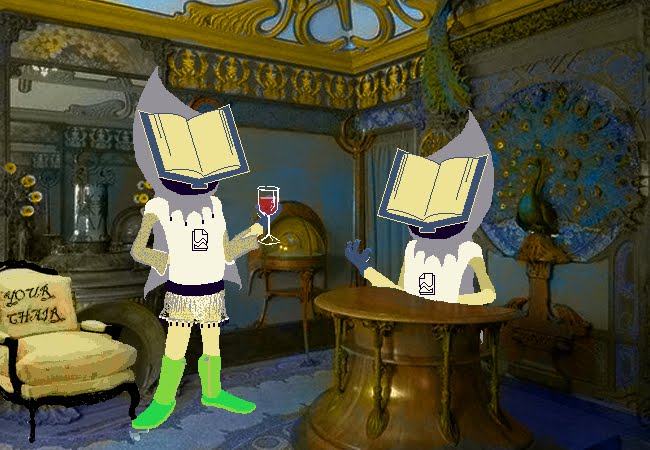
Support on Patreon
Store
Reader's Guide
Tag Index
Homestuck Articles
Solarpunk Articles
Mastodon/Fediverse
Tumblr
Bluesky
RSS Feed