The Worst Filing System Known To Humans

-Punk (5) A Song of Ice and Fire (2) Affect (9) Alienating My Audience (31) Animation (28) Anime (19) Anonymous (3) Anything Salvaged (15) Art Crit (42) Avatar the Last Airbender (2) Black Lives Matter (1) Bonus Article (1) Children's Media (6) Close Reading (90) Collaboration (1) comics (30) Cyborg Feminism (3) Deconstruction (10) Devin Townsend (2) Discworld (1) Evo Psych (1) Fandom Failstates (7) Fanfiction (28) Feminism (24) Fiction Experiments (13) Food (1) Fragments (11) Games (29) Geek Culture (28) Gender Shit (2) Getting Kicked Off Of TV Tropes For This One (11) Gnostic (6) Guest Posts (5) Guest: Ian McDevitt (2) Guest: Jon Grasseschi (3) Guest: Leslie the Sleepless Film Producer (1) Guest: Sara the Hot Librarian (2) Guest: Timebaum (1) Harry Potter (8) Harry Potter and the Methods of Rationality (3) Has DC Done Something Stupid Today (5) Hauntology (6) Homestuck (18) How Very Queer (35) hyperallthethings (10) hyperanimation (1) Hypercomics (11) I Didn't Ask For Your Life Story Sheesh (24) Illustrated (37) In The Shadow Of No Towers (1) It Just Keeps Tumblring Down Tumblring Down Tumblring Down (9) It's D&D (2) Judeo-Christian (9) Lady Gaga (5) Let's Read Theory (3) Lit Crit (20) Living In The Future Problems (11) Lord of the Rings (4) Mad Max (1) Madoka Magica (1) Magic The Gathering (4) Manos (2) Marvel Cinematic Universe (17) Marx My Words (15) Medium Specificity (15) Meme Hell (1) Metal (2) Movies (33) Music (26) Music Videos (21) NFTs (10) Object Oriented Ontology (4) Occupy Wall Street (3) Pacific Rim (2) Paradise Lost (2) Parafiction (6) Patreon Announcements (15) Phenomenology (4) Poetry (6) Pokemon (3) Politics and Taxes and People Grinding Axes (13) PONIES (9) Pop Art (6) Raising My Pageranks Through Porn (4) Reload The Canons! (7) Remixes (8) Review Compilations (6) Room For You Inside (2) Science Fiction Double Feature (32) Self-Referential Bullshit (23) Semiotics (3) Sense8 (4) Sociology (12) Spooky Stuff (45) Sports (1) Star Wars (6) Steven Universe (3) Surrealism (11) The Net Is Vast (36) Time (1) To Make An Apple Pie (4) Transhumanism (9) Twilight (4) Using This Thing To Explain That Thing (120) Video Response (2) Watchmen (3) Webcomics (2) Who Killed The World? (9)

Reload the Canons!

This series of articles is an attempt to play through The Canon of videogames: your Metroids, your Marios, your Zeldas, your Pokemons, that kind of thing.

Except I'm not playing the original games. Instead, I'm playing only remakes, remixes, and weird fan projects. This is the canon of games as seen through the eyes of fans, and I'm going to treat fan games as what they are: legitimate works of art in their own right that deserve our analysis and respect.

Showing posts with label Lord of the Rings. Show all posts

Thursday, June 30, 2016

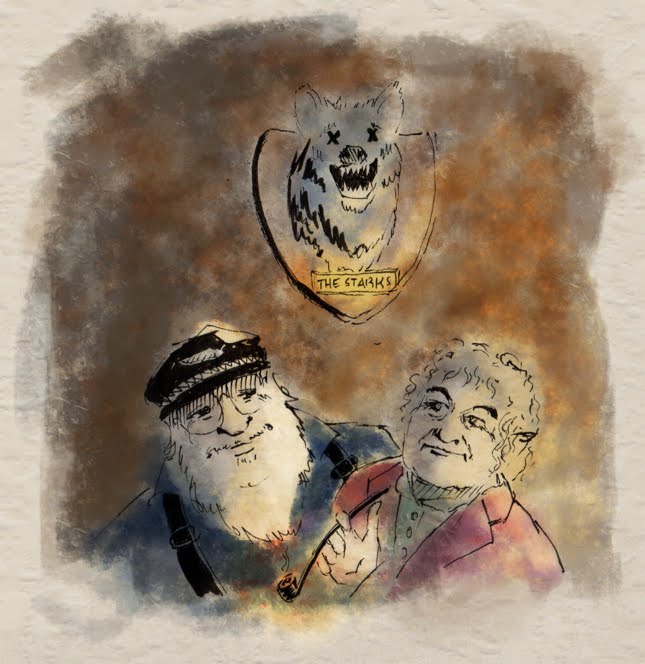
Not All Who Wander Are Lost: George RR Martin and Tolkien as Fellow Travelers

My first introduction to A Song of Ice and Fire was as a deconstruction of fantasy. George RR Martin's epic (now a "daring" and "brave" television series which you can see on HBO if you turn the brightness and contrast on your TV way, way, WAY up!!!) is, I was told, dark fantasy, with lots of shades of grey and violence and sex and so on.

It is, the subtext and sometimes the explicit text ran, not like Lord of the Rings. Or at least not like the traditions of Tolkienesque fantasy. This review of a recent episode of the (brave! genius! award winning!) tv show for example takes umbrage at the fact that the ending of a battle "has replaced that deconstruction with a blatant lift from Tolkien’s book, with the Vale forces riding in to save the day like Gandalf riding in to save Helm’s Deep." The notion of Tolkien and Martin as in some sort of competition or stark (hah) contrast is in the zeitgeist, is what I'm saying.

Having recently read the books, though, and also recently revisited The Lord of the Rings, I can't help but see this as more a product of a very narrow reading of Tolkien, and of Martin.


Some of this reading is possibly derived less from the source texts themselves but from Peter Jackson's adaptation. Look, I'm not gonna pretend that I haven't been deeply frustrated with The Lord of the Rings films since I was like 12. A lot of the stuff that most resonated with me as a kid ended up weirdly flattened, sensationalized, cut apart, or altered beyond recognition. And in the process everything got a lot more simple. I'm personally never going to forgive The Two Towers for introducing some fucking nonsense Aragorn Falls Off A Cliff subplot only to make up for it by hacking huge holes in the plot of Faramir, one of my absolute favorite characters. And others have written about some of the ways that in Jackson's hands characters like Saruman lose their thematic reason-to-be, becoming one note villains rather than complex and tragic figures.

Martin has suffered some of the same problems from the "brave" adaptation of his books, an adaptation I can't claim to have seen much of but which on a basic stylistic level seems to be run by people who don't understand that "dark fantasy" doesn't literally mean that all the sets should be chronically underlit and the characters should all wear the most drab clothing possible. I mean given that in the original text the Others are described basically as evil elves and the show develops them into ice orcs, and given that no one is walking around in the show with dyed-green beards like they commonly do in the book, it's pretty clear that they're more interested their sense of a "grim and gritty" aesthetic than what the text is trying to actually say.

Unfair? Not really. The critically lauded masterminds behind the "adaptation" literally once stated: "Themes are for eighth-grade book reports.” 

My contempt, I'd say, is well earned.

As a result perhaps of these less than stellar adaptations that have overtaken the originals, and as a result no doubt of Tolkien's many far lesser imitators, and probably to some extent as just a result of overexposure and fan discourses sort of overwhelming the original texts, a pretty remarkable fact has become obscured:

Lord of the Rings and A Song of Ice and Fire are much more a part of the same thematic tradition than in opposition. Basically, on a lot of levels, Tolkien and Martin are interested in the same stuff, and talking about the same things, and traveling on the same paths. And in fact some of their same formal "stumbling blocks"--things that people find particularly infuriating--parallel each other and do similarly important work within their respective narratives.

And to explain just how this makes sense, I want to talk a little bit about a book called The Worm Ouroboros.

Friday, July 13, 2012

Recrossing the Rainbow Bridge

I'm sitting here, on what has been a distinctly gloomy day, watching night fall, realizing that I'm not that excited for Dark Knight Rises.
I know, I know. I'm also wondering if there's something wrong with me. Perhaps it's simply the clouds getting to me. Perhaps its the lingering depression that I've been battling off and on for the last two months. And hey, perhaps it's the creeping, crawling apprehension, shared by many other left-leaning media theorists, that this movie is going to be, well, disturbingly right wing. The fact that the script writer is also behind a new Call of Duty game who's villain is the "leader of the 99%" has, astonishingly, done little to alleviate those fears that that this final movie will be an invective against the greedy poor, kept barely at bay by the noble and courageous upper class.

But there's something deeper at work here, I suspect, and I think it has to do with Snow White and the Huntsman.

Yes, yes, we'll wait while all the people who didn't watch it because "Eeeew, Kristen Stewaaaart!" exit the room.

That's better.

Now, I watched that movie a few weeks ago at a little late Deco era theater. I happened to enjoy it quite a bit. I can see where there were flaws, but I largely overlooked them because I was so captivated by the sheer imaginative force of the film. The film was absolutely full of downright gorgeous imagery.

And, even better, all of that imagery was essential to the themes within the film. Now, I'm not sure how overt this was to others watching, but there's a very interesting commentary within the film on our own tendency to shape the world according to our perceptions of the world. This concept absolutely saturates the film, from the way the Dark Forest generates horrors in response to your fears (the Huntsman even directly states that the forest preys on mental weakness), to the Queen's claim that she is simply giving the world what it deserves. The world responds to one's expectations, and if one expects the world to be filled with despair... well, that's what the world will become. (I want to do a longer treatment of this movie and why it's so fascinating, so keep an eye out for that).

Now, what really fascinates me about all this is that so many of the visuals--especially the ones used for the trailer, incidentally--seem to fit the modern aesthetic of Grim, Realistic Fantasy. We've seen it in everything from Game of Thrones, to Nolan's Batman trilogy, to the now seemingly omnipresent Grey First Person Shooters, to action movies, to bla bla bla, on and on and on the list runs, ad infinitum, ad nauseum.

It's an aesthetic that is getting really, really boring.

At least, I certainly am getting a bit weary of it it, and I doubt I'm the only one. After all, the grey or blue washed out aesthetic is, literally, dull. That's what dull means in color terms--desaturated, dark, dim, lacking shine or lustre. It is Kansas in The Wizard of Oz. It is the Elements of Harmony, driven to the point of despair by Discord in My Little Pony.

It is the world robbed of wonder.

And in any medium where color is viable, that greyness can be and frequently has been used to indicate dullness. And yet, it's become the dominant aesthetic in so much of our media. Why is that?

Well, one thing that seems common to these gritty, realistic, down-to-earth (which often seems to mean "covered in dirt") works is the embracing of the surprisingly low power. Oh, sure, Batman flips trucks and so on, yes, yes, but his fights are really hand to hand punchups. They're not the amazing, superhuman feats of strength of, well, Superman, or Thor, or The Incredible Hulk. The fantasy settings that use this aesthetic are stripped of magic. Sure, the wizards in Lord of the Rings sling quite a few spells, but the world itself is strangely devoid of the fairytale magic that seemed to saturate the pages of Tolkien's works. The elves have pretty buildings and lots of soft filter, but there's something tired about the larger world, something desolate that I, growing up with the illustrations of the Brothers Hildebrandt, found unsettling.

As I was typing this up, those terms--low-power and low-magic--triggered a memory. I thought back to an old, exceptionally useful series of posts on Dungeons & Dragons entitled Lessons from DMing with my Girlfriend. In the very first post, the author, Oakspar, describes how he has his players select the type of campaign they want to play before the game actually begins. Two of the options are a high vs low magic game, and a high vs low power game. Here's what Oakspar has to say about that:

You will probably be surprised by what your group picks. You will be amazed at how few players really want to play in that gritty low fantasy, low magic, low power campaign you have drawn up. After all, isn't that just another way to make your PCs more fragile, giving you more control to stroke your fragile ego with?

At the time I first read this, his conclusions raised my hackles a bit, and to some extent it still does. Who is Oakspar to judge me?! How dare he judge the intentions of the great and powerful DM! WHY IF I HAD MY ARMY OF ORCS HANDY I'D--

...Oh. Oh wait.

Yeah, there's some definite truth here, I think. Lowering the power of your characters, gritting up your setting, making it more "realistic," sure does boost the power of the author, doesn't it? It increases their power not just over the characters but, arguably, the audience as well. We're forced to sit there and watch the torments that the author dreams up, knowing that there can be no miracle, no Superman, no sudden, literal Deus Ex Machina like Odin Allfather, riding in to save the day.

And fine, maybe that's what you're going for.

But for goodness sake, let's please cut the crap.

This doesn't make a work more intellectual, nor more emotionally resonant, nor more artistically valuable, nor even darker, grimmer, and more seriously deconstructive, even. That last one is important, in particular, because I think it's becoming almost common sense that you have to use a grim, gray color scheme to tell a grim story that deconstructs traditional narratives, but it's simply not so.

The proof of that is in Snow White and the Huntsman.

Yeah, I almost forgot that we were talking about that, too.

See, the movie doesn't stick with that aesthetic. In fact, that aesthetic is explicitly a reflection of a world darkened by black magic. Once our protagonists reach the primordial faerie realms, well...


Yeah, not exactly what the badass dark fantasy trailers suggested, is it? There's fairies buzzing around, there's magic mushrooms, there's the Forest Spirit--


...Wait, am I watching the right movie?

Well, nevermind, the point is, all that grittiness is there for a reason: to set up the alternative, the glowing, bright world that is hidden, but not totally inaccessible to humanity.

This suggests a stunning possibility: perhaps this film isn't a dark deconstruction of a beloved fairy tale, but a deconstruction of dark deconstructions of beloved fairy tales.

It is, in essence, a reconstruction--it is taking what we know of the genre now that we've broken it down and deconstructed it, and it's using those fragments to build something better, something that is aware of the darkness of the Dark Forest, but is also capable of embracing the light of the Old Wood.

And that's something I think we're long overdue for. I think it's time for a Renaissance of Wonder--a resurrection of the idea of delight, as it were. To some extent, this is already happening--what are Iron Man, Thor, and the Avengers, if not heralds of bright, stunning, imaginative possibility that is still aware of the lessons of Nolan's Batman trilogy or, going back even further, The Dark Knight Returns or Watchmen? What is Rebuild of Evangelion but an assertion of the human will, that retains the cruelty of the original Neon Genesis Evangelion but counterpoints it with a new vitality, a new vibrancy, and a new determination that even someone who seems totally broken can still overcome the odds? What is the end of Madoka Magica but--oh, wait, no, I shouldn't give this one away. Suffice to say, what seems slated to become the darkest of deconstructions might have a very different message, in the end.

In fact, it looks like our culture is ready to go back to the ur-example:


There it is, folks, the dullness of the world being flooded with color. And it doesn't have to be, as Neil Gaiman asserts, Delirium that we find in this wash of color. It can be Delight.

That's the world I'm finding, more and more, that I want to keep coming back to.

And sure, I'll watch The Dark Knight Rises. In theaters? Certainly. And will I enjoy it? It's Christopher Nolan, so probably.

But as geekdom around me is gearing up to return to that world, I'm looking out at the gray skies, and realizing that I'm just not so sure I want to go back. After all, it's not that different from home, and in my heart I think I want someplace that is... well...

No Place Like Home.

You can follow me on Google+ at gplus.to/SamKeeper or on Twitter @SamFateKeeper. As always, you can e-mail me at KeeperofManyNames@gmail.com. If you liked this piece please share it on Facebook, Google+, Twitter, Reddit, Equestria Daily, Xanga, MySpace, or whathaveyou, and leave some thoughts in the comments below.

Tuesday, November 29, 2011

Finding Feminist Characters

The major problem that I keep noticing with feminist critiques of art is that they tend to be framed around the idea of reforming all feminist critiques of art.

So, we're already off to a terrible start here.1

But the other problem that I've noticed is that there tends to be a decided lack of solid methodology. I mean, how does one go about finding works that do, in fact, get it right and depict women (and men) in a feminist way? Or, perhaps more importantly, how does one go about finding stages where the story goes wrong? I, admittedly, have this difficulty as well--it is only recently that, thinking about it, I began to construct a scheme for myself. It's very easy and tempting to just glance at a work and say, "wow, strong women! Nice! FEMINISM!" or "Wow, [name redacted] is just fawning all over her stalker vampire lover the whole book. SETS FEMINISM BACK A CENTURY!" This stuff tends to be pretty intuitive. But I'm not comfortable with that, because it's not really fair to creators to tell them, "well, trust me, if your work was feminist it would feel more feministyish." And besides, I hate not having a schematic way of analyzing things. It's just who I am.

My criteria break down like this:

1. Is the character someone I can admire or find compelling?

This works a bit better than you might think, because of the compelling rider. I don't necessarily have to like or even empathize with a villain, for example, to find them compelling. If a character fails this first test, that's a warning sign--especially when this is the main character.

Another phrasing for this question would be "Is the character three-dimensional, and is it a problem if they aren't?"

2. Is my feeling in line with the author's?

This gets into the murky area of authorial intent, something rather at odds with my love of the Death of the Author. This is more a useful tool for analyzing the gaps between an intended view and my actual perception.

3. Is the gap in the above due to stereotypical assumptions, or simply differences in things like personality and so on?

And, finally, and most importantly,

4. Can I justify my reading of the character, even in opposition to the actual intent of the author. Or, to put it more bluntly, can I work past the author's bad ideas to find a way of making the work still enjoyable to me?

This is kind of dense, sometimes weirdly phrased stuff, and I had to go back and figure out what the hell I meant by most of it just now (give me a break, I wrote the first half of this article like a month ago). So, let me try to break it down using three different characters. Introducing:

Eowyn! From The Lord of the Rings!

Hermione Granger! From Harry Potter!
And, last but certainly not least:

Lord Humongous! The Ayatollah of Rock and Ro--
Oh, no, wait, that's wrong...

Uh, let's go with:

I know it's cliche. I'm sorry. It just works too well.


CATEGORY I: WELL ROUNDEDNESS:

Right from the start we're seeing some interesting things here. Hermione and Eowyn are both characters that I greatly admire for very different reasons--Hermione for her intellectual prowess and levelheadedness in the face of the kind of crazy things that were going on by the end of the Harry Potter series, and Eowyn for facing down the fucking Witch King of Angmar. Listen, this dude was a being so powerful that he locked up Gandalf for a while.

Bella, on the other hand... aaeeeeahhhh.

What's interesting about Eowyn here is that she isn't the kind of female character we normally get in fantasy and science fiction. She isn't an irrepressible badass. She's a human being with definite flaws--obsessiveness, a a tendency to be a bit over dramatic. This is why I phrased the question the way I did: there is nothing compelling in a two dimensional female character, no matter how many bad guys they kill over the course of a film. What makes Eowyn compelling is how she comes to heroism through despair, and ultimately chooses to attack death head on rather than succumb to it. What makes Hermione compelling is how she comes to balance her tendency to obsess over the intellectual side of things with real heroism and a bond with other human beings.

What makes Bella Swan less compelling is her fundamental lack of a characterization beyond "in love with Edward" and "doesn't like math."2

CATEGORY II: HOW THIS LINES UP WITH THE AUTHOR'S INTENTIONS

This tells us less about the work and more about the author, but it's important for the overall critique of these characters in the next two questions. In Eowyn's case, I have seen absolutely nothing that implies to me that she is supposed to be anything less than a compelling, fully realized female character. To some extent, she exists so that Tolkien can pull his "I am no man" trick on the audience, but the fact that he spends so much damn time on her and Faramir at the end indicates to me that he was fundamentally committed to turning her into a true character.

Of course, there's another possibility here, one that I've seen hinted at (although not explicitly stated) in other Feminist critiques: that Eowyn exists so that Tolkien can, at the end, set her up to be married to Faramir and retire from combat to a comfortable home. This is, as far as I can see, the only way you can effectively claim that Eowyn is not a feminist character. And it doesn't work. See, part of having a well rounded character is, of course, having flaws. And I see her mooning over Aragorn as a flaw. But more importantly for the sake of this critique, I think Tolkien does, too.

Similarly, Rowling seems committed to portraying Hermione as a rounded character that has a number of flaws--her temper, her obsession with studying, her awkwardness in some social situations--but it wouldn't make sense to view these flaws as anti-feminist, because both Rowling and I agree that they aren't necessarily good qualities in ANYBODY.

Bella, on the other hand, represents everything that Smeyers loves and everything that I can't stand. Especially the bit about hating math. I mean, come on, Smeyers, how much pandering are you really willing to do here? 3

CATEGORY IV: WHERE DOES THE GAP COME FROM?

If I perceive a character differently from the author, I want to know why. Hermione is easy here--there doesn't seem to be one, besides me feeling like she should be the main character rather than that ass Harry. Hermione Forever! But, I can see the logic behind keeping Harry as the main character, so I'm happy writing that off as me being kinda silly, more than anything else.

Bella is similarly straightforward, albeit in a different way. The difference does, in fact, come from a total difference in opinion on the role of women in society. I think they shouldn't be subservient to gender stereotypes. Smeyers does. Here, I think the problem lies with her.

Now, notice what I'm doing here. I'm critiquing my critique by figuring out why my perceptions don't line up with the author's. This helps me to evaluate whether I'm correct in criticizing the character, or whether I need to repeat the MST3K Mantra:

"If you're wondering how he eats or breaths
And other science facts (la la la)
Repeat to yourself 'It's just a show,
I should really just relax...'"

Sound advice.

Especially with Eowyn. If I were to take the position of her critics for a moment, how would I answer the question of the gap in perception between me and Tolkien? Well, the first possible criticism is that she spends too much time mooning over Aragorn. Isn't that rather Bella of her? Well, this was answered by the second question--there isn't actually a gap here, because Tolkien doesn't approve of her gloomyness either. So, what's the second one? Well, the critique I've seen is that her sudden falling for Faramir at the end of the story undermines her strength as a character. Again, I don't think Tolkien sees it that way, so let's look at where the difference in perceptions comes from. I think what's going on here is that commentators are looking at her action in the abstract and reading it as representative of a message about, I don't know, women finding happiness in marriage, I suppose.

Tolkien, on the other hand, is giving Eowyn and Faramir their one chance at happiness--the only chance at happiness they have left.

See, it's not like Faramir is any happier at this point. He's just been almost burned alive by his father, and then functionally deposed by Aragorn. Eowyn has just witnessed the death of her father and killed a being that can destroy your will to live simply by standing next to you. What Tolkien has realized here is that Faramir and Eowyn are probably the only humans that can understand each other's trauma. Having them fall in love here isn't a cop-out, it's a story of two terribly scarred people finding solace in the person that can truly understand their pain. (Remember, Tolkien lived through two World Wars--he was surely aware of the results of war.)

In this case, I think the gap lies in the fact that the critics are looking for a message, whereas Tolkien is looking for a character arc. To avoid that would, for me, flatten Eowyn out into the kind of 2D badass gritty perfect female warrior of modern fantasy. Yes, she's vulnerable here. Yes, that means that she isn't as perfectly strong a character as we might, in some ways, want. But that's what makes her a deeply compelling character. 4

CATEGORY FINAL: CAN I MISREAD THE CHARACTER BACK TO LIFE?

Maybe you don't buy my reading of Eowyn, or my assertion that this is what Tolkien was going for. Alright. That's cool. But I'm willing to bet you can think of it the way I am. Even if you think it's a misreading, I bet you can misread Eowyn as a powerful, admirable, and compelling character.

And isn't that better than just writing her off entirely? Remember, Anything Can Be Salvaged, and if it can be salvaged... well, it probably should.

Hermione is already awesome. She doesn't need to be fixed.

Bella, on the other hand, is beyond my help. 5

THIS WAS A BAIT AND SWITCH

Alright, I admit it, really what I was most interested in here was explaining why I love Eowyn. What can I say? My whole family is basically in the Eowyn/Faramir fanclub. They are probably our collective favorite characters in The Lord of the Rings. (No, we were not happy about Faramir's movie appearance. At. All.) But I wanted to actually set up a way of looking at this character before I delved into why I think she's so great, because otherwise I'm just rambling rather than explaining my reasoning. And I think providing the counterexamples of Hermione and Bella helped to clarify just how my system works.

But ultimately I think the important thing is that we have systems--personal, if not universal--because otherwise we're just going off of how things feel intuitively, and there's not really an effective way of communicating that. There's value in those intuitions, of course, but ultimately what I'm interested in is a way of expressing the intuitions.

But what do you think? 6

As always, feel free to leave comments, complaints, or, best of all, your own interpretations, or e-mail me at keeperofmanynames@gmail.com . And, if you like what you've read here, share it on Facebook, Google+, Twitter, Xanga, Netscape, or whatever else you crazy kids are using to surf the blogoblag these days.


1. It's worth noting here, of course, that this could just be a quirk of perception. Still, I keep seeing discussions framed in this way... I'm honestly not sure why.

2. What makes Lord Humongous compelling is his utter conviction of his own ultimate power--he is a being obsessed with obedience and defiance, a man with delusions of imperial power.

3. I think the creators of Road Warrior are very aware of Humongous's nature. This is part of why his character design involves the mask covering a burned face--he is a large, brutal ruler that seeks to hide his flaws. He is both odious and compelling, and the creators are quite aware of that.

4. Again, I think I'm right on the same mental track as the creators of Humongous. No commentary needed here.

5. My only criticism of Road Warrior's treatment of Lord Humongous is that there isn't more Lord Humongous. We just need more!

6. LIIIITTLE PUUUPPY?

Friday, September 16, 2011

I Need A Hero's Journey--Games and Joseph Campbell

Check out this article. For those of you that, like me, are a bit shaky when it comes to this type of tech article, allow me to translate briefly.

Essentially, what they're talking about here is the ability to create videogames that constantly generate totally unique landscapes each time you want to start a new adventure. In this type of game, you would always be exploring new locations, because the code itself would create new locations. Essentially, all "procedural generation" means is that instead of telling your code "Hey, a wall goes here" you tell the code, "Hey, here's a set of rules that tell you whether or not you want to put a wall here."

A set of rules and categories that can be used to generate multiple different experiences... hm... now where have I heard that before?


AAAAAAAIIIIIIIIiiiioh hello there, Mr Campbell.

This is Joseph Campbell, the very person whose ideas were on the tip of my tongue just now. Campbell wasn't the first person to codify or use the term "Archetype," but he's the thinker most relevant to our current discussion. What is an archetype, you ask?

Well, an archetype is really rather similar to the rules that go into procedural generation. It is essentially a set of rules that determines the underlying structure of a character or story. In Campbell's ideas, a whole selection of archetypes put together generate what he termed the Hero's Journey, or Monomyth. The core of this concept is that all the great myths and stories have the same underlying characteristics, even if individual elements are edited and changed--just as in the game landscapes described above, basic qualities like the presence of forests and deserts and mountains, and regions of cold in the North and heat in the South, are changed and rearranged in order to create unique maps.

So let's break this down a bit more into some of the component parts, and how they show up in more familiar works of fiction. These are, of course, the extremely condensed, cribbed versions of the archetypes, and are probably four or five generations removed from Campbell's actual scheme, but it should give you a general sense of how this all works.

THE CALL (It Knows Where You Live!)


This is, as the name suggests, the summoning of the hero character, and the start of the adventure. This is R2D2 showing Luke the hologram of Leia. It's Gandalf showing up at Frodo's door, looking like a complete basket case, going, "Is it secret?! Is it safe!?" (He was only ever that crazy in the movie...)

THE REFUSAL OF THE CALL

The Hero, due to the universal law that Good Is Dumb, will totally blow The Call off. This will result in events that eventually force him or her back into the quest. This is Luke trying to avoid getting involved, and coming back from Ben Kenobi's hut to find that the Storm Troopers have killed his family. In a modified form, it's Frodo realizing that unless he accepts the role of ring bearer, the meeting called by Elrond will deteriorate into strife and violence.

THE MENTOR

This isn't a stage; it's a character. The Mentor teaches and instructs the hero, and sets the hero on his or her path. Usually this mentor will die, generally as a symbolic passing on of the quest to the Hero. This is Gandalf in the Mines of Moria, and both Obi-Wan and Yoda passing on and vanishing into the Force. It's also, arguably, Dumbledore at the end of the sixth Harry Potter book.1

THE BIG BAD

This, as far as I can tell, isn't an explicit element of Campbell's myth arc, and it doesn't actually appear in many older myth epics, but it seems to be a mainstay of modern Hero's Journey stories--whether it be Sauron, Emperor Palpatine, or Voldemort.

THE LITTLE BAD

Here we're really running off the tracks, but this is a sort of miniboss character that, I suspect, falls generally under what Campbell called the Road of Trials--a set of tasks that the hero must fulfill before reaching the goal. Shelob and Saruman, Darth Vader, and any number of minor Death Eaters like Malfoy or Snape all fit this model--they are lesser obsticals for the hero to overcome.

INITIATION and DESCENT INTO THE UNDERWORLD

And this is where things get a bit crazy. The idea is that the Hero is initiated into the world of the heroic quest, and marked as a part of this world. Again, I'm sort of rolling a bunch of ideas into one category for the sake of simplicity and time, but one of the elements of this initiation is often some sort of spiritual death, attaining of cosmic knowledge, and rebirth. Frodo passing through Shelob's Layer can be seen as this sort of descent, or Luke's fall from grace at the end of The Empire Strikes Back.

THE VICTORY AND RETURN

This is an interesting one. The hero attains the goal of the quest and returns home... but this isn't often so easy. In Lord of the Rings, the heroes are forever altered by their experiences and have trouble reintegrating into normal life. The Elves, along with Gandalf, Sam, and Frodo, all journey off into paradise. Eowyn and Faramir, scarred by their experiences, eventually manage to find comfort in each other but still are dislocated from their former lives. One of the major complaints about the end of the Harry Potter series is that there is no difficulty of return for the heroes--they simply live out happy lives and have children named after their dead friends.2

This is the bare bones explanation of the Hero's Journey concept, and, as I said, it's hardly accurate to Campbell's exact theories. But, it should give you a bit of a primer for how these ideas work.

Now, this might seem like just one of my tangential explanations of one thing by introducing another thing, but there's a deeper application here. In essence, I think that the tools--the archetypes--that can be used to set up a story in other media can be used as parameters in a generated game. Rather than just abstract story elements strung together, the Hero's Journey would give players a set of goals and a point where the quest becomes complete, while not railroading them down a particular path.

Let me conjure up some help to explain this bit.

It is at this point that you notice, with growing trepadation, that there is a third beer glass sitting upon the table between us, as though awaiting another visitor. With a horrible rumble, the entire fireplace heaves back in its moorings to reveal a vast bank of sparking transistors, from which issues forth a spirit of fire and energy. It reaches out, takes the glass, swirls it, and grimmaces at the poor quality. There is a smell of brimstone and crushed dreams.

This is Ian McDevitt, a friend of mine in training to become a game developer. Perhaps he can shed some light on this subject.

The first and most obvious question, I suppose, is would it even be possible to generate the characters of a Hero's Journey tale?

 Absolutely. I've seen examples of character generators that give you nuanced backstories, character motivations, detailed physical descriptions, personality quirks... basically, everything you could possibly ask for in describing a person. If you have an archetype to build off of, like, say the Chosen One, then it's that much easier. You've got a finite list of character motivations, like not wanting to let everyone down, pride in being Chosen (by whatever mechanism it happens to have been), or fear of their world being engulfed in darkness (or whatever evil they've been Chosen to fight). Of course, this is just an example; I imagine the player would fill the role of the Chosen One, typically.

Would it be possible to create those sorts of characters without the gameplay becoming repetitive and predictable, though?

 That would depend on the limits of the archetypes. If the archetype demands that the Plucky Sidekick, for instance, be an idiot and basically useless, then in every game it generates that has a Plucky Sidekick, you're going to get a basically useless idiot.
And from what I gather, useless idiot sidekicks are rather overabundant in games these days.

 Hahaha, basically, though usually it's not the programmers' intent; it's just really difficult to teach NPCs to fight (or do whatever it is the player's doing) nearly as well as a human can. Though on the other side of the same coin, it's perfectly possible to make an NPC too good at it...

Which could be a problem if you end up with a generated Big Bad that is too tough to kill. But looking at these archetypes might be a good way of picking out where whole character types tend to be problematic, letting developers preempt some of these problems.

 Absolutely. I'm of the opinion that basically any information about how something works will help you design a computer system to replicate it. As any programmer will know, the hardest part of solving a problem is formally defining it. That's really the main difficulty in procedural generation and artificial intelligences.

Speaking of artificial intelligences... would these generated characters be able to exist as characters? For example, could they carry on an actual conversation with the player?

  If we teach a computer that, "If you see a grouping of letters together, there's some likelihood that the next letter will be __," then the computer will learn to create strings of characters that are ordered thusly. You can extend it to groups of words, and groups of sentences, to make full paragraphs of coherent speech. On top of all that, you can program in grammatical rules that humans follow (well, most of follow them!), so that it has a sort of censorship; it won't output anything until it has checked and made sure that it makes grammatical sense! Then it's just a matter of plugging actual subject matter into the right location and tweaking speech based on a given character's personality quirks. It sounds more difficult than it is!

  No, wait, that's backwards, it's actually more difficult than it sounds!


So, this is something that will need time and effort, but ultimately isn't impossible.

 Absolutely not impossible. Just... difficult.

Well, we know we can do it, with effort... but why should we? Where's the value in this sort of generated content? After all, the article I linked to describes how much less detailed the graphics become, and how much simpler the stories would have to be. What's the advantage here?

  For the most part, novelty. And I don't mean, "Oh, hey, this is a kitschy little system, let's build it as a senior project for the hell of it," I mean more along the lines of actually having something new and novel every time you boot it up. As for making things that are lower-quality, that may be the case in terms of actual graphical crispness, but I don't agree that the stories would have to be simpler. A computer can generate anything you teach it to, so it's just a matter of teaching it how our stories work, and it will make stories that are very close to the mark.

So, essentially this system would be valuable because each time you played it, it would be different.

  Essentially, yeah. But the great thing about a system like this is that because of the way computers randomize things, there's always what's called a seed. If you give players a way to check what seed was used to generate their world, and a way for players to pick which seed to use for that generation, players will begin sharing their worlds with one another. Minecraft has a system like that, and it has spawned, at the very least, www.minecraft-seeds.net .

So the most interesting quests--the most interesting stories--would be traded around, replayed, and explored over and over. Really, not different at all from how the best myths get passed down through centuries and across cultures.

The spectre, pleased with this conclusion, chugs the rest of its cheep beer and descends back into the bank of transistors from whence it came, leaving a smell of ozone and charred trollflesh in the air.

And that, ladies and gentlemen, about wraps things up for the evening. Ultimately, both these ideas--procedural generation and the Hero's Journey Archetype--are tools used to generate story experiences that people can enjoy and relate to. From simple rules can come enduring complexity, so profound that it remains with us even today, after all these centuries.

As always, feel free to leave comments, complaints, or, best of all, your own interpretations. And, if you like what you've read here, share it on Facebook, Google+, Twitter, Xanga, Netscape, or whatever else you crazy kids are using to surf the blogoblag these days.


1SPOILER ALERT DUMBLEDORE DIES.

2"There is literally no way to move forward from this point!"
Support on Patreon
Store
Reader's Guide
Tag Index
Homestuck Articles
Solarpunk Articles
Mastodon/Fediverse
Tumblr
Bluesky
RSS Feed