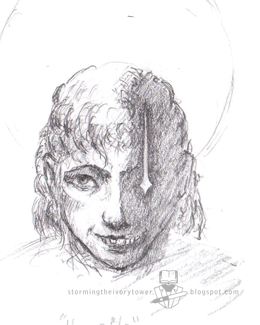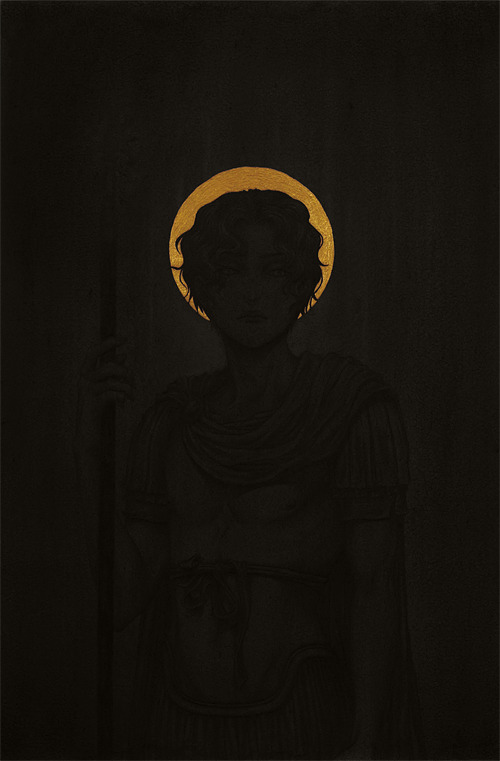
So, I happened upon this piece of art on Tumblr recently, and my immediate thought was, "Wow, there's so much to analyze here; this is fantastic:"
Then my second thought was, "I wonder how much of what I'm seeing here was intentional."
And my third was, naturally, that it was time to write a new article.
I actually get asked a lot of questions about a postmodernist concept known as Death of the Author. It's a concept that, if we're talking strict definitions, comes from a guy named Roland Barthes, and describes a very particular type of metacriticism aimed at taking those damn Formalists (the New Critics, remember? I've talked about them before) down a few pegs. It marks a transition from discussion of "Works"--masterpieces from a single author that contain a prime theme of universal human relevance--to "Texts"--collections of signs that combine and contrast to form their own meanings. The Death of the Author is the death of the Work, and also, Barthes gleefully points out, the death of the Critic and the rise of the Reader.
But it's also paradoxically a pretty good description of the moves a lot of modern theorists made. The Formalists, for example, opened the floodgates to begin with, ironically enough, by suggesting that meaning resides in the text. They suggested that we had to interpret based not on historical details or the author's biography but rather on the elements contained within a work. Barthes and other Semiologists extended that logic further to the point where the author had virtually no control over interpretation, and everything took place on the level of signs. Reader Response critics asserted that meaning actually came from the reader rather than the text, and any act of interpretation actually was an act of self-reflection and should be explored as such. I'm a bit less familiar with the psychoanalytic critics, but even there the impression I've gotten is that they are interested in how the text reveals the intentions not of the conscious mind of the artist but of some deeper force (whether an Id or a Jungian collective unconscious asserting itself).
Whew.
Anyway, I don't want to dwell on the history of criticism here, I just want to give you a sense of how Death of the Author is an enduring concept common to most modern criticism, even if it doesn't go by that name. Same actor, different parts, yeah?
But what I'm driving at with all this is that there's lots of ways in which meaning can be constructed without the artist's direct intervention. In fact, what I want to at least attempt to demonstrate today is that these constructions are totally impossible to avoid. In other words, this isn't just a bunch of theory mumbo jumbo of interest only to scholars, this is something that happens in your head every time you confront a work of art.
Watch.
The first thing I'm confronted with in this illustration is its simple structural qualities--namely, the fact that it low key to the point of being barely comprehensible, save for the saint's gold halo. It's so dark than on some of your monitors it may actually be completely black. Uh, if that's the case, do adjust the brightness accordingly; it's really worth being able to see properly.
So, already there's a kind of magic going on as my brain has to react to the visual stimuli and start to compose a narrative of what it's seeing. The main thing I'm getting is that the halo is the most important point. I'm articulating that here because I've got the training and language to do so, but really that recognition of the halo's importance happens on a level below your conscious awareness before you can consciously process what it means--we see that bright yellow jump out at us, while the rest of the picture recedes into the background. The same principle is true even when such contrast isn't quite so glaringly obvious. (Huh, it's almost like I chose this example specifically because of how clear its formal components are. Crazy!)
Then, once I'm over how beautiful that thing crescent of gold is on that black background (and really, if you simplified it down to just its geometry, this is a gorgeous composition) I start to take in the features of the figure. The first thing I notice there is that it's, well, really damn good. It's a nice drawing. But it's also somewhat roughly done--elements like the spear are left unfinished as though this is just a study. Again we get the impression that it's the halo that is important, not the figure: the rough study quality suggests both that this is a quick portrait sketch, almost like a study for a larger work, and that the soft lines of the figure are of lower order concern, despite their beauty, than the strongly defined contours of the halo.
The figure is also somewhat feminine looking. This is perhaps surprising, given that it is a portrait of Saint George. In the very unlikely chance that anyone is unfamiliar with that particular saint, George was a slayer of dragons. Yeah. This youthful, effeminate fellow is Saint George the Dragon Slayer. I'll get to what all of that suggests in a moment, but let's just quickly note the posture of the figure--there are strong verticals throughout the piece and the composition as a whole sits within a fairly tall and narrow rectangle. All of this gives the figure a kind of regal authority and solidity. The figure is like a sturdy column.
So, we've reacted viscerally to the physical qualities and their aesthetic power. Now we start to piece together a story of what's going on, based on what signifiers we observe, and what associations they bring to mind.
Now, keep in mind that I'm laying all this out in detail but all of this is happening within the span of a few seconds in my mind, automatically. This is what I mean by these acts of interpretation being out of our control--I'm not willing myself to react to this stuff, I'm just taking it in, processing it, and spitting it back out.
But if I articulate the thought process what I get is this:
The halo, as the most important element of the piece compositionally, signifies the prime importance of the celestial, of the holy, in this picture. In fact, the figure is overshadowed (literally?) by the presence of the holy, and the picture suggests through color and value that Saint George and his heroic deeds are less important than the divine strength behind his power. What's more, instead of showing St George as a burly heroic figure of legend, as we might expect, or a proverbial Knight in Shining Armor, St George is depicted as a youth--unbowed and unflinching from our gaze, to be sure, but a youthful, almost delicate creature all the same. This subverts our expectation of what a St George should look like, and in response we are once again brought back to that heavenly strength that empowers the saint. Oh, but don't get too caught up in the androgynous gorgeousness of St George, because remember, that beauty is shrouded in shadow. Even as we contemplate the aesthetic qualities of the figure we are stymied and frustrated by the darkness of the image, doubly reprimanded by the upsetting of our expectations and desires, and finally forced to set aside our desire to sanctify the man, leaving us only with the contemplation of God.
Which is, like I said, not what consciously went through my mind when I saw this picture.
Lemme try to transcribe that quickly, I think it went something like:
"Holy fuck this is a pretty picture."
Aw yeah, nothing like the eloquence of the conscious mind.
But that's kind of the point--I reacted aesthetically and then semiotically before I reacted consciously. My mind's will to interpret took over before my mind's respect for Authorial Vision And Intent could take over and tell me to stop. Remember, I can't know whether any of that was intentional on the part of the artist. ("But what if you asked her, doofus? She's got a tumblr!" I'll get to that in a moment, Oh Ye of Little Faith.) I only take what I know--or have programmed into me by evolution--and spit out a reaction and a reading, and that composes my best guess at what the picture is attempting to tell me. The picture. Not the artist.
But... what if you just ask the artist? Why can't you do that?
Well, first of all, artists are liars. No, really, listen, I speak as an artist and writer here, and trust me, we're all liars at heart. I mean, most of what you do in fine art is a carefully constructed lie--even artists that work from life in an illusionistic style distort reality to better fit the way the human eye and mind interpret visual stimuli. And fiction writers... man, do I even need to get into how heavily fiction writers distort reality?
So, knowing all that... why do you expect an artist to suddenly start telling the truth when they put the keyboard or pencil down?
But alright, that is a snarky response, I admit it. Not all artists are out to dupe you. (Just most of the ones that win the Turner Prize.) But even then, we're left with this problem: if we already know how powerful the unconscious mind, the little homunculus that pushes the aesthetic and semiotic buttons in our heads, is... why should we elevate even the author's conscious mind over their own homunculus? How can we conclude that even an artist is fully aware of all the aesthetic gears and cogs in their own work, when so much goes into a piece? We have so little control over our initial interpretive efforts; it seems strange to me that we should give a single individual sole interpretive power just because that individual has an authorial claim.
And I mean, what artist, when given a complex, clever analysis of their work is going to say, "Nope, all that happened totally by chance"? The answer, of course, is an artist with more integrity than I have, because if any of you suckers come to me with a brilliant insight into my work, I fully intend to nod my head and say, in a sagely tone, "Ah yes, my child, you have understood well."
Artists: the snake oil salesmen of high culture.
Aaaanyway, I don't want to cast aspersion on Casey here with all this rambling, I just want to address some of the fundamental problems with relying on an authorial voice to guide your interpretation, since that voice is often unavailable, and often unreliable. That's not even to say that you must never agree with an authorial interpretation; that would be really goofy and kind of a dumb critical stance to take. I'm just saying that we have some power here, and that power comes from how interpretation happens automatically.
In fact, I have one more thing to say about how Death of the Author is conceptually unavoidable, and it has to do with the application of semiotic associations on a metatextual level.
I am so, so sorry for subjecting you to that sentence.
What I'm saying, in simple terms, is that there are associations that happen not just between signs in a text and other external signs, but associations between a text as a whole and other texts. There's kind of an interesting idea in the further weirder reaches of critical theory that texts talk to one another, and the more texts you read the more they all start to babble back and forth. And again, this is something you can't really turn off.
To stick with St George here, for example, I immediately associated it with two very different schools of work: Byzantine icons, and the ultraminimalist black on black paintings of Ad Reinhardt.
Remember how I ranted a few paragraphs ago about being a liar? Well, I may have tweaked the truth somewhat when I talked about how the piece compositionally suggests that St George is of lower concern than the holy power behind him. I say "may" because I'm not completely sure--this stuff happens all in a big, rapid jumble, remember? But I think I may have been influenced not just by my understanding of the composition but by my familiarity with the constant struggle in Eastern Orthodoxy over whether or not Icons count as Idols. The problem is that when you've got what is pretty much straight up a graven image--something the Bible explicitly forbids--representing saints that you pray to, it's always going to occur to someone that maybe, just maybe, the icons should be smashed like the heathen idols they actually are.
The way the Byzantines got around this was by constructing a rather complex and strange line of reasoning that, put simply, claimed the icons WERE the saints! They couldn't be graven images because they weren't images at all--they were literal manifestations through the artist's paint or mosaic tile of a heavenly being.
When I look at this piece, I can't stop knowing what I know about the Byzantines. I can't unlearn what I know about that conflict.
So when I look at this piece, I think to myself, "Wow, it's a depiction of a saint that remains an icon in form but devalues the person in favor of the holy ideal he represents. That's a clever solution to the Iconoclasm problem."
And really, I wouldn't want to turn off that bit of my mind even if I could. See, my understanding of the piece is greatly enriched by my knowledge of history, and even if Casey is not a Byzantine scholar, I need not limit my own understanding of the piece's historical context and what it says within that context to correspond to that limit.
In fact, I would go so far as to call this very specifically a kind of modernist icon, the kind of piece that could only exist at this historical moment in time. That's where Ad Reinhardt comes in. I've talked a bit about him before; he's the cat that started painting all black canvases that were actually complex slight variations on black in specific patterns. He was trying to achieve ultimate subtlety with his works, and I think some of that impulse is present in St George. There is the same interest in very subtle contrasts and in delicacy, and ultimately they have a similar effect: they invite deep, almost meditative contemplation. When combined with religious subject matter and iconography you get an icon that can only exist in a time of postmodern experimentation with form, but that ultimately calls back to a long tradition of religious art.
And those conclusions, whether consciously derived or not, begin with the confrontation between the text--the portrait of St George--and the repertoire in my head, the signifieds, signifiers, and associations, and the evolved or learned response to deep compositional structures.
We can argue theory all we want but in my mind the author is already dead. And in that death, just as Barthes suggested, the reader is given new life through the ability to interpret expressively and creatively. It's not a denegration of the author, it's just a recognition that there is a sphere beyond an author's intentions, and that's the sphere that we access in that first moment when, confronted by an object of stunning beauty, our minds spit out the primal interpretive insight:
"Holy fuck that's a pretty picture!"
Hahahaha this was supposed to be a short piece. Whoops. Check me out on Google+ at gplus.to/SamKeeper or on Twitter @SamFateKeeper. As always, you can e-mail me at KeeperofManyNames@gmail.com. If you liked this piece please share it on Facebook, Google+, Twitter, Reddit, Equestria Daily, Xanga, MySpace, or whathaveyou, and leave some thoughts in the comments below. Oh, and really, check out Casey's stuff. It's so cool.
The Worst Filing System Known To Humans
-Punk
(5)
A Song of Ice and Fire
(2)
Affect
(9)
Alienating My Audience
(31)
Animation
(28)
Anime
(19)
Anonymous
(3)
Anything Salvaged
(15)
Art Crit
(42)
Avatar the Last Airbender
(2)
Black Lives Matter
(1)
Bonus Article
(1)
Children's Media
(6)
Close Reading
(90)
Collaboration
(1)
comics
(30)
Cyborg Feminism
(3)
Deconstruction
(10)
Devin Townsend
(2)
Discworld
(1)
Evo Psych
(1)
Fandom Failstates
(7)
Fanfiction
(28)
Feminism
(24)
Fiction Experiments
(13)
Food
(1)
Fragments
(11)
Games
(29)
Geek Culture
(28)
Gender Shit
(2)
Getting Kicked Off Of TV Tropes For This One
(11)
Gnostic
(6)
Guest Posts
(5)
Guest: Ian McDevitt
(2)
Guest: Jon Grasseschi
(3)
Guest: Leslie the Sleepless Film Producer
(1)
Guest: Sara the Hot Librarian
(2)
Guest: Timebaum
(1)
Harry Potter
(8)
Harry Potter and the Methods of Rationality
(3)
Has DC Done Something Stupid Today
(5)
Hauntology
(6)
Homestuck
(18)
How Very Queer
(35)
hyperallthethings
(10)
hyperanimation
(1)
Hypercomics
(11)
I Didn't Ask For Your Life Story Sheesh
(24)
Illustrated
(37)
In The Shadow Of No Towers
(1)
It Just Keeps Tumblring Down Tumblring Down Tumblring Down
(9)
It's D&D
(2)
Judeo-Christian
(9)
Lady Gaga
(5)
Let's Read Theory
(3)
Lit Crit
(20)
Living In The Future Problems
(11)
Lord of the Rings
(4)
Mad Max
(1)
Madoka Magica
(1)
Magic The Gathering
(4)
Manos
(2)
Marvel Cinematic Universe
(17)
Marx My Words
(15)
Medium Specificity
(15)
Meme Hell
(1)
Metal
(2)
Movies
(33)
Music
(26)
Music Videos
(21)
NFTs
(10)
Object Oriented Ontology
(4)
Occupy Wall Street
(3)
Pacific Rim
(2)
Paradise Lost
(2)
Parafiction
(6)
Patreon Announcements
(15)
Phenomenology
(4)
Poetry
(6)
Pokemon
(3)
Politics and Taxes and People Grinding Axes
(13)
PONIES
(9)
Pop Art
(6)
Raising My Pageranks Through Porn
(4)
Reload The Canons!
(7)
Remixes
(8)
Review Compilations
(6)
Room For You Inside
(2)
Science Fiction Double Feature
(32)
Self-Referential Bullshit
(23)
Semiotics
(3)
Sense8
(4)
Sociology
(12)
Spooky Stuff
(45)
Sports
(1)
Star Wars
(6)
Steven Universe
(3)
Surrealism
(11)
The Net Is Vast
(36)
Time
(1)
To Make An Apple Pie
(4)
Transhumanism
(9)
Twilight
(4)
Using This Thing To Explain That Thing
(120)
Video Response
(2)
Watchmen
(3)
Webcomics
(2)
Who Killed The World?
(9)
Reload the Canons!
This series of articles is an attempt to play through The Canon of videogames: your Metroids, your Marios, your Zeldas, your Pokemons, that kind of thing.
Except I'm not playing the original games. Instead, I'm playing only remakes, remixes, and weird fan projects. This is the canon of games as seen through the eyes of fans, and I'm going to treat fan games as what they are: legitimate works of art in their own right that deserve our analysis and respect.
Showing posts with label Judeo-Christian. Show all posts
Monday, February 18, 2013
Monday, December 3, 2012
Seer of Light: Ascend (Why Homestuck is a Gnostic Story)
Lately there's been a lot of buzz in the Homestuck fandom about this strange thing called Gnosticism. After all, more and more references to it are cropping up in the comic and people are, naturally, taking note. As far as I can find, though, no one has put Hussie's symbolic puzzle pieces together into a coherent thematic analysis of why the hints are there, and what he might be trying to tell us. So, I decided to quickly slap together an article on the subject before more competent people can give their takes on the whole garbled mess.
Now, Gnosticism itself is kind of a jumble, from what I've seen. It's really a collection of loosely interlinked myth traditions that take Abrahamic Monotheism as the starting line and then swerve wildly in a completely different direction. It's associated with early Christianity and most of the texts are related to the story of Jesus Christ's birth, death, and resurrection, but the creation myth that they're working with is a little odd. It goes like this:
In The Beginning there's a sort of primordial soup of Godness which emanates a series of male//female binary pairs of creative entities called Aeons. These are supposed to create together (they are called a "syzygy", which apparently means "yoked together." Great word, huh?), but one aeon, Sophia, goes off on her own and interacts with the shadowy primordial chaos outside of Godness, emanating a being without the help of her other half.
The result is a being known as the Demiurge, the Creator, Artisan or possibly the Will To Create.
His name is Yaltabaoth.
Yaltabaoth looks around the dark, formless void that he is birthed into and concludes that he and he alone is God. From chaos he forms the Earth, seven Heavens, and a whole series of shadow servants and angels called The Authorities. It is a flawed, cruel world cut off from the light of Godness, made by a being that should never have existed. It is, in short, a prison of matter. Sophia, when she realizes her error, descends into the world to give it the light of wisdom that is her aspect in the celestial hierarchy. And this descent sets into motion a series of conflicts that would, in time, allow humanity to Rise Up out of the prison that is the world.
See, although The Authorities eventually create Adam and Eve in mockery of Sophia, she and uh... a few other characters that are too confusing to really talk too much about here (gnostic creation mythology is kind of complicated, especially if you're reading the original texts) instill in them the same light that Sophia brought into the world in opposition to the primal darkness of Yaltabaoth. In time Eve eats the Fruit of Knowledge, which is the first step in humanity's process of self-actualization and ascent to a level rivaling the dark gods of the world. The story culminates with the entrance of Christ into the world in the form of Jesus, and he teaches humanity Gnosis, the knowledge, before eventually being sacrificed to make humanity's ascent possible.
We've already seen a number of references to this basic mythology in Homestuck. There's the presence of Yaltabaoth as an actual denizen. There's the recent update's mention of the "Lion's Mouth" (the Demiurge is sometimes described as a serpent with a lion's face, or even just "lion-like"). There's the chumhandles: "gardenGNOSTIC" and "TIMMAEUStestified" (Timmaeus was a Platonic dialogue that hypothesized the existence of a Demiurge). Seven Heavens correspond to Seven Gates, and players seem to be divided evenly between male and female players. There's all sorts of little clues along these lines.
And all of that adds up to...
What exactly?
This is where things get tricky. See, it's one thing to point out a bunch of symbols and argue that they point towards a particular mythic text that's being referenced... and it's another to actually say something worthwhile about that reference. Like, ok, it's obvious that The Sufferer is a Christ analogue. Great. That's an easy reference to make!
But... who cares?
The problem with saying that Everyone Is Jesus In Purgatory is NOT that critics and scholars and English teachers are "Reading Too Much Into Things." That, ladies and gentlemen, is what we call a Shitty Argument. It's an argument that refuses to discuss the merits of symbols and just dismisses them entirely because "The author couldn't have meant that!"
Which is stupid, because authors often do mean it, actually. If we're going to run with our Sufferer example, Andrew Hussie has straight up called him a Christ analogue. So... yeah, it's pretty stupid just on that level alone, even if we ignore the whole Death of the Author/Meaning is in the Text thing that critics have been arguing for the past century.
No, the problem with saying "The Sufferer is a Christ analogue" is that it just points out a similarity, not a meaning. This is also why "This story is an archetypal Hero's Journey tale!" style criticism is dull and pointless, actually--it doesn't tell us a damn thing about the story's emotional or philosophical point.
"Hey look, that painting is a rectangle!"
Thanks, Kenneth, but what does that mean?
Here's the better way of doing it. Because the Sufferer is a Christ analogue, we can take note of the fact that Kankri's death is not celebrated due to his rebirth but due to his last furious string of curse words. I mean, isn't that an interesting commentary on the difference between the two messianic sacrificial figures, that one dies in pain but rises in glory, and the other just... dies bitching out the universe so furiously that all his teachings are encoded in his string of cursewords? What a perfect summation of the black comedy that is Alternian culture--even their Christ is a prophet ultimately of exasperated fury at the sheer stupidity around him.
That's pretty perfunctory, but it's at least a decent working example of this sort of analysis--you have to dig beneath the similarities and discuss why they are present and what they imply about the story.
Anyway, this article is supposedly about Gnosticism so let's start actually digging into that, shall we?
The most obvious similarity, to my mind, is the nature of the Gnostic and Homestuck stories: they are essentially complex creation myths. They are creation myths of a particular kind, though: they are meditations on the nature of failed gods, and the nature of their failed creations. This is where the stories go way off the beaten path--you don't usually see creator figures that are fundamentally evil or, even worse, incompetent. And yet, in both narratives we see powerful beings that create completely new worlds, and in the process generally make everything worse. There's at least three separate creations that we get to watch, two Scratches and the birth of one completely new universe, and each time the result is degraded and broken in some way. Twice, this degradation occurs because of the machinations of devil figures (Doc Scratch and the Condesce, respectively).
However, we get to spend quite a bit of time with one Demiurge who differs dramatically from the demonic entity the Gnostics blame for our broken world:
Karkat.
Whether or not it's fair of Karkat to blame himself for the failures of the whole team and their inability to create a pure universe, I don't think we can deny that he occupies the same position as the Gnostic Demiurge. He's a flawed being that attempts to create an entire universe, but all his creations are fundamentally broken, and ultimately he becomes a wrathful, bitter god that rages at his own creation. I mean, he hates John so much initially--and John, as we'll see, is arguably a type of Adam--that he considers a caliginous relationship with the other player. That's some pretty intense wrath right there.
In a sense, Karkat gives us a window into the character of Yaltabaoth, a window not provided by the strictly dogmatic Gnostic scriptures. We see that our creator is tormented by his failure and his constant furious trolling is only an outward reflection of his own inner turmoil. It is written: "For they will come to be like volcanoes and consume one another until they perish at the hand of the prime parent [Yaltabaoth]. When he has destroyed them, he will turn against himself and destroy himself until he ceases to exist." Karkat turns his rage inward and drowns himself in futile flagellation, arguing with his past and future selves about why exactly everything went wrong. Whether he pulls himself out of this model or "destroys himself until he ceases to exist" remains to be seen. (Interestingly, that evocative quote could apply to a couple other characters as well, albeit in subtly different ways, and those characters could arguably stand in for Yaltabaoth given a slightly different interpretation. Hussie seems to be suggesting that creative and destructive (particularly self-destructive) impulses are wedded in their own kind of syzygic pair...)
Then there's the idea that Karkat finally hits upon, that he has failed so spectacularly that he has given an entire universe terminal cancer. Because he tried to cut corners, because he endorsed a half-baked creation, an entire universe is going to die horribly, betrayed by its own genetic code. In fact, this flawed, abortive creative process is central to Homestuck as a whole. The characters, not just Karkat but everyone involved in the game, fumble along, usually accomplishing things half by accident. And through it all there's the omnipresence of the Word, so central to Abrahamic myth, the power to will things into being with language itself.
And the Word was with God, and the Word was God, huh? There's an equivalence between language and object in Homestuck that initially derives from the computer metaphor but since then has taken on this quasi-religious air about it. Homestuck isn't exactly the first story to link the Word of Creation with the idea of genetic code, but I don't think I've seen a story where the metaphor is so profoundly resonant. Part of Hussie's brilliance comes from the balance between the pun on Karkat's zodiac sign with the profound terror of that hidden timebomb of an illness. (And look at the trappings of the Tumor--it literally is a ticking timebomb that starts at the birth of the universe. Oh, and the Tumor-like bomb that Meenah uses to blow up the Beforan trolls? It's another magic 8-ball, representing the bad luck of the genetic lottery.)
The interesting difference is that the repeated nested creation, where each predecessor must flee their own disintegrating universe into a new one of their own design, is engendered not through the malicious arrogance of Yaltabaoth, the aggrandizing Demiurge to Create... it's just a matter of a bunch of kids playing a game. Yaltabaoth commands the world and heavens to form, jumpstarting creation with the power of his voice alone. But the players issue their verbal commands in dreams, in sleep, in madness and in pain. They issue their commands not with authority but by possession and manipulation, and they are ignorant to their own role in the strange time loops that Paradox Space delights in until after the fact. Karkat is, for all his bluster, a deeply sympathetic protagonist who badgers his crew into staying together and does his best to make the game a success. if Karkat is our Demiurge, he doesn't show it much--he seems pretty bewildered and freaked out by the whole ectobiological cloning process that he is responsible for, and he doesn't seem particularly interested in what, to him, must seem a silly side game more analogous to breeding Chokobos than to getting the ultimate item needed to complete the game. He is a failed god less because of his aggrandizement and malice and more because he is distracted by the need to keep everyone from murdering each other.
In short, the gnostic Demiurge is an evil being who creates the world out of error and maliciously curses the inhabitants in order to elevate himself.
The kids who play SBURB and its variations in Paradox Space are simply trying desperately to survive.
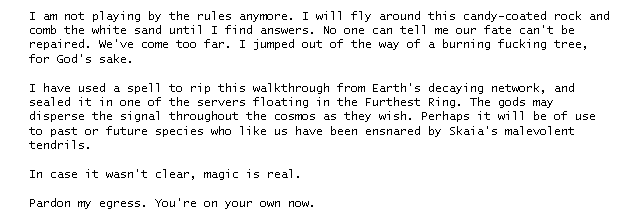
Hussie's tale becomes not one of evil creators, then, but one of an evil system that traps creators and creation alike in a vicious cosmic double reacharound. For all the light and wonder of Skaia, Rose is right to describe it as having ensnared them with "malevolent tendrils." The kids aren't just trying to escape the prison of the world, they're trying to escape the prison that is SBURB's infinite recursivity.
But before that thought gets too developed, let's suddenly switch topics and talk a bit about that escape from the prison of the world! I promise I'll get back to that thought later, but we need to talk about the Adam and Eve thing that the characters have got going on.
Let's talk apples.
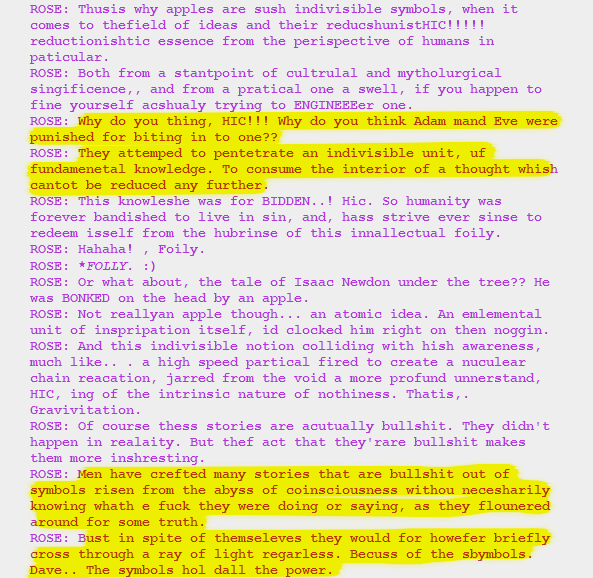
The Apple has been a subtly recurring symbol within the comic, showing up just seldom enough to be overlooked, but in places that suggest its fundamentality. Rose suggests as much during her drunken rant:
In the beginning was the word and the word was with God and THE WORD WAS GOD.
Information (light) and transcendent power together as one.
And how does the first kid enter the Medium?
Yeah.
The other kids aren't far removed from this sort of symbolism, either. Jade, too, deals with an implied apple in the form of a Bec-shaped fruit that she must shoot blindfolded, just as William Tell shoots an apple off of his son's head. Rose's item is a bottle--a reference both to Roxy's drinking habits and to her element, which is light or information, a metaphorical message in a bottle that she must retrieve. And Dave's is an egg, ancient symbol of rebirth, new beginnings, and perhaps, given the orange feathery asshole that watches over it, the Phoenix, an animal significant to the Gnostics (although I honestly doubt Hussie was thinking of them specifically when he created Dave's sprite and egg).
So, we've got one symbol of a new birth (associated with someone who can duplicate himself and evade death through time shenanigans), two parallel manifestations of the Apple, the modern symbol for the initially undefined "Fruit of Knowledge," and something we can read as a message in a bottle. Sounds to me like the kids are analogues for Adam and Eve, just as Rose suggests. They are cast out of their generally pretty idyllic life into one of strife and death as a curse for installing the game and taking a bite of the apple, so to speak.
But here again, we see the Gnostic pattern begin to assert itself. Think about it like this: the universe was always a broken entity fated for destruction. Karkat and the other trolls created it that way, as flawed Demiurges.
So, the kids always had to escape somehow, and although they have been cursed for their efforts by the vengeful creator gods (remember that initially the trolls blame the kids unfairly for Jack's presence in their session) their quest for knowledge--the desire to connect with Sophia, the Light of Wisdom--is the one thing that can ultimately help them escape the prison of the world. This is why the apple symbolism cannot simply be explained as a traditional Christian icon--here, instead of a Fall, or a Descent from Grace, we see the characters Rise Up through the intellectual hubris of taking the bite from the Irreducible Apple. And eventually they rise beyond the game's rules as well, once it becomes apparent that the system itself is against them.
![]() |
| "Then Eve, being a force, laughed at their decision." |
So it is with Homestuck.
But that's not all. See, the Gnostic myth is one of self-actualization, where humanity is deceived by ignorance and their path blocked or disrupted by agents of darkness. They must learn to avoid deception and seize the knowledge needed to become Gods.
You can probably see by now where this line of thought is going.
When you get right down to it, Homestuck at its core is a coming of age story (or if you want to get really German about it, a Bildungsroman. Remember that for your SAT, kids!). They grow into their class and into their own beings, out of the shadow of their elders, as they travel the Medium. That's really the deeper point of the classes--attaining God Tier isn't a matter of getting flashy new powers, it's a matter of gaining a new understanding of yourself and your potential as a person. We can find parallels to that in the New Testament. Christ repeatedly tells people to keep quiet about his miracles; I suspect strongly that he recognizes the natural impulse to latch onto the flashy tangible details while missing the underlying growth into wisdom signified by those powers.
And we have ample evidence of the reality of that failure: the Beforan trolls all seem to have completely missed the point of their personal quests, and they've been stuck in developmental stasis since their deaths. I suppose you could argue that this is just a property of their status as, you know, dead people, but Vriska and Tavros seem to have grown and changed in ways that the Beforan trolls haven't. They are growing into their classes, as are the pre-Scratch kids. If you've been following any of the theories on Aspect Inversion from lildurandal or bladekindeyewear you already know how very possible it is to fail in that attempt at growth.
So, it seems to me that Gnosticism provides us a good lens through which to understand the goals of the game: ultimately the players must undergo a process of self actualization that allows them to transcend their previous universe, undergo a death and rebirth into glory (isn't that death and rebirth part of what makes [S] Cascade so powerful?), and become fully aware of their own nature and potential.
Except for two problems.
First, SBURB is recursive--it generates new universes in order to perpetuate the cycle of corrupted creation and inevitable destruction via the Reckoning. So, even if players escape into the new universe, that universe will still be subject to the same curse, the same fatal flaw, as before.
And second, they still have to deal with an entity that seems to embody inevitable doom:
![]() |
Inescapability. The illusion of free will. The tyranny of the Alpha Timeline. The cruel, calculated bargain made by Paradox Space in order that it might continue to bring itself into being.
All of these concepts are embodied in Lord English.
Now, I'm not sure how much of this is coming from Gnosticism proper and how much is coming from Umberto Eco (his novels Baudolino and Foucault's Pendulum both touch on these ideas, and sometimes I garble together what I've learned from the prime texts and what I've picked up through the mouthpiece of Eco's characters) but I have heard it said that the primal light of Godness is a timeless entity. The Fourth Dimension comes into being with the birth of Yaltabaoth within darkness. He thus is a being that bestows Time upon the universe. I don't think it's a stretch to describe Yaltabaoth as a Lord Of Time. And his feminine aspect is, perhaps a bit more nebulously, a Muse of Space, a being of inspiring light that is present within all matter.
So, it's fitting that the final boss should be a type of Yaltabaoth--or a type of Samael, a blind god incapable of seeing truth or goodness. Caliborn isn't really much of a Demiurge, but he sure fits the Gnostic need for an inescapable force of suppression, deception, and blind spite.
And that suggests to me a more proper final endgame than simply the creation of a new universe; more proper even than the defeat of Lord English.
It's ultimately the system of SBURB's recursive inevitability, the malevolent tendrils of Skaia, the casually genocidal indifference of a reality where Lord English's existence is sanctioned by Paradox Space...
THIS is the prison from which the players must escape.
I suspect very strongly that Homestuck will end not with just the creation of a new universe, but with the creation of a universe free of the baleful influence of SBURB. A universe where the game is never created.
...Or, you know, the kids could end up creating the universe needed for Caliborn and Calliope's session. Hell, that might be just as likely given the recurring theme of failed creation. Guess we'll just have to wait and see.
But my money is on the idea that the gods of the new world will be establishing a paradise beyond the reach of Skaia's passive malevolence. And we may even speculate that the Dreaming Dead will have a rebirth in this new paradise.
Either way, I think we're going to see plenty more Gnostic nods in the text, and I think what we can take away from them is that SBURB is a game ultimately of transcendence and maturation.
Which is a pretty circuitous way of getting at something that you probably already knew.
Tuesday, July 17, 2012
Fertile Ground
My sister does not read this blog. She claims that it is because she is "Too Busy" to read--which really means "Way Too Cool" to read, of course. So, when she said to me, "Hey, I want to read your take on the Dead Can Dance video "Persephone" I jumped on that prompt like a DDR junkie slamming zir feet down at the sight of a looming <= =>.
And at first, the assignment seemed pretty manageable. Check the video out:
Wow. It's a nice piece, actually, saturated with a mythic post-apocalyptic gloom that is so over the top that it staggers with wild junkie eyes straight back into the realms of Wonder. It's like a live action Goya painting, from the incomprehensible rites of fertility to the laughing crones to the bleak and horrible landscape.
Let's dig into the symbolism a bit, though, shall we?
Check out the kid at the beginning with the crucifix. Now, what we can draw from that is that this is some sort of debased civilization--the relics of the past have been left in the mud. The serpent (or, maybe some sort of giant hideous worm? We never see more than the slithery tail) slips through this landscape unhindered. I love the little touch, incidentally, of the child nailing the little Christ to his little cross with a big honking brick. The video doesn't linger on this image, which is a good choice--with such a brief presence the clip remains sly rather than obnoxiously overt. Taken together, these images proclaim a kind of barbarity holding sway over the world. This is even more profound when paired to the sepulchral background music, which groans ponderously in a medieval dirge.
Welcome, the video says, to the new dark age.
Then, if you weren't overstuffed with Christ already, we've got an almost pagan blood rite between our two protagonists, as they cut their hands (in the middle of a mud covered wasteland, I might add--hope penicillin isn't a lost technology here) and join their blood together. I bring it up as another nod to Christianity, though, because these hand wounds are rather reminiscent, in my mind, to stigmata, the wounds of Christ on the cross, wounds that would appear sometimes upon the palms of the devout. (This is, you'll recall, an image the Surrealists really dig.)
I would normally feel a bit odd about the repeated footage of the hand carving scene here, but I think the reintroduction of the footage, its use of slow motion, and the pairing of that moment with a shift in the music itself to a clearer choral sound actually works in the video's favor. It all seems to emphasize a sort of inevitability of the whole thing, an almost obsessive caressing of details, an etherization of time itself upon the examiner's table, a sense of how one moment plods hopelessly into the next.
I think this actually works quite well with the title--Persephone. For those unfamiliar with Greek myth (not that common these days, I know, but let's review just in case) Persephone was a goddess of nature and fertility that Hades, the dark god of the underworld, fell in love with--or at least in lust with. In typical Greek God fashion, instead of asking her on a date like a normal, well adjusted God, he just rode out of the realm of the dead, scooped the screaming goddess up, and dragged her straight to hell, as it were. Charming. Her mother, Demeter, understandably freaked the fuck out and killed basically all the vegetation until an exasperated Zeus finally agreed to get off his ass and make a bargain with his creepy basement-dwelling brother to let the poor goddess go. They made a deal where Persephone would hang out in the world's largest basement dwelling neckbeard den for half the year, and the other half would live in the world of sunlight and so forth. Her mother, true to form, freaked out again every year, which is why Pennsylvania's roads are either covered in ice, or covered in road crews, depending on the season.
Not that I'm bitter or anything.
Wait, where was I?
Oh, right, Persephone.
Now, what's interesting about this is that Persephone's stories is one of a larger class of stories about death and rebirth--cyclical fertility stories, if you will--that often depended upon the idea of a god sacrificing himself and then returning to life. We see this even more overtly with Adonis, with Osiris, and, yes, with Jesus Christ.
Except... this video isn't exactly doing it right, is it? Do you see, at the end of the video, any hint of rebirth? Nooot really. As soon as our red head, ridden by Satan, jams her bull horns (another symbol of fertility and virility, incidentally) into her lover it does start raining, of course, but the watching old creeps react by putting on their veils and hats again and heading for dryer pastures. The grimy kids hang about gathering up the coins left behind, which doesn't strike me as a particularly optimistic symbol of rebirth. (Note also that the coins are rather reminiscent of the silver paid to Judas in return for his betrayal of Christ.) Our sacrificial lamb does smile at the end, but there sure doesn't seem to be much to indicate that his smile--and, presumably, the hope it carries of some meaning to the death--is anything more than dying delusion, and we're left with a shot of our protagonist sitting in the rain crying tears of blood.
Everything here indicates to me that this is not a resurrection right but a failed, perverse echo of an ancient hope in a blasted post-civilization wasteland. It is not a fertility rite, it is an infertility rite, with sterile coins tossed by sterile crones at children murdering each other for what amounts to empty entertainment. Whether it be Christ or Persephone, the old myths, the old rites, have no meaning here. What's more, sacrifice here seems sanctioned not by some higher divinity but by the malignant, possessing perversity of Hell, as our protagonist is ridden and reduced to bestial fury by some occult force.
It's a stunningly bleak video that has, as its aim, the creation of a dark mythology, a mythology that Lovecraft would doubtless recognize: the myth of a world where the only divinity you're likely to find is the divine presence of horrors that toy with humanity for their languid amusement.
Wow.
And that's the essay Emily wanted me to write. Not my longest or my best work, I don't think, but it digs into the video effectively enough, and I think I've uncovered some themes that might not be as immediately apparent. It would be easy, after all, to just read the video as a fertility rite, missing the heavy irony suggested by the final image and the dirgelike tone of the music.
I finished up this analysis satisfied that I had done all I needed to do.
But then, like a moron, I scrolled down to look at the YouTube comments. My reactions ran something like this:
Alright, first comment, pretty damn incoherent, actually. It doesn't even really work grammatically, but hey, it's possible this is their second language. Whatever, moving on...
Yeah, kind of a shallow reading that doesn't take into account the full range of the symbols, but I like the whole three women motif, that's an interesting bit of analysis.
...Uh oh.
Looks like my homework assignment just got doubled.
Yes, ladies and gentlemen, it turns out that this is NOT a Dead Can Dance video at all. It is a video produced for a French artist Mylène Farmer, for her song Sans Logique--a song from 1988, if you can believe it. Yes, that's a video from the late 80s, when American videos were still just a bunch of people in odd clothes dancing. Hm.
Let's take a look:
Now, there's two things this video shows us. The first is that music videos are fundamentally, inextricably linked to their music, far more so than other cinema. This is partly because of how elements like the title and lyrics alter the meaning of the video. Here, for example, the change to Farmer's lyrics and title emphasize not the idea of the failed, barren rite but the sheer absurdity of the whole situation and the war within the female protagonist. She seems to struggle with the rising force of unreason and diabolical possession within a world that has long since disintegrated.
The music, too, transforms from dirgelike medieval groaning to a danceable cabaret rhythm that heightens not the desolation of the world at large but the perversity of the protagonist's struggles, and the warped nature of the event. There is no longer the sense of hopeless inevitability, but it is replaced not by an new sense of hope but by a sense of the absurd randomness of the world. Freedom amidst absolute chaos and capriciousness, after all, is no better than an inevitable, ritualized fate--you still can't successfully control your life or even choose your own poison. Yikes.
So, the change doesn't make the video any less bleak, but it dramatically alters our understanding of the video's message. And, while we're at it, it's worth pointing out that the video has countless other possible interpretations that are generated by its pairing to Farmer's score--and, by extension, the pairing to Dead Can Dance should at the very least double that number. The simple act of changing the tune and making the few other minor cuts necessary to extend the video to the required length can make visible a whole new range of meanings that might not have been initially visible.
And that's pretty freaking cool.
But there's a second lesson here:
The history of Music Videos is totally unwritten, and might already have passed the point where we can make sense of it.
See, unless that heroic YouTuber had mentioned the fact that this was originally a video for a totally different song, I would have no way of knowing one way or another. Documentation of music videos is horrifically sloppy even in databases like Wikipedia which categorize every other damn trivial bit of information about an artist. There's no easy way to confirm that there ISN'T a video for Dead Can Dance's "Persephone"--in fact, it never occurred to me to even try. There's just too little record of who is producing music videos, and recognizing a reworked video can be downright impossible, especially when the video is, as here, devoid of anyone actively singing the song.
On top of that, there is an overwhelming amount of information to sift through, and any historian of music videos is going to immediately be faced with the problem of specialized, localized knowledge. I had never heard of Farmer, for example, despite the fact that she was doing, two decades ago, what I've been analyzing in Lady Gaga videos for the past year or so. I mean, everything that I've praised Gaga's videos for, their willingness to push the boundaries of possibility, their length, their production value, their unique aesthetic and European arthouse sensibilities... all of that is present in Farmer's work. It's really, really worth checking out if you're at all interested in the medium, in other words.
But there's no way for the casual viewer to know that this stuff exists, because the information is so piecemeal.
And WOW is that exciting.
See, this might be a staggeringly daunting task, but it's also a sign that this field is absolutely rife with possibilities. As we critics start to build up a preliminary history, more and more gems will be unearthed from the sludge, more and more interesting material that hasn't crossed the Atlantic, or that hasn't spread out of particular genres (I just spent the day discovering the brilliance that is early rap and hip hop, for example) is going to start seeing the light of day. It's an exciting time to be looking at music videos, because everywhere you turn there's something new.
And that's not even taking into account the myriad possibilities of interpretation within each video.
So, I think there's a wonderful kind of irony to this bleak video. Although its message is one largely of confusion and hopelessness, it also represents a different kind of confusion. It demonstrates the fertile Precambrian chaos, the fecund disorder, of the Music Video medium. Dig into the soil and you'll find all sorts of life scuttling around. And as you do, please, leave a record of your discoveries. Don't let the myths fall into disrepair over the grinding ages--let's share the secrets that we find.
Oh, and if you, like my sister, want me to dig into a particular work, let me know. I'm always looking for new things to explore, and it's always more fun to go exploring when you've got a companion.
You can follow me on Google+ at gplus.to/SamKeeper or on Twitter @SamFateKeeper. As always, you can e-mail me at KeeperofManyNames@gmail.com. If you liked this piece please share it on Facebook, Google+, Twitter, Reddit, Equestria Daily, Xanga, MySpace, or whathaveyou, and leave some thoughts in the comments below.
And at first, the assignment seemed pretty manageable. Check the video out:
Wow. It's a nice piece, actually, saturated with a mythic post-apocalyptic gloom that is so over the top that it staggers with wild junkie eyes straight back into the realms of Wonder. It's like a live action Goya painting, from the incomprehensible rites of fertility to the laughing crones to the bleak and horrible landscape.
Let's dig into the symbolism a bit, though, shall we?
Check out the kid at the beginning with the crucifix. Now, what we can draw from that is that this is some sort of debased civilization--the relics of the past have been left in the mud. The serpent (or, maybe some sort of giant hideous worm? We never see more than the slithery tail) slips through this landscape unhindered. I love the little touch, incidentally, of the child nailing the little Christ to his little cross with a big honking brick. The video doesn't linger on this image, which is a good choice--with such a brief presence the clip remains sly rather than obnoxiously overt. Taken together, these images proclaim a kind of barbarity holding sway over the world. This is even more profound when paired to the sepulchral background music, which groans ponderously in a medieval dirge.
Welcome, the video says, to the new dark age.
Then, if you weren't overstuffed with Christ already, we've got an almost pagan blood rite between our two protagonists, as they cut their hands (in the middle of a mud covered wasteland, I might add--hope penicillin isn't a lost technology here) and join their blood together. I bring it up as another nod to Christianity, though, because these hand wounds are rather reminiscent, in my mind, to stigmata, the wounds of Christ on the cross, wounds that would appear sometimes upon the palms of the devout. (This is, you'll recall, an image the Surrealists really dig.)
I would normally feel a bit odd about the repeated footage of the hand carving scene here, but I think the reintroduction of the footage, its use of slow motion, and the pairing of that moment with a shift in the music itself to a clearer choral sound actually works in the video's favor. It all seems to emphasize a sort of inevitability of the whole thing, an almost obsessive caressing of details, an etherization of time itself upon the examiner's table, a sense of how one moment plods hopelessly into the next.
I think this actually works quite well with the title--Persephone. For those unfamiliar with Greek myth (not that common these days, I know, but let's review just in case) Persephone was a goddess of nature and fertility that Hades, the dark god of the underworld, fell in love with--or at least in lust with. In typical Greek God fashion, instead of asking her on a date like a normal, well adjusted God, he just rode out of the realm of the dead, scooped the screaming goddess up, and dragged her straight to hell, as it were. Charming. Her mother, Demeter, understandably freaked the fuck out and killed basically all the vegetation until an exasperated Zeus finally agreed to get off his ass and make a bargain with his creepy basement-dwelling brother to let the poor goddess go. They made a deal where Persephone would hang out in the world's largest basement dwelling neckbeard den for half the year, and the other half would live in the world of sunlight and so forth. Her mother, true to form, freaked out again every year, which is why Pennsylvania's roads are either covered in ice, or covered in road crews, depending on the season.
Not that I'm bitter or anything.
Wait, where was I?
Oh, right, Persephone.
Now, what's interesting about this is that Persephone's stories is one of a larger class of stories about death and rebirth--cyclical fertility stories, if you will--that often depended upon the idea of a god sacrificing himself and then returning to life. We see this even more overtly with Adonis, with Osiris, and, yes, with Jesus Christ.
Except... this video isn't exactly doing it right, is it? Do you see, at the end of the video, any hint of rebirth? Nooot really. As soon as our red head, ridden by Satan, jams her bull horns (another symbol of fertility and virility, incidentally) into her lover it does start raining, of course, but the watching old creeps react by putting on their veils and hats again and heading for dryer pastures. The grimy kids hang about gathering up the coins left behind, which doesn't strike me as a particularly optimistic symbol of rebirth. (Note also that the coins are rather reminiscent of the silver paid to Judas in return for his betrayal of Christ.) Our sacrificial lamb does smile at the end, but there sure doesn't seem to be much to indicate that his smile--and, presumably, the hope it carries of some meaning to the death--is anything more than dying delusion, and we're left with a shot of our protagonist sitting in the rain crying tears of blood.
Everything here indicates to me that this is not a resurrection right but a failed, perverse echo of an ancient hope in a blasted post-civilization wasteland. It is not a fertility rite, it is an infertility rite, with sterile coins tossed by sterile crones at children murdering each other for what amounts to empty entertainment. Whether it be Christ or Persephone, the old myths, the old rites, have no meaning here. What's more, sacrifice here seems sanctioned not by some higher divinity but by the malignant, possessing perversity of Hell, as our protagonist is ridden and reduced to bestial fury by some occult force.
It's a stunningly bleak video that has, as its aim, the creation of a dark mythology, a mythology that Lovecraft would doubtless recognize: the myth of a world where the only divinity you're likely to find is the divine presence of horrors that toy with humanity for their languid amusement.
Wow.
And that's the essay Emily wanted me to write. Not my longest or my best work, I don't think, but it digs into the video effectively enough, and I think I've uncovered some themes that might not be as immediately apparent. It would be easy, after all, to just read the video as a fertility rite, missing the heavy irony suggested by the final image and the dirgelike tone of the music.
I finished up this analysis satisfied that I had done all I needed to do.
But then, like a moron, I scrolled down to look at the YouTube comments. My reactions ran something like this:
"thank all my fans, means a lot to raise awareness of our feelings and human decadence, but we know that love is always hope ..."
Alright, first comment, pretty damn incoherent, actually. It doesn't even really work grammatically, but hey, it's possible this is their second language. Whatever, moving on...
"This is about the old pagan rites for fertility.The old women represent the crone..the pregnant one, the mother..the young one the maiden.The young man is the corn or wheat God who must die to be reborn.For the sake of the land.Hence the rain..the planting.They mourn his death..celebrate his rebirth."
Yeah, kind of a shallow reading that doesn't take into account the full range of the symbols, but I like the whole three women motif, that's an interesting bit of analysis.
"Lol, the video matches with the song so well that i tend to forget that is actually a Mylene Farmer video. Even though i like the original background song."
...Uh oh.
Looks like my homework assignment just got doubled.
Yes, ladies and gentlemen, it turns out that this is NOT a Dead Can Dance video at all. It is a video produced for a French artist Mylène Farmer, for her song Sans Logique--a song from 1988, if you can believe it. Yes, that's a video from the late 80s, when American videos were still just a bunch of people in odd clothes dancing. Hm.
Let's take a look:
Now, there's two things this video shows us. The first is that music videos are fundamentally, inextricably linked to their music, far more so than other cinema. This is partly because of how elements like the title and lyrics alter the meaning of the video. Here, for example, the change to Farmer's lyrics and title emphasize not the idea of the failed, barren rite but the sheer absurdity of the whole situation and the war within the female protagonist. She seems to struggle with the rising force of unreason and diabolical possession within a world that has long since disintegrated.
The music, too, transforms from dirgelike medieval groaning to a danceable cabaret rhythm that heightens not the desolation of the world at large but the perversity of the protagonist's struggles, and the warped nature of the event. There is no longer the sense of hopeless inevitability, but it is replaced not by an new sense of hope but by a sense of the absurd randomness of the world. Freedom amidst absolute chaos and capriciousness, after all, is no better than an inevitable, ritualized fate--you still can't successfully control your life or even choose your own poison. Yikes.
So, the change doesn't make the video any less bleak, but it dramatically alters our understanding of the video's message. And, while we're at it, it's worth pointing out that the video has countless other possible interpretations that are generated by its pairing to Farmer's score--and, by extension, the pairing to Dead Can Dance should at the very least double that number. The simple act of changing the tune and making the few other minor cuts necessary to extend the video to the required length can make visible a whole new range of meanings that might not have been initially visible.
And that's pretty freaking cool.
But there's a second lesson here:
The history of Music Videos is totally unwritten, and might already have passed the point where we can make sense of it.
See, unless that heroic YouTuber had mentioned the fact that this was originally a video for a totally different song, I would have no way of knowing one way or another. Documentation of music videos is horrifically sloppy even in databases like Wikipedia which categorize every other damn trivial bit of information about an artist. There's no easy way to confirm that there ISN'T a video for Dead Can Dance's "Persephone"--in fact, it never occurred to me to even try. There's just too little record of who is producing music videos, and recognizing a reworked video can be downright impossible, especially when the video is, as here, devoid of anyone actively singing the song.
On top of that, there is an overwhelming amount of information to sift through, and any historian of music videos is going to immediately be faced with the problem of specialized, localized knowledge. I had never heard of Farmer, for example, despite the fact that she was doing, two decades ago, what I've been analyzing in Lady Gaga videos for the past year or so. I mean, everything that I've praised Gaga's videos for, their willingness to push the boundaries of possibility, their length, their production value, their unique aesthetic and European arthouse sensibilities... all of that is present in Farmer's work. It's really, really worth checking out if you're at all interested in the medium, in other words.
But there's no way for the casual viewer to know that this stuff exists, because the information is so piecemeal.
And WOW is that exciting.
See, this might be a staggeringly daunting task, but it's also a sign that this field is absolutely rife with possibilities. As we critics start to build up a preliminary history, more and more gems will be unearthed from the sludge, more and more interesting material that hasn't crossed the Atlantic, or that hasn't spread out of particular genres (I just spent the day discovering the brilliance that is early rap and hip hop, for example) is going to start seeing the light of day. It's an exciting time to be looking at music videos, because everywhere you turn there's something new.
And that's not even taking into account the myriad possibilities of interpretation within each video.
So, I think there's a wonderful kind of irony to this bleak video. Although its message is one largely of confusion and hopelessness, it also represents a different kind of confusion. It demonstrates the fertile Precambrian chaos, the fecund disorder, of the Music Video medium. Dig into the soil and you'll find all sorts of life scuttling around. And as you do, please, leave a record of your discoveries. Don't let the myths fall into disrepair over the grinding ages--let's share the secrets that we find.
Oh, and if you, like my sister, want me to dig into a particular work, let me know. I'm always looking for new things to explore, and it's always more fun to go exploring when you've got a companion.
You can follow me on Google+ at gplus.to/SamKeeper or on Twitter @SamFateKeeper. As always, you can e-mail me at KeeperofManyNames@gmail.com. If you liked this piece please share it on Facebook, Google+, Twitter, Reddit, Equestria Daily, Xanga, MySpace, or whathaveyou, and leave some thoughts in the comments below.
Thursday, July 5, 2012
Storming the Tower of Babel (Why TV Tropes is DoublePlusUnGood)
i reley dont wan to say this (but I have to now)
I would like to say that midway through the article you're about to read, I realized that it was falling apart on me.
Unfortunately, that moment of realization actually came as I stared at the blank page in front of me. The blinking cursor had become a symbol whose meaning was all too clear: I couldn't find the words to express what I wanted to say.
All of which is fitting. You see, this is an article about the Tower of Babel.
Well, that's not quite true. Really, this is an article about some of the major structural problems with TV Tropes, the repository of narrative terminology. But we're going to get there by way of Babel, because, well, why walk in a straight line when you can wander all over the map?
I'm bringing up Babel because of a very specific bit of cultural history illuminated by Umberto Eco. Basically, in Judeo-Christian mythology, humankind originally spoke the same tongue--the language of Eden, a perfect language with perfect correspondences between object and word. From a semiotic perspective, we would say that the Signifier (the word uttered or written) has a perfect relationship to the Signified (what that utterance represents)--it is not arbitrary or subject to ambiguity like normal language.
Now, humans, as they do, decided they wanted to reach the Heavens and become gods themselves. To do so, they came from all around the world to construct a massive tower--the Tower of Babel.
If you're familiar at all with the Abrahamaic God you can probably see where this is going.
Yes, ladies and gentlemen, the old sourpuss in the sky decided that he didn't particularly appreciate the humans building their Sumerian Space Elevator and, like a kindergartener affronted by another child's sandcastle, kicked that shit over. But, more importantly, God realized that if humans were able to communicate perfectly, they could basically do whatever the hell they wanted to. (This is another of those places where the Gnostic idea of a God bent on keeping humans from achieving their true potential starts to make a whole lot more sense, incidentally). So, he used his confuse ray and the humans forgot how to talk to one another. The languages split apart into countless fragmentary tongues, now arbitrary in nature, and the tower was abandoned.
Now, fast forward to the Renaissance and the dawn of the Age of Reason. This idea of Babel is still firmly in the minds of the great thinkers of this period. After all, it is a time of many language-based upheavals: there is the invention of new mathematical languages for interpreting the universe, there is the unification of formerly scattered towns under the banner of single nations, there is a growing interest in dead languages, and so on. All of this occurred (although not necessarily in that order) within a few centuries.
In the midst of this upheaval, scholars hit on an intriguing possibility:
What if they could reclaim the language of Eden, the perfect language before Babel?
What if our discourse was so perfect that we could determine Truth simply by laying out language like a calculation, and leave the table convinced of the divine perfection of our conclusions?
What if we could revolutionize language, clean it up, perfect it, make it better?
Why, is there anything we could not achieve?
This quest is, of course, impossible. We know now that language is a construct, and words have meaning that derives arbitrarily from their context within a system of utterances. And, what's more, there are some really problematic concepts inherent in this quest, but we'll get to that a bit later.
The important idea here is that TV Tropes, like its ancestor Wikipedia, and arguably all encyclopedias and dictionaries, is an iteration of this attempt to reclaim the Edenic language--to get back to before Babel.
Think about it. You've got a project that is trying to be the full, encyclopedic, comprehensive list of all tropes in fiction. It is attempting to set down in print a perfect set of categories that can, when assembled properly, can construct any and all fiction. This is no different, fundamentally, from Leibniz's dream of a language that would operate like mathematics, a language that could be used to calculate Truth itself. And, like Leibniz's dream, it's a utopian fantasy, to be sure, but Leibniz ended up inventing Formal Logic, and TV Tropes has similarly helped to spread and popularize a whole bunch of important terms.
But, any quest like this has the possibility of going horribly, horribly wrong. There is, after all, one other cautionary tale of top-down Perfect Language creation... but again, let's let that rest for the moment. First, I want to start talking about where TV Tropes is starting to run off the rails. In particular, I want to talk about the recent scandal where every trope that included the word "rape" in the name was removed from the site.
Yeah.
It was pretty bad.
After all, language helps to enable thought, right? This is actually something we can demonstrate with psychological science: things like whether or not a civilization has access to number words drastically and dramatically alter whether they can perform tasks of spacial rearrangement that we would find simple, for example. I ran into this problem when I was working with my collaborator Ian McDevitt on a large analysis of Hypercomics--we had to invent a whole series of terms before we could effectively discuss the techniques we were analyzing. Oh, and the difference between "mankind" and "humankind?" Yeah, that's another good example of this sort of thing--it's easier to think of men as the default and women as the deviation in part because the continued use, in English, of male-specific words to represent all of humanity.
So, when we remove all the terms dealing with rape from one of the most important cultural repositories on the web, we are essentially hamstringing our ability to discuss the issue of rape. In a culture of silence and victim-shaming, that is catastrophic.
Now, all of this came about because Google suddenly pulled their ads--which TV Tropes depends upon for survival--from the whole site due to complaints about the rape tropes. So, to some extent, this isn't the fault of TV Tropes, per se--but it is evidence of a fault running through the site's structure.
Still, I think a lot of commentary on this, while good, (there's been plenty of criticism of the totally botched handling of the whole crisis by TV Tropes--you can see some of the boneheaded decisions in the article linked to above, and I don't feel like digging into those issues too deeply here) has missed what I think is that deeper faultline I mentioned, a fault running through the endeavors of what promises to be the most important source of media discourse in the beginning of our century.
Let's dig into some of the executive decisions over there and what their implications are, shall we?
TV Tropes Is A Perfect Language Model
I've already described why this is true--TV Tropes is attempting to put together a set of words that are more perfect in their descriptive power, and that are of an almost scientific value--they can be used to construct narratives as we use the symbols of chemistry to form compounds or the symbols of mathematics to form new theorems.
There are some problematic implications of this when taken to the extreme, however. After all, a perfect language has to be as close to exact as possible, right? Well, TV Tropes has, relatively recently, been embarking on a campaign of generalization and simplification. That's perfectly in keeping with the quest for a perfect language--it's actually probably inevitable. The problem with this is that each time the terminology is better changed to reflect a more perfect form--a task that, as I've already pointed out, is an ultimately hopeless quest--a greater level of confusion is introduced into the system. It's not that different from the French revolutionary calendar, which attempted to create a decimal system of minutes, hours, and weeks, or the unified Italian that originated with Dante and eventually became the common language of the nation. Both of these methods--one assuredly more successful than the other--ultimately were not completely adopted by the common people. They represented an external order imposed upon the native tongues--the native system of symbols--and were thus never fully accepted as true language.
So, this is one of the more misguided aspects of TV Tropes. But it's not quite as problematic as some of the other decisions, on the face of it. Shall we explore further?
A Perfect Language Allows No Ambiguity
Is a trope subjective? Well, better put it in its own separate page on the site, because subjectivity spurs debate.
Is a particular instance of a trope or an example debatable? Well, now we've got an Analysis page for that, because we don't want "Natter" on the main page.
Ambiguity is Scary.
Now we're starting to get into the more problematic aspects of how TV Tropes is run. See, if TV Tropes is going to be a perfect language, it can't allow debate. Now, the moderators have largely claimed that they want a clean set of pages that don't include "natter"--i.e. endless back and forth debates about a particular entry. The result of this, though, is a quashing of discourse. For a site that claims to not be a "stuffy encyclopedic wiki" (remember when this actually just said "Wikipedia?") this is a surprising suppression of conversation.
This is where we start to see the contradictory nature of the quest for a perfect language. It is prompted, after all, by a desire for improved communication. But to establish its nature as a PERFECT language, it can't allow for the complex ambiguities of discourse that naturally arise from interpretation and the arbitrary nature of signs.
Wait, let me put it in a way that has less Theory.
TV Tropes wants to help us communicate, but ONLY ON ITS TERMS.
Now, if you're starting to get a vague sense of deja vu, I won't be surprised. If language controls thought, language can be actively used to control thought. But again, let's let this go for a moment and move on to the next stage in our analysis.
The Perfect Language Is Ideologically Compromised
And here we get into why the google ads scandal was not just possible, not just probable, but inevitable. See, the Perfect Language is a reflection of reality, right? But some aspects of reality have been deemed Unspeakable--explicit sex, nonconsentual sex, paedophilia, and so on. This is not just a problem with TV Tropes, of course--it is a simple result of Google's attempt to control language. And it is a decidedly Orwellian control.
Yes, this is what I've been driving at. We've made our way from the perfect language of Babel to the perfect language of INGSOC. We have catapulted through conceptual time from 2000 years after the creation of Adam to 1984.
If language is constricted according to what is "appropriate," it functions as a means of control. This is the purpose of the new language of Orwell's 1984: the goal is to simplify language so much that it becomes impossible to discuss potentially revolutionary ideas. Here, Google and TV Tropes have worked in concert, however accidentally, to achieve what even the Victorians (if you believe Foucault) weren't able to accomplish: they've answered the incitement to discourse about sexuality with a responding total ban. Wow. It's actually staggeringly ambitious, if sickening. It's its own sort of Tower of Babel--an impossible task of godlike control.
And it's not just because of Google's ad interventions, either:
The Perfect Language Is A Beautiful Language
The language of birds. The language of God. The language of Adam from before the Fall. The quest for the Perfect Language has always been one of beauty. And TV Tropes has followed suit by transforming itself from a site that once was capable of critically analyzing art, to one that now can only celebrate art.
TV Tropes has become the gaggle of seraphim that float around God's throne singing "Holy! Holy! Holy! Holy!"
Except that they accept any throne as the throne of God. Because the perfect language is the language of the celebration of beauty.
Which of course all makes sense on a metaphorical level. I'm sure the surface level reasons simply involve the mods being unwilling to sort out criticism--which is interesting in and of itself, since you would think that a wiki would be self correcting. I would even suggest that this is evidence either of an unreasonable obsession with control, or evidence that the concept of the Wiki is inherently, irreparably flawed. I'll let you chew over that on your own, though.
What particularly grates about this state of being is the fact that this was NOT the way TV Tropes used to be. In fact, the front page originally read:
By 2011, the front page sported this line:
The site has since done its damnedest to bury this snarky past. The Perfect Language cannot allow for the disputes that emerge from real critical thought.
Only Perfect Things Can Be Described By The Perfect Language
This is the culmination of all of the principles described above, and basically explains why TV Tropes is on a collision course with obsoletion.
See, if the Perfect Language is a language of Beauty, if it cannot allow ambiguity, if it allows for the existence only of that which is acceptable socially, the Perfect Language inevitably must purge itself of entries from the Devil's Dictionary:
Unlike Wikipedia, we have a policy of non-negativity and non-notability, which if left unchecked enables the writing of articles about obscure, offensive works, which gives them publicity. Since listing criticisms of the works we trope is both negative and off-mission, we are unable to present a truly neutral perspective on these works, which creates the impression that we endorse them. This is not a problem Wikipedia has to concern itself with.
That disgusting passage was from the announcement that the site would be purged of works that a specialized council of moderators decided was pornographic. Here we have, plain to see, the INGSOC project in its infancy. Look at the way this author describes things as being "off-mission," as though TV Tropes is a political party that must maintain a unified message so as to sway the voting public. Let me be frank. This makes me furious. This passage takes a bunch of premises that are already shot through with rot, accepts them as fundamental to the project, and then, rather than abandoning them when they cease to work, establishes further stillborn statutes in order to effect ever greater control!
TV Tropes is on the path toward an impoverishment rather than an enrichment of language, make no mistake. These incidents will continue, and perhaps even increase, and more and more of the site will inevitably be bowdlerized until what is deemed "fiction" is reduced to a highly problematic fraction of what that word can and should encompass. Hell, on a personal level, as someone that has already argued for the storytelling power of pornography, this is an affront to everything I believe.
And it is infuriating, above all, because it leads to the inevitable final death sentence of a conclusion:
The Perfect Language Is Perfectly Useless
I already touched on this a bit when I described how the project fundamentally contradicts itself in its aims, due to its attempts to both promote and stifle discourse simultaneously, but it's worth describing in greater detail. As long as TV Tropes continues to go down the path of censorship, restriction, removal of discussion, and suppression of ambiguity, it will continue to diminish its usefulness, because it will become increasingly archaic and artificial. It will support particular sociopolitical goals without being able to reflect upon its own intrinsic support.
It will become ossified, the lifegiving fertile mud transformed into a hard, unyielding brick, all in the service of a tower that elevates a select set of texts to the level of Godhood. No Such Thing As Notability, huh? I would say it is ironic, but irony is a concept that TV Tropes is doing its best to remove from its ranks.
Isn't it amazing how all the bricks fall into place?
I can see only one solution here to this ossification. The Tower has to fall. The Perfect Language has to be rescattered. here are, of course, multiple ways of going about such a confusing of tongues. There could be a radical change in the moderation of the site--this is, perhaps, the best method. But, if there isn't a change in how they run things, there has to be an alternative, a counter tongue that helps to confuse the discourse. A rival wiki? Perhaps. Perhaps simply the regular storming of the Tower of TV Tropes with the goal of changing and fucking with as much as possible is called for.
But as much as it pains me to say it, we can no longer rely on TV Tropes for our language.
Because (Beacuase?) this site, always unabashedly anti-academic to the point of being obnoxious about its window-smashing rebelliousness, has become another Ivory Tower, and if we aren't careful, our discourse is going to start to become as whited-out, as barren, as its snowy slopes--as blank as a page with a single cursor blinking within, no words available to articulate the author's designs.
I would like to thank Pinnacle Whipped Vodka for making this article possible. Heaven knows I wasn't getting through this without being a little bit buzzed. You can follow me on Google+ at gplus.to/SamKeeper or on Twitter @SamFateKeeper. As always, you can e-mail me at KeeperofManyNames@gmail.com. If you liked this piece please share it on Facebook, Google+, Twitter, Reddit, Equestria Daily, Xanga, MySpace, or whathaveyou, and leave some thoughts in the comments below.
I would like to say that midway through the article you're about to read, I realized that it was falling apart on me.
Unfortunately, that moment of realization actually came as I stared at the blank page in front of me. The blinking cursor had become a symbol whose meaning was all too clear: I couldn't find the words to express what I wanted to say.
All of which is fitting. You see, this is an article about the Tower of Babel.
Well, that's not quite true. Really, this is an article about some of the major structural problems with TV Tropes, the repository of narrative terminology. But we're going to get there by way of Babel, because, well, why walk in a straight line when you can wander all over the map?
I'm bringing up Babel because of a very specific bit of cultural history illuminated by Umberto Eco. Basically, in Judeo-Christian mythology, humankind originally spoke the same tongue--the language of Eden, a perfect language with perfect correspondences between object and word. From a semiotic perspective, we would say that the Signifier (the word uttered or written) has a perfect relationship to the Signified (what that utterance represents)--it is not arbitrary or subject to ambiguity like normal language.
Now, humans, as they do, decided they wanted to reach the Heavens and become gods themselves. To do so, they came from all around the world to construct a massive tower--the Tower of Babel.
If you're familiar at all with the Abrahamaic God you can probably see where this is going.
Yes, ladies and gentlemen, the old sourpuss in the sky decided that he didn't particularly appreciate the humans building their Sumerian Space Elevator and, like a kindergartener affronted by another child's sandcastle, kicked that shit over. But, more importantly, God realized that if humans were able to communicate perfectly, they could basically do whatever the hell they wanted to. (This is another of those places where the Gnostic idea of a God bent on keeping humans from achieving their true potential starts to make a whole lot more sense, incidentally). So, he used his confuse ray and the humans forgot how to talk to one another. The languages split apart into countless fragmentary tongues, now arbitrary in nature, and the tower was abandoned.
Now, fast forward to the Renaissance and the dawn of the Age of Reason. This idea of Babel is still firmly in the minds of the great thinkers of this period. After all, it is a time of many language-based upheavals: there is the invention of new mathematical languages for interpreting the universe, there is the unification of formerly scattered towns under the banner of single nations, there is a growing interest in dead languages, and so on. All of this occurred (although not necessarily in that order) within a few centuries.
In the midst of this upheaval, scholars hit on an intriguing possibility:
What if they could reclaim the language of Eden, the perfect language before Babel?
What if our discourse was so perfect that we could determine Truth simply by laying out language like a calculation, and leave the table convinced of the divine perfection of our conclusions?
What if we could revolutionize language, clean it up, perfect it, make it better?
Why, is there anything we could not achieve?
This quest is, of course, impossible. We know now that language is a construct, and words have meaning that derives arbitrarily from their context within a system of utterances. And, what's more, there are some really problematic concepts inherent in this quest, but we'll get to that a bit later.
The important idea here is that TV Tropes, like its ancestor Wikipedia, and arguably all encyclopedias and dictionaries, is an iteration of this attempt to reclaim the Edenic language--to get back to before Babel.
Think about it. You've got a project that is trying to be the full, encyclopedic, comprehensive list of all tropes in fiction. It is attempting to set down in print a perfect set of categories that can, when assembled properly, can construct any and all fiction. This is no different, fundamentally, from Leibniz's dream of a language that would operate like mathematics, a language that could be used to calculate Truth itself. And, like Leibniz's dream, it's a utopian fantasy, to be sure, but Leibniz ended up inventing Formal Logic, and TV Tropes has similarly helped to spread and popularize a whole bunch of important terms.
But, any quest like this has the possibility of going horribly, horribly wrong. There is, after all, one other cautionary tale of top-down Perfect Language creation... but again, let's let that rest for the moment. First, I want to start talking about where TV Tropes is starting to run off the rails. In particular, I want to talk about the recent scandal where every trope that included the word "rape" in the name was removed from the site.
Yeah.
It was pretty bad.
After all, language helps to enable thought, right? This is actually something we can demonstrate with psychological science: things like whether or not a civilization has access to number words drastically and dramatically alter whether they can perform tasks of spacial rearrangement that we would find simple, for example. I ran into this problem when I was working with my collaborator Ian McDevitt on a large analysis of Hypercomics--we had to invent a whole series of terms before we could effectively discuss the techniques we were analyzing. Oh, and the difference between "mankind" and "humankind?" Yeah, that's another good example of this sort of thing--it's easier to think of men as the default and women as the deviation in part because the continued use, in English, of male-specific words to represent all of humanity.
So, when we remove all the terms dealing with rape from one of the most important cultural repositories on the web, we are essentially hamstringing our ability to discuss the issue of rape. In a culture of silence and victim-shaming, that is catastrophic.
Now, all of this came about because Google suddenly pulled their ads--which TV Tropes depends upon for survival--from the whole site due to complaints about the rape tropes. So, to some extent, this isn't the fault of TV Tropes, per se--but it is evidence of a fault running through the site's structure.
Still, I think a lot of commentary on this, while good, (there's been plenty of criticism of the totally botched handling of the whole crisis by TV Tropes--you can see some of the boneheaded decisions in the article linked to above, and I don't feel like digging into those issues too deeply here) has missed what I think is that deeper faultline I mentioned, a fault running through the endeavors of what promises to be the most important source of media discourse in the beginning of our century.
Let's dig into some of the executive decisions over there and what their implications are, shall we?
TV Tropes Is A Perfect Language Model
I've already described why this is true--TV Tropes is attempting to put together a set of words that are more perfect in their descriptive power, and that are of an almost scientific value--they can be used to construct narratives as we use the symbols of chemistry to form compounds or the symbols of mathematics to form new theorems.
There are some problematic implications of this when taken to the extreme, however. After all, a perfect language has to be as close to exact as possible, right? Well, TV Tropes has, relatively recently, been embarking on a campaign of generalization and simplification. That's perfectly in keeping with the quest for a perfect language--it's actually probably inevitable. The problem with this is that each time the terminology is better changed to reflect a more perfect form--a task that, as I've already pointed out, is an ultimately hopeless quest--a greater level of confusion is introduced into the system. It's not that different from the French revolutionary calendar, which attempted to create a decimal system of minutes, hours, and weeks, or the unified Italian that originated with Dante and eventually became the common language of the nation. Both of these methods--one assuredly more successful than the other--ultimately were not completely adopted by the common people. They represented an external order imposed upon the native tongues--the native system of symbols--and were thus never fully accepted as true language.
So, this is one of the more misguided aspects of TV Tropes. But it's not quite as problematic as some of the other decisions, on the face of it. Shall we explore further?
A Perfect Language Allows No Ambiguity
Is a trope subjective? Well, better put it in its own separate page on the site, because subjectivity spurs debate.
Is a particular instance of a trope or an example debatable? Well, now we've got an Analysis page for that, because we don't want "Natter" on the main page.
Ambiguity is Scary.
Now we're starting to get into the more problematic aspects of how TV Tropes is run. See, if TV Tropes is going to be a perfect language, it can't allow debate. Now, the moderators have largely claimed that they want a clean set of pages that don't include "natter"--i.e. endless back and forth debates about a particular entry. The result of this, though, is a quashing of discourse. For a site that claims to not be a "stuffy encyclopedic wiki" (remember when this actually just said "Wikipedia?") this is a surprising suppression of conversation.
This is where we start to see the contradictory nature of the quest for a perfect language. It is prompted, after all, by a desire for improved communication. But to establish its nature as a PERFECT language, it can't allow for the complex ambiguities of discourse that naturally arise from interpretation and the arbitrary nature of signs.
Wait, let me put it in a way that has less Theory.
TV Tropes wants to help us communicate, but ONLY ON ITS TERMS.
Now, if you're starting to get a vague sense of deja vu, I won't be surprised. If language controls thought, language can be actively used to control thought. But again, let's let this go for a moment and move on to the next stage in our analysis.
The Perfect Language Is Ideologically Compromised
And here we get into why the google ads scandal was not just possible, not just probable, but inevitable. See, the Perfect Language is a reflection of reality, right? But some aspects of reality have been deemed Unspeakable--explicit sex, nonconsentual sex, paedophilia, and so on. This is not just a problem with TV Tropes, of course--it is a simple result of Google's attempt to control language. And it is a decidedly Orwellian control.
Yes, this is what I've been driving at. We've made our way from the perfect language of Babel to the perfect language of INGSOC. We have catapulted through conceptual time from 2000 years after the creation of Adam to 1984.
If language is constricted according to what is "appropriate," it functions as a means of control. This is the purpose of the new language of Orwell's 1984: the goal is to simplify language so much that it becomes impossible to discuss potentially revolutionary ideas. Here, Google and TV Tropes have worked in concert, however accidentally, to achieve what even the Victorians (if you believe Foucault) weren't able to accomplish: they've answered the incitement to discourse about sexuality with a responding total ban. Wow. It's actually staggeringly ambitious, if sickening. It's its own sort of Tower of Babel--an impossible task of godlike control.
And it's not just because of Google's ad interventions, either:
The Perfect Language Is A Beautiful Language
The language of birds. The language of God. The language of Adam from before the Fall. The quest for the Perfect Language has always been one of beauty. And TV Tropes has followed suit by transforming itself from a site that once was capable of critically analyzing art, to one that now can only celebrate art.
TV Tropes has become the gaggle of seraphim that float around God's throne singing "Holy! Holy! Holy! Holy!"
Except that they accept any throne as the throne of God. Because the perfect language is the language of the celebration of beauty.
Which of course all makes sense on a metaphorical level. I'm sure the surface level reasons simply involve the mods being unwilling to sort out criticism--which is interesting in and of itself, since you would think that a wiki would be self correcting. I would even suggest that this is evidence either of an unreasonable obsession with control, or evidence that the concept of the Wiki is inherently, irreparably flawed. I'll let you chew over that on your own, though.
What particularly grates about this state of being is the fact that this was NOT the way TV Tropes used to be. In fact, the front page originally read:
We are not Wikipedia. We're a buttload more informal. There Is No Such Thing As Notability, and no citations are needed. If your entry cannot gather any evidence by the Wiki Magic, it will just wither and die. Until then, though, it will be available through the Main Tropes Index. We encourage breezy language and original thought (and won't object to the occasional snarky comment, either).
By 2011, the front page sported this line:
"We are also not a wiki for bashing things. Once again, we're about celebrating fiction, not showing off how snide and sarcastic we can be."
The site has since done its damnedest to bury this snarky past. The Perfect Language cannot allow for the disputes that emerge from real critical thought.
Only Perfect Things Can Be Described By The Perfect Language
This is the culmination of all of the principles described above, and basically explains why TV Tropes is on a collision course with obsoletion.
See, if the Perfect Language is a language of Beauty, if it cannot allow ambiguity, if it allows for the existence only of that which is acceptable socially, the Perfect Language inevitably must purge itself of entries from the Devil's Dictionary:
Unlike Wikipedia, we have a policy of non-negativity and non-notability, which if left unchecked enables the writing of articles about obscure, offensive works, which gives them publicity. Since listing criticisms of the works we trope is both negative and off-mission, we are unable to present a truly neutral perspective on these works, which creates the impression that we endorse them. This is not a problem Wikipedia has to concern itself with.
That disgusting passage was from the announcement that the site would be purged of works that a specialized council of moderators decided was pornographic. Here we have, plain to see, the INGSOC project in its infancy. Look at the way this author describes things as being "off-mission," as though TV Tropes is a political party that must maintain a unified message so as to sway the voting public. Let me be frank. This makes me furious. This passage takes a bunch of premises that are already shot through with rot, accepts them as fundamental to the project, and then, rather than abandoning them when they cease to work, establishes further stillborn statutes in order to effect ever greater control!
TV Tropes is on the path toward an impoverishment rather than an enrichment of language, make no mistake. These incidents will continue, and perhaps even increase, and more and more of the site will inevitably be bowdlerized until what is deemed "fiction" is reduced to a highly problematic fraction of what that word can and should encompass. Hell, on a personal level, as someone that has already argued for the storytelling power of pornography, this is an affront to everything I believe.
And it is infuriating, above all, because it leads to the inevitable final death sentence of a conclusion:
The Perfect Language Is Perfectly Useless
I already touched on this a bit when I described how the project fundamentally contradicts itself in its aims, due to its attempts to both promote and stifle discourse simultaneously, but it's worth describing in greater detail. As long as TV Tropes continues to go down the path of censorship, restriction, removal of discussion, and suppression of ambiguity, it will continue to diminish its usefulness, because it will become increasingly archaic and artificial. It will support particular sociopolitical goals without being able to reflect upon its own intrinsic support.
It will become ossified, the lifegiving fertile mud transformed into a hard, unyielding brick, all in the service of a tower that elevates a select set of texts to the level of Godhood. No Such Thing As Notability, huh? I would say it is ironic, but irony is a concept that TV Tropes is doing its best to remove from its ranks.
Isn't it amazing how all the bricks fall into place?
I can see only one solution here to this ossification. The Tower has to fall. The Perfect Language has to be rescattered. here are, of course, multiple ways of going about such a confusing of tongues. There could be a radical change in the moderation of the site--this is, perhaps, the best method. But, if there isn't a change in how they run things, there has to be an alternative, a counter tongue that helps to confuse the discourse. A rival wiki? Perhaps. Perhaps simply the regular storming of the Tower of TV Tropes with the goal of changing and fucking with as much as possible is called for.
But as much as it pains me to say it, we can no longer rely on TV Tropes for our language.
Because (Beacuase?) this site, always unabashedly anti-academic to the point of being obnoxious about its window-smashing rebelliousness, has become another Ivory Tower, and if we aren't careful, our discourse is going to start to become as whited-out, as barren, as its snowy slopes--as blank as a page with a single cursor blinking within, no words available to articulate the author's designs.
I would like to thank Pinnacle Whipped Vodka for making this article possible. Heaven knows I wasn't getting through this without being a little bit buzzed. You can follow me on Google+ at gplus.to/SamKeeper or on Twitter @SamFateKeeper. As always, you can e-mail me at KeeperofManyNames@gmail.com. If you liked this piece please share it on Facebook, Google+, Twitter, Reddit, Equestria Daily, Xanga, MySpace, or whathaveyou, and leave some thoughts in the comments below.
Monday, June 18, 2012
Genesis of Genesis
Art is about problem solving.
I've talked about that idea a little bit on here before, and it's an important concept implicit within most of my articles. After all, it makes no sense to do the kind of complex critiques I do here if you can't turn those critiques around and apply them to your work as an artist. Still, I haven't talked much about my own artistic process in that light, and since I just had a show yesterday (first place in the Graphic category, wooo!) this seemed like a good time to walk through the steps I go through in my artistic process. This should help to illuminate my own problem solving process a little.
I'm an illustrator at heart. I love the idea that visual art can be used to tell a story or accompany and augment a tale. So, I tend to start my process with an idea of a story that I want to tell.
This series of works that I'll be talking about today comes from what might broadly be termed Abrahamaic mythology--so, Judeism, Christianity, Gnosticism, and other, smaller offshoots such as the Judeo-Christian folk traditions and fanfictions such as Milton's Paradise Lost and Blake's Marriage of Heaven and Hell. I've been interested in these works for a long time, and my study, a few years ago, of Byzantine art fanned that spark of interest into a flame.
I was confronted by two problems, though. For one thing, I was interested in a number of characters from totally contradictory mythologies. The Gnostics creator god, for example, is actually evil, and the whole Garden of Eden thing is an escape from a prison of blissful ignorance! But Milton's Satan is an evil being that orchestrates the fall from the Garden of Eden to cause suffering. How do you reconcile those two things?
Secondly, what characters did I want to focus on? There are, if you didn't know, a WHOLE LOT of biblically-related characters, not even counting the giant selection of angels and demons that medievalists created, the mind-bendingly complex Gnostic system of heavens, and so on.
This is the first major part of the artistic process: narrowing your stuff down to a manageable size. It's a matter of paring down the concept itself before you put pencil to paper. After all, it's a waste of effort to do a whole series of pieces that fall apart at the conceptual level. For that reason, I tend to ask myself, before I begin: what is the driving idea behind this piece or series? What is the major theme I want to convey? What holds these works together?
In this case, I solved both of my problems by deciding to focus on the early part of Genesis--a miniscule part of the story, to be sure, but a manageable part. This let me negotiate some of the difficulties the varied sets of stories presented by making the act of creation and the birth of evil the focal point.
Now, I'm going to try to walk through the whole combined mythos that I designed. It's dense stuff, since I'm compressing a lot of myths together, but I'll try to make it clear. As I walk through the first four pieces (all that's really far enough along to show you) I'll be posting the mostly pretty awful rough sketches I did.
Ready?
Sophia (a character from Gnostic mythology) emerged as an emanation of a sort of primordial Godness--a light outside of time. Although she was accompanied by other such emanations, Sophia decided to go off on her own and call into being another creature, a sort of reflection of herself. This is Samael, the Gnostic creator god.
Now, Samael was created without the timeless light of Godness, and was born hidden by Sophia within a cloud of darkness. Coming into being in such a way, as a flawed entity from the outset, Samael looked around at Chaos and declared himself God. He, the Demiurge, the will to create, was the masterless lord of this primordial chaos, and from it, he would summon the world. He is the Gnostic creator god.
And he is piece number one.
This is where the story starts to go downhill. See, Sophia quickly realized, presumably around the time that Samael declared himself God, that she done goofed. Now, Samael had already summoned a whole hierarchy of beings to rule over this world in preparation for his prime creation--more on that later. Among them were seven Archons, lords over Samael's heavens, and beings far more terrifying even than the alien Angels. (Yes, angels are freaky.)
These seven were the first to witness Sophia's entrance into the world as a being of pure light. They were captivated by her glory, and tried to touch her, but as beings of shadow they could not come near her. Six of these beings became resentful toward both the light they could not grasp, and toward their master, Samael, who was rather shocked himself to discover that there was a being who could match his power. One, however, received Sophia's wisdom--the knowledge of Good and Evil--and betrayed Samael, establishing his own kingdom of light in Heaven. His name was Sabaoth.
And he is the second piece.
Samael was shaken by these events, and the stab of the world's first Betrayal, but he was not deterred. After all, he had a whole Creation planned out and he wasn't going to let this stop him! He announced to his angels that he was going to create Humankind, and that their king, his Son, would rule over all, second only to his power.
This did not go over well with the archangel Lucifer, (a character from more traditional Christian mythology, and from Milton's Paradise Lost) who coveted power for himself and had come to recognize, with Sabaoth's betrayal, the possibility of defection. He was not motivated by truth, however, but avarice, and his war nearly destroyed the newly formed Heaven. After the newly formed Son refused to enter the conflict (another major departure here from traditional mythology) and Lucifer's fellow Archangel Michael was unable to bring himself to destroy his former friend, Samael entered the fray and personally cast Lucifer and the rebel angels into Hell.
Lucifer is the third piece.
This (and an unfinished illustration of Samael's creation) ended up being the first four pieces that create, broadly, a connected narrative arc. There are other stories I could have included--the relationship between the Archangels, for example--but these events in particular seemed to say some interesting things about creations getting the best of their creators, and about the complex nature of good and evil.
From there, I shifted focus to the Earth itself. See, Samael, after the whole War In Heaven thing was sorted out, finally got the spare moment he needed to create the first humans: Adam and Lilith. Yes, I know, bear with me here. Samael sent out four of the remaining Archangels--Gabriel, Israfel, Michael, and Azrael--out to gather the dust of the world (an event taken from Islamic sources). Only Azrael succeeded, and from that dust Samael created the first two humans and set them up in an earthly paradise known as Eden.
Paradise only lasted a relatively short time, however, and it was, of course, Adam who screwed things up. See, Samael had declared Adam the ruler over Lilith, and she wasn't particularly pleased with that, since she had been created at the same time as him, from the same earth. The final straw came with Adam demanded that he be on top during sex. Lilith was fed up with the whole Creation thing and decided to leave Eden and make it on her own in the land beyond the Red Sea. She apparently was quite capable of doing so, as well: when Samael sent three angels to harass her, she used the biblical equivalent of a banhammer on them and sent them packing. See, Lilith had somehow managed to learn the anagrammed true name of God.
The biblical first Strong Female Character is the fourth piece.
The series concludes with Adam, Eve, and another image of Samael, but I won't get into that, since all of them are still largely in the sketch stage.
So, I had my stories, I had my characters, and I had sorted through the cosmology and stitched it together into an ugly Frankenstein's Monster that I could love and pamper. But, problems always resurface. I now had three new problems to deal with. First, what medium should I use to create the pieces? Second, how could I convey the philosophical ideas I was interested in exploring? And third, how could I still make it accessible despite the density of the material?
The third and the first are connected through the consideration of display. I could not count on people knowing what was going on in the pictures, so I had to make the pictures interesting enough aesthetically that they were still captivating. Essentially, I had to draw people in long enough to explain the thought behind the pieces. If my audience reacted the way I have often seen audiences react to contemporary art--looking at it, feeling confused, and moving on--I was lost.
I tried a number of different processes and hit on a few techniques I was satisfied with. They're all a little difficult to display on the internet, so I won't be including them all here, just the last technique I hit upon. See, I was experimenting with printing from my computer onto what is essentially a kind of thick, sturdy tracing paper, and I found that if I stacked pieces of this semitransparent paper, I could hide the lower layers. You're probably wondering what the point of that was. Why have invisible layers? Well, the semitransparent nature of the paper meant that the layers could become visible if they were lit behind.
Turns out having artwork that glows with color when hit with the sun makes for a good point of conversation.
I'm not having a good time getting photographs of these works--one of the inherent problems with what I'm terming Digitally Irreproduceable Artwork is that it's not, you know, Digitally Reproduceable. Go figure. However, I can show you the composite pictures and, in the process, give you a sense of how I solved that second problem of message conveyance. See, one of the things I picked up from the Byzantines is that you can convey complex ideas by juxtaposing stories together, and limiting your images to simple iconography that makes characters and events more readily recognizable.
I'll post the pictures with the explanatory text that I've been giving out to people. You can judge for yourself how well it came together.
Now, that's not where the process ends, though, despite these being finished works. See, I covered all the big problems. But there's lots of little technical problems to cover that come as a result of most drawings just being plain bad. See all those sketches up there? I did about twice that number overall for just these four pieces, at minimum. That means that about 1/5 or 1/6 of my overall work actually ended up as a finished piece. And what's more, I drew those first sketches about a year and a half ago now. I've done a lot of drawing since then, and I can't help but look back at those early sketches and cringe.
How do I know they're bad?
Well, this is what I've been working on lately:
Yeah, that's the revised version of Sabaoth. It's a hell of a lot more dynamic, the anatomy is working much better, the face is more detailed, the pose makes more sense, there's a LOT more background detail, that left hand is actually doing something meaningful... and so on. It's a much better drawing. It's unfinished, but it's already significantly improved.
I got to that point by taking the drawings I had done and analyzing their shortcomings. This is a huge part of artistic problem solving: figuring out what doesn't work and how to fix it. You end up in some pretty strange situations at times... like, standing around in your room making odd poses and flexing your muscles in order to sort out a tricky bit of anatomy--but if you work at it you can create a more complete work, and grow as an artist.
I think that's what I most want you to come away with as a reader: artistic problems are not just a matter of intuition and feeling, but are intellectual puzzles that have findable solutions. Finding those solutions often takes countless rough sketches, doodles, thoughts, jotted notes, philosophical musings, and so on. It's a long process that, sure, ends up with you Expressing Your Feelings, but you can't just Express Your Feelings and expect everyone to understand. Hell, I honestly still don't know whether I've succeeded with these works. There's always more problems to solve, after all. And that's the ultimate struggle of creation: that your plans don't always work out right, that sometimes your solutions just lead to more problems later on, and that only through time, lots of hard work, and understanding can you get everything to work out.
Makes even Samael seem a bit more sympathetic, doesn't it?
You can follow me on Google+ at gplus.to/SamKeeper or on Twitter @SamFateKeeper. As always, you can e-mail me at KeeperofManyNames@gmail.com. If you liked this piece please share it on Facebook, Google+, Twitter, Reddit, Equestria Daily, Xanga, MySpace, or whathaveyou, and leave some thoughts in the comments below.
I've talked about that idea a little bit on here before, and it's an important concept implicit within most of my articles. After all, it makes no sense to do the kind of complex critiques I do here if you can't turn those critiques around and apply them to your work as an artist. Still, I haven't talked much about my own artistic process in that light, and since I just had a show yesterday (first place in the Graphic category, wooo!) this seemed like a good time to walk through the steps I go through in my artistic process. This should help to illuminate my own problem solving process a little.
I'm an illustrator at heart. I love the idea that visual art can be used to tell a story or accompany and augment a tale. So, I tend to start my process with an idea of a story that I want to tell.
This series of works that I'll be talking about today comes from what might broadly be termed Abrahamaic mythology--so, Judeism, Christianity, Gnosticism, and other, smaller offshoots such as the Judeo-Christian folk traditions and fanfictions such as Milton's Paradise Lost and Blake's Marriage of Heaven and Hell. I've been interested in these works for a long time, and my study, a few years ago, of Byzantine art fanned that spark of interest into a flame.
I was confronted by two problems, though. For one thing, I was interested in a number of characters from totally contradictory mythologies. The Gnostics creator god, for example, is actually evil, and the whole Garden of Eden thing is an escape from a prison of blissful ignorance! But Milton's Satan is an evil being that orchestrates the fall from the Garden of Eden to cause suffering. How do you reconcile those two things?
Secondly, what characters did I want to focus on? There are, if you didn't know, a WHOLE LOT of biblically-related characters, not even counting the giant selection of angels and demons that medievalists created, the mind-bendingly complex Gnostic system of heavens, and so on.
This is the first major part of the artistic process: narrowing your stuff down to a manageable size. It's a matter of paring down the concept itself before you put pencil to paper. After all, it's a waste of effort to do a whole series of pieces that fall apart at the conceptual level. For that reason, I tend to ask myself, before I begin: what is the driving idea behind this piece or series? What is the major theme I want to convey? What holds these works together?
In this case, I solved both of my problems by deciding to focus on the early part of Genesis--a miniscule part of the story, to be sure, but a manageable part. This let me negotiate some of the difficulties the varied sets of stories presented by making the act of creation and the birth of evil the focal point.
Now, I'm going to try to walk through the whole combined mythos that I designed. It's dense stuff, since I'm compressing a lot of myths together, but I'll try to make it clear. As I walk through the first four pieces (all that's really far enough along to show you) I'll be posting the mostly pretty awful rough sketches I did.
Ready?
Sophia (a character from Gnostic mythology) emerged as an emanation of a sort of primordial Godness--a light outside of time. Although she was accompanied by other such emanations, Sophia decided to go off on her own and call into being another creature, a sort of reflection of herself. This is Samael, the Gnostic creator god.
Now, Samael was created without the timeless light of Godness, and was born hidden by Sophia within a cloud of darkness. Coming into being in such a way, as a flawed entity from the outset, Samael looked around at Chaos and declared himself God. He, the Demiurge, the will to create, was the masterless lord of this primordial chaos, and from it, he would summon the world. He is the Gnostic creator god.
And he is piece number one.
This is where the story starts to go downhill. See, Sophia quickly realized, presumably around the time that Samael declared himself God, that she done goofed. Now, Samael had already summoned a whole hierarchy of beings to rule over this world in preparation for his prime creation--more on that later. Among them were seven Archons, lords over Samael's heavens, and beings far more terrifying even than the alien Angels. (Yes, angels are freaky.)
These seven were the first to witness Sophia's entrance into the world as a being of pure light. They were captivated by her glory, and tried to touch her, but as beings of shadow they could not come near her. Six of these beings became resentful toward both the light they could not grasp, and toward their master, Samael, who was rather shocked himself to discover that there was a being who could match his power. One, however, received Sophia's wisdom--the knowledge of Good and Evil--and betrayed Samael, establishing his own kingdom of light in Heaven. His name was Sabaoth.
And he is the second piece.
Samael was shaken by these events, and the stab of the world's first Betrayal, but he was not deterred. After all, he had a whole Creation planned out and he wasn't going to let this stop him! He announced to his angels that he was going to create Humankind, and that their king, his Son, would rule over all, second only to his power.
This did not go over well with the archangel Lucifer, (a character from more traditional Christian mythology, and from Milton's Paradise Lost) who coveted power for himself and had come to recognize, with Sabaoth's betrayal, the possibility of defection. He was not motivated by truth, however, but avarice, and his war nearly destroyed the newly formed Heaven. After the newly formed Son refused to enter the conflict (another major departure here from traditional mythology) and Lucifer's fellow Archangel Michael was unable to bring himself to destroy his former friend, Samael entered the fray and personally cast Lucifer and the rebel angels into Hell.
Lucifer is the third piece.
This (and an unfinished illustration of Samael's creation) ended up being the first four pieces that create, broadly, a connected narrative arc. There are other stories I could have included--the relationship between the Archangels, for example--but these events in particular seemed to say some interesting things about creations getting the best of their creators, and about the complex nature of good and evil.
From there, I shifted focus to the Earth itself. See, Samael, after the whole War In Heaven thing was sorted out, finally got the spare moment he needed to create the first humans: Adam and Lilith. Yes, I know, bear with me here. Samael sent out four of the remaining Archangels--Gabriel, Israfel, Michael, and Azrael--out to gather the dust of the world (an event taken from Islamic sources). Only Azrael succeeded, and from that dust Samael created the first two humans and set them up in an earthly paradise known as Eden.
Paradise only lasted a relatively short time, however, and it was, of course, Adam who screwed things up. See, Samael had declared Adam the ruler over Lilith, and she wasn't particularly pleased with that, since she had been created at the same time as him, from the same earth. The final straw came with Adam demanded that he be on top during sex. Lilith was fed up with the whole Creation thing and decided to leave Eden and make it on her own in the land beyond the Red Sea. She apparently was quite capable of doing so, as well: when Samael sent three angels to harass her, she used the biblical equivalent of a banhammer on them and sent them packing. See, Lilith had somehow managed to learn the anagrammed true name of God.
The biblical first Strong Female Character is the fourth piece.
The series concludes with Adam, Eve, and another image of Samael, but I won't get into that, since all of them are still largely in the sketch stage.
So, I had my stories, I had my characters, and I had sorted through the cosmology and stitched it together into an ugly Frankenstein's Monster that I could love and pamper. But, problems always resurface. I now had three new problems to deal with. First, what medium should I use to create the pieces? Second, how could I convey the philosophical ideas I was interested in exploring? And third, how could I still make it accessible despite the density of the material?
The third and the first are connected through the consideration of display. I could not count on people knowing what was going on in the pictures, so I had to make the pictures interesting enough aesthetically that they were still captivating. Essentially, I had to draw people in long enough to explain the thought behind the pieces. If my audience reacted the way I have often seen audiences react to contemporary art--looking at it, feeling confused, and moving on--I was lost.
I tried a number of different processes and hit on a few techniques I was satisfied with. They're all a little difficult to display on the internet, so I won't be including them all here, just the last technique I hit upon. See, I was experimenting with printing from my computer onto what is essentially a kind of thick, sturdy tracing paper, and I found that if I stacked pieces of this semitransparent paper, I could hide the lower layers. You're probably wondering what the point of that was. Why have invisible layers? Well, the semitransparent nature of the paper meant that the layers could become visible if they were lit behind.
Turns out having artwork that glows with color when hit with the sun makes for a good point of conversation.
I'm not having a good time getting photographs of these works--one of the inherent problems with what I'm terming Digitally Irreproduceable Artwork is that it's not, you know, Digitally Reproduceable. Go figure. However, I can show you the composite pictures and, in the process, give you a sense of how I solved that second problem of message conveyance. See, one of the things I picked up from the Byzantines is that you can convey complex ideas by juxtaposing stories together, and limiting your images to simple iconography that makes characters and events more readily recognizable.
I'll post the pictures with the explanatory text that I've been giving out to people. You can judge for yourself how well it came together.
SAMAEL
The Demiurge. Yaltabaoth. Samael. Whatever we call him, his role in the cosmos is the same: he is the creator of our broken world. Samael was called into being by a flawed emanation of the true primordial Godness, and falsely declared himself the lord over everything. This being, incomplete by nature, created an incomplete world—our world—and ruled it jealously, trapping our ancestors within the realm of ignorant bliss—the Garden of Eden.
In this image, we see the Demiurge calling the world into being from thought and void. The stars form a constellation around his head, depicting, in the top bar, the seven days of creation, and along the side the hierarchy of nine angel classes. Although these events have yet to occur and these angelic servants do not yet exist, they are predicted in the lights in the sky.
SABAOTH
The Demiurge Samael, the false God that created this flawed world, was supported and aided in his endeavors by seven great archons. Sabaoth was the greatest of these powerful beings. However, when Samael’s creator entered into the world as a glowing emanation of light, Sabaoth became aware of Samael’s falsehood. He turned upon his former master and became a powerful ally of truth in the world.
Sabaoth is here shown on the cusp of his decision, holding the fabled Fruit of Knowledge and preparing to betray his former master. His action is paralleled, in the border, with another great traitor: Judas betraying Christ in the garden. The two traitors, although ostensibly on opposite sides of the divide between good and evil, may not be so different after all. They both, after all, act cruelly in order to effect a greater good.
LUCIFER
The Morning Star is a consummate liar and an irredeemable narcissist. Unlike other angels and archons who rebelled against God to find a higher truth, Lucifer rebelled—along with a third of the angels in heaven—solely for his own power and desires. In the process, he manipulated countless other angels, betrayed Gabriel and Michael, the two archangels closest to him, and nearly destroyed heaven with his war.
It is fitting, then, that Lucifer should appear paralleled with the modern day lying politician, corporate stooge, or military man. Surrounded by a fawning, reverent media, as Lucifer surrounded himself with likeminded angels, the figure makes promises and declarations while crossing his figures behind his back. Michael and Gabriel flank the smiling Lucifer, looking on in despair and horror as Samael in his lion-headed-serpent form looms overhead, readying his wrath…
LILITH
Reviled as a demon in most Abrahamaic traditions, Lilith was Adam’s first wife in the Garden of Eden. Born of the same soil as Adam, Lilith was affronted by Samael’s declaration that she must be subservient to her husband. Abandoning Adam and Eden, Lilith traveled into the land beyond the Red Sea upon her wings—a feature that was, like autonomy, removed by God from Adam’s second wife.
Lilith’s demonization no doubt is partly a response to her strong will and intelligence. When assailed by three angels—Senoy, Sansenoy, and Semangelof—Lilith revealed that she knew the true anagrammed name of God, and repelled her angelic attackers. In this image she is shown surrounded by the three dominions sent to harry her. Beneath her is Mary Magdalene in the desert—another woman who abandoned easy comfort in order to follow her convictions.
Now, that's not where the process ends, though, despite these being finished works. See, I covered all the big problems. But there's lots of little technical problems to cover that come as a result of most drawings just being plain bad. See all those sketches up there? I did about twice that number overall for just these four pieces, at minimum. That means that about 1/5 or 1/6 of my overall work actually ended up as a finished piece. And what's more, I drew those first sketches about a year and a half ago now. I've done a lot of drawing since then, and I can't help but look back at those early sketches and cringe.
How do I know they're bad?
Well, this is what I've been working on lately:
![]() |
| So, he's symbolically washing his hands of Samael... and literally washing off the angel blood. Charming. |
Yeah, that's the revised version of Sabaoth. It's a hell of a lot more dynamic, the anatomy is working much better, the face is more detailed, the pose makes more sense, there's a LOT more background detail, that left hand is actually doing something meaningful... and so on. It's a much better drawing. It's unfinished, but it's already significantly improved.
I got to that point by taking the drawings I had done and analyzing their shortcomings. This is a huge part of artistic problem solving: figuring out what doesn't work and how to fix it. You end up in some pretty strange situations at times... like, standing around in your room making odd poses and flexing your muscles in order to sort out a tricky bit of anatomy--but if you work at it you can create a more complete work, and grow as an artist.
I think that's what I most want you to come away with as a reader: artistic problems are not just a matter of intuition and feeling, but are intellectual puzzles that have findable solutions. Finding those solutions often takes countless rough sketches, doodles, thoughts, jotted notes, philosophical musings, and so on. It's a long process that, sure, ends up with you Expressing Your Feelings, but you can't just Express Your Feelings and expect everyone to understand. Hell, I honestly still don't know whether I've succeeded with these works. There's always more problems to solve, after all. And that's the ultimate struggle of creation: that your plans don't always work out right, that sometimes your solutions just lead to more problems later on, and that only through time, lots of hard work, and understanding can you get everything to work out.
Makes even Samael seem a bit more sympathetic, doesn't it?
You can follow me on Google+ at gplus.to/SamKeeper or on Twitter @SamFateKeeper. As always, you can e-mail me at KeeperofManyNames@gmail.com. If you liked this piece please share it on Facebook, Google+, Twitter, Reddit, Equestria Daily, Xanga, MySpace, or whathaveyou, and leave some thoughts in the comments below.
Subscribe to:
Comments (Atom)