The Worst Filing System Known To Humans

-Punk (5) A Song of Ice and Fire (2) Affect (9) Alienating My Audience (31) Animation (28) Anime (19) Anonymous (3) Anything Salvaged (15) Art Crit (42) Avatar the Last Airbender (2) Black Lives Matter (1) Bonus Article (1) Children's Media (6) Close Reading (90) Collaboration (1) comics (30) Cyborg Feminism (3) Deconstruction (10) Devin Townsend (2) Discworld (1) Evo Psych (1) Fandom Failstates (7) Fanfiction (28) Feminism (24) Fiction Experiments (13) Food (1) Fragments (11) Games (29) Geek Culture (28) Gender Shit (2) Getting Kicked Off Of TV Tropes For This One (11) Gnostic (6) Guest Posts (5) Guest: Ian McDevitt (2) Guest: Jon Grasseschi (3) Guest: Leslie the Sleepless Film Producer (1) Guest: Sara the Hot Librarian (2) Guest: Timebaum (1) Harry Potter (8) Harry Potter and the Methods of Rationality (3) Has DC Done Something Stupid Today (5) Hauntology (6) Homestuck (18) How Very Queer (35) hyperallthethings (10) hyperanimation (1) Hypercomics (11) I Didn't Ask For Your Life Story Sheesh (24) Illustrated (37) In The Shadow Of No Towers (1) It Just Keeps Tumblring Down Tumblring Down Tumblring Down (9) It's D&D (2) Judeo-Christian (9) Lady Gaga (5) Let's Read Theory (3) Lit Crit (20) Living In The Future Problems (11) Lord of the Rings (4) Mad Max (1) Madoka Magica (1) Magic The Gathering (4) Manos (2) Marvel Cinematic Universe (17) Marx My Words (15) Medium Specificity (15) Meme Hell (1) Metal (2) Movies (33) Music (26) Music Videos (21) NFTs (10) Object Oriented Ontology (4) Occupy Wall Street (3) Pacific Rim (2) Paradise Lost (2) Parafiction (6) Patreon Announcements (15) Phenomenology (4) Poetry (6) Pokemon (3) Politics and Taxes and People Grinding Axes (13) PONIES (9) Pop Art (6) Raising My Pageranks Through Porn (4) Reload The Canons! (7) Remixes (8) Review Compilations (6) Room For You Inside (2) Science Fiction Double Feature (32) Self-Referential Bullshit (23) Semiotics (3) Sense8 (4) Sociology (12) Spooky Stuff (45) Sports (1) Star Wars (6) Steven Universe (3) Surrealism (11) The Net Is Vast (36) Time (1) To Make An Apple Pie (4) Transhumanism (9) Twilight (4) Using This Thing To Explain That Thing (120) Video Response (2) Watchmen (3) Webcomics (2) Who Killed The World? (9)

Reload the Canons!

This series of articles is an attempt to play through The Canon of videogames: your Metroids, your Marios, your Zeldas, your Pokemons, that kind of thing.

Except I'm not playing the original games. Instead, I'm playing only remakes, remixes, and weird fan projects. This is the canon of games as seen through the eyes of fans, and I'm going to treat fan games as what they are: legitimate works of art in their own right that deserve our analysis and respect.

Showing posts with label Close Reading. Show all posts

Tuesday, September 22, 2020

In The End We All Do What We Must: Universal Paperclips, Clicker Games, AI, and Agency

Remember Universal Paperclips, that clicker game? Remember turning the human race into paperclips? Ok, so, what if you just... didn't? What would that choice tell us about game design, agency, artificial intelligence, and people?

Thursday, August 27, 2020

Nasty, Brutish, and Short: The Promised Neverland and Human Nature

The nightmarish final boss of hit manga The Promised Neverland is... philosopher Thomas Hobbes??

Content warning for major late manga spoilers for The Promised Neverland, cannibalism, gore, monarchy, body horror.

Saturday, June 20, 2020

2x2 Girls: Queer Mirroring in She-Ra

She-Ra and the Princesses of Power ended on a high and very gay note, but the show's queerness goes much deeper than the flashy finale. To understand how the show is constructed around its central lesbian relationship, though, we have to be open to learning the techniques it uses to tell their story.

Monday, September 23, 2019

Happily Ever After Never Ends: Steven Universe the Movie and Serial Narrative

Where does a story go after the end? It's a strange question for serial narratives grapple with, and a major one for Steven Universe The Movie. Caught between the status quo and a grim cycle of trauma, the film finds a new kind of happily ever after.

Monday, July 22, 2019

I Want To Connect (But It's Hard To Understand) Part B

Complex shows like Sarazanmai and Revolutionary Girl Utena use powerful techniques to connect to their audience. But the most powerful tool might be the audience itself and the connections we make to each other.

Monday, June 24, 2019

Dubious Forms: The Homestuck Epilogues As Fanfiction

The Homestuck Epilogues position themselves as fanfiction, exploding the typical author/fan binary. But can fandom navigate this new exploded world?

Imagine you're dreaming in anime. A howling hole in reality, in meaning itself, opens, and everything sucks into nothingness, into noncanonicity. As you watch the horrible cosmic sucking, disorganized words flow into your vision. It's like the opening of the first Kingdom Hearts game. You've played that right? It's just like that. The words come:


One phrase stands out: "Tales of dubious authenticity." What could it mean?

Monday, June 17, 2019

Complicated and Messy: Kingdom Hearts, Plot, and Being A Teen Queer

Kingdom Hearts feels like a wild game of pretend played with every random thing the players had lying around. That's also what my experience of being a queer teenager felt like.


Monday, April 17, 2017

Film Theory Theory: MatPat's Star Wars Theories Are Nazi Garbage

"Save the Death Star!" shouts MatPat, "because destroying it would make the money sad!" How does someone argue himself into supporting Space Nazis? Why do fandoms eat it up? And might Star Wars itself have something to say about the way that the culture we live in clouds our vision, preventing us from seeing the stories in front of us?


Thursday, March 9, 2017

Modern Myth-Busting: Are Rogue One's Characters Worthy Star Wars Heroes?

"Rogue One is too dark and gritty," cries the Internet! "It sullies the black and white morality of the Modern Myth, Star Wars!" But are these thinkpieces, reviews, and fandom metas really paying close attention to the movies they claim to love? And what does it say that Rogue One's cast is held to a different standard than Han Solo?


Monday, October 31, 2016

Which Wicked: Castle Hangnail and Navigating Fantasy Narratives

Ursula Vernon's Castle Hangnail, about a 12 year old girl striving to become master of an ancient magical castle, shares a tradition of humorous and somewhat self-aware fantasy with modern authors like Terry Pratchett and early fantasy writers like Edith Nesbit. Exploring those connections can help us see the way Vernon's book explores ideas about consent, narrative convention, and the vulnerability that comes with being strange. In a world of witches and sorceresses, what does it really mean to be "Wicked," and is it really the same thing as "Bad?"

This article and all the normally Patron-exclusive features accompanying this piece free to the public were underwritten by $10 backer David Formosa. The article was written and edited in a live stream here. To learn when future live streams are happening, and to follow StIT's projects like this, sign up on Patreon and follow the site's Facebook and Twitter.


Monday, September 19, 2016

I'm Crazy But I'm Not Wrong: Stranger Things and Mental Illness

Spoilers for Stranger Things and Hannibal follow; trigger warnings for gaslighting, medical abuse, and narratively satisfying vivisection.

"I'm not crazy!"

It's a line you hear a lot in everything from urban fantasy to horror to paranoid conspiracy thrillers. The idea is to communicate that what's happening is real, and not just a delusion.

As far as throwaway utilitarian lines go, it's fine enough I suppose, but I think we can come up with a better line. Stranger Things, a Netflix original series which is so aggressively 80s that I keep expecting while watching to spontaneously be enveloped in black leather and chrome, might give us a bit of a glimpse of what a better line might be:

"I'm crazy, but I'm not wrong about this."

The basic narrative of Stranger Things follows a group of kids and adults battling against a Sinister Government Conspiracy and the Horrifying Extradimensional Monster that the government creeps have unleashed. And also there's a girl who can flip vans USING MIND BULLETS.

THAT'S TELEKINESIS KYLE.

What's really notable in the series is that major protagonists are, in fact, crazy, in the sense that they struggle with a variety of mental illnesses and traumas predating the start of the story proper. But that doesn't make them wrong. You can be both mentally ill in this show, and a main character, and correct about government forces fucking up your life. This is important to me as someone mentally ill in an exciting variety of ways, and as someone familiar with gaslighting and people taking advantage of my own uncertainty about my perceptions. This show, in setting out a narrative where people are explicitly suffering from various conditions, and who have to fight against those trying to take advantage of them because of this, is doing something important culturally.

A real good starting point for analyzing this is one of the show's absolute best characters: Joyce "Wallfucker" Byers.

Tuesday, August 9, 2016

Something That Could Never Ever Possibly Destroy Us: Ghostbusters And Its Ghosts

Writing about the new Ghostbusters film is tricky because the kind of stuff I like doing--digging into thematics and interesting structural decisions and so on--is hard to get to when a film is so totally surrounded by a river of malevolent cultural ectoplasm. And you can't really do pure structural critique anymore anyway--that hasn't really been in vogue since the early 20th century, so acting like you can just strip something of its context is disingenuous at best.

Luckily Ghostbusters does a good enough job of anticipating and reacting to its social context that you can get at the structural stuff and the cultural stuff all at once.

It's impossible to ignore the fact that this film has faced a major backlash merely for existence. The simple audacity of it daring-to-be is outrageous to people who might best be describe as "shitheads." Now I've written plenty before about geeks being conservative culturally and politically, hostile to outsiders, and rabid in their determination to ban any new thought whatsoever in the field of ostensibly "speculative" fiction. There's no point in me really retreading it here because while things are certainly badone this is essentially just the world we live in. It's Tuesday, the nerds are raging again.

In an astonishing series of events Leslie Jones was harassed off of Twitter, in the most egregious case of nerds raging. Thankfully, this led finally to the banning from Twitter of Milo Yiannopoulos, a man who is doing his best to bring back the early 20th century "gay-for-fascists" aesthetic, and an utterly repulsive racist piece of shit in the same class as Vox Day and Mencius Moldbug.
But I still feel compelled to cover the film simply because of the way it stands in relation to its predecessor and how we can understand that from a metatextual perspective. It hasn't escaped the notice of viewers that this is a film very conscious of the fact that it's coming on the heels of a "classic" film, rebooting or remaking or retreading or rehashing the film with a gender swapped cast. That is after all what all the nerd rage is about. And the film's creators are quite aware of the context that surrounds them. Sometimes this self-awareness is abrasive... but other times it is quite compelling, compelling enough to spend some time picking apart.

Now, it's probably worth noting that I'm not necessarily making this argument in order to win over long term Ghostbusters fans, because I don't really... care so much about The Ghostbusters Legacy or whatever, and I'm not that interested in consecrating the wider franchise. Someone else can do that. And while I'm always a little skeptical of the "unpleasable fanbase" thing (often a tool of huge corporations like, yes, Sony, who can deride all criticism as simply a vocal minority of over-committed fans), when an actress is getting hatemobbed off social media I feel like we have to accept that we've gone way outside the realm of the reasonable and we're not gonna pull people back.

Instead I want to talk to people who already enjoyed the film enough that they'll be interested in some deeper analysis of what the film is trying to do... and ultimately I want to try giving an imperfect film what a shocking number of people refuse to give it:

A fair chance to receive meaningful analysis.


Monday, July 18, 2016

Sweetest of Sounds Turned to Raging Thunder: Silverthorn and Ghostly Trauma

It's no secret my musical taste is pretty questionable. And part of that deeply questionable taste is an abiding love for symphonic metal concept albums. But there's concept albums and there's concept albums--not everything can sustain an entire article. You have to have a really compelling story, like say, an alien on a galaxy-spanning rampage in search of the perfect cup of coffee.

Kamelot's album Silverthorn is such a story. I'm continually fascinated with this album, in fact, because of the concepts it's particularly preoccupied with, and the way its recurring symbols haunt it, lurking within a twin(n)ing and reflexive narrative. Silverthorn is really an album about trauma and how the failure to grapple with trauma leads to further violence and trauma, all in the context of a Victorian gothic setting. This is interesting to me because it feels like a departure to me from the kind of masculine posturing present in so much metal, and it's also deeply engaged with a kind of hauntological tradition, a tradition of gothic ghost stories in which the repressed returns with a vengeance and the boundaries between the natural and supernatural are hazy at best.

Now, critical to the album is one particular motif which haunts the contents, a set of notes that I'll call the Silverthorn theme--not Silverthorn the album but its namesake, a beautiful silver-tipped cello bow.

It is this cello bow that in the climactic scene of the narrative becomes a murder weapon.

Yeah, I wasn't kidding when I called this a gothic story. This is a story where extended families die out in mysterious circumstances, characters chase ghosts through labyrinthine churches, and people get stabbed through the heart with musical instruments as part of sinister plots. And part of the reason I love this, like I love most metal really, is that it's simultaneously ridiculous in the extreme while also being carefully composed and deeply compelling. This is the space that the Gothic at its best tends to inhabit. Think of Bill Sikes being chased by the ghost of the murdered Nancy in Oliver Twist, ultimately being driven by this possibly imagined pursuit and the very real pursuit of an angry mob to an accidental self-hanging. This is our domain for this album and core to understanding it, I think, is this interplay between the over the top and the emotionally resonant, as well as the ambiguous status of the haunting.

Anyway, the Silverthorn motif, which can be found in the chorus of the title track ("Pale in the moonlight, the bringer of pain...") haunts the album, weaving back and forth across its narrative as the reverberations of the story's central trauma rattle an entire family to pieces. If this is a somewhat ambiguous ghost story, the ghost just might be the Silverthorn motif itself, a melody that the main characters can never seem to escape.

Now I don't think this is necessarily an album where you have to understand the story in detail to understand the music. The album gives enough details to help you puzzle out some of the basic story, and the very compressed narrative of the (shockingly pretty damn good) video for Angel of Afterlife provides an overview, albeit one that has an odd relationship to both the album itself and the written story of the album (more on this momentarily). The basic thrust though is that this is a story about a tragedy that befalls a family and how they fail spectacularly to grapple with that tragedy. Which of course I love, people failing spectacularly to deal with the world is kinda my bread and butter; it's why I'm an Evangelion fan. So this family of nice Victorians has two twin sons, Robert and an unnamed narrator, and one younger daughter, Jolee, and the story starts with an accident involving the three children where the sister is dragged by a kite that the three of them are playing with into a river and is swept away. The boys, blaming themselves for her death, and terrified of punishment, hide their knowledge of how the accident occurred, but mark their skin with a word to remind them of their involvement in her death:

"Veritas".

Truth.


Thursday, June 30, 2016

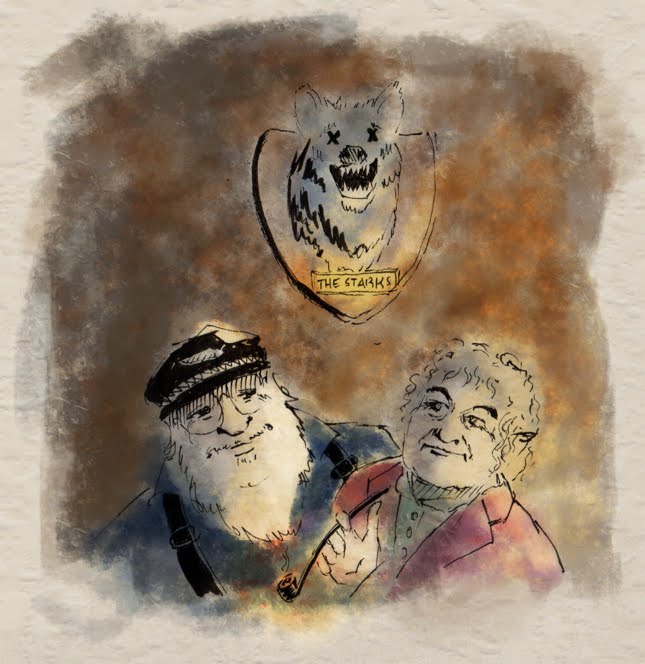
Not All Who Wander Are Lost: George RR Martin and Tolkien as Fellow Travelers

My first introduction to A Song of Ice and Fire was as a deconstruction of fantasy. George RR Martin's epic (now a "daring" and "brave" television series which you can see on HBO if you turn the brightness and contrast on your TV way, way, WAY up!!!) is, I was told, dark fantasy, with lots of shades of grey and violence and sex and so on.

It is, the subtext and sometimes the explicit text ran, not like Lord of the Rings. Or at least not like the traditions of Tolkienesque fantasy. This review of a recent episode of the (brave! genius! award winning!) tv show for example takes umbrage at the fact that the ending of a battle "has replaced that deconstruction with a blatant lift from Tolkien’s book, with the Vale forces riding in to save the day like Gandalf riding in to save Helm’s Deep." The notion of Tolkien and Martin as in some sort of competition or stark (hah) contrast is in the zeitgeist, is what I'm saying.

Having recently read the books, though, and also recently revisited The Lord of the Rings, I can't help but see this as more a product of a very narrow reading of Tolkien, and of Martin.


Some of this reading is possibly derived less from the source texts themselves but from Peter Jackson's adaptation. Look, I'm not gonna pretend that I haven't been deeply frustrated with The Lord of the Rings films since I was like 12. A lot of the stuff that most resonated with me as a kid ended up weirdly flattened, sensationalized, cut apart, or altered beyond recognition. And in the process everything got a lot more simple. I'm personally never going to forgive The Two Towers for introducing some fucking nonsense Aragorn Falls Off A Cliff subplot only to make up for it by hacking huge holes in the plot of Faramir, one of my absolute favorite characters. And others have written about some of the ways that in Jackson's hands characters like Saruman lose their thematic reason-to-be, becoming one note villains rather than complex and tragic figures.

Martin has suffered some of the same problems from the "brave" adaptation of his books, an adaptation I can't claim to have seen much of but which on a basic stylistic level seems to be run by people who don't understand that "dark fantasy" doesn't literally mean that all the sets should be chronically underlit and the characters should all wear the most drab clothing possible. I mean given that in the original text the Others are described basically as evil elves and the show develops them into ice orcs, and given that no one is walking around in the show with dyed-green beards like they commonly do in the book, it's pretty clear that they're more interested their sense of a "grim and gritty" aesthetic than what the text is trying to actually say.

Unfair? Not really. The critically lauded masterminds behind the "adaptation" literally once stated: "Themes are for eighth-grade book reports.” 

My contempt, I'd say, is well earned.

As a result perhaps of these less than stellar adaptations that have overtaken the originals, and as a result no doubt of Tolkien's many far lesser imitators, and probably to some extent as just a result of overexposure and fan discourses sort of overwhelming the original texts, a pretty remarkable fact has become obscured:

Lord of the Rings and A Song of Ice and Fire are much more a part of the same thematic tradition than in opposition. Basically, on a lot of levels, Tolkien and Martin are interested in the same stuff, and talking about the same things, and traveling on the same paths. And in fact some of their same formal "stumbling blocks"--things that people find particularly infuriating--parallel each other and do similarly important work within their respective narratives.

And to explain just how this makes sense, I want to talk a little bit about a book called The Worm Ouroboros.

Wednesday, May 4, 2016

Just Peachy: Homestuck, Act 6, and Difficulty

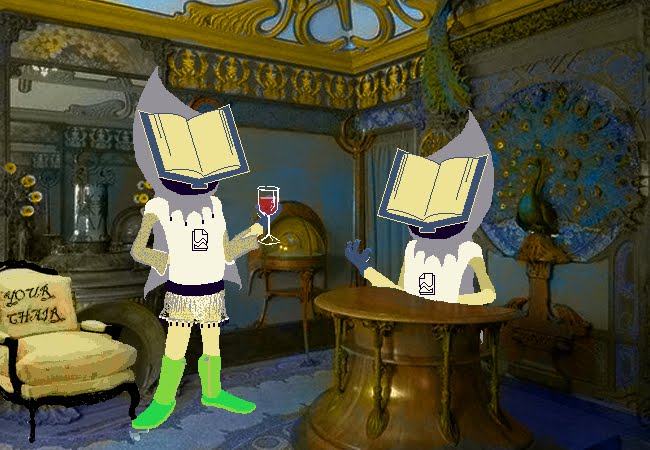
==> Storming the Ivory Tower Writer: Fondly Observe Libations


You, which is to say I, observe your, which is to say my, IMMACULATE DOMAIN, containing my IMMACULATE CHAIR and IMMACULATE SELF. You (read: I) have cleared away all those EXTRA SAM KEEPERS which were clogging up the joint, repaired the roof that's been busted for SEVERAL YEARS, and finally gotten some NICE WINE which you (still me) are currently fondly regarding.

You (I) have achieved the absolute apex of God Tier powers, which includes among other things fixing roofs, ushering extraneous versions of people gently but firmly out of the narrative so they don't clutter up things for the real, true versions, and to make absolute pronouncements with assured certainty, which everyone will accept automatically you're sure (which is to say I am sure).

==> StIT Writer: Demonstrate Abilities.

Act 6 and Act 7 do a much better job of addressing and resolving character arcs than [s] Cascade does.

Boom. See that?

Staggering in its radical brilliance but fundamentally undeniable in its accuracy.

(Sam Keeper): What? You can't just say something like that and pat yourself on the back! There's loads of stuff you'd have to explain to make that make sense to people.

==> StIT Writer: Ignore Unwelcome Intrusion


(Sam Keeper): Are you listening to me? You're leaving out so much important information, like even ignoring the fact that you haven't explained why you're even MAKING that comparison, the comparison is only interesting if you talk about a bunch of other stuff that Act 6 is doing. I mean yeah the whole act is basically about experiencing difficulty and working through that difficulty rather than expecting flashy magical solutions, and that APPLIES to this comparison, but the comparison really isn't interesting unless you talk about all that stuff first!

(Sam Keeper): In fact, even people that seem to agree with me that the end of Homestuck was pretty great take as given the idea that [s] Cascade resolved a load of stuff, and they position [s] Act 7 in opposition to this.

(Sam Keeper): Look, just, fill people in a bit! Act 6 is difficult but that difficulty is really interesting and worth talking about, so let's talk about it!

==> StIT Writer: Indulge This Walking Narrative Cul-De-Sac


Wednesday, April 27, 2016

Homestuck, Destiny, and why Social Constructs are Bullshit

==> StIT Reader: Survey The Mayhem


You enter the pub to find that things are EVEN WORSE THAN USUAL. Most notably, there seem to be MANY SAM KEEPERS. This is a terrible development, you think to yourself. And you are correct. One Sam Keeper was already just about all that you could handle. This is ENTIRELY TOO MANY SAM KEEPERS.

The most agitated looking of the Sam Keepers is PONTIFICATING ABOUT SOME BULLSHIT.

==> StIT Reader: Listen to pontification

Sam Keeper: Oh god, who could have possibly predicted that my extremely nebulously defined and possibly totally bullshit powers as the mythic Page of Paper could have caused so many problems? All the jumping I've done recently between various places has just created all these weird, kind of creepy alternate versions of myself, and now the whole blog is stuck under some mountain... I'll never finish my epic quest at this point and grow up to be a Well Adjusted Adult! And I have this whole article to write about how totally perfect and unassailable every aspect of Troll culture is! What the heck am I going to do???

==> StIT Reader: Offer to listen to Keeper's excellent theories about quadrant shipping

Hell no. Keeper made her bed and she can sleep in it. Or more specifically she stole your chair and she can sit in it. Yeah, that metaphor scans, kinda. Anyway it's probably just Keeper's intractable destiny to fuck everything up forever.

Hold on, though, it looks like one of the other Keepers has something to say.

==> Sam Coper: Sort this mess out


Sam Coper: You know Alternian culture is bullshit though right?

Sam Keeper: What the heck? Who are you?

Sam Coper: I'm you, but way, way calmer. Way calmer. Jesus buddy. I'm the you that actually learned to cope with things instead of doing an acrobatic fucking pirouette off the handle every time something goes wrong. And also I figured out that I can make this God Tier outfit have a cool skirt and shit, look at it!

Anyway, for real though, Alternian culture is bullshit, and so is your destiny, and that's... actually kind of a huge theme within the comic.

Sam Keeper: Ok, look, you're gonna have to break this one down for me a bit more.

Sam Coper: With pleasure.

See, Homestuck, among many other things, reveals that lots of stuff we think is natural or an inescapable fact of reality is actually a social and historical construct! And in fact, Homestuck shows that our identities might be a lot more free and fluid than we think.

==> StIT Reader: Try to understand.


Tuesday, June 23, 2015

Building and Breaking, In Comics as in BDSM

The seducer of the innocent. Corrupter. A medium driven by affect--the raw, visceral, embodied experience of emotion. A trap to lead the unwary into perversion.

Comics.

It is to this gutter medium, this medium of ill repute, that I dedicated the last eight months of my life, transforming myself into the willing servant of an often capricious master. My thesis was, in large part, about the emotional content of comics--the very content that encouraged cultural critics ranging from Frederic Wertham, infamous comic censor, to Clement Greenberg and his followers, masters of disinterested analysis and the pure aesthetic critique of art, to malign the medium. I analyzed a structure that I dubbed the building and breaking template, a template consisting of a rising narrative arc depicted with a rigid grid of panels that concludes with some break from that grid at the moment of narrative climax.

I did NOT, however, analyze Stjepan Šejić's comic Sunstone. I namedropped it briefly in my conclusion, but I did not analyze it, simply because devoting a whole chapter of my thesis to a comic about two women discovering their love of domination and submission, sadism and masochism, and that other letter pair that I always forget, seemed like a pretty risky prospect. Unfortunately I'm not entirely sure that the time is right for the affective and semiotic analysis of porn comics, at least not in academia.

But this isn't academia. This is Storming the Ivory Tower, where I can do whatever the hell I want up to and including stealing your chair, and this week I want to take a look at Sunstone through the lens of some of my research and explore some of the ways that comics--all comics--get us hot and bothered.

Monday, August 11, 2014

Tony Stark in the Integrated Circuit: The Iron Man films and Cyborg Feminism

In Iron Man 2, Tony Stark describes his suit, the Iron Man suit, as a prosthesis. Now, granted, he's describing it that way in order to flummox a congressional committee who assert that his suit is, in fact, a weapon. The scene as a whole is full of uncomfortable, almost Randian grand standingone. It's a problematic scene, to be sure.

The wild thing about Tony's claim, though, is that the films are almost calculated to back him up and support his claim. Iron Man--or, later, the Iron Men--is/are an extension of Tony's being. They are a prosthetic not in the sense that they restore him to some idealized "normal" human functionality but in the sense that they are a tool that acts as an extension of the human body in order to facilitate a human's aims.

It should be obvious that Tony Stark is a cyborg, though not a conventional one. His most obvious cybernetic feature is the power core embedded in his chest, but his suit, in the way it extends both his body and will, is also a part of his cybernetic being. The films consistently portray the Suit as a second self for Tony, an eventually unlimited tangle of extra limbs that transform his body into a fluidly-bounded and ambiguous mass.

Why am I bringing all this obvious stuff up?

Well, because these concepts aren't just of interest to transhumanists and science fiction fans, they're also of interest to a particular strand of contemporary critical theory--Cyborg Feminism. And the films don't just have a veneer of cyberization, they also can serve as an access point to these ideas and the deconstructive power they level at the existing power structures of the world.

Let's talk about Tony Stark the Cyborg.

I'm on a Giacometti kick after last article.

Sunday, July 20, 2014

Cha-Change! Formal Experimentation in Adventure Time

I want to talk about Adventure Time, and the experimental direction that the show has taken, and the episode Food Chain in particular, but we're going to have to do some work before we can get to that discussion. That's ok, because it's a discussion well worth having!

When a show gets as experimental as Adventure Time has, playing with different styles, metatextual elements, surreal explorations of sexuality, and so on, that show deserves praise. And I think it deserves praise that goes a bit beyond the initial "well isn't that neat" praise of pop culture journalism and digs into the weird alien guts of the thing to see how it all fits together, why it's significant, and what it all means. Which, of course, takes work, particularly when you're discussing an episode as odd as Food Chain, an episode where lead characters Finn and Jake metamorphose progressively through the forms and lives of different organisms as they experience the titular food chain first hand on a small desert oasis. The episode explores this philosophical journey through a dynamic and cheerfully--even gleefully--off model animation style notably different from the show's usual techniques. And in the process it makes it possible for us to discuss some of the odder recent offerings in Theory.

But let's not get ahead of things here. First, let's talk about why Adventure Time has the freedom to play around with form and narrative so extensively. The show has, over the course of five-and-change seasons, grounded the weirdness in remarkably sincere emotional relationships between the characters. And this sincerity is a gift that keeps giving as far as experimentation is concerned.

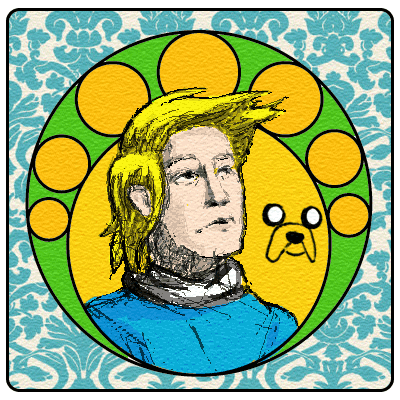
Pictured: Finn and Jake

Monday, July 14, 2014

Hyperflexible Mythology: Classpects, Fandom, and Fanfiction

Several months ago when I decided to move this entire establishment to the icy howling perpetual nightmare that is Jupiter's Great Red Spot some reacted with undue skepticism. But it looks like yet again I have gotten the last laugh, fools, for through a chain of events too complex to describe here but stemming inexorably from my decision to drop a once hospitable pub into the middle of a storm that ravages the flesh and mind alike with fingers of icy death, I have finally achieved my highest level of power yet!

Yes, indeed, I have reached... GOD TIER!

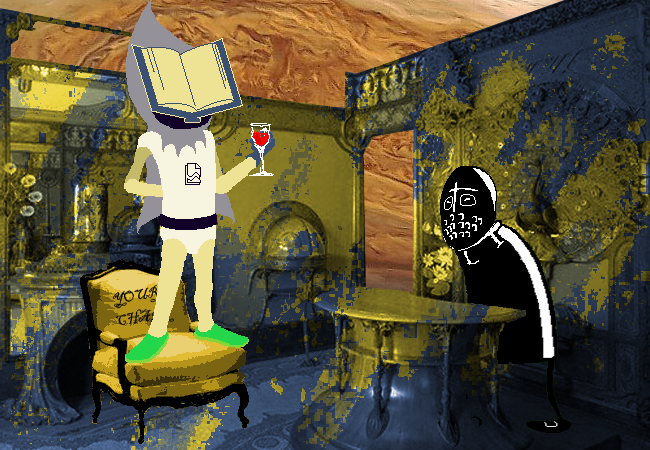
Pictured: My pantless apotheosis is complete.
AND THIS ISN'T EVEN MY FINAL FORM!

This change couldn't have come at a better time, as by sheer coincidence I wish to speak today about famed hypercomic Homestuck's symbolic and mythological structure which ties into the "God Tier" that certain characters reach throughout the narrative.

One of the many game-inspired parts of Homestuck is its use of what are called Mythological Roles for each character. That sounds very lofty, but what it really amounts to is one of the oldest elements in fantasy games: a magical area of expertise or "aspect," and a way in which that aspect is used as a tool by the character: a "class." Together, these mythological roles are described, somewhat awkwardly, as "Classpects," and they overshadow much of the fandom's activity.

I want to talk about them today not so much to analyze what individual classpects mean and do, or even their role in the wider narrative of Homestuck (plenty of other writers have already spilled much ink on these topics), but to explore what they mean for the fandom. See, the classpects are, in the words of author Andrew Hussie, a kind of hyperflexible mythology with a wide range of possible interpretations and implementations. These aren't necessarily traditional "elements" or rpg classes--classes include such odd things as "Sylph," "Muse," and "Heir," and aspects include "Breath," "Light," "Blood," "Hope," and "Void"--and the classpects are often ill-defined in their powers, or profoundly shaky in application, in part due to the fact that many of the characters do not, themselves, understand their own abilities. This leads, inevitably, to lots of fan speculation and conversation. It also represents one of the many systems within Homestuck that fans can latch onto as a structure to manipulate and deviate from in fan works.

Homestuck is not alone in having such a structure. The Classpects share many of their most useful qualities with such diverse systems as the Five Colors of Magic in Magic: The Gathering, the four Houses of Hogwarts, and the multi-person teamup nature of Pacific Rim's Jaegers. What these systems all share is a certain amount of arbitraryness and vagueness balanced by a named structure and a range of possible, tangible implementations of that structure. And they seem to share many of the same effects on fanfiction and fandom activities, making certain things possible that are not, perhaps, as easy to pull off with either more loosely or more rigidly defined structures.

Support on Patreon
Store
Reader's Guide
Tag Index
Homestuck Articles
Solarpunk Articles
Mastodon/Fediverse
Tumblr
Bluesky
RSS Feed