You sit at your usual booth, wondering where your book-headed friend is. Normally he’s here by now, and though you don’t so much converse as he rants, you can’t help but find him entertaining, even when you disagree. Sometimes you even learn.
You look around the bar to see if you can see him, and when you don’t, you turn back around to sit more comfortably... only to have your eyes meet the irritated, bespectacled gaze of a heavy-set man who hasn’t had a haircut in way too damn long. Your breathing hitches for a brief second. You remember this man. He just would not shut up about Cowboy Bebop.
“Oh, hello,” you say, trying your best to be friendly. “Can I buy you a bevera—“
“SHUT YER PIE HOLE I’VE GOT THINGS TO TALK ABOUT”
So, you’ve heard that they’re doing a movie of The Last of Us now, right? That’s great! I’m excited. It’s rumored Bruce “Jesus Christ” Campbell is attached, and I believe dude will dig down deep and bring some serious pathos to the character of Joel. And Naughty Dog made the damn game, and they’re involved, and they’re not going to let their baby fail.
Here’s the thing that’s bothering me: Unless they’re absolutely willing to murder every single one of their darlings, like the novelists say, their movie is going to go the way of Tomb Raider and Mortal Kombat Annihilation and Resident Evil: Thesaurus Word for “Bad” and Max Payne. Most of us are going to hate it because it took a game with a great plot and made a movie that’s mostly unwatchable.
And I know you’re wondering why I’m so sure of this. And I will tell you.
And in order to do this I will need to talk about the plot and the ending of The Last of Us, so SPOILER ALERTS ARE IN EFFECT. So get the hell out of this bar, right now, and play through The Last of Us and come back so we can talk about it.
**********
Welcome back! I am so glad you did that thing I just told you to do.
So wasn’t that game awesome!? Cinematic in all the best ways and emotional and great characters and holy hell, it’s going to be hard to make a good movie out of that.
I can see you mouthing the words wondering what I’m on about, but it kind of gets to why video game adaptations... and cross-media adaptations in general... have historically tended towards the awful. See, various media engages us in different ways, and how we engage with games is very, very different from how we engage with other art forms.
Think about how you relate the events of a movie or a comic or a novel. It’s third person. “So then Captain America kicks Batroc in the head!” “And Indiana gets on his feet and kicks that Nazi in the head!” “And then Shane gets into a bar fight and kicks a guy in the head!”*
*This actually happens in the novel. And I hope someone out there appreciates me bringing up Shane, of all things.
Now consider how you relate what happened in a game you played. “So I’m surrounded by zombies but I manage to spam the dodge maneuver until I get to the door, just inside the time limit!” “So then I score a crit that one-shots the mind flayer the round before he TPKs the party!” “That’s when I land on Dave’s Boardwalk with a full hotel built, and so I knocked the board over and went to bed!”
See, none of the hypothetical tellers of those tales is referring to their characters in game, even though individually they’re playing the roles of Jill Valentine, Llewellyn Ironblade the Elf Fighter, and a boot. And this is where most video game adaptations stumble: huge chunks, if not the entirety, of the art and story and designs are created that way to serve the gameplay. And that gameplay is the thing: you providing action and making decisions gives you the illusion of control, and more than that, involvement. It’s a much, much different storytelling mechanism than the mechanisms of other media.
You can get as wrapped up in a book or a comic or movie as you can a video game, but it’s a much different process to get there.
This is a big portion of why Silent Hill, the movie, was so much less scary than Silent Hill, the game. Despite using a number of the scariest monsters in the whole series and inventing monsters even more screwed up than that (re: Colin the Janitor), those couldn’t actually get as terrifying as running from low-polygon-count dogs across a chain-link floor with poor texture work. Rose Da Silva is probably a better fleshed-out character than Harry Mason, but we care more about what’s happening to him because on some level it’s happening to us. The low-polygon-count dogs are chasing us. Interactivity can bridge gaps when storytelling fails to cross them.
(I should point out that this is all by way of example. The Silent Hill flick had problems way above and beyond not being able to control the characters.)
And here’s the thing about The Last of Us: that game uses that sense of immersion granted by interactivity as well as anyone else ever has. Maybe better. Unlike the Half-Life series, it does have cutscenes, but Last of Us does give you control in some surprising areas that other games wouldn’t (controlling Sarah at the beginning of the game, where the fact you can look even as you’re stuck in the back of Joel’s car adds verisimilitude). It includes emotional high points nestled regular game play (the bit near the end where you slide from gameplay to cut scene to gameplay and watch the giraffes for as long as you want). And at the end of it, it will force you to do things you don’t necessarily want to do.
Think about that sequence at the end when you (there’s that dreaded second-person again) rescue Ellie. The only way to do so is to kill the doctors about to operate on her. Whether you want to is irrelevant, because that’s what Joel, the character wants. But this isn’t a cut scene. This is something you control.
This is you being forced into taking the actions that your character would take, morally repugnant as you may or may not find them (and it’s enough of a grey area, given the plot of the game, that finding them repugnant is completely possible).
So where does that leave us? The Last of Us is so moving and affecting and genuinely upsetting because its plot is built to take advantage of things that only video games really do, much in the same way Silent Hill was, or how Watchmen and The Sandman are built around comics and House of Leaves is built around prose and Avatar: The Last Airbender was built around TV.
Each of these properties were either hampered in their film adaptations or have yet to have film adaptations at all by the fact that the plots of these properties are very, very tied in to the mechanics of their media, and those that had adaptations, hilariously, failed to adapt. I quite liked that Watchmen flick, but even I have to admit that it was pretty underwhelming considering that it was based on one of the great comics of all time. Part of it was that the innovations the comic made had already been subsumed by art and culture by the time the movie was made, so the content was no longer as challenging. But I’d say the bigger part was that it was such a slavish recreation that it lifted things that took advantage of the comics medium whole-cloth into the film, ignoring the use of the mechanics of medium that made them effective to begin with. Chapter breaks, juxtapositions, pacing... these are mechanics that work a certain way particularly well in the comics medium and that the Watchmen comic took advantage of. Film has its own mechanics, but the Watchmen movie assumed that they would port over because they’re both visual. This led to a flick with weird pacing problems and sequences that fell flat even though they still dazzle in the comic to this day. (Keeper's Note: way back in the prehistory of this blog I argued that changing the mechanics of the ending of Watchmen was one of the best decisions the film makers made.)
So what can the creators of the film version of The Last of Us do to avoid an adaptation that seems to use all of the parts of the game but feels hollow or terribly flawed as a cinematic story?
... good question. That may not be answerable until it’s answered, if that makes any sense. The plot is long and circuitous and relies heavily on gameplay sections to get the characters from point A to point B, and the game’s story covers nearly a year divided into four nearly stand-alone chapters, something that kind of works against the usual flow of movies. It’s a small-scale story that takes place on a huge vista, and that’s the sort of thing movie producers loathe throwing money at (why throw so much money for location shoots and special effects if it’s not for spectacle?). It’s a story that absolutely does not let itself to traditional ways of cinematic storytelling.
The only way, then, that they’re going to live up to the promise of the video game is break new artistic ground with the movie, much as the game did for interactive storytelling.
I hope they can.
With that, the large man takes off his glasses, and wearily informs you that his name is Zomburai!, or Jon Grasseschi in IRL. He’s the author of the webcomic EverydayAbnormal (analyzed previously on this very blog!) and the nascent Dungeons & Dragons blog Mythic Histories. He says he likes long walks on the beach, sensitive women, and world domination. He has a Patreon, a Twitter, and a Facebooks.

Oddball media crit--laying siege to academia's ivory tower from pop culture's gutter
Showing posts with label Guest Posts. Show all posts
Showing posts with label Guest Posts. Show all posts
Monday, September 1, 2014
Friday, February 22, 2013
So Long Space Cowboy: The Doomed Past in Cowboy Bebop
You enter the pub, as has become habit, and are greeted with the usual scent of fresh beer and old sorrows. It's comforting in its own way. You head towards the back of the bar, fully realizing that your chair will be taken by the redheaded man, but honestly, that's comforting, too. The chair on the opposite side of the table has become almost as comfortable as the old one, though you sometimes wish Keeper wouldn't steal it quite so often. As you reach the tables in the back, you smile warily as you see Keeper--but what's this?
Someone else is in your new chair.
The rotund, bespectacled man motions you over. "Oh, hey! This must be who you were telling me about! Pull up a chair. Yeah, you'll be in the aisle, but that's okay. I was just about to start talking about some things..."
 |
| And the work which has become a genre unto itself shall be called: Storming the Ivory Tower |
But it's actually his work as an editor that's germane to this discussion.
For a long while, he had the guidelines that he had on his now archived website posted that he used as an editor at DC Comics (though I can't find the document now, the whole website is worth a good, long read). And in there he breaks down storytelling in a way I've never forgotten and never quite heard anyplace else:
"The story is two things: what the story is about, and what the story is really about."
The fancy term for this is, of course, the story's theme, but that's not quite all "what it's really about" actually encompasses. It can encompass allegory, motif, symbolism, commentary... basically, all the things that the story is talking about without it taking place in the plot1.
Theme and its subtextual friends may actually be the most versatile tools in the storyteller's box. It can work with the brute force of a sledgehammer (The Matrix, even the phenomenal first film, likes to smack you around the head with its religious parallels) or it can be as subtle as a straight razor (Black Swan can be interpreted as the struggle to create art thanks mostly to the very last line of the film).
So, with all that in mind, we're going to dissect what one story is really about: Cowboy Bebop2.
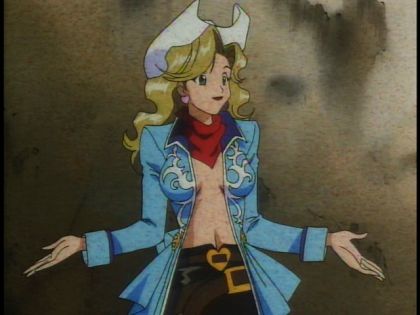 |
| Personally, I think this is what the show's really about. |
Obviously, there's a lot of thematic stuff going on here, and most of the obvious ones are well known. Look at any description of the series and they'll mention the style-over-substance aesthetic, the homages to 70s and 80s film, the haunted pasts of the main cast, and (according to Wikipedia) its examination of existential ennui3. The series is all of those things. But it's also about the end of a way of life.
Look, for example, at the jazz, bebop, and early rock-and-roll influences that defines so much of the show's world.
 |
| It's like that. |
Well, not necessarily. Punk-rock visuals would have happily gone with the "lawlessness" vibe that permeates so much of the work, but punk is A) a much more recent sub-culture and musical genre that 2) sublimated much, much differently into the larger culture than jazz did. The bands following in the Clash and the Sex Pistols' footsteps incorporated various bits into their music and their acts, so while the movement itself is not really a going concern, the various parts that make it are familiar.
Jazz, however, lives on as an artistic genre, but less of a commercial one. The music and style have evolved beyond easy recognition, and the term "Bebop," sitting happily in the logotype, calls to mind images like this:
.jpg) |
| Charlie Parker, bebop artist, playing at a local Callisto tavern |
Refrain
Those kinds of associations with lost ages are all over Cowboy Bebop. They are the foundation on top of which the whole story is built. But it's a very specific sort of lost age that the series goes out of its way to associate itself with. Spike Spiegel's mastery of Jeet Kun Do associates him with Bruce Lee, who died young.
The episode "Heavy Metal Queen" (a tribute itself to Convoy) makes heavy use of a system similar to CB radio, even using actual trucker CB terms on an interplanetary shuttle. The CB system is tied to a good deal of nostalgia since its golden age was brought low by overuse and the advent of cheap and wide-ranging cell phone technology.
The final episode features (amongst all of its other symbols of endings and passings) an altered ending title card. "You're Gonna Carry That Weight," a reference to one of the last songs on the last album the Beatles recorded.
Each of these are eras with distinct ends, or what the popular imagination thinks are distinct ends. The Beatles break up, CB radio falls out of favor, the arrival of rock ends the jazz era, an actor's death immortalizes him, the mob's time of honor and family is destroyed by compromise and infighting.
Crescendo
Most telling of all, though, is the Western theme.
The show's bounty hunters are called "cowboys," an epithet that calls to mind the Old West. That time period's probably been warped in the popular imagination more than any of the lesser time periods listed; when audiences in '98 or viewers in '12 think of the Wild West, we think of heroes and outlaws. We think of bounty hunters and criminals and sheriffs fighting battles for morality and survival against the backdrop of the lawless frontier. And we think of progress, symbolized by the railroad bringing those days to an end.
In our heads, in the mythos of the cowboy, there's an implied but usually unspoken tragedy that the battles fought by these larger-than-life figures are, ultimately, pointless, because history is going to wipe the slate clean, and everything they fought for will be for nothing.
We can infer that the same thing is happening in the background of Cowboy Bebop. I believe we can legitimately interpret that the action of that series is taking place in the waning days of the bounty hunter. The way of life of the in-universe cowboys is about to end and the solar system is about to experience stability5.
Consider Andy.
 |
| Keeper has Lord Humongous, but I have ANDY!! |
... to a freaking samurai.
Even changing his whole persona, and he can't escape the implication that he's doomed by history.
Breakdown
So, at this point, you're almost certainly telling me that my conclusions are obvious and I'm the last one to realize them. That, or you're telling me to wrap this up.
Keeper never told me you were this rude.
So, we know that "The Real Folk Blues" establishes and points out all sorts of juicy symbolism and foreshadowing about endings and deaths, and it's certainly tempting to just assume that all of that deals with individual characters, particularly Spike. But it also shatters the Bebop crew, destroys the Red Dragons, and cancels Big Shot.
|
| Never have I been so sad to be so wrong. |
If those endings were just about characters and lives, it would still be one of the best animated series of all time.
But all of those are taking place in a context. Almost all of the context we've been given establishes this way of life, this circumstance, as one ultimately transitory and doomed by history. That's what the theme does. It provides us context. It's the filter in which we view everything else in the story. And it's one that ultimately renders the struggles of their Bebop crew and their foes important personally but meaningless in any sort of grander form.
The hosts of Big Shot might be the last people you'd expect to metaphorically tell us what's going on in wider CB universe, given that they're mostly played for laughs and are generally content to tell us what's going on explicitly. But, other than ANDY!! they're the most "cowboy" thing in the whole of the anime.
And then Big Shot gets cancelled.
We next see Punch, looking like just another extra. He's going to be taking care of his mother. His co-host is getting married. He's settling down to an utterly mundane life. His cowboy days are long behind him.
It's hard to imagine that he's going to be the only one.
Jon Grasseschi is the author of urban-fantasy webcomic EverydayAbnormal. He doesn't usually write like such a pretentious boob, nor does he often natter quite so badly. He thinks it's your round, buddy.
1 When your story is not talking about things not present in the plot, you get the Transformers movies.
2 Sweet Jesus, will you scoot in? The poor waitress has customers and needs to get by, buddy.
3 Basically, it's a Wolverine comic. Zing!
4 And no, not the age where the Stones created good music, though that age is never coming back.
5 Ed's father, if you'll recall, has a pretty amazing speech about imposing order onto chaos late in the series...

Sunday, February 10, 2013
Gold Trans Am: Ride Through Ke$ha's Parody Career
A guest article by David Timebaum
You sit in your chair. It has been some time since the strange bearded man has come to take it, forcing you to sit in the other chair, and you intend to enjoy it. You crack open another drink, enjoying the comfort that has been so often taken from you. You briefly wonder where the strange, usurping man is, but you can’t keep up with everyone in the world. And it is such a busy world.
And so you sit, enjoying relaxation that you truly feel you deserve. But what’s that sound? A loud, thumping bass. You actually feel it in the floor before you hear it. Suddenly, the bar is alight with panic. The front door bursts open, and inside pours an unusual assortment of characters. In pour men in suits with rubber unicorn heads, teen ravers leaving trails of glitter and colored dust behind them, people in fursuits (some dressed in outlandish attire, others naked), and at the head of the crew is a... man. A man dressed in a skimpy, sparkling jacket covered by a blue, fuzzy vest. A man wearing a blonde wig that goes down past his shoulders. A man wearing a pair of high heels that look absolutely fabulous, though incredibly uncomfortable A man wearing... the shortest jean shorts you have ever seen.
He heads straight for you, party in tow. He grabs you, says something you don’t quite catch (“Wham, bam, thank you ma’am”?) and drags you outside, clearly saying, “Get inside my fuckin’ gold Trans Am.” It takes you a moment for you to raise your head and realize he’s serious. You get inside the car. He jumps in the driver’s seat and waits. You wonder what's happening, when suddenly the car starts slowly moving forward. Of course. It's a solid gold Trans Am. There's no engine. It's being pulled by the previously mentioned crew of furries and ravers, dragging it with gold chains attached to... solid gold bicycles.
The man turns to you (no sense paying attention to the road while being dragged) and asks “So, what is your opinion on Ke$ha?” Before you have a chance to respond, he begins what sounds like a lecture.
Oh god, he’s no better than the last one.
Let's start by talking about music videos. Name some of the common tropes of pop music videos now, particularly those of female musicians. Sexualization? Zany outfits? Rave/club scene? Furries? (Seriously, it’s more common than you think.) Religious references? Bright/psychedelic colors? Dark, color-filter scenes? Choreographed dancing?
Passenger, I present to you the ultimate modern pop music video:
So let's look at that video scene-by-scene, shall we? So how does it begin? Our protagonist, Ke$ha herself, is late to her job at Awful House, a diner operated by a man named Ri¢hard. This man's kind of a scumbag, as he slaps her ass as he passes her behind the counter. An older gentleman starts asking for coffee, despite the fact that his cup clearly has some in it.
She quits. Ri¢hard says she can't quit, being fired (has that ever actually happened in reality?), and she walks out. Then things get fun. She sits on a bench, lightning strikes and spits out the "Dream Maker," a neon green van driven by a man (presumably) in a cat suit. He pops a tape in, the trippy colors start, and the music part of the video begins. So, what were the things we said before?
Oh right. Sexualization, for starters. Well, we had that earlier with Di¢k slapping her ass, showing the negative sides of it. But now we also have it in a more, well, consenting light. Here it's her acting sexy, laying on the bed and playing with bubbles in the tub. Before, it was someone taking advantage of her. The lyrics also go along with the general theme of sexualization.
So she's dressed seductively, like a Hooters waitress, but has been keeping her actions clean. Now, however, she's actually consenting and actively wanting to take part in non-PG activities. Sounds like a good message to me.
What was the next one? Zany outfits? I think that one speaks for itself. Same with Furries, really.
Ah, next is the Rave/Club scene. I love how Ke$ha does this. See, she doesn't do it in the traditional way. Instead, she and her furry compatriots have an impromptu rave. Well, two, actually. One in a convenience store they're tearing up, and one in the Awful House.
The "rave" scene is also very different from the typical music video rave of recent Pop. This is a much more lighthearted affair. It's bright, colorful, simple, and small. And it takes place in a diner, primarily. Here we see the bright, psychedelic colors come back, too.
The last two things, Religious stuff and dark color filters only come up briefly, but they do certainly make an appearance. Behind the counter of the store they trash is a large crucifix, and there are a number of them hanging for sale.

The dark color filter, which is generally used to show edgier, more dangerous scenes appears immediately after a clawed hand slaps a big, red button labelled "Engage Dance Mode." She then uses the dramatic lighting to smash some bottles with a baseball bat.
So, my captive audience, what does all this mean? That Ke$ha is capable of copying what everyone else is doing? Does she have no creativity of her own? Is she simply a parrot, mimicking what she sees and hears, albeit in a squawkier accent?
No, I'd say. Instead, Ke$ha is doing all of this deliberately. She copies what others are doing not for lack of creativity, but to point out that everyone else is doing the same thing. Put simply, she's mocking Pop Music, herself included.
Let's take a look at another of her videos. Personally, I like this one a bit better, both for video and song. It also shows her self-mocking a bit better.
Let me give you a moment for that to sink in.
Ok, moment over. What the hell was that? Genius, that's what. Let's take this step-by-step.
The video starts, once again, without any music. It starts with a disclaimer, saying that no mythological creatures were harmed while making this video. I don't know about you, but my interest is immediately piqued.
So then it cuts to our protagonist, Ke$ha, talking to two very well-dressed unicorns at what appears to be a classy party. She's telling the story of how she was elected to Parliament of Uzbekistan.
Of course.
So, she laughs, a bit psychotically, and the music starts. A waiter comes up and offers her a very small piece of cheese, apparently sent from the only other human at the party, played by James Van Der Beek.
The video then alternates between Ke$ha singing the song and her walking towards the mysterious other human. During this walk over, she takes time to make out with a few of the unicorns along the way. The mysterious man also takes the time to pretty himself up for the oncoming encounter (I have to say that my favorite part of that bit is when he rips the sleeves off of his jacket, making it a vest, and then rips off the vest). Ke$ha, likewise, prepares by ripping out her bra (an act immediately copied by the mysterious man, causing a confused look from out female lead).
Finally, the two meet, and the song takes a backseat to the dialogue. They both make fun of the other's name ("James Van Der Douche" and "Ke Dollar-Sign Ha"), before Ke$ha sarcastically thanks him for the cheese, muenster, which he describes as "like edible, lactose gold." They then begin to "dance," which, naturally, involves them having a laser battle. Many of the unicorns are hit in the process, and they begin bleeding rainbows everywhere. James gets hit in the shoulder, then gets capped by Ke$ha, who mounts his head on the wall on a plaque which states "James Van Der Dead." She and the unicorns laugh, and the video ends.
So what have we learned from this video? Well, simply put, Ke$ha doesn't really care about being serious. In fact, I'd say she actively goes out of her way to make fun of stuff and be absurd and silly.
I believe that finally brings me to what all this has been leading up to: Ke$ha is a parody artist. She parodies not like Weird Al does, by parodying specific songs, but instead makes fun of the whole genre of Pop Music. And she does so in a way that nobody notices without actually analyzing it. To the average person, Ke$ha is a party-girl Pop music singer-songwriter. However, to someone who takes the time to analyze her work, or someone strapped in and unable to escape a lecture, she is a brilliant parody artist. Her work takes on an additional, sarcastic and critical tone. She mocks the genre, but she still enjoys it and has fun with it.
Let's look at another video while that sinks in. This one's for the song "Take It Off."
Let's look at this video along side its lyrics, shall we?
This video starts in the evening. The sun is clearly out, and shining bright. There isn't even a cloud in the sky.
I don't know how I'd describe the rag-tag assortment of people shown, but none of them are what I'd think of as looking like a pimp. Gold Trans Am? Only car I'm seeing is clearly ancient. It's rusting, and it's missing several windows and tires. Also, she clearly doesn't have any sort of bag, let alone one containing a water bottle full of whisky. She's also phoneless, and seemingly rather sober.
I'm curious to see what the uptown looks like if this is the downtown. This seems to be a motel in the middle of a desert in the middle of nowhere. If I didn't know any better (and given that this is a Ke$ha video, I guess I don't), I'd expect a tire to roll in and start blowing people's heads up. I guess the people could be considered freaks, especially when you keep watching the video. I can kind of see how it's a "dirty free-for-all," and I suppose the motel could be described as a "hole in the wall." I can definitely say, though, that nobody at this point is taking anything off. In fact, they're doing a remarkable job keeping everything on, seeing how loose all of it is. If you're looking for a show, I'd probably keep away from this place, as it seems rather dull and uneventful, really. The only "hardcore" probably only goes on behind the doors, and while I'm sure the floors aren't clean, I highly doubt there's much glitter anywhere. And, again, everyone's keeping their clothes on.
Everyone seems to be holding on to at least most of their sanity, as well as their clothes. Delirious, I think-

I guess "tear it down" could refer to the fence, but they seem to be more than happy to just climb over it. But, again, the sun hasn't even gone down yet, let alone come "back around."
They're getting a little smashed, mostly by kind of moshing with each other. Knocking over trash cans... That guy just threw a single trash can for no reason.

Looks like nobody's breaking bottles at all, and while the place is rather filthy, I doubt I'd call it a "hot mess" at this point. Wanna get faded? Provided those are the actual lyrics (again, I'm not sure for that line), I guess you could turn to... dust... or whatever, like that guy kind of did. Also, designated driver? Ke$ha, from what I can tell, you all either live there, walked there, or rode there in cabs.
Ok then! Still arguing about the "downtown" bit, but yeah, freaks coming around, I can see that. I can see where that glitter you mentioned before might have come from, too... Hole in the wall and dirty free-for-all? Yeah, I can see that now. My god, why didn't I listen to you before? Definitely see some stripping, too. And... exploding. Quite the show, I'd say, yeah. Hardcore? Yes. Glitter on the floor? Yeah. I'm sorry I doubted you earlier.
Ke$ha strips her coat, which she never had before this scene. She also... opens her chest... revealing the glitter inside.

I'm pretty sure we all suspected she was full of glitter for years anyway. So at this point, everyone's rolling around, running around, spinning, and exploding into glitter and colored dust. It's even night now.
Ke$ha, I'm sorry I doubted you. You were right the whole time.
So, what did we learn? Don't give me that face! Come'on, what was the lesson of this music video? No, not that Ke$ha is made of glitter. We already knew that. Come'on!
This video shows her self-mocking tendencies. Up until the end, she's pretty much saying the opposite of what the video's actually showing. And, seriously, the trash can thing. You have to admit that was hilarious, and it was obviously intentional. She deliberately made this video to contradict most of what the song says. Based on the lyrics, I'd say the song's about a big rave/nightclub in NYC or something, somewhat trashy but a lot of fun. The video's about a motel in the middle of nowhere with a dried-up pool that people made of colored dust go to explode in. And yet, in many cases, the lyrics sync up with the song. It's clear that this wasn't like some music videos where the song and video are completely unrelated. This was all intentional.
And there we have it. All that Ke$ha does is deliberately self-mocking, or deliberately mocking the genre, or deliberately mocking the party-boy/girl culture. It's all intentional, and it's all rather brilliant.
Alright, so, before you go (Sit down. I know you're eager to get back to your precious chair, but we've only gone, like, a block and a half), I want you to listen to one last song. Sadly, this one doesn't have a music video. Not yet, anyway. Hopefully it will soon, but whatever. I feel like this song on its own perfectly shows Ke$ha's parody nature.
I don't know how anyone could take this song seriously. Ever.
Alright, there you are. You're free to go. Get back to your chair. Good night, and party on.
And while you party on, be sure to check out Timebaum's own strange little blog, where he writes all kinds of odd things. And check me out on Google+ at gplus.to/SamKeeper or on Twitter @SamFateKeeper. As always, you can e-mail me at KeeperofManyNames@gmail.com. If you liked this piece please share it on Facebook, Google+, Twitter, Reddit, Equestria Daily, Xanga, MySpace, or whathaveyou, and leave some thoughts in the comments below. Sorry this wasn't an article on 101 Dalmations.
You sit in your chair. It has been some time since the strange bearded man has come to take it, forcing you to sit in the other chair, and you intend to enjoy it. You crack open another drink, enjoying the comfort that has been so often taken from you. You briefly wonder where the strange, usurping man is, but you can’t keep up with everyone in the world. And it is such a busy world.
And so you sit, enjoying relaxation that you truly feel you deserve. But what’s that sound? A loud, thumping bass. You actually feel it in the floor before you hear it. Suddenly, the bar is alight with panic. The front door bursts open, and inside pours an unusual assortment of characters. In pour men in suits with rubber unicorn heads, teen ravers leaving trails of glitter and colored dust behind them, people in fursuits (some dressed in outlandish attire, others naked), and at the head of the crew is a... man. A man dressed in a skimpy, sparkling jacket covered by a blue, fuzzy vest. A man wearing a blonde wig that goes down past his shoulders. A man wearing a pair of high heels that look absolutely fabulous, though incredibly uncomfortable A man wearing... the shortest jean shorts you have ever seen.
 |
| The leader is the party, the party is the leader's mind. Timebaum had no clue I was doing this drawing, incidentally... --Keeper |
He heads straight for you, party in tow. He grabs you, says something you don’t quite catch (“Wham, bam, thank you ma’am”?) and drags you outside, clearly saying, “Get inside my fuckin’ gold Trans Am.” It takes you a moment for you to raise your head and realize he’s serious. You get inside the car. He jumps in the driver’s seat and waits. You wonder what's happening, when suddenly the car starts slowly moving forward. Of course. It's a solid gold Trans Am. There's no engine. It's being pulled by the previously mentioned crew of furries and ravers, dragging it with gold chains attached to... solid gold bicycles.
The man turns to you (no sense paying attention to the road while being dragged) and asks “So, what is your opinion on Ke$ha?” Before you have a chance to respond, he begins what sounds like a lecture.
Oh god, he’s no better than the last one.
Let's start by talking about music videos. Name some of the common tropes of pop music videos now, particularly those of female musicians. Sexualization? Zany outfits? Rave/club scene? Furries? (Seriously, it’s more common than you think.) Religious references? Bright/psychedelic colors? Dark, color-filter scenes? Choreographed dancing?
Passenger, I present to you the ultimate modern pop music video:
The dashboard of this gold car also plays music videos.
So let's look at that video scene-by-scene, shall we? So how does it begin? Our protagonist, Ke$ha herself, is late to her job at Awful House, a diner operated by a man named Ri¢hard. This man's kind of a scumbag, as he slaps her ass as he passes her behind the counter. An older gentleman starts asking for coffee, despite the fact that his cup clearly has some in it.
 |
| If it's an empty cup, it won't splash. |
Oh right. Sexualization, for starters. Well, we had that earlier with Di¢k slapping her ass, showing the negative sides of it. But now we also have it in a more, well, consenting light. Here it's her acting sexy, laying on the bed and playing with bubbles in the tub. Before, it was someone taking advantage of her. The lyrics also go along with the general theme of sexualization.
Hot 'cause the party don't stop,
I'm in a crop top like I'm working at Hooters.
We been keepin' it PG
But I wanna get a little frisky.
So she's dressed seductively, like a Hooters waitress, but has been keeping her actions clean. Now, however, she's actually consenting and actively wanting to take part in non-PG activities. Sounds like a good message to me.
What was the next one? Zany outfits? I think that one speaks for itself. Same with Furries, really.
Ah, next is the Rave/Club scene. I love how Ke$ha does this. See, she doesn't do it in the traditional way. Instead, she and her furry compatriots have an impromptu rave. Well, two, actually. One in a convenience store they're tearing up, and one in the Awful House.
 |
In case you missed it, the pinata is our good friend Dick.
|
The last two things, Religious stuff and dark color filters only come up briefly, but they do certainly make an appearance. Behind the counter of the store they trash is a large crucifix, and there are a number of them hanging for sale.
She also turns the clerk into a cat, which is clearly a reference to when Jesus turned into a cat.
That happened, right?
The dark color filter, which is generally used to show edgier, more dangerous scenes appears immediately after a clawed hand slaps a big, red button labelled "Engage Dance Mode." She then uses the dramatic lighting to smash some bottles with a baseball bat.
So, my captive audience, what does all this mean? That Ke$ha is capable of copying what everyone else is doing? Does she have no creativity of her own? Is she simply a parrot, mimicking what she sees and hears, albeit in a squawkier accent?
No, I'd say. Instead, Ke$ha is doing all of this deliberately. She copies what others are doing not for lack of creativity, but to point out that everyone else is doing the same thing. Put simply, she's mocking Pop Music, herself included.
Let's take a look at another of her videos. Personally, I like this one a bit better, both for video and song. It also shows her self-mocking a bit better.
Let me give you a moment for that to sink in.
Ok, moment over. What the hell was that? Genius, that's what. Let's take this step-by-step.
The video starts, once again, without any music. It starts with a disclaimer, saying that no mythological creatures were harmed while making this video. I don't know about you, but my interest is immediately piqued.
So then it cuts to our protagonist, Ke$ha, talking to two very well-dressed unicorns at what appears to be a classy party. She's telling the story of how she was elected to Parliament of Uzbekistan.
Of course.
So, she laughs, a bit psychotically, and the music starts. A waiter comes up and offers her a very small piece of cheese, apparently sent from the only other human at the party, played by James Van Der Beek.
The video then alternates between Ke$ha singing the song and her walking towards the mysterious other human. During this walk over, she takes time to make out with a few of the unicorns along the way. The mysterious man also takes the time to pretty himself up for the oncoming encounter (I have to say that my favorite part of that bit is when he rips the sleeves off of his jacket, making it a vest, and then rips off the vest). Ke$ha, likewise, prepares by ripping out her bra (an act immediately copied by the mysterious man, causing a confused look from out female lead).
Finally, the two meet, and the song takes a backseat to the dialogue. They both make fun of the other's name ("James Van Der Douche" and "Ke Dollar-Sign Ha"), before Ke$ha sarcastically thanks him for the cheese, muenster, which he describes as "like edible, lactose gold." They then begin to "dance," which, naturally, involves them having a laser battle. Many of the unicorns are hit in the process, and they begin bleeding rainbows everywhere. James gets hit in the shoulder, then gets capped by Ke$ha, who mounts his head on the wall on a plaque which states "James Van Der Dead." She and the unicorns laugh, and the video ends.
So what have we learned from this video? Well, simply put, Ke$ha doesn't really care about being serious. In fact, I'd say she actively goes out of her way to make fun of stuff and be absurd and silly.
I believe that finally brings me to what all this has been leading up to: Ke$ha is a parody artist. She parodies not like Weird Al does, by parodying specific songs, but instead makes fun of the whole genre of Pop Music. And she does so in a way that nobody notices without actually analyzing it. To the average person, Ke$ha is a party-girl Pop music singer-songwriter. However, to someone who takes the time to analyze her work, or someone strapped in and unable to escape a lecture, she is a brilliant parody artist. Her work takes on an additional, sarcastic and critical tone. She mocks the genre, but she still enjoys it and has fun with it.
Let's look at another video while that sinks in. This one's for the song "Take It Off."
There's a place downtown in the middle of the desert.
Let's look at this video along side its lyrics, shall we?
"When the dark of the night comes around, that's the time that the animal comes alive, looking for something wild."
This video starts in the evening. The sun is clearly out, and shining bright. There isn't even a cloud in the sky.
"And now we lookin' like pimps in my gold Trans Am. Got a water bottle full of whisky in my handbag. Got my drunk text on. I'll regret it in the morning. But tonight, I don't give a - I don't give a - I don't give"
I don't know how I'd describe the rag-tag assortment of people shown, but none of them are what I'd think of as looking like a pimp. Gold Trans Am? Only car I'm seeing is clearly ancient. It's rusting, and it's missing several windows and tires. Also, she clearly doesn't have any sort of bag, let alone one containing a water bottle full of whisky. She's also phoneless, and seemingly rather sober.
"There's a place downtown where the freaks all come around. It's a hole in the wall, it's a dirty free-for-all. And they turn me on when they take it off. When they take it off. Everybody take it off. There's a place I know if you're looking for a show. Where they go hardcore and there's glitter on the floor. And they turn me on when they take it off. When they take it off. Everybody take it off."
I'm curious to see what the uptown looks like if this is the downtown. This seems to be a motel in the middle of a desert in the middle of nowhere. If I didn't know any better (and given that this is a Ke$ha video, I guess I don't), I'd expect a tire to roll in and start blowing people's heads up. I guess the people could be considered freaks, especially when you keep watching the video. I can kind of see how it's a "dirty free-for-all," and I suppose the motel could be described as a "hole in the wall." I can definitely say, though, that nobody at this point is taking anything off. In fact, they're doing a remarkable job keeping everything on, seeing how loose all of it is. If you're looking for a show, I'd probably keep away from this place, as it seems rather dull and uneventful, really. The only "hardcore" probably only goes on behind the doors, and while I'm sure the floors aren't clean, I highly doubt there's much glitter anywhere. And, again, everyone's keeping their clothes on.
"Lose your mind, lose it now. Lose your clothes in the crowd. We're delirious. Tear it down. 'Til the sun comes back around."
Ok, yeah, that... I'm willing to grant you "Delirious."
I guess "tear it down" could refer to the fence, but they seem to be more than happy to just climb over it. But, again, the sun hasn't even gone down yet, let alone come "back around."
"And now we gettin' so smashed. Knockin' over trash cans. Everybody breakin' bottles. It's a filthy, hot mess. Gonna get faded (I can't actually discern the lyrics for that line, but that's what the lyrics site I use says). I'm not the designated driver so I don't give a - I don't give a - I don't give"
They're getting a little smashed, mostly by kind of moshing with each other. Knocking over trash cans... That guy just threw a single trash can for no reason.
ANARCHY!
Looks like nobody's breaking bottles at all, and while the place is rather filthy, I doubt I'd call it a "hot mess" at this point. Wanna get faded? Provided those are the actual lyrics (again, I'm not sure for that line), I guess you could turn to... dust... or whatever, like that guy kind of did. Also, designated driver? Ke$ha, from what I can tell, you all either live there, walked there, or rode there in cabs.
"There's a place downtown where the freaks all come around. It's a hole in the wall, it's a dirty free-for-all. And they turn me on when they take it off. When they take it off. Everybody take it off. There's a place I know if you're looking for a show. Where they go hardcore and there's glitter on the floor. And they turn me on when they take it off. When they take it off. Everybody take it off."
"Everybody take it off! Everybody take it off! Right now. Take it off! Right now. Take it off! Right now. Take it off! Right now. Take it off! Everybody take it off!"
Ke$ha strips her coat, which she never had before this scene. She also... opens her chest... revealing the glitter inside.
Someone's gonna look through my computer, find "Ke$hasglitterhole.png" and get the wrong idea.
I'm pretty sure we all suspected she was full of glitter for years anyway. So at this point, everyone's rolling around, running around, spinning, and exploding into glitter and colored dust. It's even night now.
"There's a place downtown where the freaks all come around. It's a hole in the wall, it's a dirty free-for-all. And they turn me on when they take it off. When they take it off. Everybody take it off. There's a place I know if you're looking for a show. Where they go hardcore and there's glitter on the floor. And they turn me on when they take it off. When they take it off. Everybody take it off."
So, what did we learn? Don't give me that face! Come'on, what was the lesson of this music video? No, not that Ke$ha is made of glitter. We already knew that. Come'on!
This video shows her self-mocking tendencies. Up until the end, she's pretty much saying the opposite of what the video's actually showing. And, seriously, the trash can thing. You have to admit that was hilarious, and it was obviously intentional. She deliberately made this video to contradict most of what the song says. Based on the lyrics, I'd say the song's about a big rave/nightclub in NYC or something, somewhat trashy but a lot of fun. The video's about a motel in the middle of nowhere with a dried-up pool that people made of colored dust go to explode in. And yet, in many cases, the lyrics sync up with the song. It's clear that this wasn't like some music videos where the song and video are completely unrelated. This was all intentional.
And there we have it. All that Ke$ha does is deliberately self-mocking, or deliberately mocking the genre, or deliberately mocking the party-boy/girl culture. It's all intentional, and it's all rather brilliant.
Alright, so, before you go (Sit down. I know you're eager to get back to your precious chair, but we've only gone, like, a block and a half), I want you to listen to one last song. Sadly, this one doesn't have a music video. Not yet, anyway. Hopefully it will soon, but whatever. I feel like this song on its own perfectly shows Ke$ha's parody nature.
I don't know how anyone could take this song seriously. Ever.
Alright, there you are. You're free to go. Get back to your chair. Good night, and party on.
And while you party on, be sure to check out Timebaum's own strange little blog, where he writes all kinds of odd things. And check me out on Google+ at gplus.to/SamKeeper or on Twitter @SamFateKeeper. As always, you can e-mail me at KeeperofManyNames@gmail.com. If you liked this piece please share it on Facebook, Google+, Twitter, Reddit, Equestria Daily, Xanga, MySpace, or whathaveyou, and leave some thoughts in the comments below. Sorry this wasn't an article on 101 Dalmations.
Saturday, December 3, 2011
I Can Has Filtered Reality?
In this post I shall explore the shift over time from consumption of visual media as escapism to the active participation in digital visual media creating a mass “filtered” reality.
Anyone who has even taken a film class, read a book about film history, or expressed even the most remote interest in film has heard it said that motion pictures were uber-popular during the depression because they offered audiences an “escape from reality.” Considering the exponential growth of visual media over the decades since, its pretty safe to say that escaping from reality is still a valued pastime. But what exactly does it mean to escape from reality anyway? Any sci-fi nerd will tell you with a sigh of longing that as of now our science has yet to build any kind of bridge, gateway, wormhole, or thread that allows us to travel between parallel universes. So what exactly are we doing when we “escape” and what does it mean that we’ve decided to label the act in this way?
Before I continue I’m sure you’ve figured out by now that this ain’t Keeper, but I’ve chosen to mimic his style here because, well, it seems to work. To give you one, vague bit of information about me that hopefully will at least validate my opinions re: escapism to y’all, I’m a cinephile. (It’s okay, I’m in a support group. It’s called film school.) I grew up escaping from reality. In fact, I was raised on the same stuff that folks during the depression were watching.
There are numerous reasons that people at the turn of the century might want to step outside their lives for a moment and enter a world of swashbuckling heroes – not the least of which being bread lines (‘sup 99%!) – but to speak of indulging in cinema as escaping from reality implies dissatisfaction with reality. Even if you were reasonably okay with your life, suddenly an entire industry sprang up around the idea that you weren’t – and today Hollywood thrives on malcontent. Love the place to death, but, well, in LA if you get LivingSocial deals in your inbox they’re all, “Half off 40 units of Botox!” “Brazilian Wax for $15!”
 |
| City of. |
Back in the early 20th century, Hollywood beckoned the disaffected masses out of their homes to their local nickelodeon or movie house or picture palace, to sit in a dark room full of other thrill-seekers for anywhere from a 40 minute program to one that lasted several hours. They consisted of selected short pieces – cartoons, newsreels, musical presentations, and one, perhaps even two, feature films. You could stay for the entire program, or just the short you wanted to watch, but let’s be real here you just paid anywhere from a nickel to a dollar for this escape – you want to get your money’s worth. So you sit in the dark and gossip with the people sitting near you, sing-along with the musical short, and throw popcorn at the kids running through the aisles.
Was film the immersive turn-off-your-cellphones-put-on-your-3D-glasses-lean-back-to-see-the-IMAX-picture experience we know today? Hell-to-the-no. Might seem counterintuitive, but it didn’t need to be. The world of the movie theater was something completely separated from the outside. The dark space was safe for dreaming and socializing with people you might not otherwise meet. It resided outside of your reality.
So way-back-when we have going to the theater as a mini-vacation. And on that vacation you might catch something like this cinematic gem:
Yes, we’ve loved us some lolcats since 1903. Here’s one everyone’s probably familiar with:
Clearly its much easier to find teh kittehs today. Flip open your laptop. Thumb the YouTube application icon on your smart phone. Bam. I can has cuddlez.
Assuming for a second that its part of human nature to seek out adorableness that consumes mini-chunks of time – its pretty clear that changes in the technology that provide access to it have altered the nature of escapism. Though we may be viewing the same kittens, the experience today is no longer social, and requires little effort on our part. Not to mention the primary change – they’re everywhere – in videos, ads, memes, etc.
So what does this mean about the way we view our reality? Since I’m on a roll with the felines here, consider for a second the kitteh that Keeper used in his self-referential entry about how he writes his articles:

This meme [blank] cat is [blank] has many variations, as memes will, and as far as I can tell began with the infamous longcat.
 |
| 'Nuff said. |
(I may be wrong in this and feel free to correct me. My meme research is occasionally hindered by a pledge I made to never, ever visit 4chan directly.)
So beginning with an image of a frankly, big but not too extraordinary cat held up to display its length, we get a meme that consists of laying a statement of the obvious over an image of a cat.
 |
| You don’t fuck with dramatic cat. |
Reading too much into a cat meme? Probably. But its worth looking at as a function of the media schizophrenic world we live in. We’re bombarded by flashy imagery that markets everything to us from toothpaste to sex. Reality is just as difficult to pin down as methods to escape from it, so we resort to simple, familiar outlets such as internet memes to define and shape our version of reality. Want a more prosaic example? Log in to Facebook. (Don’t tell me you don’t have one – you might not want one, but you have one.) Made a status update lately? Tweeted anything?
 |
| Yep. |
Social networking and the proliferation of visual media that is easily accessible (particularly online), have resulted in an inability to completely escape from reality – its too prevalent, too much a part of the reality we want to escape from. Visual, and especially digital media, can however filter our experience of reality. It’s as if by putting our funny junk out there on the Internet, we’re sending it through a wormhole outside of reality, and then bringing it back in washed in the sweet detergent of Internet. It comes back better – less real – than when we sent it out. When we watch fuzzy cat videos, some cute chick’s video blog about caffeine (embedded below – you’re welcome), or even reality shows like Jersey Shore, Cake Boss, etc. we’re not escaping from reality, we’re grasping at a safer version of it.
Escapism is alive and well. Cineplexes still provide us with a form of it. We sit in the dark and dream together, without speaking to one another, focused entirely on the single story presented to us. But with the expansion of visual media outside the theater, we’re gained the ability to filter our reality through it, as if we are in a state of constant, incomplete “escape.” Whether or not it is detrimental to human existence to wander around with a haze of lolcat in front of our eyes is a matter of opinion. I mean damn, they are cute aren’t they?
Now caffeine. Caffeine we can all agree is evil.
Thanks to Leslie for this guest article. I love how dense and crazy it is. I suspect, based upon what little I know of its genesis, that even deeper secrets will emerge if you read it while inebriated. As always, feel free to leave comments, complaints, or, best of all, your own interpretations, or e-mail me at keeperofmanynames@gmail.com . And, if you like what you've read here, share it on Facebook, Google+, Twitter, Xanga, Netscape, or whatever else you crazy kids are using to surf the blogoblag these days.
Friday, September 16, 2011
I Need A Hero's Journey--Games and Joseph Campbell
Check out this article. For those of you that, like me, are a bit shaky when it comes to this type of tech article, allow me to translate briefly.
Essentially, what they're talking about here is the ability to create videogames that constantly generate totally unique landscapes each time you want to start a new adventure. In this type of game, you would always be exploring new locations, because the code itself would create new locations. Essentially, all "procedural generation" means is that instead of telling your code "Hey, a wall goes here" you tell the code, "Hey, here's a set of rules that tell you whether or not you want to put a wall here."
A set of rules and categories that can be used to generate multiple different experiences... hm... now where have I heard that before?

AAAAAAAIIIIIIIIiiiioh hello there, Mr Campbell.
This is Joseph Campbell, the very person whose ideas were on the tip of my tongue just now. Campbell wasn't the first person to codify or use the term "Archetype," but he's the thinker most relevant to our current discussion. What is an archetype, you ask?
Well, an archetype is really rather similar to the rules that go into procedural generation. It is essentially a set of rules that determines the underlying structure of a character or story. In Campbell's ideas, a whole selection of archetypes put together generate what he termed the Hero's Journey, or Monomyth. The core of this concept is that all the great myths and stories have the same underlying characteristics, even if individual elements are edited and changed--just as in the game landscapes described above, basic qualities like the presence of forests and deserts and mountains, and regions of cold in the North and heat in the South, are changed and rearranged in order to create unique maps.
So let's break this down a bit more into some of the component parts, and how they show up in more familiar works of fiction. These are, of course, the extremely condensed, cribbed versions of the archetypes, and are probably four or five generations removed from Campbell's actual scheme, but it should give you a general sense of how this all works.
THE CALL (It Knows Where You Live!)
This is, as the name suggests, the summoning of the hero character, and the start of the adventure. This is R2D2 showing Luke the hologram of Leia. It's Gandalf showing up at Frodo's door, looking like a complete basket case, going, "Is it secret?! Is it safe!?" (He was only ever that crazy in the movie...)
THE REFUSAL OF THE CALL
The Hero, due to the universal law that Good Is Dumb, will totally blow The Call off. This will result in events that eventually force him or her back into the quest. This is Luke trying to avoid getting involved, and coming back from Ben Kenobi's hut to find that the Storm Troopers have killed his family. In a modified form, it's Frodo realizing that unless he accepts the role of ring bearer, the meeting called by Elrond will deteriorate into strife and violence.
THE MENTOR
This isn't a stage; it's a character. The Mentor teaches and instructs the hero, and sets the hero on his or her path. Usually this mentor will die, generally as a symbolic passing on of the quest to the Hero. This is Gandalf in the Mines of Moria, and both Obi-Wan and Yoda passing on and vanishing into the Force. It's also, arguably, Dumbledore at the end of the sixth Harry Potter book.1
THE BIG BAD
This, as far as I can tell, isn't an explicit element of Campbell's myth arc, and it doesn't actually appear in many older myth epics, but it seems to be a mainstay of modern Hero's Journey stories--whether it be Sauron, Emperor Palpatine, or Voldemort.
THE LITTLE BAD
Here we're really running off the tracks, but this is a sort of miniboss character that, I suspect, falls generally under what Campbell called the Road of Trials--a set of tasks that the hero must fulfill before reaching the goal. Shelob and Saruman, Darth Vader, and any number of minor Death Eaters like Malfoy or Snape all fit this model--they are lesser obsticals for the hero to overcome.
INITIATION and DESCENT INTO THE UNDERWORLD
And this is where things get a bit crazy. The idea is that the Hero is initiated into the world of the heroic quest, and marked as a part of this world. Again, I'm sort of rolling a bunch of ideas into one category for the sake of simplicity and time, but one of the elements of this initiation is often some sort of spiritual death, attaining of cosmic knowledge, and rebirth. Frodo passing through Shelob's Layer can be seen as this sort of descent, or Luke's fall from grace at the end of The Empire Strikes Back.
THE VICTORY AND RETURN
This is an interesting one. The hero attains the goal of the quest and returns home... but this isn't often so easy. In Lord of the Rings, the heroes are forever altered by their experiences and have trouble reintegrating into normal life. The Elves, along with Gandalf, Sam, and Frodo, all journey off into paradise. Eowyn and Faramir, scarred by their experiences, eventually manage to find comfort in each other but still are dislocated from their former lives. One of the major complaints about the end of the Harry Potter series is that there is no difficulty of return for the heroes--they simply live out happy lives and have children named after their dead friends.2
This is the bare bones explanation of the Hero's Journey concept, and, as I said, it's hardly accurate to Campbell's exact theories. But, it should give you a bit of a primer for how these ideas work.
Now, this might seem like just one of my tangential explanations of one thing by introducing another thing, but there's a deeper application here. In essence, I think that the tools--the archetypes--that can be used to set up a story in other media can be used as parameters in a generated game. Rather than just abstract story elements strung together, the Hero's Journey would give players a set of goals and a point where the quest becomes complete, while not railroading them down a particular path.
Let me conjure up some help to explain this bit.
It is at this point that you notice, with growing trepadation, that there is a third beer glass sitting upon the table between us, as though awaiting another visitor. With a horrible rumble, the entire fireplace heaves back in its moorings to reveal a vast bank of sparking transistors, from which issues forth a spirit of fire and energy. It reaches out, takes the glass, swirls it, and grimmaces at the poor quality. There is a smell of brimstone and crushed dreams.
This is Ian McDevitt, a friend of mine in training to become a game developer. Perhaps he can shed some light on this subject.
The first and most obvious question, I suppose, is would it even be possible to generate the characters of a Hero's Journey tale?
Absolutely. I've seen examples of character generators that give you nuanced backstories, character motivations, detailed physical descriptions, personality quirks... basically, everything you could possibly ask for in describing a person. If you have an archetype to build off of, like, say the Chosen One, then it's that much easier. You've got a finite list of character motivations, like not wanting to let everyone down, pride in being Chosen (by whatever mechanism it happens to have been), or fear of their world being engulfed in darkness (or whatever evil they've been Chosen to fight). Of course, this is just an example; I imagine the player would fill the role of the Chosen One, typically.
Would it be possible to create those sorts of characters without the gameplay becoming repetitive and predictable, though?
That would depend on the limits of the archetypes. If the archetype demands that the Plucky Sidekick, for instance, be an idiot and basically useless, then in every game it generates that has a Plucky Sidekick, you're going to get a basically useless idiot.
And from what I gather, useless idiot sidekicks are rather overabundant in games these days.
Hahaha, basically, though usually it's not the programmers' intent; it's just really difficult to teach NPCs to fight (or do whatever it is the player's doing) nearly as well as a human can. Though on the other side of the same coin, it's perfectly possible to make an NPC too good at it...
Which could be a problem if you end up with a generated Big Bad that is too tough to kill. But looking at these archetypes might be a good way of picking out where whole character types tend to be problematic, letting developers preempt some of these problems.
Absolutely. I'm of the opinion that basically any information about how something works will help you design a computer system to replicate it. As any programmer will know, the hardest part of solving a problem is formally defining it. That's really the main difficulty in procedural generation and artificial intelligences.
Speaking of artificial intelligences... would these generated characters be able to exist as characters? For example, could they carry on an actual conversation with the player?
If we teach a computer that, "If you see a grouping of letters together, there's some likelihood that the next letter will be __," then the computer will learn to create strings of characters that are ordered thusly. You can extend it to groups of words, and groups of sentences, to make full paragraphs of coherent speech. On top of all that, you can program in grammatical rules that humans follow (well, most of follow them!), so that it has a sort of censorship; it won't output anything until it has checked and made sure that it makes grammatical sense! Then it's just a matter of plugging actual subject matter into the right location and tweaking speech based on a given character's personality quirks. It sounds more difficult than it is!
No, wait, that's backwards, it's actually more difficult than it sounds!
So, this is something that will need time and effort, but ultimately isn't impossible.
Absolutely not impossible. Just... difficult.
Well, we know we can do it, with effort... but why should we? Where's the value in this sort of generated content? After all, the article I linked to describes how much less detailed the graphics become, and how much simpler the stories would have to be. What's the advantage here?
For the most part, novelty. And I don't mean, "Oh, hey, this is a kitschy little system, let's build it as a senior project for the hell of it," I mean more along the lines of actually having something new and novel every time you boot it up. As for making things that are lower-quality, that may be the case in terms of actual graphical crispness, but I don't agree that the stories would have to be simpler. A computer can generate anything you teach it to, so it's just a matter of teaching it how our stories work, and it will make stories that are very close to the mark.
So, essentially this system would be valuable because each time you played it, it would be different.
Essentially, yeah. But the great thing about a system like this is that because of the way computers randomize things, there's always what's called a seed. If you give players a way to check what seed was used to generate their world, and a way for players to pick which seed to use for that generation, players will begin sharing their worlds with one another. Minecraft has a system like that, and it has spawned, at the very least, www.minecraft-seeds.net .
So the most interesting quests--the most interesting stories--would be traded around, replayed, and explored over and over. Really, not different at all from how the best myths get passed down through centuries and across cultures.
The spectre, pleased with this conclusion, chugs the rest of its cheep beer and descends back into the bank of transistors from whence it came, leaving a smell of ozone and charred trollflesh in the air.
And that, ladies and gentlemen, about wraps things up for the evening. Ultimately, both these ideas--procedural generation and the Hero's Journey Archetype--are tools used to generate story experiences that people can enjoy and relate to. From simple rules can come enduring complexity, so profound that it remains with us even today, after all these centuries.
As always, feel free to leave comments, complaints, or, best of all, your own interpretations. And, if you like what you've read here, share it on Facebook, Google+, Twitter, Xanga, Netscape, or whatever else you crazy kids are using to surf the blogoblag these days.
1SPOILER ALERT DUMBLEDORE DIES.
2"There is literally no way to move forward from this point!"
Essentially, what they're talking about here is the ability to create videogames that constantly generate totally unique landscapes each time you want to start a new adventure. In this type of game, you would always be exploring new locations, because the code itself would create new locations. Essentially, all "procedural generation" means is that instead of telling your code "Hey, a wall goes here" you tell the code, "Hey, here's a set of rules that tell you whether or not you want to put a wall here."
A set of rules and categories that can be used to generate multiple different experiences... hm... now where have I heard that before?

AAAAAAAIIIIIIIIiiiioh hello there, Mr Campbell.
This is Joseph Campbell, the very person whose ideas were on the tip of my tongue just now. Campbell wasn't the first person to codify or use the term "Archetype," but he's the thinker most relevant to our current discussion. What is an archetype, you ask?
Well, an archetype is really rather similar to the rules that go into procedural generation. It is essentially a set of rules that determines the underlying structure of a character or story. In Campbell's ideas, a whole selection of archetypes put together generate what he termed the Hero's Journey, or Monomyth. The core of this concept is that all the great myths and stories have the same underlying characteristics, even if individual elements are edited and changed--just as in the game landscapes described above, basic qualities like the presence of forests and deserts and mountains, and regions of cold in the North and heat in the South, are changed and rearranged in order to create unique maps.
So let's break this down a bit more into some of the component parts, and how they show up in more familiar works of fiction. These are, of course, the extremely condensed, cribbed versions of the archetypes, and are probably four or five generations removed from Campbell's actual scheme, but it should give you a general sense of how this all works.
THE CALL (It Knows Where You Live!)
This is, as the name suggests, the summoning of the hero character, and the start of the adventure. This is R2D2 showing Luke the hologram of Leia. It's Gandalf showing up at Frodo's door, looking like a complete basket case, going, "Is it secret?! Is it safe!?" (He was only ever that crazy in the movie...)
THE REFUSAL OF THE CALL
The Hero, due to the universal law that Good Is Dumb, will totally blow The Call off. This will result in events that eventually force him or her back into the quest. This is Luke trying to avoid getting involved, and coming back from Ben Kenobi's hut to find that the Storm Troopers have killed his family. In a modified form, it's Frodo realizing that unless he accepts the role of ring bearer, the meeting called by Elrond will deteriorate into strife and violence.
THE MENTOR
This isn't a stage; it's a character. The Mentor teaches and instructs the hero, and sets the hero on his or her path. Usually this mentor will die, generally as a symbolic passing on of the quest to the Hero. This is Gandalf in the Mines of Moria, and both Obi-Wan and Yoda passing on and vanishing into the Force. It's also, arguably, Dumbledore at the end of the sixth Harry Potter book.1
THE BIG BAD
This, as far as I can tell, isn't an explicit element of Campbell's myth arc, and it doesn't actually appear in many older myth epics, but it seems to be a mainstay of modern Hero's Journey stories--whether it be Sauron, Emperor Palpatine, or Voldemort.
THE LITTLE BAD
Here we're really running off the tracks, but this is a sort of miniboss character that, I suspect, falls generally under what Campbell called the Road of Trials--a set of tasks that the hero must fulfill before reaching the goal. Shelob and Saruman, Darth Vader, and any number of minor Death Eaters like Malfoy or Snape all fit this model--they are lesser obsticals for the hero to overcome.
INITIATION and DESCENT INTO THE UNDERWORLD
And this is where things get a bit crazy. The idea is that the Hero is initiated into the world of the heroic quest, and marked as a part of this world. Again, I'm sort of rolling a bunch of ideas into one category for the sake of simplicity and time, but one of the elements of this initiation is often some sort of spiritual death, attaining of cosmic knowledge, and rebirth. Frodo passing through Shelob's Layer can be seen as this sort of descent, or Luke's fall from grace at the end of The Empire Strikes Back.
THE VICTORY AND RETURN
This is an interesting one. The hero attains the goal of the quest and returns home... but this isn't often so easy. In Lord of the Rings, the heroes are forever altered by their experiences and have trouble reintegrating into normal life. The Elves, along with Gandalf, Sam, and Frodo, all journey off into paradise. Eowyn and Faramir, scarred by their experiences, eventually manage to find comfort in each other but still are dislocated from their former lives. One of the major complaints about the end of the Harry Potter series is that there is no difficulty of return for the heroes--they simply live out happy lives and have children named after their dead friends.2
This is the bare bones explanation of the Hero's Journey concept, and, as I said, it's hardly accurate to Campbell's exact theories. But, it should give you a bit of a primer for how these ideas work.
Now, this might seem like just one of my tangential explanations of one thing by introducing another thing, but there's a deeper application here. In essence, I think that the tools--the archetypes--that can be used to set up a story in other media can be used as parameters in a generated game. Rather than just abstract story elements strung together, the Hero's Journey would give players a set of goals and a point where the quest becomes complete, while not railroading them down a particular path.
Let me conjure up some help to explain this bit.
It is at this point that you notice, with growing trepadation, that there is a third beer glass sitting upon the table between us, as though awaiting another visitor. With a horrible rumble, the entire fireplace heaves back in its moorings to reveal a vast bank of sparking transistors, from which issues forth a spirit of fire and energy. It reaches out, takes the glass, swirls it, and grimmaces at the poor quality. There is a smell of brimstone and crushed dreams.
This is Ian McDevitt, a friend of mine in training to become a game developer. Perhaps he can shed some light on this subject.
The first and most obvious question, I suppose, is would it even be possible to generate the characters of a Hero's Journey tale?
Absolutely. I've seen examples of character generators that give you nuanced backstories, character motivations, detailed physical descriptions, personality quirks... basically, everything you could possibly ask for in describing a person. If you have an archetype to build off of, like, say the Chosen One, then it's that much easier. You've got a finite list of character motivations, like not wanting to let everyone down, pride in being Chosen (by whatever mechanism it happens to have been), or fear of their world being engulfed in darkness (or whatever evil they've been Chosen to fight). Of course, this is just an example; I imagine the player would fill the role of the Chosen One, typically.
Would it be possible to create those sorts of characters without the gameplay becoming repetitive and predictable, though?
That would depend on the limits of the archetypes. If the archetype demands that the Plucky Sidekick, for instance, be an idiot and basically useless, then in every game it generates that has a Plucky Sidekick, you're going to get a basically useless idiot.
And from what I gather, useless idiot sidekicks are rather overabundant in games these days.
Hahaha, basically, though usually it's not the programmers' intent; it's just really difficult to teach NPCs to fight (or do whatever it is the player's doing) nearly as well as a human can. Though on the other side of the same coin, it's perfectly possible to make an NPC too good at it...
Which could be a problem if you end up with a generated Big Bad that is too tough to kill. But looking at these archetypes might be a good way of picking out where whole character types tend to be problematic, letting developers preempt some of these problems.
Absolutely. I'm of the opinion that basically any information about how something works will help you design a computer system to replicate it. As any programmer will know, the hardest part of solving a problem is formally defining it. That's really the main difficulty in procedural generation and artificial intelligences.
Speaking of artificial intelligences... would these generated characters be able to exist as characters? For example, could they carry on an actual conversation with the player?
If we teach a computer that, "If you see a grouping of letters together, there's some likelihood that the next letter will be __," then the computer will learn to create strings of characters that are ordered thusly. You can extend it to groups of words, and groups of sentences, to make full paragraphs of coherent speech. On top of all that, you can program in grammatical rules that humans follow (well, most of follow them!), so that it has a sort of censorship; it won't output anything until it has checked and made sure that it makes grammatical sense! Then it's just a matter of plugging actual subject matter into the right location and tweaking speech based on a given character's personality quirks. It sounds more difficult than it is!
No, wait, that's backwards, it's actually more difficult than it sounds!
So, this is something that will need time and effort, but ultimately isn't impossible.
Absolutely not impossible. Just... difficult.
Well, we know we can do it, with effort... but why should we? Where's the value in this sort of generated content? After all, the article I linked to describes how much less detailed the graphics become, and how much simpler the stories would have to be. What's the advantage here?
For the most part, novelty. And I don't mean, "Oh, hey, this is a kitschy little system, let's build it as a senior project for the hell of it," I mean more along the lines of actually having something new and novel every time you boot it up. As for making things that are lower-quality, that may be the case in terms of actual graphical crispness, but I don't agree that the stories would have to be simpler. A computer can generate anything you teach it to, so it's just a matter of teaching it how our stories work, and it will make stories that are very close to the mark.
So, essentially this system would be valuable because each time you played it, it would be different.
Essentially, yeah. But the great thing about a system like this is that because of the way computers randomize things, there's always what's called a seed. If you give players a way to check what seed was used to generate their world, and a way for players to pick which seed to use for that generation, players will begin sharing their worlds with one another. Minecraft has a system like that, and it has spawned, at the very least, www.minecraft-seeds.net .
So the most interesting quests--the most interesting stories--would be traded around, replayed, and explored over and over. Really, not different at all from how the best myths get passed down through centuries and across cultures.
The spectre, pleased with this conclusion, chugs the rest of its cheep beer and descends back into the bank of transistors from whence it came, leaving a smell of ozone and charred trollflesh in the air.
And that, ladies and gentlemen, about wraps things up for the evening. Ultimately, both these ideas--procedural generation and the Hero's Journey Archetype--are tools used to generate story experiences that people can enjoy and relate to. From simple rules can come enduring complexity, so profound that it remains with us even today, after all these centuries.
As always, feel free to leave comments, complaints, or, best of all, your own interpretations. And, if you like what you've read here, share it on Facebook, Google+, Twitter, Xanga, Netscape, or whatever else you crazy kids are using to surf the blogoblag these days.
1SPOILER ALERT DUMBLEDORE DIES.
2"There is literally no way to move forward from this point!"
Subscribe to:
Comments (Atom)