The Worst Filing System Known To Humans

-Punk (5) A Song of Ice and Fire (2) Affect (9) Alienating My Audience (31) Animation (28) Anime (19) Anonymous (3) Anything Salvaged (15) Art Crit (42) Avatar the Last Airbender (2) Black Lives Matter (1) Bonus Article (1) Children's Media (6) Close Reading (90) Collaboration (1) comics (30) Cyborg Feminism (3) Deconstruction (10) Devin Townsend (2) Discworld (1) Evo Psych (1) Fandom Failstates (7) Fanfiction (28) Feminism (24) Fiction Experiments (13) Food (1) Fragments (11) Games (29) Geek Culture (28) Gender Shit (2) Getting Kicked Off Of TV Tropes For This One (11) Gnostic (6) Guest Posts (5) Guest: Ian McDevitt (2) Guest: Jon Grasseschi (3) Guest: Leslie the Sleepless Film Producer (1) Guest: Sara the Hot Librarian (2) Guest: Timebaum (1) Harry Potter (8) Harry Potter and the Methods of Rationality (3) Has DC Done Something Stupid Today (5) Hauntology (6) Homestuck (18) How Very Queer (35) hyperallthethings (10) hyperanimation (1) Hypercomics (11) I Didn't Ask For Your Life Story Sheesh (24) Illustrated (37) In The Shadow Of No Towers (1) It Just Keeps Tumblring Down Tumblring Down Tumblring Down (9) It's D&D (2) Judeo-Christian (9) Lady Gaga (5) Let's Read Theory (3) Lit Crit (20) Living In The Future Problems (11) Lord of the Rings (4) Mad Max (1) Madoka Magica (1) Magic The Gathering (4) Manos (2) Marvel Cinematic Universe (17) Marx My Words (15) Medium Specificity (15) Meme Hell (1) Metal (2) Movies (33) Music (26) Music Videos (21) NFTs (10) Object Oriented Ontology (4) Occupy Wall Street (3) Pacific Rim (2) Paradise Lost (2) Parafiction (6) Patreon Announcements (15) Phenomenology (4) Poetry (6) Pokemon (3) Politics and Taxes and People Grinding Axes (13) PONIES (9) Pop Art (6) Raising My Pageranks Through Porn (4) Reload The Canons! (7) Remixes (8) Review Compilations (6) Room For You Inside (2) Science Fiction Double Feature (32) Self-Referential Bullshit (23) Semiotics (3) Sense8 (4) Sociology (12) Spooky Stuff (45) Sports (1) Star Wars (6) Steven Universe (3) Surrealism (11) The Net Is Vast (36) Time (1) To Make An Apple Pie (4) Transhumanism (9) Twilight (4) Using This Thing To Explain That Thing (120) Video Response (2) Watchmen (3) Webcomics (2) Who Killed The World? (9)

Reload the Canons!

This series of articles is an attempt to play through The Canon of videogames: your Metroids, your Marios, your Zeldas, your Pokemons, that kind of thing.

Except I'm not playing the original games. Instead, I'm playing only remakes, remixes, and weird fan projects. This is the canon of games as seen through the eyes of fans, and I'm going to treat fan games as what they are: legitimate works of art in their own right that deserve our analysis and respect.

Showing posts with label Lady Gaga. Show all posts

Tuesday, July 17, 2012

Fertile Ground

My sister does not read this blog. She claims that it is because she is "Too Busy" to read--which really means "Way Too Cool" to read, of course. So, when she said to me, "Hey, I want to read your take on the Dead Can Dance video "Persephone" I jumped on that prompt like a DDR junkie slamming zir feet down at the sight of a looming <=  =>.

And at first, the assignment seemed pretty manageable. Check the video out:


Wow. It's a nice piece, actually, saturated with a mythic post-apocalyptic gloom that is so over the top that it staggers with wild junkie eyes straight back into the realms of Wonder. It's like a live action Goya painting, from the incomprehensible rites of fertility to the laughing crones to the bleak and horrible landscape.

Let's dig into the symbolism a bit, though, shall we?

Check out the kid at the beginning with the crucifix. Now, what we can draw from that is that this is some sort of debased civilization--the relics of the past have been left in the mud. The serpent (or, maybe some sort of giant hideous worm? We never see more than the slithery tail) slips through this landscape unhindered. I love the little touch, incidentally, of the child nailing the little Christ to his little cross with a big honking brick. The video doesn't linger on this image, which is a good choice--with such a brief presence the clip remains sly rather than obnoxiously overt. Taken together, these images proclaim a kind of barbarity holding sway over the world. This is even more profound when paired to the sepulchral background music, which groans ponderously in a medieval dirge.

Welcome, the video says, to the new dark age.

Then, if you weren't overstuffed with Christ already, we've got an almost pagan blood rite between our two protagonists, as they cut their hands (in the middle of a mud covered wasteland, I might add--hope penicillin isn't a lost technology here) and join their blood together. I bring it up as another nod to Christianity, though, because these hand wounds are rather reminiscent, in my mind, to stigmata, the wounds of Christ on the cross, wounds that would appear sometimes upon the palms of the devout. (This is, you'll recall, an image the Surrealists really dig.)

I would normally feel a bit odd about the repeated footage of the hand carving scene here, but I think the reintroduction of the footage, its use of slow motion, and the pairing of that moment with a shift in the music itself to a clearer choral sound actually works in the video's favor. It all seems to emphasize a sort of inevitability of the whole thing, an almost obsessive caressing of details, an etherization of time itself upon the examiner's table, a sense of how one moment plods hopelessly into the next.

I think this actually works quite well with the title--Persephone. For those unfamiliar with Greek myth (not that common these days, I know, but let's review just in case) Persephone was a goddess of nature and fertility that Hades, the dark god of the underworld, fell in love with--or at least in lust with. In typical Greek God fashion, instead of asking her on a date like a normal, well adjusted God, he just rode out of the realm of the dead, scooped the screaming goddess up, and dragged her straight to hell, as it were. Charming. Her mother, Demeter, understandably freaked the fuck out and killed basically all the vegetation until an exasperated Zeus finally agreed to get off his ass and make a bargain with his creepy basement-dwelling brother to let the poor goddess go. They made a deal where Persephone would hang out in the world's largest basement dwelling neckbeard den for half the year, and the other half would live in the world of sunlight and so forth. Her mother, true to form, freaked out again every year, which is why Pennsylvania's roads are either covered in ice, or covered in road crews, depending on the season.

Not that I'm bitter or anything.

Wait, where was I?

Oh, right, Persephone.

Now, what's interesting about this is that Persephone's stories is one of a larger class of stories about death and rebirth--cyclical fertility stories, if you will--that often depended upon the idea of a god sacrificing himself and then returning to life. We see this even more overtly with Adonis, with Osiris, and, yes, with Jesus Christ.

Except... this video isn't exactly doing it right, is it? Do you see, at the end of the video, any hint of rebirth? Nooot really. As soon as our red head, ridden by Satan, jams her bull horns (another symbol of fertility and virility, incidentally) into her lover it does start raining, of course, but the watching old creeps react by putting on their veils and hats again and heading for dryer pastures. The grimy kids hang about gathering up the coins left behind, which doesn't strike me as a particularly optimistic symbol of rebirth. (Note also that the coins are rather reminiscent of the silver paid to Judas in return for his betrayal of Christ.) Our sacrificial lamb does smile at the end, but there sure doesn't seem to be much to indicate that his smile--and, presumably, the hope it carries of some meaning to the death--is anything more than dying delusion, and we're left with a shot of our protagonist sitting in the rain crying tears of blood.

Everything here indicates to me that this is not a resurrection right but a failed, perverse echo of an ancient hope in a blasted post-civilization wasteland. It is not a fertility rite, it is an infertility rite, with sterile coins tossed by sterile crones at children murdering each other for what amounts to empty entertainment. Whether it be Christ or Persephone, the old myths, the old rites, have no meaning here. What's more, sacrifice here seems sanctioned not by some higher divinity but by the malignant, possessing perversity of Hell, as our protagonist is ridden and reduced to bestial fury by some occult force.

It's a stunningly bleak video that has, as its aim, the creation of a dark mythology, a mythology that Lovecraft would doubtless recognize: the myth of a world where the only divinity you're likely to find is the divine presence of horrors that toy with humanity for their languid amusement.

Wow.

And that's the essay Emily wanted me to write. Not my longest or my best work, I don't think, but it digs into the video effectively enough, and I think I've uncovered some themes that might not be as immediately apparent. It would be easy, after all, to just read the video as a fertility rite, missing the heavy irony suggested by the final image and the dirgelike tone of the music.

I finished up this analysis satisfied that I had done all I needed to do.

But then, like a moron, I scrolled down to look at the YouTube comments. My reactions ran something like this:

"thank all my fans, means a lot to raise awareness of our feelings and human decadence, but we know that love is always hope ..."

Alright, first comment, pretty damn incoherent, actually. It doesn't even really work grammatically, but hey, it's possible this is their second language. Whatever, moving on...

"This is about the old pagan rites for fertility.The old women represent the crone..the pregnant one, the mother..the young one the maiden.The young man is the corn or wheat God who must die to be reborn.For the sake of the land.Hence the rain..the planting.They mourn his death..celebrate his rebirth."

Yeah, kind of a shallow reading that doesn't take into account the full range of the symbols, but I like the whole three women motif, that's an interesting bit of analysis.

"Lol, the video matches with the song so well that i tend to forget that is actually a Mylene Farmer video. Even though i like the original background song."

...Uh oh.

Looks like my homework assignment just got doubled.

Yes, ladies and gentlemen, it turns out that this is NOT a Dead Can Dance video at all. It is a video produced for a French artist Mylène Farmer, for her song Sans Logique--a song from 1988, if you can believe it. Yes, that's a video from the late 80s, when American videos were still just a bunch of people in odd clothes dancing. Hm.

Let's take a look:


Now, there's two things this video shows us. The first is that music videos are fundamentally, inextricably linked to their music, far more so than other cinema. This is partly because of how elements like the title and lyrics alter the meaning of the video. Here, for example, the change to Farmer's lyrics and title emphasize not the idea of the failed, barren rite but the sheer absurdity of the whole situation and the war within the female protagonist. She seems to struggle with the rising force of unreason and diabolical possession within a world that has long since disintegrated.

The music, too, transforms from dirgelike medieval groaning to a danceable cabaret rhythm that heightens not the desolation of the world at large but the perversity of the protagonist's struggles, and the warped nature of the event. There is no longer the sense of hopeless inevitability, but it is replaced not by an new sense of hope but by a sense of the absurd randomness of the world. Freedom amidst absolute chaos and capriciousness, after all, is no better than an inevitable, ritualized fate--you still can't successfully control your life or even choose your own poison. Yikes.

So, the change doesn't make the video any less bleak, but it dramatically alters our understanding of the video's message. And, while we're at it, it's worth pointing out that the video has countless other possible interpretations that are generated by its pairing to Farmer's score--and, by extension, the pairing to Dead Can Dance should at the very least double that number. The simple act of changing the tune and making the few other minor cuts necessary to extend the video to the required length can make visible a whole new range of meanings that might not have been initially visible.

And that's pretty freaking cool.

But there's a second lesson here:

The history of Music Videos is totally unwritten, and might already have passed the point where we can make sense of it.

See, unless that heroic YouTuber had mentioned the fact that this was originally a video for a totally different song, I would have no way of knowing one way or another. Documentation of music videos is horrifically sloppy even in databases like Wikipedia which categorize every other damn trivial bit of information about an artist. There's no easy way to confirm that there ISN'T a video for Dead Can Dance's "Persephone"--in fact, it never occurred to me to even try. There's just too little record of who is producing music videos, and recognizing a reworked video can be downright impossible, especially when the video is, as here, devoid of anyone actively singing the song.

On top of that, there is an overwhelming amount of information to sift through, and any historian of music videos is going to immediately be faced with the problem of specialized, localized knowledge. I had never heard of Farmer, for example, despite the fact that she was doing, two decades ago, what I've been analyzing in Lady Gaga videos for the past year or so. I mean, everything that I've praised Gaga's videos for, their willingness to push the boundaries of possibility, their length, their production value, their unique aesthetic and European arthouse sensibilities... all of that is present in Farmer's work. It's really, really worth checking out if you're at all interested in the medium, in other words.

But there's no way for the casual viewer to know that this stuff exists, because the information is so piecemeal.

And WOW is that exciting.

See, this might be a staggeringly daunting task, but it's also a sign that this field is absolutely rife with possibilities. As we critics start to build up a preliminary history, more and more gems will be unearthed from the sludge, more and more interesting material that hasn't crossed the Atlantic, or that hasn't spread out of particular genres (I just spent the day discovering the brilliance that is early rap and hip hop, for example) is going to start seeing the light of day. It's an exciting time to be looking at music videos, because everywhere you turn there's something new.

And that's not even taking into account the myriad possibilities of interpretation within each video.

So, I think there's a wonderful kind of irony to this bleak video. Although its message is one largely of confusion and hopelessness, it also represents a different kind of confusion. It demonstrates the fertile Precambrian chaos, the fecund disorder, of the Music Video medium. Dig into the soil and you'll find all sorts of life scuttling around. And as you do, please, leave a record of your discoveries. Don't let the myths fall into disrepair over the grinding ages--let's share the secrets that we find.

Oh, and if you, like my sister, want me to dig into a particular work, let me know. I'm always looking for new things to explore, and it's always more fun to go exploring when you've got a companion.

 You can follow me on Google+ at gplus.to/SamKeeper or on Twitter @SamFateKeeper. As always, you can e-mail me at KeeperofManyNames@gmail.com. If you liked this piece please share it on Facebook, Google+, Twitter, Reddit, Equestria Daily, Xanga, MySpace, or whathaveyou, and leave some thoughts in the comments below.

Saturday, January 21, 2012

Gaga Intermission: Pop.Sci.Fi Part II

If you want to really understand music videos, sci fi pop videos are a great place to start. They already, after all, have an established genre they're working in that we can compare to other media. We understand science fiction tropes and we understand pop music tropes, so we can stat with a strong foundation and, from there, pick apart just why certain videos work.

And, occasionally, why certain videos stride into the territory of the staggeringly brilliant.

To pick apart some of this, I'm going to delve into what are probably two of the most interesting videos in this genre out right now, Nero's "Promises" and... alright, hold the laughter till the end, people, please... Katy Perry's "ET." Yes, ladies and gentlemen, it's time for me to aesthetically critique a Katy Perry video. [downs the entire wine glass] Let's get this show moving, shall we?


Check out this video by Nero. This video is doing a lot of what we saw in WoRG1: we've got the predominantly white surroundings, we've got a dystopia where technology is used to subjugate and cut people off from love, and we've got a female lead that rebels against the society. We can also see its relationship to some of the works in Tuesday's article, going all the way back to Orgy's "Stitches." It's a great aesthetic that here, as in those other videos, is used to wonderful stylistic effect. The overwhelming whiteness of the scenery perfectly reinforces the sterilized atmosphere and, unlike in "Bad Romance," this sterility is never disrupted. It's all black, white, and blue.

The band they're dancing to is Kraftwerk Orange.
What's interesting, actually, is how completely opposed the two visions in "Promises" and "Bad Romance" are. Gaga's is flashy. It ends with her torching the bed of her buyer with a flamethrower bra--the sterility is destroyed. The dancing is spasmodic and extremely overstated. The cuts between individual shots are extremely rapid and often jump back and forth in time and space. In Nero's video, on the other hand, everything is drawn back and extremely understated. But it is no less powerful and, in some ways, is even more emotionally gripping.

There's only three real movements here plus intro and conclusion--the introduction at the beginning, the first scene where we see the taking of the pills and the fact that the main character isn't taking her meds, the second scene where we see the dance, and the tragic, 1984 style finale, where the pathetically brief romance shatters and our rebel is made to understand that She Loves Big Brother. When you put the last audio clip, "It's so... beautiful", what you have is not just the perfect five part PSSA essay (shout out to my American standardized test bullshit hommies!) but also a very simple rising action, short climax, and even shorter denouement. This is a far cry from the jumbled stories of Bad Romance and Alejandro, and by limiting the structure of the story so much each element stands out crystal clear, not hidden under the jumble of interesting visuals that Gaga is so fond of. So, one thing that we can learn here is that music videos have incredible stylistic freedom, but that means that their creators have to use the style consciously to reinforce whatever the video is saying.

Then, of course, there's the incredible power that comes from the tension during the climax. Rewatch that scene where our rebel hero and her ten-minute boyfriend dance. It's so slow, and so controlled, and so undramatic compared to Gaga's dance style... but every single fucking nerve is on edge, you can see their bodies quivering, you can sense the tension in the air. It's incredibly sensual, incredibly sexy, and incredibly heartbreaking if you know what's coming. It's the perfect setup for the silent anguished cry that we see as the two are ripped apart.

The dancing in this sequence serves as a good example of the distillation of Gaga's (and, consequentially, Pop's) use of traditional music video qualities in order to set up a science fiction story. As my lovely girlfriend Sara pointed out to me, the style of the dancing is very strongly tied to the individual characters. As a dancer, she noticed that the figures in the background are using smooth, controlled motions at every point. Yeah, sure, great, who cares, right? That's obvious. Well, maybe not quite as obvious as you might think. Look at that little movement they do as they move their hands upward and then back down. It's a very smooth movement. Now, even though our main characters are dancing together in a similarly slow and smooth way--which, again, really adds to the tension of the moment--their movements are not uniformly smooth. There's a slight accent on that hand flip, and that's what tells us, consciously or not, that these two are different. It's incredible how subtly this works in our minds, but it's undeniable that they stand out from the other dancers, even though they aren't doing the crazy gyrations that the main character was doing a few moments before.

Walk Like An Egyptian?
Now, of course, music videos have always used dancing, and often used dancing for quite effective storytelling purposes. "Thriller" is probably the best example of this. But I think what sets this apart is the fact that the dancing is really quite subtle, understated, and ultimately there to serve a story purpose. The dancing makes sense from a narrative perspective while also serving as a perfect way of showing the sudden growth in emotion in the two characters, with their very human dancing style subtly played off of the very inhuman dancing of the other drugged dystopians.

It's a good example, therefore, of how important dance is to music videos, and also how powerful it can be when integrated into the narrative of the video. For a sillier example of this, check out LMFAO's "Party Rock Anthem," a great example of a video that explicitly plays with horror movie tropes. And, there's the chaotic dancing at the end of Katy Perry's "Firework" that expresses so effectively the vibrant message of the video as a whole. ... Alright, ladies and gentlemen, I said that last sentence with a straight face. Let's see how the rest of the article goes.


Since I've already tipped my hat here to the fact that this article is going to critically engage Katy Perry, an artist not known for the profundity of her work, let me just get my two great blasphemies out of the way right up front here.

I think ET is a stunning video and a stunning song.

I also think that Kanye West really bungles the whole thing up.

Now that you've presumably splattered your whiskey all over the monitor here, let me explain in a bit more detail.

Perry's piece sets itself up, in a way, for a harder struggle than Nero's piece. She's not putting together a narrative, really. It's much more of a tonal work that uses lots of different images to create a particular thematic response. To my mind, that's a bit harder, because it's very easy for that to come across as pretentious or a cop-out. But Perry largely succeeds for a few reasons.

Her images, for one thing, are interesting. They verge on the territory of the surreal, actually, in the traditional sense: they seem to come more from the unconscious mind than from any real desire to depict The World of Tomorrow. The recurring image of the deer getting eaten by a... cheetah, I think that is... certainly works in this way, especially since she ends up with deer legs at the end. This kind of thing doesn't really make sense literally, but she's building a system of symbols here, not a narrative.

Furthermore, she's similarly using style to reinforce her theme. If there's one overriding idea that the song and video center upon it is this idea of an attraction and obsession that moves beyond human terms into something truly fantastic. This is an interesting contrast to Nero's video, where the music was used to help explore a science fiction concept. Here, the science fiction and music are both used to explore a metaphor.

As a consequence, the style is much more lush and exaggerated than the toned down minimalism of Nero or Orgy. If we want to go back to our predecessors again (although, judging by the mediocre pageviews of my last article, no, "we" really don't even if "I" do) this video has a lot more in common with "Blue" and "Larger Than Life." Hell, it's theme even is similar to "Larger than Life," although it expresses that theme in a far, far more effective way than that video does. 1 The colors are vibrant, the movements fluid and full of strange shapeshifting, and the creators of the video have really gone out of their way to emphasize the strangeness of virtually everything that's happening.

"Lady Gaga? Never heard of her."
The video as a whole really expresses the kind of celestial, transhuman passion that Perry is trying to express.

Which is why Kanye is able to so fully fuck everything up.

Really, his sections are a disaster. Is the rap good? Oh, sure. Is the style good? Well, alright, I guess, although it's nowhere near as interesting as the other sections--one of its great flaws and possibly an indication that the director was just not that interested in jamming Kanye in. Is he flying around in Sputnik? Yes. Yes he is. And I've really got to hand it to whoever came up with that idea... that's just hilarious.

Sputnik.
But it does. not. fit. the theme.

Remember how I said earlier that this video sets itself up for a harder struggle because it relies so heavily upon symbolism and theme? Well, this is the problem with that manifested. Kanye's bits just stick out like a sore thumb because they really are all about the idea of Kanye fucking aliens, whereas the whole rest of the video is driving toward an idea of a sexual, sure, but also celestial encounter. Perry is off touching greatness, and Kanye is off touching... himself? Maybe. He certainly seems to spend every available moment stroking his ego, at the very least, in a way that totally intrudes upon the song and makes it all about him.

So, what can we learn from this? Well, what this tells us is that what makes sense as a musical choice (although I'm still not sold on the idea that this musical choice made sense to begin with) might not make sense in the context of the music video. The people who created this set out to portray a particular theme, and they really succeeded.

Kanye should have been jettisoned (Jetsoned?) in order to keep that theme intact.

Because, Kanye, I know you think you're super sexy, and I'mma let you finish, but...

[drool]

This is one of the sexiest guys of all time.

And he doesn't interrupt the theme to rap about it.

At any rate, what we have here is two very different but very effective ways of treating sci fi content in music videos. Both are indebted to their predecessors (it's pretty obvious that Perry is cribbing notes furiously from Lady Gaga--at least she's copying from the best, I suppose) and each expands on the tradition in quite different ways. There's a lot that one could work with here, between the use of style and setting, the use of dance, how the musical choices impact the video, and so on. There's probably much more than I can fully analyze here.

So, rather than gush on further about these videos, let me just leave you with this gem of a performance from will.i.am, which brings us full circle, back to where we began so many words and years ago, with those dancing robots in "Larger than Life":


Because beyond anything else, pop sci fi is about the movie and the music and how powerful and awesome the two are when used together.

Here, let's get some Reader Involvement. Your homework for this week is: find another science fiction music video, and post it in the comments section with your analysis. You've got the tools, let's see what you can do. I suspect that you, too, will find that will.i.am is a genius. Or something. As always, feel free to leave comments, complaints, or, best of all, your own interpretations, or e-mail me at keeperofmanynames@gmail.com . And, if you like what you've read here, share it on Facebook, Google+, Twitter, Reddit, Equestria Daily, Xanga, Netscape, or whatever else you crazy kids are using to surf the blogoblag these days.

1 It's worth remembering, though, what I said in the last article: The Backstreet Boys are more interested in coolness here than theme, so it's probably unfair to compare the two.

Tuesday, January 17, 2012

Ways of Reading Gaga Intermission Chapter--Pop.Sci.Fi Part I

Pop music has a weird relationship to science fiction. Pop, as a genre, sometimes touches on sci fi themes, but I would argue that it's really only recently that pop has fully embraced the stripped down industrial aesthetic of more modern science fiction, as opposed to the more over the top Space Opera aesthetic.

If you've been following this blog for a while, you can guess at just who caused the big shift.

Reading the title might also help.

For your convenience, here's the first three articles in my Ways of Reading Gaga series. Call it the first trilogy perhaps. They're worth looking over before reading this one, if only because it's been a while since I wrote the first one. It's not really a prerequisite, though, I don't think.

While you're doing that, I'm going to go ahead and brush up on some of the precursors to the modern aesthetic that sci fi pop videos are working with. The precursors largely fall into two camps: Pop Positive Space Operas and Industrial Cynical Cyberpunk. Let's check them out:

SPACE POP OPERA POSITIVE

There are two obvious precursors to sci fi in pop. They come out of the 90s, and they're perfect example of the spirit of optimism and fun that characterizes these early modern pop forays into science fiction.

One is the video for "Larger than Life" from The Backstreet Boys:


And the other is Eiffel 65's dance hit "Blue (Da Ba De)," which you'll have to watch at this finely crafted link because the uploader is apparently prone to paranoid delusions. No, sir, allowing embedding will not get you sued. Uploading the video to youtube, though, might. Excuse my deep sigh of aggravation.

Anyway.

These are fun videos. I mean, you can tell that the stars are just having a blast with what they're doing. In particular, "Larger than Life" is totally ridiculous and nonsensical. It runs on an almost Michael Bay-level Rule of Cool. I imagine the creative process for the video revolved around statements like, "Wouldn't it be totally rad if I was, like, a robot? And there were a bunch of robots dancing with me? Rad." Or however the kids talked in the 90s. I think the video ultimately works, though, because they're perfectly comfortable pushing it over the top and running with the craziness of it, what with the space battles and dancing and that robot with the tv screen head.

Similarly, Eiffel 65's "Blue" is also basically just a fun, self-consciously silly video, what with the bandmembers shooting lightening out of their hands and so forth. But the content of the video also nicely encapsulates the era's optimism. Note the key idea in the lyrics: the song's protagonist is living in a blue world because "he ain't got nobody to listen to." In short, he's living a sad life because he doesn't have music. This is the reason why the blue aliens in the video kidnap one of the musicians: they need music. (This is the point where you go "B'awww.") The video ends happily with Eiffel 65 returning to the alien planet to perform, and music is used to bring the two cultures together.

The message of the videos and their accompanying songs, then, is that music has power. It's a force that is truly larger than life. And, what's more, its fun as well, a thing to lift your spirits. This makes the space opera aesthetics perfect. They hearken back to a kind of science fiction driven more by camp and overblown heroics than the kind of dark drama of perhaps more "hard core" sci-fi.

It also strikes me as an excellent summation of the 90s as a whole, at least in the dominant culture here in America. The ideology is ultimately one of optimism, excess, a promise of a triumphant future free of cold war fears.

Of course, every civilization has its discontents...

INDUSTRIAL CYNICAL CYBERPUNK

On the other side of the spectrum, huddled out of the mainstream and picking away at the fascade of hopefulness presented elsewhere in culture, was a whole world of alternative and industrial music, roiling and full of teen angst and disaffection.

The prime example of this, coming at the end of the 90s, is the industrial band Orgy with their video "Stitches":


What a contrast. And what an interesting precursor to "Bad Romance," no? What we've got here, ladies and gentlemen, is an unabashedly science fiction-influenced deconstructive music video. The setting is decidedly cyberpunk, meaning that it's influenced by the grungy, grim meathook future of hackers, corporate hegemony, and technological ubiquity championed by authors William Gibson and, later, Neil Stephenson. 1 Furthermore, we already see some of the stylistic elements that Gaga will use later in her videos: stark whites and blacks, machine cleanliness, and, above all, reference to the conventions of the music video as an art.

Let me just transcribe a bit of the text present on the translucent museum walls:

"This video contains everything every other video has had or will have in the future. Only - this video will never exist as a completed film."

That's right, the museum walls contain an explanation of the setup for the video we're watching. It's mindboggling modernist self-reference at its absolute finest. And, what's more, the video largely consists of satirical analysis of more typical videos. Consider the random flashing lights which we see working but never see actually lighting the band. Or consider the shaky camera work, simulated for the rather unimpressed observer by the hydraulic platform.

And, of course, there's the Obligatory Female. Those shots are probably the best, and most deconstructive, of the video. It is clear that the fetishized woman is there not for any artistic or narrative purpose but because she is, well, "obligatory." These decisions are made solely because someone feels that they are required for this sort of video. And ultimately it's all about commodification and the transformation of the band into a simple object to be bought or sold. I don't think it's a coincidence that the shot of the director's fee, displayed in what seem to be rather large bills, comes directly before the Obligatory Female shot and the wonderful pan shot that moves from the standing woman to the CD single, allowing both the single and the woman to be labeled with the same word: "product." Not all that different from Gaga's Bath Haus, when you think about it.

Interestingly, both this video and the ones above are self-effacing, but in strikingly different ways. The first simply do not take themselves overly seriously and embrace a sense of silliness. The second plays the band members up as less intelligent, with their vague, stumbling requests for more strobe lights and so on. This is, of course, tinged heavily with irony, as the video oozes cleverness. It is clearly not the product of a feeble mind. So, the self-effacement here is actually directed outward at the bands that Orgy is parodying with their deconstruction. Harsh, guys. Harsh.

Pop.Sci.Fi IN THE AUGHTS

The post-Gaga world is largely a synthesis of the two approaches, or at least a far more complex and diverse field of science fiction storytelling than was perhaps previously possible. To some extent this can be explained by the fundamental change in mood between the optimistic 90s and early Aughts and the current late Aughts and early Teens sense of a crazy, unstable world.

In minor form, we can see this in videos like Niki Minaj's Fly or Britney Spears's (herself a pop star of the 90s) Till The World Ends. Let's pick some of those apart to see the changes that have taken place:


Nicki Minaj's video is interesting because it is, in many ways, clearly a follower of the industrial science fiction aesthetic that Gaga uses in Bad Romance and Alejandro. There is the burnt out, dystopian wasteland, the strange outfits, the emphasis on strong black/white contrasts, the strange outfits, the military undertones, and seriously, do all the sane fashionistas die in WWIII? Those are clearly Gaga-influenced clothes, at the very least.

What's interesting is that this video does not have the same kind of narrative or thematic complexity that Gaga's videos do. Whereas Bad Romance is a deconstruction of music videos that also examines binary oppositions of love and destruction, and Alejandro sets up a complex portrait of a dystopian warlord, Minaj's video generally focuses upon a more accessible theme of triumph over adversity. Not a bad theme, but the simplicity of the theme, and the symbolism at the end of the video of the plants growing through the rubble, seems at odds with the complexity of the set pieces and the sense of a narrative waiting just around the corner.

In a way, then, the video is almost a return to the 90s pop model, in that it ditches narrative and complex themes in favor of a broad overall message. This, to me, makes the video somewhat less interesting. It has none of the fun of "Larger than Life" but none of the fascinating complexity of "Stitches." And yeah, it hearkens back to the optimistic outlook of the 90s videos, but only in an almost self-deceptive way, and certainly not in a way that seems particularly original. I'm not sure that its style is enough to carry it. This is particularly interesting to me because it highlights the fact that a fairly good song (I do like Minaj's rapping) doesn't translate necessarily to a strong video.

The exact opposite force is at work in the next video:


This is a pretty generic song. It's not even on the level, really, of her earlier work, and the lyrics are pretty insipid, but the video... ah, now the video works. In fact, it actually works in a very clever way. Its aesthetics are drawn from the modern obsession with dystopian collapse and Mad Max-esque freak styles, of course.

Lord Humongous can be seen in the background of one shot, according to rumor

The really wild thing about this is that the apocalyptic imagery is used as a means of justifying the 90s-style hedonistic glee. If the world is falling apart, we might as well party. It's not exactly a productive message, sure, but it certainly fits the zeitgeist. Even though the message is problematic, I can't deny that the song and the video work perfectly to express it.

I just glanced over at the television and saw a commercial for some sort of lobotomized reality TV show and, quite frankly, I'm beginning to wonder if ol' Britney isn't right about the end of Western Civilization...


It's ok, though, because will.i.am has a plan. He's going to fly into space and commune with Mick Jagger (RIP), which will allow him to become the Star Child.

Yes, ladies and gentlemen, wrapping things up neatly is will.i.am's masterpiece of what the fuck T.H.E. The song title itself is amazing for its recursive value: THE becomes THE Hardest Ever becomes THE Hardest Ever Hardest Ever, and so on, ad infinitum, ad nauseum. And the video itself is... well...

It's hard (aha ha ha) to know where to begin with this video, honestly. Perhaps the best place to start would be with the TV Trope known as Beyond The Impossible (note: it's now been renamed Serial Escalation, and Beyond The Impossible means something else. I would humbly offer the suggestion that this sucks/is bullshit. Therefore, I'm just going to go ahead and use the old definition). Taken from the anime Gurren Laggan, the term refers to media that constantly escalates some aspect of itself till you can't quite believe what you're seeing anymore. And THE sure does that, with its steadily more powerful and more ridiculous means of transportation. What's interesting, for our purposes, is that it steadily escalates the ridiculousness in a way that draws on science fiction. What's really wild, in my opinion, is the way it drives back away from the stark blacks and whites of modern science fiction music videos and eventually gets to a kind of explosive absurdity that rivals anything from the 90s. 2

will.i.am: channeler of the cosmic genius. This is the single goofiest graphic I've ever produced.

And in the process, it parodies, almost shot for shot in some places, the end of 2001 A Space Odyssey.

Sweet gibbering balls.

I mean, really, the implications of this are staggering. This video binds together both of the other contemporary videos, and finally explains the reason why the mummified remains of Mick Jagger (RIP) have, in the past year, become such a powerful icon. Mick Jagger (RIP) is the alien monolith! Sensing the end of the previous stage of human evolution, and the collapse of traditional civilization (as seen in Britney's video) with the advent of what I've decided to copyright as "the hard men" (as seen in Minaj and will.i.am's videos) The Jaggerlith has come to bring us into the next stage of development!

And with the guest appearances from both J-Lo AND the Jaggerlith, it would not be wrong to say that the video...

...is full of stars.


So, what we've seen, broadly speaking, is two trends in science fiction videos that periodically merge together to form strange hybrid creatures: one focused upon dystopian or deconstructive concerns, the other focused upon fun and a continual push toward an un-self-conscious state of ridiculousness. Lady Gaga seems to be the central focal point of the recent merge and resplintering of the two strands, but who knows where things will go from here.

I have some guesses, though.

Tune in Saturday for the second part of this two part series within a so far six part series, where I delve a bit more deeply into two particularly interesting contemporary videos, including one that is quite possibly my favorite music video of all time.

And maybe by then I'll have figured out why J-Lo is also inside the monolith...

This started as a one part article. Just like Ways of Reading Gaga in general, actually... As always, feel free to leave comments, complaints, or, best of all, your own interpretations, or e-mail me at keeperofmanynames@gmail.com . And, if you like what you've read here, share it on Facebook, Google+, Twitter, Reddit, Equestria Daily, Xanga, Netscape, or whatever else you crazy kids are using to surf the blogoblag these days.

1 One might argue that this science fiction genre somewhere lost track of the word fiction... Other, far better authors than I have noted how Gibson and Stephenson both now find the present day a suitable setting for their novels. I leave it to you to ponder those implications.

2 All credit goes to my girlfriend, Sara the Bibliothecary, for noticing the color changes.

Saturday, November 19, 2011

Ways of Reading Gaga III: Ways of Gaga Reading

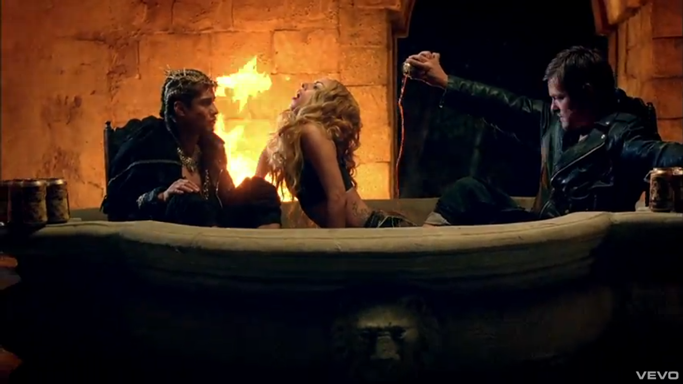
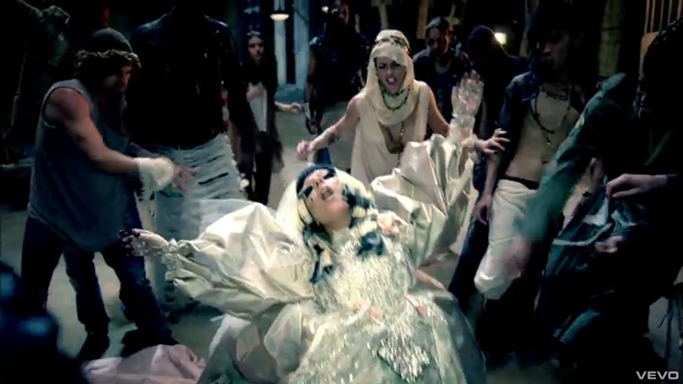
It always comes as a surprise to me when people argue that Judas is a video and song created just to attack Christians. It should not surprise me, of course: modern Fundamentalist Christianity seems to have decided that its best strategy moving forward is to become an occified relic that has systematically purged itself of all relevancy to the lives of real human beings. I'm not talking here about the barbaric wars against science, sexuality, women's rights, reason, history, all other religions, the Liberal Arts, and so on, despite how evident many of those crusades are in the above video. No, I think those wars are symptomatic of a much deeper problem:

Fundamentalism is terrified of interpretation.

What's bizarre is that this fear of interpretation--this terror of saying that perhaps the Bible cannot be perfectly understood in a literal, single way--runs counter to some of the things that have made the Judeo-Christian tradition so enduring and evocative. I've already talked on here, in very broad terms, about archetypes, and about what it means to create art as part of the interpretive process (in fact, it might be worth reviewing those articles before reading this one, although it's not a prerequisite or anything). Turns out that Christianity has, as part of its artistic tradition, its own particular way of working with those two ideas.

But this is a StIT article, so I'm going to leave that tantalizing idea hanging while we delve into what makes the video for Judas really tick.


The video opens with that same icon I've been pointing out all along: it's a red cross on a (largely) bleached-white background. This is the third video so far where we've seen this kind of iconography, which says to me that Gaga's slowly but surely developing her own set of symbols to place within her videos and performances. And part of that language of symbols is Christian iconography. So, right from the get-go this video is tied to Alejandro and Bad Romance--fittingly, as it shares many of the same dualistic themes running through her other work.

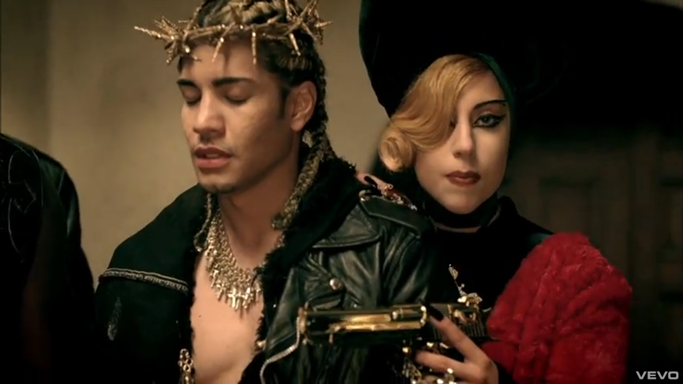
Rather than picking this apart chronologically, I'm going to make some general statements about the artistic choices here and their thematic purpose. What I hope comes out of this is evidence that Gaga has done her homework here. Take the way she depicts Christ and the Apostles. They are, of course, a biker gang.

BOOORN TO BE CRUUUUCIIFIIIIED! ...I'm going to hell.
Which is perfect.
Think about it, Christ was not someone within the orthodoxy. He was kind of a bad boy, if you really think about it. He hung around with poor people, cripples, lepers, prostitutes, wenches, people that weren't happy with Roman or Church rule... these weren't exactly the high and noble class we're talking about. These were outsiders. This was a guy that was born in a manger because his family couldn't get anyplace else to stay, who had a bunch of fishermen as his disciples. This is real rebel stuff. So, I love the biker aesthetic. It's a way of reinforcing just how revolutionary Jesus was.

Which, speaking of revolutionary--notice how Jesus is decidedly not a white Anglo-Saxon European. I'm not sure how historically accurate Gaga's replacement is race-wise, but it's still significant to me that such a replacement was made, simply because, again, it undermines this idea of white Christian hegemony. It's another way of reinforcing the idea of Christ as an outsider.

Once past the stylistic choices we can start delving into the particular characters of Christ, Judas, and--I assume this is what Gaga's going for here--Mary Magdalene.

Pictured: Jesus, A Pop Star, And Some Douchebag
 Judas is the easiest character to get ahold of here, and his characterization does not seem to be anything that a Christian--fundamentalist or otherwise--would have a problem with. He is, in short, an asshole. One of the best moments of the video is when he pours a can of wine on Gaga's back and casually tosses it behind him. This is an uncouth creep. And yet... he is still part of the Disciples. As shifty a character as he is, the others do not seem to view him as someone capable of a full on betrayal. Is this extrapolating a lot from the texts? Sure. But I don't think that makes it any stranger than the way the seventh Harry Potter movie particularly emphasizes the themes of power and responsibility. In the Gospels, Judas comes across as an odious character, but still a character horrified, in the end, with how far he fell. That's on display here.

Mary still is in Protective Mode. Christ, on the other hand, knows exactly what's coming...
Mary/Gaga has a much more Gaga-generated personality in the video, being torn between the good of Christ and the evil of Judas. Although she is frequently depicted as standing protectively beside Christ, she often gazes not at Christ but at Judas--her body language shows how torn she is. Interestingly, she is, perhaps, the most human character of the bunch. Notice how, in the kissing scene (a depiction of the moment where Judas kisses Christ, betraying him as the leader of their rebellious group to the watching soldiers) she seems to be in despair, but both Christ and Judas are largely stoic.

This seems to be Christ's characteristic, in fact--he is serene at best and stoic at worst. There is only one moment where he seems to break from serenity, and that is after the kiss scene. This moment actually parallels the gospels, interestingly enough. Check out this passage from Matthew 26:47-50:

When he was speaking, look, Yehuda, one of the twelve, came, and with him a great crowd with swords and clubs from the high priests and the elders of the people. And the betrayer told them the signal, which was, "The one I kiss is the man. Seize him."
And at once he came up to Yeshua and said, "Hello, Rabbi."
And he kissed him.
And Yeshua said,
Friend, do what you are here to do.
Then they came and laid their hands on Yeshua and seized him.
There is a sense of stoic resignation and sadness in Christ's response here to Judas's betrayal, especially evident since it comes after a scene where Christ prays to be free from his burden, only to finally conclude that he must go through with the plan, as it were. In Gaga's video, Mary is in the place of the normal human--she cannot understand the terrible necessity of the betrayal and its results. Both Jesus and Judas, however, know exactly what is coming. It's a powerful moment in the Scripture, and I truly feel that Gaga is attempting to faithfully convey that moment here.

The lyrics convey a similar attention to detail. Let's break those down a bit:

When he comes to me I am ready
I’ll wash his feet with my hair if he needs
Forgive him when his tongue lies through his brain
Even after three times he betrays me


Here Gaga is working with some fairly traditional imagery of washing feet as a gesture of religious and ritualistic respect, but because the focus is on Judas and not a more noble figure like Christ she turns it into an image of degradation. The last two lines, interestingly, are not a reference to Judas but to Simon Kefa, who responds to accusations of being associated with Christ essentially with the reponse, "I don't know what you're talking about! Never heard of this Jesus guy! No further questions, move along!" He does this three times, just as Christ predicted, and breaks down when he realizes that Christ was right. Note, though, that here is the first linking of betrayal with forgiveness within the song.

I couldn’t love a man so purely
Even prophets forgave his crooked way
I’ve learned love is like a brick you can
Build a house or sink a dead body


This is the dualism that I mentioned (but didn't bother explaining) earlier. Love here is something that can create or destroy--just as love is mixed with obsession and degradation in Bad Romance, and sex is mixed with militant totalitarian domination in Alejandro. It's a very Blakean notion, actually--that in the midst of the two opposites of Good and Evil, new ideas are created.

In the most Biblical sense,
I am beyond repentance
Fame hooker, prostitute wench, vomits her mind
But in the cultural sense
I just speak in future tense
Judas, kiss me if offenced,
Or wear an ear condom next time


This is interesting because it draws in part from a common sort of... well, I'm not sure I would call it an error, exactly, but certainly a supplementary interpretation that goes way beyond the main text. That interpretation is that Mary Magdalene was a prostitute. In our culture, she's been linked to the story of the crowd of chuckleheads who want to stone a prostitute to death, where Christ essentially steps in and says, listen, go ahead, I've got no beef with stonings, but if you're going to do it, let's have it be started by the person here who is totally without sin. Then presumably everyone sort of shuffled their feet and avoided each other's eyes and finally went home feeling like right chumps.

Pictured: Fans of Fox News
Of course, this isn't what happens at the end of Gaga's video, which says to me that she's very aware of what reception she's going to receive with this song. I wonder, is the guy in the first video I posted totally without sin? Just an idle speculation.

Also, the "wear an ear condom next time" line is hilariously apt, as it charges the listener to just ignore the song if offended while also tying back into Gaga's sexual themes. I love it.

I wanna love you,
But something’s pulling me away from you
Jesus is my virtue,
Judas is the demon I cling to
I cling to

I think this is the most telling set of lines in the song, as it gets back to the point I made waaay back at the beginning of the article: Gaga is working here in a Christian tradition of symbolic types.

See, under this system, Christian (especially early Christian) art uses the juxtaposition of different characters to show parallelism throughout the gospels. So, Jonah, eaten by the whale, is a type of Christ--he predicts Christ's entombment and resurrection. Hercules appears as a type of Samson in some Roman art. Moses and Abraham are also paralleled with Christ. These characters exist as reflections of each other through time and scripture, showing the ultimate unity of the Judeo-Christian myth tradition, and its links with other myths of the time and region.

This video is Gaga's attempt at a kind of modern Typology. She is taking the story of Christ--in particular, the story of his betrayal--and depicting its modern parallels. On the one hand she makes this more concrete by staging the story as a struggle of love between a virtuous man and a jerk. This is the most obvious view of the song.

On the other hand, it can be seen as a far more abstract metaphor for the struggle between the desire to be virtuous and the allure of evil. The video and song use the conflict between Christ and Judas to illustrate the struggle within all humans. Gaga has essentially delved into the Christian myth here and discovered not only its beauty but also its fundamental relevance to her life and, by artistic extension, our own lives.

This is what I mean when I say that the fear of interpretation is leading Fundamentalist Christianity, as an institution, down the path of ossification and, ultimately, total irrelevancy. They have said, in essence, "Our way is the only way of interacting with scripture emotionally and artistically." And, sure, every sect has probably done this to some extent, but never before have I seen such a slavish dedication to the utter stifling of everything that makes The Bible one of the most beautiful, significant, moving works in the entirety of world literature.

Wait, wait, let me say that again.

The Bible is one of the most beautiful, significant, moving works in the entirety of world literature.

And Fundamentalism is entombing it alive.

Whereas Gaga, in contrast, has taken an already deeply moving Biblical story and found a way of making it deeply relevant to her own life and experiences. She is honestly and openly interacting with the Christian tradition in a way that takes account of the basic difficulty of living up to the standard of goodness. I consider that honesty to be the mark of a much purer religious experience than dogmatic purity, because it recognizes that the answers to our questions of good and evil are not always so simple or forthcoming. It recognizes that we, as humans, are not perfect, even though we aspire to match the perfection of Christ... or of our other heroes. And it recognizes that the stories in the Bible are not singular but part of a long tradition of parallel tales--that Lady Gaga can be a type of Mary, and the men in this video represent a type of Christ and a type of Judas. I feel secure, therefore, in calling this a truly beautiful work of Christian art.

So, my charge is essentially this: take a page from Gaga's book. Be open to alternate readings. Explore the meaning of all art, both secular and scriptural. Find meaning for yourself through the creation of symbols, meaningful themes, narratives real and imagined, the play of opposites, and, ultimately, the deep and powerful act of sharing experiences. Because interpretation is not a way of muddying the waters. It is not a way of dissecting and killing the enjoyment of art. It is, itself, an artistic act, and one that can uncover the beauty and power of both a book written two thousand years ago... and a music video created just this year.

It all comes down to the ways that we read.

That's the last Ways of Reading Gaga proper, although there are at least two postscripts--one by me, and one by someone else. Those won't be out for a while though. As always, feel free to leave comments, complaints, or, best of all, your own interpretations, or e-mail me at keeperofmanynames@gmail.com . And, if you like what you've read here, share it on Facebook, Google+, Twitter, Xanga, Netscape, or whatever else you crazy kids are using to surf the blogoblag these days.

Tuesday, September 13, 2011

Some Ways Of Reading Gaga, Part II: Love and the Empire

Following the chaos and unrest of the early 21st century, following the redrawing of national borders, a number of small but strong military states rise. One such state--a totalitarian nation under the control of an army which was, in turn under the control of one powerful and charismatic woman--stands above the rest in infamy.


It's characteristics are:
  • A dynamic cult of masculinity that appears to have developed out of the late 20th century bondage subculture.
  • Force, power, virility, and sexual prowess valued above all
  • Religious devotion to the androgynous queen/general figure that heads the state
  • A hypersexualized combat training augmented by a set of ritualistic signs and ceremonies, not unlike Masonic or Rosecrucian orders of the past

The lack of records outside of the state's officially sanctioned datafiles makes any reconstruction of the character of the queen difficult, at best, but a few facts stand out:

Anecdotal evidence suggests that she begins her career as a singer in a bar frequented by soldiers, whether mercenary or otherwise (the oddly mismatched uniforms suggest that they were not a part of any official military force). She rises to power with a number of highly trusted individuals, including the other central figure in this narrative--Alejandro, chief among her lovers and supporters; a disillusioned and dour young soldier that pledges his loyalty to a woman that was to become a subject of devotion.


At some point, the violence and authoritarianism of her new regime becomes too much for the now even more disillusioned soldier, and he attempts to make contact with the resistance. In order to prevent this high-level defection from disrupting her power, the queen orders Alejandro's death. In the middle of a riot, the soldier is assassinated by rebel agents--actually unwitting sleepers under the command of the queen's secret service. Alejandro's death and lavish state funeral is used to galvanize the state's armies and the resistance is crushed. The queen coldly pays her last farewells to her former love, and relinquishes the last scraps of her humanity.


Wait... What?

If you hadn't guessed from the title, it's time for the second of my three part series, Some Ways Of Reading Gaga. Last time, if you recall, I discussed the concept of a Close Reading, and how it can be applied to something like, say, a Lady Gaga video in order to make the work both more understandable, and more enjoyable.

Tonight, I will be doing the same general thing with the video for "Alejandro", and I will be, to some extent, talking about close reading. But this time I want to talk a bit more specifically about decoding a work of staggering strangeness. Surely you've come across something like that before--a story or a poem or a movie that's just so damn odd that you really can't even grasp at a plotline, let alone any sort of deeper meaning. Some works (I'm looking at you, The Waste Land. And don't think I don't see you rolling up a spitball in the back corner, Andalusian Dog!) just seem to thumb their nose at any attempt to draw a coherent order out of the fractured images. It's quite probable that the authors never intended there to be a coherent narrative, and looking for one is like jousting with windmills.

However, that state of confusion gives us an incredible freedom. It is the freedom to construct narratives that are useful to us, rather than trying to piece together every single scrap of information. And, sure, these stories might be a bit of a stretch, and I can already hear the swirling beer and muttering in response to this article, but the end result of this sort of critique is that we have a bit of a better sense of some of the stuff going on in the work. The wonderful thing about this is that once we have the narrative, we can start to talk about what that implies about the work, and then later on we can just ditch the narrative while keeping the different insights we've gained.

Besides, this sort of thing is fun.

Care to delve a little deeper?

Alright, Where Is This Story Coming From?


A lot of this comes from my decision to just see where a leap of intuition took me. I've found that such leaps are one of the most valuable ways of generating ideas in the liberal arts--by training yourself to explore and argue for crazy ideas you end up training yourself to think outside of the box. With that in mind, I'm going to try to go through the video scene by scene and point out where my story maps onto the video.

We begin with a number of fractured images with no real sense of order or narrative. We have the shot of the marching soldiers from the beginning, with their bizarre, large, alchemical-looking symbols; we have the shot of Gaga sitting regally beside some general, both their eyes hidden from view, and we get the shots of the funeral procession and the... heart? maybe? sitting on a pillow and stuck with pins. This is strange stuff. It's even weirder than Bad Romance was. But we can already begin to see some of what's coming.

WHEN I WAS! A YOUNG BOY!
We know, for example, that there's a funeral of some sort. And, if we put that together with the shot of Gaga in a place of authority, we can surmise that this is a rather important funeral--important enough that someone as powerful as Gaga appears to be here would end up walking in front of the coffin. Interesting. We also can get a sense of the type of military that we're dealing with here. It's a cultlike organization, full of strange rituals and stranger dance routines. We're going to have to piece together what's going on, but for now that's a pretty decent start.

Oh, and, of course, there's that opening shot of the bar, with soldiers in drag. Beyond the fetish fuel here, it's worth noting that the one really awake, aware figure is the guy that will reappear in a few more closeups later. This immediately, albeit subtly and perhaps unconsciously, sets him up for a Main Character slot.

Alejandro: The Unknown Sadsack
Let's go on, shall we?

We get a lot of shots here in this first verse of the actual training exercises of Gaga's loyal troops, giving us a sense of the extreme emphasis on masculinity. This is, of course, a characteristic of quite a few fascist movements--I'll expand on this idea more next week. It's interesting that we only see Gaga fully remove the goggles of her queen outfit around the 3 minute mark. In this context, I think the odd eyewear is clearly used to put a barrier between her and the audience. If the eyes are the window of the soul, she's drawing the curtains shut.

Frankly, the whole video could have just been scenes like this.


The second verse and chorus is much the same--with a more overt bondage subtheme woven in. Fanservice or artistic idea? Hm, I leave that up to the viewer to decide. After the second verse things get quite interesting, though, as Gaga really shows off her bizarre nun habit. Remember last time when I talked about the red cross on a white ground? Well, she's doing it again here. Granted, the cross is covering her crotch this time, but it's still there. A rather interesting development. Also note that the black and white footage of combat has shifted to color--perhaps an indication that the footage is getting closer to the present day. Here we get a sense again of the cultlike nature of this army, and their apparent absolute devotion to Gaga.

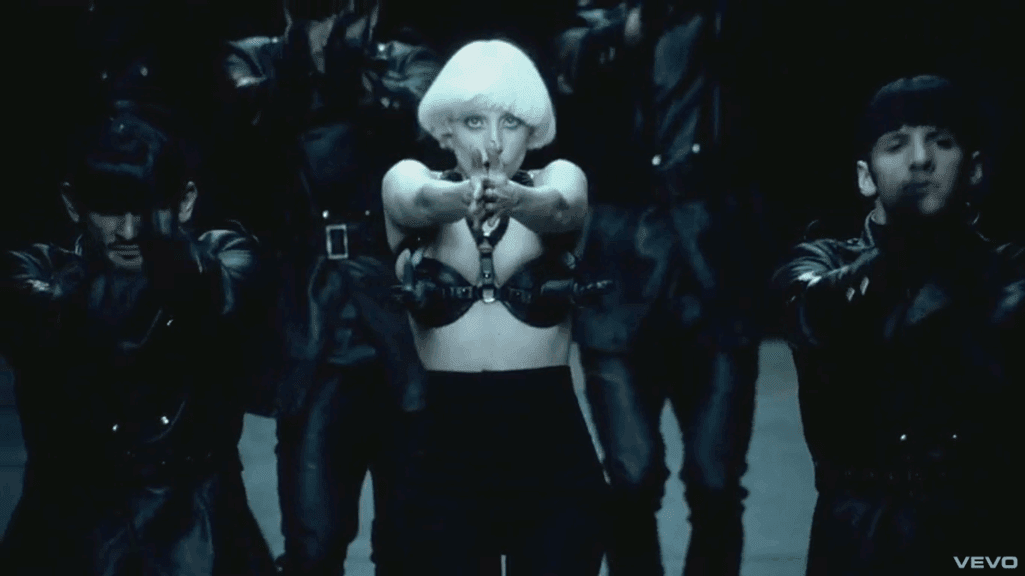
We then get a brief glimpse of Gaga at her most human. I find this scene particularly interesting because of the way it juxtaposes the more normal looking Gaga with the oncoming line of martial, threatening soldiers. I think this could be read as the transformation of Gaga from a fairly normal individual into the cold, ruthless general we see elsewhere in the video. This sense is enhanced by the fact that the very next scene takes place in the same location but now Gaga is completely surrounded by her soldiers--decked out in black, with red arm bands, conjuring images of the SS and various comic-book fascist enemies--and she has been transformed into a... a...

This.
I don't know, what would you call someone that wears machine guns on her boobs? Honestly, I can't really think of a suitable word.

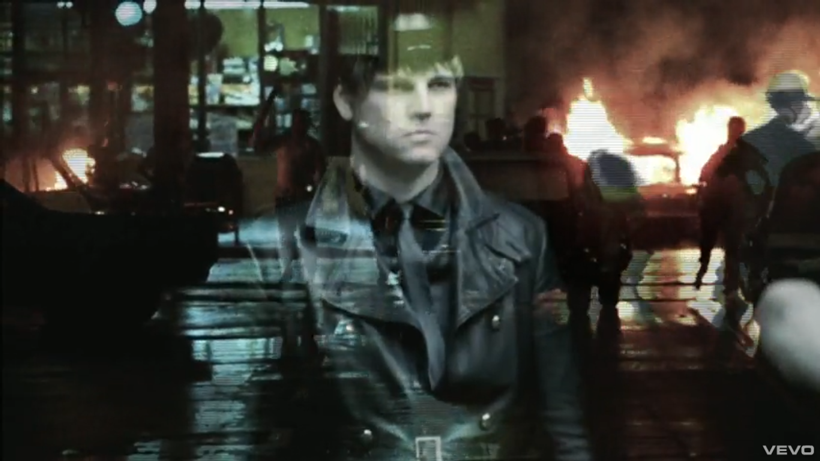
And now we get into the meat of the video, where the greatest density of information is shown. There are a few things that indicate to me that this is a flashback: the difference in style (note the collage effects over our Main Character, and the fact that Gaga is, again, relatively sensibly dressed); the fact that Gaga here is shown just as a lowly singer, not a person who commands devoted cult soldiers; the use of footage similar to what we saw playing in the background earlier. I'm reconstructing the narrative like this: Gaga began her career as a singer. That seems to line up with the symbolic transformation I talked about earlier. We also get a few shots of Gaga training her troops more directly--apparently this training involves a disturbing amount of physical abuse.

AH! DON'T HURT ME
Our boy, Alejandro, I've dubbed him, is shown with a thousand-mile stare, clearly contemplating something rather weighty. We know that he is already a part of Gaga's armies at this point, because he's wearing the uniforms seen in other shots. He seems to look on during the training and, slowly, coming to a decision, he removes his cap--a symbolic gesture that is pretty easy to read as an act of defiance and defection from decadence.

Alejandro Goes To London


The rest--the assassination, the staged funeral, the crackdown on the rebels, and so on--is pure conjecture on my part, but boy, it sure does explain a lot of what we saw in the first few minutes of the video, doesn't it? This act of defiance from Alejandro is what dooms him, and the state funeral is, of course, the ultimate irony--in death, he supports the totalitarian regime that in life he attempted to escape.

Before I go, I'll leave you with one last story-related thought. At the beginning of the actual song, the first words are "I know that we are young, and I know that you may love me... but I just can't be with you like this anymore, Alejandro!" Note that this is pronounced as Gaga stands in front of the coffin of the man that, in my narrative, she has sentenced to death for the glory of the state. Let those lines roll around in your head a bit.


They certainly do take on a bit of a different meaning, don't they? The song, with this interpretation, becomes a bitterly ironic echo of the humanity that Gaga once had, but discarded in her quest for power. It is the narrative of a person that existed long before the events of the video, and now can never be resurrected. In the last moments of the film, Gaga's face ignites from the inside in a symbolic burning away of the last shreds of her humanity.

--------------------------------------------------------------------------

There's a bit more to do with this video, but I'm going to leave that till next time, when I'll also be discussing Judas and the concept of symbolism as it appears in the two videos. That should round things off, but you never know, this might spread out into a four part series. As always, feel free to leave comments, complaints, or, best of all, your own interpretations. And, if you like what you've read here, share it on Facebook, Google+, Twitter, Xanga, Netscape, or whatever else you crazy kids are using to surf the blogoblag these days.
Support on Patreon
Store
Reader's Guide
Tag Index
Homestuck Articles
Solarpunk Articles
Mastodon/Fediverse
Tumblr
Bluesky
RSS Feed