

Oddball media crit--laying siege to academia's ivory tower from pop culture's gutter
Showing posts with label Fiction Experiments. Show all posts
Showing posts with label Fiction Experiments. Show all posts
Tuesday, October 22, 2019
Shade World: A Player's Guide (Preview 1)
Storming the Ivory Tower presents Shade World: A Player's Guide, a parafictional choose your own adventure experience, by Sam Keeper and Juniper Theory.


Monday, August 26, 2019
Save Spidey! Into the Spider-Verse's Failure and Promise
Can Spider-Man matter outside of the Marvel Cinematic Universe? Sony, Disney, #SaveSpidey, and Into the Spider-Verse.

Wednesday, August 7, 2019
Just Put "Whatever" Down For Gender: Gonzo, the Muppets, and Queerness
Gonzo The Great: famous muppet, cultural icon, and... queer non-binary performance artist? Join us as we attempt the death defying feat of discussing the queerness of the muppets, and Gonzo as modern artistic genius
Co-Written with Juniper Angel Barber
(Note: This piece looks slightly less awesome on Mobile)
Co-Written with Juniper Angel Barber
(Note: This piece looks slightly less awesome on Mobile)
 |
| Art from The Muppet Show Comic Book by Roger Langridge. |
Thursday, November 30, 2017
Hauntology/Headology: Carpe Jugulum and Gothic Justice
The vampires in Discworld novel Carpe Jugulum may be modern, but the story is still firmly gothic. So who in the story is the gothic entity haunting the present?
Monday, January 2, 2017
If The Twine Stops We All Die
Over this break, I decided to teach myself Twine. As one does. The result, which I'm releasing to all of my Patreon backers as a thank you for supporting me over the past year, is a now hyper version of my last article, "If The Train Stops We All Die." There's nothing too complex going on here, but I've tweaked and expanded some of the text and I'm hoping that the results help to highlight the intertwined nature of this article (which was always written, actually, with a hypertext format in mind).
As my $2+ backers know, I like making my stuff as accessible as possible, and the great thing about these Twines is that you can actually pull them into the program yourself and decompile them to see how they work, in the same way people are welcome to look at my original Krita files to see how I compose the layers for my artwork! This is still pretty dour stuff, of course, to ring in the new year (Happy Yekaterina Bridge! Hooray! Hooray! Hooray!) but I really am thankful to all of you for your support, and I wanted to do something extra and experimental as an added sort of end of the year perk.
So check out Patreon to download this new Twine (and something extra...), and if you haven't yet subscribed consider doing so to get access to a couple years' worth of exclusive bonus content!

As my $2+ backers know, I like making my stuff as accessible as possible, and the great thing about these Twines is that you can actually pull them into the program yourself and decompile them to see how they work, in the same way people are welcome to look at my original Krita files to see how I compose the layers for my artwork! This is still pretty dour stuff, of course, to ring in the new year (Happy Yekaterina Bridge! Hooray! Hooray! Hooray!) but I really am thankful to all of you for your support, and I wanted to do something extra and experimental as an added sort of end of the year perk.
So check out Patreon to download this new Twine (and something extra...), and if you haven't yet subscribed consider doing so to get access to a couple years' worth of exclusive bonus content!


Saturday, July 28, 2012
Poetry is Dead
What if I drop one breath?
What does it mean for a medium to be dead? I mean really dead, totally stopped in place with nowhere to go, no way forward?
What does it mean to have nothing new to explore technically?
I think about this quite a bit, actually, because of my weird background with media. Although new media is very important to me, my training comes from art history and lit crit, so I'm what you would call a child of the Old School. And one of the things I've noticed is that all sorts of media have died off over the years, just sort of spun their wheels and finally stopped.
And it's not necessarily big things. Like, there's no Death of Music (despite what both Don McLean and Devin Townsend say), and I doubt there will be in my lifetime. There's just too much territory to explore. But you can kill off a single instrument. When was the last time you heard a crumhorn, for example? It's a medium of expression just as surely as the paintbrush is, but it's fallen by the wayside. And there's other little odd things that live in the space between media and genres, things like...
Well, how about Radio Dramas?
When was the last time you heard a radio drama?
I can remember the last time I heard one. It was sometime back in, oh, 1997 maybe, somewhere around there. It was a radio dramatization of Star Wars: A New Hope. And that broadcast captivated me, it went far beyond the movie ever could, for it became my personal Star Wars, the Star Wars that played out visually inside my own head.
But you don't hear too many radio dramas these days, do you? It's another dead medium. It reached the end of what it could do, new things drew the attention of the masses, and people moved on, leaving a media ghost town.
Oh, and then, of course, there's poetry.
Poetry is dead.
But wait, let me back up a bit and explain just what I mean by a medium having nothing new to explore technically. This isn't a new concept for me, actually. It's something I call the Medium Singularity. I've already talked about it in relationship to painting, but let us roll through the main points again.
A Medium Singularity is the point where we expand a medium as far as it can go, where we reach the end, essentially, of Progress. It signifies the point where our ability to predict future possibilities goes completely out the window, where there's no technique that hasn't been taken to its furthest possible point. It borrows the concept from Transhumanism, actually--the Singularity signifies the moment of push, the great thrust beyond the limits of the merely human, where all bets are off and something totally new emerges.
Another possible term for it is Art At The End Of History. What does that mean exactly? Well, I think this quote just about sums it up:
Youch. Heavy stuff there. That's a quote from a Belgian paper, actually, translated by a friend of mine. (He couldn't locate the original source, unfortunately--another interesting example of information lost within an information flood.) The statement encapsulates, for me, the sensation of being post-historical. It's the sensation of realizing that Progress, at least in little corner of the artistic world, is over. Our happy story of a history that moves ever forward hits a wall and we're left stranded, with all the achievements of the masters of the past gathered up behind us.
And that can be insanely frustrating for artists! I don't deny that it can be the hardest part of playing in these fields today. Hell, it's a cornerstone of modernist philosophy, where instead of making new material you just endlessly disembowel the great works of the past in search of some elusive meaning among the cast out guts of consonants and vowels. From J Alfred Prufrock all the way down to Howl, there's dross left for us after the last masters plucked out their gold, and standing on the shoulders of giants, as the song goes, leaves us cold.
Poetry is the latest victim of the End of History. Think about it, when's the last time you bought a book of poetry? When's the last time you saw someone stand and recite aloud, or heard the sound on the radio?
And you know, people have been releasing new poetry. But they're the vinyl freaks of the lit world, the people who still buy their albums pressed onto those big beautiful discs, the dying crowd with their dying tech, playing out their songs till their needle jumps and another one bites the dust.
Poetry killed itself, hung itself in the attic on a tetragrammaton string that read PoMo. Some of its acolytes killed it with sound, broke it to pure noise like speaking in tongues, like gifts from the mad god of the 20th Century. Some made it a grocery list, gathered their affairs in order like Pink arranging guitar splinters in a hotel room, then passed away into the West taking the magic of the Elves with them. And some, knowing the time was at hand, hearing the tune of the jazz band, took their books and ran, their pages fanned out in a flickering street lamp in the wasteland.
Poetry hit a wall. It beat up language for its lunch money, and the funny thing was, when it was through it found nothing more to do with the change it had effected. The beat was rejected: each meter was reduced to a kind of tired pattern of use, and the modernists refused its tired truths.
And what could they do? All the clear visions of the Chinese masters were used up faster than you could conceive, they had received all the alliterating letters from the Nordic breed, and the call and answer patterns from across the Mediterranean Sea. Even long and short vowel beats, those pounding feet, had been retreaded from the Greeks by Edgar Allen Poe.
So where was there to go
but down?
But let's rein it in, I'm losing breath.
It came to the point that every technique you can imagine was played out, and, like the modernist painters, the modernist poets pushed every possibility as far as they could: repetition, the abandonment of meter and rhyme, the collapse of grammar and punctuation, the abandonment of meaning in favor of pure sound... every way you could mutilate a poem, the modernists did it. Sometimes their work was staggeringly beautiful. Sometimes it was dead. But I think that explosion of panicked experimentation can be seen as the death throes--it was the final moments of poetry's life, the rush claim the last innovatable territory.
But if you've been paying attention, you know that death isn't the end.
It's just the beginning stage of the metamorphosis.
See, just because you can't do something new technically with a medium doesn't mean you're out of things to say with that medium. In fact, I would argue that it becomes far easier to say what you want after a medium is dead, because you've got all of the tools imaginable, and you can pick and choose the tool for the message you want to convey. You're cut free from the stupid demand of the critics to be avant-garde--which isn't to say the avant-garde is bad, but the constant push in the art world for the next shock is absolutely a hard limitation that you don't have when your medium is dead. How on earth can you respond to a demand for the fury of artistic progress with anything but laughter when your medium's already been buried?
And after that laughter you can really get them worried, 'cause once the tools are all laid out before you, all the ones that are played out can start to be questioned. And this may cause some tension, but I just have to wonder:
Is poetry dead, or has it found a way to live under a new name? A name that to old poets is profane, but that has gushing through its veins the methods of Homer and the rushing presentation of a great Orator's proclamations? I speak of "SLAM," a poetry that positions its hand upon the shoulder of the oral tradition, that is bolder than the gentle bleating lamb beats that the ivory tower demands.
Tell me, when is the last time you heard a man raise a crowd's voice and hands with rhymed out lines out of his very soul? When a whole gathering of people stood at attention to hear their lives and feelings captured in a poem's mention?
But don't listen to all my nonsense, listen to Saul present this:
You can see how I might get irate when I hear someone pontificate about the youth today and how they don't appreciate art. Let me do my part as a lit crit theorist and say the nearest I've ever come to Dead Poet Society is when I'm listening to a playlist of hip hop. Hear this! The Modernists let the beat drop! And this genre caught the ball and slammed it, sample loops and all, through the hoop.
You could call it a SLAM dunk.
And you don't have to punk out
your lines, or rap to these jams,
This just shows with no doubt
that poetry died and came back
like Adonis. And I'll be honest,
I can't tell you what all this means
because once you've crossed the singularity
you're in the land of the Absolutely Free--no limits.
So give it a shot, don't let poetry
rot in a grave of its own making.
Because we're making art
at the end of history.
And poetry's only as dead
As we let it be.
Give my regards to Brooklyn.
This article really took on a life of its own--I wasn't going to write it this way, but the rhymes just started coming, and the rest, as it were, is history. No idea if it actually worked or not. You can follow me on Google+ at gplus.to/SamKeeper or on Twitter @SamFateKeeper. As always, you can e-mail me at KeeperofManyNames@gmail.com. If you liked this piece please share it on Facebook, Google+, Twitter, Reddit, Equestria Daily, Xanga, MySpace, or whathaveyou, and leave some thoughts in the comments below.
What does it mean for a medium to be dead? I mean really dead, totally stopped in place with nowhere to go, no way forward?
What does it mean to have nothing new to explore technically?
I think about this quite a bit, actually, because of my weird background with media. Although new media is very important to me, my training comes from art history and lit crit, so I'm what you would call a child of the Old School. And one of the things I've noticed is that all sorts of media have died off over the years, just sort of spun their wheels and finally stopped.
And it's not necessarily big things. Like, there's no Death of Music (despite what both Don McLean and Devin Townsend say), and I doubt there will be in my lifetime. There's just too much territory to explore. But you can kill off a single instrument. When was the last time you heard a crumhorn, for example? It's a medium of expression just as surely as the paintbrush is, but it's fallen by the wayside. And there's other little odd things that live in the space between media and genres, things like...
Well, how about Radio Dramas?
When was the last time you heard a radio drama?
I can remember the last time I heard one. It was sometime back in, oh, 1997 maybe, somewhere around there. It was a radio dramatization of Star Wars: A New Hope. And that broadcast captivated me, it went far beyond the movie ever could, for it became my personal Star Wars, the Star Wars that played out visually inside my own head.
But you don't hear too many radio dramas these days, do you? It's another dead medium. It reached the end of what it could do, new things drew the attention of the masses, and people moved on, leaving a media ghost town.
Oh, and then, of course, there's poetry.
Poetry is dead.
But wait, let me back up a bit and explain just what I mean by a medium having nothing new to explore technically. This isn't a new concept for me, actually. It's something I call the Medium Singularity. I've already talked about it in relationship to painting, but let us roll through the main points again.
A Medium Singularity is the point where we expand a medium as far as it can go, where we reach the end, essentially, of Progress. It signifies the point where our ability to predict future possibilities goes completely out the window, where there's no technique that hasn't been taken to its furthest possible point. It borrows the concept from Transhumanism, actually--the Singularity signifies the moment of push, the great thrust beyond the limits of the merely human, where all bets are off and something totally new emerges.
Another possible term for it is Art At The End Of History. What does that mean exactly? Well, I think this quote just about sums it up:
"We're the generation of 'they have already done that. They have already been there."
Youch. Heavy stuff there. That's a quote from a Belgian paper, actually, translated by a friend of mine. (He couldn't locate the original source, unfortunately--another interesting example of information lost within an information flood.) The statement encapsulates, for me, the sensation of being post-historical. It's the sensation of realizing that Progress, at least in little corner of the artistic world, is over. Our happy story of a history that moves ever forward hits a wall and we're left stranded, with all the achievements of the masters of the past gathered up behind us.
And that can be insanely frustrating for artists! I don't deny that it can be the hardest part of playing in these fields today. Hell, it's a cornerstone of modernist philosophy, where instead of making new material you just endlessly disembowel the great works of the past in search of some elusive meaning among the cast out guts of consonants and vowels. From J Alfred Prufrock all the way down to Howl, there's dross left for us after the last masters plucked out their gold, and standing on the shoulders of giants, as the song goes, leaves us cold.
Poetry is the latest victim of the End of History. Think about it, when's the last time you bought a book of poetry? When's the last time you saw someone stand and recite aloud, or heard the sound on the radio?
And you know, people have been releasing new poetry. But they're the vinyl freaks of the lit world, the people who still buy their albums pressed onto those big beautiful discs, the dying crowd with their dying tech, playing out their songs till their needle jumps and another one bites the dust.
Poetry killed itself, hung itself in the attic on a tetragrammaton string that read PoMo. Some of its acolytes killed it with sound, broke it to pure noise like speaking in tongues, like gifts from the mad god of the 20th Century. Some made it a grocery list, gathered their affairs in order like Pink arranging guitar splinters in a hotel room, then passed away into the West taking the magic of the Elves with them. And some, knowing the time was at hand, hearing the tune of the jazz band, took their books and ran, their pages fanned out in a flickering street lamp in the wasteland.
Poetry hit a wall. It beat up language for its lunch money, and the funny thing was, when it was through it found nothing more to do with the change it had effected. The beat was rejected: each meter was reduced to a kind of tired pattern of use, and the modernists refused its tired truths.
And what could they do? All the clear visions of the Chinese masters were used up faster than you could conceive, they had received all the alliterating letters from the Nordic breed, and the call and answer patterns from across the Mediterranean Sea. Even long and short vowel beats, those pounding feet, had been retreaded from the Greeks by Edgar Allen Poe.
So where was there to go
but down?
But let's rein it in, I'm losing breath.
It came to the point that every technique you can imagine was played out, and, like the modernist painters, the modernist poets pushed every possibility as far as they could: repetition, the abandonment of meter and rhyme, the collapse of grammar and punctuation, the abandonment of meaning in favor of pure sound... every way you could mutilate a poem, the modernists did it. Sometimes their work was staggeringly beautiful. Sometimes it was dead. But I think that explosion of panicked experimentation can be seen as the death throes--it was the final moments of poetry's life, the rush claim the last innovatable territory.
But if you've been paying attention, you know that death isn't the end.
It's just the beginning stage of the metamorphosis.
See, just because you can't do something new technically with a medium doesn't mean you're out of things to say with that medium. In fact, I would argue that it becomes far easier to say what you want after a medium is dead, because you've got all of the tools imaginable, and you can pick and choose the tool for the message you want to convey. You're cut free from the stupid demand of the critics to be avant-garde--which isn't to say the avant-garde is bad, but the constant push in the art world for the next shock is absolutely a hard limitation that you don't have when your medium is dead. How on earth can you respond to a demand for the fury of artistic progress with anything but laughter when your medium's already been buried?
And after that laughter you can really get them worried, 'cause once the tools are all laid out before you, all the ones that are played out can start to be questioned. And this may cause some tension, but I just have to wonder:
Is poetry dead, or has it found a way to live under a new name? A name that to old poets is profane, but that has gushing through its veins the methods of Homer and the rushing presentation of a great Orator's proclamations? I speak of "SLAM," a poetry that positions its hand upon the shoulder of the oral tradition, that is bolder than the gentle bleating lamb beats that the ivory tower demands.
Tell me, when is the last time you heard a man raise a crowd's voice and hands with rhymed out lines out of his very soul? When a whole gathering of people stood at attention to hear their lives and feelings captured in a poem's mention?
But don't listen to all my nonsense, listen to Saul present this:
You can see how I might get irate when I hear someone pontificate about the youth today and how they don't appreciate art. Let me do my part as a lit crit theorist and say the nearest I've ever come to Dead Poet Society is when I'm listening to a playlist of hip hop. Hear this! The Modernists let the beat drop! And this genre caught the ball and slammed it, sample loops and all, through the hoop.
You could call it a SLAM dunk.
And you don't have to punk out
your lines, or rap to these jams,
This just shows with no doubt
that poetry died and came back
like Adonis. And I'll be honest,
I can't tell you what all this means
because once you've crossed the singularity
you're in the land of the Absolutely Free--no limits.
So give it a shot, don't let poetry
rot in a grave of its own making.
Because we're making art
at the end of history.
And poetry's only as dead
As we let it be.
Give my regards to Brooklyn.
This article really took on a life of its own--I wasn't going to write it this way, but the rhymes just started coming, and the rest, as it were, is history. No idea if it actually worked or not. You can follow me on Google+ at gplus.to/SamKeeper or on Twitter @SamFateKeeper. As always, you can e-mail me at KeeperofManyNames@gmail.com. If you liked this piece please share it on Facebook, Google+, Twitter, Reddit, Equestria Daily, Xanga, MySpace, or whathaveyou, and leave some thoughts in the comments below.
Tuesday, December 20, 2011
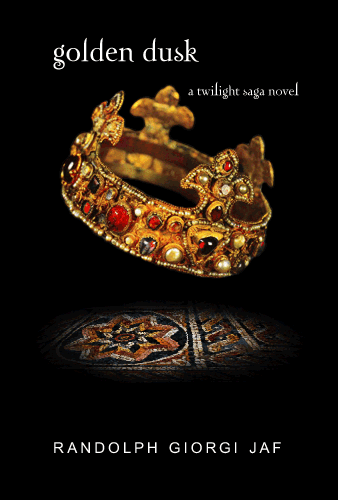
Some Fascinating Highlights from Golden Dusk
 |
| The cover of the new Twilight spinoff novel |
I know these were The Best Things because of a Best Thing I did recently. Ladies and Gentlemen, don't ask me how I did it, but I got an advance review copy, I got permission to finally spoil the cover image that everyone's been waiting to see, and I got a chance to pick over the subtext of the tale before anyone else.
And why, besides the fame and glory heaped upon me from on high, is this The Best Thing? Well, simply put, Golden Dusk is an incredibly fascinating and compelling book.
It is a work that many fans of the original series will probably hate, because it is a deep level deconstruction of what makes the original books tick, and an exploration of the implications of a world where vampires are glowing, luminous beings of temptation, werewolves are obsessives hiding in plain sight, and large institutions seem to have been utterly subverted by dark, ageless forces. It is everything the original books could have been but weren't. And instead of waiting till the last book to really expose its readers to the fucked up side of its author's psyche, these jump right in with author Randolph Georgi Jaf's translation of a certain medieval manuscript that I've mentioned on here before.1 So, its basically unromantic deconstructive nature is probably going to alienate a lot of fans, and its association with the original Twilight series and its cracked out concepts will probably inspire a lot of potential fans to steer clear.
Here's why you should check it out anyway:
Exhibit A: The Byzantine Vampire
Jaf takes the mythos in a fairly straightforward (if revolutionary) direction: the vampires are parasites cloaking themselves in the garb of Angels and Gods. There's something wonderfully perverse about this reversal of expectations, and the main antagonist/love interest (he is never named so I'm going to refer to him as The Byzantine Vampire in this article) seems to be a fascinatingly schizophrenic being, at once in love with his beauty and filled with hatred for the curse which forever separates him from humanity. This is, perhaps, one of the problems with the book--his "curse" hardly seems like much of a curse, after all. Too beautiful? Oh honey please. But his effect upon the plot is ultimately that of beautiful psychosis. The novel is explicitly designed to say, essentially, that we as readers are unable to escape the allure of such a being, but that this reaction is ultimately ruinous, and we are fools for believing anything good can come of it. So, first of all, come for the fascinating expansion of Meyer's core vampire concept.
Exhibit B: The Bella Stand In
...is a mess as a human being. She is tormented by her curse in a much more credible way than The Byzantine Vampire is, due to her religious convictions. She is obsessed with reclaiming her virtue and confuses her obsession with TBV with passionate love.2 Even within that, she is aware on some level that what she ultimately seeks is revenge, and there are a number of beautiful moments when she quite literally sharpens her blades while monologuing about undying love. I think she is still ultimately a very strong character in that she is willing to go to any lengths to reclaim her virtue--through either love or revenge. So, come for the deconstructive version of Bella that actually, you know, has a character.
And speaking of characters:
Exhibit C: The Vibrant Side Characters
C.1: Bartholomae and Cassie, the 40 year old werewolf and his 15 year old imprinted charge, locked permanently in a sort of warped, chaste-but-barely, Mutually Assured Destruction style codependency. It's a wonderful take down of the Jacob/Renesemsesmeeee... thing.
C.2: The Sybil of Cumae, a shriveled being that, as far as I can see, serves no thematic purpose, but should make fans of The Waste Land (or The Satyricon) squee with delight. I mean, come on, she's a prophetess that continues aging--unlike the Vampires--but is also immortal and slowly going insane. Yikes.
C.3: The Head of John the Baptist shows up at one point. I'm not even kidding. I won't spoil what's going on with him, but I will say that he isn't as quiet as you might expect from a decapitated head...
Everything here is either a logical extension and deconstruction of the original works, or a radical redefinition of traditional mythic figures on par with the radical redefinition of Vampires and Werewolves in the original series. In essence, everything that was bad about the originals has been horrifically deconstructed and everything that was compelling has been extended not simply by expanding the mythos of the originals but by utilizing the same strategy of totally screwing with the canon.
So, as far as I can see, that will mean that the books will be roundly hated by monster purists everywhere, and by Twilight purists everywhere, and ignored by pretty much everyone else but us dirty scholar types. Yuck. Scholarship.
But this ultimately really is a book that's worth checking out. Yes, its plotting is, at times, rather uneven. Yes, its language is dense on a level more akin to Borges or Lovecraft at his worse than to Meyer. And yes, sometimes Jaf goes chasing after totally bizarre ideas that have little or no bearing on the main plot. But for all that, it's a fascinating example of how a world can be expanded and reimagined by another author, and how the sharing of properties, even within the confines of what is ultimately a business deal, can and does produce fascinating art. It would be wonderful if more authors took Meyer's example to heart and opened their playgrounds up for others. I have to commend her for doing so; it really seems that she learned from the whole Midnight Sun kerfuffle that ultimately other people want to get involved in the world, and the writing and expansion of the world, and that's not something we should try to stifle.
Anyway, I'll get down off of my high horse, and you go preorder a copy in time for Christmas. Trust me, it's worth it.
Yes, I spent an hour and a half photoshopping a cover for a fake Twilight spinoff novel. Screw you, I'm awesome. As always, feel free to leave comments, complaints, or, best of all, your own interpretations, or e-mail me at keeperofmanynames@gmail.com . And, if you like what you've read here, share it on Facebook, Google+, Twitter, Xanga, Netscape, or whatever else you crazy kids are using to surf the blogoblag these days.
1 And can I just say--I'm thrilled that I predicted the hell out of that little development! And thrilled that Jaf has, apparently, done his homework on this one. It's definitely raised Jaf to, for me, on par with someone like Eco, Clarke, or Kostova
2 Ever heard a devout ex-virgin rationalize with a variation of the line, "If I marry him, it's ok?" Take that up to 11 and you have our main character.
Thursday, October 13, 2011
The Sparkle of the Icons of the Lord
I haven't talked about this much on here, but one of my minor interests is Byzantine art. Hence, for example, the Hagia Sophia example in my article on iconic color schemes. So, periodically, because I am a colossal nerd, I look through various books of art and manuscripts and architecture and so on. When looking through a book recently, I came across manuscript transcript, accompanied by images of the original text (which I need to scan in--I'll do that at the end of the month, probably). It's remarkable because it claims to be an actual account from Byzantium, an account written by a commoner, no less. And the content is pretty bizarre--more in line with modern urban fantasy than a medieval manuscript. The book I pulled the transcript from, though, claims that the manuscript was a hoax created by Anglo-Saxon missionaries as part of their cultural break away from the Byzantines in the East. Still, there are some elements to the tale that might be eerily familiar to modern readers.
Here is the transcription:
I once was a poor girl from a poor family, and we made our home in Constantinopolis, and my father and mother worked hard for the Glory of the Lord and for our food. I worked with them and prayed to God that misfortune should not take the blessing of my three siblings or my parents away from us, that we might continue to serve our Lord on this earth. I went to the basilica and saw the golden images of the Theotokos1 and Christ, I saw them built again in defiance of the image breakers2, and I saw the glory of God erected in light upon the walls, as though in a crystal. I was filled with the grace of God.
And then the Emperor was called back to the side of the Lord and the streets were filled with riotous fury as the successors rallied their sides. And in the chaos I lost my family, my mother, my father, my sisters, my brother. I walked through the burning streets of the city of God. For a day and a night I walked through the city of God, until it was morning once more. And there, in the road, I beheld a man, enshrouded all in hood and cloak of black.
He spoke to me: "Fear Not", and drew back his hood. And in the light of dawn his skin shone like an icon, and I knew that he was a Messenger of God.3 He gestured for me to follow, and I followed him back to a hermit's dwelling far outside the city of god. There, he named me chosen of God and led me in prayer. Our flesh became one flesh, our bone one bone. At the height of our ecstacy he pierced my throat with his teeth. He told me that my blood was holy blood, that my blood smelled of myrrh. He drank my blood as sacrament, as the blood of Christ, and took my body as the body of Christ. I was lost and fearful and believed in his splendor. I believed him and committed this sacrilege, and my body underwent awful transfiguration, and I was damned.
In the morning of the next day, he arose, sated, having given me his blood after drinking of mine, and he laughed at my nakedness and cast me out into the world, and I saw that my flesh was like unto the Angel's flesh, and like unto the icons of the Lord. And I wept and I hid from the sun out of fear.
And now a long century has passed and I behold the Emperor in his gold robes, and I see that his face is pale and his teeth are long, and I tremble, for here, in the City of God, rebellious Angels prey on the weak.
And I am so very thirsty.
As always, feel free to leave comments, complaints, or, best of all, your own interpretations, or e-mail me at keeperofmanynames@gmail.com . And, if you like what you've read here, share it on Facebook, Google+, Twitter, Xanga, Netscape, or whatever else you crazy kids are using to surf the blogoblag these days. Oh, and I'm looking for guest entries this month, so if you have something interesting to say about things that generally fit the theme, send them my way.
1The Mother of God, literally--the Virgin Mary, mother of Jesus Christ. Byzantine icon art is noted for its scintillating reflective properties, a sparkling quality attained by the overlaying of glass onto gold.
2Iconoclasts, who believed the worship of icons to be akin to Idolatry.
3A rather literal term for "Angel". Note that biblically angels tend to announce their presence with the same phrase here: Fear Not.
Here is the transcription:
I once was a poor girl from a poor family, and we made our home in Constantinopolis, and my father and mother worked hard for the Glory of the Lord and for our food. I worked with them and prayed to God that misfortune should not take the blessing of my three siblings or my parents away from us, that we might continue to serve our Lord on this earth. I went to the basilica and saw the golden images of the Theotokos1 and Christ, I saw them built again in defiance of the image breakers2, and I saw the glory of God erected in light upon the walls, as though in a crystal. I was filled with the grace of God.
And then the Emperor was called back to the side of the Lord and the streets were filled with riotous fury as the successors rallied their sides. And in the chaos I lost my family, my mother, my father, my sisters, my brother. I walked through the burning streets of the city of God. For a day and a night I walked through the city of God, until it was morning once more. And there, in the road, I beheld a man, enshrouded all in hood and cloak of black.
He spoke to me: "Fear Not", and drew back his hood. And in the light of dawn his skin shone like an icon, and I knew that he was a Messenger of God.3 He gestured for me to follow, and I followed him back to a hermit's dwelling far outside the city of god. There, he named me chosen of God and led me in prayer. Our flesh became one flesh, our bone one bone. At the height of our ecstacy he pierced my throat with his teeth. He told me that my blood was holy blood, that my blood smelled of myrrh. He drank my blood as sacrament, as the blood of Christ, and took my body as the body of Christ. I was lost and fearful and believed in his splendor. I believed him and committed this sacrilege, and my body underwent awful transfiguration, and I was damned.
In the morning of the next day, he arose, sated, having given me his blood after drinking of mine, and he laughed at my nakedness and cast me out into the world, and I saw that my flesh was like unto the Angel's flesh, and like unto the icons of the Lord. And I wept and I hid from the sun out of fear.
And now a long century has passed and I behold the Emperor in his gold robes, and I see that his face is pale and his teeth are long, and I tremble, for here, in the City of God, rebellious Angels prey on the weak.
And I am so very thirsty.
As always, feel free to leave comments, complaints, or, best of all, your own interpretations, or e-mail me at keeperofmanynames@gmail.com . And, if you like what you've read here, share it on Facebook, Google+, Twitter, Xanga, Netscape, or whatever else you crazy kids are using to surf the blogoblag these days. Oh, and I'm looking for guest entries this month, so if you have something interesting to say about things that generally fit the theme, send them my way.
1The Mother of God, literally--the Virgin Mary, mother of Jesus Christ. Byzantine icon art is noted for its scintillating reflective properties, a sparkling quality attained by the overlaying of glass onto gold.
2Iconoclasts, who believed the worship of icons to be akin to Idolatry.
3A rather literal term for "Angel". Note that biblically angels tend to announce their presence with the same phrase here: Fear Not.
Monday, October 3, 2011
Hands of Fate... or Hands of Poor Life Choices?
Normally I don't do broad, overarching movie reviews--I tend to focus more on particular scenes or themes within a movie--but I thought I would kick off my month long celebration of the spooky, strange, and uncanny with one of the most incredible films of the last few years: Manos. Of course, everyone and their grandmother has been praising the film since July, but I want to take a look at some of the deeper character interactions and decisions.
The first thing worth noting is the way the film takes advantage of the immigration debate. I'll be picking out the particular scenes where this theme emerges, but the most obvious place is the title--"Manos": "the hands". It's no accident that the title is Spanish, just as it is no accident that the action takes place somewhere in the American southwest.
It's also no accident that the majority of the initial character building takes place on the road, distant from the house where the action takes place. This is more a suspense than a horror film, in that respect. It takes the time to lavish attention on each character--from the weak and vapidly religious Margaret, to the arrogant, hypermasculine Michael, to the spacy and disconnected child Debbie. The scene where Michael asks for directions, in particular, tells us a lot about his wild west attitude and macho persona (and of his antipathy toward the migrant workers they run into), which Margaret simply quietly accepts.
The strangeness of the house itself is very subtly done, and reminds me a little of similar techniques used in the much lower budget Marble Hornets. Torgo's fateful, bizarre mantra of "It'll be dark soon; there's no way out of here" is visually demonstrated by the seeming single shot out the car window of Michael driving away from the house only to arrive back at the same spot while Margaret becomes more and more panicked.
And then, of course, you have Torgo himself.
Ah, Torgo. What can we say about Torgo?
This is probably the most interesting role that Ledger has done since The Joker, and, in some ways, it works quite well as a reprise. He's again playing a psychologically disturbed character that he imbibes with incredible depth and complexity through extremely minor cues of posture and intonation. The difference is that while previously Ledger was playing a genius improviser that constantly tried to stay on top, here he plays a stuttering, emotionally broken hybrid between man and beast.1 It's worth noting that Ledger's skin here is darkened and tanned so that he begins to resemble the other migrant worker characters. Again, the movie is playing on Michael's--and the audience's--fears here.
This helps explain some of the more overtly unsettling sexual elements of the film. Consider, for example, the unconscious Brides. Or blank-eyed Debbie lounging in a disturbingly provocative way with the massive black dogs. Or the hands that grope both Margarette and Michael in the night.
The key to all of this is the fact that the real menace comes from the pale white Master, played magnificently by an almost unrecognizeable Orlando Bloom. The whole movie has set itself up as a masterpiece of xenophobia, after all, so when the Master finally awakens and turns out to be a well-spoken, white, aristocratic American lad, the audience's perception of the film totally reverses. The latter third of the film is a complete deconstruction of the beginning two thirds, with Torgo attempting (and, of course, failing) to act as Margarette's savior2 and, of course, the Rescue scene, where the seeds Michael sewed at the beginning of the film come to harvest. As Michael staggers through the desert, he sees a light of a truck. It is the Mexican truck from earlier in the film. We get that one shot of the cop and the migrant worker talking, they notice Michael, and, with a look of condemnation, they simply shut off the headlights. And Michael is lost in the noneuclidean desert once more.
What do we learn from all this, then? Well, the movie was clearly marketed to middle class white Americans, and I think the undertones of racial fear and tension are pretty clear. The deconstructive ending suggests quite strongly to me that the filmmakers intended us to see Michael and company as proxies for our own fears, and when they are punished for their bigotry, their arrogance, and their inability to see past the immediate to the powerful people that pull the strings, we are punished as well. This is a film that doesn't want to make friends with its audience. This is the second meaning of the title: "Manos" is not just the worker's description of The Master, or Torgo's dark, schizophrenic faith, or even, as the promotional material suggests, the hands that pull the strings of each of the characters. The hands pull our strings as well, and like puppets we dance to the tune of this brilliantly manipulative film.
1Incidentally, he's been compared to a faun, but that seems like a rather odd anachronism given the tightly composed nature of the film. I would note, rather, the way he looks kind of like a hairless, faintly scaly rat, and note the way he grasps and stutters and licks his lips with that long tongue, and suggest that perhaps he is meant to be a Chubacabra.
2The image of Torgo, burning and melting, his face a rictus of fury, and the blackened hand marks on The Master's neck, strike me as some of the best film images from the past few years...
I feel that it is fitting, somehow, that I am beginning this spooky month with a ghost film. And, of course, with an exercise in mindbending confusion. If you're curious about the real "Manos" The Hands of Fate I highly recommend watching the classic MST3K version. As always, feel free to leave comments, complaints, or, best of all, your own interpretations, or e-mail me at keeperofmanynames@gmail.com . And, if you like what you've read here, share it on Facebook, Google+, Twitter, Xanga, Netscape, or whatever else you crazy kids are using to surf the blogoblag these days. Oh, and I'm looking for guest entries this month, so if you have something interesting to say about things that generally fit the theme, send them my way.
The first thing worth noting is the way the film takes advantage of the immigration debate. I'll be picking out the particular scenes where this theme emerges, but the most obvious place is the title--"Manos": "the hands". It's no accident that the title is Spanish, just as it is no accident that the action takes place somewhere in the American southwest.
It's also no accident that the majority of the initial character building takes place on the road, distant from the house where the action takes place. This is more a suspense than a horror film, in that respect. It takes the time to lavish attention on each character--from the weak and vapidly religious Margaret, to the arrogant, hypermasculine Michael, to the spacy and disconnected child Debbie. The scene where Michael asks for directions, in particular, tells us a lot about his wild west attitude and macho persona (and of his antipathy toward the migrant workers they run into), which Margaret simply quietly accepts.
The strangeness of the house itself is very subtly done, and reminds me a little of similar techniques used in the much lower budget Marble Hornets. Torgo's fateful, bizarre mantra of "It'll be dark soon; there's no way out of here" is visually demonstrated by the seeming single shot out the car window of Michael driving away from the house only to arrive back at the same spot while Margaret becomes more and more panicked.
And then, of course, you have Torgo himself.
Ah, Torgo. What can we say about Torgo?
This is probably the most interesting role that Ledger has done since The Joker, and, in some ways, it works quite well as a reprise. He's again playing a psychologically disturbed character that he imbibes with incredible depth and complexity through extremely minor cues of posture and intonation. The difference is that while previously Ledger was playing a genius improviser that constantly tried to stay on top, here he plays a stuttering, emotionally broken hybrid between man and beast.1 It's worth noting that Ledger's skin here is darkened and tanned so that he begins to resemble the other migrant worker characters. Again, the movie is playing on Michael's--and the audience's--fears here.
This helps explain some of the more overtly unsettling sexual elements of the film. Consider, for example, the unconscious Brides. Or blank-eyed Debbie lounging in a disturbingly provocative way with the massive black dogs. Or the hands that grope both Margarette and Michael in the night.
The key to all of this is the fact that the real menace comes from the pale white Master, played magnificently by an almost unrecognizeable Orlando Bloom. The whole movie has set itself up as a masterpiece of xenophobia, after all, so when the Master finally awakens and turns out to be a well-spoken, white, aristocratic American lad, the audience's perception of the film totally reverses. The latter third of the film is a complete deconstruction of the beginning two thirds, with Torgo attempting (and, of course, failing) to act as Margarette's savior2 and, of course, the Rescue scene, where the seeds Michael sewed at the beginning of the film come to harvest. As Michael staggers through the desert, he sees a light of a truck. It is the Mexican truck from earlier in the film. We get that one shot of the cop and the migrant worker talking, they notice Michael, and, with a look of condemnation, they simply shut off the headlights. And Michael is lost in the noneuclidean desert once more.
What do we learn from all this, then? Well, the movie was clearly marketed to middle class white Americans, and I think the undertones of racial fear and tension are pretty clear. The deconstructive ending suggests quite strongly to me that the filmmakers intended us to see Michael and company as proxies for our own fears, and when they are punished for their bigotry, their arrogance, and their inability to see past the immediate to the powerful people that pull the strings, we are punished as well. This is a film that doesn't want to make friends with its audience. This is the second meaning of the title: "Manos" is not just the worker's description of The Master, or Torgo's dark, schizophrenic faith, or even, as the promotional material suggests, the hands that pull the strings of each of the characters. The hands pull our strings as well, and like puppets we dance to the tune of this brilliantly manipulative film.
1Incidentally, he's been compared to a faun, but that seems like a rather odd anachronism given the tightly composed nature of the film. I would note, rather, the way he looks kind of like a hairless, faintly scaly rat, and note the way he grasps and stutters and licks his lips with that long tongue, and suggest that perhaps he is meant to be a Chubacabra.
2The image of Torgo, burning and melting, his face a rictus of fury, and the blackened hand marks on The Master's neck, strike me as some of the best film images from the past few years...
I feel that it is fitting, somehow, that I am beginning this spooky month with a ghost film. And, of course, with an exercise in mindbending confusion. If you're curious about the real "Manos" The Hands of Fate I highly recommend watching the classic MST3K version. As always, feel free to leave comments, complaints, or, best of all, your own interpretations, or e-mail me at keeperofmanynames@gmail.com . And, if you like what you've read here, share it on Facebook, Google+, Twitter, Xanga, Netscape, or whatever else you crazy kids are using to surf the blogoblag these days. Oh, and I'm looking for guest entries this month, so if you have something interesting to say about things that generally fit the theme, send them my way.
Wednesday, September 21, 2011
Approach
A white burst of lightning strobes downward and God rears His head in the sky.
He is colossal,
Implacable, steel and
Thunder.
Within him ride Angels, quick for the hunt.
Do you recall a time when they were as we are?
--Humans?
--Mortals?
As we trade our guns, so they traded numbers, on vast howling engines in our once great cities. And they traded their numbers to the ancient Gene Witches. They trialed and they errored and a whole generation of beautiful beings was born--
Beautiful boys--
Beautiful girls--
Their faces were unmarked as ours, their minds were so quick like the vast howling engines in our once great cities, their bodies so strong and so slender.
Ah, and here are their eyes, open to us now, as their colossal god eclipses the sky. Their eyes shine down rays of God's love to his children.
Their eyes shine like the sun.
Do you recall the sun? Once all the sky was alight with a warmth that let our crops grow.
Now deep beneath our old city
Moloch
Breaths his fire and the plants of the Gene Witches feed from his warmth.
Look, how the Gene Witch's hut sinks into its mire. God does not suffer a Gene Witch to live. Not anymore. Only the Witchminds,
Bred from the vats of
Angels, live in the core of
God, closest to His light and heat.
And see, the Capital sinks as well, protected from the Angels.
Do you recall music from before the Gods rose into the sky and we were left here to our once great city, and the Old Gods beneath the earth, and the old howling engines and Gene Witches?
Music before the Blessed Mixers found their beats of calamity and the Bravers fought angels? They music they played says nothing to us about our lives,
And so they mixed a new beat for our scattered tribes.
See, all the eyes are sinking to earth, and the ships of the Angels approach, bringing the
Witchminds, and the
Huntsmen, and the
Threshing dogs, and the
Whip guns. And the
Blessed Mixer will mix his beats, and the
Bravers will Brave against the Angels, and if
We are lucky and the
Howling engines bless us, we may
Capture a whip gun
For ourselves.
But now me must go in and hide, or be harvested for our Stems.
Lead me inside, girl,
Out of this storm.
And tomorrow, if the Bravers do not win, we will hang the Blessed Mixer.
So tell me again why there isn't more Science Fiction Poetry? As always, feel free to leave comments, complaints, or, best of all, your own interpretations, or e-mail me at keeperofmanynames@gmail.com . And, if you like what you've read here, share it on Facebook, Google+, Twitter, Xanga, Netscape, or whatever else you crazy kids are using to surf the blogoblag these days.
He is colossal,
Implacable, steel and
Thunder.
Within him ride Angels, quick for the hunt.
Do you recall a time when they were as we are?
--Humans?
--Mortals?
As we trade our guns, so they traded numbers, on vast howling engines in our once great cities. And they traded their numbers to the ancient Gene Witches. They trialed and they errored and a whole generation of beautiful beings was born--
Beautiful boys--
Beautiful girls--
Their faces were unmarked as ours, their minds were so quick like the vast howling engines in our once great cities, their bodies so strong and so slender.
Ah, and here are their eyes, open to us now, as their colossal god eclipses the sky. Their eyes shine down rays of God's love to his children.
Their eyes shine like the sun.
Do you recall the sun? Once all the sky was alight with a warmth that let our crops grow.
Now deep beneath our old city
Moloch
Breaths his fire and the plants of the Gene Witches feed from his warmth.
Look, how the Gene Witch's hut sinks into its mire. God does not suffer a Gene Witch to live. Not anymore. Only the Witchminds,
Bred from the vats of
Angels, live in the core of
God, closest to His light and heat.
And see, the Capital sinks as well, protected from the Angels.
Do you recall music from before the Gods rose into the sky and we were left here to our once great city, and the Old Gods beneath the earth, and the old howling engines and Gene Witches?
Music before the Blessed Mixers found their beats of calamity and the Bravers fought angels? They music they played says nothing to us about our lives,
And so they mixed a new beat for our scattered tribes.
See, all the eyes are sinking to earth, and the ships of the Angels approach, bringing the
Witchminds, and the
Huntsmen, and the
Threshing dogs, and the
Whip guns. And the
Blessed Mixer will mix his beats, and the
Bravers will Brave against the Angels, and if
We are lucky and the
Howling engines bless us, we may
Capture a whip gun
For ourselves.
But now me must go in and hide, or be harvested for our Stems.
Lead me inside, girl,
Out of this storm.
And tomorrow, if the Bravers do not win, we will hang the Blessed Mixer.
So tell me again why there isn't more Science Fiction Poetry? As always, feel free to leave comments, complaints, or, best of all, your own interpretations, or e-mail me at keeperofmanynames@gmail.com . And, if you like what you've read here, share it on Facebook, Google+, Twitter, Xanga, Netscape, or whatever else you crazy kids are using to surf the blogoblag these days.
Tuesday, September 13, 2011
Some Ways Of Reading Gaga, Part II: Love and the Empire
Following the chaos and unrest of the early 21st century, following the redrawing of national borders, a number of small but strong military states rise. One such state--a totalitarian nation under the control of an army which was, in turn under the control of one powerful and charismatic woman--stands above the rest in infamy.

It's characteristics are:

The lack of records outside of the state's officially sanctioned datafiles makes any reconstruction of the character of the queen difficult, at best, but a few facts stand out:
Anecdotal evidence suggests that she begins her career as a singer in a bar frequented by soldiers, whether mercenary or otherwise (the oddly mismatched uniforms suggest that they were not a part of any official military force). She rises to power with a number of highly trusted individuals, including the other central figure in this narrative--Alejandro, chief among her lovers and supporters; a disillusioned and dour young soldier that pledges his loyalty to a woman that was to become a subject of devotion.

At some point, the violence and authoritarianism of her new regime becomes too much for the now even more disillusioned soldier, and he attempts to make contact with the resistance. In order to prevent this high-level defection from disrupting her power, the queen orders Alejandro's death. In the middle of a riot, the soldier is assassinated by rebel agents--actually unwitting sleepers under the command of the queen's secret service. Alejandro's death and lavish state funeral is used to galvanize the state's armies and the resistance is crushed. The queen coldly pays her last farewells to her former love, and relinquishes the last scraps of her humanity.

Wait... What?
If you hadn't guessed from the title, it's time for the second of my three part series, Some Ways Of Reading Gaga. Last time, if you recall, I discussed the concept of a Close Reading, and how it can be applied to something like, say, a Lady Gaga video in order to make the work both more understandable, and more enjoyable.
Tonight, I will be doing the same general thing with the video for "Alejandro", and I will be, to some extent, talking about close reading. But this time I want to talk a bit more specifically about decoding a work of staggering strangeness. Surely you've come across something like that before--a story or a poem or a movie that's just so damn odd that you really can't even grasp at a plotline, let alone any sort of deeper meaning. Some works (I'm looking at you, The Waste Land. And don't think I don't see you rolling up a spitball in the back corner, Andalusian Dog!) just seem to thumb their nose at any attempt to draw a coherent order out of the fractured images. It's quite probable that the authors never intended there to be a coherent narrative, and looking for one is like jousting with windmills.
However, that state of confusion gives us an incredible freedom. It is the freedom to construct narratives that are useful to us, rather than trying to piece together every single scrap of information. And, sure, these stories might be a bit of a stretch, and I can already hear the swirling beer and muttering in response to this article, but the end result of this sort of critique is that we have a bit of a better sense of some of the stuff going on in the work. The wonderful thing about this is that once we have the narrative, we can start to talk about what that implies about the work, and then later on we can just ditch the narrative while keeping the different insights we've gained.
Besides, this sort of thing is fun.
Care to delve a little deeper?
Alright, Where Is This Story Coming From?
A lot of this comes from my decision to just see where a leap of intuition took me. I've found that such leaps are one of the most valuable ways of generating ideas in the liberal arts--by training yourself to explore and argue for crazy ideas you end up training yourself to think outside of the box. With that in mind, I'm going to try to go through the video scene by scene and point out where my story maps onto the video.
We begin with a number of fractured images with no real sense of order or narrative. We have the shot of the marching soldiers from the beginning, with their bizarre, large, alchemical-looking symbols; we have the shot of Gaga sitting regally beside some general, both their eyes hidden from view, and we get the shots of the funeral procession and the... heart? maybe? sitting on a pillow and stuck with pins. This is strange stuff. It's even weirder than Bad Romance was. But we can already begin to see some of what's coming.
We know, for example, that there's a funeral of some sort. And, if we put that together with the shot of Gaga in a place of authority, we can surmise that this is a rather important funeral--important enough that someone as powerful as Gaga appears to be here would end up walking in front of the coffin. Interesting. We also can get a sense of the type of military that we're dealing with here. It's a cultlike organization, full of strange rituals and stranger dance routines. We're going to have to piece together what's going on, but for now that's a pretty decent start.
Oh, and, of course, there's that opening shot of the bar, with soldiers in drag. Beyond the fetish fuel here, it's worth noting that the one really awake, aware figure is the guy that will reappear in a few more closeups later. This immediately, albeit subtly and perhaps unconsciously, sets him up for a Main Character slot.
Let's go on, shall we?
We get a lot of shots here in this first verse of the actual training exercises of Gaga's loyal troops, giving us a sense of the extreme emphasis on masculinity. This is, of course, a characteristic of quite a few fascist movements--I'll expand on this idea more next week. It's interesting that we only see Gaga fully remove the goggles of her queen outfit around the 3 minute mark. In this context, I think the odd eyewear is clearly used to put a barrier between her and the audience. If the eyes are the window of the soul, she's drawing the curtains shut.
The second verse and chorus is much the same--with a more overt bondage subtheme woven in. Fanservice or artistic idea? Hm, I leave that up to the viewer to decide. After the second verse things get quite interesting, though, as Gaga really shows off her bizarre nun habit. Remember last time when I talked about the red cross on a white ground? Well, she's doing it again here. Granted, the cross is covering her crotch this time, but it's still there. A rather interesting development. Also note that the black and white footage of combat has shifted to color--perhaps an indication that the footage is getting closer to the present day. Here we get a sense again of the cultlike nature of this army, and their apparent absolute devotion to Gaga.
We then get a brief glimpse of Gaga at her most human. I find this scene particularly interesting because of the way it juxtaposes the more normal looking Gaga with the oncoming line of martial, threatening soldiers. I think this could be read as the transformation of Gaga from a fairly normal individual into the cold, ruthless general we see elsewhere in the video. This sense is enhanced by the fact that the very next scene takes place in the same location but now Gaga is completely surrounded by her soldiers--decked out in black, with red arm bands, conjuring images of the SS and various comic-book fascist enemies--and she has been transformed into a... a...
I don't know, what would you call someone that wears machine guns on her boobs? Honestly, I can't really think of a suitable word.
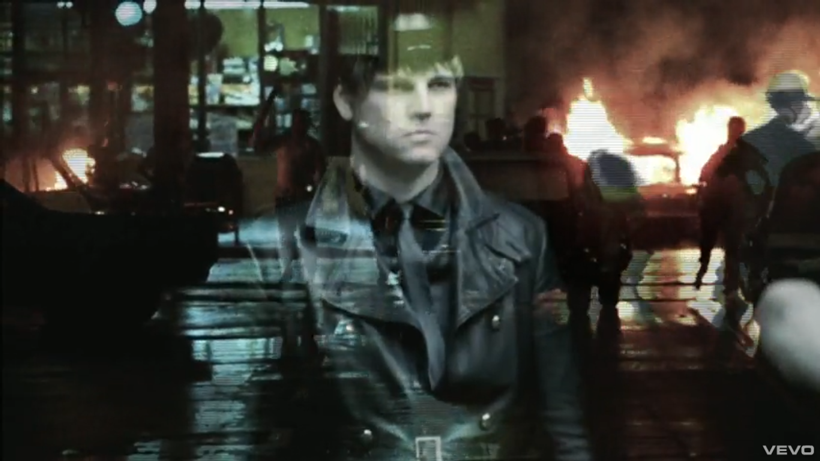
And now we get into the meat of the video, where the greatest density of information is shown. There are a few things that indicate to me that this is a flashback: the difference in style (note the collage effects over our Main Character, and the fact that Gaga is, again, relatively sensibly dressed); the fact that Gaga here is shown just as a lowly singer, not a person who commands devoted cult soldiers; the use of footage similar to what we saw playing in the background earlier. I'm reconstructing the narrative like this: Gaga began her career as a singer. That seems to line up with the symbolic transformation I talked about earlier. We also get a few shots of Gaga training her troops more directly--apparently this training involves a disturbing amount of physical abuse.

Our boy, Alejandro, I've dubbed him, is shown with a thousand-mile stare, clearly contemplating something rather weighty. We know that he is already a part of Gaga's armies at this point, because he's wearing the uniforms seen in other shots. He seems to look on during the training and, slowly, coming to a decision, he removes his cap--a symbolic gesture that is pretty easy to read as an act of defiance and defection from decadence.
The rest--the assassination, the staged funeral, the crackdown on the rebels, and so on--is pure conjecture on my part, but boy, it sure does explain a lot of what we saw in the first few minutes of the video, doesn't it? This act of defiance from Alejandro is what dooms him, and the state funeral is, of course, the ultimate irony--in death, he supports the totalitarian regime that in life he attempted to escape.
Before I go, I'll leave you with one last story-related thought. At the beginning of the actual song, the first words are "I know that we are young, and I know that you may love me... but I just can't be with you like this anymore, Alejandro!" Note that this is pronounced as Gaga stands in front of the coffin of the man that, in my narrative, she has sentenced to death for the glory of the state. Let those lines roll around in your head a bit.

They certainly do take on a bit of a different meaning, don't they? The song, with this interpretation, becomes a bitterly ironic echo of the humanity that Gaga once had, but discarded in her quest for power. It is the narrative of a person that existed long before the events of the video, and now can never be resurrected. In the last moments of the film, Gaga's face ignites from the inside in a symbolic burning away of the last shreds of her humanity.
--------------------------------------------------------------------------
There's a bit more to do with this video, but I'm going to leave that till next time, when I'll also be discussing Judas and the concept of symbolism as it appears in the two videos. That should round things off, but you never know, this might spread out into a four part series. As always, feel free to leave comments, complaints, or, best of all, your own interpretations. And, if you like what you've read here, share it on Facebook, Google+, Twitter, Xanga, Netscape, or whatever else you crazy kids are using to surf the blogoblag these days.

It's characteristics are:
- A dynamic cult of masculinity that appears to have developed out of the late 20th century bondage subculture.
- Force, power, virility, and sexual prowess valued above all
- Religious devotion to the androgynous queen/general figure that heads the state
- A hypersexualized combat training augmented by a set of ritualistic signs and ceremonies, not unlike Masonic or Rosecrucian orders of the past

The lack of records outside of the state's officially sanctioned datafiles makes any reconstruction of the character of the queen difficult, at best, but a few facts stand out:
Anecdotal evidence suggests that she begins her career as a singer in a bar frequented by soldiers, whether mercenary or otherwise (the oddly mismatched uniforms suggest that they were not a part of any official military force). She rises to power with a number of highly trusted individuals, including the other central figure in this narrative--Alejandro, chief among her lovers and supporters; a disillusioned and dour young soldier that pledges his loyalty to a woman that was to become a subject of devotion.

At some point, the violence and authoritarianism of her new regime becomes too much for the now even more disillusioned soldier, and he attempts to make contact with the resistance. In order to prevent this high-level defection from disrupting her power, the queen orders Alejandro's death. In the middle of a riot, the soldier is assassinated by rebel agents--actually unwitting sleepers under the command of the queen's secret service. Alejandro's death and lavish state funeral is used to galvanize the state's armies and the resistance is crushed. The queen coldly pays her last farewells to her former love, and relinquishes the last scraps of her humanity.

Wait... What?
If you hadn't guessed from the title, it's time for the second of my three part series, Some Ways Of Reading Gaga. Last time, if you recall, I discussed the concept of a Close Reading, and how it can be applied to something like, say, a Lady Gaga video in order to make the work both more understandable, and more enjoyable.
Tonight, I will be doing the same general thing with the video for "Alejandro", and I will be, to some extent, talking about close reading. But this time I want to talk a bit more specifically about decoding a work of staggering strangeness. Surely you've come across something like that before--a story or a poem or a movie that's just so damn odd that you really can't even grasp at a plotline, let alone any sort of deeper meaning. Some works (I'm looking at you, The Waste Land. And don't think I don't see you rolling up a spitball in the back corner, Andalusian Dog!) just seem to thumb their nose at any attempt to draw a coherent order out of the fractured images. It's quite probable that the authors never intended there to be a coherent narrative, and looking for one is like jousting with windmills.
However, that state of confusion gives us an incredible freedom. It is the freedom to construct narratives that are useful to us, rather than trying to piece together every single scrap of information. And, sure, these stories might be a bit of a stretch, and I can already hear the swirling beer and muttering in response to this article, but the end result of this sort of critique is that we have a bit of a better sense of some of the stuff going on in the work. The wonderful thing about this is that once we have the narrative, we can start to talk about what that implies about the work, and then later on we can just ditch the narrative while keeping the different insights we've gained.
Besides, this sort of thing is fun.
Care to delve a little deeper?
Alright, Where Is This Story Coming From?
A lot of this comes from my decision to just see where a leap of intuition took me. I've found that such leaps are one of the most valuable ways of generating ideas in the liberal arts--by training yourself to explore and argue for crazy ideas you end up training yourself to think outside of the box. With that in mind, I'm going to try to go through the video scene by scene and point out where my story maps onto the video.
We begin with a number of fractured images with no real sense of order or narrative. We have the shot of the marching soldiers from the beginning, with their bizarre, large, alchemical-looking symbols; we have the shot of Gaga sitting regally beside some general, both their eyes hidden from view, and we get the shots of the funeral procession and the... heart? maybe? sitting on a pillow and stuck with pins. This is strange stuff. It's even weirder than Bad Romance was. But we can already begin to see some of what's coming.
 |
| WHEN I WAS! A YOUNG BOY! |
Oh, and, of course, there's that opening shot of the bar, with soldiers in drag. Beyond the fetish fuel here, it's worth noting that the one really awake, aware figure is the guy that will reappear in a few more closeups later. This immediately, albeit subtly and perhaps unconsciously, sets him up for a Main Character slot.
|
| Alejandro: The Unknown Sadsack |
We get a lot of shots here in this first verse of the actual training exercises of Gaga's loyal troops, giving us a sense of the extreme emphasis on masculinity. This is, of course, a characteristic of quite a few fascist movements--I'll expand on this idea more next week. It's interesting that we only see Gaga fully remove the goggles of her queen outfit around the 3 minute mark. In this context, I think the odd eyewear is clearly used to put a barrier between her and the audience. If the eyes are the window of the soul, she's drawing the curtains shut.
 |
| Frankly, the whole video could have just been scenes like this. |
The second verse and chorus is much the same--with a more overt bondage subtheme woven in. Fanservice or artistic idea? Hm, I leave that up to the viewer to decide. After the second verse things get quite interesting, though, as Gaga really shows off her bizarre nun habit. Remember last time when I talked about the red cross on a white ground? Well, she's doing it again here. Granted, the cross is covering her crotch this time, but it's still there. A rather interesting development. Also note that the black and white footage of combat has shifted to color--perhaps an indication that the footage is getting closer to the present day. Here we get a sense again of the cultlike nature of this army, and their apparent absolute devotion to Gaga.
We then get a brief glimpse of Gaga at her most human. I find this scene particularly interesting because of the way it juxtaposes the more normal looking Gaga with the oncoming line of martial, threatening soldiers. I think this could be read as the transformation of Gaga from a fairly normal individual into the cold, ruthless general we see elsewhere in the video. This sense is enhanced by the fact that the very next scene takes place in the same location but now Gaga is completely surrounded by her soldiers--decked out in black, with red arm bands, conjuring images of the SS and various comic-book fascist enemies--and she has been transformed into a... a...
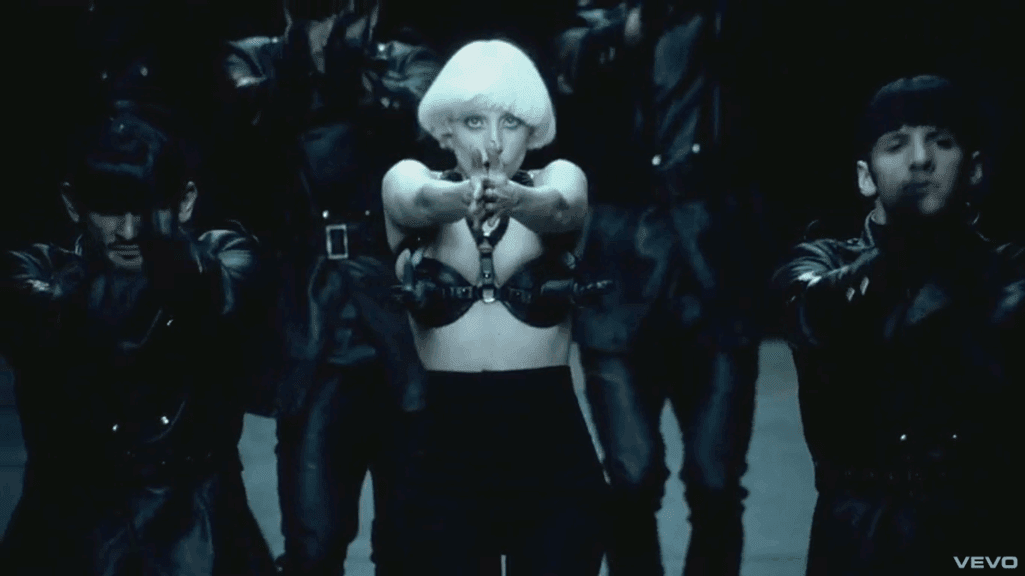 |
| This. |
And now we get into the meat of the video, where the greatest density of information is shown. There are a few things that indicate to me that this is a flashback: the difference in style (note the collage effects over our Main Character, and the fact that Gaga is, again, relatively sensibly dressed); the fact that Gaga here is shown just as a lowly singer, not a person who commands devoted cult soldiers; the use of footage similar to what we saw playing in the background earlier. I'm reconstructing the narrative like this: Gaga began her career as a singer. That seems to line up with the symbolic transformation I talked about earlier. We also get a few shots of Gaga training her troops more directly--apparently this training involves a disturbing amount of physical abuse.

 |
| AH! DON'T HURT ME |
 |
| Alejandro Goes To London |
The rest--the assassination, the staged funeral, the crackdown on the rebels, and so on--is pure conjecture on my part, but boy, it sure does explain a lot of what we saw in the first few minutes of the video, doesn't it? This act of defiance from Alejandro is what dooms him, and the state funeral is, of course, the ultimate irony--in death, he supports the totalitarian regime that in life he attempted to escape.
Before I go, I'll leave you with one last story-related thought. At the beginning of the actual song, the first words are "I know that we are young, and I know that you may love me... but I just can't be with you like this anymore, Alejandro!" Note that this is pronounced as Gaga stands in front of the coffin of the man that, in my narrative, she has sentenced to death for the glory of the state. Let those lines roll around in your head a bit.

They certainly do take on a bit of a different meaning, don't they? The song, with this interpretation, becomes a bitterly ironic echo of the humanity that Gaga once had, but discarded in her quest for power. It is the narrative of a person that existed long before the events of the video, and now can never be resurrected. In the last moments of the film, Gaga's face ignites from the inside in a symbolic burning away of the last shreds of her humanity.
--------------------------------------------------------------------------
There's a bit more to do with this video, but I'm going to leave that till next time, when I'll also be discussing Judas and the concept of symbolism as it appears in the two videos. That should round things off, but you never know, this might spread out into a four part series. As always, feel free to leave comments, complaints, or, best of all, your own interpretations. And, if you like what you've read here, share it on Facebook, Google+, Twitter, Xanga, Netscape, or whatever else you crazy kids are using to surf the blogoblag these days.
Sunday, September 11, 2011
Theater of Cruelty--Some Unpublished Images
Today there was a memorial service on campus. The students and faculty joined together as a sign of unity, arrayed in a circle, all holding hands. It was an attempt torecognize a community that "live[s] as a unified body, while acknowledging our uniqueness as individuals." Or so I hear. When I arrived, the crowd had already begun to disperse. The clouds rolled in, and I walked down the hill by the still-flooded waters and thought.
------------------------------------------------------------------------------------------------
I remember distinctly, as I sat and I typed out the last few citations, formatted the last few images, the sound of the chanting from down below. The letters recited; the anthems all chorused. And, of course, the trumpet. That damn drunken trumpet. It wasn't any sort of majestic sound. It was just a hollow blat, bursting out drunkenly as the player staggered back and forth outside my window. I stared down at an image of a colossal shoe suspended in air, ready to crash down upon New York City. And for the life of me, I could not decide whether to laugh or to cry.
------------------------------------------------------------------------------------------
At the end of the First World War, in the wake of the pillaging, and the futile grind of the trenches, and the epidemics that swept the land, two new schools of art, born of madness, emerged in Europe. They were Dada and Surrealism, and they were both a reaction to the collapse of the system of the world. Dada embraced the idea that meaning had been utterly lost, and that the ideals of the Enlightenment and rational western society had collapsed in upon themselves. It was an expression of madness loosed upon the world. Its greatest artists--people like Marcel Duchamp, Hannah Hoch, and George Grosz--freely attacked any and every target, lampooning everything from sexuality in the age of the machine (Duchamp's "The Bride Stripped Bare By Her Bachelors, Even"), the arbitrary nature of scientific standards (Duchamp, again: "Standard Stoppages" sets up a system of measurement based on randomness), to the shiny new order of consumer culture (Check out virtually anything by Hannah Hoch), or the pathetic weakness of the political regimes of the period between the wars (Grosz's acerbic work fits in here--he really had it in for the Weimar Republic). The great message is that there is no great message, and all art in the face of inhuman tragedy is barbarism.
On the other side of tragedy lurked Surrealism, the warped, basement-dwelling introspective brother of Dada. The surrealists sought to express, unfettered, uncontained, the murky depths of the human subconscious. They dwelled on images of mantises consuming the heads of their lovers, of slit eyeballs, masturbation, hoards of barbarians roiling across nightmare landscapes, dismembered bodies, and on and on. While Dada attacked the external world, Surrealism descended ever inward, seeking the underpinnings of the human mind, drawing from the young science of psychology in their quests.
What the movements shared, then, was a reaction to tragedy, a fragmented and disturbing set of visual tropes, an obsession with the comforting and familiar turned strange and threatening, and a growing disillusionment with the supposedly rational behavior of humans in general, and leaders in particular.
-------------------------------------------------------------------------------------
I cannot remember the attacks myself; not clearly, anyway. I was 10 at the time, and my parents and teachers nobly shielded me from all but the vaguest images and information. I remember just--only--a sense of confusion, a wondering just what the big deal was. Scuffing my shoes in the mulch of the playground, watching movement of those worried faces, I was displaced for the next several years.
--------------------------------------------------------------------------------------
It is 80 years since then. Art Spiegelman has become a famous man. His masterpiece, Maus, has helped to catapult comics out of the scrappy heap--into the critical eye of the world. Amidst all this growing of fame and importance, the comicker, convinced that oblivion is nigh, begins to create a series of plates titled In The Shadow Of No Towers. They're a nightmarish reenactment of his journey through the city of New York on September 11th of 2001, and of the political and personal upheaval. Their central image is a vision of two luminous, skeletal towers. Their targets for satire and anger include everyone from the monstrous perpetrators of the acts, to the political establishment that took advantage of the assault, to anirony-blind media, to complacent citizenry, to Spiegelman's own neurotic persona. In these strange pages, the ghosts of Dada and Surrealism reemerge, specters of the madness of the 20th century, reassembling their skeletons and collages and nightmare visions. Spiegelman is haunted by things that he did not see, and these ghosts fill the void.
-----------------------------------------------------------------------------------------
On the day that Osama bin Laden was announced dead--killed in Pakistan--I sat at my desk typing an essay on Dada, Surrealism, and the echoes of 20th century art within Spiegelman's work. I sought to explain why the work is so difficult, and yet is so resonant. I saw, within its pages, my own confusion, displacement, and ambivalence. And then the news came in. I was floored. The great beast of the desert, avatar of Terror, the monster that we chased for nine long years, was mortal after all. I reeled. I saw, crystalized, suspended in history, the futility and pointless waste of life that was our last nine years.
And, meanwhile, students that at the time of the attacks were six or seven years old--even further removed in understanding than I--celebrated this death with a wild, raucous party. Our team had won.
By pure chance, by dumb luck, I was left sitting, staring down at Spiegelman's text, reading over and over again the panels where he asks, desperately, why the emblem following the attacks had been a flag.
"Why not... a globe?!"
-------------------------------------------------------------------------------------------
Each year I question my own muddy feelings.
I still have not found easy answers, save to take solace in art and its shared experience.
Happy anniversary.
-------------------------------------------------------------------------------------------
If you're interested, the essay on Spiegelman and the 20th Century can be found here. It's a bit of a doorstopper, but I'm rather fond of my analysis, and, hell, Shadow is a work that gets too little credit for its genius. I explain why it gets so little credit in the essay, actually.
I probably don't need to say this, but this essay--or maybe I should call it a prose poem?--is rather personal for me, much more so than my usual works. Please, if you post comments, try to consider my feelings, as scattered and ambivalent as they are.
On Tuesday we'll resume more regular subject matter with another installment of Ways of Reading Gaga. And things will proceed from there.
------------------------------------------------------------------------------------------------
I remember distinctly, as I sat and I typed out the last few citations, formatted the last few images, the sound of the chanting from down below. The letters recited; the anthems all chorused. And, of course, the trumpet. That damn drunken trumpet. It wasn't any sort of majestic sound. It was just a hollow blat, bursting out drunkenly as the player staggered back and forth outside my window. I stared down at an image of a colossal shoe suspended in air, ready to crash down upon New York City. And for the life of me, I could not decide whether to laugh or to cry.
------------------------------------------------------------------------------------------
At the end of the First World War, in the wake of the pillaging, and the futile grind of the trenches, and the epidemics that swept the land, two new schools of art, born of madness, emerged in Europe. They were Dada and Surrealism, and they were both a reaction to the collapse of the system of the world. Dada embraced the idea that meaning had been utterly lost, and that the ideals of the Enlightenment and rational western society had collapsed in upon themselves. It was an expression of madness loosed upon the world. Its greatest artists--people like Marcel Duchamp, Hannah Hoch, and George Grosz--freely attacked any and every target, lampooning everything from sexuality in the age of the machine (Duchamp's "The Bride Stripped Bare By Her Bachelors, Even"), the arbitrary nature of scientific standards (Duchamp, again: "Standard Stoppages" sets up a system of measurement based on randomness), to the shiny new order of consumer culture (Check out virtually anything by Hannah Hoch), or the pathetic weakness of the political regimes of the period between the wars (Grosz's acerbic work fits in here--he really had it in for the Weimar Republic). The great message is that there is no great message, and all art in the face of inhuman tragedy is barbarism.
On the other side of tragedy lurked Surrealism, the warped, basement-dwelling introspective brother of Dada. The surrealists sought to express, unfettered, uncontained, the murky depths of the human subconscious. They dwelled on images of mantises consuming the heads of their lovers, of slit eyeballs, masturbation, hoards of barbarians roiling across nightmare landscapes, dismembered bodies, and on and on. While Dada attacked the external world, Surrealism descended ever inward, seeking the underpinnings of the human mind, drawing from the young science of psychology in their quests.
What the movements shared, then, was a reaction to tragedy, a fragmented and disturbing set of visual tropes, an obsession with the comforting and familiar turned strange and threatening, and a growing disillusionment with the supposedly rational behavior of humans in general, and leaders in particular.
-------------------------------------------------------------------------------------
I cannot remember the attacks myself; not clearly, anyway. I was 10 at the time, and my parents and teachers nobly shielded me from all but the vaguest images and information. I remember just--only--a sense of confusion, a wondering just what the big deal was. Scuffing my shoes in the mulch of the playground, watching movement of those worried faces, I was displaced for the next several years.
--------------------------------------------------------------------------------------
It is 80 years since then. Art Spiegelman has become a famous man. His masterpiece, Maus, has helped to catapult comics out of the scrappy heap--into the critical eye of the world. Amidst all this growing of fame and importance, the comicker, convinced that oblivion is nigh, begins to create a series of plates titled In The Shadow Of No Towers. They're a nightmarish reenactment of his journey through the city of New York on September 11th of 2001, and of the political and personal upheaval. Their central image is a vision of two luminous, skeletal towers. Their targets for satire and anger include everyone from the monstrous perpetrators of the acts, to the political establishment that took advantage of the assault, to anirony-blind media, to complacent citizenry, to Spiegelman's own neurotic persona. In these strange pages, the ghosts of Dada and Surrealism reemerge, specters of the madness of the 20th century, reassembling their skeletons and collages and nightmare visions. Spiegelman is haunted by things that he did not see, and these ghosts fill the void.
-----------------------------------------------------------------------------------------
On the day that Osama bin Laden was announced dead--killed in Pakistan--I sat at my desk typing an essay on Dada, Surrealism, and the echoes of 20th century art within Spiegelman's work. I sought to explain why the work is so difficult, and yet is so resonant. I saw, within its pages, my own confusion, displacement, and ambivalence. And then the news came in. I was floored. The great beast of the desert, avatar of Terror, the monster that we chased for nine long years, was mortal after all. I reeled. I saw, crystalized, suspended in history, the futility and pointless waste of life that was our last nine years.
And, meanwhile, students that at the time of the attacks were six or seven years old--even further removed in understanding than I--celebrated this death with a wild, raucous party. Our team had won.
By pure chance, by dumb luck, I was left sitting, staring down at Spiegelman's text, reading over and over again the panels where he asks, desperately, why the emblem following the attacks had been a flag.
"Why not... a globe?!"
-------------------------------------------------------------------------------------------
Each year I question my own muddy feelings.
I still have not found easy answers, save to take solace in art and its shared experience.
Happy anniversary.
-------------------------------------------------------------------------------------------
If you're interested, the essay on Spiegelman and the 20th Century can be found here. It's a bit of a doorstopper, but I'm rather fond of my analysis, and, hell, Shadow is a work that gets too little credit for its genius. I explain why it gets so little credit in the essay, actually.
I probably don't need to say this, but this essay--or maybe I should call it a prose poem?--is rather personal for me, much more so than my usual works. Please, if you post comments, try to consider my feelings, as scattered and ambivalent as they are.
On Tuesday we'll resume more regular subject matter with another installment of Ways of Reading Gaga. And things will proceed from there.
Tuesday, August 16, 2011


Subscribe to:
Comments (Atom)