
"I think you have served as inspiration to any creative person who's wondering if they should bother pursuing their ideas. You've shown what is possible if they do. There are no gatekeepers anymore. There's only your support to be earned. And when it is, I don't think there's a more powerful force to have on your side." --Andrew Hussie, on his fans supporting him to the tune of 2.5 million dollarsAh, hello again dear visitor, I know it's been a while since I posted, but I don't think you'll be disappointed with the finished product.
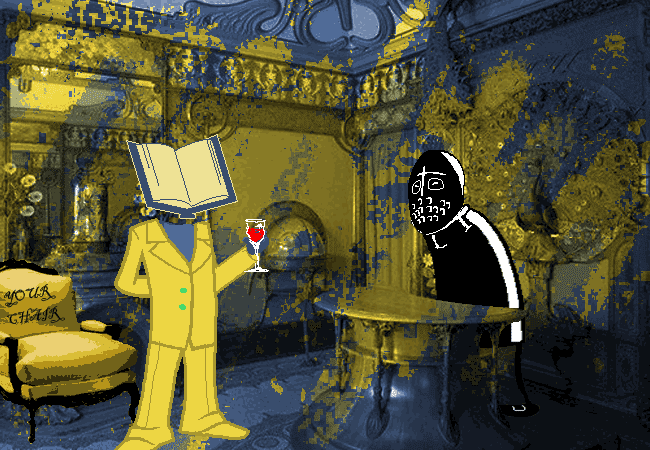 |
| As posts go, I am simply the best there is. |
We wouldn't want to have to rehash all of that in one big paragraph, would we?
Let's talk about me instead.
I happened to come to Homestuck just a month or so before Andrew Hussie, the webcomic's creator, started his now somewhat infamous Kickstarter, a Kickstarter that eventually netted Hussie 2.5 million dollars to fund the creation of a real adventure game. As I finished going through the archives a second time, and watched the numbers (both page and dollar) climb to unfathomable heights, I realized I was watching a silent revolution take place.
And what's more, I was probably going to be one of maybe just a dozen or so people worldwide that got the full implications.
See, Homestuck isn't just a webcomic. It's a Hypercomic: a comic that can only exist within the confines of a digital environment. In other words, it can't be taken from the web and printed out unless you fundamentally change the core experience. There have actually been a number of significant hypercomics (at least, significant to theorists)--enough to feel out the basic forms available to us. For example, hypercomics can make use of embedded, looped media within panels, creating a comic that uses minor animation without becoming a full animated feature (this page from 5ideways uses looped sound and animation, and this page from Argon Zark, the fabled First True Webcomic, uses looped animation). It could also make use of the interactive nature of the web to create a unique navigation system (that Argon Zark page, for example, or the smooth keyboard transition effects of Platinum Grit). And, of course, we can't leave out the very first type of Hypercomic codified by famed comics theorist Scott McCloud: the Infinite Canvas comic, which uses the screen as a window into an infinite terrain, where the page size and shape can be anything the creator wants (see the incredibly not work-safe Delta Thrives and McCloud's own experiment, My Obsession With Chess). So, there is quite a bit of material to study and examine.
And yet, if you told me a few years ago that a hypercomic could net millions of dollars for its creator, I would have probably sighed wistfully and agreed that perhaps someday some wizard of web promotion would succeed where so many others had failed. I would have treated you as a seasoned nihilist treats the prophet of the coming messiah: with dejected disbelief. See, the field of Hypercomics was in a grim state way back in 2009 when I came to the field. Let me put things into perspective:
Every single comic listed above had been abandoned by the time I found them. Every one. Even McCloud had stopped experimenting with his beloved Infinite Canvas at that point, and while there were a few notable exceptions, the more I sought new hypercomics, the more desolate ruins I discovered.
The story was the same everywhere: people really tried to make the whole experimental comics thing work, but their "real" jobs took too much of their time, and they couldn't figure out how to make any money with products that by their very definition could never be printed and sold. To make matters worse, a number of the most innovative geniuses (Neal Von Flue, for example--I would show you his work, but it's all fallen off the Internet completely now) banked on some shaky payment models that ultimately turned out to be disastrously impractical.
Hypercomics was a wasteland, and at one point I despairingly remarked to my partner in exploration, Ian McDevitt, that perhaps we were simply picking over the remains of a medium long dead. How could I know that the messiah I doubted wasn't just coming... it was already here?
Three years later, that savior of Hypercomics made its presence known in the form of a 2.5 million dollar bloom in the waste, a bloom that proved that Hypercomics were a viable medium.
Or at least... that they could be.
But it occurred to me as I watched the bemused commentary on the astronomical success flow in, and journalists and bloggers joined together in a kind of collective shrug that boiled down to "Wow, Homestuck fans sure are crazy, huh? Guess that's what happens when your comic is full of geek references," that a success so poorly understood could not be replicated.
So, just what makes Homestuck different from other hypercomics?
Well, let's start with the formal. Think of the three classifications of hypercomic I gave earlier. What would you say Homestuck is?
It actually doesn't really fit into any of them, does it? Or rather, it happily dips into any and all of the classifications whenever the narrative calls for it. It has a form that transcends the quadrants, you might say.1 What's more, it even periodically decides to stop being a comic and just straight up turn into an animated music video, a game of some sort (adventure, RPG, &c.), trashy romance novel, complex metatextual web design, and so on. Homestuck is all over the place.
That's actually the first key. Or at least, it obliquely is.
Take another look at how I phrased that: it makes use of different techniques when the narrative calls for it. In Homestuck the MESSAGE drives the MEDIUM rather than the other way around.
And this is where about half of the hypercomics ever created fall flat. They create a story--or even just a bunch of abstract pseudo-intellectual mumbo jumbo--as a vehicle to show off their new clever tech. The result is something that intellectually is quite interesting if you're a theorist, but ultimately has no heart.2 What's more, a lot of them got locked into a particular mode of storytelling. This wasn't necessarily a bad thing--comics like Platinum Grit, Delta Thrives and Patrick Farley's other major work The Spiders, Von Flue's The Jerk, and the rambling whole page compositions of Dresden Codak all made their particular model work really well for the kinds of stories they were telling--but it did mean that the supposedly infinitely variable nature of hypercomics could potentially become just as restrictive as that damnable printed page, or the "setup, beat, punchline" of the standard comic strip.
If you look at Homestuck, though, you'll find that Hussie has picked a medium for each moment, and done so deliberately to modify the tone and experience. It's sometimes a bit difficult to see when you're slogging through the archives, in part because a lot of the choices he makes seem counterintuitive or designed to frustrate, but Hussie has a good command of what techniques he's using where. (It's worth noting, in particular, where he tends to insert more complex games and what effects that more immersive experience achieves. [S] Seer: Descend and the animation that follows are a good example of this--we play through Rose's experience, making us complicit with her actions and directly involved with the hopelessness of her quest, and then at the climactic moment our control and agency is taken away and we watch what comes next helplessly. Even the music echoes this and sets the mood to one not of epic badassery but tragic inevitability. It's a masterful decision.)
This suggests that a successful Hypercomic will be driven not by the desire to invent new technology abstractly but the need to convey the story in the most effective way possible. If you want to really over simplify things, it will be driven not by the head but by the heart.
 |
| I can't believe how good this movie is. |
Well... the answer is probably that yes, Nicholas Cage jokes really are that powerful.
No, seriously. Look, one of Homestuck's great strengths is almost certainly the fractal reference humor. And, despite what skeptics might suggest, this isn't dumb reference humor, either; it's not a matter of pointing at something familiar and laughing (see: The Big Bang Theory), it's a matter of building the pop culture knowledge into the very fabric of the comic. While researching this article, I came across something Hussie said about all the Nick Cage jokes, in particular. He questioned hypothetically whether the constant mockery of Cage and his terrible movies hadn't metamorphosed into a kind of shrine to the films, simply through the process of getting to know John Egbert, and having the films become a driving force in the comic's narrative mythos. They become a fundamental part of what makes the comic tick, not just something that is recognized and passed over.
Here's that emotional core of the comic again: the jokes become a way of entering the minds of the characters, of better empathizing with them. You can see this with the trolls in particular: what start out as vaguely defined pastiches of internet culture grow into fully developed personalities. Hussie manages this process so well that people were actually disappointed when a joke character whose entire raison d'etre was horse cocks died a joke character death. He never stopped from getting more ridiculous, and yet along the way he became something people somehow related to and found admiration and sympathy for. So, it's not just the reference humor, but how Hussie develops that reference humor into a bond between reader, writer, and text.
And while we're on the subject of this bond:
I've actually seen people sneer at the way Hussie encourages shipping, fan input, rampant speculation, and a kind of semi-adversarial creative relationship between himself and his fans, as though an artist adapting to the needs of his audience is somehow creatively bankrupt. I suppose if you are committed to the idea of the Grand, Singular Authorial Vision, what Hussie does must seem odd, but to me that reaction sounds more like sour grapes.
Because like it or not, it works.
I can think of a few other properties that either accepted or openly encouraged creative fan responses, and what they have in common is a vibrant, creative fanbase that are, not coincidentally, also loyal customers. Whether it's My Little Pony: Friendship is Magic encouraging fan art and periodically giving nods to the adult community in the show, Magic: The Gathering providing forums for people to post their art, fiction, and custom card designs, or JK Rowling simply being openly OK with fanfiction, it seems that one route to success is the acceptance and even promotion of the creative efforts of fans.
This makes quite a bit of sense if you think about it. After all, if the urge to create is strongly present within most humans (I personally think it is) then entities that enable and support creative input are going to succeed. And that simply isn't something we've seen with a lot of hypercomic artists, most of whom seem to come from the auteur school of comic production where a single mastermind generates writing, text, and unified creative vision. Again, let me stress that the work that's come before is brilliant. But, if we're talking about differences between Homestuck and other hypercomics, the overwhelming encouragement of fan input and creativity is definitely one difference we can't ignore. I'm not criticizing so much as pointing out why one thing succeeded where another failed, regardless of how good the final products actually were.
This is also, of course, why I am actively encouraging you all to ship me and my guest columnists. Oh, and draw fan art of me and Lord Humongous! It's fun!
Actually, let's talk a bit about the fan materials and part of why they're so viable. Here's another McCloud Theory 101 topic: how do you encourage immersion in an environment and identification with a character?
Yep, iconic design:
 |
| The design doesn't stop from getting more iconic. |
Much of Homestuck runs on this logic, from the iconic shirts (one symbol for each character), to the vaguely-defined and intriguingly recombinable Class/Aspect system, to the use of color, to the sometimes aggrav8ting quiirk2 o+f th-E tr0ll CH4R4CT3RS. Let's take a moment to drop out of Artistic Appreciation mode and note how from a cynical marketing perspective all of this is sheer genius. Hussie has made a bunch of deliberately iconic characters that we are encouraged to see ourselves reflected in, then given each of them a particular symbol (twelve of which are just the damn zodiac plus a color), and then given them particular colors, items, and even language quirks that can be embraced and emulated and, best of all, merchandised.
Wow.
Even if this was kind of accidental, as Hussie has suggested, it's still clear in retrospect why it eventually cascaded into 2.5 million dollars in funding.
So, the way forward seems simple: find a story with emotional resonance, deliver it with a heavy use of iconic material, encourage fan input along the way, and leave yourself open to medium experimentation when the story calls for it.
And you, too, could have a 2.5 million dollar comic!
Except there's actually something else we're missing... Now what was it...
Ah, right!
The 14 hour days that Hussie worked for years to get to this point.
Perspective stings something awful, doesn't it?
Ten thousand hours is the standard suggested by Malcom Gladwell in his book Outliers; ten thousand hours until you become a true master of your field. I don't think it's unreasonable to suggest that part of the reason Hussie is so good at what he does, part of the reason he's had so much success, is because he lived and breathed Homestuck for a while, after working on other comics for years. Oh, and he's also been consciously experimenting during all that time to find what works:
I'm not trying to make the best thing ever here. Only something which is very fun, extremely flexible, and serving to accelerate my abilities, my understanding of what a story can be, and my grasp on how people react to things. That is actually a valuable part of the exercise, watching mass reactions in real time, on every aspect of each update. From the minutia, to the big plot turns. There is a very real component of this that resembles a huge social experiment. I'm not just putting pressure on the limits of a story's format. I appear to be doing this with the psyche of the readership as well. I have discovered many obscure buttons which can be pushed. I am taking extensive notes. (see: this question and answer)
Yeah. This is not a quote from someone who just stumbled into success. And here's the grim fact it suggests: my beautiful little summary up there probably isn't going to lead to any sort of guaranteed success. What it does offer us is a more complete understanding of what works, and a guide to some of the pitfalls in which hypercomic artists--and artists in general, perhaps--can become, well, stuck.
I am, in essence, some ancient eldritch chucklefuck, plotting out points of interest in the great, unfathomable void that is hypercomics theory. If you want to actually use this map for something, you are probably going to have to actively start breaking things.
I don't know if this is going to be an outlier, a chance manifestation in the void. It could be. This could be the first and last great success of Hypercomics for a few decades, even. Not everyone gets to God Tier, after all.4 But I'm hoping that someone out there is reading this and realizing that the great idea they had for a storytelling format can be enhanced by an actual story, that they can relax their authorial grip and promote experimentation, and that their technology doesn't have to be a sarcophagus--it can be one of many employable ways of telling a story.
This might just be a flash in the pan.
But I'm going to fondly regard it as the miracle of a new beginning.
Interested in Hypercomics? My aforementioned partner Ian McDevitt and I are slowly alpha testing our very own interactive metahypercomic: Understanding Hypercomics. Feel free to check it out, although be forewarned: it's pretty rough. We could definitely use the feedback though. And I swear, this time I won't spend an entire month writing the next article! You can follow me on Google+ at gplus.to/SamKeeper or on Twitter @SamFateKeeper. As always, you can e-mail me at KeeperofManyNames@gmail.com. If you liked this piece please share it on Facebook, Google+, Twitter, Reddit, Equestria Daily, Xanga, MySpace, or whathaveyou, and leave some thoughts in the comments below.
1. There's a secret fourth type of hypercomic that makes use of a unique property of the web and of George Lucas films. I keep going back and forth over whether or not Homestuck uses this technique.
Those are your hints. Good luck!
2. If you're following along, this is the ANIMIST space on your SCOTT MCCLOUD CONCEPTUAL BINGO SHEET. Most of the experimenters were hardcore formalists, and while that's very important, it ultimately misses what makes art widely resonant rather than appealing to a set group of specialists.
3. Yes, Kankri, there is something problematic about using the literal color white to represent any and all races, but on the other hand, Hussie has laid the proverbial smackdown on people criticizing cosplayers who happen to be the "wrong race," and he went out of his way to emphasize the idea that the characters are whatever the reader wants them to be. I leave it to you, dear reader, to decide whether the clock is falling on the Just or Heroic side in this debate.
4. The tiger is just too fast.

