The Worst Filing System Known To Humans

-Punk (5) A Song of Ice and Fire (2) Affect (9) Alienating My Audience (31) Animation (28) Anime (19) Anonymous (3) Anything Salvaged (15) Art Crit (42) Avatar the Last Airbender (2) Black Lives Matter (1) Bonus Article (1) Children's Media (6) Close Reading (90) Collaboration (1) comics (30) Cyborg Feminism (3) Deconstruction (10) Devin Townsend (2) Discworld (1) Evo Psych (1) Fandom Failstates (7) Fanfiction (28) Feminism (24) Fiction Experiments (13) Food (1) Fragments (11) Games (29) Geek Culture (28) Gender Shit (2) Getting Kicked Off Of TV Tropes For This One (11) Gnostic (6) Guest Posts (5) Guest: Ian McDevitt (2) Guest: Jon Grasseschi (3) Guest: Leslie the Sleepless Film Producer (1) Guest: Sara the Hot Librarian (2) Guest: Timebaum (1) Harry Potter (8) Harry Potter and the Methods of Rationality (3) Has DC Done Something Stupid Today (5) Hauntology (6) Homestuck (18) How Very Queer (35) hyperallthethings (10) hyperanimation (1) Hypercomics (11) I Didn't Ask For Your Life Story Sheesh (24) Illustrated (37) In The Shadow Of No Towers (1) It Just Keeps Tumblring Down Tumblring Down Tumblring Down (9) It's D&D (2) Judeo-Christian (9) Lady Gaga (5) Let's Read Theory (3) Lit Crit (20) Living In The Future Problems (11) Lord of the Rings (4) Mad Max (1) Madoka Magica (1) Magic The Gathering (4) Manos (2) Marvel Cinematic Universe (17) Marx My Words (15) Medium Specificity (15) Meme Hell (1) Metal (2) Movies (33) Music (26) Music Videos (21) NFTs (10) Object Oriented Ontology (4) Occupy Wall Street (3) Pacific Rim (2) Paradise Lost (2) Parafiction (6) Patreon Announcements (15) Phenomenology (4) Poetry (6) Pokemon (3) Politics and Taxes and People Grinding Axes (13) PONIES (9) Pop Art (6) Raising My Pageranks Through Porn (4) Reload The Canons! (7) Remixes (8) Review Compilations (6) Room For You Inside (2) Science Fiction Double Feature (32) Self-Referential Bullshit (23) Semiotics (3) Sense8 (4) Sociology (12) Spooky Stuff (45) Sports (1) Star Wars (6) Steven Universe (3) Surrealism (11) The Net Is Vast (36) Time (1) To Make An Apple Pie (4) Transhumanism (9) Twilight (4) Using This Thing To Explain That Thing (120) Video Response (2) Watchmen (3) Webcomics (2) Who Killed The World? (9)

Reload the Canons!

This series of articles is an attempt to play through The Canon of videogames: your Metroids, your Marios, your Zeldas, your Pokemons, that kind of thing.

Except I'm not playing the original games. Instead, I'm playing only remakes, remixes, and weird fan projects. This is the canon of games as seen through the eyes of fans, and I'm going to treat fan games as what they are: legitimate works of art in their own right that deserve our analysis and respect.

Showing posts with label Lit Crit. Show all posts

Monday, March 17, 2025

It's Just You: Getting Your Audience Agency Back

Most modern criticism agrees, audiences have a lot of interpretive say. So why do people still talk about media like it's being inflicted on them? Sink your teeth into the difficult films No Country for Old Men and Nosferatu and learn to get your agency back as an audience.


Monday, June 10, 2019

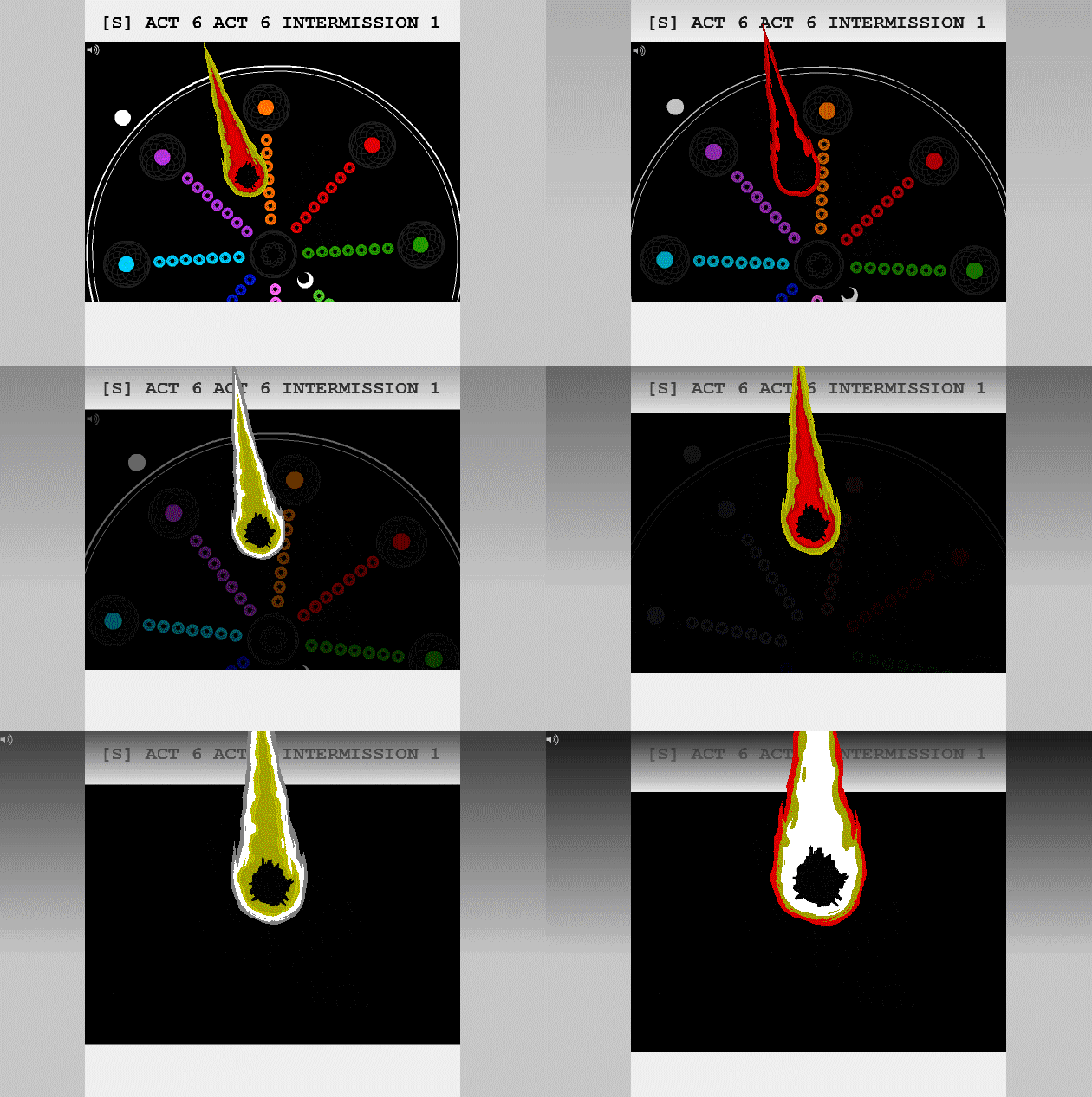
Evil Be Thou My Good, or Why Dirk Strider Is Literally Satan

Homestuck was a Gnostic story. The Homestuck Epilogues are a satanic one. Dirk Strider is the devil. To understand, we'll have to consult a poet who's of the devil's part: John Milton.

Monday, October 31, 2016

Which Wicked: Castle Hangnail and Navigating Fantasy Narratives

Ursula Vernon's Castle Hangnail, about a 12 year old girl striving to become master of an ancient magical castle, shares a tradition of humorous and somewhat self-aware fantasy with modern authors like Terry Pratchett and early fantasy writers like Edith Nesbit. Exploring those connections can help us see the way Vernon's book explores ideas about consent, narrative convention, and the vulnerability that comes with being strange. In a world of witches and sorceresses, what does it really mean to be "Wicked," and is it really the same thing as "Bad?"

This article and all the normally Patron-exclusive features accompanying this piece free to the public were underwritten by $10 backer David Formosa. The article was written and edited in a live stream here. To learn when future live streams are happening, and to follow StIT's projects like this, sign up on Patreon and follow the site's Facebook and Twitter.


Thursday, June 30, 2016

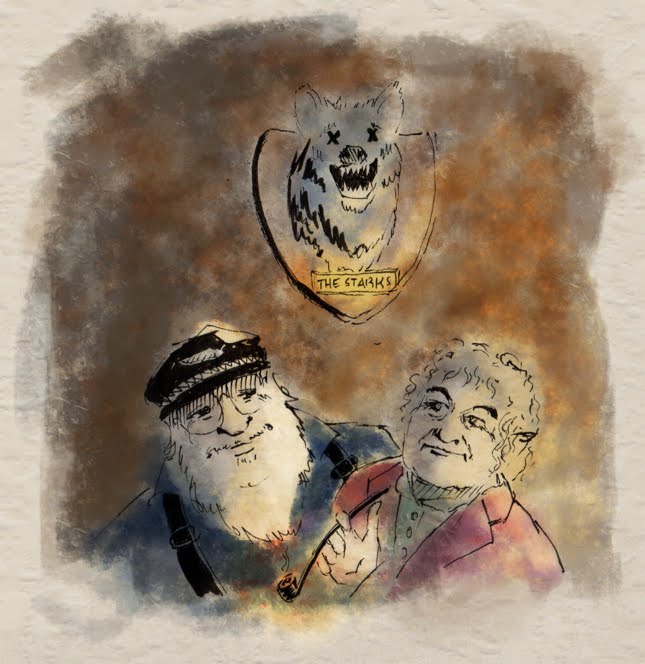
Not All Who Wander Are Lost: George RR Martin and Tolkien as Fellow Travelers

My first introduction to A Song of Ice and Fire was as a deconstruction of fantasy. George RR Martin's epic (now a "daring" and "brave" television series which you can see on HBO if you turn the brightness and contrast on your TV way, way, WAY up!!!) is, I was told, dark fantasy, with lots of shades of grey and violence and sex and so on.

It is, the subtext and sometimes the explicit text ran, not like Lord of the Rings. Or at least not like the traditions of Tolkienesque fantasy. This review of a recent episode of the (brave! genius! award winning!) tv show for example takes umbrage at the fact that the ending of a battle "has replaced that deconstruction with a blatant lift from Tolkien’s book, with the Vale forces riding in to save the day like Gandalf riding in to save Helm’s Deep." The notion of Tolkien and Martin as in some sort of competition or stark (hah) contrast is in the zeitgeist, is what I'm saying.

Having recently read the books, though, and also recently revisited The Lord of the Rings, I can't help but see this as more a product of a very narrow reading of Tolkien, and of Martin.


Some of this reading is possibly derived less from the source texts themselves but from Peter Jackson's adaptation. Look, I'm not gonna pretend that I haven't been deeply frustrated with The Lord of the Rings films since I was like 12. A lot of the stuff that most resonated with me as a kid ended up weirdly flattened, sensationalized, cut apart, or altered beyond recognition. And in the process everything got a lot more simple. I'm personally never going to forgive The Two Towers for introducing some fucking nonsense Aragorn Falls Off A Cliff subplot only to make up for it by hacking huge holes in the plot of Faramir, one of my absolute favorite characters. And others have written about some of the ways that in Jackson's hands characters like Saruman lose their thematic reason-to-be, becoming one note villains rather than complex and tragic figures.

Martin has suffered some of the same problems from the "brave" adaptation of his books, an adaptation I can't claim to have seen much of but which on a basic stylistic level seems to be run by people who don't understand that "dark fantasy" doesn't literally mean that all the sets should be chronically underlit and the characters should all wear the most drab clothing possible. I mean given that in the original text the Others are described basically as evil elves and the show develops them into ice orcs, and given that no one is walking around in the show with dyed-green beards like they commonly do in the book, it's pretty clear that they're more interested their sense of a "grim and gritty" aesthetic than what the text is trying to actually say.

Unfair? Not really. The critically lauded masterminds behind the "adaptation" literally once stated: "Themes are for eighth-grade book reports.” 

My contempt, I'd say, is well earned.

As a result perhaps of these less than stellar adaptations that have overtaken the originals, and as a result no doubt of Tolkien's many far lesser imitators, and probably to some extent as just a result of overexposure and fan discourses sort of overwhelming the original texts, a pretty remarkable fact has become obscured:

Lord of the Rings and A Song of Ice and Fire are much more a part of the same thematic tradition than in opposition. Basically, on a lot of levels, Tolkien and Martin are interested in the same stuff, and talking about the same things, and traveling on the same paths. And in fact some of their same formal "stumbling blocks"--things that people find particularly infuriating--parallel each other and do similarly important work within their respective narratives.

And to explain just how this makes sense, I want to talk a little bit about a book called The Worm Ouroboros.

Monday, May 30, 2016

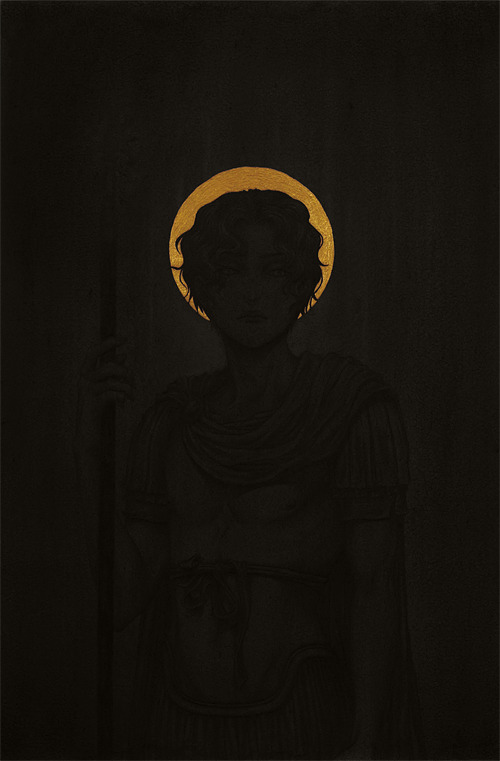
StIT Reviews: The Gnostic and the Satanic

Many of my articles are driven, to a greater or lesser extent, by necessity. I have to weigh writing an article against considerations like: can I fill out a full 3000-4000 word piece on this topic? Or: does anyone but me give a shit about this thing? Or: has anyone but me even HEARD of this thing?

So, frustratingly, I often find that there's stuff I'd like to write about that just doesn't fit the usual format of StIT. Nevertheless, there's loads of stuff I want to cover, and I have enough of a readership now that I want to make people aware of smaller projects that they might otherwise miss.

With that in mind, I'm going to start putting out articles like the one you're about to read: articles that are composed of smaller reviews or spitballing about particular topics, linked by some sort of loose theme. These are articles not intended to scoop up new readers but as something for longer-term readers of the blog, stuff designed not to get hits but to open up space for me to explore stuff I'm passionate about in a fairly off-the-cuff way.

The following reviews are just four of a nine that I've written so far. The rest can be viewed by my backers on Patreon starting at the $1 tier. I'll be adding more reviews periodically, but right now this exclusive body of work contains writing on Grant Morrison's Action Comics, a summary of China Mieville's theories of Weird and Hauntological horror, some discussion of squid people, and a review of the first two books in the Song of the Lioness quartet from my perspective as a transgender person.

If this stuff seems interesting, I welcome you to become a backer to see all the reviews.

It's kinda like a direct line into my brain as I respond to what I'm reading.

Oh, and hey, you know what I have banging around in my brain a lot?

Gnostic Christianity.

Particularly since Homestuck just ended with a conclusion that was, as I predicted four years ago, Gnostic as fuck.

So let's talk about some stuff that's engaged with Gnosticism in interesting ways.

Panel from Lady of the Shard

Monday, August 12, 2013

Hermione Granger Versus the Methods of Rationality

It's always difficult, I think, to broach the subject of flaws within Harry Potter and the Methods of Rationality, the scientifically-focused Harry Potter fanfic that seems to have taken the Internet by storm. Regardless of the intent (and that, folks, is a phrase you're going to be hearing a lot more in this article) Eliezer Yudkowsky exudes an aura of almost unassailable wisdom. That, perhaps, is part of the problem: it's easy to fall into the trap, ironically, of not thinking critically about this text in part because the presentation suggests a reading of the text that accept Rationalist!Harry as both author surrogate and sole voice of reason.

I actually talked about this issue over a year ago in a frankly pretty shitty article that nevertheless made some good points. Let me try to isolate them here quickly:

...[R]ead the conversation with McGonagall after Harry accidentally causes a shop keeper to remember what are implied to be rather traumatic memories. Note the way the conversation transforms into a lecture on pessimism and accurate predictions of the future. It's fascinating stuff, to be sure, but narratively it means that even though we are told that Harry feels bad, his behavior is reinforced because A. he's temporarily transformed into the mouthpiece of rationality and B. he still gets what he bloody well wants in the end!
Harry needs to lose here--he needs to be wrong here--because these early chapters grant him too much infallibility. He wins so often that we assume that he is always right. This actually works in direct opposition to the skills that the story is teaching us--after all, as long as we can comfortably rely upon Harry as a guide, we don't have to analyze his actions from a standpoint of rational skepticism.  
... 
I think, if nothing else, this demonstrates the fact that the narrative and the themes or purposes of a work have to be carefully set into balance, and it's very easy for one to get in the way of the other if they are not carefully arranged. It also shows that the transmission of ideas cannot rely upon an understanding of the ideas themselves alone. Communication is, by its nature, interdisciplinary, and understanding narrative from a liberal arts perspective can help even a staunchly scientific piece of writing.
 I stand by that assertion, incidentally. I think the text often works at cross-purposes with itself, because while the conscious meaning of the text promotes one attitude, the unconscious response encourages another. Texts train their readers how to read them, and this text has a recurring difficulty in telegraphing its intentions. And while you could, I suppose, simply shrug your shoulders and assert that people should be clever enough to listen only to the conscious meaning, frankly I would consider that an unartful and lazy response. If you're going to write, you may as well do it with a whole rather than a halved ass.

This is why Yudkowski's response to some recent plot events rubbed me in rather the wrong way. If you're caught up on the story you can probably guess what I'm talking about: (spoilers, obviously, from hereon out--not that I should have to say that at this point)

Hermione Granger is dead, and people aren't happy.

Which is to be expected, of course, when a beloved character dies. The issue here, however, is that many of the reactions I've seen are not what I'll call immersive reactions. I.E., they are not reactions that involve people saying, "This character that I love is dead, and it hits me hard emotionally!"

They are metatextual reactions: "This character that I love is dead, and it's a sexist choice!"

Metatextual reactions, of course, are not bad at all. It's a good sign of critical reading. However, when you have a bunch of (largely female, I think) readers responding to a major emotional moment in your story by calling you a sexist asshole... well, that suggests to me that there's been a major disconnect between the story you're attempting to tell and the story that people are reading.

So, I want to try to unpack, at least somewhat, why this was a foreseeable problem if you are aware of feminist pop media criticism, and why Yudkowski's reply was more than a little ham-fisted.

The first big problem, of course, that needs to be tackled is Yudkowski's suggestion that it is "unfair" to analyze an unfinished text. This is... well, I guess I can see how from a Formalist perspective this is accurate--after all, a Formalist criticism, as I've said before, BEGINS AT THE BEGINNING and ENDS AT THE END, as God ordains, forever and ever and ever Amen. It's a fine way of working because it allows you to examine how a theme develops and possibly turns on its head by the end of a narrative. But it is not accurate to how people react to a text. You do not read a text feeling completely neutral about it until the end, when you pass judgment. You do not read a text ignoring the theme until the end, when you pass judgment. For goodness sake, this is why people stop reading books or leave movie theaters.

Yet, Yudkowski presents this basic, totally predictable and frankly quite human reaction as not just a question of fairness or unfairness but almost as some strange, alien reaction unique to Feminist critics:
There is, I think, a very great divergence between feminists who try to be fair, and feminists who do not try to be fair. 
Attacking someone who cannot defend themselves, even in possible worlds where they possess a defense, is not fair. 
Authors of unfinished stories cannot defend themselves in the possible worlds where your accusation is unfair.
Let me be frank.

This is a shitty response to criticism.

And it's also kind of a sexist response to criticism.

It's part of a long tradition of white, straight, cismales dividing activists (frequently feminists) into two camps: good activists and bad activists. It is no coincidence that the good activists are those whose message is most appealing to said white, straight, cismales. It's a good way of breeding division within a movement and stifling radicalism--after all, the stigma of being grouped in with The Bad Camp is a powerful swayer of behaviors, considering how much humans want to be accepted rather than persecuted. And, of course, Yudkowski here could easily have used the word "readers" and conveyed largely the same point, but he did not. He defaulted to "feminists," and regardless of the intent, the result is a singling out of feminism as a movement and an establishment of Good and Bad camps that others may use to tar and label literally anyone who has a problem with HPMOR from a feminist standpoint.

I'm sorry, were we talking about unfairness? Somehow, a male author singling out readers with a sociological stance that frequently elicits responses ranging from insults and harassment all the way up to physical and sexual assault as being particularly prone towards Bad Camp behaviors does not, to me, fit under the definition of "fairness," or "good forethought," or "really any kind of self awareness whatsoever." Regardless of the intent, this is punching downward. It is a weapon in the hands of misogynists--who, and I know this will come as a staggering shock, aren't exactly unheard of in the Hard Sciences and Atheist circles.

This is a concern, to me, largely because there ARE a number of problems with the text on a Feminist level, and Yudkowski effectively addresses none in his post here. He has, however, established a field of discourse where first a feminist theorist must prove her fairness and goodness before she can even begin to discuss the text itself!

I, however, will not be doing that, because sod that. The reason I'm bringing all this up is not to establish my own fairness, but to establish that Yudkowski fucked up here, wittingly or otherwise, and it makes the whole wider conversation a whole lot more difficult to have.

What is that wider conversation?

Well, let's start with the issue of Theme. On the one hand, I think Yudkowski is right to assert that MacGonnagal has a tight thematic arc. I really do agree with that assertion! Seeing the whole thing come together was actually pretty cool, because it was quite well plotted.

Well... mostly.

There's two problems with this defense, though.

First, just because a theme is present and coherent does not make that theme defensible from other critical standpoints. Like, it might make perfect sense thematically for MacGonnagal to go from a stern disciplinarian to a more flexible thinker, but if that arc is fundamentally a story of how she learned that Rationalist!Harry Ubermensch Potter was right about everything all along, that's not exactly going to make her a better character in the eyes of a feminist critic--nor should it!

This is an opposition as old as these two forms of criticism. Formalism--the New Criticism that sought to find deep themes in everything--always positioned itself as fundamentally universal and above such petty things as the status of non-white, non-straight, non-men in texts. Feminist theory, queer theory, colonial and race theory... this stuff all emerges in part as a critique of that purported universality, and the message frequently boils down to this idea: "If the champions of your themes are always straight, white, upper middle class, cismen, and every other narrative arc in the story bends around them, then you DON'T really have a universal experience or truth, do you? You have a narrow perspective that tells readers outside that narrow band that they should just be more like those straight white uppermiddleclass cismen."

So, saying that the theme was planned from the start, even from the perspective of whether or not MacGonnagal achieves agency in the text (which can be debated, of course), does not automatically remove any complaint of feminist criticism.

For example, a feminist might question why, exactly, MacGonnagal's character arc requires her to become rigid to the point of disaster, when other characters are quite openly altered for various purposes.

This is the problem, ultimately, with Yudkowski's veiled assertion that his choices with MacGonnagal and Hermione were, in fact, out of his control:

J. K. Rowling created certain roles and assigned them genders.  The story of HPMOR is built around the parallel-universe versions of those roles, and those roles (with one exception) retain whichever genders they had in canon.  HPMOR is not deliberately feminist literature.  S.P.H.E.W. is ultimately there because it is what Hermione Granger would do in that situation, not to balance gender scales.
This is nothing short of complete and utter nonsense.

Yudkowski happily has manipulated and altered characters as he saw fit. He altered everyone from Quirrell to Dumbledore to Snape to Sirius Black to Peter Pettigrew when the story, in one way or another, called for it.

S.P.H.E.W. is ultimately there because Elizer Yudkowski wished for it to be there, not because it was mysteriously preordained in the stars that it should be so, or because J.K. Rowling tied his hands. In fact, placing the blame (I mean, he says he isn't placing the blame, but let's be honest, he totally is) on Rowling is somewhat disingenuous considering the actual source material. There is nothing in the world to say that Harry Potter should, with the proper application of Oxford Professors, turn into a rationalist supergenius, but there is likewise nothing in the world to say that, should an author wish it, Hermione Granger should grow to meet Harry Potter. In fact, it seems incredible to me that she and Draco Malfoy should be put on equal terms, when Draco shows none of her ingenuity, wit, determination, and raw problemsolving ladygrit in the source material! And yet, in this text, she is the third wheel in the wonderful communion that is Harry//Draco. Not to say that I don't ship it of course but LOOK WE'RE GETTING SIDETRACKED HERE The point is that giving Harry the opportunity so constantly to win, then giving Hermione a chance to shine only to end up turning it into another game move between Harry and his opponent, is...

Well, it sucks.

It feels like bait and switch.

And worse, the message seems to be that ultimately, the voices of sexism in the story were correct: there is no role for Hermione to be her own hero. She is always the child watched from a distanced by cool, intellectual Harry, the logical male who sees beyond the girl's silly concerns.

For gibberflipping fuck's sake, Yudkowsky fabricated an entire core plot point--the Interdict of Merlin--because it suited him, but we are to accept at face value this statement:
I am building off J. K. Rowling’s canon, in which, as Professor Quirrell observes in Ch. 70, “It is futile to count the witches among Ministers of Magic and other such ordinary folk leading ordinary existences, when Grindelwald and Dumbledore and He-Who-Must-Not-Be-Named were all men.”
What utter nonsense! There is a vast, unexplored range of open space here, and Yudkowski apparently cannot imagine anything other than these three men! I would normally have been quite charitable here and pointed out that this assertion comes from an evil character, BUT YUDKOWSKI IS AGREEING WITH HIM! And then he goes on to graciously assert that we should not blame Rowling for this state of affairs.

Well, no, we should not, because in canon, Voldemort's most feared lieutenant was a woman, a woman who, upon breaking out of Azkaban, immediately starts hexing everything in sight, cackling all the while...

...A woman who, in Yudkowski's world, is reduced to a barely-sapient, brainwashed girl and subjected to repeated rape at the hands of Voldemort's other followers.

In canon, MacGonnagal fights furiously for her students' well-being, even if it means refusing them the freedom they wish for, and frequently comes across as an extremely clever, extremely capable woman, a highly worthy successor to Albus Dumbledore...

...While in Yudkowski's world, any disagreement she might have with Harry Ubermensch Potter is portrayed as being the result of her own stubbornness, lack of insight, and inability to keep up with Dumbledore and Harry in their manbrilliance.

In canon, Ginny and Luna are heroic characters who are fundamental both to the victory of the main trio, and are fundamental to Harry's struggle to maintain his own sanity and his own humanity...

...While in Yudkowski's world, Luna is just a punchline in a single joke and Ginny is Sir Not Appearing In This Film.

In canon, Hermione Granger is the smartest witch of her year, an equal with Harry and Ron, part of a trio of three powerful young mages who ultimately save the world...

...While in Yudkowski's world, her ultimate role is to become Harry's friend so that she can die.

And she dies in order to motivate Harry to action.

She is not his equal, the companion that sticks with him through everything and helps him right up until the end to defeat his opponent.

She is, at the end of the day, a plot device, to be used and discarded as Harry goes on alone.

And perhaps that will change. Perhaps I am being "Unfair." But I don't think that the last few chapters of this story will suddenly redeem the other characters that Yudkowski has treated so poorly.

Nor do I believe that the presence of the other SPHEW members truly balances out the other issues with the portrayal of women in the text. They are jokes. They are the comic relief squad. Like it or not, they are not there to be serious heroes or to have any potential of rising beyond their rather shallow characterization, because HPMOR is ultimately about the triumph of rationality, and Yudkowski does not see fit to elevate these characters, to bring them into his ideal mindset.

The theme of the tale and its presentation is fundamentally at odds with a feminist reading of the text, and to suggest that the text is that way simply because it is realistic or it is how the characters would act is an unsatisfying, disingenuous answer. For the latter, it should be clear by now that there is no action of the characters outside the scope of the will of the writer--if he makes choices to manipulate the text elsewhere, he could make choices to manipulate here. For the former... well, I'll let you ponder on that. Perhaps you can see, without too much prompting, why asserting that the lack of Rational women that can come close to the male ubermenschen in the story is realistic would come across as just a leeeettle eensie weensie bit sexist.

I stand by my conclusion in my other shitty article. Rationalism as a doctrine is not, in and of itself, able to make up for a fundamental lack of understanding of other disciplines.

Ultimately, I cannot get behind any sentiment that scolds and chides and derides readers for reacting to a text. It's one thing to say that some strategies within feminist criticism are bad. It's quite another to say that some feminists are bad, solely because they are mildly frustrated (read, again, the post Yudkowski singles out--how uncharitable is that post being, truly? Does it really deserve the reaction it gets). And I think it's important to recognize where a text fails. This, for many readers, was such a moment of failure, and it behooves us as critics and authors to try to understand why there was a communication breakdown, and how other elements of this text led, cumulatively, to a reading that caused this reaction.

And I mean really...

When you kill off a character that to a whole lot of women is a symbol of female strength and intelligence...

You're really gonna play it like you can't understand why some people get upset?

Now now, Hermione, let's not get personal here.

Follow stormingtheivory.tumblr.com for updates, random thoughts, artwork, and news about articles. As always, you can e-mail me at KeeperofManyNames@gmail.com. Circle me on Google+ at gplus.to/SamKeeperIf you liked this piece please share it on Facebook, Google+, Twitter, Reddit, Equestria Daily, Xanga, MySpace, or whathaveyou, and leave some thoughts in the comments below.

Monday, July 22, 2013

The Visual Intelligence of Pacific Rim

I want to talk about Pacific Rim, and why it is not, as I've seen a frustrating number of commentators claim, a "dumb" movie, or a movie that "knows that it's dumb," or anything like that, but first I want to talk about my girlfriend, and you're going to let me because you've already clicked through and given me the pageview, so you may as well stick around. Besides, I think it will help provide a reference point for some of the ideas I'm talking about.

Alright?

Let's talk about my girlfriend.


My girlfriend Sara (who has given me the okay to talk about her case, in the name of supporting this movie that she's fallen head over heels in love with) has a learning disability. I'm honestly not sure what the clinical name for it is (if it has one), but one of the things she has trouble with is processing language on a non-literal level. In other words, metaphors, figures of speech, and some humor that depends on incongruities, sort of doesn't interface quite right with her brain.

However, there's no "metaphor" sector of the brain. There's nothing that interprets figurative information across media. There's brainmatter that deals with language... and brainmatter that deals with visuals.

So, while my girlfriend struggles with linguistic metaphor, she takes to visual metaphor like a fish takes to water. I have to admit, sometimes she gets comics or movies, for example, in ways that I don't, despite my training in media. She can look at a weird background motif in a Manga panel and immediately list off for me its significance, or pick out recurring color schemes used to signify something about a particular character, or decipher wordless sequences that I find confusing or disorienting and (embarrassingly) explain them back to me like it's no big thing and I'm kinda silly for not getting it.

This is obviously fascinating to me as a student of media and how it interfaces with the human mind. We have very different ways of reacting to media, sometimes, because I tend to struggle when it comes to remembering faces, whereas she struggles with following complex, fast-paced dialogue (or, to put it another way, I excel at analyzing spoken/written language and she excels at analyzing visual language). To some extent, then, it's tempting to look at this as a cool quirk and study it in the abstract as two equally viable ways of exploring media.

However, we do not exist within a culture that views the two ways of analyzing things as equal, and that's why I'm writing this article.

See, critical theory, from what I've observed, is highly linguistic in focus and scope. In fact, even casual critics on Tumblr tend to fall into a linguistic mode of criticism when discussing movies--they talk, in short, about the dialogue of a film or show primarily, and talk actions and plot secondarily. This is encouraged by an education system that has students read the plays of Shakespeare and Ibsen and Miller and so on, with the movie version as the reward once they're done reading. We consistently devalue the depth of visual communication in our culture--I mean, this isn't anything revolutionary to say, it's just the big dumb elephant in the room of media studies, that we have an overwhelmingly visual society that has no clue how to read images.

When confronted with a text that primarily relies on images, therefore, our response is to write that text off as dumb or lacking depth, because we're interpreting the text on a linguistic level rather than on the level that it's working. I mean, for goodness sake, look at the kind of language I'm using to describe this phenomenon! "Text." "Write off." Our mode of criticism, a century old, is wedded to the idea of communication through the typed or spoken word.

That's where Pacific Rim comes in. It's very easy, if you are confronting the movie with a linguistic bias, to see the film as "dumb," or, maybe even worse, a movie that's good because it "knows it's dumb" and doesn't aspire to be more. And yes, the dialogue isn't brilliant. Granted! You can totally watch the film and say "There's not a lot going on here as far as witty reparte is concerned, and the plot is pretty simple, so on that level, it's kind of a simplistic movie." You can take that away with you after watching Pacific Rim.

But that's not what my girlfriend took away from it.

She took away this:

"I thought it was really cool how Mako dyed her hair to match her jacket that she wore in the flashback scene. It was like she was still thinking about that day and carrying it with her."

I'm paraphrasing, of course, but that was one of the first things she said to me when the credits were rolling and we were freaking out together over how cool the movie was. She followed that up by talking about how expressive and cool the Kaidanovskys--the pilots of Cherno Alpha--were. These are, remember, two characters with effectively zero dialogue, beyond a few shouted commands during their fight scene, and yet they stood out dramatically within her mind as well rounded characters. And the conversation pretty much proceeded like that--sometimes with me echoing her thoughts, but often with her picking out details that I had missed completely.

She was responding to the film as a visual learner. She was reacting not as a traditionally trained--and traditionally, we might say, constrained--theorist, but as someone that interprets media according to images, body language, design symbolism, and color cues.

She was doing it right.

The rest of us are doing it wrong.

Pacific Rim is not a dumb movie at all. It is a visually intelligent movie.

Let's talk about some specific elements of the film, though, and why they operate quite differently when you view them as primarily things to be, you know, viewed.

Mako Mori is Not A Shallow, Timid, or Weak Character

One of the arguments I've seen repeatedly from multiple feminist critics can be summed up thus:

Mako Mori is not a strong, well developed female character, because she only has a few lines.

In a way, I feel the whole basic problem with our current discourse can be boiled down to just that one phrase. The character's relative depth is entirely contingent on how many lines of dialogue she gets. That, right there, is the devaluation of nonverbal, visual communication in favor of a... well, I'm not even sure what to call this. It's certainly no critical method that I've ever seen. Counting the number of lines a character gets is... well, kind of a bizarre standard, because it utterly divorces the actual content of those lines from their quantity.

The thing about Mako Mori, though, is that while her lines may be few, they pack a punch. In fact, they have strength in part due to how quiet she typically is--when she does speak, she is direct and forceful, and you know she's not speaking trivially.

But that's not exactly what I'm here to talk about. I want to talk about the visual cues surrounding this character. Mako's character development is actually almost entirely visual in nature--no one talks through her memories or explains her motivations aloud. What's more, her personality and character arc is defined strongly by color symbolism. So, while she doesn't have a huge number of lines, that doesn't make her shallow.

Let's talk about that color symbolism my girlfriend picked up on. Mako's colors in the film are blue and dark grey. The blue is, actually, the brightest spot of color that we see on her initially, and we are drawn to the blue highlight in her hair because it contrasts in saturation with the rest of her character design.

It's a small splash of blue, but look how bold it is. It screams "Pay Attention To Me."
Now, this is a good example of how a text trains or creates its ideal reader. The film is giving us a striking cue that both makes her highly identifiable as an individual, and sets us up to recall that cue later. It's telling us that we should be thinking about Mako's colors and her character design.

This pays off once we finally see into her memories and recognize that the blue which in later life occupies her hair is the blue of the coat she wore on the day she was orphaned by Onibaba's attack on Tokyo. So, while this is never articulated, it is clear that she carries the memory of that day with her--deliberately, in fact, unless someone is actively dying her hair without her knowing, which seems improbable. This lends a certain air of truth to Stacker's claim that she is highly focused on vengeance.

Grey and blue.
One of the other interesting aspects of the flashback is the way Stacker Pentecost appears idealized. He ascends from Coyote Tango backlit, like some mythic hero or demigod. And this actually makes perfect sense when you recall that we are seeing the scene through child!Mako's eyes--Stacker is quite literally colored (colored a heroic gold) by her emotions on that day. This vision provides the context for all of her interactions with Stacker throughout the film, and, again, augments her brief speech to Raleigh about "respect." The moments where she opposes Stacker's judgment involve her standing up not only to the man who raised her, but to a man that she views as a larger than life idol.

And yet, she still is adamant in her desire to pilot, and is not shy or demur about demanding her chance to seek her revenge against the alien invaders. This is a woman who knows exactly what she wants, know exactly how to get it, and is willing even to butt heads with the person she loves more than anyone on Earth for that chance.

Wow.

There's more to Mako than just this scene and its impact on the rest of the film, of course, but I think the flashback and its visual language serves to demonstrate two things: first, Mako is a complex, wholly admirable female protagonist that probably has more depth than the male protagonist (which actually isn't all that new--holla at my fellow Hermione and Eowyn fans), and second, the film is capable of saying complex things, but it says those things through visual symbolism. (CONSCIENCE EDIT: And just in case it's not clear, I don't want to sound like I'm bashing feminist criticism--I'm a feminist critic myself--I'm just suggesting that if we're evaluating female characters, number of lines in this context is kind of a myopic way of going about it. There are other feminist criticisms of the film--like the overall number of women in the ground crew, for example--that are totally on point, I think. I just think Mako isn't given nearly the credit she really deserves as a female protagonist.)

Oh, and while talking intention is always risky for a theorist (death of the author and all that) I think it's worth noting that reading the film this way does go along with del Toro's designs for the audience experience. Now, keep in mind that Sara picked out Mako's hair color and its symbolic significance on a first viewing, without assistance from any sort of word of god interpreting the film for her... and check out this quote from del Toro:

It’s impossible to condense because every single decision counts. And as I often say, I don’t do eye candy, I do eye protein because all of these design choices are telling the story.
I’ll give you one example. Mako is defined by the grey colour and the blue colour. As we go through the movie we find out that she’s defined by those colours because in her childhood we have a blue memory, a memory that’s all just in blue with splashes of red. I show her holding her heart, or a symbolic object that represents her heart. The memory has left a stain on her hair that is blue, and she’s carrying that memory with her. The introductory sequence of Mako is very significant.
Yeah. There it is, ladies and gentlemen, in black and white for all to see. Sara picked out the symbolism and together we sussed out its meaning without the aid of del Toro. This says to me that if you accept the film's language and read the film the way it quite openly prompts you to read it, you get results that are far more nuanced, valuable, and functional than if you read in opposition to the text. If you read with the film, you uncover the film's--and the character's--secrets.

Speaking of which:

The Kaidanovskys

Meet the Kaidanovskys:

Via
Look at Sasha creepin' there oh my god
The Kaidanovskys are basically the best.

I already kind of loved them for the fact that they pilot Cherno Alpha, a Jaeger that literally has its head transposed with a god damn cooling tower. But they're actually pretty fabulous even beyond having the hottest ride of them all.

For one thing, there's the fact that Sasha Kaidanovsky is, you know, another female pilot, which is pretty notable and cool. What's more, she's the member of her team that is constantly shouting information and orders. She seems to take the dominant role as far as interacting with the outside world, analogous to the dominant roles Raleigh and Stacker take when they pilot (although it's worth noting the complexity of that dynamic in Pacific Rim--the pilots are two parts of a whole, after all). In a way, her relationship with her husband is the mirror of Raleigh's with Mako: she is the expressive, somewhat more dynamic figure to her far more restrained husband who, like Mako, is less vocal and has an air about him of the coiled spring--force held carefully in balance.

Again, my reaction here is kind of colored by my shared experience of the movie with Sara, who is a huge Cherno Alpha fangirl. (Sidenote: this is why I always try, if possible, to watch movies with someone else. A shared experience, I find, is so much more meaningful. I love theaters for this reason.) One of the things we both noticed while watching was the way the two characters are given depth and personality through their body language. Look at the above images: Sasha's movements are lithe and determined... and more than a little lusty. She loves her husband and is quite open about expressing it. A simple gesture meant to beckon him to the place she's found in the mess hall thus becomes a sultry gesture. This is pretty cool, actually, as an affirmation, once more, of a female character's desire.

What's more, she puts an arm around her man protectively, baring her teeth at Raleigh to warn him away! I love this so, so much, because this kind of attitude is sort of stereotypically masculine, but here we've got the lithe, sexy female positioning herself as the protector of the big burly man. It's a funny moment, but it's also cool, because it writes, if not a novel, then certainly a god damn short story about these two characters and their relationship and their love and their connection as pilots, all through the power of body language.

No, Sasha does not get any lines of consequence.

But when the Kaidanovsky's finally decide to get out of the way of the plasma canon that threatens to blow up half the shatterdome, she's the second to start moving along the catwalk, and her body language oozes derision for the bullshit she's being subjected to, like she's doing the plasma fist a fucking favor by not just staring it down until it breaks down and cries.

And when Leatherback crushes the cockpit of Cherno Alpha, it's her scream--a scream not of pain or fear but of hate, pure hate, and boundless fury--that we hear.

Sasha Kaidanovsky is a badass, and she doesn't need to speak for us to know it. Every movement she makes speaks volumes. The Kaidanovskys have a voice in this film. Their voices are their bodies, their movements their words, their gestures their punctuation. If Mako speaks through color--if she speaks through pigment like a painter--the Kaidanovsky's speak through the dance they do together, a beautiful, loving, protective, forceful dance that continues even to the moment of their deaths.

Optimism: A Parting Thought

There's more to say, but I'm realizing first that this article is reaching Kaijulike proportions already, and second that I really need to watch the film once more before digging into some of the ideas more easily. This is by no means a comprehensive catalog of the various visual language/metaphor components of Pacific Rim. It barely even scratches the surface, in fact. Like, we could talk about:

  • The way costuming is used to portray character
  • The fact that the Australians are the only pilots to mark their kills on their armor
  • The crazy closing sequence in the rift
  • The red shoe and the symbolism there
  • Moving beyond images, the fact that Mako's freakout in the first test run happened because she was forced to experience Raleigh's brother's death both from Raleigh's perspective and his own perspective and how she would have been fine if she wasn't hit by a double dose of Raleigh's bad memories
  • The images we see of Herman and Newt's memories when they drift together
And a whole lot of other stuff besides. Some of this stuff, it's worth noting, didn't come out of my own head--it's stuff I came across on Tumblr that people picked out, or, predictably, more stuff that Sara caught and I missed. There's this whole conversation going on right now, basically, about the visual language of the movie and how we can pull out the film's messages and the character arcs from sometimes very subtle cues or momentary flashes of information.

Now...

Think about that for a moment.

If this film really, truly was "dumb," or knew enough to just be dumb and not aspire to anything greater...

...Would that conversation really, earnestly be possible?

No. 

You could have a complex conversation, sure--fans do all the time. But that conversation would be built largely around the exercise of speculation and fanfiction/fan art production, not the exercise of interpretation and the evaluation of symbols within the text. It would not be the conversation we are having right now.

And really, that's what I want you to come away from this article understanding. We CAN and SHOULD delve into this work. We can do more than simply lazily write it off. For god's sake, isn't it obvious that a work that hints at character arcs is more intellectually engaging than one that spells those arcs out directly through dialogue? This film offers us an opportunity to engage a text that challenges us critically because it goes against our cultural and academic training. The proper response is to allow that text to change us, to recognize the challenge for what it is.

And really, if the film has taught us anything, this is a challenge we can overcome, in part by coming together as a community of viewers and thinkers and theorists and lovers of giant robots. There's an attitude present in a lot of "professional" reviews--usually not stated directly, but certainly present--that this sort of film, with its message of coming together as a whole planet to defeat a seemingly unstoppable opponent, and with its appeal to the flashy, the visually indulgent, and the almost aggressively upbeat, makes this film a lesser summer movie.

Fuck.

That.

Noise.

Look, I've not exactly been shy about my disaffection towards the modern grimdarkness of media. As a choice, though, I can at least understand and accept it. What bothers me more is the critical attitude that reads a film like Dark Knight Rises as nuanced or complex due to its moral ambiguity... rather than, you know, a film that contradicts itself on literally every conceivable thematic level, to the point where the film is a giant grimdark mess of growling and posturing, sound and fury saying nothing. The flip side of that, of course, is that a film like Pacific Rim is treated as somehow naive or insignificant because it dares, gasp!, to have not just a unified message, but a quite positive, affirmative message, spoken not in the language of Lifetime movies or this year's crop of Oscar-bait, but in the language of Metal, the language of force and bombast and people in giant fucking robots punching Godzilla in the face.

We have reached a point, and really let this one sink in because it gets more flooring the more you think about it, where it's more radical and unacceptable to say, "Humans can accomplish amazing things when we set aside our differences and disagreements and work together to make the world a better place," than to say something sour and bitter and cynical.

Cynicism used to be the radical thing. 

Now it's as mainstream as Greenday.

So, what I'm asking is that you give the film a second look, if you're not already one of us fanatics who loved it the first time through. Give it a chance to speak to you in its own language. Be the Raleigh in this situation--just as he surprised Mako by knowing and speaking Japanese to her, undermining her skepticism, enter a dialogue with the film that speaks in images. Open yourself to alternate ways of thinking and understanding.

There's a place by the fire here, and we've kept your second favorite chair warm for you.

Won't you join the conversation?

Circle me on Google+ at gplus.to/SamKeeper. Follow stormingtheivory.tumblr.com for updates, random thoughts, artwork, and news about articles. As always, you can e-mail me at KeeperofManyNames@gmail.com. If you liked this piece please share it on Facebook, Google+, Twitter, Reddit, Equestria Daily, Xanga, MySpace, or whathaveyou, and leave some thoughts in the comments below.

Tuesday, June 25, 2013

[S]A6:A6:I1: Homestuck vs Tech Demos, or How To Write Hypercomics Like A Boss

So, for those who haven't heard, Homestuck, Andrew Hussie's mindbending, ultra-dense epic about friendship and tentacle sex (note: the last one may be only in the minds of fans), just came out of the Year Four Megahiatus--a months-long pause in the narrative that Hussie used to prepare for the conclusion of the story and the creation of the video game that fans gave him several million dollars to fund. And, true to form, it came out of the hiatus first with what I can only call a prolonged satire of the worst parts of Homestuck's hatedom and fandom alike, followed by...

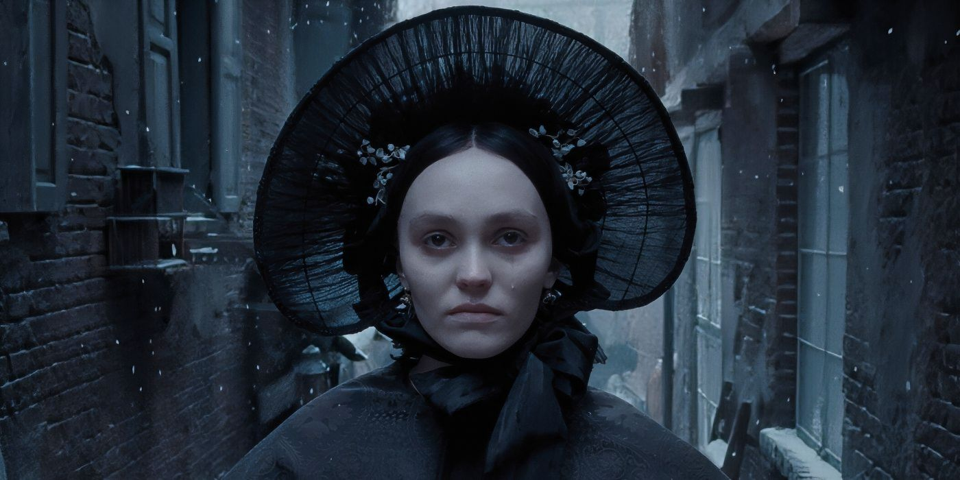
Well, here's where things get tricky, actually. I'm not quite sure how to describe [S] Act 6: Act 6: Intermission 1. I've used the term "hypercomic" to describe Homestuck before. That's a bit of a contentious point right there--Alycia Shedd, another hypercomic theorist I'm acquainted with, suggested to me the other day that it's more like an illustrated novel than a comic, and there's maybe some truth to that. Even if we do accept it as a comic, there's definitely some individual elements that jump fully into other media--animation, games of various types, and, at one point, historical romance novels. [S] A6:A6:I1 is one of those points--it's undeniably an animated sequence (images juxtaposed temporally), not a comic.

And yet... there's a number of elements that are more akin to hypercomic technology than anything else I've seen. So, maybe what we're looking at here is a hyperanimation?

This is a big deal because it gives Homestuck yet another You Were Number One achievement badge to sew on its kiddy camper handysash. A hypercomic that's already broken so many other boundaries is, apparently, gleefully breaking new ones with every few updates these days. Hell, this comes shortly after an update that turned Homestuck into a type of hypercomic that up till now was almost purely theoretical. (I'll explain more about that in a moment.)

The most notable part of this, however, is that it again underscores Homestuck's unique qualities--the things that set it apart from other formalist experiments.

[S]A6:A6:I1 isn't powerful because of its formal, experimental elements.

It's powerful because those elements are used to express a powerful, dramatic moment in the story.

I want to try to get at why, which is going to necessitate some discussion of the narrative. For those of you who haven't read any of Homestuck, this surprisingly makes for an ideal element to discuss, as the events are weird enough (and short enough) that by the time you return to this point in the comic it'll be a surprise all over again. (Homestuck's looping narrative actually makes for a great natural spoiler-baffle because it takes so long to read and there's so many twists and turns). I DON'T recommend continuing if you're almost caught up, however--there's just enough visual information that you can piece together some of what's happened in the last few acts. Anyway, the point is that this article should be comprehensible even to those of you who haven't read the comic while not going old information for those of you who have kept up with these recent updates.

I should also warn you that while the first half has lots of juicy textual analysis, the second half is application of the lessons learned to some other stuff, so I'm gonna drift away from Homestuck for a bit. If you're just here for the analysis of [S]A6:A6:I1, you can check out that that point, it's cool, although I'd be most obliged if you stuck around.

Cool?

Cool.

Let's begin.

What Is It Doing

Part of what makes this video so interesting is its relationship to Homestuck as a whole. Before we start analyzing, let's take note of the dimensions of the starting screen. That's the standard layout for Homestuck, the norm from which panels sometimes (or, recently, frequently) deviate from. If you've been following this blog for a while, you might recall that I find such deviations to be particularly interesting, because they often work viscerally on a reader, emphasizing certain emotions, sensations, or narrative elements through their structure. (The only reason I haven't discussed it more is because I'm turning this idea into my grad thesis, so I want to keep it just a little under wraps for now. Well, that, and the actual nitty gritty underlying theory would probably be a huge snoozefest for most anyone that isn't me.)

Keep this idea of norms and deviations in mind as we start watching:

[S] Act 6: Act 6: Intermission 1

Did it take a moment to realize that the comet was breaking the panel border?

The first time, it caught me off guard. I wasn't expecting that transition at all, and it crept up on me, partly because it was so smooth:


I love the way this video begins, actually. It starts with a purely symbolic representation of the universe that the game encompasses--eight planets connected by seven gateways to the central entity known as Skaia, and through that abstract space flies a massive meteor... a meteor which then breaks the panel border.

So, let's start there. What is Hussie trying to show us through that strange breaking of form? Why shatter the established page boundaries here?

Well, first of all, notice how there are four planets to start with, with four more appearing. This is a symbolic representation instantly understandable to fans--it signifies that two universes are finally, after a three year wait in-comic, being merged together. This is an interesting choice, I think. Hussie could have depicted this by actually showing the four new planets materializing in this reality... but instead he simply indicated the titanic shift iconically. This allows him to indicate to the reader what is happening in a way that is still chill-inducing, especially when paired with the ambient cross-speaker pulse of the music, but keeps this event from drawing focus from what he considers the main action to be.

And in fact, the symbols of the planets dissolve into blackness just as the meteor starts growing and breaks the panel borders, and just as the music picks up. This indicates a transition from a symbolic reality to a literal one, and the literal reality of the meteor cannot be contained. There is a very conscious, consistent visual language at work here, actually, that isn't unique to Hussie--the ability to break the restrictions of the panel or page is an indicator, in countless media, of power beyond normal mortals. This is why Rococo angels and putti spill out of heaven onto the molding of churches, why Jack Kirby's gutter-breaking action is so dynamic, why Alphonse Mucha adds borders onto his religious paintings only to have his gods and angels and spirits break those established bounds... heck, it's why Planeswalker cards in Magic the Gathering, which represent beings on the same level as players rather than servile summoned creatures, break out of their art boxes:

Venser, the SojournerTezzeret the SeekerChandra Nalaar

Hussie is no stranger to the use of such structural indicators. In fact, there are moments in the comic where the entire layout of the website is reworked to indicate the presence of a being powerful enough to reshape the narrative to its own will and vision.

So, what we get out of this is that A. the meteor is real, not part of the symbolic world represented by the starting panel, B. it's the subject of this video--the important thing we should be focusing on, and C. this meteor is, in some way, too powerful to be contained by the comic's typical dimensions. This is extremely strong storytelling, because it uses simple elements to convey a LOT of information, much of which flashes past instantly without your brain having to really ponder it. This is why writing articles like this can be tricky--this stuff seems kind of obvious when you spell it out, but most of it is happening on an unconscious level. You're not constantly assailed by a voice spelling all this out like I'm doing, you just "read" it and understand. I suspect some of this is even going to be accessible to people unfamiliar with the astrological symbols invoked here, and unfamiliar with the narrative, because the structure is simply that strong.

As hypermedia, then, this is already a raging success, primarily because it uses hyperelements like the breaking of the previously sacrosanct page--a mark of Infinite Canvas techniques--for a specific informational purpose. The techniques are cool, for sure. Part of the experience comes just from the sheer element of, "woah, I've never seen anything quite like that before!" But that element complements rather than distracts from the actual information--factual and experiential--being conveyed. This is an area where other hypercomics have traditionally struggled, so this page is important from the perspective of pointing toward a way of making use of hypertech. This is what I mean when I describe Homestuck as a successful tech demo: it shows not just what you can do but why the new tech is useful and powerful. It's not just showing off a bunch of disconnected mechanisms, it's showing why we, as creators, might be interested in utilizing similar techniques, and why we, as consumers, should get excited about where the comic is headed.

There's one more thing the first section does well, actually. It leaves us wondering about conclusion C: why is this meteor powerful enough to break page borders?

We keep watching, expecting an answer... and in a moment, we get it:


The meteor is being piloted by a powerful figure. It's not the meteor in and of itself that breaks the boundaries of the comic, it's this dark looking being. (Those of you who have been keeping up with the comic know what's going on, those of you who haven't read any of it should be comfortably baffled and spoiler-immune at this point, and those of you who have read past Act 5 but haven't gotten further now know why I told them not to read this damn article. Too late now, ha ha!)

We have, here, the same techniques that we saw before being used to convey this character's power. Her presence extends beyond the confines of the established page, setting up her later actions as plausible.

And actually, we're starting to see some of the hyperanimation elements that I mentioned earlier. Right now, Hussie is using techniques that couldn't work effectively in a traditional video format, because they depend on the establishment of a small window, followed by the breaking of that window. While it's hard to imagine TV audiences accepting a work that regularly uses just one sixth or so of their viewing screen, such things are perfectly acceptable to computer audiences. What's more, the fact that Hussie is uploading flash constructions himself allows him to do things impossible on sites like YouTube (unless you somehow hack the website and install a bunch of java stuff, which I think Google wouldn't appreciate, the putzes).

What we're seeing here is Hussie utilizing only the parts of the screen he needs, but simultaneously eschewing the arbitrary constraints of single shots, spacial continuity, or set aspect ratios. This is all shit straight out of the Infinite Canvas playbook--when you don't have to worry about paying for blank space on a printed page, you have unlimited freedom of panel size, shape, and spacing. Hussie is using a technique previously reserved for hypercomics and applying it to animation. Thus, hyperanimation. And, like I keep stressing, the techniques are used here for a concrete purpose--here, for A. showing the figure's power and B. establishing a three dimensional spacial relationship between the meteor and the portal above Skaia while also giving us a dramatic closeup on the figure. Hussie is showing us what is possible, but always in the context of the larger purposes of the narrative.

And actually, there's another interesting hypertechnique at work both here and in the next bit:


(For those feeling a bit lost, the meteor just went through a protective portal around Skaia, redirecting it to Earth. What we're seeing here is the meteor leaving that portal and blasting off toward our planet... oh, which is also about to be destroyed by those red things which are tearing the universe apart because a homicidal middle-managing bureaucrat was given omnipotence and decided to take out his anger on the frog that is the universe and DAMMIT THIS EXPLANATION JUST MADE EVERYTHING MORE CONFUSING DIDN'T IT?)

One of the things Ian McDevitt and I discussed in the alpha of Understanding Hypercomics (which is woefully out of date but still pretty astute in a LOT of ways of I do say so myself and I do) was that hypercomics could emulate other media more easily than traditional media, because the web is more mutable than, say, the printed page.

This, it seems, extends to other hypermedia. The video here, for example, is emulating comics. This is possible for two reasons. First, Hussie has, as I mentioned above, decided to ignore traditional boundaries and fill the space or leave it blank as the content demands. Second, this hyperanimation comes in the context of a comic. Since we're already primed for comic panel reading (where not everything has to relate spacially) we understand that the meteor is traveling between one close up panel into a much wider shot--not literally, of course, but this transition helps us understand the layout of the event without losing any of the detail. It blends the best elements of comic and animation. It's an animation within a comic emulating a comic.

Homestuck: so meta you'll want to punch something.

This actually brings up another interesting fact about Homestuck: it's constantly doing stuff that we knew was theoretically conceivable, but hadn't been explored in practice.

Want a more tangible example? Ok. Let's take a brief diversion here and talk about Time Variable Hypercomics.

So, one of the things that we realized when writing Understanding Hypercomics was that the editable, reviseable nature of the web meant a comic could stay in one state up to a certain point and then, after it progressed past that point, the previous existing content could change to reflect new information. We came across just one semi-example during our research, and we're still pretty sure the author has no idea of the significance of his experiment. Besides that, and our own tech demo, there was no proof that this could be used as anything other than a gimmick. We had some ideas about using it to show a change in the reader's understanding--like, you could totally do a Fight Club hypercomic where the scenes with Tyler after you read to a certain point would be revised to show just one person fighting with himself, or a 1984 comic where you literally always would have been at war with East Asia... right up until the point where you would always have been at war with Eurasia--but again, we had no concrete implementations.

Or, we didn't, anyway, until John stuck his hand through something weird and suddenly appeared all over the timeline in Homestuck in various panels... and Hussie actually edited those panels to show John's hand materializing inexplicably.

Time. Fucking. Variable.

This blew me away completely, because it was not only an implementation of a previously purely theoretical (and often kind of difficult to explain or understand) class of hypercomics, it also served a strong narrative purpose. As a technique, it both resulted in a humorous circumstance (the slapstick of John's hand showing up in the background of random panels in midair)... and an indication that for the first time ever, the temporal rules of Homestuck were being totally busted. Something that should not have been possible became possible, and the medium itself bent to accommodate. It was a fantastic blending of form and function, made all the more significant by the fact that it was something no one else, to my knowledge, had ever done for a deliberate, in-narrative, not-a-retconny reason.

HUSSIIIIIIIIEEEEEEEE!

Anyway, that's what I'm talking about when I say that Hussie does stuff in Homestuck that otherwise is purely in the realm of the theoretical. And again, it's always pushing boundaries not at the expense of the narrative but to its benefit.

I don't actually have a lot to say about this next bit, so let's just take a moment to appreciate how cool it is:

I love the dynamism at work here. Stuff is flying all around at this point. Panels transform into stylistic elements (love the way the green of the figure is backed by that thinning red line, for example), we get some more of that cool spacial shifting... nnf. It's just good stuff.

And then, suddenly, everything breaks:


The video that is the comic that is the game Homestuck glitches right the hell out and we're left with an incomplete video. But look how slick that is--the music is written to accommodate that sudden structural break, it glitches in time and in tone in a way that's still intriguing to listen to, before finally breaking apart completely as the video comes to an end. And what's more, the glitching comes as a shock because we've already gotten used to the smooth flowing animation used in the video. Hussie has established a NEW baseline, only to immediately deviate from it once more to indicate...

Well, what's going on here? This might, again, for those of you who aren't caught up, just make things more confusing, but let me try to explain. Homestuck is played on two game disks. We ran out of game disks recently, but there's an expansion pack that continues the narrative, in the form of an old school game cartridge. Only, some asshole decided to fill the game cartridge with sugar and candy corn, like the obnoxious little shit he is. Asshole cherubs. Anyway, currently the narrative itself is glitching because the game has been damaged by the presence of sugary bullshit in its delicate inner workings.

So, all this sliding and panel breaking and stuff has really just been a red herring. It's a setup to get us excited about what's coming... only to bust up the animation at the last moment as the screen is taken over by broken image files that hint tantalizingly at the content of the rest of the video, but keep any semblance of meaning hidden.

And then, to really drive the point home, on the next page we get this message:

The cool Flash animation is unexpectedly cut short due a critical stardust clog. What a shame. Those exciting new gameplay features were looking real slick, too. You think it was pretty neat how the panels were sliding around like that. Oh well, you probably didn't miss all that much. 

Nevertheless, on a hunch you navigate once again to your trusty bandcamp page, and check the length of the song in question. Your fears are confirmed. It seems you missed four solid minutes of footage. You wonder if you'll ever find out what happened? 
HUSSIIIIIIIIEEEEEEEE!!!!!!!!

We've been pranked.

But we could only have been pranked so severely in the context of a masterful use of this medium.

This gag only works because everything that comes before it is so expertly put together. This is the strength of what Hussie is doing: he's making you really and truly want more. As a tech demo, this is perfect because it stirs interest while leaving the audience hanging and wanting satisfaction. It's advertising 101. And to add insult to injury, it's all an unintended, incidental consequence--Hussie isn't trying to market his game engine or anything like that, he's just doing what's best for the narrative.

So, that leaves us to pick up where he left off.

What Can We Do With What It's Doing

This is the bit where Homestuck fans here just for Homestuck stuff can feel free to check out, although of course I'd be glad to have you stick around. I want to talk about what we can take away from the techniques at work here, and how simple exposure to competent experiments can spark other experimentation.

To do that, I want to talk a bit about an idea this sparked in me. To do so, I'm going to have you watch this clip from the show So You Think You Can Dance:


So, this is actually a pretty sweet dance. I don't watch So You Think You Can Dance (I find the premise of reality shows--the idea of artists competing and getting ranked and voted off and told to go do something else--to be really distasteful on a deep kind of gut level) but my girlfriend, who is a dancer, sent this along to me because she knew I'd dig it. It's got the odd kind of off-kilter rhythms and unexpected controlled movements that I like in other media on a more metaphorical or structural level. It's control and release, you know? Just like what I've been ranting about for the last several thousand words or so. My girl knows what I'm into.

But what does this have to do with Homestuck?

Well, as I was watching, it occurred to me, as the camera focused on the judges and their reactions to the dance, that there was absolutely no one in the omniverse at that moment that I gave less of a shit about THAN THE FUCKING JUDGES.

I wanted to see the damn dance, for goodness sake!

And I thought, ok, wait, some people probably do give a shit about those people even though I don't, because some people watch this for the competition rather than the dances alone and they want to see the body language indicators that signify success or failure. Cool, I dig that. But this way we're both getting a fraction of what we want--I'm getting a hamstrung experience and they're missing the flow of body language in response to the other body's movement. To shrink down one screen and split the existing screen would be pretty cumbersome, I think, even with wide screen TVs that not everyone has.

But there's nothing besides the fact that no one has tried it yet to stop a whole other screen from getting added to the mix here. Look at it as a blank border section that you can use, or can leave as empty canvas--just like Homestuck uses the sides and tops of its panels when it needs to. Can you imagine a multiscreen rig that had variable-dimensioned, poseable screens that could be put into use if necessary? I suppose this could be done with a large enough single screen but perhaps not as elegantly or as interestingly. And maybe this is the kind of thing that can only work in specialized spaces with specialized media. That's ok! Shit, we already buy whole gaming systems that run games exclusive to their hardware, and with blu-ray in existence now we've also got multiple hardware types for movies (leaving aside the benighted VHS, which I still use thankyewverymuch). Is it that much of a stretch to say that this has potential?

I don't think so (or at least I didn't a couple of days ago but now it's sounding pretty dumb, actually), but I'd need some sort of demonstration.

And that's where the idea threatens to fall flat on its face.

See, something like this, especially for an idea that arguably could be solved far more easily and economically by hiring some better fucking film editors (seriously, who decided that concerts and dances and comedy performances needed to show the audience's reactions every 12 seconds? I don't care about those unwashed peasants, if I want to see them I'll leave my darksom and odorous room-den), can't stand on its own strength alone. Otherwise it's just glitz. It's just a trained dancing bear and has roughly the same resonant appeal.

That's where so many tech demos fall flat. That's why so much in AAA game design is mindbendingly wrongheaded. You can't tech demo your way to emotion, no matter how many pretty wrinkles you put on the face of your sad old man sprite! Emotion isn't higher resolution, you're not saying anything more profound with those pixels! You say profound things with a marriage of form and content, a blending of experimentation and sound communication techniques.

In other words, you do exactly what Hussie is doing--you write a story, then you bend the tech around that story to accommodate your message.

Wait, I've got one more example:


So. I guess this is impressive? Somehow? Like, it's probably a pretty big deal that it's running real time on the PS3 rather than being prerendered. Alright.

But.

I just.

Don't care?

I just can't work up the will to give a shit about this tech demo or anything it's trying to show me, because the story is a flat, sexist, overdone box-checking exercise. Press [Female In Vulnerable Position] button! Receive protective sympathy lizard brain response! It's rote, it's unimaginative, and it's really kind of gross and male-gazey... I mean, wow, what an explicit power fantasy--only you can protect the naked sexbot! You have the power, insubstantiated male off screen voice implied to be the viewer!

Yuck. Yuck all around.

There's nothing in this video to show why the technology in play here is necessary. Our stupid lizard brains would react regardless of the relative high or low resolution of the figures. This opens no doors, shows us nothing that we haven't seen before, gives me no reason to want to know more.

Basically, this video is everything that [S]A6:A6:I1 is not: dull, closed-ended, and saddled with a narrative ineffectually trying to show of tech, rather than supported by tech designed to effectively show off narrative.

If I wanted naked robots, Bjork already pulled this off in a way that's more compelling, better shot, and way, way sexier.


More like all is full of academic nerd rage!

Anyway, the point I'm driving at here is that as far as Homestuck takes us when it comes to tech, the tech alone can't carry us forward into the future of hypermedia. For that, we need to take the lesson of Homestuck's narrative. We need to see how the tech is used to serve the story, rather than the other way around. And above all else, we need identical lesbian makeo-


NO, no, wait, sorry, got sidetracked there for a moment. Ah, the point is, we're on the verge, culturally, of exploring some really cool stuff. Stuff that busts the boundaries of media wide open. The way forward is to be conscious of how we are putting these ideas out there. We want to see them succeed and grow and change. We want them to inspire people to apply them elsewhere, in surprising new ways.

To accomplish that, we have to move beyond the tech demo. We have to move beyond the tech-driven demo, and create narrative demos. Because ultimately, no matter what the technology looks like, it exists to serve a purpose as old as human thought: telling a tale.

Circle me on Google+ at gplus.to/SamKeeper. Follow stormingtheivory.tumblr.com for updates, random thoughts, artwork, and news about articles. As always, you can e-mail me at KeeperofManyNames@gmail.com. If you liked this piece please share it on Facebook, Google+, Twitter, Reddit, Equestria Daily, Xanga, MySpace, or whathaveyou, and leave some thoughts in the comments below.

Monday, February 18, 2013

Saint George and the Death of the Author

So, I happened upon this piece of art on Tumblr recently, and my immediate thought was, "Wow, there's so much to analyze here; this is fantastic:"

This piece is a portrait of Saint George, and is by an artist going by the name Casey. If you want to check out more of her gorgeous art, see: http://cparris.tumblr.com. The original piece can be found at http://cparris.tumblr.com/post/3909497389/saint-george-if-you-can-hardly-see-it-then-you

Then my second thought was, "I wonder how much of what I'm seeing here was intentional."

And my third was, naturally, that it was time to write a new article.

I actually get asked a lot of questions about a postmodernist concept known as Death of the Author. It's a concept that, if we're talking strict definitions, comes from a guy named Roland Barthes, and describes a very particular type of metacriticism aimed at taking those damn Formalists (the New Critics, remember? I've talked about them before) down a few pegs. It marks a transition from discussion of "Works"--masterpieces from a single author that contain a prime theme of universal human relevance--to "Texts"--collections of signs that combine and contrast to form their own meanings. The Death of the Author is the death of the Work, and also, Barthes gleefully points out, the death of the Critic and the rise of the Reader.

But it's also paradoxically a pretty good description of the moves a lot of modern theorists made. The Formalists, for example, opened the floodgates to begin with, ironically enough, by suggesting that meaning resides in the text. They suggested that we had to interpret based not on historical details or the author's biography but rather on the elements contained within a work. Barthes and other Semiologists extended that logic further to the point where the author had virtually no control over interpretation, and everything took place on the level of signs. Reader Response critics asserted that meaning actually came from the reader rather than the text, and any act of interpretation actually was an act of self-reflection and should be explored as such. I'm a bit less familiar with the psychoanalytic critics, but even there the impression I've gotten is that they are interested in how the text reveals the intentions not of the conscious mind of the artist but of some deeper force (whether an Id or a Jungian collective unconscious asserting itself).

Whew.

Anyway, I don't want to dwell on the history of criticism here, I just want to give you a sense of how Death of the Author is an enduring concept common to most modern criticism, even if it doesn't go by that name. Same actor, different parts, yeah?

But what I'm driving at with all this is that there's lots of ways in which meaning can be constructed without the artist's direct intervention. In fact, what I want to at least attempt to demonstrate today is that these constructions are totally impossible to avoid. In other words, this isn't just a bunch of theory mumbo jumbo of interest only to scholars, this is something that happens in your head every time you confront a work of art.

Watch.

The first thing I'm confronted with in this illustration is its simple structural qualities--namely, the fact that it low key to the point of being barely comprehensible, save for the saint's gold halo. It's so dark than on some of your monitors it may actually be completely black. Uh, if that's the case, do adjust the brightness accordingly; it's really worth being able to see properly.

So, already there's a kind of magic going on as my brain has to react to the visual stimuli and start to compose a narrative of what it's seeing. The main thing I'm getting is that the halo is the most important point. I'm articulating that here because I've got the training and language to do so, but really that recognition of the halo's importance happens on a level below your conscious awareness before you can consciously process what it means--we see that bright yellow jump out at us, while the rest of the picture recedes into the background. The same principle is true even when such contrast isn't quite so glaringly obvious. (Huh, it's almost like I chose this example specifically because of how clear its formal components are. Crazy!)

Then, once I'm over how beautiful that thing crescent of gold is on that black background (and really, if you simplified it down to just its geometry, this is a gorgeous composition) I start to take in the features of the figure. The first thing I notice there is that it's, well, really damn good. It's a nice drawing. But it's also somewhat roughly done--elements like the spear are left unfinished as though this is just a study. Again we get the impression that it's the halo that is important, not the figure: the rough study quality suggests both that this is a quick portrait sketch, almost like a study for a larger work, and that the soft lines of the figure are of lower order concern, despite their beauty, than the strongly defined contours of the halo.

The figure is also somewhat feminine looking. This is perhaps surprising, given that it is a portrait of Saint George. In the very unlikely chance that anyone is unfamiliar with that particular saint, George was a slayer of dragons. Yeah. This youthful, effeminate fellow is Saint George the Dragon Slayer. I'll get to what all of that suggests in a moment, but let's just quickly note the posture of the figure--there are strong verticals throughout the piece and the composition as a whole sits within a fairly tall and narrow rectangle. All of this gives the figure a kind of regal authority and solidity. The figure is like a sturdy column.

So, we've reacted viscerally to the physical qualities and their aesthetic power. Now we start to piece together a story of what's going on, based on what signifiers we observe, and what associations they bring to mind.

Now, keep in mind that I'm laying all this out in detail but all of this is happening within the span of a few seconds in my mind, automatically. This is what I mean by these acts of interpretation being out of our control--I'm not willing myself to react to this stuff, I'm just taking it in, processing it, and spitting it back out.

But if I articulate the thought process what I get is this:

The halo, as the most important element of the piece compositionally, signifies the prime importance of the celestial, of the holy, in this picture. In fact, the figure is overshadowed (literally?) by the presence of the holy, and the picture suggests through color and value that Saint George and his heroic deeds are less important than the divine strength behind his power. What's more, instead of showing St George as a burly heroic figure of legend, as we might expect, or a proverbial Knight in Shining Armor, St George is depicted as a youth--unbowed and unflinching from our gaze, to be sure, but a youthful, almost delicate creature all the same. This subverts our expectation of what a St George should look like, and in response we are once again brought back to that heavenly strength that empowers the saint. Oh, but don't get too caught up in the androgynous gorgeousness of St George, because remember, that beauty is shrouded in shadow. Even as we contemplate the aesthetic qualities of the figure we are stymied and frustrated by the darkness of the image, doubly reprimanded by the upsetting of our expectations and desires, and finally forced to set aside our desire to sanctify the man, leaving us only with the contemplation of God.

Which is, like I said, not what consciously went through my mind when I saw this picture.

Lemme try to transcribe that quickly, I think it went something like:

"Holy fuck this is a pretty picture."

Aw yeah, nothing like the eloquence of the conscious mind.

But that's kind of the point--I reacted aesthetically and then semiotically before I reacted consciously. My mind's will to interpret took over before my mind's respect for Authorial Vision And Intent could take over and tell me to stop. Remember, I can't know whether any of that was intentional on the part of the artist. ("But what if you asked her, doofus? She's got a tumblr!" I'll get to that in a moment, Oh Ye of Little Faith.) I only take what I know--or have programmed into me by evolution--and spit out a reaction and a reading, and that composes my best guess at what the picture is attempting to tell me. The picture. Not the artist.

But... what if you just ask the artist? Why can't you do that?

Well, first of all, artists are liars. No, really, listen, I speak as an artist and writer here, and trust me, we're all liars at heart. I mean, most of what you do in fine art is a carefully constructed lie--even artists that work from life in an illusionistic style distort reality to better fit the way the human eye and mind interpret visual stimuli. And fiction writers... man, do I even need to get into how heavily fiction writers distort reality?

So, knowing all that... why do you expect an artist to suddenly start telling the truth when they put the keyboard or pencil down?

But alright, that is a snarky response, I admit it. Not all artists are out to dupe you. (Just most of the ones that win the Turner Prize.) But even then, we're left with this problem: if we already know how powerful the unconscious mind, the little homunculus that pushes the aesthetic and semiotic buttons in our heads, is... why should we elevate even the author's conscious mind over their own homunculus? How can we conclude that even an artist is fully aware of all the aesthetic gears and cogs in their own work, when so much goes into a piece? We have so little control over our initial interpretive efforts; it seems strange to me that we should give a single individual sole interpretive power just because that individual has an authorial claim.

And I mean, what artist, when given a complex, clever analysis of their work is going to say, "Nope, all that happened totally by chance"? The answer, of course, is an artist with more integrity than I have, because if any of you suckers come to me with a brilliant insight into my work, I fully intend to nod my head and say, in a sagely tone, "Ah yes, my child, you have understood well."

Artists: the snake oil salesmen of high culture.

Aaaanyway, I don't want to cast aspersion on Casey here with all this rambling, I just want to address some of the fundamental problems with relying on an authorial voice to guide your interpretation, since that voice is often unavailable, and often unreliable. That's not even to say that you must never agree with an authorial interpretation; that would be really goofy and kind of a dumb critical stance to take. I'm just saying that we have some power here, and that power comes from how interpretation happens automatically.

In fact, I have one more thing to say about how Death of the Author is conceptually unavoidable, and it has to do with the application of semiotic associations on a metatextual level.

I am so, so sorry for subjecting you to that sentence.

What I'm saying, in simple terms, is that there are associations that happen not just between signs in a text and other external signs, but associations between a text as a whole and other texts. There's kind of an interesting idea in the further weirder reaches of critical theory that texts talk to one another, and the more texts you read the more they all start to babble back and forth. And again, this is something you can't really turn off.

To stick with St George here, for example, I immediately associated it with two very different schools of work: Byzantine icons, and the ultraminimalist black on black paintings of Ad Reinhardt.

Remember how I ranted a few paragraphs ago about being a liar? Well, I may have tweaked the truth somewhat when I talked about how the piece compositionally suggests that St George is of lower concern than the holy power behind him. I say "may" because I'm not completely sure--this stuff happens all in a big, rapid jumble, remember? But I think I may have been influenced not just by my understanding of the composition but by my familiarity with the constant struggle in Eastern Orthodoxy over whether or not Icons count as Idols. The problem is that when you've got what is pretty much straight up a graven image--something the Bible explicitly forbids--representing saints that you pray to, it's always going to occur to someone that maybe, just maybe, the icons should be smashed like the heathen idols they actually are.

The way the Byzantines got around this was by constructing a rather complex and strange line of reasoning that, put simply, claimed the icons WERE the saints! They couldn't be graven images because they weren't images at all--they were literal manifestations through the artist's paint or mosaic tile of a heavenly being.

When I look at this piece, I can't stop knowing what I know about the Byzantines. I can't unlearn what I know about that conflict.

So when I look at this piece, I think to myself, "Wow, it's a depiction of a saint that remains an icon in form but devalues the person in favor of the holy ideal he represents. That's a clever solution to the Iconoclasm problem."

And really, I wouldn't want to turn off that bit of my mind even if I could. See, my understanding of the piece is greatly enriched by my knowledge of history, and even if Casey is not a Byzantine scholar, I need not limit my own understanding of the piece's historical context and what it says within that context to correspond to that limit.

In fact, I would go so far as to call this very specifically a kind of modernist icon, the kind of piece that could only exist at this historical moment in time. That's where Ad Reinhardt comes in. I've talked a bit about him before; he's the cat that started painting all black canvases that were actually complex slight variations on black in specific patterns. He was trying to achieve ultimate subtlety with his works, and I think some of that impulse is present in St George. There is the same interest in very subtle contrasts and in delicacy, and ultimately they have a similar effect: they invite deep, almost meditative contemplation. When combined with religious subject matter and iconography you get an icon that can only exist in a time of postmodern experimentation with form, but that ultimately calls back to a long tradition of religious art.

And those conclusions, whether consciously derived or not, begin with the confrontation between the text--the portrait of St George--and the repertoire in my head, the signifieds, signifiers, and associations, and the evolved or learned response to deep compositional structures.

We can argue theory all we want but in my mind the author is already dead. And in that death, just as Barthes suggested, the reader is given new life through the ability to interpret expressively and creatively. It's not a denegration of the author, it's just a recognition that there is a sphere beyond an author's intentions, and that's the sphere that we access in that first moment when, confronted by an object of stunning beauty, our minds spit out the primal interpretive insight:

"Holy fuck that's a pretty picture!"

Hahahaha this was supposed to be a short piece. Whoops. Check me out on Google+ at gplus.to/SamKeeper or on Twitter @SamFateKeeper. As always, you can e-mail me at KeeperofManyNames@gmail.com. If you liked this piece please share it on Facebook, Google+, Twitter, Reddit, Equestria Daily, Xanga, MySpace, or whathaveyou, and leave some thoughts in the comments below. Oh, and really, check out Casey's stuff. It's so cool.
Support on Patreon
Store
Reader's Guide
Tag Index
Homestuck Articles
Solarpunk Articles
Mastodon/Fediverse
Tumblr
Bluesky
RSS Feed