Let's talk about Madness.
Specifically, the song Madness by Muse and its accompanying music video.
It's actually a favorite of mine, as is the song. Muse on this track really shows off their versatility--they're a band that's often been compared to a mashup of Queen and Radiohead, but here they sample stylistic elements from Dubstep to pretty excellent effect. You can never say, of Muse, that they don't push their boundaries.
In a way, that's kind of what I want to talk about tonight. I think the idea of pushing and finally shattering boundaries is essential to a lot of what Muse does, and is certainly central to what's going on in this video. The video is fairly simple in construction--it shows a man and a woman in a subway station, circling around each other and finally sharing a pretty intense kiss. This is intercut with images of the band, and images of a riot. Now, we could read this simplistically as just Muse's attempt to build energy throughout the song by using these images of violence--as an adrenaline-boosting strategy--but (surprise, surprise) I think there's a lot more to these juxtapositions than simple appropriation of images we've seen frequently in the media over the last four years.
To get at what Muse is saying with this video, though, we've got to turn (again, surprise, surprise) to some theory.
Specifically, we need to understand the idea of the Hegelian Dialectic... or at least, the Hegelian Dialectic as interpreted through interpreters of Marx. Yeah, already things are getting a bit dense. Look, the problem here is that Hegel, the philosopher that came up with the notion we're going to discuss, isn't necessarily the most important person to write on these ideas. Rather, it's his ideas interpreted through Marx (essentially the father of Communist thought) and through Engels (Marx's collaborator), and then filtered through other thinkers, that we're most interested in. Honestly, some of what I'm going to be discussing is also filtered through my own interpretation of what other scholars have told me, so this is pretty far removed from the source.
This actually works in our favor, though, because what comes out the other side is a highly symbolic, highly romanticized understanding of Hegel's ideas, which fits well with a reading of an emotionally-charged piece of art.
"Get to the point!" you howl and wave your flagon in my general direction!
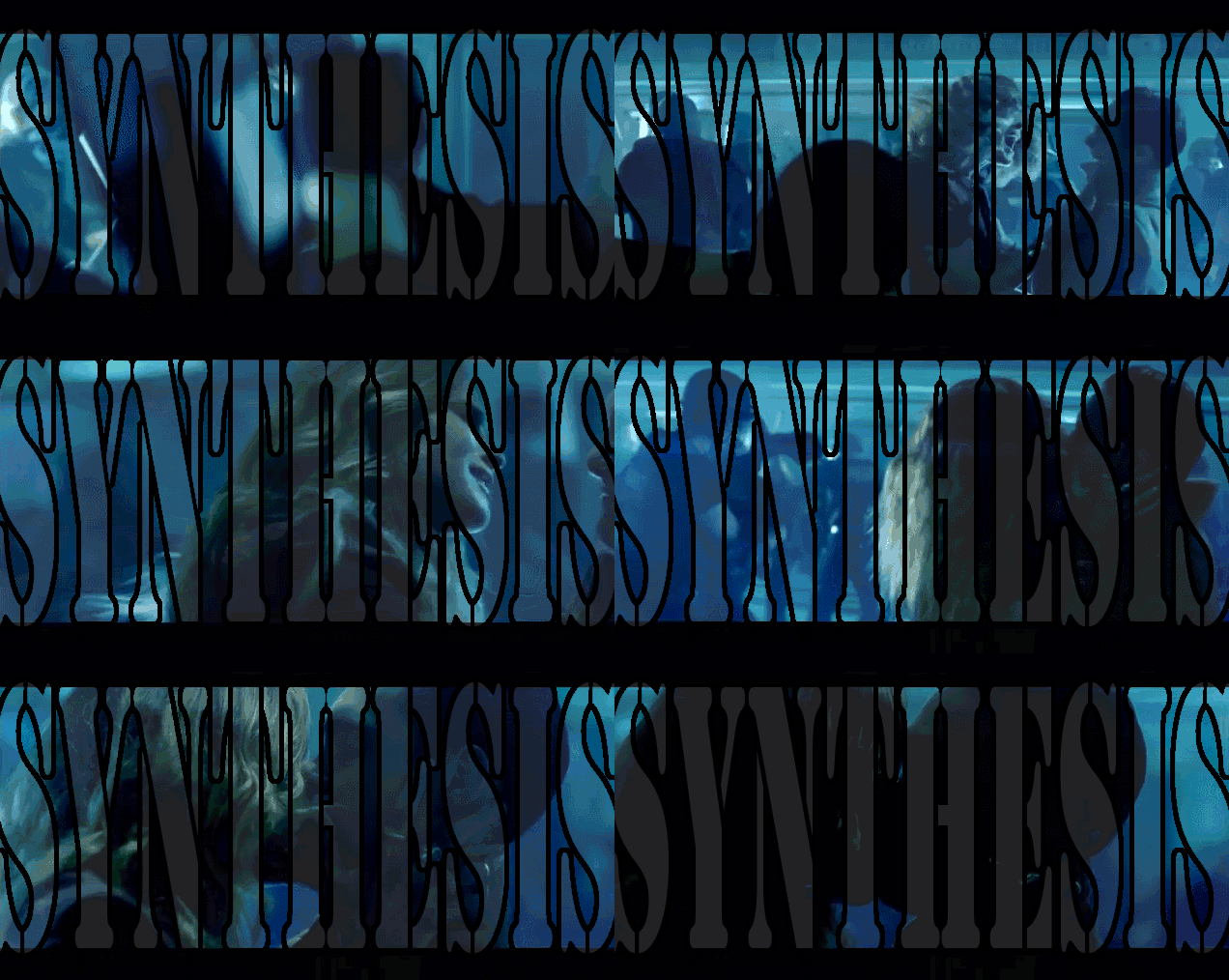
Don't be impatient! You can't start being an Antithesis until I present my Thesis! You're jumping ahead!
Which is really what the Hegelian Dialectic--or, for Marx, the Dialectical Materialism--is about.
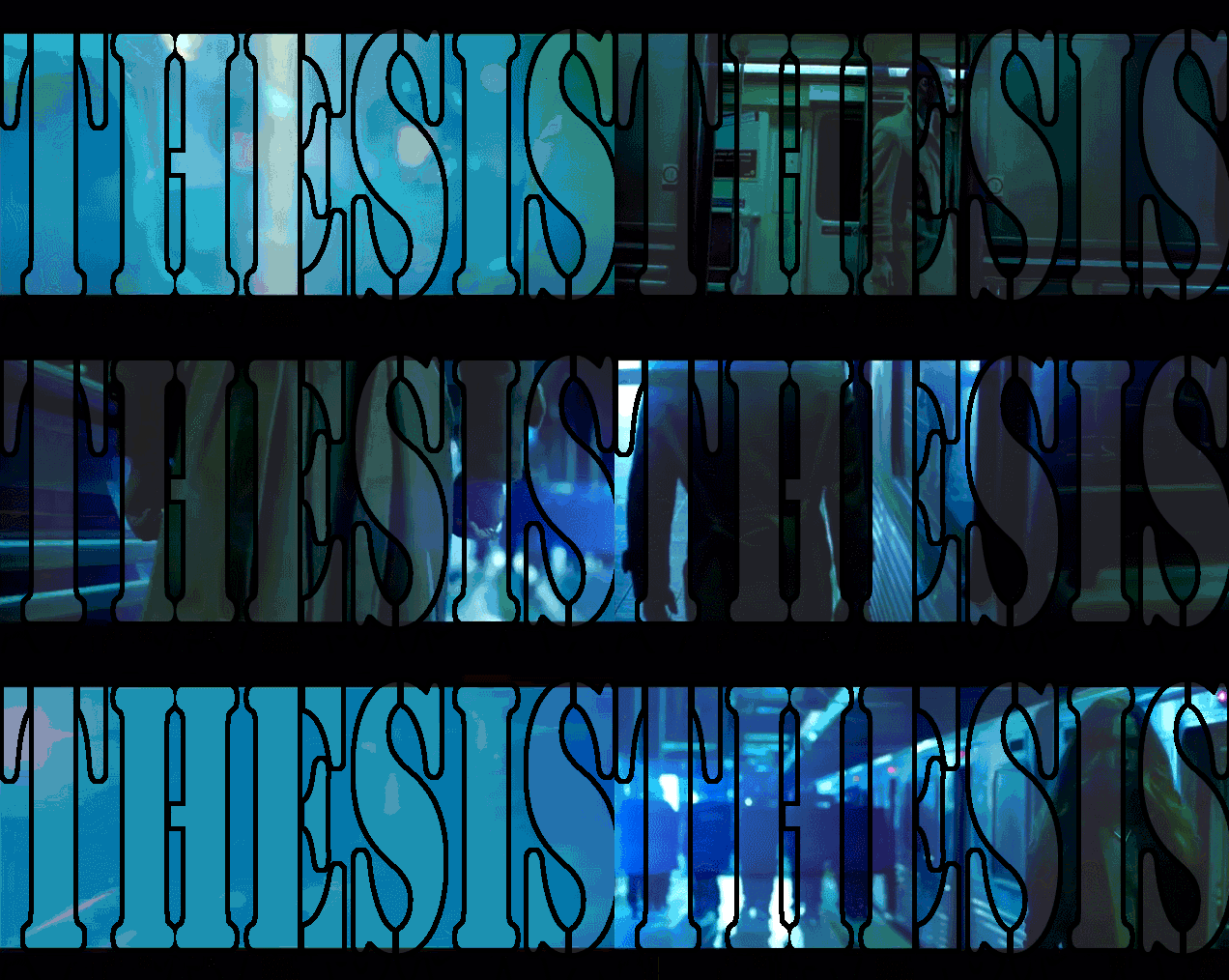
There's a Thesis--this is a state of being, a power structure, a dominant idea.
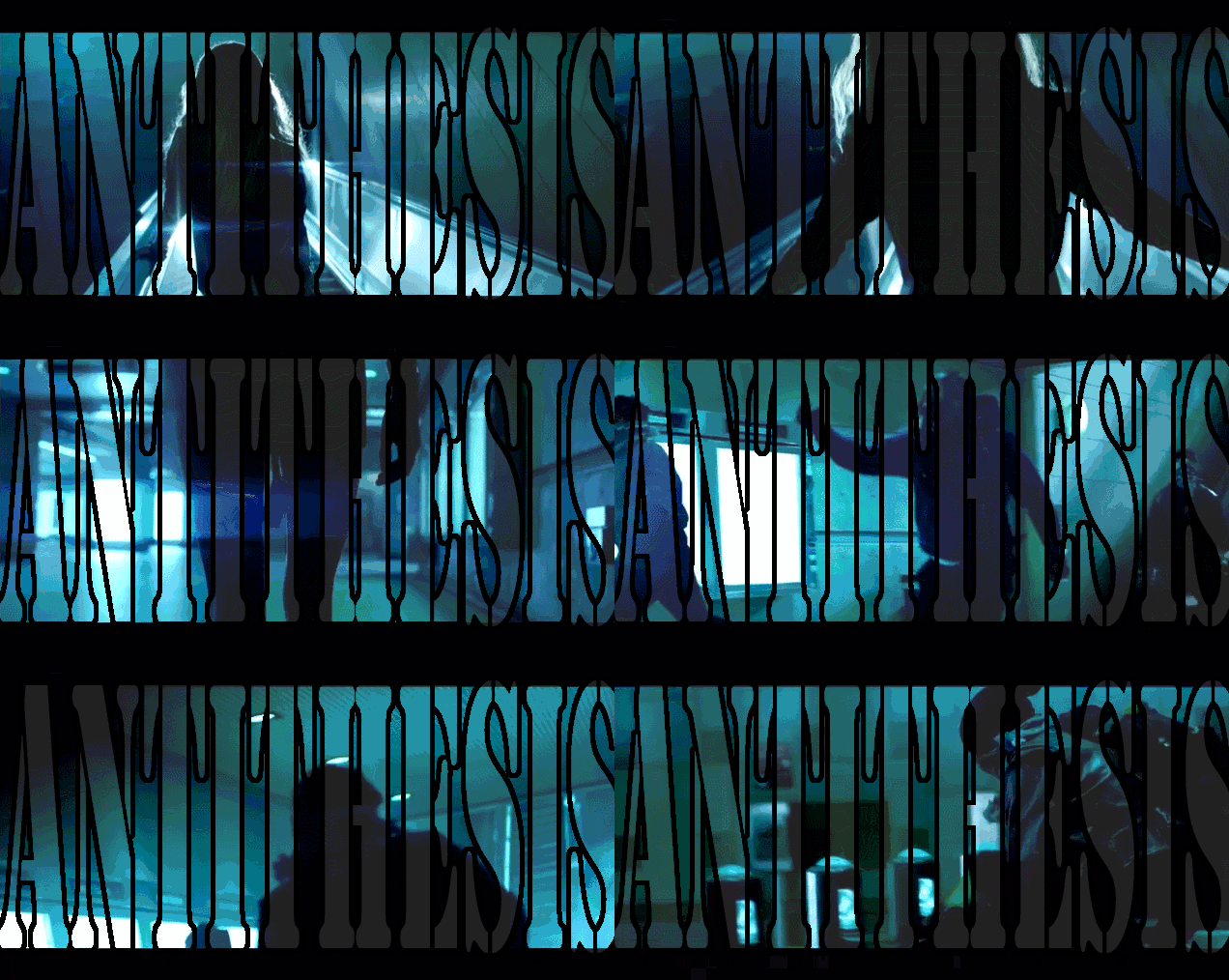
Then there's an Anthithesis--the alienations and contradictions and things left disenfranchised by the Thesis.
And then, when the two ideas come together, as when your beer sloshes into my wine while you're waving your cup around angrily, they create a Synthesis, an new form that arises from the clashing of a state of being and its contradictions. For Marx, who's going to be important for this essay, these referred to material states of being--i.e. the thesis is a way of ordering society that leads to a series of problems and people who have been disenfranchised--antithesis--resulting in a revolution of the ordering of society. The synthesized society then becomes a new thesis with its own contradictions.
Of course, no one actually agrees on anything about the Dialectic. Some scholars even claim that Thesis-Antithesis-Synthesis has nothing to do with Hegel's real ideas! It's basically a giant, hideous mess.
But we don't care about any of that, because regardless of their source, the Dialectic is a powerful, powerful meme, with resonances built deep in Western history (compare, for example, William Blake's idea that you need to merge Heaven and Hell in order to create something new). It's less important to me what Marx or Hegel really, truly said and more important to see this powerful notion of a thing smashed against its opposite in order to create a new thing.
What does this have to do with "Madness?"
Only everything.
Let's talk dialectics.
"Madness" is really not a song about madness alone.
It's a song about an opposition.
Love... and Madness.
That structure is repeated everywhere throughout the video and song.
First, we have the lyrics themselves:
And now I need to know is this real love,
Or is it just madness keeping us afloat?
And when I look back at all the crazy fights we had,
Like some kind of madness was taking control
Here's where the opposition is most explicitly stated, but the other verse has a similar structure to it--a state is posited, and then madness is reintroduced into the song. The states of being are worth examining though. Most significant, of course, is the suggestion that one of the two possibilities is "real love." This, to me, seems like the dominant idea or Thesis. We could extrapolate a bit here and suggest that this is a traditional, stable, picture-perfect relationship. It is easily understood, orderly, and genuine.
This notion is paired in the video with two major things: the male character (notionally linked to the male singer) and the militant police state. Look at the header for this section: the video makes heavy use of the "montage" technique, which is widely known in pop culture as "that thing where they show a bunch of clips of people doing stuff really fast so that it seems like lots of stuff is getting done," but which
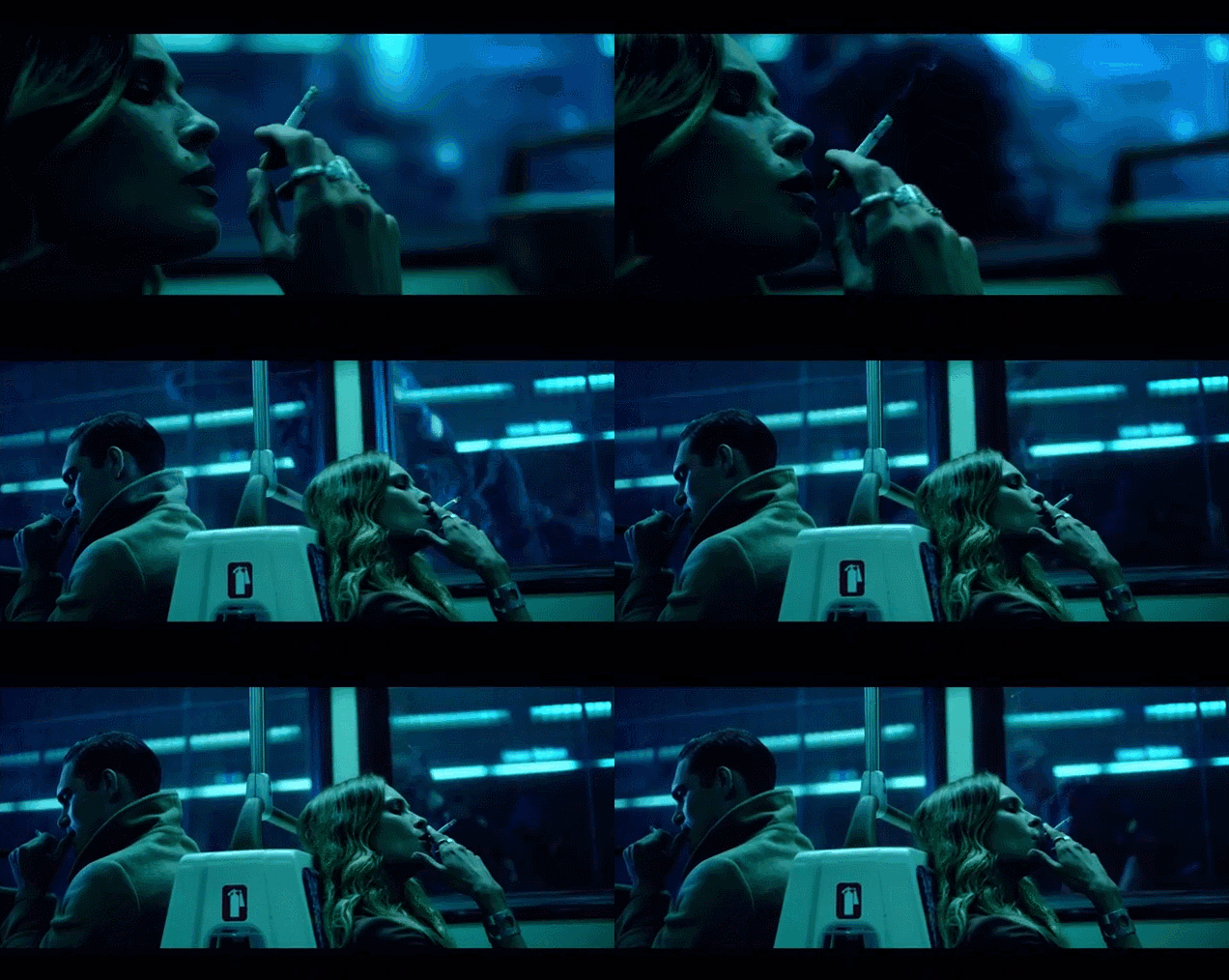
really means a series of cuts between different footage meant to draw out associations between the things depicted. It's a major feature of early Russian cinema (sometime I'll have to get Sara to write something with me on that--she's done research in this area), incidentally, while we're on the subject of Marx. Here, the montaging is used to draw a connection between the man and the riot police. As he walks down the side of the subway car, his motions are intercut with shots of the marching riot police, and finally the sequence concludes with a shot of the woman followed by the police.
So, the thesis here is both the male figure, and the spectre of state power and repression.
This is pretty wild, actually. "Love" being linked to an army of riot police marching in time to crack the heads of the proletariat, or to a guy following a woman through a subway station? Kind of Orwellian, and more than a little creepy, no?
Well, maybe. There's more going on here than what's apparent on the surface, though. First of all, the suggestion in the song is that the concept of "real love" has become a constraint, a box within which the implied relationship is not fitting comfortably. Love is an absolute ideal, a perfect state, just like the state of law and order upheld by the noble police force. The video and song paired together, then, suggest that the Thesis here has started to crumble due to its own rigidity and inability to deal with... what? Well, the Antithesis, in its tripartite form.
The Antithesis is Madness. Here, the comparisons fit a little more readily. Madness can be seen as disorder, chaos, disruption. It is commonly linked to artistry in part because of its potential to upset expectations and preconceptions. It is the entity that won't fit comfortably within an established box like "Love" and "Law" and "Order."
And in this video, it is the disenfranchised rising up from a state of poverty and repression and just straight up wrecking shit.
But what's interesting to me is the fact that the Antithesis is given subjective privilege within this song. The speaker is the Thesis, the Male, the State, Love, but the subject of the song, the driving force within the song and within the video, is the Antithesis, the Woman, the Proletariat, Madness. The word "love" only appears in the second verse. Before that, the idea of love exists only as an implication, a prior assumed state, just as the society we exist within is an unexamined entity that is only given form when it is contrasted with its shortcomings. Similarly, the man and his stated doppleganger is given focus in the second verse. The scenes in the clip above come from the first segment of the song, where, again, montage is used to link the woman notionally with the rioters, passing through the subway backdrop (and what a perfect image of the dream of order opposed by the material reality of crowding, poverty, and refuse!) as a primal storm of upheaval.
It would be easy to read the interactions between the man and the woman here quite shallowly as a creepy dude following a hot chick, but she is, quite explicitly, flirting with him constantly, daring him to come closer while simultaneously seeming threatening. The song, the speaker, the man, and the State, are all overwhelmed and driven by this force that they don't fully understand and don't know how to react to.
Muse's sympathies clearly lie with the antithesis--fitting, for artists. The antithesis offers the possibility of something new and unexplored (like, say, the possibilities of using dubstep techniques within the context of an anthemic Queen-esque rock band's ensemble?) and, rather than a sign of things going horribly wrong, it is a captivating force.
And it is this captivating force that will ultimately take control of the song, the video, and the world.
Can we just take a moment here to talk about how great the structure of this song is? The dubstep qualities to it set up this really excellent sense of expectation which is continually deferred. Normally, in a dubstep song you expect to have some sort of buildup until the bass is proverbially dropped and Skrillex is out another Italian Upright. But in this song, we wait around perpetually for the climax. Just when we think it's finally maybe about to start after the second verse, we get shunted off again as the music tones down again for a stripped back sounding and relatively simple (especially compared to some of their other work) guitar solo. This is in stark contrast to Follow Me, another track on this album that has a much more traditional buildup and break structure including dropped bass and all.
For this song, then, Muse wants to tease us.
For this song, they're drawing the foreplay out... just as the aggressive flirting is drawn out throughout the video, until we finally reach the climax:
But now I have finally seen the end
And I'm not expecting you to care
But I have finally seen the light
I have finally realized
I need to love
I need to love
The confusion throughout the song and video are finally getting resolved, as the woman grabs the man by the jacket and the riot police finally clash with the protesters. Form itself becomes distorted at this point as blurred figures merge into one another. Here, again, love reappears, but it seems to be undergoing some process of redefinition that makes the early question of whether or not it is "real love" immaterial or irrelevant. The singer needs to love, regardless of how it is interpreted.
And in that moment, synthesis occurs.
Come to me
Just in a dream.
Come on and rescue me.
Yes I know, I can be wrong,
Maybe I'm too headstrong.
Our love is Madness
Not, "our love is like madness" or even the earlier "is our love madness," "our love IS madness." I love, love, love that in the video at this point it's very clear that the woman is pulling the man into the kiss. She is the one with all the power here, and it's... it's not even just sexy, it's downright breathtaking. At this point the sexual subtext of the video is barely even subtext anymore. It's basically just straight up text. I mean, the video ends with:
...Which I'm pretty sure is basically the universal movie signifier for "We just fucked." And in the background someone gets hurled against the wall of the subway car. Alright.
The suggestion, then, is that the social upheaval seen in the video is analogous to the kind of emotional turmoil experienced in the song, where the singer has to reconcile himself to a love that doesn't fit within his narrow understanding. Love IS Madness in the end, and the singer acknowledges, as the state ultimately must, that it "could be wrong" and may be "too headstrong," too in love with authority, too tied to existing power structures.
We have here nothing less than a romanticization and eroticization of revolution and uprising. By drawing these notions parallel to one another, Muse suggests that social disorder like we are experiencing now should be seen as an exhilarating start of a confusing, as yet undefined state of being. In that sense, despite the heterosexual pairing in the video, I might even suggest that the video is queering revolution by comparing it to the kind of unstable, rough, contentious power dynamics that you might find in BDSM (not without precedent in theory, incidentally--theory writers, it turns out, are kinky as fuck).
Synthesis is therefore both threatening and compelling, a creative force that we should welcome rather than fear, as the Thesis might.
I really can't quite express just how brilliant I think this video is. It's working on so many levels at once, and it's impossible to say just which is supposed to be the metaphor and which is supposed to be the thing represented. Every set of notions can be switched and jumbled around with another set in a kind of orgiastic mating of symbols. And, of course, it's hot as hell. God, that moment when she just sort of digs her hand into his shoulder... [bites lip]
The point is, this video and song are built entirely upon the Dialectic--the Thesis is confronted by an Antithesis that it can't easy absorb back into its prior state, so it needs to adapt and be changed in order to reach a new stable point. These individual components, though, are reflected across an array of symbols and actors within the narrative, to the point where the nature of the song itself becomes indeterminate and suggestive of new possibilities.
It is in that uneasy territory between opposing things that both art and interpretation hover, finding unity and opposition again and again, madness keeping it afloat.
Human theorists would never be able to adequately diagnose the relationship between the Antithesis and her Thesis. But troll theorists could immediately place it as a dead ringer for kismesissitude. They would think we were all pretty stupid for not getting it. And they would be right. Follow stormingtheivory.tumblr.com for updates, random thoughts, artwork, and news about articles. As always, you can e-mail me at KeeperofManyNames@gmail.com. Circle me on Google+ at gplus.to/SamKeeper. If you liked this piece please share it on Facebook, Google+, Twitter, Reddit, Equestria Daily, Xanga, MySpace, or whathaveyou, and leave some thoughts in the comments below.




.png)