The Worst Filing System Known To Humans

-Punk (5) A Song of Ice and Fire (2) Affect (9) Alienating My Audience (31) Animation (28) Anime (19) Anonymous (3) Anything Salvaged (15) Art Crit (42) Avatar the Last Airbender (2) Black Lives Matter (1) Bonus Article (1) Children's Media (6) Close Reading (90) Collaboration (1) comics (30) Cyborg Feminism (3) Deconstruction (10) Devin Townsend (2) Discworld (1) Evo Psych (1) Fandom Failstates (7) Fanfiction (28) Feminism (24) Fiction Experiments (13) Food (1) Fragments (11) Games (29) Geek Culture (28) Gender Shit (2) Getting Kicked Off Of TV Tropes For This One (11) Gnostic (6) Guest Posts (5) Guest: Ian McDevitt (2) Guest: Jon Grasseschi (3) Guest: Leslie the Sleepless Film Producer (1) Guest: Sara the Hot Librarian (2) Guest: Timebaum (1) Harry Potter (8) Harry Potter and the Methods of Rationality (3) Has DC Done Something Stupid Today (5) Hauntology (6) Homestuck (18) How Very Queer (35) hyperallthethings (10) hyperanimation (1) Hypercomics (11) I Didn't Ask For Your Life Story Sheesh (24) Illustrated (37) In The Shadow Of No Towers (1) It Just Keeps Tumblring Down Tumblring Down Tumblring Down (9) It's D&D (2) Judeo-Christian (9) Lady Gaga (5) Let's Read Theory (3) Lit Crit (20) Living In The Future Problems (11) Lord of the Rings (4) Mad Max (1) Madoka Magica (1) Magic The Gathering (4) Manos (2) Marvel Cinematic Universe (17) Marx My Words (15) Medium Specificity (15) Meme Hell (1) Metal (2) Movies (33) Music (26) Music Videos (21) NFTs (10) Object Oriented Ontology (4) Occupy Wall Street (3) Pacific Rim (2) Paradise Lost (2) Parafiction (6) Patreon Announcements (15) Phenomenology (4) Poetry (6) Pokemon (3) Politics and Taxes and People Grinding Axes (13) PONIES (9) Pop Art (6) Raising My Pageranks Through Porn (4) Reload The Canons! (7) Remixes (8) Review Compilations (6) Room For You Inside (2) Science Fiction Double Feature (32) Self-Referential Bullshit (23) Semiotics (3) Sense8 (4) Sociology (12) Spooky Stuff (45) Sports (1) Star Wars (6) Steven Universe (3) Surrealism (11) The Net Is Vast (36) Time (1) To Make An Apple Pie (4) Transhumanism (9) Twilight (4) Using This Thing To Explain That Thing (120) Video Response (2) Watchmen (3) Webcomics (2) Who Killed The World? (9)

Reload the Canons!

This series of articles is an attempt to play through The Canon of videogames: your Metroids, your Marios, your Zeldas, your Pokemons, that kind of thing.

Except I'm not playing the original games. Instead, I'm playing only remakes, remixes, and weird fan projects. This is the canon of games as seen through the eyes of fans, and I'm going to treat fan games as what they are: legitimate works of art in their own right that deserve our analysis and respect.

Showing posts with label Harry Potter. Show all posts

Monday, August 12, 2013

Hermione Granger Versus the Methods of Rationality

It's always difficult, I think, to broach the subject of flaws within Harry Potter and the Methods of Rationality, the scientifically-focused Harry Potter fanfic that seems to have taken the Internet by storm. Regardless of the intent (and that, folks, is a phrase you're going to be hearing a lot more in this article) Eliezer Yudkowsky exudes an aura of almost unassailable wisdom. That, perhaps, is part of the problem: it's easy to fall into the trap, ironically, of not thinking critically about this text in part because the presentation suggests a reading of the text that accept Rationalist!Harry as both author surrogate and sole voice of reason.

I actually talked about this issue over a year ago in a frankly pretty shitty article that nevertheless made some good points. Let me try to isolate them here quickly:

...[R]ead the conversation with McGonagall after Harry accidentally causes a shop keeper to remember what are implied to be rather traumatic memories. Note the way the conversation transforms into a lecture on pessimism and accurate predictions of the future. It's fascinating stuff, to be sure, but narratively it means that even though we are told that Harry feels bad, his behavior is reinforced because A. he's temporarily transformed into the mouthpiece of rationality and B. he still gets what he bloody well wants in the end!
Harry needs to lose here--he needs to be wrong here--because these early chapters grant him too much infallibility. He wins so often that we assume that he is always right. This actually works in direct opposition to the skills that the story is teaching us--after all, as long as we can comfortably rely upon Harry as a guide, we don't have to analyze his actions from a standpoint of rational skepticism.  
... 
I think, if nothing else, this demonstrates the fact that the narrative and the themes or purposes of a work have to be carefully set into balance, and it's very easy for one to get in the way of the other if they are not carefully arranged. It also shows that the transmission of ideas cannot rely upon an understanding of the ideas themselves alone. Communication is, by its nature, interdisciplinary, and understanding narrative from a liberal arts perspective can help even a staunchly scientific piece of writing.
 I stand by that assertion, incidentally. I think the text often works at cross-purposes with itself, because while the conscious meaning of the text promotes one attitude, the unconscious response encourages another. Texts train their readers how to read them, and this text has a recurring difficulty in telegraphing its intentions. And while you could, I suppose, simply shrug your shoulders and assert that people should be clever enough to listen only to the conscious meaning, frankly I would consider that an unartful and lazy response. If you're going to write, you may as well do it with a whole rather than a halved ass.

This is why Yudkowski's response to some recent plot events rubbed me in rather the wrong way. If you're caught up on the story you can probably guess what I'm talking about: (spoilers, obviously, from hereon out--not that I should have to say that at this point)

Hermione Granger is dead, and people aren't happy.

Which is to be expected, of course, when a beloved character dies. The issue here, however, is that many of the reactions I've seen are not what I'll call immersive reactions. I.E., they are not reactions that involve people saying, "This character that I love is dead, and it hits me hard emotionally!"

They are metatextual reactions: "This character that I love is dead, and it's a sexist choice!"

Metatextual reactions, of course, are not bad at all. It's a good sign of critical reading. However, when you have a bunch of (largely female, I think) readers responding to a major emotional moment in your story by calling you a sexist asshole... well, that suggests to me that there's been a major disconnect between the story you're attempting to tell and the story that people are reading.

So, I want to try to unpack, at least somewhat, why this was a foreseeable problem if you are aware of feminist pop media criticism, and why Yudkowski's reply was more than a little ham-fisted.

The first big problem, of course, that needs to be tackled is Yudkowski's suggestion that it is "unfair" to analyze an unfinished text. This is... well, I guess I can see how from a Formalist perspective this is accurate--after all, a Formalist criticism, as I've said before, BEGINS AT THE BEGINNING and ENDS AT THE END, as God ordains, forever and ever and ever Amen. It's a fine way of working because it allows you to examine how a theme develops and possibly turns on its head by the end of a narrative. But it is not accurate to how people react to a text. You do not read a text feeling completely neutral about it until the end, when you pass judgment. You do not read a text ignoring the theme until the end, when you pass judgment. For goodness sake, this is why people stop reading books or leave movie theaters.

Yet, Yudkowski presents this basic, totally predictable and frankly quite human reaction as not just a question of fairness or unfairness but almost as some strange, alien reaction unique to Feminist critics:
There is, I think, a very great divergence between feminists who try to be fair, and feminists who do not try to be fair. 
Attacking someone who cannot defend themselves, even in possible worlds where they possess a defense, is not fair. 
Authors of unfinished stories cannot defend themselves in the possible worlds where your accusation is unfair.
Let me be frank.

This is a shitty response to criticism.

And it's also kind of a sexist response to criticism.

It's part of a long tradition of white, straight, cismales dividing activists (frequently feminists) into two camps: good activists and bad activists. It is no coincidence that the good activists are those whose message is most appealing to said white, straight, cismales. It's a good way of breeding division within a movement and stifling radicalism--after all, the stigma of being grouped in with The Bad Camp is a powerful swayer of behaviors, considering how much humans want to be accepted rather than persecuted. And, of course, Yudkowski here could easily have used the word "readers" and conveyed largely the same point, but he did not. He defaulted to "feminists," and regardless of the intent, the result is a singling out of feminism as a movement and an establishment of Good and Bad camps that others may use to tar and label literally anyone who has a problem with HPMOR from a feminist standpoint.

I'm sorry, were we talking about unfairness? Somehow, a male author singling out readers with a sociological stance that frequently elicits responses ranging from insults and harassment all the way up to physical and sexual assault as being particularly prone towards Bad Camp behaviors does not, to me, fit under the definition of "fairness," or "good forethought," or "really any kind of self awareness whatsoever." Regardless of the intent, this is punching downward. It is a weapon in the hands of misogynists--who, and I know this will come as a staggering shock, aren't exactly unheard of in the Hard Sciences and Atheist circles.

This is a concern, to me, largely because there ARE a number of problems with the text on a Feminist level, and Yudkowski effectively addresses none in his post here. He has, however, established a field of discourse where first a feminist theorist must prove her fairness and goodness before she can even begin to discuss the text itself!

I, however, will not be doing that, because sod that. The reason I'm bringing all this up is not to establish my own fairness, but to establish that Yudkowski fucked up here, wittingly or otherwise, and it makes the whole wider conversation a whole lot more difficult to have.

What is that wider conversation?

Well, let's start with the issue of Theme. On the one hand, I think Yudkowski is right to assert that MacGonnagal has a tight thematic arc. I really do agree with that assertion! Seeing the whole thing come together was actually pretty cool, because it was quite well plotted.

Well... mostly.

There's two problems with this defense, though.

First, just because a theme is present and coherent does not make that theme defensible from other critical standpoints. Like, it might make perfect sense thematically for MacGonnagal to go from a stern disciplinarian to a more flexible thinker, but if that arc is fundamentally a story of how she learned that Rationalist!Harry Ubermensch Potter was right about everything all along, that's not exactly going to make her a better character in the eyes of a feminist critic--nor should it!

This is an opposition as old as these two forms of criticism. Formalism--the New Criticism that sought to find deep themes in everything--always positioned itself as fundamentally universal and above such petty things as the status of non-white, non-straight, non-men in texts. Feminist theory, queer theory, colonial and race theory... this stuff all emerges in part as a critique of that purported universality, and the message frequently boils down to this idea: "If the champions of your themes are always straight, white, upper middle class, cismen, and every other narrative arc in the story bends around them, then you DON'T really have a universal experience or truth, do you? You have a narrow perspective that tells readers outside that narrow band that they should just be more like those straight white uppermiddleclass cismen."

So, saying that the theme was planned from the start, even from the perspective of whether or not MacGonnagal achieves agency in the text (which can be debated, of course), does not automatically remove any complaint of feminist criticism.

For example, a feminist might question why, exactly, MacGonnagal's character arc requires her to become rigid to the point of disaster, when other characters are quite openly altered for various purposes.

This is the problem, ultimately, with Yudkowski's veiled assertion that his choices with MacGonnagal and Hermione were, in fact, out of his control:

J. K. Rowling created certain roles and assigned them genders.  The story of HPMOR is built around the parallel-universe versions of those roles, and those roles (with one exception) retain whichever genders they had in canon.  HPMOR is not deliberately feminist literature.  S.P.H.E.W. is ultimately there because it is what Hermione Granger would do in that situation, not to balance gender scales.
This is nothing short of complete and utter nonsense.

Yudkowski happily has manipulated and altered characters as he saw fit. He altered everyone from Quirrell to Dumbledore to Snape to Sirius Black to Peter Pettigrew when the story, in one way or another, called for it.

S.P.H.E.W. is ultimately there because Elizer Yudkowski wished for it to be there, not because it was mysteriously preordained in the stars that it should be so, or because J.K. Rowling tied his hands. In fact, placing the blame (I mean, he says he isn't placing the blame, but let's be honest, he totally is) on Rowling is somewhat disingenuous considering the actual source material. There is nothing in the world to say that Harry Potter should, with the proper application of Oxford Professors, turn into a rationalist supergenius, but there is likewise nothing in the world to say that, should an author wish it, Hermione Granger should grow to meet Harry Potter. In fact, it seems incredible to me that she and Draco Malfoy should be put on equal terms, when Draco shows none of her ingenuity, wit, determination, and raw problemsolving ladygrit in the source material! And yet, in this text, she is the third wheel in the wonderful communion that is Harry//Draco. Not to say that I don't ship it of course but LOOK WE'RE GETTING SIDETRACKED HERE The point is that giving Harry the opportunity so constantly to win, then giving Hermione a chance to shine only to end up turning it into another game move between Harry and his opponent, is...

Well, it sucks.

It feels like bait and switch.

And worse, the message seems to be that ultimately, the voices of sexism in the story were correct: there is no role for Hermione to be her own hero. She is always the child watched from a distanced by cool, intellectual Harry, the logical male who sees beyond the girl's silly concerns.

For gibberflipping fuck's sake, Yudkowsky fabricated an entire core plot point--the Interdict of Merlin--because it suited him, but we are to accept at face value this statement:
I am building off J. K. Rowling’s canon, in which, as Professor Quirrell observes in Ch. 70, “It is futile to count the witches among Ministers of Magic and other such ordinary folk leading ordinary existences, when Grindelwald and Dumbledore and He-Who-Must-Not-Be-Named were all men.”
What utter nonsense! There is a vast, unexplored range of open space here, and Yudkowski apparently cannot imagine anything other than these three men! I would normally have been quite charitable here and pointed out that this assertion comes from an evil character, BUT YUDKOWSKI IS AGREEING WITH HIM! And then he goes on to graciously assert that we should not blame Rowling for this state of affairs.

Well, no, we should not, because in canon, Voldemort's most feared lieutenant was a woman, a woman who, upon breaking out of Azkaban, immediately starts hexing everything in sight, cackling all the while...

...A woman who, in Yudkowski's world, is reduced to a barely-sapient, brainwashed girl and subjected to repeated rape at the hands of Voldemort's other followers.

In canon, MacGonnagal fights furiously for her students' well-being, even if it means refusing them the freedom they wish for, and frequently comes across as an extremely clever, extremely capable woman, a highly worthy successor to Albus Dumbledore...

...While in Yudkowski's world, any disagreement she might have with Harry Ubermensch Potter is portrayed as being the result of her own stubbornness, lack of insight, and inability to keep up with Dumbledore and Harry in their manbrilliance.

In canon, Ginny and Luna are heroic characters who are fundamental both to the victory of the main trio, and are fundamental to Harry's struggle to maintain his own sanity and his own humanity...

...While in Yudkowski's world, Luna is just a punchline in a single joke and Ginny is Sir Not Appearing In This Film.

In canon, Hermione Granger is the smartest witch of her year, an equal with Harry and Ron, part of a trio of three powerful young mages who ultimately save the world...

...While in Yudkowski's world, her ultimate role is to become Harry's friend so that she can die.

And she dies in order to motivate Harry to action.

She is not his equal, the companion that sticks with him through everything and helps him right up until the end to defeat his opponent.

She is, at the end of the day, a plot device, to be used and discarded as Harry goes on alone.

And perhaps that will change. Perhaps I am being "Unfair." But I don't think that the last few chapters of this story will suddenly redeem the other characters that Yudkowski has treated so poorly.

Nor do I believe that the presence of the other SPHEW members truly balances out the other issues with the portrayal of women in the text. They are jokes. They are the comic relief squad. Like it or not, they are not there to be serious heroes or to have any potential of rising beyond their rather shallow characterization, because HPMOR is ultimately about the triumph of rationality, and Yudkowski does not see fit to elevate these characters, to bring them into his ideal mindset.

The theme of the tale and its presentation is fundamentally at odds with a feminist reading of the text, and to suggest that the text is that way simply because it is realistic or it is how the characters would act is an unsatisfying, disingenuous answer. For the latter, it should be clear by now that there is no action of the characters outside the scope of the will of the writer--if he makes choices to manipulate the text elsewhere, he could make choices to manipulate here. For the former... well, I'll let you ponder on that. Perhaps you can see, without too much prompting, why asserting that the lack of Rational women that can come close to the male ubermenschen in the story is realistic would come across as just a leeeettle eensie weensie bit sexist.

I stand by my conclusion in my other shitty article. Rationalism as a doctrine is not, in and of itself, able to make up for a fundamental lack of understanding of other disciplines.

Ultimately, I cannot get behind any sentiment that scolds and chides and derides readers for reacting to a text. It's one thing to say that some strategies within feminist criticism are bad. It's quite another to say that some feminists are bad, solely because they are mildly frustrated (read, again, the post Yudkowski singles out--how uncharitable is that post being, truly? Does it really deserve the reaction it gets). And I think it's important to recognize where a text fails. This, for many readers, was such a moment of failure, and it behooves us as critics and authors to try to understand why there was a communication breakdown, and how other elements of this text led, cumulatively, to a reading that caused this reaction.

And I mean really...

When you kill off a character that to a whole lot of women is a symbol of female strength and intelligence...

You're really gonna play it like you can't understand why some people get upset?

Now now, Hermione, let's not get personal here.

Follow stormingtheivory.tumblr.com for updates, random thoughts, artwork, and news about articles. As always, you can e-mail me at KeeperofManyNames@gmail.com. Circle me on Google+ at gplus.to/SamKeeperIf you liked this piece please share it on Facebook, Google+, Twitter, Reddit, Equestria Daily, Xanga, MySpace, or whathaveyou, and leave some thoughts in the comments below.

Tuesday, June 5, 2012

The Madness to the Methods


I hate being right in ways that aren't demonstrable. See, after an event, I can claim the predictive power of a prophet if I so choose, and it's really impossible to prove me right or wrong.

Of course, you can safely bet on the latter option because of the idea of the Greater Miracle. Think about it like this:

  • Is it more miraculous that I broke the flow of time and predicted the future psychically
  • Or is it more miraculous that I lied, misremembered, or was tricked somehow into thinking I broke the flow of time

Option 2 doesn't seem that incredible, let alone miraculous.

Basically, when we put things in those terms we are evaluating what is the greater miracle, and then discarding that option as being much more unlikely.

This idea comes from philosopher Simon Blackburn in his excellent volume Think, and all credit for the very clever method of evaluation goes to him. It's an idea, however, that would certainly be at home with a certain fanfiction that I've mentioned on here before: Harry Potter and the Methods of Rationality. For those not familiar with the story, the idea is that instead of being raised in the abusive conditions of the Dursley household, Harry was instead raised by his Aunt Petunia and Uncle Michael Verres, an Oxford scientist. Harry, when put in this environment, turns into a bit of a frightening genius, and a champion for rational, scientific analysis of the world.

And then he is told that he is a wizard.

Hilarity, naturally, ensues.

Interestingly, some of the early plot might be thought of as related to Blackburn's idea of the greater miracle, and, in some ways, a critique of that model's limitations. See, Blackburn's idea works for related accounts but weird stuff happens when you're directly confronted with evidence of a miracle. Then, you have to think:

  • Is it more miraculous that I have just witnessed something that overturns my understanding of the laws of physics?
  • Or is it more miraculous that I have been deceived?
  • Or there is a still physics-compatible mechanism at work that is invisible to me?

See, things start to get complex when you're the one standing there and watching the miraculous occurrence, and Harry James Potter-Evans-Verres decides to do what a good scientist should do when confronted with such extraordinary proof of an extraordinary claim.

He decides to study it further.

Now, as for me, I'm not actually claiming psychic prescience, I'm just claiming that I called out some of the problems with a certain text a few months ago, to myself and to some of my friends. I mean, you still have only my word that I predicted it, but it's not quite the miracle that a full on psychic vision would be. Still, I can't help but crow a bit now that I have seeming confirmation that my critiques were right, in the form of an author's revisions.

The text I critiqued is Harry Potter and the Methods of Rationality.

Yes, there was, in fact, a point to all that blather at the beginning.

See, I wanted to give you a sense of how HPMOR works. It's actually very similar, in some ways, to how I try to write my blog articles: it serves as both an entertainment piece and a tool for teaching critical analysis. So, you can read one of my articles as just an analysis of a work, or you can read it as a description of a methodology that allows YOU to do similar sorts of analysis on other works.

Similarly, HPMOR can be read both as a critique of of the original series and its mechanisms and a vehicle for author LessWrong to pass on the methodology of his analysis--teaching by doing, and sometimes by just having his lead character come right out and explaining particular concepts. This story is, in fact, one of the inspirations for my claim that fanfiction and critical essays occupy overlapping space in discourse. It remains, along with a handful of other fics, remakes, spin offs, and deconstructions, a favorite example of this overlapping territory for me.

Yet, that territory comes with some problems, problems that stem from the sometimes contradictory pull between the story and the message.

See, Rational!Harry is not a perfect hero. However, he is often the vehicle through which the reader comes to understand rationalist ideas, so he's also our teacher. This sets up a bizarre narrative paradox: we need to think like a rationalist to judge Harry's actions and ideas, but we are in the process of learning to be a rationalist. We don't have the requisite expertise to judge Harry's own expertise. (Incidentally, this idea that novices are incapable of judging whether someone is an expert seems to be supported by recent studies, which is why I bring it up, but I'll be damned if I can find any actual journal articles to link to. If someone could link in the comments, I'd be much obliged.)

This, I suspect, is the reason behind LessWrong's recent decision to revise Harry's win rate in the early chapters--the revision I mentioned earlier. Check out his author notes:

...I figure I’d better get around sooner rather than later to some intended revisions to the earlier chapters…

No!  Don’t panic!  This isn’t a rewrite, just a few revisions. ...  6, 7, and 9 are the main chapters that might require larger revisions, and I expect there to be some controversy.

Today I got to Ch. 5 (again minor alterations only) and am, at this instant, almost done with Ch. 6, which was the first chapter to require major repair.  One section of the chapter had Mood Whiplash – tension rising too quickly, with insufficient warning – which I think I’ve now repaired mostly.  The deeper problem in Ch. 6 is that Harry’s conflict with Professor McGonagall looks too much like a victory – it is a major flaw of Methods that Harry doesn’t lose hard until Ch. 10, so he must at least not win too much before then.  That’s the part I’m working on at this very instant.

Now, what could be so fundamentally flawed about this current structure? Well, without knowing exactly what LessWrong is thinking, might I offer the suggestion that it's creating a situation where Harry is infallible. He's a total ubermensch of a character, in a lot of situations, to the point where it becomes almost more miraculous that Harry should be wrong than the alternative.

If you look at Chapter Six, for example, what you'll find is that Harry behaves, frankly, like a little prick much of the way through. He's rude, domineering, unconscientious, and only briefly shows actual remorse rather than self-rightiousness. Oh, it makes for high drama, to be sure, and is a major step on the way towards Harry's character development, but there's one big problem here:

Harry can perfectly justify everything he does.

In fact, read the conversation with McGonagall after Harry accidentally causes a shop keeper to remember what are implied to be rather traumatic memories. Note the way the conversation transforms into a lecture on pessimism and accurate predictions of the future. It's fascinating stuff, to be sure, but narratively it means that even though we are told that Harry feels bad, his behavior is reinforced because A. he's temporarily transformed into the mouthpiece of rationality and B. he still gets what he bloody well wants in the end!

Harry needs to lose here--he needs to be wrong here--because these early chapters grant him too much infallibility. He wins so often that we assume that he is always right. This actually works in direct opposition to the skills that the story is teaching us--after all, as long as we can comfortably rely upon Harry as a guide, we don't have to analyze his actions from a standpoint of rational skepticism.

It's a problem that, in fact, crops up repeatedly throughout the story. I think the repairs to this chapter will go a long way to alleviate that, but it's something that comes up again and again, in his arguments with Dumbledore, in his victories during the bloated Stanford Prison Experiment arc, and so on. I would not hesitate to describe it as the greatest fundamental structural fault of the text.

Now, that's not to say the fault can't be repaired, as LessWrong is doing with the early chapters. I have never bought into the idea that audiences simply want the hero to win, and the text could be refined significantly by letting Harry lose a little more frequently. Such a change allows the teaching side of the text to function while actually aiding rather than damaging the narrative. After all, a flawless hero, or an invincible hero, is kind of a dull one. And, in Harry's case, kind of an insufferable one. It's rather difficult to persuade yourself of particular ideas when they come from the mouth of someone who is well and truly insufferable, after all, and I think LessWrong is aware of that, based upon his interest in the idea of Harry's friendships and how his choices affect whether or not he is alone.

I think, if nothing else, this demonstrates the fact that the narrative and the themes or purposes of a work have to be carefully set into balance, and it's very easy for one to get in the way of the other if they are not carefully arranged. It also shows that the transmission of ideas cannot rely upon an understanding of the ideas themselves alone. Communication is, by its nature, interdisciplinary, and understanding narrative from a liberal arts perspective can help even a staunchly scientific piece of writing.

Alternately, we could just go with the idea that I'm always right and brilliant and you should just listen to whatever I say, but, you know, that would be quite a miracle.

Incidentally, if you want to bask in my miraculous intellect, you can follow me on Google+ at gplus.to/SamKeeper or on Twitter @SamFateKeeper. As always, you can e-mail me at KeeperofManyNames@gmail.com. If you liked this piece please share it on Facebook, Google+, Twitter, Reddit, Equestria Daily, Xanga, MySpace, or whathaveyou, and leave some thoughts in the comments below.

Wednesday, April 18, 2012

Hunger Metagames

Oh my faithful drinking companion, how I've missed you! Ah, you weren't expecting me, were you? I can see from the expression on your face that you're trying to suppress a smile of welcome. And you kept my seat so nice for me! How is Abraxis? I take your silence to mean that all is well.

But enough of our silly banter, faithful companion. Let me tell you where I've been: I feel as though I've been spending the last few weeks tromping around the hostile woods of Academia, dodging essay fireballs, murdering graduate assistants, and struggling to keep fed and hydrated.

My nightmare ordeal began (ah, better call for another beer, this might take a while) when I was shipped back to Newark, Center of the Western World, on a plane that offered me what was, simply put, the most hellish sandwich of my existence. It was accompanied by some hellish reading--hellish in the sense that the story wasn't particularly chipper, not in the sense that it was badly written. No, I churned through nearly the entirety of Suzanne Collins's The Hunger Games on that flight, and enjoyed it considerably.


Hey, a book review about a book that actually exists! That's a change of pace

I came home that Sunday night and finished the book well before my bedtime, satisfied, tired, and prepared to return to my classes the next day.

Roughly a half an hour later I realized that my airplane sandwich had poisoned me.

I spend the next nine hours either rushing to the bathroom to be sick, or lying in bed hallucinating. Apparently reading novels about children murdering each other directly before suffering from a high fever, illness, and dehydration is not the best plan.

Still, somewhere amidst my haze of paranoid delusions (I think I dreamed at some point that you hated me... something about stealing your chair? Ah, I don't remember, it was very silly) I managed to pull together a few coherent thoughts on the novel and why it is not just a good novel, but an important one.

I've talked quite a bit about the power of media to shape culture, and I've talked a little about the three female characters I consider particularly important in our culture, and their relative value for readers.

I could do that with Katniss, the protagonist of The Hunger Games. It would actually be fairly interesting to delve into her psychology and what drives her as a character. She is, for one thing, a fantastically flawed character. Throughout the book it is apparent that she is rather emotionally walled off, protective of a select group of people but somewhat indifferent beyond that--or at least, she does her best to train her mind that way. Here is a sixteen year old girl who is essentially attempting to turn herself into a near-sociopath. The striking move Collins makes, though, is that she places Katniss in a situation where her massive character flaw is a massive character asset, and then destabilizes things again by throwing in a number of elements that force Katniss to choose between retaining the flaws that are keeping her alive or growing as a person along the lines that she clearly wants to. It's striking.

But her development actually isn't what I'm interested in. It's fascinating, but it doesn't have the kind of social impact I'm fascinated with.

To understand that impact, though, I need to borrow an idea from the much lauded fanfic Harry Potter and the Methods of Rationality. There's a sequence there that I think will be particularly useful to this discussion. Harry, who in this version of the story is a master schemer and a trained rational scientist (hence the title) at one point discusses the idea of playing at different levels. The key idea is that to outsmart your opponents in a battle of wits (as if there was any other kind) you must think recursively: you must be able to think about what your opponent is thinking. The amount of recursion you can handle is your level. I'm a little shaky on the math (feel free to clear this up for me in the comments) but I believe the system works something like:

I'm thinking about a plan - - -
And I know you're thinking about what I'm thinking - - -
So I'm thinking about the plan in terms of what you think I'm thinking.

That's level three.

Do you follow so far?

(Incidentally, one of the best jokes in the story comes after this discussion. Harry asks his dark-aligned mastermind mentor what level he is playing at. The mentor replies, "One level higher than you."

Not a bad answer, all things considered.)

Now, there's a particular weight to the choice, in the fic, of referring to the these levels as part of Playing The Game. It's meaningful because any gamers in the audience--whether video- or tabletop-gamers--will probably catch on to the fact that this recursive thinking in levels is very similar to the concept of the metagame. The metagame is what goes on around and outside of an individual match. Any alliances, choices of strategies based on other players, even attempts to out-think judges or the rules of a tournament... all of this stuff is part of the metagame, the game beyond the game. It's thinking about the game in terms of a higher level of play.

And it's what makes The Hunger Games so important.

Think of it like this. Katniss has been chosen for a game where she must battle against a bunch of other children, to the death, in an unknown arena. However, she can get help from a former winner from her district, and supplies from donors that like her pluck. All of this also happens against a backdrop of totalitarian control and desired resistance against an oppressive central metropolitan power.

If Katniss wants to survive, she can't think like some of the other players do--in terms of each individual battle.

She can't just play the game.

She must play the metagame.

Consider an early example. She is a day into the game, and she is desperately in need of water. She's on the verge of passing out from dehydration. She knows that it would not take much money for her guardian in the outside world to send her water, and yet he doesn't.

So, she thinks recursively. Why would the man trying to keep her alive refuse to send her the resources she needs?

They must, she realizes, be nearby.

Now, that's a very simple set of recursions. Katniss knows that her guardian is aware of her intelligence. So, she can predict that he will move based on her ability to read his thinking. He is thinking based on her thinking based on his thinking. So, they are able to communicate by thinking recursively about one another.

This becomes steadily more complicated as the book goes on. I don't want to give the plotting away for anyone who has not yet picked up a copy, but suffice to say that by the end of the game Katniss has begun thinking not just about the game, not just about the game, but about the... what would we call it, the petagame? She is thinking about the individual moves of the game in terms of how the metagame of alliances, sponsors, and the transmission of supplies reflects an even higher, more sinister political game played by the state against the subjugated provinces.

And here's where Katniss, and the novel, become so important to wider culture.

Because Katniss decides that she wants to beat the game on Every. Single. Fucking. Level.

Take that in for a moment, would you? Think about her decision to flip the proverbial bird at the state not in terms simply of rebellion, but in terms of forcing an outcome in the highest possible level of recursion. She has out thought the people running the whole show.

She is one level higher than you.

And this is what makes the book so important. Because this book teaches a lesson that few other young adult novels do: that it's not just possible but desirable to use your wits, to push your mind to the furthest possible point, and look for solutions that others might ignore.

What this book is is training. Not to be a brutal killer, of course, but to be a metagame thinker--to think recursively. Not only that, it teaches both that metagame thinking is cool and desirable in a hero, and, importantly, that metagame thinking has its own limits, and can be self-destructive when taken too far. There's a lot of nuance there, and nuance is also an important skill.

This game is, in essence, a preparatory program that sets up works like HPMOR, or Frank Herbert's Dune, or Le Guin's The Dispossessed, or any number of brilliant classic works of literature. And I hate to hammer this point home, but it does so when few other books do. How recursive of a thinker, for example, is Bella Swan? Not particularly, right? As much as we love him, is Canon!Harry Potter a metagame thinker? Not really. Although, interestingly, Hermione is... what does that say about the books, I wonder?

Lord Humongous is not a metagame thinker.
So, the reason I am currently quite excited about The Hunger Games is that they are endorsing cleverness and intellect in a way that few other things are. Their popularity seems to suggest that people are eager for such things, as well, which gives me great hope for the future of young adult literature, and literature in general.

Here's to you, Suzanne Collins, for figuring out a way to make metagame thinking cool.

But I'm sure you already knew I was going to say that.


Seriously, I spent nine hours having the worst trip ever, and then spent the next few weeks desperately catching up on work. I'm an absolute mess, but I just can't keep away from this blog for too long... Oh well. If you like what you've read here, share it on Facebook, Google+, Twitter, Reddit, Equestria Daily, Xanga, MySpace, or whathaveyou, and leave me some kind words in the comments below.

Tuesday, November 29, 2011

Finding Feminist Characters

The major problem that I keep noticing with feminist critiques of art is that they tend to be framed around the idea of reforming all feminist critiques of art.

So, we're already off to a terrible start here.1

But the other problem that I've noticed is that there tends to be a decided lack of solid methodology. I mean, how does one go about finding works that do, in fact, get it right and depict women (and men) in a feminist way? Or, perhaps more importantly, how does one go about finding stages where the story goes wrong? I, admittedly, have this difficulty as well--it is only recently that, thinking about it, I began to construct a scheme for myself. It's very easy and tempting to just glance at a work and say, "wow, strong women! Nice! FEMINISM!" or "Wow, [name redacted] is just fawning all over her stalker vampire lover the whole book. SETS FEMINISM BACK A CENTURY!" This stuff tends to be pretty intuitive. But I'm not comfortable with that, because it's not really fair to creators to tell them, "well, trust me, if your work was feminist it would feel more feministyish." And besides, I hate not having a schematic way of analyzing things. It's just who I am.

My criteria break down like this:

1. Is the character someone I can admire or find compelling?

This works a bit better than you might think, because of the compelling rider. I don't necessarily have to like or even empathize with a villain, for example, to find them compelling. If a character fails this first test, that's a warning sign--especially when this is the main character.

Another phrasing for this question would be "Is the character three-dimensional, and is it a problem if they aren't?"

2. Is my feeling in line with the author's?

This gets into the murky area of authorial intent, something rather at odds with my love of the Death of the Author. This is more a useful tool for analyzing the gaps between an intended view and my actual perception.

3. Is the gap in the above due to stereotypical assumptions, or simply differences in things like personality and so on?

And, finally, and most importantly,

4. Can I justify my reading of the character, even in opposition to the actual intent of the author. Or, to put it more bluntly, can I work past the author's bad ideas to find a way of making the work still enjoyable to me?

This is kind of dense, sometimes weirdly phrased stuff, and I had to go back and figure out what the hell I meant by most of it just now (give me a break, I wrote the first half of this article like a month ago). So, let me try to break it down using three different characters. Introducing:

Eowyn! From The Lord of the Rings!

Hermione Granger! From Harry Potter!
And, last but certainly not least:

Lord Humongous! The Ayatollah of Rock and Ro--
Oh, no, wait, that's wrong...

Uh, let's go with:

I know it's cliche. I'm sorry. It just works too well.


CATEGORY I: WELL ROUNDEDNESS:

Right from the start we're seeing some interesting things here. Hermione and Eowyn are both characters that I greatly admire for very different reasons--Hermione for her intellectual prowess and levelheadedness in the face of the kind of crazy things that were going on by the end of the Harry Potter series, and Eowyn for facing down the fucking Witch King of Angmar. Listen, this dude was a being so powerful that he locked up Gandalf for a while.

Bella, on the other hand... aaeeeeahhhh.

What's interesting about Eowyn here is that she isn't the kind of female character we normally get in fantasy and science fiction. She isn't an irrepressible badass. She's a human being with definite flaws--obsessiveness, a a tendency to be a bit over dramatic. This is why I phrased the question the way I did: there is nothing compelling in a two dimensional female character, no matter how many bad guys they kill over the course of a film. What makes Eowyn compelling is how she comes to heroism through despair, and ultimately chooses to attack death head on rather than succumb to it. What makes Hermione compelling is how she comes to balance her tendency to obsess over the intellectual side of things with real heroism and a bond with other human beings.

What makes Bella Swan less compelling is her fundamental lack of a characterization beyond "in love with Edward" and "doesn't like math."2

CATEGORY II: HOW THIS LINES UP WITH THE AUTHOR'S INTENTIONS

This tells us less about the work and more about the author, but it's important for the overall critique of these characters in the next two questions. In Eowyn's case, I have seen absolutely nothing that implies to me that she is supposed to be anything less than a compelling, fully realized female character. To some extent, she exists so that Tolkien can pull his "I am no man" trick on the audience, but the fact that he spends so much damn time on her and Faramir at the end indicates to me that he was fundamentally committed to turning her into a true character.

Of course, there's another possibility here, one that I've seen hinted at (although not explicitly stated) in other Feminist critiques: that Eowyn exists so that Tolkien can, at the end, set her up to be married to Faramir and retire from combat to a comfortable home. This is, as far as I can see, the only way you can effectively claim that Eowyn is not a feminist character. And it doesn't work. See, part of having a well rounded character is, of course, having flaws. And I see her mooning over Aragorn as a flaw. But more importantly for the sake of this critique, I think Tolkien does, too.

Similarly, Rowling seems committed to portraying Hermione as a rounded character that has a number of flaws--her temper, her obsession with studying, her awkwardness in some social situations--but it wouldn't make sense to view these flaws as anti-feminist, because both Rowling and I agree that they aren't necessarily good qualities in ANYBODY.

Bella, on the other hand, represents everything that Smeyers loves and everything that I can't stand. Especially the bit about hating math. I mean, come on, Smeyers, how much pandering are you really willing to do here? 3

CATEGORY IV: WHERE DOES THE GAP COME FROM?

If I perceive a character differently from the author, I want to know why. Hermione is easy here--there doesn't seem to be one, besides me feeling like she should be the main character rather than that ass Harry. Hermione Forever! But, I can see the logic behind keeping Harry as the main character, so I'm happy writing that off as me being kinda silly, more than anything else.

Bella is similarly straightforward, albeit in a different way. The difference does, in fact, come from a total difference in opinion on the role of women in society. I think they shouldn't be subservient to gender stereotypes. Smeyers does. Here, I think the problem lies with her.

Now, notice what I'm doing here. I'm critiquing my critique by figuring out why my perceptions don't line up with the author's. This helps me to evaluate whether I'm correct in criticizing the character, or whether I need to repeat the MST3K Mantra:

"If you're wondering how he eats or breaths
And other science facts (la la la)
Repeat to yourself 'It's just a show,
I should really just relax...'"

Sound advice.

Especially with Eowyn. If I were to take the position of her critics for a moment, how would I answer the question of the gap in perception between me and Tolkien? Well, the first possible criticism is that she spends too much time mooning over Aragorn. Isn't that rather Bella of her? Well, this was answered by the second question--there isn't actually a gap here, because Tolkien doesn't approve of her gloomyness either. So, what's the second one? Well, the critique I've seen is that her sudden falling for Faramir at the end of the story undermines her strength as a character. Again, I don't think Tolkien sees it that way, so let's look at where the difference in perceptions comes from. I think what's going on here is that commentators are looking at her action in the abstract and reading it as representative of a message about, I don't know, women finding happiness in marriage, I suppose.

Tolkien, on the other hand, is giving Eowyn and Faramir their one chance at happiness--the only chance at happiness they have left.

See, it's not like Faramir is any happier at this point. He's just been almost burned alive by his father, and then functionally deposed by Aragorn. Eowyn has just witnessed the death of her father and killed a being that can destroy your will to live simply by standing next to you. What Tolkien has realized here is that Faramir and Eowyn are probably the only humans that can understand each other's trauma. Having them fall in love here isn't a cop-out, it's a story of two terribly scarred people finding solace in the person that can truly understand their pain. (Remember, Tolkien lived through two World Wars--he was surely aware of the results of war.)

In this case, I think the gap lies in the fact that the critics are looking for a message, whereas Tolkien is looking for a character arc. To avoid that would, for me, flatten Eowyn out into the kind of 2D badass gritty perfect female warrior of modern fantasy. Yes, she's vulnerable here. Yes, that means that she isn't as perfectly strong a character as we might, in some ways, want. But that's what makes her a deeply compelling character. 4

CATEGORY FINAL: CAN I MISREAD THE CHARACTER BACK TO LIFE?

Maybe you don't buy my reading of Eowyn, or my assertion that this is what Tolkien was going for. Alright. That's cool. But I'm willing to bet you can think of it the way I am. Even if you think it's a misreading, I bet you can misread Eowyn as a powerful, admirable, and compelling character.

And isn't that better than just writing her off entirely? Remember, Anything Can Be Salvaged, and if it can be salvaged... well, it probably should.

Hermione is already awesome. She doesn't need to be fixed.

Bella, on the other hand, is beyond my help. 5

THIS WAS A BAIT AND SWITCH

Alright, I admit it, really what I was most interested in here was explaining why I love Eowyn. What can I say? My whole family is basically in the Eowyn/Faramir fanclub. They are probably our collective favorite characters in The Lord of the Rings. (No, we were not happy about Faramir's movie appearance. At. All.) But I wanted to actually set up a way of looking at this character before I delved into why I think she's so great, because otherwise I'm just rambling rather than explaining my reasoning. And I think providing the counterexamples of Hermione and Bella helped to clarify just how my system works.

But ultimately I think the important thing is that we have systems--personal, if not universal--because otherwise we're just going off of how things feel intuitively, and there's not really an effective way of communicating that. There's value in those intuitions, of course, but ultimately what I'm interested in is a way of expressing the intuitions.

But what do you think? 6

As always, feel free to leave comments, complaints, or, best of all, your own interpretations, or e-mail me at keeperofmanynames@gmail.com . And, if you like what you've read here, share it on Facebook, Google+, Twitter, Xanga, Netscape, or whatever else you crazy kids are using to surf the blogoblag these days.


1. It's worth noting here, of course, that this could just be a quirk of perception. Still, I keep seeing discussions framed in this way... I'm honestly not sure why.

2. What makes Lord Humongous compelling is his utter conviction of his own ultimate power--he is a being obsessed with obedience and defiance, a man with delusions of imperial power.

3. I think the creators of Road Warrior are very aware of Humongous's nature. This is part of why his character design involves the mask covering a burned face--he is a large, brutal ruler that seeks to hide his flaws. He is both odious and compelling, and the creators are quite aware of that.

4. Again, I think I'm right on the same mental track as the creators of Humongous. No commentary needed here.

5. My only criticism of Road Warrior's treatment of Lord Humongous is that there isn't more Lord Humongous. We just need more!

6. LIIIITTLE PUUUPPY?

Wednesday, October 5, 2011

Uncanny Motions

There's a certain sensation in some media that I can only describe as the uncanny. It isn't horror, exactly. It's something more subtle. It's a sense of creeping, gnawing wrongness. It's the sensation of something seeming just profoundly wrong on some deep, physical level. H.P. Lovecraft, creator of the Cthulhu mythos, often attempted to capture this effect by describing architecture that occupied bizarre, non-Euclidean, four or five dimensional space. A number of other artists--I think particularly of several Anime directors--try more for a sense of mindscrew and discomfort (check out much of Neon Genesis Evangelion for what I'm talking about). And, of course, there are people like T.S. Eliot who create a sense of existential uncannyness through their warping of the familiar world into something phantasmagorical. I'll get back to Eliot in a later article, but his methods are a good jumping off point for what I want to discuss today.

Uncanny motion.

What I mean by this rather odd term is the recognition that an act or movement is partly natural and partly unnatural. Things move in ways they just aren't supposed to--whether doing physically impossible actions, or--much more subtly--keeping some things moving naturally while others stay unnaturally still.

But I can ramble on about this all day with no one getting any closer to understanding me. So, let's move on to the examples, shall we?


This is a video from How To Destroy Angels, Trent Reznor's (of Nine Inch Nails fame) new band with his wife, who does double duty here as a singer and as a dead body. (Reznor is, however, pictured without his legendary nails.) We've got a pretty uncanny start in this video, displaying some of the methods I discussed above. The video begins with a number of quick shots of enigmatic objects, and slowly we piece together the idea that two people have been quite thoroughly murdered here. We've got some signs already that something weird is going on, though--there's the shot of the sink overflowing, the cigarette slowly burning down unsmoked, the shot of someone apparently having quite a pleasant conversation on the phone, and then there's... there's... oh god, is that corpse...

Singing?

Yup, that's definitely a singing corpse. May I express my feelings with an "Auuuuaaauugh."

Yup. Hooboy. This is where the video takes a turn into the realm of horror. It is totally decontextualized horror, of course: we have absolutely no idea what's going on, or what happened directly before we poked our heads into the video. And it's all the more disturbing because of it.

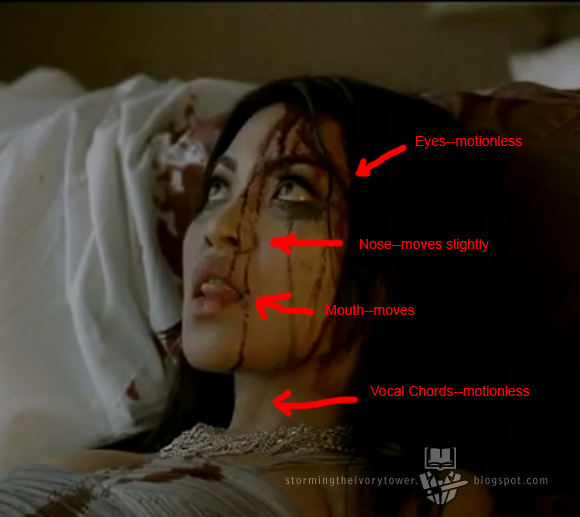
There are some subtleties to how this disturbance works, though. This corpse isn't Helena, getting up and doing a jerky ballet down the aisle of the First Church of Our Lord And Savior Gerard Way. No, this corpse is staying right where she fell, not even getting up to put out the fire that is consuming her. The key to the creep factor of this video is the way only her lips move, the rest of her body, including her cold, dead eyes, remaining perfectly still. I mean, take a good look at her when she mouths the line "Still remain, the things we couldn't kill":

This picture took me a whole two minutes to create! You smucks had better appreciate it!
Watch how her lips and tongue caress those words. Urgh. And through it all, everything else involved in speech stays still--the vocal chords, the eyes--

What, you don't believe me? Try talking without moving your eyes and nose. You can do it, sure, but it doesn't seem particularly natural, does it? There's something weird about talking without even slight changes of facial expression. And, of course, I doubt you can sing without your throat moving a little bit. This is part of where the uncannyness comes from. It's not just that we've got a corpse here that's singing, it's the fact that the corpse is singing in a materially impossible way.

Er, impossible beyond the obvious. Of course.

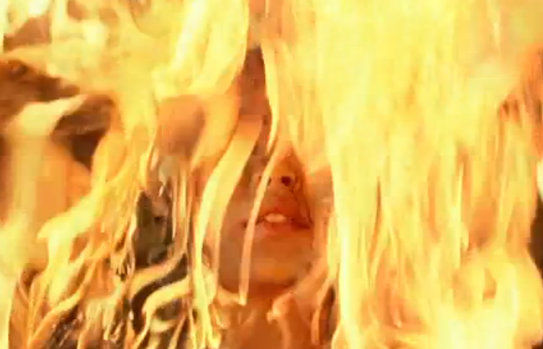
And, because Trent Reznor is not one to go halfway on things, she keeps singing even as she is consumed by flames.

Fire in the disco! Fire in the... Taco B--oh, wait, wrong song.
Yikes.

The same effect is at work in the beginning of the second of the seventh Harry Potter movies. Yes, we're back to that again. Check out this cobbled together version of the intro sequence:


What stands out to me is the shot beginning at roughly 0:35--the Dementors hovering around Hogwarts. You're all smart people, so you probably have a good idea of what I'm going to say now--these creatures are particularly disturbing to look at because they should be in motion and they aren't. Hell, they even look like they're moving when you pull out a still frame:

Up in the sky! It's a bird! It's a plane! No, it's OH GOD THEY'RE EATING MY SOUL
They're tilted forward in a position that we associate with forward movement, their cloaks flap behind them in the wind, and yet... they are still. Completely still. They seemed supported by some invisible, immobile beam, perfectly suspended in air. There is something deeply threatening about this pose, as though they have simply been frozen in the act of sweeping in for the kill. They are uncanny in a way that is unlike anything else in the films, or in most fantasy, for that matter. They are horrifying because they seem wrong on a deeper, visceral level.

I think I'll leave you with that cheery image (They're Coming To Get You, Dear Reader! HAHAHA), but before I flit off I think I'll leave you with one final example of the kind of uncannyness I've described here. Check out this Korean comic. Turn on your speakers. And scroll downward nice and slow. Don't worry if you don't know Korean.

Trust me... you'll understand it just fine.

After all, if these examples are any indication, some things just go completely beyond words and into realms where the mind can do little but quake. I think, perhaps, that this effect is particularly potent when applied to us modern, rational, technology-besotted folk. We have been raised to view the world as a concrete, relatively consistent, comprehensible place. When the rules of that ordered world begin to slowly unscrew themselves, and the seams of things rattle apart, is it any surprise when the goosebumps rise on our arms, almost of their own accord?

As always, feel free to leave comments, complaints, or, best of all, your own interpretations, or e-mail me at keeperofmanynames@gmail.com . And, if you like what you've read here, share it on Facebook, Google+, Twitter, Xanga, Netscape, or whatever else you crazy kids are using to surf the blogoblag these days. Oh, and I'm looking for guest entries this month, so if you have something interesting to say about things that generally fit the theme, send them my way.

Friday, September 16, 2011

I Need A Hero's Journey--Games and Joseph Campbell

Check out this article. For those of you that, like me, are a bit shaky when it comes to this type of tech article, allow me to translate briefly.

Essentially, what they're talking about here is the ability to create videogames that constantly generate totally unique landscapes each time you want to start a new adventure. In this type of game, you would always be exploring new locations, because the code itself would create new locations. Essentially, all "procedural generation" means is that instead of telling your code "Hey, a wall goes here" you tell the code, "Hey, here's a set of rules that tell you whether or not you want to put a wall here."

A set of rules and categories that can be used to generate multiple different experiences... hm... now where have I heard that before?


AAAAAAAIIIIIIIIiiiioh hello there, Mr Campbell.

This is Joseph Campbell, the very person whose ideas were on the tip of my tongue just now. Campbell wasn't the first person to codify or use the term "Archetype," but he's the thinker most relevant to our current discussion. What is an archetype, you ask?

Well, an archetype is really rather similar to the rules that go into procedural generation. It is essentially a set of rules that determines the underlying structure of a character or story. In Campbell's ideas, a whole selection of archetypes put together generate what he termed the Hero's Journey, or Monomyth. The core of this concept is that all the great myths and stories have the same underlying characteristics, even if individual elements are edited and changed--just as in the game landscapes described above, basic qualities like the presence of forests and deserts and mountains, and regions of cold in the North and heat in the South, are changed and rearranged in order to create unique maps.

So let's break this down a bit more into some of the component parts, and how they show up in more familiar works of fiction. These are, of course, the extremely condensed, cribbed versions of the archetypes, and are probably four or five generations removed from Campbell's actual scheme, but it should give you a general sense of how this all works.

THE CALL (It Knows Where You Live!)


This is, as the name suggests, the summoning of the hero character, and the start of the adventure. This is R2D2 showing Luke the hologram of Leia. It's Gandalf showing up at Frodo's door, looking like a complete basket case, going, "Is it secret?! Is it safe!?" (He was only ever that crazy in the movie...)

THE REFUSAL OF THE CALL

The Hero, due to the universal law that Good Is Dumb, will totally blow The Call off. This will result in events that eventually force him or her back into the quest. This is Luke trying to avoid getting involved, and coming back from Ben Kenobi's hut to find that the Storm Troopers have killed his family. In a modified form, it's Frodo realizing that unless he accepts the role of ring bearer, the meeting called by Elrond will deteriorate into strife and violence.

THE MENTOR

This isn't a stage; it's a character. The Mentor teaches and instructs the hero, and sets the hero on his or her path. Usually this mentor will die, generally as a symbolic passing on of the quest to the Hero. This is Gandalf in the Mines of Moria, and both Obi-Wan and Yoda passing on and vanishing into the Force. It's also, arguably, Dumbledore at the end of the sixth Harry Potter book.1

THE BIG BAD

This, as far as I can tell, isn't an explicit element of Campbell's myth arc, and it doesn't actually appear in many older myth epics, but it seems to be a mainstay of modern Hero's Journey stories--whether it be Sauron, Emperor Palpatine, or Voldemort.

THE LITTLE BAD

Here we're really running off the tracks, but this is a sort of miniboss character that, I suspect, falls generally under what Campbell called the Road of Trials--a set of tasks that the hero must fulfill before reaching the goal. Shelob and Saruman, Darth Vader, and any number of minor Death Eaters like Malfoy or Snape all fit this model--they are lesser obsticals for the hero to overcome.

INITIATION and DESCENT INTO THE UNDERWORLD

And this is where things get a bit crazy. The idea is that the Hero is initiated into the world of the heroic quest, and marked as a part of this world. Again, I'm sort of rolling a bunch of ideas into one category for the sake of simplicity and time, but one of the elements of this initiation is often some sort of spiritual death, attaining of cosmic knowledge, and rebirth. Frodo passing through Shelob's Layer can be seen as this sort of descent, or Luke's fall from grace at the end of The Empire Strikes Back.

THE VICTORY AND RETURN

This is an interesting one. The hero attains the goal of the quest and returns home... but this isn't often so easy. In Lord of the Rings, the heroes are forever altered by their experiences and have trouble reintegrating into normal life. The Elves, along with Gandalf, Sam, and Frodo, all journey off into paradise. Eowyn and Faramir, scarred by their experiences, eventually manage to find comfort in each other but still are dislocated from their former lives. One of the major complaints about the end of the Harry Potter series is that there is no difficulty of return for the heroes--they simply live out happy lives and have children named after their dead friends.2

This is the bare bones explanation of the Hero's Journey concept, and, as I said, it's hardly accurate to Campbell's exact theories. But, it should give you a bit of a primer for how these ideas work.

Now, this might seem like just one of my tangential explanations of one thing by introducing another thing, but there's a deeper application here. In essence, I think that the tools--the archetypes--that can be used to set up a story in other media can be used as parameters in a generated game. Rather than just abstract story elements strung together, the Hero's Journey would give players a set of goals and a point where the quest becomes complete, while not railroading them down a particular path.

Let me conjure up some help to explain this bit.

It is at this point that you notice, with growing trepadation, that there is a third beer glass sitting upon the table between us, as though awaiting another visitor. With a horrible rumble, the entire fireplace heaves back in its moorings to reveal a vast bank of sparking transistors, from which issues forth a spirit of fire and energy. It reaches out, takes the glass, swirls it, and grimmaces at the poor quality. There is a smell of brimstone and crushed dreams.

This is Ian McDevitt, a friend of mine in training to become a game developer. Perhaps he can shed some light on this subject.

The first and most obvious question, I suppose, is would it even be possible to generate the characters of a Hero's Journey tale?

 Absolutely. I've seen examples of character generators that give you nuanced backstories, character motivations, detailed physical descriptions, personality quirks... basically, everything you could possibly ask for in describing a person. If you have an archetype to build off of, like, say the Chosen One, then it's that much easier. You've got a finite list of character motivations, like not wanting to let everyone down, pride in being Chosen (by whatever mechanism it happens to have been), or fear of their world being engulfed in darkness (or whatever evil they've been Chosen to fight). Of course, this is just an example; I imagine the player would fill the role of the Chosen One, typically.

Would it be possible to create those sorts of characters without the gameplay becoming repetitive and predictable, though?

 That would depend on the limits of the archetypes. If the archetype demands that the Plucky Sidekick, for instance, be an idiot and basically useless, then in every game it generates that has a Plucky Sidekick, you're going to get a basically useless idiot.
And from what I gather, useless idiot sidekicks are rather overabundant in games these days.

 Hahaha, basically, though usually it's not the programmers' intent; it's just really difficult to teach NPCs to fight (or do whatever it is the player's doing) nearly as well as a human can. Though on the other side of the same coin, it's perfectly possible to make an NPC too good at it...

Which could be a problem if you end up with a generated Big Bad that is too tough to kill. But looking at these archetypes might be a good way of picking out where whole character types tend to be problematic, letting developers preempt some of these problems.

 Absolutely. I'm of the opinion that basically any information about how something works will help you design a computer system to replicate it. As any programmer will know, the hardest part of solving a problem is formally defining it. That's really the main difficulty in procedural generation and artificial intelligences.

Speaking of artificial intelligences... would these generated characters be able to exist as characters? For example, could they carry on an actual conversation with the player?

  If we teach a computer that, "If you see a grouping of letters together, there's some likelihood that the next letter will be __," then the computer will learn to create strings of characters that are ordered thusly. You can extend it to groups of words, and groups of sentences, to make full paragraphs of coherent speech. On top of all that, you can program in grammatical rules that humans follow (well, most of follow them!), so that it has a sort of censorship; it won't output anything until it has checked and made sure that it makes grammatical sense! Then it's just a matter of plugging actual subject matter into the right location and tweaking speech based on a given character's personality quirks. It sounds more difficult than it is!

  No, wait, that's backwards, it's actually more difficult than it sounds!


So, this is something that will need time and effort, but ultimately isn't impossible.

 Absolutely not impossible. Just... difficult.

Well, we know we can do it, with effort... but why should we? Where's the value in this sort of generated content? After all, the article I linked to describes how much less detailed the graphics become, and how much simpler the stories would have to be. What's the advantage here?

  For the most part, novelty. And I don't mean, "Oh, hey, this is a kitschy little system, let's build it as a senior project for the hell of it," I mean more along the lines of actually having something new and novel every time you boot it up. As for making things that are lower-quality, that may be the case in terms of actual graphical crispness, but I don't agree that the stories would have to be simpler. A computer can generate anything you teach it to, so it's just a matter of teaching it how our stories work, and it will make stories that are very close to the mark.

So, essentially this system would be valuable because each time you played it, it would be different.

  Essentially, yeah. But the great thing about a system like this is that because of the way computers randomize things, there's always what's called a seed. If you give players a way to check what seed was used to generate their world, and a way for players to pick which seed to use for that generation, players will begin sharing their worlds with one another. Minecraft has a system like that, and it has spawned, at the very least, www.minecraft-seeds.net .

So the most interesting quests--the most interesting stories--would be traded around, replayed, and explored over and over. Really, not different at all from how the best myths get passed down through centuries and across cultures.

The spectre, pleased with this conclusion, chugs the rest of its cheep beer and descends back into the bank of transistors from whence it came, leaving a smell of ozone and charred trollflesh in the air.

And that, ladies and gentlemen, about wraps things up for the evening. Ultimately, both these ideas--procedural generation and the Hero's Journey Archetype--are tools used to generate story experiences that people can enjoy and relate to. From simple rules can come enduring complexity, so profound that it remains with us even today, after all these centuries.

As always, feel free to leave comments, complaints, or, best of all, your own interpretations. And, if you like what you've read here, share it on Facebook, Google+, Twitter, Xanga, Netscape, or whatever else you crazy kids are using to surf the blogoblag these days.


1SPOILER ALERT DUMBLEDORE DIES.

2"There is literally no way to move forward from this point!"

Monday, August 22, 2011

Hugs from Voldemort

Heavens, is it This Week already? I suppose I should actually put one of these blog post things up then, shouldn't I? Today's article is a bit shorter. Wednesday's article will be a bit longer and will include an absurd number of pictures. I have no idea what I'll be doing on Friday. C'est la vie.


The last Harry Potter post was written so that you didn’t have to be familiar with the work to get the gist of the argument. This one is. Be forewarned.

Although, as I've noted before, I quite enjoyed Harry Potter and the Deathly Hallows Part II, one scene puzzled me. You know the one. It's when Voldemort gives Draco Malfoy the single most awkward hug ever put on screen. It's forced, bizarre, and a total mood killer. Everyone in my particular theater reacted to the moment by bursting out laughing. The same goes for Voldemort's bizarre laugh at the beginning of that scene. It's even more strange coming, as it does, right after Ginny's heartwrenching dialogue.

I didn't really understand it until I talked it over with my sister a few days later, and she suggested that the scene was constructed that way in order to convey Voldemort's most fundamental character trait:

He is completely inhuman.

The whole scene marvelously demonstrates just how far removed from reality he is. Voldemort is, in essence, capable of going through the motions of being human, but those motions are bizarre and forced. The Deatheaters follow him not because he is particularly charismatic anymore but because he spits killing curses at the drop of a hat and has a habit of feeding people to his snake. That, and most of them seem to be legitimately awful people who may be just as cracked as he is. (Bellatrix fits this category quite well--it's interesting to consider whether she was always that deranged, or she became that way after years at Voldemort's side. Or, even worse, that she became truly unhinged after her stay in Azkaban.)

What's more, it makes perfect sense to portray him this way, because at this point we have seen his true face. In fact, it makes more sense to undercut the tension there, because the tension is ultimately unsustainable. We know Harry is alive, and at this point we know that he's going to win, so portraying Voldemort as anything other than a blustering, warped madman would be to cheaply attempt to wring more feeling from the audience. It would be, ironically, rather dull to sit through.

But this way we get to see the truth about Voldemort as set up in his confrontation scene and continued in the King's Cross sequence (which is probably one of the most brilliant moments of the whole film). Here, we see the hints already of Voldemort's complete unraveling. Pay close attention to how he behaves during his confrontation in the woods with young Mr Potter--he's scared. Behind all that bluster is real fear, and even in victory it seems clear that he has slipped further away from sanity. Even as he boasts later to the assembled defenders of Hogwarts he declares Potter's death with dazed amazement. And, of course, of course, there is the thing under the bench in King's Cross. It is in that quick flash where we observe the remnants of Voldemort's shattered, gibbering psyche, and hear Dumbledore sadly pronouncing the fact that they can do nothing to help it, that we fully understand the truth of Voldemort.

He is a pitiable creature. No longer threatening, no longer powerful, simply a being so warped by his terror of death and desire for power that he has completely lost touch with humanity.

So, it makes sense to portray him not as a shrieking villain but as a terrible actor, desperately trying to create an air of grandeur but failing utterly. The scene is far from a failure. On the contrary, I would consider it a resounding success. The movie made us fear him, and it made us hate him, and finally it made us both pity him and laugh at him.

I would compare it, perhaps, to the climactic scene of The Labyrinth. Ultimately, our laughter serves the same function as Sarah's play lines. We look evil in the face and reply, "You have no power over me."

Sunday, August 14, 2011

The Dark Lord Potter--Using Critical Analysis As A Creator

I've rattled on a few times before about what interpretation of a work is, and why it's a useful tool for an audience. But what I want to play around with today is the idea that interpretation can be useful to creators of art as well.

To show how this works, I'm going to take a look at some of the things going on in Harry Potter VII: Harry Potter and the Deathly Hallows (Part 2 (Dobby's Revenge)). Oh, and I'll be taking a brief look at Watchmen, both the film and the comic. I've tried to write this so that ANYONE can make sense of my argument, not just people intimitely familiar with both works. So, don't stay away if you haven't seen either movie. But be forwarned--there will be many spoilers here. I'll be revealing some major events. If I wanted to black out the spoilers in this column, the whole site would quickly turn into a Sisters of Mercy concert.

We'll save the goth invasion for when my sister does a guest post.

HPVII-2 does a few interesting thing with the characters. In particular, it plays up the ambiguity of action and motivation, to the point where it's hard to tell sometimes if there are any completely good characters or, to a lesser extent, if there are any completely evil ones.

Besides, of course, Voldemort, who is still an evil sod.

Take, for example, the infiltration of the wizarding bank Gringotts, where Harry uses an Unforgivable Curse--specifically, a mind control curse--on an innocent goblin. Yes, our beemish, noble hero used one of the four curses that the books refer to not as "Kinda Bad", not "Rather Unfortunate, But Alright, Maybe Just This Once" but as "Unforgivable." Hm. This is a bit of a divergence from Harry's earlier habit of shouting disarming charms at every obstacle. What's more, he gets there by bluffing another goblin into trusting him despite him having exactly zero plans for honoring his end of the bargain. Oh, and the goblin that he mind controls? Torched by a dragon. Hm. This is a far cry from Harry's tendency to save absolutely everyone earlier on in the series, and it also shows that his willingness to bend the rules has transformed, under pressure, almost into ruthlessness.

Now, this is something that happened in the books. It wasn't invented whole cloth for this movie. And yet... I can't help but feel, and you may lob that glass at my head if you disagree, but I can't help but feel that this wasn't ever candidly addressed in the book the way it was in the movie. There's something a little sickening about that goblin standing there, dazed, about to meet a grizzly end. It's a moment that can be glossed over much more easily in the text. In the movie, we can't avoid seeing the casualties of this war, and the compromising of Harry's principles.

Rather grim, no?

It is this sort of scene (there are others) that more completely sets up the final confrontation. We see, in the King's Cross scene, what Harry's great enemy Voldemort has become. Just for an instant, just for a few seconds, we see the huddled, gasping wound that is Voldemort's soul. This, and Harry's earlier willingess to use his power in destructive or unethical ways in order to win, sets up their last battle. Consider the visuals as they hurl themselves around the castle, locked in a death grip. In the midst of Voldemort's shadow, the two combatants twist and seem to almost merge together, becoming one writhing, howling being. The visuals are too obvious, and too distinct, to be anything other than deliberate. The creators of this film are telling us something. But what?

Well, in the book it was fairly obvious what Rowling wanted us to take away from the final battle. Harry, by sacrificing himself, had saved all his friends. Here, we are meant to see Harry as a messianic archetype--in other words, as a Jesus figure. But the creators want us to see him as something less pure, less noble.

They want us to see him as the next Dark Lord.

This makes the scene where Harry breaks the staggeringly powerful Elder Wand far more powerful. Here, Harry willingly turns away from power, having seen both his own willingness to use it, and the vision of what power could turn him into. What makes this interesting is that here the scene has far more meaning than it did in the original text. In the original text it was odd that Harry should throw away the Elder Wand, because he had been set up by Rowling as a noble Jesus figure. Why would he give away that power? He's one of the good guys! But in the movie... he isn't. He's not so unambiguously noble there, so the scene sends a more powerful, albeit unstated, message.

The same thing occurs, less successfuly, in Watchmen. In the original comic book, if you aren't familiar with it, New York is destroyed by a giant psychic tentacle monster (affectionately dubbed "The Squidgina" by fans). The thing is, the giant tentacle monster hasn't come from outer space. No, it's been created by a mortal man, as a massive hoax: he plans to stop an almost certain nuclear war between the US and Russia by convincing the world that an alien invasion is imminent.


In the movie, however, he creates a weapon that imitates the power of the godlike character Dr Manhattan... and, again, blows up New York. This change is not arbitrary. It means that humanity bands together against the threat of a functionally deistic power. They band together under the threat of the Wrath of God. It puts an interesting new dimension on the ending that wasn't present in the original, but it builds off of ideas introduced in the original work.

What? The point?

Ooooh, yes yes yes. The point. Right.

The point of all this is that both movies gained strength from the fact that the creators critically interpreted the texts that the movies were based on. In the case of HPVII-2, they took the ambiguity of the hero's actions, played the ambiguity up, and ultimately drew a new message out of the text--that it is preferable to give up power than to be consumed by it. In Watchmen, the analysis of Manhattan's godlike power and ambiguous morals was emphasized and turned into a contemplation of how humans behave when a godlike, wrathful being watches over them. Maybe. I could be totally off my rocker, and I have some doubts that Watchmen, in particular, was deliberately framed that way--it is, after all, Zack Snyder we're talking about here.

But even if I'm wrong, and all of this was just chance, I think it shows that this sort of analysis CAN be useful. It can allow us to look at a work that we're creating, and to say, "Now, some of what this character is doing implies x, y, z. What if I play that up? What if I change this scene to better fit in with those ideas? How will the reader interpret this?" And so on. Most writers probably already do that, to some extent, but it's a process that's worth doing a bit more consciously. This sort of thing allows us to bridge the gap between art that is pretty but has no real message, and art that has a message but thwacks us over the head with it. It lets us start to see a middle path, where we can raise interesting questions through subtle cues and themes. And, of course, it allows us to pick them out in other works and learn from them.

So, criticism isn't just for critics. And it's not just for the consumers of art. It's for the producers as well. Because choosing to critically analyze a work lets us create more nuanced and, ultimately, more meaningful stories.
Support on Patreon
Store
Reader's Guide
Tag Index
Homestuck Articles
Solarpunk Articles
Mastodon/Fediverse
Tumblr
Bluesky
RSS Feed