You sit at your usual booth, wondering where your book-headed friend is. Normally he’s here by now, and though you don’t so much converse as he rants, you can’t help but find him entertaining, even when you disagree. Sometimes you even learn.
You look around the bar to see if you can see him, and when you don’t, you turn back around to sit more comfortably... only to have your eyes meet the irritated, bespectacled gaze of a heavy-set man who hasn’t had a haircut in way too damn long. Your breathing hitches for a brief second. You remember this man. He just would not shut up about Cowboy Bebop.
“Oh, hello,” you say, trying your best to be friendly. “Can I buy you a bevera—“
“SHUT YER PIE HOLE I’VE GOT THINGS TO TALK ABOUT”
So, you’ve heard that they’re doing a movie of The Last of Us now, right? That’s great! I’m excited. It’s rumored Bruce “Jesus Christ” Campbell is attached, and I believe dude will dig down deep and bring some serious pathos to the character of Joel. And Naughty Dog made the damn game, and they’re involved, and they’re not going to let their baby fail.
Here’s the thing that’s bothering me: Unless they’re absolutely willing to murder every single one of their darlings, like the novelists say, their movie is going to go the way of Tomb Raider and Mortal Kombat Annihilation and Resident Evil: Thesaurus Word for “Bad” and Max Payne. Most of us are going to hate it because it took a game with a great plot and made a movie that’s mostly unwatchable.
And I know you’re wondering why I’m so sure of this. And I will tell you.
And in order to do this I will need to talk about the plot and the ending of The Last of Us, so SPOILER ALERTS ARE IN EFFECT. So get the hell out of this bar, right now, and play through The Last of Us and come back so we can talk about it.
**********
Welcome back! I am so glad you did that thing I just told you to do.
So wasn’t that game awesome!? Cinematic in all the best ways and emotional and great characters and holy hell, it’s going to be hard to make a good movie out of that.
I can see you mouthing the words wondering what I’m on about, but it kind of gets to why video game adaptations... and cross-media adaptations in general... have historically tended towards the awful. See, various media engages us in different ways, and how we engage with games is very, very different from how we engage with other art forms.
Think about how you relate the events of a movie or a comic or a novel. It’s third person. “So then Captain America kicks Batroc in the head!” “And Indiana gets on his feet and kicks that Nazi in the head!” “And then Shane gets into a bar fight and kicks a guy in the head!”*
*This actually happens in the novel. And I hope someone out there appreciates me bringing up Shane, of all things.
Now consider how you relate what happened in a game you played. “So I’m surrounded by zombies but I manage to spam the dodge maneuver until I get to the door, just inside the time limit!” “So then I score a crit that one-shots the mind flayer the round before he TPKs the party!” “That’s when I land on Dave’s Boardwalk with a full hotel built, and so I knocked the board over and went to bed!”
See, none of the hypothetical tellers of those tales is referring to their characters in game, even though individually they’re playing the roles of Jill Valentine, Llewellyn Ironblade the Elf Fighter, and a boot. And this is where most video game adaptations stumble: huge chunks, if not the entirety, of the art and story and designs are created that way to serve the gameplay. And that gameplay is the thing: you providing action and making decisions gives you the illusion of control, and more than that, involvement. It’s a much, much different storytelling mechanism than the mechanisms of other media.
You can get as wrapped up in a book or a comic or movie as you can a video game, but it’s a much different process to get there.
This is a big portion of why Silent Hill, the movie, was so much less scary than Silent Hill, the game. Despite using a number of the scariest monsters in the whole series and inventing monsters even more screwed up than that (re: Colin the Janitor), those couldn’t actually get as terrifying as running from low-polygon-count dogs across a chain-link floor with poor texture work. Rose Da Silva is probably a better fleshed-out character than Harry Mason, but we care more about what’s happening to him because on some level it’s happening to us. The low-polygon-count dogs are chasing us. Interactivity can bridge gaps when storytelling fails to cross them.
(I should point out that this is all by way of example. The Silent Hill flick had problems way above and beyond not being able to control the characters.)
And here’s the thing about The Last of Us: that game uses that sense of immersion granted by interactivity as well as anyone else ever has. Maybe better. Unlike the Half-Life series, it does have cutscenes, but Last of Us does give you control in some surprising areas that other games wouldn’t (controlling Sarah at the beginning of the game, where the fact you can look even as you’re stuck in the back of Joel’s car adds verisimilitude). It includes emotional high points nestled regular game play (the bit near the end where you slide from gameplay to cut scene to gameplay and watch the giraffes for as long as you want). And at the end of it, it will force you to do things you don’t necessarily want to do.
Think about that sequence at the end when you (there’s that dreaded second-person again) rescue Ellie. The only way to do so is to kill the doctors about to operate on her. Whether you want to is irrelevant, because that’s what Joel, the character wants. But this isn’t a cut scene. This is something you control.
This is you being forced into taking the actions that your character would take, morally repugnant as you may or may not find them (and it’s enough of a grey area, given the plot of the game, that finding them repugnant is completely possible).
So where does that leave us? The Last of Us is so moving and affecting and genuinely upsetting because its plot is built to take advantage of things that only video games really do, much in the same way Silent Hill was, or how Watchmen and The Sandman are built around comics and House of Leaves is built around prose and Avatar: The Last Airbender was built around TV.
Each of these properties were either hampered in their film adaptations or have yet to have film adaptations at all by the fact that the plots of these properties are very, very tied in to the mechanics of their media, and those that had adaptations, hilariously, failed to adapt. I quite liked that Watchmen flick, but even I have to admit that it was pretty underwhelming considering that it was based on one of the great comics of all time. Part of it was that the innovations the comic made had already been subsumed by art and culture by the time the movie was made, so the content was no longer as challenging. But I’d say the bigger part was that it was such a slavish recreation that it lifted things that took advantage of the comics medium whole-cloth into the film, ignoring the use of the mechanics of medium that made them effective to begin with. Chapter breaks, juxtapositions, pacing... these are mechanics that work a certain way particularly well in the comics medium and that the Watchmen comic took advantage of. Film has its own mechanics, but the Watchmen movie assumed that they would port over because they’re both visual. This led to a flick with weird pacing problems and sequences that fell flat even though they still dazzle in the comic to this day. (Keeper's Note: way back in the prehistory of this blog I argued that changing the mechanics of the ending of Watchmen was one of the best decisions the film makers made.)
So what can the creators of the film version of The Last of Us do to avoid an adaptation that seems to use all of the parts of the game but feels hollow or terribly flawed as a cinematic story?
... good question. That may not be answerable until it’s answered, if that makes any sense. The plot is long and circuitous and relies heavily on gameplay sections to get the characters from point A to point B, and the game’s story covers nearly a year divided into four nearly stand-alone chapters, something that kind of works against the usual flow of movies. It’s a small-scale story that takes place on a huge vista, and that’s the sort of thing movie producers loathe throwing money at (why throw so much money for location shoots and special effects if it’s not for spectacle?). It’s a story that absolutely does not let itself to traditional ways of cinematic storytelling.
The only way, then, that they’re going to live up to the promise of the video game is break new artistic ground with the movie, much as the game did for interactive storytelling.
I hope they can.
With that, the large man takes off his glasses, and wearily informs you that his name is Zomburai!, or Jon Grasseschi in IRL. He’s the author of the webcomic EverydayAbnormal (analyzed previously on this very blog!) and the nascent Dungeons & Dragons blog Mythic Histories. He says he likes long walks on the beach, sensitive women, and world domination. He has a Patreon, a Twitter, and a Facebooks.

Oddball media crit--laying siege to academia's ivory tower from pop culture's gutter
Showing posts with label Guest: Jon Grasseschi. Show all posts
Showing posts with label Guest: Jon Grasseschi. Show all posts
Monday, September 1, 2014
Saturday, March 2, 2013
Abnormal Panels
So, friend of the blog and guest writer Jon Grasseschi is off at Emerald City Comic Con this weekend promoting his own webcomic, Everday Abnormal. I've actually been meaning to dig into some of the moving parts of the comic, so this seemed like a good time to do it.
Why this comic, though, besides the fact that Jon's a good friend of mine and I want to promote his work?
Well, the thing about webcomics is this: a lot of people can draw, and can write (in the sense that they can string a narrative together), and can put the plot and pictures together in relatively pleasing ways. Comics consists of those two elements, ultimately, so relying on just those elements alone works fine for plenty of comickers.
What sets Jon apart, then, is an eye to the medium itself and its particular structural peculiarities--the abnormal effects that you can only get when you've got a whole bunch of images side by side, when the spacial relationships and dimensions of things enter into the equation. Few webcomickers pay attention to these structures--or at least, their fail to pay close enough attention--and their work ends up reaching a certain plateau of expertise. It's worth taking note, therefore, when someone at the beginning of their career as a producer of comics is already playing with these tools.
Let me lay some groundwork first, though. I started paying attention to EA as a scholar, not just as a reader and fan, when I embarked on my occasionally-alluded-to quest to understand rhythm and patterning in comics. Now, that project slated to become my graduate thesis, so I've kept the contents fairly close to my chest (although several of the core ideas are already presented in the unfinished draft of Understanding Hypercomics). While looking through the big draft document of what I had written thus far, though, I came to the conclusion that not only do I have enough material here for at least a whole book, I have some bits that probably work best as stand-alone works.
One of these bits is the notion that some of the enjoyment of a daily gag strip comic comes from the variation of its writing within certain parameters. The best gag strip artists are adept at using three or four panels in a repeated pattern to create fresh and surprising gags--they excel at humor (or emotion) that strives against limits and works with economy. Think of how Doonsbury periodically goes into silhouette mode, or how Calvin and Hobbes sometimes drops the borders on the comic, or how the last panel in a 3eanuts comic becomes the new punchline after the original punchline has been removed. All of these things, one way or another, are designed to achieve a level of complexity and variation within a highly restricted medium.
But what does this have to do with EA? That comic has much more similarity to a traditional Western comic book than to a gag strip.
Well, one of the weird notions I hit upon while working on the larger project was that little clusters of comics can approximate the kind of structural techniques of a smaller overall work like a gag strip. Once we start to analyze panels in terms of small groupings, rather than just individually or as whole pages, we can start to see these techniques emerge.
Check out this relatively spoiler-free page early in the first volume of EA, in which one of the protagonists attempts to get more information from a family who's son has recently been ritualistically murdered:
I absolutely loved this page from the moment I saw it, and it was a love that had nothing to do with all this highbrow intellectual stuff I'm yammering on about. That last panel, that last speech bubble, is like a bucket of ice cold water. You go through the tension of Lilith's story there, and the family's response where it seems like they're going to keep pushing back, and then suddenly this previously silent and unassuming character blurts something out that the reader had no way to expect.
When Lilith, on the next page, describes the family as "implod[ing] from the news" you believe it, because you've just been hit in the face yourself, totally out of left field. It's good writing.
But let's dig into why it works, and how those last three panels function. Now, Jon's made an interesting choice here. The action takes place in the same shot, so to speak--you could take out the panel borders and gutters and get a single, unbroken image that would work pretty much the same way. Since we read right to left, I think the temporal functioning would be largely the same. So what do the gutters do for the comic?
Well, it turns these three panels at the end of a page into a cluster that approximates the functioning of a gag strip. It is a limited set of information containers that build up to what is effectively a punchline. Not that we're consciously or necessarily unconsciously thinking in terms of gag strips when we read it, of course, but it's a way of parceling off elements of time so that they are emphasized as discrete units. By turning a whole panorama into three discrete moments, each one is given equal weight, and the last one gets emphasized as significant.
But what's most important to my mind is the fact that it happens with an economy of space. A bombshell like this would normally drop with a closeup and a larger panel--something that broadcast's the moment's intent. Now, this is something a gag strip can't do. And it's not just because a gag strip has limited space, it's because a joke is only funny--a punchline only packs a punch--if you don't see it coming. If you broadcast the intentions of the joke with a big dramatic closeup you spoil the joke. So, even though a closeup here would emphasize the emotional intensity of the moment in a film, here the fact that the panels are all immediately visible takes that tool out of our chest, yeah?
So, if Jon wants this to be a punchline--if he wants it to be, in particular, a sucker punch--he's got to give it a kick without broadcasting what's coming. If the scene was drawn without the panels, he wouldn't be able to get the kick because the moment would seem to smoothly flow together; there would be nothing to tell the audience to focus on each set of speech bubbles as discrete units.
With that panel drawn around the older sister, though, we're nudged to pause and take in what she's saying. And what's more, the fact that the other panels are crowded with irate, highly fraught text makes her simple three word statement intense purely by contrast. It's like how greyscale is normally low intensity--that's kinda the definition of desaturation, right?--but if you suddenly suck all the color out of normally bright and saturated characters, it comes off as a very intense choice. Why do you think that trick is used multiple times in My Little Pony: Friendship is Magic? It's intense by contrast to the norm, even though in the abstract it would be low-intensity.
And it also means that the character is boxed in spacially. Instead of being in a big wide panel--in a big wide room--she's cramped in this tiny vertical space, and within that space she seems almost frozen. Unlike the other characters, who fill their panels in dynamic, leaning poses, she's surrounded by white space, and her pose is totally vertical. You don't have to hear that she's gasping out those words, on the verge of tears, barely able to choke it out. You don't have to hear it because you feel it in your gut, because you see how small and helpless she seems, how tense she seems, in that narrow little box.
That, ladies and gentlemen, is good. fucking. comics.
So, to sum up, this little cluster works because Jon is telling us what we need to know with an economy of space, and using the same techniques that gag comics use to hide the punchline while still achieving intensity through contrast and through the composition of forms within their panels. He's telling a story not just with images and words but with the design of panels.
And you know what? This isn't the end of it, either.
Check out this similarly low-spoiler page from the third story arc:
I think by now you should have a good idea of what we could do with the three clusters of the man being interrogated by Lilith. Each one of them serves, to some extent, the way our earlier three-panel pseudo gag strip did. But I'll leave that to you folks to sort out. I want to talk about something different here.
Let's talk about Hieratic Scales.
See, there's this big concept in art of the Hieratic Scale, where figures are depicted according to how badass they are, rather than how strictly large they actually are. The Ur-example (ahahahahahaha sorry.) is probably the Code of Hammurabi:
Hammurabi is standing to the left here, and it's pretty clear that even though he might be a badass king, he doesn't come close to a God like Shamash, the figure on the right there. If Shamash stood up, Hammurabi would be at eye level with Shamash's undoubtedly huge, rippling abs. That's what Hieratic Scales are all about: we show the character that's most important in a way that gives physical weight and presence to that importance. It's another way of showing intensity, too, if you're taking notes.
In this page from EA we see that Lilith is hieratically important compared to the officious little man (see how we even use terms like "little" to insult people? Size does matter, at least when it comes to art and semiotics). Jon's able to get away with that without introducing distortions because he can make her larger within her panel (which just so coincidentally happens to be the whole damn page). The juxtaposition of panels allows him to make her hieratically large without shifting space itself--although it's worth noting that hieratic distortions aren't off the table for single panels. After all, Manga indulges in those sort of distortions all the time. Reality is a lot more plastic in Eastern comics than in Western ones, and in some ways that's an advantage. But I digress.
There's another thing the panels allow him to do, though. Remember my babbling about how the older sister sits within her panel, and how the space the panel creates affects the narrative? Well, the same thing is going on here. By necessity, if Jon wants to show enough of Lilith's face, he has to reduce the size of the director's panels down quite a bit and throw a number of them in a row. But look what he has the director do within those panels: he doesn't just sit there, he writhes around, he rants, he stands up at one point even, and finally he slumps in defeat, leaving most of the panel empty and unoccupied.
But he never breaks the panel. The panel's view never changes. He's trapped in his little box, and when he stands up to rant, the panel just cuts off part of his head.
Lilith, on the other hand, transcends the panels. She goes right to the edge of the page. She's not boxed in--or at least, she wants to make it seem like she has all the cards. We experience her power and dominance in this situation not just hieratically, but through her ability to ignore the panel boundaries that lock the director in.
And this is all stuff that is unique to comics as a medium. These are effects you just can't get from another kind of storytelling.
So my thought is this: if you're going to be writing a webcomic, if you're going to get into this medium, you should go beyond that plateau of pretty images and pretty plots. Start studying structure if you want to write good comics.
And pay attention to where Jon is going. I certainly will. In fact, one of these days when I manage to scrounge some spare cash (I got them College Loan Blues!) I'm going to pick up a print version of EA, and I recommend you do the same. I suspect that when you see this stuff in print it'll be both a whole lot more apparent and a whole lot more impactful.
Oh, and of course, if you're at ECCC, check out Jon's booth! He'll be selling copies of the first and I believe the second volume, and I'm sure he'd love some attention. Tell him Sam Keeper sent you, and ask him about his panel designs.
Check me out on Google+ at gplus.to/SamKeeper or on Twitter @SamFateKeeper. As always, you can e-mail me at KeeperofManyNames@gmail.com. If you liked this piece please share it on Facebook, Google+, Twitter, Reddit, Equestria Daily, Xanga, MySpace, or whathaveyou, and leave some thoughts in the comments below. And remember to check out Everyday Abnormal!
Why this comic, though, besides the fact that Jon's a good friend of mine and I want to promote his work?
Well, the thing about webcomics is this: a lot of people can draw, and can write (in the sense that they can string a narrative together), and can put the plot and pictures together in relatively pleasing ways. Comics consists of those two elements, ultimately, so relying on just those elements alone works fine for plenty of comickers.
What sets Jon apart, then, is an eye to the medium itself and its particular structural peculiarities--the abnormal effects that you can only get when you've got a whole bunch of images side by side, when the spacial relationships and dimensions of things enter into the equation. Few webcomickers pay attention to these structures--or at least, their fail to pay close enough attention--and their work ends up reaching a certain plateau of expertise. It's worth taking note, therefore, when someone at the beginning of their career as a producer of comics is already playing with these tools.
Let me lay some groundwork first, though. I started paying attention to EA as a scholar, not just as a reader and fan, when I embarked on my occasionally-alluded-to quest to understand rhythm and patterning in comics. Now, that project slated to become my graduate thesis, so I've kept the contents fairly close to my chest (although several of the core ideas are already presented in the unfinished draft of Understanding Hypercomics). While looking through the big draft document of what I had written thus far, though, I came to the conclusion that not only do I have enough material here for at least a whole book, I have some bits that probably work best as stand-alone works.
One of these bits is the notion that some of the enjoyment of a daily gag strip comic comes from the variation of its writing within certain parameters. The best gag strip artists are adept at using three or four panels in a repeated pattern to create fresh and surprising gags--they excel at humor (or emotion) that strives against limits and works with economy. Think of how Doonsbury periodically goes into silhouette mode, or how Calvin and Hobbes sometimes drops the borders on the comic, or how the last panel in a 3eanuts comic becomes the new punchline after the original punchline has been removed. All of these things, one way or another, are designed to achieve a level of complexity and variation within a highly restricted medium.
But what does this have to do with EA? That comic has much more similarity to a traditional Western comic book than to a gag strip.
Well, one of the weird notions I hit upon while working on the larger project was that little clusters of comics can approximate the kind of structural techniques of a smaller overall work like a gag strip. Once we start to analyze panels in terms of small groupings, rather than just individually or as whole pages, we can start to see these techniques emerge.
Check out this relatively spoiler-free page early in the first volume of EA, in which one of the protagonists attempts to get more information from a family who's son has recently been ritualistically murdered:
 |
| Click through to see it larger, or check it out in context. |
When Lilith, on the next page, describes the family as "implod[ing] from the news" you believe it, because you've just been hit in the face yourself, totally out of left field. It's good writing.
But let's dig into why it works, and how those last three panels function. Now, Jon's made an interesting choice here. The action takes place in the same shot, so to speak--you could take out the panel borders and gutters and get a single, unbroken image that would work pretty much the same way. Since we read right to left, I think the temporal functioning would be largely the same. So what do the gutters do for the comic?
Well, it turns these three panels at the end of a page into a cluster that approximates the functioning of a gag strip. It is a limited set of information containers that build up to what is effectively a punchline. Not that we're consciously or necessarily unconsciously thinking in terms of gag strips when we read it, of course, but it's a way of parceling off elements of time so that they are emphasized as discrete units. By turning a whole panorama into three discrete moments, each one is given equal weight, and the last one gets emphasized as significant.
But what's most important to my mind is the fact that it happens with an economy of space. A bombshell like this would normally drop with a closeup and a larger panel--something that broadcast's the moment's intent. Now, this is something a gag strip can't do. And it's not just because a gag strip has limited space, it's because a joke is only funny--a punchline only packs a punch--if you don't see it coming. If you broadcast the intentions of the joke with a big dramatic closeup you spoil the joke. So, even though a closeup here would emphasize the emotional intensity of the moment in a film, here the fact that the panels are all immediately visible takes that tool out of our chest, yeah?
So, if Jon wants this to be a punchline--if he wants it to be, in particular, a sucker punch--he's got to give it a kick without broadcasting what's coming. If the scene was drawn without the panels, he wouldn't be able to get the kick because the moment would seem to smoothly flow together; there would be nothing to tell the audience to focus on each set of speech bubbles as discrete units.
With that panel drawn around the older sister, though, we're nudged to pause and take in what she's saying. And what's more, the fact that the other panels are crowded with irate, highly fraught text makes her simple three word statement intense purely by contrast. It's like how greyscale is normally low intensity--that's kinda the definition of desaturation, right?--but if you suddenly suck all the color out of normally bright and saturated characters, it comes off as a very intense choice. Why do you think that trick is used multiple times in My Little Pony: Friendship is Magic? It's intense by contrast to the norm, even though in the abstract it would be low-intensity.
And it also means that the character is boxed in spacially. Instead of being in a big wide panel--in a big wide room--she's cramped in this tiny vertical space, and within that space she seems almost frozen. Unlike the other characters, who fill their panels in dynamic, leaning poses, she's surrounded by white space, and her pose is totally vertical. You don't have to hear that she's gasping out those words, on the verge of tears, barely able to choke it out. You don't have to hear it because you feel it in your gut, because you see how small and helpless she seems, how tense she seems, in that narrow little box.
That, ladies and gentlemen, is good. fucking. comics.
So, to sum up, this little cluster works because Jon is telling us what we need to know with an economy of space, and using the same techniques that gag comics use to hide the punchline while still achieving intensity through contrast and through the composition of forms within their panels. He's telling a story not just with images and words but with the design of panels.
And you know what? This isn't the end of it, either.
Check out this similarly low-spoiler page from the third story arc:
 |
| Again, click through to see it larger, or view it in context. |
Let's talk about Hieratic Scales.
See, there's this big concept in art of the Hieratic Scale, where figures are depicted according to how badass they are, rather than how strictly large they actually are. The Ur-example (ahahahahahaha sorry.) is probably the Code of Hammurabi:
 |
| Yeah, I'm pulling the "Associate Comics With Ancient Art" trick McCloud loves so much. |
In this page from EA we see that Lilith is hieratically important compared to the officious little man (see how we even use terms like "little" to insult people? Size does matter, at least when it comes to art and semiotics). Jon's able to get away with that without introducing distortions because he can make her larger within her panel (which just so coincidentally happens to be the whole damn page). The juxtaposition of panels allows him to make her hieratically large without shifting space itself--although it's worth noting that hieratic distortions aren't off the table for single panels. After all, Manga indulges in those sort of distortions all the time. Reality is a lot more plastic in Eastern comics than in Western ones, and in some ways that's an advantage. But I digress.
There's another thing the panels allow him to do, though. Remember my babbling about how the older sister sits within her panel, and how the space the panel creates affects the narrative? Well, the same thing is going on here. By necessity, if Jon wants to show enough of Lilith's face, he has to reduce the size of the director's panels down quite a bit and throw a number of them in a row. But look what he has the director do within those panels: he doesn't just sit there, he writhes around, he rants, he stands up at one point even, and finally he slumps in defeat, leaving most of the panel empty and unoccupied.
But he never breaks the panel. The panel's view never changes. He's trapped in his little box, and when he stands up to rant, the panel just cuts off part of his head.
Lilith, on the other hand, transcends the panels. She goes right to the edge of the page. She's not boxed in--or at least, she wants to make it seem like she has all the cards. We experience her power and dominance in this situation not just hieratically, but through her ability to ignore the panel boundaries that lock the director in.
And this is all stuff that is unique to comics as a medium. These are effects you just can't get from another kind of storytelling.
So my thought is this: if you're going to be writing a webcomic, if you're going to get into this medium, you should go beyond that plateau of pretty images and pretty plots. Start studying structure if you want to write good comics.
And pay attention to where Jon is going. I certainly will. In fact, one of these days when I manage to scrounge some spare cash (I got them College Loan Blues!) I'm going to pick up a print version of EA, and I recommend you do the same. I suspect that when you see this stuff in print it'll be both a whole lot more apparent and a whole lot more impactful.
Oh, and of course, if you're at ECCC, check out Jon's booth! He'll be selling copies of the first and I believe the second volume, and I'm sure he'd love some attention. Tell him Sam Keeper sent you, and ask him about his panel designs.
Check me out on Google+ at gplus.to/SamKeeper or on Twitter @SamFateKeeper. As always, you can e-mail me at KeeperofManyNames@gmail.com. If you liked this piece please share it on Facebook, Google+, Twitter, Reddit, Equestria Daily, Xanga, MySpace, or whathaveyou, and leave some thoughts in the comments below. And remember to check out Everyday Abnormal!

Friday, February 22, 2013
So Long Space Cowboy: The Doomed Past in Cowboy Bebop
You enter the pub, as has become habit, and are greeted with the usual scent of fresh beer and old sorrows. It's comforting in its own way. You head towards the back of the bar, fully realizing that your chair will be taken by the redheaded man, but honestly, that's comforting, too. The chair on the opposite side of the table has become almost as comfortable as the old one, though you sometimes wish Keeper wouldn't steal it quite so often. As you reach the tables in the back, you smile warily as you see Keeper--but what's this?
Someone else is in your new chair.
The rotund, bespectacled man motions you over. "Oh, hey! This must be who you were telling me about! Pull up a chair. Yeah, you'll be in the aisle, but that's okay. I was just about to start talking about some things..."
 |
| And the work which has become a genre unto itself shall be called: Storming the Ivory Tower |
But it's actually his work as an editor that's germane to this discussion.
For a long while, he had the guidelines that he had on his now archived website posted that he used as an editor at DC Comics (though I can't find the document now, the whole website is worth a good, long read). And in there he breaks down storytelling in a way I've never forgotten and never quite heard anyplace else:
"The story is two things: what the story is about, and what the story is really about."
The fancy term for this is, of course, the story's theme, but that's not quite all "what it's really about" actually encompasses. It can encompass allegory, motif, symbolism, commentary... basically, all the things that the story is talking about without it taking place in the plot1.
Theme and its subtextual friends may actually be the most versatile tools in the storyteller's box. It can work with the brute force of a sledgehammer (The Matrix, even the phenomenal first film, likes to smack you around the head with its religious parallels) or it can be as subtle as a straight razor (Black Swan can be interpreted as the struggle to create art thanks mostly to the very last line of the film).
So, with all that in mind, we're going to dissect what one story is really about: Cowboy Bebop2.
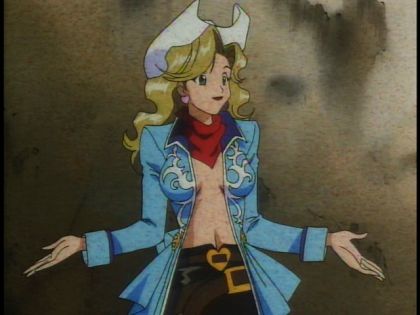 |
| Personally, I think this is what the show's really about. |
Obviously, there's a lot of thematic stuff going on here, and most of the obvious ones are well known. Look at any description of the series and they'll mention the style-over-substance aesthetic, the homages to 70s and 80s film, the haunted pasts of the main cast, and (according to Wikipedia) its examination of existential ennui3. The series is all of those things. But it's also about the end of a way of life.
Look, for example, at the jazz, bebop, and early rock-and-roll influences that defines so much of the show's world.
 |
| It's like that. |
Well, not necessarily. Punk-rock visuals would have happily gone with the "lawlessness" vibe that permeates so much of the work, but punk is A) a much more recent sub-culture and musical genre that 2) sublimated much, much differently into the larger culture than jazz did. The bands following in the Clash and the Sex Pistols' footsteps incorporated various bits into their music and their acts, so while the movement itself is not really a going concern, the various parts that make it are familiar.
Jazz, however, lives on as an artistic genre, but less of a commercial one. The music and style have evolved beyond easy recognition, and the term "Bebop," sitting happily in the logotype, calls to mind images like this:
.jpg) |
| Charlie Parker, bebop artist, playing at a local Callisto tavern |
Refrain
Those kinds of associations with lost ages are all over Cowboy Bebop. They are the foundation on top of which the whole story is built. But it's a very specific sort of lost age that the series goes out of its way to associate itself with. Spike Spiegel's mastery of Jeet Kun Do associates him with Bruce Lee, who died young.
The episode "Heavy Metal Queen" (a tribute itself to Convoy) makes heavy use of a system similar to CB radio, even using actual trucker CB terms on an interplanetary shuttle. The CB system is tied to a good deal of nostalgia since its golden age was brought low by overuse and the advent of cheap and wide-ranging cell phone technology.
The final episode features (amongst all of its other symbols of endings and passings) an altered ending title card. "You're Gonna Carry That Weight," a reference to one of the last songs on the last album the Beatles recorded.
Each of these are eras with distinct ends, or what the popular imagination thinks are distinct ends. The Beatles break up, CB radio falls out of favor, the arrival of rock ends the jazz era, an actor's death immortalizes him, the mob's time of honor and family is destroyed by compromise and infighting.
Crescendo
Most telling of all, though, is the Western theme.
The show's bounty hunters are called "cowboys," an epithet that calls to mind the Old West. That time period's probably been warped in the popular imagination more than any of the lesser time periods listed; when audiences in '98 or viewers in '12 think of the Wild West, we think of heroes and outlaws. We think of bounty hunters and criminals and sheriffs fighting battles for morality and survival against the backdrop of the lawless frontier. And we think of progress, symbolized by the railroad bringing those days to an end.
In our heads, in the mythos of the cowboy, there's an implied but usually unspoken tragedy that the battles fought by these larger-than-life figures are, ultimately, pointless, because history is going to wipe the slate clean, and everything they fought for will be for nothing.
We can infer that the same thing is happening in the background of Cowboy Bebop. I believe we can legitimately interpret that the action of that series is taking place in the waning days of the bounty hunter. The way of life of the in-universe cowboys is about to end and the solar system is about to experience stability5.
Consider Andy.
 |
| Keeper has Lord Humongous, but I have ANDY!! |
... to a freaking samurai.
Even changing his whole persona, and he can't escape the implication that he's doomed by history.
Breakdown
So, at this point, you're almost certainly telling me that my conclusions are obvious and I'm the last one to realize them. That, or you're telling me to wrap this up.
Keeper never told me you were this rude.
So, we know that "The Real Folk Blues" establishes and points out all sorts of juicy symbolism and foreshadowing about endings and deaths, and it's certainly tempting to just assume that all of that deals with individual characters, particularly Spike. But it also shatters the Bebop crew, destroys the Red Dragons, and cancels Big Shot.
|
| Never have I been so sad to be so wrong. |
If those endings were just about characters and lives, it would still be one of the best animated series of all time.
But all of those are taking place in a context. Almost all of the context we've been given establishes this way of life, this circumstance, as one ultimately transitory and doomed by history. That's what the theme does. It provides us context. It's the filter in which we view everything else in the story. And it's one that ultimately renders the struggles of their Bebop crew and their foes important personally but meaningless in any sort of grander form.
The hosts of Big Shot might be the last people you'd expect to metaphorically tell us what's going on in wider CB universe, given that they're mostly played for laughs and are generally content to tell us what's going on explicitly. But, other than ANDY!! they're the most "cowboy" thing in the whole of the anime.
And then Big Shot gets cancelled.
We next see Punch, looking like just another extra. He's going to be taking care of his mother. His co-host is getting married. He's settling down to an utterly mundane life. His cowboy days are long behind him.
It's hard to imagine that he's going to be the only one.
Jon Grasseschi is the author of urban-fantasy webcomic EverydayAbnormal. He doesn't usually write like such a pretentious boob, nor does he often natter quite so badly. He thinks it's your round, buddy.
1 When your story is not talking about things not present in the plot, you get the Transformers movies.
2 Sweet Jesus, will you scoot in? The poor waitress has customers and needs to get by, buddy.
3 Basically, it's a Wolverine comic. Zing!
4 And no, not the age where the Stones created good music, though that age is never coming back.
5 Ed's father, if you'll recall, has a pretty amazing speech about imposing order onto chaos late in the series...
Subscribe to:
Comments (Atom)