The Worst Filing System Known To Humans

-Punk (5) A Song of Ice and Fire (2) Affect (9) Alienating My Audience (31) Animation (28) Anime (19) Anonymous (3) Anything Salvaged (15) Art Crit (42) Avatar the Last Airbender (2) Black Lives Matter (1) Bonus Article (1) Children's Media (6) Close Reading (90) Collaboration (1) comics (30) Cyborg Feminism (3) Deconstruction (10) Devin Townsend (2) Discworld (1) Evo Psych (1) Fandom Failstates (7) Fanfiction (28) Feminism (24) Fiction Experiments (13) Food (1) Fragments (11) Games (29) Geek Culture (28) Gender Shit (2) Getting Kicked Off Of TV Tropes For This One (11) Gnostic (6) Guest Posts (5) Guest: Ian McDevitt (2) Guest: Jon Grasseschi (3) Guest: Leslie the Sleepless Film Producer (1) Guest: Sara the Hot Librarian (2) Guest: Timebaum (1) Harry Potter (8) Harry Potter and the Methods of Rationality (3) Has DC Done Something Stupid Today (5) Hauntology (6) Homestuck (18) How Very Queer (35) hyperallthethings (10) hyperanimation (1) Hypercomics (11) I Didn't Ask For Your Life Story Sheesh (24) Illustrated (37) In The Shadow Of No Towers (1) It Just Keeps Tumblring Down Tumblring Down Tumblring Down (9) It's D&D (2) Judeo-Christian (9) Lady Gaga (5) Let's Read Theory (3) Lit Crit (20) Living In The Future Problems (11) Lord of the Rings (4) Mad Max (1) Madoka Magica (1) Magic The Gathering (4) Manos (2) Marvel Cinematic Universe (17) Marx My Words (15) Medium Specificity (15) Meme Hell (1) Metal (2) Movies (33) Music (26) Music Videos (21) NFTs (10) Object Oriented Ontology (4) Occupy Wall Street (3) Pacific Rim (2) Paradise Lost (2) Parafiction (6) Patreon Announcements (15) Phenomenology (4) Poetry (6) Pokemon (3) Politics and Taxes and People Grinding Axes (13) PONIES (9) Pop Art (6) Raising My Pageranks Through Porn (4) Reload The Canons! (7) Remixes (8) Review Compilations (6) Room For You Inside (2) Science Fiction Double Feature (32) Self-Referential Bullshit (23) Semiotics (3) Sense8 (4) Sociology (12) Spooky Stuff (45) Sports (1) Star Wars (6) Steven Universe (3) Surrealism (11) The Net Is Vast (36) Time (1) To Make An Apple Pie (4) Transhumanism (9) Twilight (4) Using This Thing To Explain That Thing (120) Video Response (2) Watchmen (3) Webcomics (2) Who Killed The World? (9)

Reload the Canons!

This series of articles is an attempt to play through The Canon of videogames: your Metroids, your Marios, your Zeldas, your Pokemons, that kind of thing.

Except I'm not playing the original games. Instead, I'm playing only remakes, remixes, and weird fan projects. This is the canon of games as seen through the eyes of fans, and I'm going to treat fan games as what they are: legitimate works of art in their own right that deserve our analysis and respect.

Showing posts with label Anime. Show all posts

Friday, August 1, 2025

My Dress Up Darling Is The World I Want To Live In

The protagonists of anime My Dress Up Darling occupy a kinder world, more free to explore their identities and passions. Our world has more dangers, but have we given up on treating causes of harm when kids have latitude to express themselves, in favor of treating the symptoms with crude amputation?

there's nothing wrong with him wearing a bunny suit!

Wednesday, April 9, 2025

Zenshu: What Is The Soul Of Sakuga?

Zenshu, one of the standout animes of last season, positions itself as a love letter to animation. But under all the smooth movement and beautiful effects, what does it think animation really means?


Wednesday, August 31, 2022

Give Me Wings: Dance Dance Danseur and the Craft of Gender

The anime Dance Dance Danseur dwells on the angst of conforming to standards of performance--of art, and of gender. Why does its protagonist seek out the pain of classical ballet training?


Tuesday, February 22, 2022

The Corniness Is The Point

As celebrities sell out to NFT schemes, mutual hostility with the skeptics boils over. How can we keep our heads as cryptoart now achieves a seemingly impossible level of corniness?


Wednesday, December 23, 2020

Culture Kept In Its Coffin: How The Netflix Model Buries Our Media History

Classic anime like Revolutionary Girl Utena could get a new lease on life if released serially in the present day... but Netflix and its many competitors aren't in the business of preserving or selling art. What do we lose when our media history becomes #Content?

Thursday, August 27, 2020

Nasty, Brutish, and Short: The Promised Neverland and Human Nature

The nightmarish final boss of hit manga The Promised Neverland is... philosopher Thomas Hobbes??

Content warning for major late manga spoilers for The Promised Neverland, cannibalism, gore, monarchy, body horror.

Saturday, June 20, 2020

2x2 Girls: Queer Mirroring in She-Ra

She-Ra and the Princesses of Power ended on a high and very gay note, but the show's queerness goes much deeper than the flashy finale. To understand how the show is constructed around its central lesbian relationship, though, we have to be open to learning the techniques it uses to tell their story.

Monday, July 29, 2019

Eve Laughed At Their Decision

Yes, the Christian symbols in Neon Genesis Evangelion mean something. Rei Ayanami is the key... but does the word of her creating god give us enough room to find our own meaning?

Content warning for discussions of rape, abuse, medical abuse, and heresy.

Monday, July 22, 2019

I Want To Connect (But It's Hard To Understand) Part B

Complex shows like Sarazanmai and Revolutionary Girl Utena use powerful techniques to connect to their audience. But the most powerful tool might be the audience itself and the connections we make to each other.

Monday, July 15, 2019

I Want To Connect (But It's Hard To Understand): Sarazanmai Part A

For an anime all about connections, Sarazanmai, with its musical numbers, kappa mythology, and formal experimentation sure can be obscure. But its unique symbols are an inventive communication tool, one rooted in the unique power of cartooning.


Monday, June 17, 2019

Complicated and Messy: Kingdom Hearts, Plot, and Being A Teen Queer

Kingdom Hearts feels like a wild game of pretend played with every random thing the players had lying around. That's also what my experience of being a queer teenager felt like.


Saturday, March 31, 2018

Let's Pop Together Part 2

Is what Pop Team Epic does to everything it touches that different from what Ready Player One does to The Iron Giant? After you flatten pop down, break it apart, and repeat it to the point of meaninglessness, can you find a way back to sincerity?


Saturday, March 24, 2018

Let's Pop Together: Part 1

What is it that makes today's Pop Team Epic's so different, so appealing? And can it explain why people hate the marketing for Ready Player One so damn much?


Monday, January 9, 2017

Video Killed The Yurio Star: Why Is Yuri On Ice's Soundtrack So Weak?

The homoerotic skating anime Yuri On Ice places great importance on the choice of music for performance. But can its soundtrack live up to its own implicit standards? And what does that say about the rest of the show's creative direction?


Monday, December 12, 2016

Crazy Noisy Bizarre Town: Mob Psycho 100, Diamond Is Unbreakable, and... Post-Shonen Anime?

Mob Psycho 100, like comicker One's previous work One Punch Man, has a premise that seems to undermine core aspects of Shonen narratives... or even action narratives in general. Coincidentally, the current arc of JoJo's Bizarre Adventure, Diamond Is Unbreakable, has developed in ways that also disrupt traditional storytelling. Might we call these two works post-Shonen? And what can a 1961 short story by Kurt Vonnegut tell us about what these shows are trying to do?


Sunday, July 6, 2014

The Remarkable Queerness of Shinji Ikari

Our hero, Shinji Ikari
The fandom for acclaimed anime Neon Genesis Evangelion has developed some remarkably bizarre attitudes and ideas about the series they love. I'm not talking here about the speculation regarding the actual narrative itself--the questions of "what the hell did I just watch, what happened in the last two episodes, why is there a live action shot of people in a movie theater, was this sort of a Freudian thing..."--which do get pretty bizarre at times, but which are on the whole pretty innocuous. These are ideas that despite their strangeness simply attempt to clarify the basic narrative of the original series, the film that followed, and the heavily altered narrative of the reboot films (of which, out of four total, three have been released. We're still waiting to see whether the fourth one explains what the hell happened in the third one).

No, the really weird ideas that I want to talk about today are the notions that the fandom has adopted that fly in the face of just about everything the text attempts to establish thematically. One of the more obvious examples of this comes from the heavy sexualization of the two teenage female pilots that the fandom--and, frustratingly, the marketing team--participates in, despite the fact that the show goes to great lengths to deconstruct everything from harem anime tropes to the specific character archetypes of those characters to the idea of fanservice in general. The most fanservicey scenes are frequently profoundly uncomfortable, if not outright nightmarishly surreal. According to fan lore, End of Evangelion, the film that acts as the conclusion to the original series, was deliberately dark, brutal, incomprehensible, and full of psychosexual revulsion directed squarely at the protagonist because creator Hideaki Anno was so outraged and disgusted with the Otaku misreading of the film. Whether or not that's true, the fact that the fanbase regards it as plausible should tell you a lot about... well, about the whole Eva phenomenon really.

That's not what I'm here to rant angrily about this week though. No, I want to hone in on another particularly bizarre idea that the fandom has adopted. Specifically, the weird notion that the series protagonist, Shinji Ikari, is straight.

As with a lot of the other more frustrating reactions to the series, it's not just a reproduction of the shitty backwards attitudes that a lot of geeks hold, it reproduces them in such a way that it garbles the actual thematic arc of the series and makes character actions and development alike borderline incomprehensible. It's of particular interest to me, as well, for the way it results in a dismantling of creator efforts to increase representation, forcefully repressing "deviant" sexuality. This is the much canonized practice in fandom culture of erasing what few paltry instances of queer representation exist popular culture. It's the flip side of the coin I discussed a few weeks ago with respect to the possibility of reading queerness into Jonathan Strange and Mr Norrell: it's reading queerness out of media.

Before we get to discuss Shinji Ikari's bi- or perhaps pansexuality, though, we need to talk a little about what makes Evangelion tick as a narrative. And that means diving deep into the boggy nightmare of Eva's plot.

Bear with me, folks, I'm going to try to make this as comprehensible as possible.

Wednesday, October 2, 2013

The World is a Cruel Place: Theme in Attack on Titan

The last episode of Attack on Titan came out yesterday (I mean, it did if you watch it illegally, which I ended up doing out of sheer exasperation after 90% of the finale was spoiled in anachronistic order by Tumblr. Thanks, guys! Thanks a lot) and the internet buzzes with the sound of exclamations of joy, rage, and confusion, in equal measure.

I wasn't originally going to say too much about this show, actually, since I think the basic thematic structure is pretty easy to sort out (I mean, they straight up prattle about the humiliation of being in a cage multiple times during the show; you don't get much more overt than that). However, there's some weird pieces that folks are having some trouble fitting together, and there's some interesting stuff going on with the adaptation of the story and the question of how successful it is, so I figured, what the hell, might as well swoop in and give my take on the whole thing.

Besides, the alternative was an article on erotic fanfiction, and I need some more time to do research before I put that one together.

Yes. Research. Indeed.

All joking aside, browsing porn based on Harry Potter is a true descent into madness, and I need to process what I have seen before I can write anything coherent about it. So, let's talk about something a little more sane, like giant naked photosynthesizing cannibals. Significantly more sane. [shudder]

The Miner

Apparently Attack on Titan: The Animated Series has decided that the best way to convey information during the climax of the series is through vast walls of text. Thus it was that this image materialized on my dash:


...with the tags "#important" "#probably."

And it is, actually. I think this image does an excellent job of summarizing some of the main themes in the series. Those themes revolve around the concept of Freedom. This story, seen in that context, becomes a clear fable with a somewhat unclear resolution.

The Miner is our Everyman figure, the dude we're supposed to identify with. For that figure, the Wall is not an icon of protection but an icon of restrictive state power. Without the wall that is defended by the Military Police (a more direct arm of the State) he would be able to live and work where he pleased. The wall is thus a stand-in for the State, and he is literally undermining that state power in the process of digging under the wall. That's, after all, what undermining is--it is the act of digging underneath the fortifications of an enemy wall in order to weaken the foundation or even lay mines--explosives--that will destroy the wall. The Miner is thus a Miner in a military sense of the word, a lone warrior against the State.

His friend acts as a foil, urging complacency and acceptance of life as it is. The State's agents are always watching, after all, and it is not their lot in life to seek something greater. The Miner persists, however, and...

...And what? A lot hinges upon this ambiguity at the end of the story. Either the Miner and his friend escaped beneath the wall, or they were destroyed in the attempt--the story is unclear. If it is the former, the suggestion is that a determined individual can undermine the State, no matter how deep the roots of the State seem to run; if the latter, that the State is an implacably destructive force that will do anything to retain its power.

It's the Libertarian ur-fable, really. Everything boils down to a question of whether or not people are restricted physically by governmental authority.

And it has particular relevance with the revelation that there are Titans within the walls. This means that the threat from outside and the threat from within--the threat of state power--are really one and the same.

So, this story occupies a weird space within the narrative where on the one hand it's clearly a legend that has symbolic value within the setting, while on the other it helps unlock some of the underlying ideology of the show for those of us outside of the narrative, and on the third hand (presumably we're piloting Crimson Typhoon a this point) it serves as a hint about the weird, supernatural nature of the walls.

In that sense, it's really doing some interesting multi-tiered work, work that shores up the broader arguments made throughout the show about self-determination and the existentialist dilemma. Eren Jaeger's character arc seems to largely consist of his need for freedom and his reluctance to face the responsibility that accompanies this freedom. It's kind of the classical Existentialist problem, actually--if you have absolute freedom, you also have absolute responsibility for everything that happens, and often you can't actually determine what the outcomes of your choices will be. This absolute responsibility is terrifying, which is why it is easier for Erin to accept the orders of Captain Levi aka Reveille and trust in his comrades rather than taking matters into his own hands. Although he thought he was ceding authority to another, ultimately he still was responsible for their deaths, because he decided not to choose differently. As Rush puts it, "if you choose not to decide, you still have made a choice."

The show, seen through the lens of Eren's character development and the Miner's story, is thus an existentialist story about freedom, and a fairly coherent one at that.

...At least, that's how it seems on the surface.

The Rewrite

One of the critiques spinning around on Tumblr right now of the series or season or whatever finale is that the studio made a number of unwarranted changes to the narrative. People tend to fall into two camps on this sort of thing. On the one side are the Originators, who (some might say slavishly) adhere to the "original" work. On the other are the Isolators, who claim to see each work as fundamentally independent and judge each upon its own merits.

I'm not a big fan anymore of either position, but I'm more sympathetic to the Originator position on the whole. The issue with the Originator position is that it assumes an Author capable of writing a definitive Work that is not subject to error, ambiguity, flaw, changeability, accident, and so on. You see this with some Lord of the Rings and Harry Potter fans--any change is considered bad simply because it is a change from what the author intended.

If you've been following along for a while, you know how skeptical I am of authorial intent. If there's one thing 20th Century theory taught us, it's that meanings can emerge that are outside of the author's ideas, because our minds are association-generating engines. There is very little change, for example, that Hajime Isayama, the author of Attack on Titan, anticipated the punning I did with the Underminer earlier on in this article. And yet, the associations emerged regardless of the author's intent. Part of interpreting a work is running the risk that interpretation will go against the will of the author, and therein lies interpretation's great freedom. In that sense, interpretation tips on the same existential tightrope that Erin staggers along--interpretation is most interesting when it is risky.

On the other hand, though, it seems ridiculous to me that we should simply ignore alternate versions of a work while doing analysis. This would be the equivalent of saying that we must read each article analyzing Attack on Titan completely independently, never weighing any argument against another, never comparing which reading is the most effective of most pleasing, never allowing ideas to cross-pollinate or interact in any way.

The idea that we cannot judge Lord of the Rings, say, by the standard of the book is simply absurd. It's ludicrous to suggest that we can ever close out the other material we have synthesized in order to judge works completely independently. In that sense, the Isolators enact the same folly that the Originators do, prizing the work as an isolated entity associated only with itself.

Viewing an adaptation alongside alternate versions lets us see where the different versions succeed or fail. I think that side by side comparison is quite useful in the case of Attack on Titan's finale, as numerous plot points were added in order to draw out the conclusion and make it seem like a much larger finish. In the process of adding these plot points, some of the thematic coherency was lost.

The biggest one, of course, is the fact that Eren has to be badgered into fighting against Annie. He's emotional, the others are angry with him, bla bla bla, this is nothing new for Shonen anime.

But in the comic, when Eren asks how Mikasa and Armin can fight against Annie, Mikasa says:

Shingeki no Kyojin 32 Page 38

And Eren's response is to say:

Shingeki no Kyojin 32 Page 41

It sure is. None of the "FIRIN' MY LASER" powerup nonsense we get in the show, just cold, bitter resolve. While the show's take is far more dramatic in the sense that there's a lot of flashy intense stuff going on, I think it's clear that the comic has far more human drama, and even more dramatic lighting when you get right down to it. The lengthy dithering simply serves to mute the drama of this fateful decision.

And when you get right down to it, it's the decision here, not the transformation into a titan, that makes this moment dramatic. In the show, Eren must transform into a titan to avoid spikey death. Here, he does it because he consciously decides to set aside his humanity and harden his heart. It plays much better into this paired theme of his freedom vs the responsibility that is his freedom's price. The interaction between the character and the theme generates the impact (plus, you know, the shadowy, backlit composition of this page, which is really stunning).

If we compare the comic and the anime, then, I think it's clear that the comic has a stronger overall composition. The show has always had issues with pacing, and the attempt to draw the ending out and introduce unnecessary elements that served only to muddy the overall character interactions (what was Levi aka Ravioli doing there, anyway?) accentuated those pacing issues while damaging the show's thematic coherency.

Of course, that said, is the theme really all that coherent to begin with?

The Existentialist

There's some odd incoherency between the different elements of the theme, actually, that I think are worth examining a little. On the one hand, the show is very consistent in how the themes are portrayed. On the other hand, the internal logic of those ideas doesn't hold together very well.

The problem is this:

There's a lot in the show that points to a traditionally existentialist outlook, particularly the idea of the world being a cruel and absurd place in which humans must construct meaning and their own identity but in which the ultimate responsibility for meaning and choice fall upon them. That's where the whole idea of angst comes from, the pain of growing up and being responsible for your life, being forced by your father to pilot Eva to become a Titan-shifter, &c. &c. That's great! It's solid material for a story about an adolescent, particularly, and it's well explored here.

Except the existential dilemma, the existentialist angst, comes from the realization that limits are internal and once you abandon those limits you can jump off any cliff you want with the absolute responsibility of the outcome.

The three walls of Attack on Titan are, however, an external constraint and part of Eren's angst comes from being constrained by these external forces.

See the issue here? Existentialism seems, to me, to be largely inward-focused while the plot of Attack on Titan increasingly places state institutions as an external enemy that must be defeated to achieve freedom. In essence, this injection of a fundamentally Libertarian or Anarchist ethos unsettles the existentialist ideas in the show because it moves the conflict from the introspective to the external world. It's basically the opposite of what happens in Evangelion, interestingly, where the conflict appears to be external but gradually becomes more and more existential as the show goes on until the final battles are fought in the mind, and Shinji must confront the fact that he is responsible for his own happiness.

The introduction of the Miner, who as far as I can tell does not appear in the comic, really does a serious blow to the thematic coherency because it makes far more explicit the Libertarian bent, at least, of the show's adapters. The story seems far more obviously an allegory of the evils of state power than about the need for the Miner to realize his own freedom of action and identity that precedes Minerhood. Whereas Eren's choice in the comic indicates a resolution to action within an absurd and cruel world, his choice in the show, when paired with this story, suggests a need to struggle for survival against a very specific foe (rather than a need to struggle for meaning against an indifferent universe). So, again, the adaptation brings the show into conflict with itself.

Does that uncomfortable conflation of internal understanding of freedom with external achievement of freedom help or hinder the show? I honestly don't have an answer to that question. I think it might be something every fan has to determine for zirself, fittingly enough. The theme itself seems to be effectively carried through the show, so the question of whether or not you agree with the theme itself almost runs parallel to the question of whether or not the show is successful, I think. It's ok to find a work artistically coherent while politically incoherent or even objectionable.

At the very least, it's worth considering what message this show is sending and how that message is changed through the act of adaptation, especially for those engaged in fan art and fanfiction, where the development of new stories and scenarios has rich potential for reconsidered and altered themes.

Regardless, I'm eager to see where the theme goes in both the anime and the manga, which suggests that even if the theme isn't always successful, it's at least intriguing... which is maybe what really matters most, in the end.

SIE SIND DIE TEXTEN UND WIR SIND DIE READERS! AH AH AH AH AH AH AAAAAA. Follow stormingtheivory.tumblr.com for updates, random thoughts, artwork, and news about articles. As always, you can e-mail me at KeeperofManyNames@gmail.com. Circle me on Google+ at gplus.to/SamKeeperIf you liked this piece please share it on Facebook, Google+, Twitter, Reddit, Equestria Daily, Xanga, MySpace, or whathaveyou, and leave some thoughts in the comments below.


Monday, July 29, 2013

The Girls Who Walk Away From Kyubee

"Do you believe? Do you accept the festival, the city, the joy? No? Then let me describe one more thing..." 
"In place of you, who could accomplish anything but won't, I am suffering in your stead!"

Since we're on an optimistic streak of late, I want to talk a little bit about Madoka Magica. This might seem, at first glance, like an odd choice. The show, for folks who are not familiar (and if you're not familiar I don't recommend reading much further, as it's impossible to discuss the show's thesis without discussing a whole raft of rather serious spoilers) is a deconstruction of the Magical Girl genre popular in Anime. It's kind of like Cardcaptor Sakura or Sailor Moon, but the idea of teenage girls going out to battle cosmic evil is treated much more psychologically seriously, and a whole lot of suffering ensues. It's a beautiful show, but it will tear your heart right out. So, yeah, seems like kind of an odd choice for Optimism Month or whatever we've got going on here on StIT.

Except, I don't think pervading despair is, despite all indications to the contrary, really the most important aspect of the show. In fact, I would argue that the show is a deliberate and explicit argument against despair--and, more importantly, the acceptance of wretchedness as inevitable or even acceptable for the sake of a greater cause.

To dig into why, though, I want to talk a little bit about a story by famed science fiction and fantasy author Ursula Le Guin. The story in question is entitled "The Ones Who Walk Away From Omelas," and it can be read, in full, here. It's not long, so I'm going to kind of assume that you read it before we begin.

Ok?

So, to sum up what you definitely just read as I instructed rather than blowing off my request completely while rolling your eyes, the main premise of the story (if you can even call it that--it's almost more of a thought experiment) is that there's this city--the most beautiful city ever, where everything is basically fantastic.


But Le Guin suggests that we might not buy such a town. That we have to have something to make it more believable.

So she introduces a child that suffers a wretched and debased existence, kept within the perfect town--someone damned so that the joys of the rest of the town can be given significance and meaning.


And then she suggests something interesting:

The townsfolk are introduced to this child's existence at a certain age, and most accept it as a simple fact of the town's existence and use it to provide a context for their joy. But not everyone is willing to accept the joy of the town, once they understand the child's existence.

These are the titular Ones Who Walk Away From Omelas.

And they cannot accept the price of their joy.


A part of me is tempted to just sort of lazily close the article here and let the text and pictures talk for me, but I actually wrote this bit last and the next bit first so I guess I'm kind of stuck now, huh? Whoops.

Anyway, I think it's worth digging into the comparison I'm making there a little more deeply in order to pick apart the ideas expressed within the show. It's helpful, I think, to compare it to Le Guin's tale, because she is quite explicit in the moral of her story, or at least the broader moral question she hopes to raise, whereas the show can be, at times, maybe a little more difficult to untangle (but only a little!).

Let's start by talking about Omelas and its relationship to the broader setting of Madoka Magica. The setting in these stories is important, and it's worth exploring how MM's setting is introduced, especially compared to other anime.

Remember the whole sequence in the first episode where the teacher rants about the proper way to cook eggs?
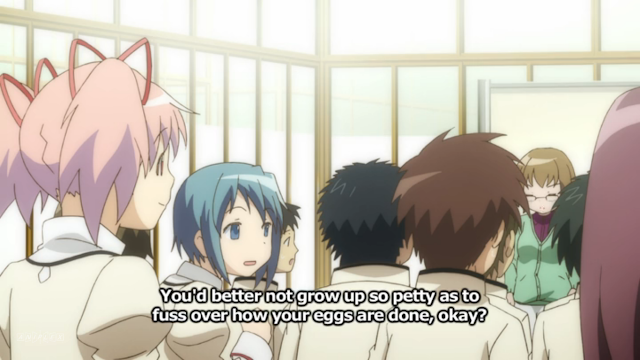
This one.
There's something kind of interesting about the staging of this scene--or rather, how this scene ISN'T staged. The soundtrack doesn't go overtly comical or jaunty as we might expect, there's no exaggerated (eggzagerated sorry sorry sorry) reactions from the students, and there's no super deformation of the character designs.

In contrast: Fullmetal Alchemist, which uses superdeformation to indicate tonal shifts quite effectively.
Now, part of the reason the show succeeds so well in juxtaposing its two tones is the fact that it doesn't use these exaggerated techniques. Yes, the situation is absurd and comical, but one thing is undeniable:

This is simply the reality in which Madoka lives.

And it is completely frivolous.

The fact that the show remains in a realistic mode of staging emphasizes the fact that this is just what daily life is like for Madoka and her peers. There's no stylistic switch to indicate a change from the serious, plot-relevant parts of the show, and the frivolous, comic relief parts.

I think it works more successfully than, say, Code Geass, which never quite managed to juggle its tonal shifts effectively (for me, anyway--obviously, it worked just fine for many, many other viewers). But it's worth making the comparison to that show because they both have a similar aim: the simple, largely carefree lives of the elite are being set in opposition to the suffering of a few. You can sense it as soon as Homura walks into the room: there's just a fundamental difference from the awestruck students and the cold, broken warrior. She's conscious--hyperconscious--of how thin the eggshell of the world really is, and how tenuous the cuteness of the first three episodes really is. Interestingly, though, this only becomes clear on a second viewing. On a first viewing, the endless prettiness is just glorious eyecandy that we drink in.

On a second viewing, though...

Me too, Homura. Me too.
Well, this may be simply my own miserablism dampening the proceedings, and maybe I'm just unduly affected by the rather grim mindset I was in while watching the series a second time, but I found the endless cuteness, the overwhelming prettiness, overwhelming and cloying.

And part of the reason for that is that I had seen the graves upon which that cuteness was built. It is built on the suffering of teenage girls. Which is, especially when you put it so bluntly, pretty fucked up. All those beautiful, airy buildings can only exist in a world where teenage girls fight beings that are literal suffering and anguish made manifest, only to eventually die or, worse, transform into those sorts of beings of literal suffering themselves. The people that live in Madoka's world are the same as the people of Omelas--living in bliss through the suffering of a few.

Perhaps this judgment is not completely fair. The thing about Madoka is that the character's--the side characters, I mean--aren't bad people. And really, it's not quite fair to compare them to the people of Omelas. After all, they have no idea that their world is so beautiful, so rich in multiple senses of the word, because of the suffering of Kyubee's targets.

But still, it's hard to shake that feeling that there's something corrupt about the show's joy. In many ways, the show takes great pains to lead us to that conclusion--Madoka's repeated cry that it's "just too cruel" comes to mind. And while Kyubee's race seems to have good intentions, their minds are ultimately quite alien, and Kyubee's own reaction to Madoka's suffering is not the reaction of the people of Omelas--it is not a reaction that acknowledges the suffering and responds--it is a dispassionate response of a being that sees humans as tools or livestock--a convenient power source.

So, what is all this trying to say?

Well, one of the things a lot of readers seem to overlook with LeGuin's text is her critique of imagination. It's very easy to get caught up by the philosophical question of whether or not we should accept a paradise built on foundations of suffering while missing her underlying question. Here's probably the most concise expression of the question within the text:
"The trouble is that we have a bad habit, encouraged by pedants and sophisticates, of considering happiness as something rather stupid. Only pain is intellectual, only evil interesting. This is the treason of the artist: a refusal to admit the banality of evil and the terrible boredom of pain. If you can’t lick ‘em, join ‘em. If it hurts, repeat it. But to praise despair is to condemn delight, to embrace violence is to lose hold of everything else. We have almost lost hold; we can no longer describe a happy man, nor make any celebration of joy."
And, of course, Le Guin is a great writer, so she goes further than simply posing the problem, she forces us through it by describing a paradise, and then demanding that we confront our reaction to it. She says, her, let me add this element of suffering. Is this more plausible to you? And from there, let us ask: why do we find it so difficult to imagine a paradise without a dark halo? Why do we find it so hard to believe in goodness and peace? Why do we accept the "treason of the artist?"

Of course, some of this might be because it'd be hard to write a story without some conflict, but there's conflict and then there's conflict, you know? There's conflict in a Hayao Miyazaki film even if there isn't always a lot of suffering, per se... it's part of why his villains are often so much less villainous than you would perhaps expect if you've grown up on Disney films.

But LeGuin seems to be asking us to dig a bit deeper into our own psyches and question why we glorify evil, essentially. This is a particularly relevant question when discussing a deconstruction like Madoka, or Neon Genesis Evangelion, or Revolutionary Girl Utena, or the newest Batman and Superman films. Why are we compelled to take relatively bright worlds and dwell in their penumbra?

Why does LeGuin feel compelled to introduce her suffering child into the bright city of Omelas?

Well, what both Madoka and LeGuin are getting at, I think, is that we have to be willing to directly confront our tendency to find darkness in light, both as philosophers and as artists. In fact, there is an inherent challenge within these stories to find more optimal solutions rather than simply accepting a tainted reality.

After all, isn't that just what Madoka does?

Madoka is one of those who walk away from Omelas. And her choice has real impact because we have grown to deeply sympathize with the tortured child in this scenario: Homura. (And to a lesser extent Sayaka and Whatsherface, of course.) In fact, the emotional arcs of the story are meant to deliberately bring us to an understanding of why Madoka must inevitably make the kind of wish that she does ultimately make.

This is, incidentally, one of the many brilliant narrative tricks of the show. The relationship--the love--between Madoka and Homura is not incidental to the show's themes. In fact, it is Homura's agony--her deliberate taking on of pain in order to support Madoka's paradise--that allows us to see the horrible human consequence of the Faustian bargains made in the show.

In fact, Homura's first speech to Madoka in the conclusive timeline of the show is a declaration that she must never swerve from who she is--i.e. she must never attempt to crack the eggshell of the world and discover the rotted core--if she wants to continue living in bliss. Homura knows, you can tell that she knows because of her facial expression, that in doing this she is forfeiting her own happiness. She is willingly choosing the path of the martyr for Madoka's sake.

This introduces a crucial difference between this series and Le Guin's text. For Le Guin, the Child is one character, and the Omelans... Omelasians... Omelamas... ah, let's just call them the Townsfolk, is another "character" (the third being the ones who walk away, of course). In Madoka Magica, in contrast, the Townsfolk and the Child are one--the Magical Girls are both the sufferer, and the people who accept that suffering on some level (either by enjoying their lives understanding their Faustian suffering, or by embracing and ultimately becoming an embodiment of suffering and hopelessness--either way, there is acceptance of suffering as inevitable and ultimately, in some way, permissible).

Homura is the ultimate example of this, of course, although all the other magical girls express it to a greater or lesser extent. In fact, one might argue that Homura is the only truly significant example, as, in some ways, she has the most free will of any character. She's similar to a character like Paul Atreides from Dune: she has an imperfect kind of prescience, in that she has seen multiple possible futures and is capable of acting with full knowledge of the way other characters behaved in other timelines. It is, as I say, imperfect, but ultimately other characters are put in a reactive position to Homura's iterative actions as she continually attempts to a future in which Madoka is saved.

It is significant, then, that she never sees a possible victory beyond Madoka's personal salvation. This is why Homura, for all her power and autonomy within the various timelines, is ultimately still trapped. She willingly traps herself by accepting that her own suffering and the suffering of the other magical girls is inevitable. She is one of the Townsfolk--or one of the traitor artists--accepting that a paradise can only exist if someone, somewhere pays a hideous price.

Madoka, then, is the perfect counterpoint to Homura's demigodly despair. She is the only agonist capable of canceling the despair that pervades the universe. It is interesting to me that not only does Madoka retain the powers of her previous iterations, she seems to retain some glimpses or fragments of memory, as seen in the first episode. While Homura can map out possible futures, she can still be caught off guard--she is not omniscient--and Madoka, in particular, has the power to surprise her, perhaps in part because of her ability to sort through Homura's iterative futures and find a way out that Homura herself cannot see.

Madoka sees the Suffering Child and decides that such suffering, even for her own happiness, even for her own humanity and continued existence in this world, is unbearable.

Madoka perceives the rules of Kyubee's game, and short circuits them.

She does more than walk away from Omelas--she rips out the foundations of the whole fucking city.

To me, it's pretty clear that the show is more than a revisionist reimagining of the Magical Girl genre. The show tears down the trappings of the Magical Girl only to tear down the trappings of the revisionist narrative as well. Remember that Le Guin is interested in pointing out the treason of artists--the willingness of creators to accept evil as something that must exist for there to be beauty. This show asserts, in its own way, the same basic idea. The cynicism of Homura is shown to be a weak and mortal thing in the face of the boundless love of a goddess willing to see a path out of suffering. So, too, is the cynicism of the deconstruction shown to be ultimately insignificant in the face of profound optimism and a belief in beauty not tainted by darkness or diabolical compromises.

Madoka's ascent is accompanied by one of the most stunning lines in the entire show:

"If someone says it's wrong to have hope, then I'll tell them they're wrong, every single time."

The brilliance of this line comes from the fact that it is a logical "If-Then" statement. If x, then y. And for Madoka, this statement is more than just a declaration or boast. It is literally a new law, written into the very fabric of the universe itself. She has reordered reality to make this refutation an inevitability.

It is an inevitability that supplants the inevitability of wretchedness.

And, to some extent, I can't help but wonder if as an artist part of my own role in the world should be to take on Madoka's declaration and hold it close to my work and to my heart. There is certainly a role for deconstruction--there is a purpose to the exposure of the Suffering Child, the exposure of wretchedness, the exposure of how people in our society are shut out and tormented and made to believe that brutality is the only law in the universe. But is it really enough to hold a mirror to society? At what point does the exposure of the wretched become to us, as it becomes to Homura, an inevitable damnation to be accepted, a burden that we take upon ourselves?

In the end, whether you struggle forever accepting your own ruin, or transform into a Witch and accept the ruin of those around you, have you made a truly significant choice?

Le Guin's story and this short, concise cartoon demand, ultimately, the same reflection from us as critics and artists.

They demand that we ask ourselves whether or not we are among the ones who walk away from Omelas.
Support on Patreon
Store
Reader's Guide
Tag Index
Homestuck Articles
Solarpunk Articles
Mastodon/Fediverse
Tumblr
Bluesky
RSS Feed