So, for those who haven't heard, Homestuck, Andrew Hussie's mindbending, ultra-dense epic about friendship and tentacle sex (note: the last one may be only in the minds of fans), just came out of the Year Four Megahiatus--a months-long pause in the narrative that Hussie used to prepare for the conclusion of the story and the creation of the video game that fans gave him several million dollars to fund. And, true to form, it came out of the hiatus first with what I can only call a prolonged satire of the worst parts of Homestuck's hatedom and fandom alike, followed by...
Well, here's where things get tricky, actually. I'm not quite sure how to describe [S] Act 6: Act 6: Intermission 1. I've used the term "hypercomic" to describe Homestuck before. That's a bit of a contentious point right there--
Alycia Shedd, another
hypercomic theorist I'm acquainted with, suggested to me the other day that it's more like an illustrated novel than a comic, and there's maybe some truth to that. Even if we do accept it as a comic, there's definitely some individual elements that jump fully into other media--animation, games of various types, and, at one point, historical romance novels. [S] A6:A6:I1 is one of those points--it's undeniably an animated sequence (images juxtaposed temporally), not a comic.
And yet... there's a number of elements that are more akin to hypercomic technology than anything else I've seen. So, maybe what we're looking at here is a hyperanimation?
This is a big deal because it gives Homestuck yet another You Were Number One achievement badge to sew on its kiddy camper handysash. A hypercomic that's already broken so many other boundaries is, apparently, gleefully breaking new ones with every few updates these days. Hell, this comes shortly after an update that turned Homestuck into a type of hypercomic that up till now was almost purely theoretical. (I'll explain more about that in a moment.)
The most notable part of this, however, is that it again underscores Homestuck's unique qualities--the things that set it apart from other formalist experiments.
[S]A6:A6:I1 isn't powerful because of its formal, experimental elements.
It's powerful because those elements are used to express a powerful, dramatic moment in the story.
I want to try to get at why, which is going to necessitate some discussion of the narrative. For those of you who haven't read any of Homestuck, this surprisingly makes for an ideal element to discuss, as the events are weird enough (and short enough) that by the time you return to this point in the comic it'll be a surprise all over again. (Homestuck's looping narrative actually makes for a great natural spoiler-baffle because it takes so long to read and there's so many twists and turns). I DON'T recommend continuing if you're almost caught up, however--there's just enough visual information that you can piece together some of what's happened in the last few acts. Anyway, the point is that this article should be comprehensible even to those of you who haven't read the comic while not going old information for those of you who have kept up with these recent updates.
I should also warn you that while the first half has lots of juicy textual analysis, the second half is application of the lessons learned to some other stuff, so I'm gonna drift away from Homestuck for a bit. If you're just here for the analysis of [S]A6:A6:I1, you can check out that that point, it's cool, although I'd be most obliged if you stuck around.
Cool?
Cool.
Let's begin.
What Is It Doing
Part of what makes this video so interesting is its relationship to Homestuck as a whole. Before we start analyzing, let's take note of the dimensions of the starting screen. That's the standard layout for Homestuck, the norm from which panels sometimes (or, recently,
frequently) deviate from. If you've been following this blog for a while, you might recall that I find such deviations to be particularly interesting,
because they often work viscerally on a reader, emphasizing certain emotions, sensations, or narrative elements through their structure. (The only reason I haven't discussed it more is because I'm turning this idea into my grad thesis, so I want to keep it just a little under wraps for now. Well, that, and the actual nitty gritty underlying theory would probably be a huge snoozefest for most anyone that isn't me.)
Keep this idea of norms and deviations in mind as we start watching:
[S] Act 6: Act 6: Intermission 1
Did it take a moment to realize that the comet was breaking the panel border?
The first time, it caught me off guard. I wasn't expecting that transition at all, and it crept up on me, partly because it was so smooth:
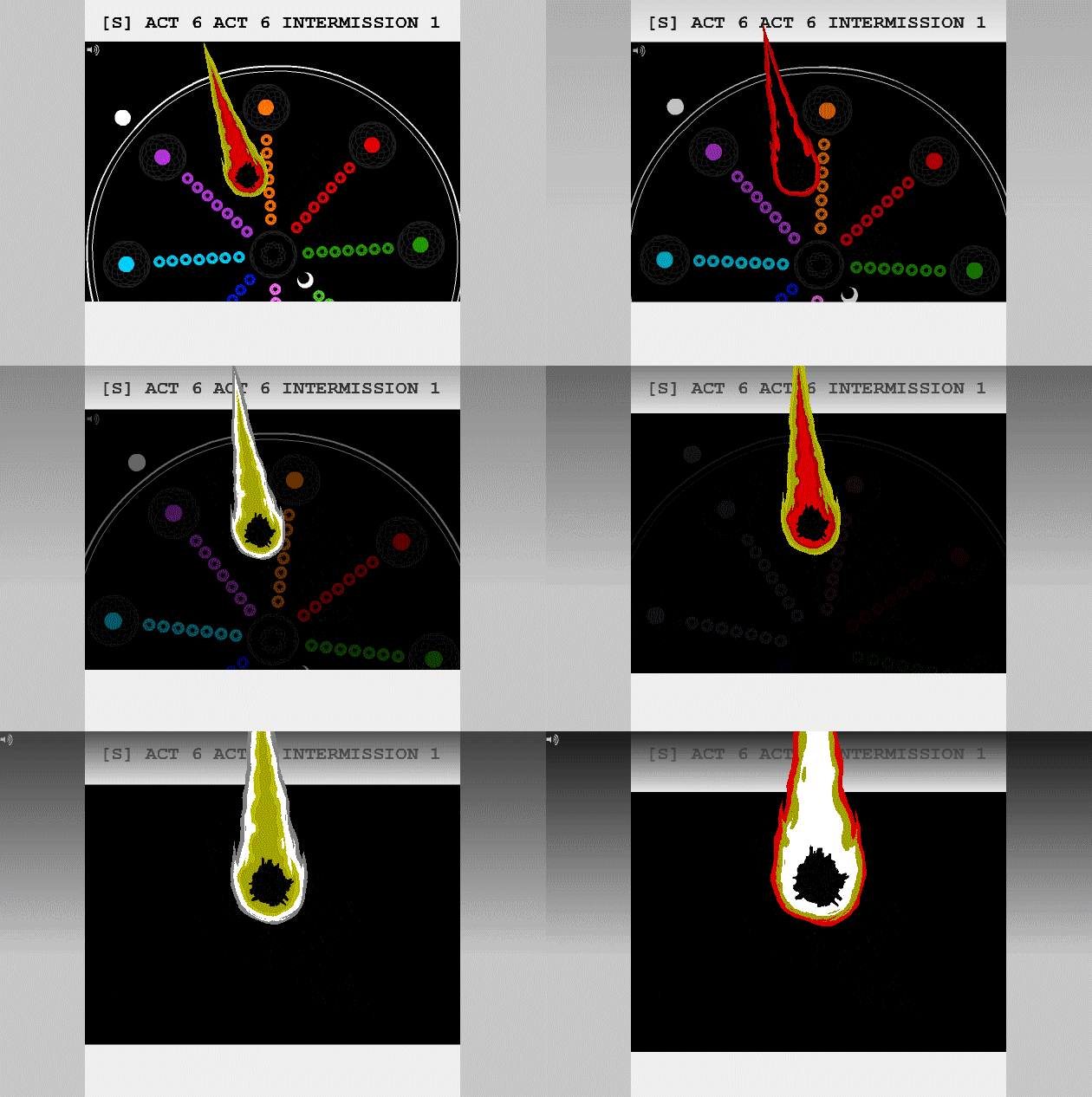
I love the way this video begins, actually. It starts with a purely symbolic representation of the universe that the game encompasses--eight planets connected by seven gateways to the central entity known as Skaia, and through that abstract space flies a massive meteor... a meteor which then breaks the panel border.
So, let's start there. What is Hussie trying to show us through that strange breaking of form? Why shatter the established page boundaries here?
Well, first of all, notice how there are four planets to start with, with four more appearing. This is a symbolic representation instantly understandable to fans--it signifies that two universes are finally, after a three year wait in-comic, being merged together. This is an interesting choice, I think. Hussie could have depicted this by actually showing the four new planets materializing in this reality... but instead he simply indicated the titanic shift iconically. This allows him to indicate to the reader what is happening in a way that is still chill-inducing, especially when paired with the ambient cross-speaker pulse of the music, but keeps this event from drawing focus from what he considers the main action to be.
And in fact, the symbols of the planets dissolve into blackness just as the meteor starts growing and breaks the panel borders, and just as the music picks up. This indicates a transition from a symbolic reality to a literal one, and the literal reality of the meteor cannot be contained. There is a very conscious, consistent visual language at work here, actually, that isn't unique to Hussie--the ability to break the restrictions of the panel or page is an indicator, in countless media, of power beyond normal mortals. This is why Rococo angels and putti spill out of heaven onto the molding of churches, why Jack Kirby's gutter-breaking action is so dynamic, why Alphonse Mucha adds borders onto his religious paintings only to have his gods and angels and spirits break those established bounds... heck, it's why Planeswalker cards in Magic the Gathering, which represent beings on the same level as players rather than servile summoned creatures, break out of their art boxes:


Hussie is no stranger to the use of such structural indicators. In fact, there are moments in the comic where the entire layout of the website is reworked to indicate the presence of a being powerful enough to reshape the narrative to its own will and vision.
So, what we get out of this is that A. the meteor is real, not part of the symbolic world represented by the starting panel, B. it's the subject of this video--the important thing we should be focusing on, and C. this meteor is, in some way, too powerful to be contained by the comic's typical dimensions. This is extremely strong storytelling, because it uses simple elements to convey a LOT of information, much of which flashes past instantly without your brain having to really ponder it. This is why writing articles like this can be tricky--this stuff seems kind of obvious when you spell it out, but most of it is happening on an unconscious level. You're not constantly assailed by a voice spelling all this out like I'm doing, you just "read" it and understand. I suspect some of this is even going to be accessible to people unfamiliar with the astrological symbols invoked here, and unfamiliar with the narrative, because the structure is simply that strong.
As hypermedia, then, this is already a raging success, primarily because it uses hyperelements like the breaking of the previously sacrosanct page--a mark of Infinite Canvas techniques--for a specific informational purpose. The techniques are cool, for sure. Part of the experience comes just from the sheer element of, "woah, I've never seen anything quite like that before!" But that element complements rather than distracts from the actual information--factual and experiential--being conveyed. This is an area where other hypercomics have traditionally struggled, so this page is important from the perspective of pointing toward a way of making use of hypertech. This is what I mean when I describe Homestuck as a successful tech demo: it shows not just what you can do but why the new tech is useful and powerful. It's not just showing off a bunch of disconnected mechanisms, it's showing why we, as creators, might be interested in utilizing similar techniques, and why we, as consumers, should get excited about where the comic is headed.
There's one more thing the first section does well, actually. It leaves us wondering about conclusion C: why is this meteor powerful enough to break page borders?
We keep watching, expecting an answer... and in a moment, we get it:
The meteor is being piloted by a powerful figure. It's not the meteor in and of itself that breaks the boundaries of the comic, it's this dark looking being. (Those of you who have been keeping up with the comic know what's going on, those of you who haven't read any of it should be comfortably baffled and spoiler-immune at this point, and those of you who have read past Act 5 but haven't gotten further now know why I told them not to read this damn article. Too late now, ha ha!)
We have, here, the same techniques that we saw before being used to convey this character's power. Her presence extends beyond the confines of the established page, setting up her later actions as plausible.
And actually, we're starting to see some of the hyperanimation elements that I mentioned earlier. Right now, Hussie is using techniques that couldn't work effectively in a traditional video format, because they depend on the establishment of a small window, followed by the breaking of that window. While it's hard to imagine TV audiences accepting a work that regularly uses just one sixth or so of their viewing screen, such things are perfectly acceptable to computer audiences. What's more, the fact that Hussie is uploading flash constructions himself allows him to do things impossible on sites like YouTube (unless you somehow hack the website and install a bunch of java stuff, which I think Google wouldn't appreciate, the putzes).
What we're seeing here is Hussie utilizing only the parts of the screen he needs, but simultaneously eschewing the arbitrary constraints of single shots, spacial continuity, or set aspect ratios. This is all shit straight out of the Infinite Canvas playbook--when you don't have to worry about paying for blank space on a printed page, you have unlimited freedom of panel size, shape, and spacing. Hussie is using a technique previously reserved for hypercomics and applying it to animation. Thus, hyperanimation. And, like I keep stressing, the techniques are used here for a concrete purpose--here, for A. showing the figure's power and B. establishing a three dimensional spacial relationship between the meteor and the portal above Skaia while also giving us a dramatic closeup on the figure. Hussie is showing us what is possible, but always in the context of the larger purposes of the narrative.
And actually, there's another interesting hypertechnique at work both here and in the next bit:
(For those feeling a bit lost, the meteor just went through a protective portal around Skaia, redirecting it to Earth. What we're seeing here is the meteor leaving that portal and blasting off toward our planet... oh, which is also about to be destroyed by those red things which are tearing the universe apart because a homicidal middle-managing bureaucrat was given omnipotence and decided to take out his anger on the frog that is the universe and DAMMIT THIS EXPLANATION JUST MADE EVERYTHING MORE CONFUSING DIDN'T IT?)
One of the things Ian McDevitt and I discussed in the alpha of
Understanding Hypercomics (which is woefully out of date but still pretty astute in a LOT of ways of I do say so myself and I do) was that hypercomics could emulate other media more easily than traditional media, because the web is more mutable than, say, the printed page.
This, it seems, extends to other hypermedia. The video here, for example, is emulating comics. This is possible for two reasons. First, Hussie has, as I mentioned above, decided to ignore traditional boundaries and fill the space or leave it blank as the content demands. Second, this hyperanimation comes in the context of a comic. Since we're already primed for comic panel reading (where not everything has to relate spacially) we understand that the meteor is traveling between one close up panel into a much wider shot--not literally, of course, but this transition helps us understand the layout of the event without losing any of the detail. It blends the best elements of comic and animation. It's an animation within a comic emulating a comic.
Homestuck: so meta you'll want to punch something.
This actually brings up another interesting fact about Homestuck: it's constantly doing stuff that we knew was
theoretically conceivable, but hadn't been explored in practice.
Want a more tangible example? Ok. Let's take a brief diversion here and talk about Time Variable Hypercomics.
So, one of the things that we realized when writing Understanding Hypercomics was that the editable, reviseable nature of the web meant a comic could stay in one state up to a certain point and then, after it progressed past that point, the previous existing content could change to reflect new information. We came across just one semi-example during our research, and we're still pretty sure the author has no idea of the significance of his experiment. Besides that, and our own tech demo, there was no proof that this could be used as anything other than a gimmick. We had some ideas about using it to show a change in the reader's understanding--like, you could totally do a Fight Club hypercomic where the scenes with Tyler after you read to a certain point would be revised to show just one person fighting with himself, or a 1984 comic where you literally always would have been at war with East Asia... right up until the point where you would
always have been at war with Eurasia--but again, we had no concrete implementations.
Or, we didn't, anyway, until John stuck his hand through something weird and suddenly appeared all over the timeline in Homestuck in various panels... and Hussie actually edited those panels to show John's hand materializing inexplicably.
Time. Fucking. Variable.
This blew me away completely, because it was not only an implementation of a previously purely theoretical (and often kind of difficult to explain or understand) class of hypercomics, it also served a strong narrative purpose. As a technique, it both resulted in a humorous circumstance (the slapstick of John's hand showing up in the background of random panels in midair)... and an indication that for the first time ever, the temporal rules of Homestuck were being totally busted. Something that should not have been possible became possible, and the medium itself bent to accommodate. It was a fantastic blending of form and function, made all the more significant by the fact that it was something no one else, to my knowledge, had ever done for a deliberate, in-narrative, not-a-retconny reason.
HUSSIIIIIIIIEEEEEEEE!
Anyway, that's what I'm talking about when I say that Hussie does stuff in Homestuck that otherwise is purely in the realm of the theoretical. And again, it's always pushing boundaries not at the expense of the narrative but to its benefit.
I don't actually have a lot to say about this next bit, so let's just take a moment to appreciate how cool it is:
I love the dynamism at work here. Stuff is flying all around at this point. Panels transform into stylistic elements (love the way the green of the figure is backed by that thinning red line, for example), we get some more of that cool spacial shifting... nnf. It's just good stuff.
And then, suddenly, everything breaks:
The video that is the comic that is the game Homestuck glitches right the hell out and we're left with an incomplete video. But look how slick that is--the music is written to accommodate that sudden structural break, it glitches in time and in tone in a way that's still intriguing to listen to, before finally breaking apart completely as the video comes to an end. And what's more, the glitching comes as a shock because we've already gotten used to the smooth flowing animation used in the video. Hussie has established a NEW baseline, only to immediately deviate from it once more to indicate...
Well, what's going on here? This might, again, for those of you who aren't caught up, just make things more confusing, but let me try to explain. Homestuck is played on two game disks. We ran out of game disks recently, but there's an expansion pack that continues the narrative, in the form of an old school game cartridge. Only, some asshole decided to fill the game cartridge with sugar and candy corn, like the obnoxious little shit he is. Asshole cherubs. Anyway, currently the narrative itself is glitching because the game has been damaged by the presence of sugary bullshit in its delicate inner workings.
So, all this sliding and panel breaking and stuff has really just been a red herring. It's a setup to get us excited about what's coming... only to bust up the animation at the last moment as the screen is taken over by broken image files that hint tantalizingly at the content of the rest of the video, but keep any semblance of meaning hidden.
And then, to really drive the point home, on the next page we get this message:
The cool Flash animation is unexpectedly cut short due a critical stardust clog. What a shame. Those exciting new gameplay features were looking real slick, too. You think it was pretty neat how the panels were sliding around like that. Oh well, you probably didn't miss all that much.
Nevertheless, on a hunch you navigate once again to your trusty bandcamp page, and check the length of the song in question. Your fears are confirmed. It seems you missed four solid minutes of footage. You wonder if you'll ever find out what happened?
HUSSIIIIIIIIEEEEEEEE!!!!!!!!
We've been pranked.
But we could only have been pranked so severely in the context of a masterful use of this medium.
This gag only works because everything that comes before it is so expertly put together. This is the strength of what Hussie is doing: he's making you really and truly want more. As a tech demo, this is perfect because it stirs interest while leaving the audience hanging and wanting satisfaction. It's advertising 101. And to add insult to injury, it's all an unintended, incidental consequence--Hussie isn't trying to market his game engine or anything like that, he's just doing what's best for the narrative.
So, that leaves us to pick up where he left off.
What Can We Do With What It's Doing
This is the bit where Homestuck fans here just for Homestuck stuff can feel free to check out, although of course I'd be glad to have you stick around. I want to talk about what we can take away from the techniques at work here, and how simple exposure to competent experiments can spark other experimentation.
To do that, I want to talk a bit about an idea this sparked in me. To do so, I'm going to have you watch this clip from the show So You Think You Can Dance:
So, this is actually a pretty sweet dance. I don't watch So You Think You Can Dance (I find the premise of reality shows--the idea of artists competing and getting ranked and voted off and told to go do something else--to be really distasteful on a deep kind of gut level) but my girlfriend, who is a dancer, sent this along to me because she knew I'd dig it. It's got the odd kind of off-kilter rhythms and unexpected controlled movements that I like in other media on a more metaphorical or structural level. It's control and release, you know? Just like what I've been ranting about for the last several thousand words or so. My girl knows what I'm into.
But what does this have to do with Homestuck?
Well, as I was watching, it occurred to me, as the camera focused on the judges and their reactions to the dance, that there was absolutely no one in the omniverse at that moment that I gave less of a shit about THAN THE FUCKING JUDGES.
I wanted to see the damn dance, for goodness sake!
And I thought, ok, wait, some people probably do give a shit about those people even though I don't, because some people watch this for the competition rather than the dances alone and they want to see the body language indicators that signify success or failure. Cool, I dig that. But this way we're both getting a fraction of what we want--I'm getting a hamstrung experience and they're missing the flow of body language in response to the other body's movement. To shrink down one screen and split the existing screen would be pretty cumbersome, I think, even with wide screen TVs that not everyone has.
But there's nothing besides the fact that no one has tried it yet to stop a whole other screen from getting added to the mix here. Look at it as a blank border section that you can use, or can leave as empty canvas--just like Homestuck uses the sides and tops of its panels when it needs to. Can you imagine a multiscreen rig that had variable-dimensioned, poseable screens that could be put into use if necessary? I suppose this could be done with a large enough single screen but perhaps not as elegantly or as interestingly. And maybe this is the kind of thing that can only work in specialized spaces with specialized media. That's ok! Shit, we already buy whole gaming systems that run games exclusive to their hardware, and with blu-ray in existence now we've also got multiple hardware types for movies (leaving aside the benighted VHS, which I still use thankyewverymuch). Is it that much of a stretch to say that this has potential?
I don't think so (or at least I didn't a couple of days ago but now it's sounding pretty dumb, actually), but I'd need some sort of demonstration.
And that's where the idea threatens to fall flat on its face.
See, something like this, especially for an idea that arguably could be solved far more easily and economically by hiring some better fucking film editors (seriously, who decided that concerts and dances and comedy performances needed to show the audience's reactions every 12 seconds? I don't care about those unwashed peasants, if I want to see them I'll leave my darksom and odorous room-den), can't stand on its own strength alone. Otherwise it's just glitz. It's just a trained dancing bear and has roughly the same resonant appeal.
That's where so many tech demos fall flat. That's why so much in AAA game design is mindbendingly wrongheaded. You can't tech demo your way to emotion, no matter how many pretty wrinkles you put on the face of your sad old man sprite! Emotion isn't higher resolution, you're not saying anything more profound with those pixels! You say profound things with a marriage of form and content, a blending of experimentation and sound communication techniques.
In other words, you do exactly what Hussie is doing--you write a story, then you bend the tech around that story to accommodate your message.
Wait, I've got one more example:
So. I guess this is impressive? Somehow? Like, it's probably a pretty big deal that it's running real time on the PS3 rather than being prerendered. Alright.
But.
I just.
Don't care?
I just can't work up the will to give a shit about this tech demo or anything it's trying to show me, because the story is a flat, sexist, overdone box-checking exercise. Press [Female In Vulnerable Position] button! Receive protective sympathy lizard brain response! It's rote, it's unimaginative, and it's really kind of gross and male-gazey... I mean, wow, what an explicit power fantasy--only you can protect the naked sexbot! You have the power, insubstantiated male off screen voice implied to be the viewer!
Yuck. Yuck all around.
There's nothing in this video to show why the technology in play here is necessary. Our stupid lizard brains would react regardless of the relative high or low resolution of the figures. This opens no doors, shows us nothing that we haven't seen before, gives me no reason to want to know more.
Basically, this video is everything that [S]A6:A6:I1 is not: dull, closed-ended, and saddled with a narrative ineffectually trying to show of tech, rather than supported by tech designed to effectively show off narrative.
If I wanted naked robots, Bjork already pulled this off in a way that's more compelling, better shot, and way, way sexier.
More like all is full of academic nerd rage!
Anyway, the point I'm driving at here is that as far as Homestuck takes us when it comes to tech, the tech alone can't carry us forward into the future of hypermedia. For that, we need to take the lesson of Homestuck's narrative. We need to see how the tech is used to serve the story, rather than the other way around. And above all else,
we need identical lesbian makeo-


NO, no, wait, sorry, got sidetracked there for a moment. Ah, the point is, we're on the verge, culturally, of exploring some really cool stuff. Stuff that busts the boundaries of media wide open. The way forward is to be conscious of how we are putting these ideas out there. We want to see them succeed and grow and change. We want them to inspire people to apply them elsewhere, in surprising new ways.
To accomplish that, we have to move beyond the tech demo. We have to move beyond the
tech-driven demo, and create narrative demos. Because ultimately, no matter what the technology looks like, it exists to serve a purpose as old as human thought: telling a tale.
Circle me on Google+ at gplus.to/SamKeeper. Follow stormingtheivory.tumblr.com for updates, random thoughts, artwork, and news about articles. As always, you can e-mail me at KeeperofManyNames@gmail.com. If you liked this piece please share it on Facebook, Google+, Twitter, Reddit, Equestria Daily, Xanga, MySpace, or whathaveyou, and leave some thoughts in the comments below.