The Worst Filing System Known To Humans

-Punk (5) A Song of Ice and Fire (2) Affect (9) Alienating My Audience (31) Animation (28) Anime (19) Anonymous (3) Anything Salvaged (15) Art Crit (42) Avatar the Last Airbender (2) Black Lives Matter (1) Bonus Article (1) Children's Media (6) Close Reading (90) Collaboration (1) comics (30) Cyborg Feminism (3) Deconstruction (10) Devin Townsend (2) Discworld (1) Evo Psych (1) Fandom Failstates (7) Fanfiction (28) Feminism (24) Fiction Experiments (13) Food (1) Fragments (11) Games (29) Geek Culture (28) Gender Shit (2) Getting Kicked Off Of TV Tropes For This One (11) Gnostic (6) Guest Posts (5) Guest: Ian McDevitt (2) Guest: Jon Grasseschi (3) Guest: Leslie the Sleepless Film Producer (1) Guest: Sara the Hot Librarian (2) Guest: Timebaum (1) Harry Potter (8) Harry Potter and the Methods of Rationality (3) Has DC Done Something Stupid Today (5) Hauntology (6) Homestuck (18) How Very Queer (35) hyperallthethings (10) hyperanimation (1) Hypercomics (11) I Didn't Ask For Your Life Story Sheesh (24) Illustrated (37) In The Shadow Of No Towers (1) It Just Keeps Tumblring Down Tumblring Down Tumblring Down (9) It's D&D (2) Judeo-Christian (9) Lady Gaga (5) Let's Read Theory (3) Lit Crit (20) Living In The Future Problems (11) Lord of the Rings (4) Mad Max (1) Madoka Magica (1) Magic The Gathering (4) Manos (2) Marvel Cinematic Universe (17) Marx My Words (15) Medium Specificity (15) Meme Hell (1) Metal (2) Movies (33) Music (26) Music Videos (21) NFTs (10) Object Oriented Ontology (4) Occupy Wall Street (3) Pacific Rim (2) Paradise Lost (2) Parafiction (6) Patreon Announcements (15) Phenomenology (4) Poetry (6) Pokemon (3) Politics and Taxes and People Grinding Axes (13) PONIES (9) Pop Art (6) Raising My Pageranks Through Porn (4) Reload The Canons! (7) Remixes (8) Review Compilations (6) Room For You Inside (2) Science Fiction Double Feature (32) Self-Referential Bullshit (23) Semiotics (3) Sense8 (4) Sociology (12) Spooky Stuff (45) Sports (1) Star Wars (6) Steven Universe (3) Surrealism (11) The Net Is Vast (36) Time (1) To Make An Apple Pie (4) Transhumanism (9) Twilight (4) Using This Thing To Explain That Thing (120) Video Response (2) Watchmen (3) Webcomics (2) Who Killed The World? (9)

Reload the Canons!

This series of articles is an attempt to play through The Canon of videogames: your Metroids, your Marios, your Zeldas, your Pokemons, that kind of thing.

Except I'm not playing the original games. Instead, I'm playing only remakes, remixes, and weird fan projects. This is the canon of games as seen through the eyes of fans, and I'm going to treat fan games as what they are: legitimate works of art in their own right that deserve our analysis and respect.

Showing posts with label Hypercomics. Show all posts

Monday, June 9, 2025

Hey Look At This... Comic? The Timekeepers of Eternity

Timekeepers of Eternity rips and tears the material of classic Stephen King serial the Langoliers to shreds. It might just accidentally be the greatest motion comic ever made, and it's made of photocopies. What's the deal with this strange fan edit?

Wednesday, August 23, 2017

Let's Play 17776 Part 1: Is This 'Football'?

In the future, we hang out. Hang out with me as I read Jon Bois's epic sci fi hypercomic 17776 for the first time and discover the power of duration art, the stress of immortality, and the fact that everything continues to basically be Homestuck.


Bonus Patreon Content:

Read more about 17776 and its hypercomics techniques

Go behind the scenes and learn the workflow I used both to create this video and to end my own existence

Hungry for more video content? Can't wait till next week? Check out the extended cut of part 1

Tuesday, November 22, 2016

[READER,PLAYER].DIE();: What Kind Of Media Is Problem Sleuth?

Problem Sleuth, Bard Quest, and Jailbreak may not be as renowned as Andrew Hussie's magnum opus Homestuck, but they helped put him on the cultural map, and they have a lot to offer anyone interested in the current boom of Hypercomics, comics that make special use of their digital platforms. But is Problem Sleuth really a comic? Or is it a game? Or a hypertext? Or is it something else entirely? 
This piece is the first of a series of hypercomic reviews appearing in A Horizon of Jostling Curiosities: Essays on Homestuck and Form, coming on November 28th to my Patreon backers. Subscribe at the $1 tier to gain access to the full text, or the $5 tier to download the text, as well as my previous three books, in illustrated ebook form.

Monday, May 30, 2016

StIT Reviews: The Gnostic and the Satanic

Many of my articles are driven, to a greater or lesser extent, by necessity. I have to weigh writing an article against considerations like: can I fill out a full 3000-4000 word piece on this topic? Or: does anyone but me give a shit about this thing? Or: has anyone but me even HEARD of this thing?

So, frustratingly, I often find that there's stuff I'd like to write about that just doesn't fit the usual format of StIT. Nevertheless, there's loads of stuff I want to cover, and I have enough of a readership now that I want to make people aware of smaller projects that they might otherwise miss.

With that in mind, I'm going to start putting out articles like the one you're about to read: articles that are composed of smaller reviews or spitballing about particular topics, linked by some sort of loose theme. These are articles not intended to scoop up new readers but as something for longer-term readers of the blog, stuff designed not to get hits but to open up space for me to explore stuff I'm passionate about in a fairly off-the-cuff way.

The following reviews are just four of a nine that I've written so far. The rest can be viewed by my backers on Patreon starting at the $1 tier. I'll be adding more reviews periodically, but right now this exclusive body of work contains writing on Grant Morrison's Action Comics, a summary of China Mieville's theories of Weird and Hauntological horror, some discussion of squid people, and a review of the first two books in the Song of the Lioness quartet from my perspective as a transgender person.

If this stuff seems interesting, I welcome you to become a backer to see all the reviews.

It's kinda like a direct line into my brain as I respond to what I'm reading.

Oh, and hey, you know what I have banging around in my brain a lot?

Gnostic Christianity.

Particularly since Homestuck just ended with a conclusion that was, as I predicted four years ago, Gnostic as fuck.

So let's talk about some stuff that's engaged with Gnosticism in interesting ways.

Panel from Lady of the Shard

Monday, August 31, 2015

The Paradox of Paradox Space's Artistic Weakness

This awesome illustration was provided by Arin aka fullmetaldorkamist. His art can be viewed here.
For about a year, Paradox Space filled in the void left in our lives by the absence of infamous 2.5 million dollar hypercomic Homosuck I mean Homestuck. Yes, the Story that can End All Stories one
if only because if printed out it could form a weight capable of crushing all the authors in the world into a red paste
went on hiatus, and Paradox Space emerged to fill the gap by updating each weekday with a new page of story content.

Expectations for Paradox Space were initially quite high--there were a number of talented people working on the project, and it seemed to offer the potential to explore areas of the Homestuck canon that haven’t been explored in the main comic. What more could we want?

Quite a bit more, it turns out, than what we got. Or at least that’s how some of us have ended up feeling. I know I’m not alone in thinking that PS didn’t quite live up to the hype. Some of that can be blamed on excessively high expectations, I’m sure. Homestuck, after all, is a very, very good story. It’s a very high bar to reach, and I think a certain level of disappointment is natural. But it’s interesting to me that a 2.5 million dollar hypercomic couldn’t manage, apparently, to turn a decent profit from a spin off comic: Paradox Space, it seems, didn’t only underperform artistically, it underperformed economically as well.

I’m not here to explain why Paradox Space didn’t make bank. Obviously, Andrew Hussie is much better at this web 2.0 money making thing than I, a mere shifty Patreon beggar, will ever be. But I do study comics, and I do study fandom cultures, and I do think I can shed some insights into why, even factoring in unreasonable expectations, Paradox Space didn’t do so well… and maybe why it could never have done well in the first place.

Monday, July 14, 2014

Hyperflexible Mythology: Classpects, Fandom, and Fanfiction

Several months ago when I decided to move this entire establishment to the icy howling perpetual nightmare that is Jupiter's Great Red Spot some reacted with undue skepticism. But it looks like yet again I have gotten the last laugh, fools, for through a chain of events too complex to describe here but stemming inexorably from my decision to drop a once hospitable pub into the middle of a storm that ravages the flesh and mind alike with fingers of icy death, I have finally achieved my highest level of power yet!

Yes, indeed, I have reached... GOD TIER!

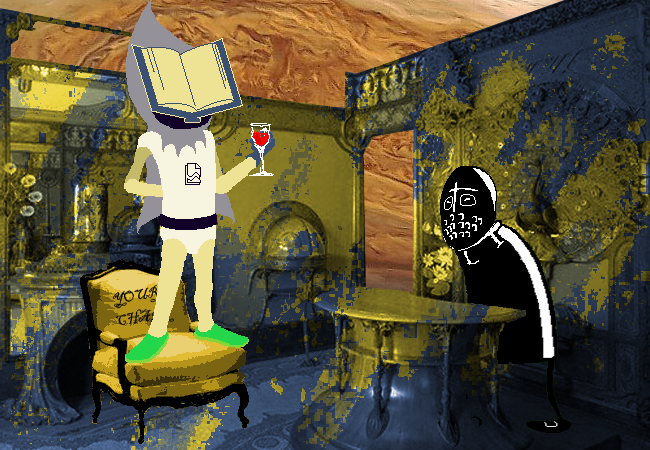
Pictured: My pantless apotheosis is complete.
AND THIS ISN'T EVEN MY FINAL FORM!

This change couldn't have come at a better time, as by sheer coincidence I wish to speak today about famed hypercomic Homestuck's symbolic and mythological structure which ties into the "God Tier" that certain characters reach throughout the narrative.

One of the many game-inspired parts of Homestuck is its use of what are called Mythological Roles for each character. That sounds very lofty, but what it really amounts to is one of the oldest elements in fantasy games: a magical area of expertise or "aspect," and a way in which that aspect is used as a tool by the character: a "class." Together, these mythological roles are described, somewhat awkwardly, as "Classpects," and they overshadow much of the fandom's activity.

I want to talk about them today not so much to analyze what individual classpects mean and do, or even their role in the wider narrative of Homestuck (plenty of other writers have already spilled much ink on these topics), but to explore what they mean for the fandom. See, the classpects are, in the words of author Andrew Hussie, a kind of hyperflexible mythology with a wide range of possible interpretations and implementations. These aren't necessarily traditional "elements" or rpg classes--classes include such odd things as "Sylph," "Muse," and "Heir," and aspects include "Breath," "Light," "Blood," "Hope," and "Void"--and the classpects are often ill-defined in their powers, or profoundly shaky in application, in part due to the fact that many of the characters do not, themselves, understand their own abilities. This leads, inevitably, to lots of fan speculation and conversation. It also represents one of the many systems within Homestuck that fans can latch onto as a structure to manipulate and deviate from in fan works.

Homestuck is not alone in having such a structure. The Classpects share many of their most useful qualities with such diverse systems as the Five Colors of Magic in Magic: The Gathering, the four Houses of Hogwarts, and the multi-person teamup nature of Pacific Rim's Jaegers. What these systems all share is a certain amount of arbitraryness and vagueness balanced by a named structure and a range of possible, tangible implementations of that structure. And they seem to share many of the same effects on fanfiction and fandom activities, making certain things possible that are not, perhaps, as easy to pull off with either more loosely or more rigidly defined structures.

Tuesday, June 25, 2013

[S]A6:A6:I1: Homestuck vs Tech Demos, or How To Write Hypercomics Like A Boss

So, for those who haven't heard, Homestuck, Andrew Hussie's mindbending, ultra-dense epic about friendship and tentacle sex (note: the last one may be only in the minds of fans), just came out of the Year Four Megahiatus--a months-long pause in the narrative that Hussie used to prepare for the conclusion of the story and the creation of the video game that fans gave him several million dollars to fund. And, true to form, it came out of the hiatus first with what I can only call a prolonged satire of the worst parts of Homestuck's hatedom and fandom alike, followed by...

Well, here's where things get tricky, actually. I'm not quite sure how to describe [S] Act 6: Act 6: Intermission 1. I've used the term "hypercomic" to describe Homestuck before. That's a bit of a contentious point right there--Alycia Shedd, another hypercomic theorist I'm acquainted with, suggested to me the other day that it's more like an illustrated novel than a comic, and there's maybe some truth to that. Even if we do accept it as a comic, there's definitely some individual elements that jump fully into other media--animation, games of various types, and, at one point, historical romance novels. [S] A6:A6:I1 is one of those points--it's undeniably an animated sequence (images juxtaposed temporally), not a comic.

And yet... there's a number of elements that are more akin to hypercomic technology than anything else I've seen. So, maybe what we're looking at here is a hyperanimation?

This is a big deal because it gives Homestuck yet another You Were Number One achievement badge to sew on its kiddy camper handysash. A hypercomic that's already broken so many other boundaries is, apparently, gleefully breaking new ones with every few updates these days. Hell, this comes shortly after an update that turned Homestuck into a type of hypercomic that up till now was almost purely theoretical. (I'll explain more about that in a moment.)

The most notable part of this, however, is that it again underscores Homestuck's unique qualities--the things that set it apart from other formalist experiments.

[S]A6:A6:I1 isn't powerful because of its formal, experimental elements.

It's powerful because those elements are used to express a powerful, dramatic moment in the story.

I want to try to get at why, which is going to necessitate some discussion of the narrative. For those of you who haven't read any of Homestuck, this surprisingly makes for an ideal element to discuss, as the events are weird enough (and short enough) that by the time you return to this point in the comic it'll be a surprise all over again. (Homestuck's looping narrative actually makes for a great natural spoiler-baffle because it takes so long to read and there's so many twists and turns). I DON'T recommend continuing if you're almost caught up, however--there's just enough visual information that you can piece together some of what's happened in the last few acts. Anyway, the point is that this article should be comprehensible even to those of you who haven't read the comic while not going old information for those of you who have kept up with these recent updates.

I should also warn you that while the first half has lots of juicy textual analysis, the second half is application of the lessons learned to some other stuff, so I'm gonna drift away from Homestuck for a bit. If you're just here for the analysis of [S]A6:A6:I1, you can check out that that point, it's cool, although I'd be most obliged if you stuck around.

Cool?

Cool.

Let's begin.

What Is It Doing

Part of what makes this video so interesting is its relationship to Homestuck as a whole. Before we start analyzing, let's take note of the dimensions of the starting screen. That's the standard layout for Homestuck, the norm from which panels sometimes (or, recently, frequently) deviate from. If you've been following this blog for a while, you might recall that I find such deviations to be particularly interesting, because they often work viscerally on a reader, emphasizing certain emotions, sensations, or narrative elements through their structure. (The only reason I haven't discussed it more is because I'm turning this idea into my grad thesis, so I want to keep it just a little under wraps for now. Well, that, and the actual nitty gritty underlying theory would probably be a huge snoozefest for most anyone that isn't me.)

Keep this idea of norms and deviations in mind as we start watching:

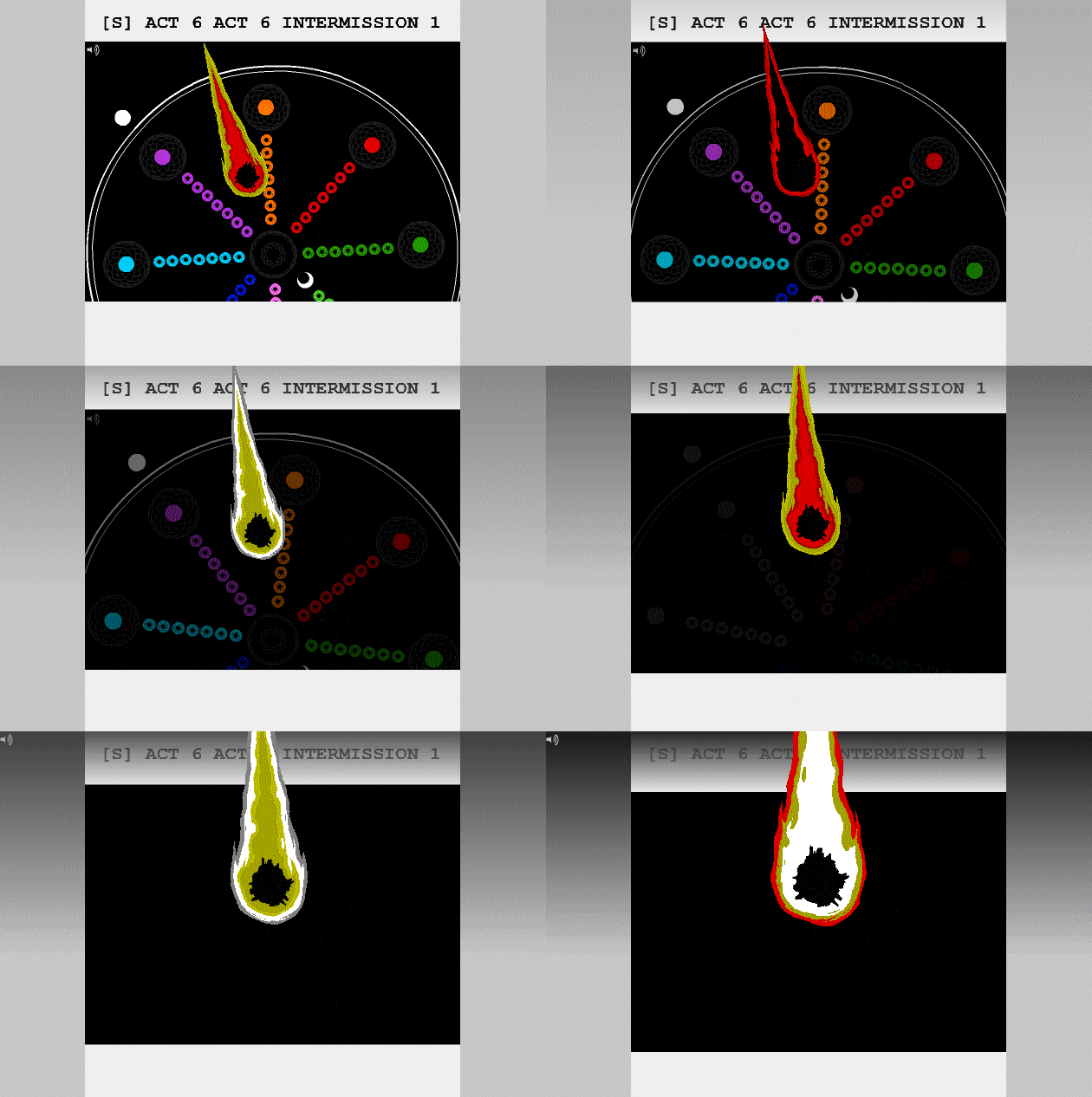
[S] Act 6: Act 6: Intermission 1

Did it take a moment to realize that the comet was breaking the panel border?

The first time, it caught me off guard. I wasn't expecting that transition at all, and it crept up on me, partly because it was so smooth:


I love the way this video begins, actually. It starts with a purely symbolic representation of the universe that the game encompasses--eight planets connected by seven gateways to the central entity known as Skaia, and through that abstract space flies a massive meteor... a meteor which then breaks the panel border.

So, let's start there. What is Hussie trying to show us through that strange breaking of form? Why shatter the established page boundaries here?

Well, first of all, notice how there are four planets to start with, with four more appearing. This is a symbolic representation instantly understandable to fans--it signifies that two universes are finally, after a three year wait in-comic, being merged together. This is an interesting choice, I think. Hussie could have depicted this by actually showing the four new planets materializing in this reality... but instead he simply indicated the titanic shift iconically. This allows him to indicate to the reader what is happening in a way that is still chill-inducing, especially when paired with the ambient cross-speaker pulse of the music, but keeps this event from drawing focus from what he considers the main action to be.

And in fact, the symbols of the planets dissolve into blackness just as the meteor starts growing and breaks the panel borders, and just as the music picks up. This indicates a transition from a symbolic reality to a literal one, and the literal reality of the meteor cannot be contained. There is a very conscious, consistent visual language at work here, actually, that isn't unique to Hussie--the ability to break the restrictions of the panel or page is an indicator, in countless media, of power beyond normal mortals. This is why Rococo angels and putti spill out of heaven onto the molding of churches, why Jack Kirby's gutter-breaking action is so dynamic, why Alphonse Mucha adds borders onto his religious paintings only to have his gods and angels and spirits break those established bounds... heck, it's why Planeswalker cards in Magic the Gathering, which represent beings on the same level as players rather than servile summoned creatures, break out of their art boxes:

Venser, the SojournerTezzeret the SeekerChandra Nalaar

Hussie is no stranger to the use of such structural indicators. In fact, there are moments in the comic where the entire layout of the website is reworked to indicate the presence of a being powerful enough to reshape the narrative to its own will and vision.

So, what we get out of this is that A. the meteor is real, not part of the symbolic world represented by the starting panel, B. it's the subject of this video--the important thing we should be focusing on, and C. this meteor is, in some way, too powerful to be contained by the comic's typical dimensions. This is extremely strong storytelling, because it uses simple elements to convey a LOT of information, much of which flashes past instantly without your brain having to really ponder it. This is why writing articles like this can be tricky--this stuff seems kind of obvious when you spell it out, but most of it is happening on an unconscious level. You're not constantly assailed by a voice spelling all this out like I'm doing, you just "read" it and understand. I suspect some of this is even going to be accessible to people unfamiliar with the astrological symbols invoked here, and unfamiliar with the narrative, because the structure is simply that strong.

As hypermedia, then, this is already a raging success, primarily because it uses hyperelements like the breaking of the previously sacrosanct page--a mark of Infinite Canvas techniques--for a specific informational purpose. The techniques are cool, for sure. Part of the experience comes just from the sheer element of, "woah, I've never seen anything quite like that before!" But that element complements rather than distracts from the actual information--factual and experiential--being conveyed. This is an area where other hypercomics have traditionally struggled, so this page is important from the perspective of pointing toward a way of making use of hypertech. This is what I mean when I describe Homestuck as a successful tech demo: it shows not just what you can do but why the new tech is useful and powerful. It's not just showing off a bunch of disconnected mechanisms, it's showing why we, as creators, might be interested in utilizing similar techniques, and why we, as consumers, should get excited about where the comic is headed.

There's one more thing the first section does well, actually. It leaves us wondering about conclusion C: why is this meteor powerful enough to break page borders?

We keep watching, expecting an answer... and in a moment, we get it:


The meteor is being piloted by a powerful figure. It's not the meteor in and of itself that breaks the boundaries of the comic, it's this dark looking being. (Those of you who have been keeping up with the comic know what's going on, those of you who haven't read any of it should be comfortably baffled and spoiler-immune at this point, and those of you who have read past Act 5 but haven't gotten further now know why I told them not to read this damn article. Too late now, ha ha!)

We have, here, the same techniques that we saw before being used to convey this character's power. Her presence extends beyond the confines of the established page, setting up her later actions as plausible.

And actually, we're starting to see some of the hyperanimation elements that I mentioned earlier. Right now, Hussie is using techniques that couldn't work effectively in a traditional video format, because they depend on the establishment of a small window, followed by the breaking of that window. While it's hard to imagine TV audiences accepting a work that regularly uses just one sixth or so of their viewing screen, such things are perfectly acceptable to computer audiences. What's more, the fact that Hussie is uploading flash constructions himself allows him to do things impossible on sites like YouTube (unless you somehow hack the website and install a bunch of java stuff, which I think Google wouldn't appreciate, the putzes).

What we're seeing here is Hussie utilizing only the parts of the screen he needs, but simultaneously eschewing the arbitrary constraints of single shots, spacial continuity, or set aspect ratios. This is all shit straight out of the Infinite Canvas playbook--when you don't have to worry about paying for blank space on a printed page, you have unlimited freedom of panel size, shape, and spacing. Hussie is using a technique previously reserved for hypercomics and applying it to animation. Thus, hyperanimation. And, like I keep stressing, the techniques are used here for a concrete purpose--here, for A. showing the figure's power and B. establishing a three dimensional spacial relationship between the meteor and the portal above Skaia while also giving us a dramatic closeup on the figure. Hussie is showing us what is possible, but always in the context of the larger purposes of the narrative.

And actually, there's another interesting hypertechnique at work both here and in the next bit:


(For those feeling a bit lost, the meteor just went through a protective portal around Skaia, redirecting it to Earth. What we're seeing here is the meteor leaving that portal and blasting off toward our planet... oh, which is also about to be destroyed by those red things which are tearing the universe apart because a homicidal middle-managing bureaucrat was given omnipotence and decided to take out his anger on the frog that is the universe and DAMMIT THIS EXPLANATION JUST MADE EVERYTHING MORE CONFUSING DIDN'T IT?)

One of the things Ian McDevitt and I discussed in the alpha of Understanding Hypercomics (which is woefully out of date but still pretty astute in a LOT of ways of I do say so myself and I do) was that hypercomics could emulate other media more easily than traditional media, because the web is more mutable than, say, the printed page.

This, it seems, extends to other hypermedia. The video here, for example, is emulating comics. This is possible for two reasons. First, Hussie has, as I mentioned above, decided to ignore traditional boundaries and fill the space or leave it blank as the content demands. Second, this hyperanimation comes in the context of a comic. Since we're already primed for comic panel reading (where not everything has to relate spacially) we understand that the meteor is traveling between one close up panel into a much wider shot--not literally, of course, but this transition helps us understand the layout of the event without losing any of the detail. It blends the best elements of comic and animation. It's an animation within a comic emulating a comic.

Homestuck: so meta you'll want to punch something.

This actually brings up another interesting fact about Homestuck: it's constantly doing stuff that we knew was theoretically conceivable, but hadn't been explored in practice.

Want a more tangible example? Ok. Let's take a brief diversion here and talk about Time Variable Hypercomics.

So, one of the things that we realized when writing Understanding Hypercomics was that the editable, reviseable nature of the web meant a comic could stay in one state up to a certain point and then, after it progressed past that point, the previous existing content could change to reflect new information. We came across just one semi-example during our research, and we're still pretty sure the author has no idea of the significance of his experiment. Besides that, and our own tech demo, there was no proof that this could be used as anything other than a gimmick. We had some ideas about using it to show a change in the reader's understanding--like, you could totally do a Fight Club hypercomic where the scenes with Tyler after you read to a certain point would be revised to show just one person fighting with himself, or a 1984 comic where you literally always would have been at war with East Asia... right up until the point where you would always have been at war with Eurasia--but again, we had no concrete implementations.

Or, we didn't, anyway, until John stuck his hand through something weird and suddenly appeared all over the timeline in Homestuck in various panels... and Hussie actually edited those panels to show John's hand materializing inexplicably.

Time. Fucking. Variable.

This blew me away completely, because it was not only an implementation of a previously purely theoretical (and often kind of difficult to explain or understand) class of hypercomics, it also served a strong narrative purpose. As a technique, it both resulted in a humorous circumstance (the slapstick of John's hand showing up in the background of random panels in midair)... and an indication that for the first time ever, the temporal rules of Homestuck were being totally busted. Something that should not have been possible became possible, and the medium itself bent to accommodate. It was a fantastic blending of form and function, made all the more significant by the fact that it was something no one else, to my knowledge, had ever done for a deliberate, in-narrative, not-a-retconny reason.

HUSSIIIIIIIIEEEEEEEE!

Anyway, that's what I'm talking about when I say that Hussie does stuff in Homestuck that otherwise is purely in the realm of the theoretical. And again, it's always pushing boundaries not at the expense of the narrative but to its benefit.

I don't actually have a lot to say about this next bit, so let's just take a moment to appreciate how cool it is:

I love the dynamism at work here. Stuff is flying all around at this point. Panels transform into stylistic elements (love the way the green of the figure is backed by that thinning red line, for example), we get some more of that cool spacial shifting... nnf. It's just good stuff.

And then, suddenly, everything breaks:


The video that is the comic that is the game Homestuck glitches right the hell out and we're left with an incomplete video. But look how slick that is--the music is written to accommodate that sudden structural break, it glitches in time and in tone in a way that's still intriguing to listen to, before finally breaking apart completely as the video comes to an end. And what's more, the glitching comes as a shock because we've already gotten used to the smooth flowing animation used in the video. Hussie has established a NEW baseline, only to immediately deviate from it once more to indicate...

Well, what's going on here? This might, again, for those of you who aren't caught up, just make things more confusing, but let me try to explain. Homestuck is played on two game disks. We ran out of game disks recently, but there's an expansion pack that continues the narrative, in the form of an old school game cartridge. Only, some asshole decided to fill the game cartridge with sugar and candy corn, like the obnoxious little shit he is. Asshole cherubs. Anyway, currently the narrative itself is glitching because the game has been damaged by the presence of sugary bullshit in its delicate inner workings.

So, all this sliding and panel breaking and stuff has really just been a red herring. It's a setup to get us excited about what's coming... only to bust up the animation at the last moment as the screen is taken over by broken image files that hint tantalizingly at the content of the rest of the video, but keep any semblance of meaning hidden.

And then, to really drive the point home, on the next page we get this message:

The cool Flash animation is unexpectedly cut short due a critical stardust clog. What a shame. Those exciting new gameplay features were looking real slick, too. You think it was pretty neat how the panels were sliding around like that. Oh well, you probably didn't miss all that much. 

Nevertheless, on a hunch you navigate once again to your trusty bandcamp page, and check the length of the song in question. Your fears are confirmed. It seems you missed four solid minutes of footage. You wonder if you'll ever find out what happened? 
HUSSIIIIIIIIEEEEEEEE!!!!!!!!

We've been pranked.

But we could only have been pranked so severely in the context of a masterful use of this medium.

This gag only works because everything that comes before it is so expertly put together. This is the strength of what Hussie is doing: he's making you really and truly want more. As a tech demo, this is perfect because it stirs interest while leaving the audience hanging and wanting satisfaction. It's advertising 101. And to add insult to injury, it's all an unintended, incidental consequence--Hussie isn't trying to market his game engine or anything like that, he's just doing what's best for the narrative.

So, that leaves us to pick up where he left off.

What Can We Do With What It's Doing

This is the bit where Homestuck fans here just for Homestuck stuff can feel free to check out, although of course I'd be glad to have you stick around. I want to talk about what we can take away from the techniques at work here, and how simple exposure to competent experiments can spark other experimentation.

To do that, I want to talk a bit about an idea this sparked in me. To do so, I'm going to have you watch this clip from the show So You Think You Can Dance:


So, this is actually a pretty sweet dance. I don't watch So You Think You Can Dance (I find the premise of reality shows--the idea of artists competing and getting ranked and voted off and told to go do something else--to be really distasteful on a deep kind of gut level) but my girlfriend, who is a dancer, sent this along to me because she knew I'd dig it. It's got the odd kind of off-kilter rhythms and unexpected controlled movements that I like in other media on a more metaphorical or structural level. It's control and release, you know? Just like what I've been ranting about for the last several thousand words or so. My girl knows what I'm into.

But what does this have to do with Homestuck?

Well, as I was watching, it occurred to me, as the camera focused on the judges and their reactions to the dance, that there was absolutely no one in the omniverse at that moment that I gave less of a shit about THAN THE FUCKING JUDGES.

I wanted to see the damn dance, for goodness sake!

And I thought, ok, wait, some people probably do give a shit about those people even though I don't, because some people watch this for the competition rather than the dances alone and they want to see the body language indicators that signify success or failure. Cool, I dig that. But this way we're both getting a fraction of what we want--I'm getting a hamstrung experience and they're missing the flow of body language in response to the other body's movement. To shrink down one screen and split the existing screen would be pretty cumbersome, I think, even with wide screen TVs that not everyone has.

But there's nothing besides the fact that no one has tried it yet to stop a whole other screen from getting added to the mix here. Look at it as a blank border section that you can use, or can leave as empty canvas--just like Homestuck uses the sides and tops of its panels when it needs to. Can you imagine a multiscreen rig that had variable-dimensioned, poseable screens that could be put into use if necessary? I suppose this could be done with a large enough single screen but perhaps not as elegantly or as interestingly. And maybe this is the kind of thing that can only work in specialized spaces with specialized media. That's ok! Shit, we already buy whole gaming systems that run games exclusive to their hardware, and with blu-ray in existence now we've also got multiple hardware types for movies (leaving aside the benighted VHS, which I still use thankyewverymuch). Is it that much of a stretch to say that this has potential?

I don't think so (or at least I didn't a couple of days ago but now it's sounding pretty dumb, actually), but I'd need some sort of demonstration.

And that's where the idea threatens to fall flat on its face.

See, something like this, especially for an idea that arguably could be solved far more easily and economically by hiring some better fucking film editors (seriously, who decided that concerts and dances and comedy performances needed to show the audience's reactions every 12 seconds? I don't care about those unwashed peasants, if I want to see them I'll leave my darksom and odorous room-den), can't stand on its own strength alone. Otherwise it's just glitz. It's just a trained dancing bear and has roughly the same resonant appeal.

That's where so many tech demos fall flat. That's why so much in AAA game design is mindbendingly wrongheaded. You can't tech demo your way to emotion, no matter how many pretty wrinkles you put on the face of your sad old man sprite! Emotion isn't higher resolution, you're not saying anything more profound with those pixels! You say profound things with a marriage of form and content, a blending of experimentation and sound communication techniques.

In other words, you do exactly what Hussie is doing--you write a story, then you bend the tech around that story to accommodate your message.

Wait, I've got one more example:


So. I guess this is impressive? Somehow? Like, it's probably a pretty big deal that it's running real time on the PS3 rather than being prerendered. Alright.

But.

I just.

Don't care?

I just can't work up the will to give a shit about this tech demo or anything it's trying to show me, because the story is a flat, sexist, overdone box-checking exercise. Press [Female In Vulnerable Position] button! Receive protective sympathy lizard brain response! It's rote, it's unimaginative, and it's really kind of gross and male-gazey... I mean, wow, what an explicit power fantasy--only you can protect the naked sexbot! You have the power, insubstantiated male off screen voice implied to be the viewer!

Yuck. Yuck all around.

There's nothing in this video to show why the technology in play here is necessary. Our stupid lizard brains would react regardless of the relative high or low resolution of the figures. This opens no doors, shows us nothing that we haven't seen before, gives me no reason to want to know more.

Basically, this video is everything that [S]A6:A6:I1 is not: dull, closed-ended, and saddled with a narrative ineffectually trying to show of tech, rather than supported by tech designed to effectively show off narrative.

If I wanted naked robots, Bjork already pulled this off in a way that's more compelling, better shot, and way, way sexier.


More like all is full of academic nerd rage!

Anyway, the point I'm driving at here is that as far as Homestuck takes us when it comes to tech, the tech alone can't carry us forward into the future of hypermedia. For that, we need to take the lesson of Homestuck's narrative. We need to see how the tech is used to serve the story, rather than the other way around. And above all else, we need identical lesbian makeo-


NO, no, wait, sorry, got sidetracked there for a moment. Ah, the point is, we're on the verge, culturally, of exploring some really cool stuff. Stuff that busts the boundaries of media wide open. The way forward is to be conscious of how we are putting these ideas out there. We want to see them succeed and grow and change. We want them to inspire people to apply them elsewhere, in surprising new ways.

To accomplish that, we have to move beyond the tech demo. We have to move beyond the tech-driven demo, and create narrative demos. Because ultimately, no matter what the technology looks like, it exists to serve a purpose as old as human thought: telling a tale.

Circle me on Google+ at gplus.to/SamKeeper. Follow stormingtheivory.tumblr.com for updates, random thoughts, artwork, and news about articles. As always, you can e-mail me at KeeperofManyNames@gmail.com. If you liked this piece please share it on Facebook, Google+, Twitter, Reddit, Equestria Daily, Xanga, MySpace, or whathaveyou, and leave some thoughts in the comments below.

Monday, December 3, 2012

Seer of Light: Ascend (Why Homestuck is a Gnostic Story)


Lately there's been a lot of buzz in the Homestuck fandom about this strange thing called Gnosticism. After all, more and more references to it are cropping up in the comic and people are, naturally, taking note. As far as I can find, though, no one has put Hussie's symbolic puzzle pieces together into a coherent thematic analysis of why the hints are there, and what he might be trying to tell us. So, I decided to quickly slap together an article on the subject before more competent people can give their takes on the whole garbled mess.

Now, Gnosticism itself is kind of a jumble, from what I've seen. It's really a collection of loosely interlinked myth traditions that take Abrahamic Monotheism as the starting line and then swerve wildly in a completely different direction. It's associated with early Christianity and most of the texts are related to the story of Jesus Christ's birth, death, and resurrection, but the creation myth that they're working with is a little odd. It goes like this:

In The Beginning there's a sort of primordial soup of Godness which emanates a series of male//female binary pairs of creative entities called Aeons. These are supposed to create together (they are called a "syzygy", which apparently means "yoked together." Great word, huh?), but one aeon, Sophia, goes off on her own and interacts with the shadowy primordial chaos outside of Godness, emanating a being without the help of her other half.

The result is a being known as the Demiurge, the Creator, Artisan or possibly the Will To Create.

His name is Yaltabaoth.

Yaltabaoth looks around the dark, formless void that he is birthed into and concludes that he and he alone is God. From chaos he forms the Earth, seven Heavens, and a whole series of shadow servants and angels called The Authorities. It is a flawed, cruel world cut off from the light of Godness, made by a being that should never have existed. It is, in short, a prison of matter. Sophia, when she realizes her error, descends into the world to give it the light of wisdom that is her aspect in the celestial hierarchy. And this descent sets into motion a series of conflicts that would, in time, allow humanity to Rise Up out of the prison that is the world.

See, although The Authorities eventually create Adam and Eve in mockery of Sophia, she and uh... a few other characters that are too confusing to really talk too much about here (gnostic creation mythology is kind of complicated, especially if you're reading the original texts) instill in them the same light that Sophia brought into the world in opposition to the primal darkness of Yaltabaoth. In time Eve eats the Fruit of Knowledge, which is the first step in humanity's process of self-actualization and ascent to a level rivaling the dark gods of the world. The story culminates with the entrance of Christ into the world in the form of Jesus, and he teaches humanity Gnosis, the knowledge, before eventually being sacrificed to make humanity's ascent possible.

We've already seen a number of references to this basic mythology in Homestuck. There's the presence of Yaltabaoth as an actual denizen. There's the recent update's mention of the "Lion's Mouth" (the Demiurge is sometimes described as a serpent with a lion's face, or even just "lion-like"). There's the chumhandles: "gardenGNOSTIC" and "TIMMAEUStestified" (Timmaeus was a Platonic dialogue that hypothesized the existence of a Demiurge). Seven Heavens correspond to Seven Gates, and players seem to be divided evenly between male and female players. There's all sorts of little clues along these lines.

And all of that adds up to...

What exactly?

This is where things get tricky. See, it's one thing to point out a bunch of symbols and argue that they point towards a particular mythic text that's being referenced... and it's another to actually say something worthwhile about that reference. Like, ok, it's obvious that The Sufferer is a Christ analogue. Great. That's an easy reference to make!


But... who cares?

The problem with saying that Everyone Is Jesus In Purgatory is NOT that critics and scholars and English teachers are "Reading Too Much Into Things." That, ladies and gentlemen, is what we call a Shitty Argument. It's an argument that refuses to discuss the merits of symbols and just dismisses them entirely because "The author couldn't have meant that!"

Which is stupid, because authors often do mean it, actually. If we're going to run with our Sufferer example, Andrew Hussie has straight up called him a Christ analogue. So... yeah, it's pretty stupid just on that level alone, even if we ignore the whole Death of the Author/Meaning is in the Text thing that critics have been arguing for the past century.

No, the problem with saying "The Sufferer is a Christ analogue" is that it just points out a similarity, not a meaning. This is also why "This story is an archetypal Hero's Journey tale!" style criticism is dull and pointless, actually--it doesn't tell us a damn thing about the story's emotional or philosophical point.

"Hey look, that painting is a rectangle!"

Thanks, Kenneth, but what does that mean?

Here's the better way of doing it. Because the Sufferer is a Christ analogue, we can take note of the fact that Kankri's death is not celebrated due to his rebirth but due to his last furious string of curse words. I mean, isn't that an interesting commentary on the difference between the two messianic sacrificial figures, that one dies in pain but rises in glory, and the other just... dies bitching out the universe so furiously that all his teachings are encoded in his string of cursewords? What a perfect summation of the black comedy that is Alternian culture--even their Christ is a prophet ultimately of exasperated fury at the sheer stupidity around him.

That's pretty perfunctory, but it's at least a decent working example of this sort of analysis--you have to dig beneath the similarities and discuss why they are present and what they imply about the story.

Anyway, this article is supposedly about Gnosticism so let's start actually digging into that, shall we?

The most obvious similarity, to my mind, is the nature of the Gnostic and Homestuck stories: they are essentially complex creation myths. They are creation myths of a particular kind, though: they are meditations on the nature of failed gods, and the nature of their failed creations. This is where the stories go way off the beaten path--you don't usually see creator figures that are fundamentally evil or, even worse, incompetent. And yet, in both narratives we see powerful beings that create completely new worlds, and in the process generally make everything worse. There's at least three separate creations that we get to watch, two Scratches and the birth of one completely new universe, and each time the result is degraded and broken in some way. Twice, this degradation occurs because of the machinations of devil figures (Doc Scratch and the Condesce, respectively).

However, we get to spend quite a bit of time with one Demiurge who differs dramatically from the demonic entity the Gnostics blame for our broken world:


Karkat.

Whether or not it's fair of Karkat to blame himself for the failures of the whole team and their inability to create a pure universe, I don't think we can deny that he occupies the same position as the Gnostic Demiurge. He's a flawed being that attempts to create an entire universe, but all his creations are fundamentally broken, and ultimately he becomes a wrathful, bitter god that rages at his own creation. I mean, he hates John so much initially--and John, as we'll see, is arguably a type of Adam--that he considers a caliginous relationship with the other player. That's some pretty intense wrath right there.

In a sense, Karkat gives us a window into the character of Yaltabaoth, a window not provided by the strictly dogmatic Gnostic scriptures. We see that our creator is tormented by his failure and his constant furious trolling is only an outward reflection of his own inner turmoil. It is written: "For they will come to be like volcanoes and consume one another until they perish at the hand of the prime parent [Yaltabaoth]. When he has destroyed them, he will turn against himself and destroy himself until he ceases to exist." Karkat turns his rage inward and drowns himself in futile flagellation, arguing with his past and future selves about why exactly everything went wrong. Whether he pulls himself out of this model or "destroys himself until he ceases to exist" remains to be seen. (Interestingly, that evocative quote could apply to a couple other characters as well, albeit in subtly different ways, and those characters could arguably stand in for Yaltabaoth given a slightly different interpretation. Hussie seems to be suggesting that creative and destructive (particularly self-destructive) impulses are wedded in their own kind of syzygic pair...)

Then there's the idea that Karkat finally hits upon, that he has failed so spectacularly that he has given an entire universe terminal cancer. Because he tried to cut corners, because he endorsed a half-baked creation, an entire universe is going to die horribly, betrayed by its own genetic code. In fact, this flawed, abortive creative process is central to Homestuck as a whole. The characters, not just Karkat but everyone involved in the game, fumble along, usually accomplishing things half by accident. And through it all there's the omnipresence of the Word, so central to Abrahamic myth, the power to will things into being with language itself.

And the Word was with God, and the Word was God, huh? There's an equivalence between language and object in Homestuck that initially derives from the computer metaphor but since then has taken on this quasi-religious air about it. Homestuck isn't exactly the first story to link the Word of Creation with the idea of genetic code, but I don't think I've seen a story where the metaphor is so profoundly resonant. Part of Hussie's brilliance comes from the balance between the pun on Karkat's zodiac sign with the profound terror of that hidden timebomb of an illness. (And look at the trappings of the Tumor--it literally is a ticking timebomb that starts at the birth of the universe. Oh, and the Tumor-like bomb that Meenah uses to blow up the Beforan trolls? It's another magic 8-ball, representing the bad luck of the genetic lottery.)

The interesting difference is that the repeated nested creation, where each predecessor must flee their own disintegrating universe into a new one of their own design, is engendered not through the malicious arrogance of Yaltabaoth, the aggrandizing Demiurge to Create... it's just a matter of a bunch of kids playing a game. Yaltabaoth commands the world and heavens to form, jumpstarting creation with the power of his voice alone. But the players issue their verbal commands in dreams, in sleep, in madness and in pain. They issue their commands not with authority but by possession and manipulation, and they are ignorant to their own role in the strange time loops that Paradox Space delights in until after the fact. Karkat is, for all his bluster, a deeply sympathetic protagonist who badgers his crew into staying together and does his best to make the game a success. if Karkat is our Demiurge, he doesn't show it much--he seems pretty bewildered and freaked out by the whole ectobiological cloning process that he is responsible for, and he doesn't seem particularly interested in what, to him, must seem a silly side game more analogous to breeding Chokobos than to getting the ultimate item needed to complete the game. He is a failed god less because of his aggrandizement and malice and more because he is distracted by the need to keep everyone from murdering each other.

In short, the gnostic Demiurge is an evil being who creates the world out of error and maliciously curses the inhabitants in order to elevate himself.

The kids who play SBURB and its variations in Paradox Space are simply trying desperately to survive.

Hussie's tale becomes not one of evil creators, then, but one of an evil system that traps creators and creation alike in a vicious cosmic double reacharound. For all the light and wonder of Skaia, Rose is right to describe it as having ensnared them with "malevolent tendrils." The kids aren't just trying to escape the prison of the world, they're trying to escape the prison that is SBURB's infinite recursivity.

But before that thought gets too developed, let's suddenly switch topics and talk a bit about that escape from the prison of the world! I promise I'll get back to that thought later, but we need to talk about the Adam and Eve thing that the characters have got going on.

Let's talk apples.

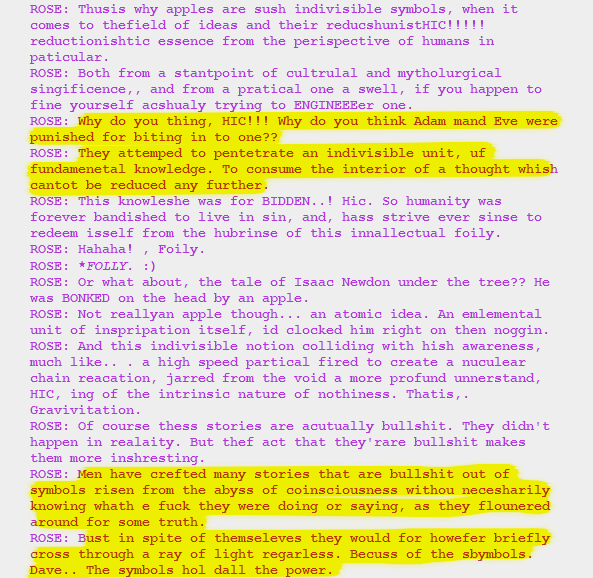
The Apple has been a subtly recurring symbol within the comic, showing up just seldom enough to be overlooked, but in places that suggest its fundamentality. Rose suggests as much during her drunken rant:


In the beginning was the word and the word was with God and THE WORD WAS GOD.

Information (light) and transcendent power together as one.

And how does the first kid enter the Medium?


Yeah.

The other kids aren't far removed from this sort of symbolism, either. Jade, too, deals with an implied apple in the form of a Bec-shaped fruit that she must shoot blindfolded, just as William Tell shoots an apple off of his son's head. Rose's item is a bottle--a reference both to Roxy's drinking habits and to her element, which is light or information, a metaphorical message in a bottle that she must retrieve. And Dave's is an egg, ancient symbol of rebirth, new beginnings, and perhaps, given the orange feathery asshole that watches over it, the Phoenix, an animal significant to the Gnostics (although I honestly doubt Hussie was thinking of them specifically when he created Dave's sprite and egg).

So, we've got one symbol of a new birth (associated with someone who can duplicate himself and evade death through time shenanigans), two parallel manifestations of the Apple, the modern symbol for the initially undefined "Fruit of Knowledge," and something we can read as a message in a bottle. Sounds to me like the kids are analogues for Adam and Eve, just as Rose suggests. They are cast out of their generally pretty idyllic life into one of strife and death as a curse for installing the game and taking a bite of the apple, so to speak.

But here again, we see the Gnostic pattern begin to assert itself. Think about it like this: the universe was always a broken entity fated for destruction. Karkat and the other trolls created it that way, as flawed Demiurges.

So, the kids always had to escape somehow, and although they have been cursed for their efforts by the vengeful creator gods (remember that initially the trolls blame the kids unfairly for Jack's presence in their session) their quest for knowledge--the desire to connect with Sophia, the Light of Wisdom--is the one thing that can ultimately help them escape the prison of the world. This is why the apple symbolism cannot simply be explained as a traditional Christian icon--here, instead of a Fall, or a Descent from Grace, we see the characters Rise Up through the intellectual hubris of taking the bite from the Irreducible Apple. And eventually they rise beyond the game's rules as well, once it becomes apparent that the system itself is against them.
"Then Eve, being a force, laughed at their decision."
This is the meaning of the rising and falling action of Homestuck's characters. Just as in the Gnostic myth cycle, characters both good and evil rise up from dark chaos to the heights of the Seven Heavens, or descend from light into darkness. From the first moment when the Seer of Light, Sophia, descends into the world to bring wisdom and is shrouded in darkness, the Gnostic action is one of movement between states and the subsequent ripples it sends through space, time, and the cast of characters.

So it is with Homestuck.

But that's not all. See, the Gnostic myth is one of self-actualization, where humanity is deceived by ignorance and their path blocked or disrupted by agents of darkness. They must learn to avoid deception and seize the knowledge needed to become Gods.

You can probably see by now where this line of thought is going.

When you get right down to it, Homestuck at its core is a coming of age story (or if you want to get really German about it, a Bildungsroman. Remember that for your SAT, kids!). They grow into their class and into their own beings, out of the shadow of their elders, as they travel the Medium. That's really the deeper point of the classes--attaining God Tier isn't a matter of getting flashy new powers, it's a matter of gaining a new understanding of yourself and your potential as a person. We can find parallels to that in the New Testament. Christ repeatedly tells people to keep quiet about his miracles; I suspect strongly that he recognizes the natural impulse to latch onto the flashy tangible details while missing the underlying growth into wisdom signified by those powers.

And we have ample evidence of the reality of that failure: the Beforan trolls all seem to have completely missed the point of their personal quests, and they've been stuck in developmental stasis since their deaths. I suppose you could argue that this is just a property of their status as, you know, dead people, but Vriska and Tavros seem to have grown and changed in ways that the Beforan trolls haven't. They are growing into their classes, as are the pre-Scratch kids. If you've been following any of the theories on Aspect Inversion from lildurandal or bladekindeyewear you already know how very possible it is to fail in that attempt at growth.

So, it seems to me that Gnosticism provides us a good lens through which to understand the goals of the game: ultimately the players must undergo a process of self actualization that allows them to transcend their previous universe, undergo a death and rebirth into glory (isn't that death and rebirth part of what makes [S] Cascade so powerful?), and become fully aware of their own nature and potential.

Except for two problems.

First, SBURB is recursive--it generates new universes in order to perpetuate the cycle of corrupted creation and inevitable destruction via the Reckoning. So, even if players escape into the new universe, that universe will still be subject to the same curse, the same fatal flaw, as before.

And second, they still have to deal with an entity that seems to embody inevitable doom:


Inescapability. The illusion of free will. The tyranny of the Alpha Timeline. The cruel, calculated bargain made by Paradox Space in order that it might continue to bring itself into being.

All of these concepts are embodied in Lord English.

Now, I'm not sure how much of this is coming from Gnosticism proper and how much is coming from Umberto Eco (his novels Baudolino and Foucault's Pendulum both touch on these ideas, and sometimes I garble together what I've learned from the prime texts and what I've picked up through the mouthpiece of Eco's characters) but I have heard it said that the primal light of Godness is a timeless entity. The Fourth Dimension comes into being with the birth of Yaltabaoth within darkness. He thus is a being that bestows Time upon the universe. I don't think it's a stretch to describe Yaltabaoth as a Lord Of Time. And his feminine aspect is, perhaps a bit more nebulously, a Muse of Space, a being of inspiring light that is present within all matter.

So, it's fitting that the final boss should be a type of Yaltabaoth--or a type of Samael, a blind god incapable of seeing truth or goodness. Caliborn isn't really much of a Demiurge, but he sure fits the Gnostic need for an inescapable force of suppression, deception, and blind spite.

And that suggests to me a more proper final endgame than simply the creation of a new universe; more proper even than the defeat of Lord English.

It's ultimately the system of SBURB's recursive inevitability, the malevolent tendrils of Skaia, the casually genocidal indifference of a reality where Lord English's existence is sanctioned by Paradox Space...

THIS is the prison from which the players must escape.

I suspect very strongly that Homestuck will end not with just the creation of a new universe, but with the creation of a universe free of the baleful influence of SBURB. A universe where the game is never created.

...Or, you know, the kids could end up creating the universe needed for Caliborn and Calliope's session. Hell, that might be just as likely given the recurring theme of failed creation. Guess we'll just have to wait and see.

But my money is on the idea that the gods of the new world will be establishing a paradise beyond the reach of Skaia's passive malevolence. And we may even speculate that the Dreaming Dead will have a rebirth in this new paradise.

Either way, I think we're going to see plenty more Gnostic nods in the text, and I think what we can take away from them is that SBURB is a game ultimately of transcendence and maturation.

Which is a pretty circuitous way of getting at something that you probably already knew.


Monday, November 5, 2012

Hyperstuck: Homestuck, Kickstarter, and Experimental Comics

"I think you have served as inspiration to any creative person who's wondering if they should bother pursuing their ideas. You've shown what is possible if they do. There are no gatekeepers anymore. There's only your support to be earned. And when it is, I don't think there's a more powerful force to have on your side." --Andrew Hussie, on his fans supporting him to the tune of 2.5 million dollars
Ah, hello again dear visitor, I know it's been a while since I posted, but I don't think you'll be disappointed with the finished product.

As posts go, I am simply the best there is.
I suppose this is the part where I say "Let me tell you about Homestuck," but an entity of my unfathomable genius need not stoop to such banality. Every article on the comic always begins with the same tired explanation: the comic depicts the adventures of four internet friends who decide to play a game together, a game that will eventually usher in the destruction of the entire world. Along the way, they come into contact with twelve alien kids who are similarly ensnared by the game's clutches, and over time it becomes apparent that the fates of the two groups are intertwined in mysterious and sometimes labyrinthine ways. The comic begins as a humorous pastiche of text based adventure games and gradually metamorphoses into an epic quest against forces beyond evil, forces that threaten the basic ability of intelligent beings in all real and hypothetical planes of existence to give a shit.

We wouldn't want to have to rehash all of that in one big paragraph, would we?

Let's talk about me instead.

I happened to come to Homestuck just a month or so before Andrew Hussie, the webcomic's creator, started his now somewhat infamous Kickstarter, a Kickstarter that eventually netted Hussie 2.5 million dollars to fund the creation of a real adventure game. As I finished going through the archives a second time, and watched the numbers (both page and dollar) climb to unfathomable heights, I realized I was watching a silent revolution take place.

And what's more, I was probably going to be one of maybe just a dozen or so people worldwide that got the full implications.

See, Homestuck isn't just a webcomic. It's a Hypercomic: a comic that can only exist within the confines of a digital environment. In other words, it can't be taken from the web and printed out unless you fundamentally change the core experience. There have actually been a number of significant hypercomics (at least, significant to theorists)--enough to feel out the basic forms available to us. For example, hypercomics can make use of embedded, looped media within panels, creating a comic that uses minor animation without becoming a full animated feature (this page from 5ideways uses looped sound and animation, and this page from Argon Zark, the fabled First True Webcomic, uses looped animation). It could also make use of the interactive nature of the web to create a unique navigation system (that Argon Zark page, for example, or the smooth keyboard transition effects of Platinum Grit). And, of course, we can't leave out the very first type of Hypercomic codified by famed comics theorist Scott McCloud: the Infinite Canvas comic, which uses the screen as a window into an infinite terrain, where the page size and shape can be anything the creator wants (see the incredibly not work-safe Delta Thrives and McCloud's own experiment, My Obsession With Chess). So, there is quite a bit of material to study and examine.

And yet, if you told me a few years ago that a hypercomic could net millions of dollars for its creator, I would have probably sighed wistfully and agreed that perhaps someday some wizard of web promotion would succeed where so many others had failed. I would have treated you as a seasoned nihilist treats the prophet of the coming messiah: with dejected disbelief. See, the field of Hypercomics was in a grim state way back in 2009 when I came to the field. Let me put things into perspective:

Every single comic listed above had been abandoned by the time I found them. Every one. Even McCloud had stopped experimenting with his beloved Infinite Canvas at that point, and while there were a few notable exceptions, the more I sought new hypercomics, the more desolate ruins I discovered.

The story was the same everywhere: people really tried to make the whole experimental comics thing work, but their "real" jobs took too much of their time, and they couldn't figure out how to make any money with products that by their very definition could never be printed and sold. To make matters worse, a number of the most innovative geniuses (Neal Von Flue, for example--I would show you his work, but it's all fallen off the Internet completely now) banked on some shaky payment models that ultimately turned out to be disastrously impractical.

Hypercomics was a wasteland, and at one point I despairingly remarked to my partner in exploration, Ian McDevitt, that perhaps we were simply picking over the remains of a medium long dead. How could I know that the messiah I doubted wasn't just coming... it was already here?

Three years later, that savior of Hypercomics made its presence known in the form of a 2.5 million dollar bloom in the waste, a bloom that proved that Hypercomics were a viable medium.

Or at least... that they could be.

But it occurred to me as I watched the bemused commentary on the astronomical success flow in, and journalists and bloggers joined together in a kind of collective shrug that boiled down to "Wow, Homestuck fans sure are crazy, huh? Guess that's what happens when your comic is full of geek references," that a success so poorly understood could not be replicated.

So, just what makes Homestuck different from other hypercomics?

Well, let's start with the formal. Think of the three classifications of hypercomic I gave earlier. What would you say Homestuck is?

It actually doesn't really fit into any of them, does it? Or rather, it happily dips into any and all of the classifications whenever the narrative calls for it. It has a form that transcends the quadrants, you might say.1 What's more, it even periodically decides to stop being a comic and just straight up turn into an animated music video, a game of some sort (adventure, RPG, &c.), trashy romance novel, complex metatextual web design, and so on. Homestuck is all over the place.

That's actually the first key. Or at least, it obliquely is.

Take another look at how I phrased that: it makes use of different techniques when the narrative calls for it. In Homestuck the MESSAGE drives the MEDIUM rather than the other way around.

And this is where about half of the hypercomics ever created fall flat. They create a story--or even just a bunch of abstract pseudo-intellectual mumbo jumbo--as a vehicle to show off their new clever tech. The result is something that intellectually is quite interesting if you're a theorist, but ultimately has no heart.2 What's more, a lot of them got locked into a particular mode of storytelling. This wasn't necessarily a bad thing--comics like Platinum Grit, Delta Thrives and Patrick Farley's other major work The Spiders, Von Flue's The Jerk, and the rambling whole page compositions of Dresden Codak all made their particular model work really well for the kinds of stories they were telling--but it did mean that the supposedly infinitely variable nature of hypercomics could potentially become just as restrictive as that damnable printed page, or the "setup, beat, punchline" of the standard comic strip.

If you look at Homestuck, though, you'll find that Hussie has picked a medium for each moment, and done so deliberately to modify the tone and experience. It's sometimes a bit difficult to see when you're slogging through the archives, in part because a lot of the choices he makes seem counterintuitive or designed to frustrate, but Hussie has a good command of what techniques he's using where. (It's worth noting, in particular, where he tends to insert more complex games and what effects that more immersive experience achieves. [S] Seer: Descend and the animation that follows are a good example of this--we play through Rose's experience, making us complicit with her actions and directly involved with the hopelessness of her quest, and then at the climactic moment our control and agency is taken away and we watch what comes next helplessly. Even the music echoes this and sets the mood to one not of epic badassery but tragic inevitability. It's a masterful decision.)

This suggests that a successful Hypercomic will be driven not by the desire to invent new technology abstractly but the need to convey the story in the most effective way possible. If you want to really over simplify things, it will be driven not by the head but by the heart.

I can't believe how good this movie is.
"But wait, Freder!" I hear you say, "What about all the Hypercomics that have taken a multimedia approach, or at least have made excellent use of their particular tech, and still failed to reach Homestuck's massive, unnervingly passionate audience? Why haven't Plantinum Grit, or NAWLZ, or The Spiders, or When I Am King, or any of the other great hyperstories gotten the hyperattention Homestuck has? Are Nicholas Cage jokes really that powerful?"

Well... the answer is probably that yes, Nicholas Cage jokes really are that powerful.

No, seriously. Look, one of Homestuck's great strengths is almost certainly the fractal reference humor. And, despite what skeptics might suggest, this isn't dumb reference humor, either; it's not a matter of pointing at something familiar and laughing (see: The Big Bang Theory), it's a matter of building the pop culture knowledge into the very fabric of the comic. While researching this article, I came across something Hussie said about all the Nick Cage jokes, in particular. He questioned hypothetically whether the constant mockery of Cage and his terrible movies hadn't metamorphosed into a kind of shrine to the films, simply through the process of getting to know John Egbert, and having the films become a driving force in the comic's narrative mythos. They become a fundamental part of what makes the comic tick, not just something that is recognized and passed over.

Here's that emotional core of the comic again: the jokes become a way of entering the minds of the characters, of better empathizing with them. You can see this with the trolls in particular: what start out as vaguely defined pastiches of internet culture grow into fully developed personalities. Hussie manages this process so well that people were actually disappointed when a joke character whose entire raison d'etre was horse cocks died a joke character death. He never stopped from getting more ridiculous, and yet along the way he became something people somehow related to and found admiration and sympathy for. So, it's not just the reference humor, but how Hussie develops that reference humor into a bond between reader, writer, and text.

And while we're on the subject of this bond:

I've actually seen people sneer at the way Hussie encourages shipping, fan input, rampant speculation, and a kind of semi-adversarial creative relationship between himself and his fans, as though an artist adapting to the needs of his audience is somehow creatively bankrupt. I suppose if you are committed to the idea of the Grand, Singular Authorial Vision, what Hussie does must seem odd, but to me that reaction sounds more like sour grapes.

Because like it or not, it works.

I can think of a few other properties that either accepted or openly encouraged creative fan responses, and what they have in common is a vibrant, creative fanbase that are, not coincidentally, also loyal customers. Whether it's My Little Pony: Friendship is Magic encouraging fan art and periodically giving nods to the adult community in the show, Magic: The Gathering providing forums for people to post their art, fiction, and custom card designs, or JK Rowling simply being openly OK with fanfiction, it seems that one route to success is the acceptance and even promotion of the creative efforts of fans.

This makes quite a bit of sense if you think about it. After all, if the urge to create is strongly present within most humans (I personally think it is) then entities that enable and support creative input are going to succeed. And that simply isn't something we've seen with a lot of hypercomic artists, most of whom seem to come from the auteur school of comic production where a single mastermind generates writing, text, and unified creative vision. Again, let me stress that the work that's come before is brilliant. But, if we're talking about differences between Homestuck and other hypercomics, the overwhelming encouragement of fan input and creativity is definitely one difference we can't ignore. I'm not criticizing so much as pointing out why one thing succeeded where another failed, regardless of how good the final products actually were.

This is also, of course, why I am actively encouraging you all to ship me and my guest columnists. Oh, and draw fan art of me and Lord Humongous! It's fun!

Actually, let's talk a bit about the fan materials and part of why they're so viable. Here's another McCloud Theory 101 topic: how do you encourage immersion in an environment and identification with a character?

Yep, iconic design:

The design doesn't stop from getting more iconic.
Hussie has described the characters in Homestuck as gaming abstractions, placeholders for what the player imagines. Canonically, Homestuck characters are a-racial3, and their depictions can differ dramatically from panel to panel depending on the style employed. According to McCloud, this is actually a useful strategy for encouraging identification, because we fill in the character with our minds, taking on their role while exploring the more detailed environment.

Much of Homestuck runs on this logic, from the iconic shirts (one symbol for each character), to the vaguely-defined and intriguingly recombinable Class/Aspect system, to the use of color, to the sometimes aggrav8ting quiirk2 o+f th-E tr0ll CH4R4CT3RS. Let's take a moment to drop out of Artistic Appreciation mode and note how from a cynical marketing perspective all of this is sheer genius. Hussie has made a bunch of deliberately iconic characters that we are encouraged to see ourselves reflected in, then given each of them a particular symbol (twelve of which are just the damn zodiac plus a color), and then given them particular colors, items, and even language quirks that can be embraced and emulated and, best of all, merchandised.

Wow.

Even if this was kind of accidental, as Hussie has suggested, it's still clear in retrospect why it eventually cascaded into 2.5 million dollars in funding.

So, the way forward seems simple: find a story with emotional resonance, deliver it with a heavy use of iconic material, encourage fan input along the way, and leave yourself open to medium experimentation when the story calls for it.

And you, too, could have a 2.5 million dollar comic!

Except there's actually something else we're missing... Now what was it...

Ah, right!

The 14 hour days that Hussie worked for years to get to this point.

Perspective stings something awful, doesn't it?

Ten thousand hours is the standard suggested by Malcom Gladwell in his book Outliers; ten thousand hours until you become a true master of your field. I don't think it's unreasonable to suggest that part of the reason Hussie is so good at what he does, part of the reason he's had so much success, is because he lived and breathed Homestuck for a while, after working on other comics for years. Oh, and he's also been consciously experimenting during all that time to find what works:

I'm not trying to make the best thing ever here. Only something which is very fun, extremely flexible, and serving to accelerate my abilities, my understanding of what a story can be, and my grasp on how people react to things. That is actually a valuable part of the exercise, watching mass reactions in real time, on every aspect of each update. From the minutia, to the big plot turns. There is a very real component of this that resembles a huge social experiment. I'm not just putting pressure on the limits of a story's format. I appear to be doing this with the psyche of the readership as well. I have discovered many obscure buttons which can be pushed. I am taking extensive notes. (see: this question and answer)

Yeah. This is not a quote from someone who just stumbled into success. And here's the grim fact it suggests: my beautiful little summary up there probably isn't going to lead to any sort of guaranteed success. What it does offer us is a more complete understanding of what works, and a guide to some of the pitfalls in which hypercomic artists--and artists in general, perhaps--can become, well, stuck.

I am, in essence, some ancient eldritch chucklefuck, plotting out points of interest in the great, unfathomable void that is hypercomics theory. If you want to actually use this map for something, you are probably going to have to actively start breaking things.

I don't know if this is going to be an outlier, a chance manifestation in the void. It could be. This could be the first and last great success of Hypercomics for a few decades, even. Not everyone gets to God Tier, after all.4 But I'm hoping that someone out there is reading this and realizing that the great idea they had for a storytelling format can be enhanced by an actual story, that they can relax their authorial grip and promote experimentation, and that their technology doesn't have to be a sarcophagus--it can be one of many employable ways of telling a story.

This might just be a flash in the pan.

But I'm going to fondly regard it as the miracle of a new beginning.

Interested in Hypercomics? My aforementioned partner Ian McDevitt and I are slowly alpha testing our very own interactive metahypercomic: Understanding Hypercomics. Feel free to check it out, although be forewarned: it's pretty rough. We could definitely use the feedback though. And I swear, this time I won't spend an entire month writing the next article! You can follow me on Google+ at gplus.to/SamKeeper or on Twitter @SamFateKeeper. As always, you can e-mail me at KeeperofManyNames@gmail.com. If you liked this piece please share it on Facebook, Google+, Twitter, Reddit, Equestria Daily, Xanga, MySpace, or whathaveyou, and leave some thoughts in the comments below.

1. There's a secret fourth type of hypercomic that makes use of a unique property of the web and of George Lucas films. I keep going back and forth over whether or not Homestuck uses this technique.

Those are your hints. Good luck!

2. If you're following along, this is the ANIMIST space on your SCOTT MCCLOUD CONCEPTUAL BINGO SHEET. Most of the experimenters were hardcore formalists, and while that's very important, it ultimately misses what makes art widely resonant rather than appealing to a set group of specialists.

3. Yes, Kankri, there is something problematic about using the literal color white to represent any and all races, but on the other hand, Hussie has laid the proverbial smackdown on people criticizing cosplayers who happen to be the "wrong race," and he went out of his way to emphasize the idea that the characters are whatever the reader wants them to be. I leave it to you, dear reader, to decide whether the clock is falling on the Just or Heroic side in this debate.

4. The tiger is just too fast.
Support on Patreon
Store
Reader's Guide
Tag Index
Homestuck Articles
Solarpunk Articles
Mastodon/Fediverse
Tumblr
Bluesky
RSS Feed