The Worst Filing System Known To Humans

-Punk (5) A Song of Ice and Fire (2) Affect (9) Alienating My Audience (31) Animation (28) Anime (19) Anonymous (3) Anything Salvaged (15) Art Crit (42) Avatar the Last Airbender (2) Black Lives Matter (1) Bonus Article (1) Children's Media (6) Close Reading (90) Collaboration (1) comics (30) Cyborg Feminism (3) Deconstruction (10) Devin Townsend (2) Discworld (1) Evo Psych (1) Fandom Failstates (7) Fanfiction (28) Feminism (24) Fiction Experiments (13) Food (1) Fragments (11) Games (29) Geek Culture (28) Gender Shit (2) Getting Kicked Off Of TV Tropes For This One (11) Gnostic (6) Guest Posts (5) Guest: Ian McDevitt (2) Guest: Jon Grasseschi (3) Guest: Leslie the Sleepless Film Producer (1) Guest: Sara the Hot Librarian (2) Guest: Timebaum (1) Harry Potter (8) Harry Potter and the Methods of Rationality (3) Has DC Done Something Stupid Today (5) Hauntology (6) Homestuck (18) How Very Queer (35) hyperallthethings (10) hyperanimation (1) Hypercomics (11) I Didn't Ask For Your Life Story Sheesh (24) Illustrated (37) In The Shadow Of No Towers (1) It Just Keeps Tumblring Down Tumblring Down Tumblring Down (9) It's D&D (2) Judeo-Christian (9) Lady Gaga (5) Let's Read Theory (3) Lit Crit (20) Living In The Future Problems (11) Lord of the Rings (4) Mad Max (1) Madoka Magica (1) Magic The Gathering (4) Manos (2) Marvel Cinematic Universe (17) Marx My Words (15) Medium Specificity (15) Meme Hell (1) Metal (2) Movies (33) Music (26) Music Videos (21) NFTs (10) Object Oriented Ontology (4) Occupy Wall Street (3) Pacific Rim (2) Paradise Lost (2) Parafiction (6) Patreon Announcements (15) Phenomenology (4) Poetry (6) Pokemon (3) Politics and Taxes and People Grinding Axes (13) PONIES (9) Pop Art (6) Raising My Pageranks Through Porn (4) Reload The Canons! (7) Remixes (8) Review Compilations (6) Room For You Inside (2) Science Fiction Double Feature (32) Self-Referential Bullshit (23) Semiotics (3) Sense8 (4) Sociology (12) Spooky Stuff (45) Sports (1) Star Wars (6) Steven Universe (3) Surrealism (11) The Net Is Vast (36) Time (1) To Make An Apple Pie (4) Transhumanism (9) Twilight (4) Using This Thing To Explain That Thing (120) Video Response (2) Watchmen (3) Webcomics (2) Who Killed The World? (9)

Reload the Canons!

This series of articles is an attempt to play through The Canon of videogames: your Metroids, your Marios, your Zeldas, your Pokemons, that kind of thing.

Except I'm not playing the original games. Instead, I'm playing only remakes, remixes, and weird fan projects. This is the canon of games as seen through the eyes of fans, and I'm going to treat fan games as what they are: legitimate works of art in their own right that deserve our analysis and respect.

Friday, February 22, 2013

So Long Space Cowboy: The Doomed Past in Cowboy Bebop


You enter the pub, as has become habit, and are greeted with the usual scent of fresh beer and old sorrows. It's comforting in its own way. You head towards the back of the bar, fully realizing that your chair will be taken by the redheaded man, but honestly, that's comforting, too. The chair on the opposite side of the table has become almost as comfortable as the old one, though you sometimes wish Keeper wouldn't steal it quite so often. As you reach the tables in the back, you smile warily as you see Keeper--but what's this?

Someone else is in your new chair.

The rotund, bespectacled man motions you over. "Oh, hey! This must be who you were telling me about! Pull up a chair. Yeah, you'll be in the aisle, but that's okay. I was just about to start talking about some things..."


And the work which has become a genre unto itself shall be called: Storming the Ivory Tower
So, there's a writer of comics named Christopher Priest. You've probably never heard of him, which is a damned shame, because he was mainstay of cape books for ages and his Black Panther run was one of the best comics Marvel released in the Aughts.

But it's actually his work as an editor that's germane to this discussion.

For a long while, he had the guidelines that he had on his now archived website posted that he used as an editor at DC Comics (though I can't find the document now, the whole website is worth a good, long read). And in there he breaks down storytelling in a way I've never forgotten and never quite heard anyplace else:

"The story is two things: what the story is about, and what the story is really about."

The fancy term for this is, of course, the story's theme, but that's not quite all "what it's really about" actually encompasses. It can encompass allegory, motif, symbolism, commentary... basically, all the things that the story is talking about without it taking place in the plot1.

Theme and its subtextual friends may actually be the most versatile tools in the storyteller's box. It can work with the brute force of a sledgehammer (The Matrix, even the phenomenal first film, likes to smack you around the head with its religious parallels) or it can be as subtle as a straight razor (Black Swan can be interpreted as the struggle to create art thanks mostly to the very last line of the film).

So, with all that in mind, we're going to dissect what one story is really about: Cowboy Bebop2.
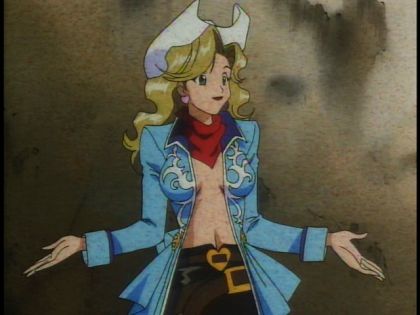
Personally, I think this is what the show's really about.
Melody

Obviously, there's a lot of thematic stuff going on here, and most of the obvious ones are well known. Look at any description of the series and they'll mention the style-over-substance aesthetic, the homages to 70s and 80s film, the haunted pasts of the main cast, and (according to Wikipedia) its examination of existential ennui3. The series is all of those things. But it's also about the end of a way of life.

Look, for example, at the jazz, bebop, and early rock-and-roll influences that defines so much of the show's world.

It's like that.
One the one hand, yes, it does serve to align the Bebop crew with counter-cultures and trendiness, and one can't deny the slick, stylish visuals. On the other--would a punk rock aesthetic not have made an equally unique setting and still hit the thematic notes?

Well, not necessarily. Punk-rock visuals would have happily gone with the "lawlessness" vibe that permeates so much of the work, but punk is A) a much more recent sub-culture and musical genre that 2) sublimated much, much differently into the larger culture than jazz did. The bands following in the Clash and the Sex Pistols' footsteps incorporated various bits into their music and their acts, so while the movement itself is not really a going concern, the various parts that make it are familiar.

Jazz, however, lives on as an artistic genre, but less of a commercial one. The music and style have evolved beyond easy recognition, and the term "Bebop," sitting happily in the logotype, calls to mind images like this:

Charlie Parker, bebop artist, playing at a local Callisto tavern
When we see Wen playing his mouth harp in that nightclub at the beginning of "Sympathy for the Devil," it immediately connects us to nostalgaic, time-lost ages. We're being told as the viewers to associate this with a lost age4.

Refrain

Those kinds of associations with lost ages are all over Cowboy Bebop. They are the foundation on top of which the whole story is built. But it's a very specific sort of lost age that the series goes out of its way to associate itself with. Spike Spiegel's mastery of Jeet Kun Do associates him with Bruce Lee, who died young.

The episode "Heavy Metal Queen" (a tribute itself to Convoy) makes heavy use of a system similar to CB radio, even using actual trucker CB terms on an interplanetary shuttle. The CB system is tied to a good deal of nostalgia since its golden age was brought low by overuse and the advent of cheap and wide-ranging cell phone technology.

The final episode features (amongst all of its other symbols of endings and passings) an altered ending title card. "You're Gonna Carry That Weight," a reference to one of the last songs on the last album the Beatles recorded.

Each of these are eras with distinct ends, or what the popular imagination thinks are distinct ends. The Beatles break up, CB radio falls out of favor, the arrival of rock ends the jazz era, an actor's death immortalizes him, the mob's time of honor and family is destroyed by compromise and infighting.

Crescendo

Most telling of all, though, is the Western theme.

The show's bounty hunters are called "cowboys," an epithet that calls to mind the Old West. That time period's probably been warped in the popular imagination more than any of the lesser time periods listed; when audiences in '98 or viewers in '12 think of the Wild West, we think of heroes and outlaws. We think of bounty hunters and criminals and sheriffs fighting battles for morality and survival against the backdrop of the lawless frontier. And we think of progress, symbolized by the railroad bringing those days to an end.

In our heads, in the mythos of the cowboy, there's an implied but usually unspoken tragedy that the battles fought by these larger-than-life figures are, ultimately, pointless, because history is going to wipe the slate clean, and everything they fought for will be for nothing.

We can infer that the same thing is happening in the background of Cowboy Bebop. I believe we can legitimately interpret that the action of that series is taking place in the waning days of the bounty hunter. The way of life of the in-universe cowboys is about to end and the solar system is about to experience stability5.

Consider Andy.

Keeper has Lord Humongous, but I have ANDY!!
Andy, by all appearances, seems to be a funny throwaway character late in the series, a guy who takes the whole "cowboy" thing a bit too far (up to and including riding a horse on a sci-fi elevator. Andy's amazing). However, after his encounter with Spike, he decides to give up on the cowboy thing. He still hunts bounties, but he changes his gimmick...

... to a freaking samurai.

Even changing his whole persona, and he can't escape the implication that he's doomed by history.

Breakdown

So, at this point, you're almost certainly telling me that my conclusions are obvious and I'm the last one to realize them. That, or you're telling me to wrap this up.

Keeper never told me you were this rude.

So, we know that "The Real Folk Blues" establishes and points out all sorts of juicy symbolism and foreshadowing about endings and deaths, and it's certainly tempting to just assume that all of that deals with individual characters, particularly Spike. But it also shatters the Bebop crew, destroys the Red Dragons, and cancels Big Shot.

Never have I been so sad to be so wrong.
Endings are all over the place. The series is about endings, in a sense.

If those endings were just about characters and lives, it would still be one of the best animated series of all time.

But all of those are taking place in a context. Almost all of the context we've been given establishes this way of life, this circumstance, as one ultimately transitory and doomed by history. That's what the theme does. It provides us context. It's the filter in which we view everything else in the story. And it's one that ultimately renders the struggles of their Bebop crew and their foes important personally but meaningless in any sort of grander form.

The hosts of Big Shot might be the last people you'd expect to metaphorically tell us what's going on in wider CB universe, given that they're mostly played for laughs and are generally content to tell us what's going on explicitly. But, other than ANDY!! they're the most "cowboy" thing in the whole of the anime.

And then Big Shot gets cancelled.

We next see Punch, looking like just another extra. He's going to be taking care of his mother. His co-host is getting married. He's settling down to an utterly mundane life. His cowboy days are long behind him.

It's hard to imagine that he's going to be the only one.

Jon Grasseschi is the author of urban-fantasy webcomic EverydayAbnormal. He doesn't usually write like such a pretentious boob, nor does he often natter quite so badly. He thinks it's your round, buddy.

1 When your story is not talking about things not present in the plot, you get the Transformers movies.

2 Sweet Jesus, will you scoot in? The poor waitress has customers and needs to get by, buddy.

3 Basically, it's a Wolverine comic. Zing!

4 And no, not the age where the Stones created good music, though that age is never coming back.

5 Ed's father, if you'll recall, has a pretty amazing speech about imposing order onto chaos late in the series...

Monday, February 18, 2013

Saint George and the Death of the Author

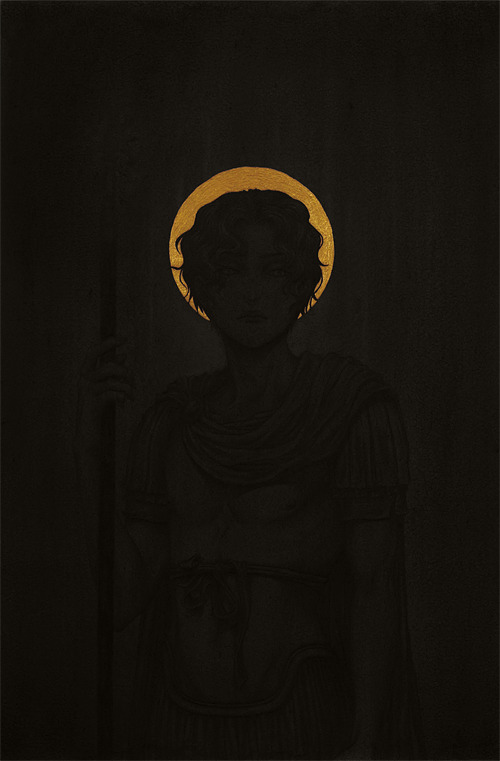
So, I happened upon this piece of art on Tumblr recently, and my immediate thought was, "Wow, there's so much to analyze here; this is fantastic:"

This piece is a portrait of Saint George, and is by an artist going by the name Casey. If you want to check out more of her gorgeous art, see: http://cparris.tumblr.com. The original piece can be found at http://cparris.tumblr.com/post/3909497389/saint-george-if-you-can-hardly-see-it-then-you

Then my second thought was, "I wonder how much of what I'm seeing here was intentional."

And my third was, naturally, that it was time to write a new article.

I actually get asked a lot of questions about a postmodernist concept known as Death of the Author. It's a concept that, if we're talking strict definitions, comes from a guy named Roland Barthes, and describes a very particular type of metacriticism aimed at taking those damn Formalists (the New Critics, remember? I've talked about them before) down a few pegs. It marks a transition from discussion of "Works"--masterpieces from a single author that contain a prime theme of universal human relevance--to "Texts"--collections of signs that combine and contrast to form their own meanings. The Death of the Author is the death of the Work, and also, Barthes gleefully points out, the death of the Critic and the rise of the Reader.

But it's also paradoxically a pretty good description of the moves a lot of modern theorists made. The Formalists, for example, opened the floodgates to begin with, ironically enough, by suggesting that meaning resides in the text. They suggested that we had to interpret based not on historical details or the author's biography but rather on the elements contained within a work. Barthes and other Semiologists extended that logic further to the point where the author had virtually no control over interpretation, and everything took place on the level of signs. Reader Response critics asserted that meaning actually came from the reader rather than the text, and any act of interpretation actually was an act of self-reflection and should be explored as such. I'm a bit less familiar with the psychoanalytic critics, but even there the impression I've gotten is that they are interested in how the text reveals the intentions not of the conscious mind of the artist but of some deeper force (whether an Id or a Jungian collective unconscious asserting itself).

Whew.

Anyway, I don't want to dwell on the history of criticism here, I just want to give you a sense of how Death of the Author is an enduring concept common to most modern criticism, even if it doesn't go by that name. Same actor, different parts, yeah?

But what I'm driving at with all this is that there's lots of ways in which meaning can be constructed without the artist's direct intervention. In fact, what I want to at least attempt to demonstrate today is that these constructions are totally impossible to avoid. In other words, this isn't just a bunch of theory mumbo jumbo of interest only to scholars, this is something that happens in your head every time you confront a work of art.

Watch.

The first thing I'm confronted with in this illustration is its simple structural qualities--namely, the fact that it low key to the point of being barely comprehensible, save for the saint's gold halo. It's so dark than on some of your monitors it may actually be completely black. Uh, if that's the case, do adjust the brightness accordingly; it's really worth being able to see properly.

So, already there's a kind of magic going on as my brain has to react to the visual stimuli and start to compose a narrative of what it's seeing. The main thing I'm getting is that the halo is the most important point. I'm articulating that here because I've got the training and language to do so, but really that recognition of the halo's importance happens on a level below your conscious awareness before you can consciously process what it means--we see that bright yellow jump out at us, while the rest of the picture recedes into the background. The same principle is true even when such contrast isn't quite so glaringly obvious. (Huh, it's almost like I chose this example specifically because of how clear its formal components are. Crazy!)

Then, once I'm over how beautiful that thing crescent of gold is on that black background (and really, if you simplified it down to just its geometry, this is a gorgeous composition) I start to take in the features of the figure. The first thing I notice there is that it's, well, really damn good. It's a nice drawing. But it's also somewhat roughly done--elements like the spear are left unfinished as though this is just a study. Again we get the impression that it's the halo that is important, not the figure: the rough study quality suggests both that this is a quick portrait sketch, almost like a study for a larger work, and that the soft lines of the figure are of lower order concern, despite their beauty, than the strongly defined contours of the halo.

The figure is also somewhat feminine looking. This is perhaps surprising, given that it is a portrait of Saint George. In the very unlikely chance that anyone is unfamiliar with that particular saint, George was a slayer of dragons. Yeah. This youthful, effeminate fellow is Saint George the Dragon Slayer. I'll get to what all of that suggests in a moment, but let's just quickly note the posture of the figure--there are strong verticals throughout the piece and the composition as a whole sits within a fairly tall and narrow rectangle. All of this gives the figure a kind of regal authority and solidity. The figure is like a sturdy column.

So, we've reacted viscerally to the physical qualities and their aesthetic power. Now we start to piece together a story of what's going on, based on what signifiers we observe, and what associations they bring to mind.

Now, keep in mind that I'm laying all this out in detail but all of this is happening within the span of a few seconds in my mind, automatically. This is what I mean by these acts of interpretation being out of our control--I'm not willing myself to react to this stuff, I'm just taking it in, processing it, and spitting it back out.

But if I articulate the thought process what I get is this:

The halo, as the most important element of the piece compositionally, signifies the prime importance of the celestial, of the holy, in this picture. In fact, the figure is overshadowed (literally?) by the presence of the holy, and the picture suggests through color and value that Saint George and his heroic deeds are less important than the divine strength behind his power. What's more, instead of showing St George as a burly heroic figure of legend, as we might expect, or a proverbial Knight in Shining Armor, St George is depicted as a youth--unbowed and unflinching from our gaze, to be sure, but a youthful, almost delicate creature all the same. This subverts our expectation of what a St George should look like, and in response we are once again brought back to that heavenly strength that empowers the saint. Oh, but don't get too caught up in the androgynous gorgeousness of St George, because remember, that beauty is shrouded in shadow. Even as we contemplate the aesthetic qualities of the figure we are stymied and frustrated by the darkness of the image, doubly reprimanded by the upsetting of our expectations and desires, and finally forced to set aside our desire to sanctify the man, leaving us only with the contemplation of God.

Which is, like I said, not what consciously went through my mind when I saw this picture.

Lemme try to transcribe that quickly, I think it went something like:

"Holy fuck this is a pretty picture."

Aw yeah, nothing like the eloquence of the conscious mind.

But that's kind of the point--I reacted aesthetically and then semiotically before I reacted consciously. My mind's will to interpret took over before my mind's respect for Authorial Vision And Intent could take over and tell me to stop. Remember, I can't know whether any of that was intentional on the part of the artist. ("But what if you asked her, doofus? She's got a tumblr!" I'll get to that in a moment, Oh Ye of Little Faith.) I only take what I know--or have programmed into me by evolution--and spit out a reaction and a reading, and that composes my best guess at what the picture is attempting to tell me. The picture. Not the artist.

But... what if you just ask the artist? Why can't you do that?

Well, first of all, artists are liars. No, really, listen, I speak as an artist and writer here, and trust me, we're all liars at heart. I mean, most of what you do in fine art is a carefully constructed lie--even artists that work from life in an illusionistic style distort reality to better fit the way the human eye and mind interpret visual stimuli. And fiction writers... man, do I even need to get into how heavily fiction writers distort reality?

So, knowing all that... why do you expect an artist to suddenly start telling the truth when they put the keyboard or pencil down?

But alright, that is a snarky response, I admit it. Not all artists are out to dupe you. (Just most of the ones that win the Turner Prize.) But even then, we're left with this problem: if we already know how powerful the unconscious mind, the little homunculus that pushes the aesthetic and semiotic buttons in our heads, is... why should we elevate even the author's conscious mind over their own homunculus? How can we conclude that even an artist is fully aware of all the aesthetic gears and cogs in their own work, when so much goes into a piece? We have so little control over our initial interpretive efforts; it seems strange to me that we should give a single individual sole interpretive power just because that individual has an authorial claim.

And I mean, what artist, when given a complex, clever analysis of their work is going to say, "Nope, all that happened totally by chance"? The answer, of course, is an artist with more integrity than I have, because if any of you suckers come to me with a brilliant insight into my work, I fully intend to nod my head and say, in a sagely tone, "Ah yes, my child, you have understood well."

Artists: the snake oil salesmen of high culture.

Aaaanyway, I don't want to cast aspersion on Casey here with all this rambling, I just want to address some of the fundamental problems with relying on an authorial voice to guide your interpretation, since that voice is often unavailable, and often unreliable. That's not even to say that you must never agree with an authorial interpretation; that would be really goofy and kind of a dumb critical stance to take. I'm just saying that we have some power here, and that power comes from how interpretation happens automatically.

In fact, I have one more thing to say about how Death of the Author is conceptually unavoidable, and it has to do with the application of semiotic associations on a metatextual level.

I am so, so sorry for subjecting you to that sentence.

What I'm saying, in simple terms, is that there are associations that happen not just between signs in a text and other external signs, but associations between a text as a whole and other texts. There's kind of an interesting idea in the further weirder reaches of critical theory that texts talk to one another, and the more texts you read the more they all start to babble back and forth. And again, this is something you can't really turn off.

To stick with St George here, for example, I immediately associated it with two very different schools of work: Byzantine icons, and the ultraminimalist black on black paintings of Ad Reinhardt.

Remember how I ranted a few paragraphs ago about being a liar? Well, I may have tweaked the truth somewhat when I talked about how the piece compositionally suggests that St George is of lower concern than the holy power behind him. I say "may" because I'm not completely sure--this stuff happens all in a big, rapid jumble, remember? But I think I may have been influenced not just by my understanding of the composition but by my familiarity with the constant struggle in Eastern Orthodoxy over whether or not Icons count as Idols. The problem is that when you've got what is pretty much straight up a graven image--something the Bible explicitly forbids--representing saints that you pray to, it's always going to occur to someone that maybe, just maybe, the icons should be smashed like the heathen idols they actually are.

The way the Byzantines got around this was by constructing a rather complex and strange line of reasoning that, put simply, claimed the icons WERE the saints! They couldn't be graven images because they weren't images at all--they were literal manifestations through the artist's paint or mosaic tile of a heavenly being.

When I look at this piece, I can't stop knowing what I know about the Byzantines. I can't unlearn what I know about that conflict.

So when I look at this piece, I think to myself, "Wow, it's a depiction of a saint that remains an icon in form but devalues the person in favor of the holy ideal he represents. That's a clever solution to the Iconoclasm problem."

And really, I wouldn't want to turn off that bit of my mind even if I could. See, my understanding of the piece is greatly enriched by my knowledge of history, and even if Casey is not a Byzantine scholar, I need not limit my own understanding of the piece's historical context and what it says within that context to correspond to that limit.

In fact, I would go so far as to call this very specifically a kind of modernist icon, the kind of piece that could only exist at this historical moment in time. That's where Ad Reinhardt comes in. I've talked a bit about him before; he's the cat that started painting all black canvases that were actually complex slight variations on black in specific patterns. He was trying to achieve ultimate subtlety with his works, and I think some of that impulse is present in St George. There is the same interest in very subtle contrasts and in delicacy, and ultimately they have a similar effect: they invite deep, almost meditative contemplation. When combined with religious subject matter and iconography you get an icon that can only exist in a time of postmodern experimentation with form, but that ultimately calls back to a long tradition of religious art.

And those conclusions, whether consciously derived or not, begin with the confrontation between the text--the portrait of St George--and the repertoire in my head, the signifieds, signifiers, and associations, and the evolved or learned response to deep compositional structures.

We can argue theory all we want but in my mind the author is already dead. And in that death, just as Barthes suggested, the reader is given new life through the ability to interpret expressively and creatively. It's not a denegration of the author, it's just a recognition that there is a sphere beyond an author's intentions, and that's the sphere that we access in that first moment when, confronted by an object of stunning beauty, our minds spit out the primal interpretive insight:

"Holy fuck that's a pretty picture!"

Hahahaha this was supposed to be a short piece. Whoops. Check me out on Google+ at gplus.to/SamKeeper or on Twitter @SamFateKeeper. As always, you can e-mail me at KeeperofManyNames@gmail.com. If you liked this piece please share it on Facebook, Google+, Twitter, Reddit, Equestria Daily, Xanga, MySpace, or whathaveyou, and leave some thoughts in the comments below. Oh, and really, check out Casey's stuff. It's so cool.
Support on Patreon
Store
Reader's Guide
Tag Index
Homestuck Articles
Solarpunk Articles
Mastodon/Fediverse
Tumblr
Bluesky
RSS Feed